Life Sucks. College Should, Too.

Want to get a conservative intellectual hoppin mad? Tell them (yes, I can use the plural to refer to just one person now) that college students have a right to complain.
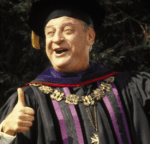
back to school thornton melon

College protesters get no respect…

A recent comment about the harshness of real life by a new Haverford student has a few conservative commenters cheering. As SAGLRROILYBYGTH know, I’m no conservative myself. But I wonder if erudite pundits such as R.R. Reno and Rod Dreher really want to start down the anti-intellectual path they seem to be taking.

In the pages of the social platform Odyssey, Haverford student Olivia Legaspi explains that working at McDonald’s taught her more about life than did her elite college sensitivity seminars. As she put it,

I have PTSD — because of this, the environment at work was anxiety-producing much of the time. Yet there was no “trigger warning” for when a customer was about to start yelling, when the restaurant would get so busy that I had no time to breathe between orders and the noise would make me feel faint, when a group of men in the drive-thru would whistle and catcall me as they pulled away. The sexual harassment I experienced there is another story entirely — the point is, at work, my mental illness and I were irrelevant. And from that, I grew; I learned to take care of myself in ways that didn’t inconvenience anyone, draw unnecessary attention to myself, or interfere with the structures in place and the work which had to be done. McDonald’s was not a “safe space” for me, and that was how it should be; I was a small part of a big picture, and my feelings had no business influencing said big picture.

At First Things and The American Conservative, respectively, R.R. Reno and Rod Dreher cheer Legaspi’s real-world education. McDonald’s, Dreher cheers, taught her the value of “hard work and humility.” Her essay, Reno notes, shows that excessive college “luxury isn’t helpful.”

I can’t believe they really mean it. And, to be fair, Reno explicitly points out that the goal of college should be to create “communities of care that uplift rather than run down.” However, to say that college students should not be complaining about unsafe spaces because the real world is not safe misses the point entirely.

This is the same tired anti-intellectual argument that we’ve seen for generations. Why study Plato, or postmodernism, or piano, when such things are not valued in the real world?  I don’t believe thoughtful commentators really hope to diminish the value of non-real-world higher education.

What should we do instead? All of us—progressive, conservative, and either/or—should be celebrating the fact that a few college students are a little over-eager in their moral activism. We don’t want to castigate schools for helping create a safe space. Rather, we should be encouraging students to take their campus activism out to the streets and the fast-food counters.

Legaspi points out that her McDonald’s manager would have simply fired her if she tried to complain about working conditions. To her mind—and to Reno’s and Dreher’s—that real-world lesson was worth more than any sensitivity-raising workshop at Haverford. But they seem to come to the morally opposite conclusion. Instead of pushing Haverford to loosen up and get more like McDonald’s, we should all be figuring out ways to make McDonald’s more like Haverford.
Tough Crowd…

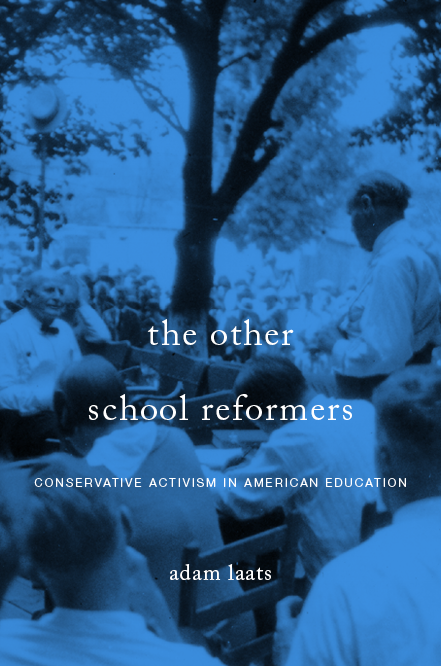
The reviews keep comin in!  I’m delighted to report another review of The Other School Reformers.  This one is by Princeton’s Kevin Kruse, in the pages of the Journal of American History (sorry, subscription required).

Non-academic readers might not know Professor Kruse, but every nerd knows that he has done as much as anyone to help us understand what it has meant to be “conservative” in American history.  Naturally, I was anxious to see what this uber-expert would think about my book.  Did he think my argument about the development of “educational conservatism” was worthwhile?

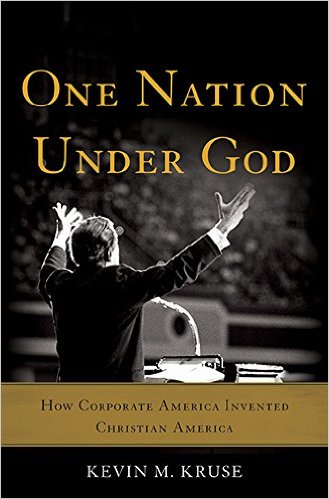
kruse one nation under god

Required reading…

Kruse’s first book, White Flight, examined racial politics and their implications in Atlanta.  His more recent book, One Nation Under God, has stormed the best-seller lists.

So when it comes to expert opinion about the history of American conservatism, it would be hard to find a more qualified reviewer than Professor Kruse.  It was with some trepidation that I first opened his review of The Other School Reformers.

What did he think?  If you have a library membership, check out the whole review, but the good news is that he liked it.  As he concluded,

Each of these case studies is carefully drawn, built upon a deep foundation of original research and a strong engagement with the secondary literature. Together they demonstrate quite ably that “educational conservatism”—and, indeed, conservatism writ large—was constantly evolving, site to site, moment to moment, across the twentieth century. Taking aim at the historian George Nash’s 1976 claim in The Conservative Intellectual Movement in America since 1945 that modern conservatism resulted from a deliberate campaign to bring together Burkean traditionalism, libertarianism, and Cold War anticommunism, Laats argues convincingly that “conservatism, for most educational activists, was not a deliberate fusion of disparate strands of ideology but rather variegated fruit from the same tangled vine” (p. 12). Over the years, conservative thinking on the key issues of race, religion, and science changed dramatically, as did conservatives’ belief in the proper role of educational experts and the federal government.

Well researched, well written, and well argued, The Other School Reformers offers a clear, evenhanded account of conservative activism in public education. It also makes a persuasive case for studying the lessons of their struggle seriously, as insight into the larger workings of modern conservatism and the traditions it sought to define and defend beyond the classroom.

Almost makes me want to read it myself!

What Today’s Campus Radicals Should Be Doing

Not instead of, mind you, but in addition to. We all know elite colleges and college-watchers are aflutter with the recent batch of campus protests. A dean at Claremont McKenna was roasted for inappropriately worded sympathy. An instructor at Yale was blasted for inappropriately worded revelry. Cafeteria workers at Oberlin were attacked for inappropriately sautéed chicken.

protestingoncampus

What do we want? Not sure! When do we want it? Now!

With good reasons, pundits have excoriated these overly precious effusions of moral indignation. As SAGLRROILYBYGTH know, I’m bullish overall on this round of campus activism. But I think we old folks should humbly remind today’s students of some of the more elementary rules of social activism. In short, we need to remind today’s activists that it is more important to hit em where it hurts than to garner big negative headlines.

What effect do today’s protests have? They allow people around the country to laugh up their sleeves at the ways fancy students react to the tiniest smidgens of intellectual discomfort. That is not their aim. Rather, I think today’s protests are, at heart, admirable attempts to make elite colleges more truly inclusive, more truly welcoming.

That is an enormously important goal. If elite colleges remain the province of an already privileged minority, we will see nothing but a fierce doubling-down of America’s yawning class divide.

Today’s elite university students are in a unique position to change the game. If students can push colleges to do more than change their ideological window-dressing, they might make higher education more welcoming to all.

But just chanting and blocking aren’t enough.

Elite colleges these days only retain their inflated prestige due to their ability to set potential students against one another. The competition for spots at elite schools has become fiercer than ever. That allows the top schools to reject most applicants, retaining their “selective” status and feeding the vicious cycle.

What can today’s campus radicals do? Go on an application strike. If no top students applied to Oberlin, Yale, or Claremont McKenna, the elite status of those schools would be instantly deflated. That is something school administrators absolutely could not allow. They would be willing to make real, dramatic changes to their admissions policies in order to bring back top applicants.

Could it work? Probably not, because applicants have nothing in common except their deep insecurities and hyperactive resume-building. And this scheme would face the eternal problem of labor solidarity. If a few scabs chose to take advantage, the entire scheme would be defeated.

Moreover, as Peter Greene has recently noted, elite college students today are literally killing themselves in their competition with their fellow applicants. That sort of mindset does not lend itself to picket-line solidarity.

Plus, this kind of activism would require real sacrifice on the part of student activists. They would have to gamble with their collegiate futures. Instead of just protesting on Monday, then graduating and moving into their high-powered careers on Tuesday, this plan might leave them out in the cold, forced to attend less-Olympian schools.

Nevertheless, I think it’s worth talking about. The real problem of inclusion at today’s top universities is not a question of culturally appropriative Halloween costumes or cafeteria offerings. The real problem, instead, is that students are fighting each other tooth and nail for admission. Only students who are already privileged stand a chance to get into the even-more-privileged world of high-end higher education.

Change that, and you could make some real changes in the inequities of schools and society.

Nine Best ILYBYGTH Ten-Best Lists

The year is skidding to a halt. As always, logorrhetes like your humble editor begin frantically compiling year-end lists. This year, ILYBYGTH has scratched together a list of the nine best end-of-year ten best lists. (I tried for ten, but I didn’t want to dilute these pages with chaff.) What were the year’s biggest stories in religion, education and culture?

First, for pure bravado, is Michael Petrilli’s “My Ten Best Articles of the Year.” The free-marketeer explains why poverty does not explain weak test scores, why schools should be more eager to get rid of disruptive students, and how schools can help fix the “marriage crisis.”

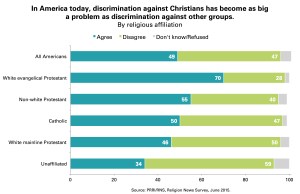
Next, Religion Dispatches offers a list (okay, it’s only six) of the biggest religion-related survey finds of 2015. Do Americans think the US is a Christian Nation? Do we think Christians are being discriminated against? Is the Pope a (helpful) Catholic? And more!

PRRI-Christian-Discrimination-chart

Who’s the victim here?

Number three: The Chronicle of Higher Education has gathered its own top ten stories. They are locked up, I’m afraid, but if you have a subscription it’s worth exploring. There are some biggies in here, including Steven Salaita’s reflections on his experience as a loud-mouth academic walking the line between “freedom” and “hate speech;” Laura Kipnis’s essay about campus revolutionaries eating their young (and their old); and thoughts on the reality of transitioning from one race to another.

Four: What did evangelicals think? Christianity Today put together a list of its top twenty stories. (Sorry, they didn’t read the ILYBYGTH rules, either.) What do evangelicals think about same-sex marriage? What makes a church a cult? Plus porn, Christian colleges, and missionaries.

And fifth, what were the science geeks at the National Center for Science Education up to in 2015? Minda Berbeco reviews their efforts to combat creationism, climate-change denialism, and other modern science bugbears.

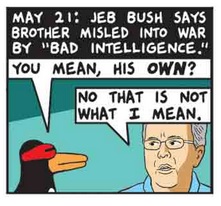
What did 2015 look like from the perspective of a smart-mouthed progressive penguin?

tom  tomorrow 2015

Seeing clearly through nostalgic red visors…

What books did thoughtful non-conforming conservative intellectuals enjoy in 2015? Check out the American Conservative’s list of the year’s top reads.

Coming in at number eight, at ThinkProgress, Dylan Petrohilos gives us a sobering account of the numbers of people killed by police in 2015.

Last but not least, Lauren Turek at Religion in American History has compiled a list of religion panels at the upcoming meeting of the American Historical Association in Atlanta. It’s not a top-ten list, and it’s not a look back at the glories of 2015, but I’m including it anyway. For one thing, it starts off with our culture-wars panel (more on that to come). Also, listing all these retrospectives was getting a little maudlin, so I wanted to include something about the future.

Where Can a Conservative Safely Go to College?

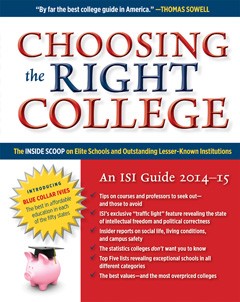
What is a parent to do? There are a million college guides out there. How can we tell what school is right for our kid(s)? Most parents and students are concerned with things such as party culture, cost, programs, and prestige. For some students, though, a school’s friendliness to conservatism might be a primary consideration. For those folks, the conservative Intercollegiate Studies Institute has published its latest guide to colleges and universities.

ISI college guide

The RIGHT schools…

We all know that college rankings are a scam. Publishers prey on families’ anxieties to offer a dog’s breakfast of ranking systems. Depending on how schools are evaluated, we can come up with wildly varying scales.

I can say this in full confidence, since my beloved Binghamton University usually comes out near the top. In the recent Kiplinger’s ranking, for instance, we came out 22nd among public universities, 16th for out-of-state students. That puts us far above bigger schools such as Colorado (90), Iowa (55), and Michigan State (40), Alabama (46), Texas A&M (35), and Illinois (26). More important, I’m pretty sure our never-defeated football team could utterly crush the squads from any of those other schools.

But what does that ranking mean? In the Kiplinger’s system, factors such as cost, average completion rate, average student debt load, and other financial factors dominate. Is that really what people care most about when it comes to picking an institution of higher education?

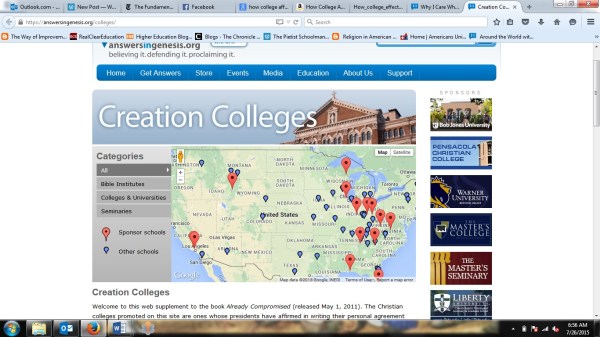
For students and families with more specific questions, everybody and their brother have published niche guides to colleges. For the young-earth creationists out there, Ken Ham’s Answers In Genesis has maintained a handy guide to schools that will not challenge creationist faith.

creation colleges screenshot

Can college make a difference?

At Heterodox Academy, Joshua Dunn has reviewed the Intercollegiate Studies Institute’s guide to conservative colleges. As Dunn relates, ISI has been the voice of “movement” conservatism on America’s campuses for generations. For its college survey, ISI looked at 148 schools. As Dunn explains,

To measure the academic seriousness of an institution, ISI examined the faculty and course offerings in three departments, English, History, and Political Science. In English, it looked for that classes focusing on great authors in the western literary tradition but without an emphasis on trendy and politicized literary theories.  “Avoid,” ISI urges, “classes that mention ‘race,’ ‘class,’ or ‘gender.’” In short, study Chaucer and Shakespeare but leave the “fecopoetics” and deconstructionism behind. History departments should require classes that cover more than post-1965 American protest movements. And Political Science departments should require courses in classical political philosophy and the U.S. Constitution. If a department’s course offerings are skewed toward “Marxist meta-analysis of postcolonial Asia,” students should look elsewhere.

The ISI guide gives schools a “green light,” “yellow light,” or “red light” rating. Many elite schools, such as Amherst, Duke, and Oberlin, are no-gos for conservative students. The ISI system, however, produces some surprises. Schools such as Wheaton College—one of the evangelical schools I’m writing about these days—come out with only a “yellow light” ranking, in spite of the fact that their faculty all agree to an evangelical statement of faith. On the other hand, riotously pluralist schools like my own beloved Binghamton University get a green light, in spite of the fact that we welcome many avowedly leftist professors to our campus.

What is a conservative student to do? I’m torn. On the one hand, I’m deeply sympathetic to all students—even conservative students—who are made to feel out-of-place or unwelcome in their schools. On the other hand, as I’ve argued in these pages and in my recent book about conservative activism in education, much of the conservative angst about the state of higher education is woefully misleading.

It can be very difficult to look past authoritative-sounding college guidebooks. What student does not want to go to a top-ranked school? But all students, whatever their ideological or religious backgrounds, should rely on more than a book to choose a college. Talk to people you know who have gone there. Visit the campus. Ask difficult questions of admissions officers. Read the student newspapers.

In the end, relying on a college guide to choose the best school is about as useful as relying on a sandwich guide to help you choose the best lunch.

I Love You but You Didn’t Do the Reading

[Editor’s Note: We at ILYBYGTH are happy to announce a new feature, “I Love You but You Didn’t Do the Reading.”  In this weekly column, we’ll point out stories of interest to SAGLRROILYBYGTH, a sort of “in case you missed it” list.  Will we be able to keep it up?  Who knows.  But let’s give it a try and see if people like it.  Suggestions for readings are always welcome to our editorial desk: alaats AT binghamton DOT edu .]

December Twenty-Seventh, 2015

What did you miss out there? A few stories that caught our eye this past week:

READING goofy washington

Words, words, words…

General Tso joins the culture wars at Oberlin College.

Progressives celebrate big educational wins in 2015.

Wall Street Journal: Ed Dept punts on punishing colleges with a history of shaky student loans.

Young-earth creationist takes over Arizona’s public schools.

Does Life Imply Creation? Don McLeroy Says Yes

Should mainstream scientists debate with creationists?  This morning we have another chance to discuss the nature of life, science, and evolution with a prominent creationist intellectual. Will anyone take it?

Don McLeroy

Science, c’est moi…

Some mainstream scientists affect a pose of exhaustion. Speaking with creationists, they say, is not worth the effort. Some folks criticize popularizers such as Bill Nye “The Science Guy” for deigning to debate young-earth impresario Ken Ham. Doing so, critics say, only feeds creationist pretensions to the label “science.” Doing so, critics insist, only gives creationists a win; it falsely implies that evolution is “controversial,” a controversy worth sharing in America’s classrooms.

Dr. Don McLeroy, erstwhile head of the Texas State Board of Education, has shared an essay he’s penned about the deficiencies of materialism.

I hope readers will take time to read and consider Dr. McLeroy’s intellectual claims. Dr. McLeroy, after all, is not your run-of-the-mill creationist. While other creationists fume and fuss over new evolution-heavy textbooks, Dr. McLeroy encourages kids to read em. Why? Because, Dr. McLeroy thinks, the truth will out. If students read about evolutionary science, they will quickly see that the evolutionary emperor has no clothes.

In his essay, Dr. McLeroy insists that only “biblical explanations” pass the test of science. As he puts it,

materialist explanations concerning the origin of the universe, the origin of plant life, the origin of creature life and the origin of human consciousness, fail the test of science.

Dr. McLeroy claims allies such as Richard Lewontin, who insisted in 1997 that only our “prior commitment” to materialism makes it seem convincing.

If we can only lay aside for a moment our faulty assumptions in favor of materialism, McLeroy argues, we can see how empty they really are. For example, the astounding suggestion that something—everything—could come out of nothingness only makes sense if we assume that God is involved as the Uncreated Creator.

As McLeroy concludes,

we do see a cosmos that had a beginning and thus had a cause; we do see plants and animals that reproduce after their kind and can be organized into distinct classifications; we do see creatures with a life and not just a living form; and we do see man in a separate class from all the other unique creatures. All these simple observations support the ideas of Genesis; they pass the test of science. Therefore, why not give the biblical explanations a better look? As [Neil DeGrasse] Tyson explained: let us ‘build on those ideas that pass the test, reject the ones that fail, follow the evidence wherever it leads and question everything.’

Are you convinced? More important, if you’re not convinced, why not?

I Love You but You Didn’t Do the Reading

[Editor’s Note: We at ILYBYGTH are happy to announce a new feature, “I Love You but You Didn’t Do the Reading.”  In this weekly column, we’ll point out stories of interest to SAGLRROILYBYGTH, a sort of “in case you missed it” list.  Will we be able to keep it up?  Who knows.  But let’s give it a try and see if people like it.  Suggestions for readings are always welcome to our editorial desk: alaats AT binghamton DOT edu .]

December Twenty-First, 2015

READING woman apple

Words, words, words…

What did you miss out there? A few stories that caught our eye this past week:

Demons and Daddies: What a Christian cult looks like these days.

University of Wisconsin: Students do not have the right to be unoffended.

Most of the world’s scientists call themselves religious.

Campuses don’t need more diversity training; they need these three things instead.

Another big creation museum!

Is there really a “mismatch?” Do African Americans students really do worse at elite colleges?

Terror threats close down schools in California, but threats of learning about Islam close down schools in Virginia.

How the other half goes to college.

Why Go to Fundamentalist U? To Get a Better Job!

Why should students go to a fundamentalist university? For about a century, the argument has always been the same. A new marketing campaign by fundamentalist behemoth Bob Jones University shows that the times, they are a’changin.

Pettit on BJU

What is school for? Careers!

To be fair, Bob Jones University has always insisted that its graduates would have the absolute best academic education. Back in its earliest days, founder Bob Jones Sr. insisted that the school would keep children both theologically safe and academically privileged. As he put it in 1928,

The fathers and mothers who place their sons and daughters in our institution can go to sleep at night with no haunting fear that some skeptical teacher will steal the faith of their precious children.

Jones’s very next line, though, showed that he understood what parents really wanted in a college. Not only should it keep kids Christian, but it should also prepare them for professions. In his words,

Your son and daughter can get in the Bob Jones College everything that they can get in any school of Liberal Arts.

In 1949, Bob Jones Sr. re-emphasized the point that his school—now a University—would always insist on the very best academics. As he put it,

We have always insisted that an educational institution with the right kind of spiritual standards will maintain the highest possible academic standards.

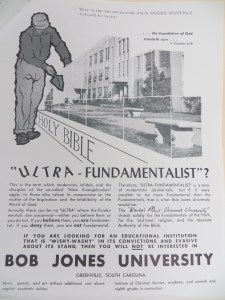
It’s fair to say, however, that for marketing purposes, the biggest selling point of BJU in the past was its staunch commitment to fundamentalist Protestantism. Other schools may waver, the Bob Joneses have always promised, but BJU would never budge.

If you wanted your child to have a college experience firmly dedicated to fundamentalism and only fundamentalism, the message was, BJU is for you.

In the 1950s, for example, as “fundamentalist” schools were separating from “neo-evangelical” colleges, BJU sold itself as the unapologetic fundamentalist choice. So unapologetically, in fact, that leading evangelical magazines such as Moody Monthly refused to run its advertisements for fear of alienating good evangelical readers.bju canceled MM ad full again good one RIGHT SIDE UP

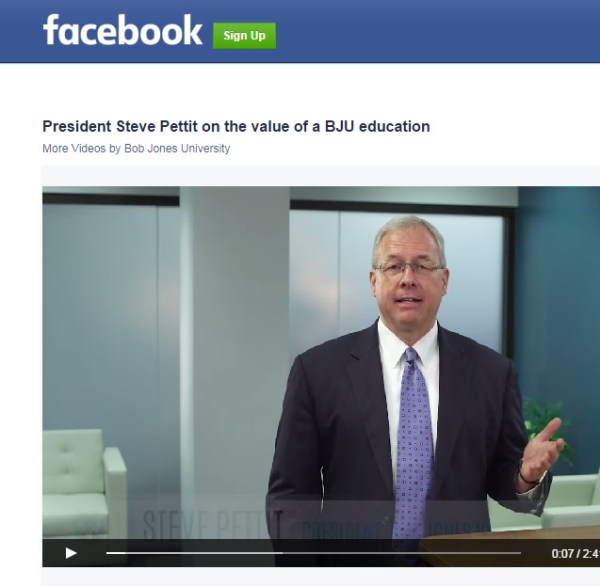
Today, in contrast, BJU’s President Steven Pettit offers fundamentalist families a very different primary reason for attending his school. Why should they attend BJU? For its unbeatable record of preparing students for high-flying professional careers. BJU students, President Pettit promises, do better at passing med-school exams, accounting exams, nursing exams, and engineering exams.

As Pettit puts it,

If you’re looking for a college worth the investment of your time and money, a college that will prepare you well for future employment, and help you to grow spiritually in the process, Bob Jones University is the place for you. . . . I think you’ll find BJU provides the value you’re looking for.

Why go to Fundamentalist U? To get a better job!

More proof that schools such as Bob Jones University are not quite as different as other colleges and universities as we might think.

Hijab & Halloween

Well, that just proves it, you might be tempted to say. When Wheaton College can suspend a tenured professor for saying that Muslims and Christians worship the “same God,” it just goes to show that the “Fundamentalist Harvard” is (still) more “Fundamentalist” than “Harvard.”

Hawkins Wheaton

Whose God?

But wait just one minute. If we look at this episode another way, we see that Wheaton’s recent strange action puts it smack dab in the mainstream of elite higher education these days.

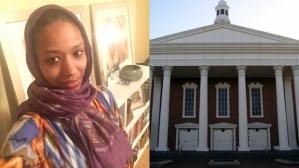
You’ve probably seen the story by now. As Christianity Today reports, political science professor Larycia Hawkins was suspended recently. Professor Hawkins planned to wear a traditional Islamic headcovering—the hijab—during Advent this year to express her Christian solidarity with Muslims.

That’s not why she was suspended, at least not officially. The college suspended her, officially, for her statements about God. In a Facebook post on December 10, Professor Hawkins explained the reasons for her act of sartorial solidarity: “as Pope Francis stated last week, we worship the same God.”

Non-evangelicals like me might not see the problem. But as Christianity Today pointed out, the question of Muslims and Christians worshipping the same God is intensely controversial among some Christians.

It is tempting to see this episode as proof of Wheaton’s continuing status as a school outside of the higher educational mainstream. As I’m arguing in my new book about the history of conservative evangelical higher education, however, the truth has always been more complicated. Wheaton is NOT outside the mainstream here. Rather, this is exactly the sort of action that is taking place at elite colleges across the nation.

Of course, the details are different; the specific issues are different. In Wheaton’s case, the administration acted to suspend Professor Hawkins because, in their words,

As a Christian liberal arts institution, Wheaton College embodies a distinctive Protestant evangelical identity, represented in our Statement of Faith, which guides the leadership, faculty and students of Wheaton at the core of our institution’s identity. Upon entering into a contractual employment agreement, each of our faculty and staff members voluntarily commits to accept and model the Statement of Faith with integrity, compassion and theological clarity.

This final problem of “theological clarity” seems to be the rub. Wheaton’s administration said they sympathized with Prof. Hawkins’s sympathy for Muslims. But, they repeated, “our compassion must be infused with theological clarity.” Professor Hawkins, in short, was suspended for “theological statements that seemed inconsistent with Wheaton College’s doctrinal convictions.”

Obviously, no pluralist, liberal, or secular school would suspend a professor for an act of theological un-clarity. As we’ve seen over the past few months, however, elite colleges everywhere are suspending professors and administrators for actions and statements that seem inconsistent with their non-theological convictions.

Like Professor Hawkins, for example, Erika Christakis at Yale has left her teaching duties. Why? Because she wrote an email that many students found unsettling. We might say that Christakis’s suspension was due to her lack of sufficient “clarity” about her racial ideology.

Or, we might consider the case of Mary Spellman at Claremont McKenna College. Did Dean Spellman make racist comments? No, but her attempt to care for one non-white student seemed to lack clarity to many students and activists.

SAGLRROILYBYGTH are sick of hearing it. But I think it is true, and I think this episode is further proof: Mainstream colleges today are moving more toward the “impulse to orthodoxy” that has been the hallmark of conservative evangelical colleges like Wheaton.

It’s easy enough to point out differences, of course. At Wheaton, pressure came from conservative alumni and administrators. At the other schools, pressure came—at first—from students. At Wheaton, the statement of faith is explicit and official, whereas the other orthodoxies are implicit and tentative.

In the end, though, I think the parallels are striking. At elite colleges these days, instructors, students, and administrators are expected to do more than agree generally and in principle with their schools’ current orthodoxy. They are expected, rather, to agree with forceful clarity. They are expected to avoid any statement or action that “seem[s] inconsistent” with dominant moral ideas.

To this reporter, it looks as if Wheaton College continues to be more similar than different from other elite schools these days.

HT: EH