Decadence and the Fall of American Public Education

Things today ain’t as good as when I was young.

That’s the central notion, the vaguely articulated impulse, the often-unexamined presumption behind a good deal of conservative educational rhetoric.  Schooling these days has declined from glory days of the past.

In an essay in The American Interest, Charles Hill warns of the real consequence of decadence in American life.

As Hill notes, the idea of civilizational decline and fall is an old one.  Yet Hill insists that it retains explanatory power; Hill makes the case that twenty-first century America is sliding into a dizzying downward spiral.  Everything from technologically induced “screen culture” to awkward proletarianization of elites can be better understood as part of a lamentable decadence.

As Hill concludes,

Around the turn of the 19th to the 20th century, “decadence” arose as a romantically thrilling elitist fashion, providing a “sweet spot” in which a privileged, self-selected class could revel in dissolute practices while applauding their own cultural superiority. At the turn of the 20th to the 21st century something akin has emerged—call it a democratized form of decadence—among a far wider swath of the population, with the support of government and approbation of the cultural elite. Many observers have gazed upon such phenomena, then and now, and have seen mainly the sources of shifts in the art world. We move from the 1913 New York Armory Exhibition to mainstreaming of “street art” a century later rather effortlessly. But if what is at stake is world order, with national character and identity as its foundation stone, and democracy as the procedurally and practically most efficacious political form, then the fate of the art world may be the least of our concerns.

The essay is worth reading in its entirety.

Of particular interest here are its implications for American education.  Hill makes a few points about this himself.  For one thing, he notices the disturbing intellectual ramifications of “screen culture” especially among the young.  A generation accustomed to viewing people on computers, tablets, TVs, and phones, able to view without being viewed, Hill argues, adds a “new dimension” to old ideas about decadence.  Weaned on screen culture, Hill says, young people “can become oblivious to others.”

In a nuts-and-bolts way, Hill notes the way our current decadence has squeezed out learning in favor of training.

Of more consequence than the specific educational ramifications argued by Hill is the sense of decline Hill articulates.

As I’ve argued elsewhere, it is nearly impossible to understand the conservative impulse in American educational thought and activism without grasping the power of the idea of decadence.  Leading conservative intellectuals—even ones from very different backgrounds—have all grounded their educational philosophy on a notion that the educational system in the United States has ground down in a systematic pattern of decline.

In his landmark work Capitalism and Freedom, for example, free-market theorist Milton Friedman insisted that American public education entered a noticeable period of decline after the American Civil War when the government “gradually” (page 85) stumbled into the near-total “‘nationalization,’ as it were, of the bulk of the ‘education industry’”(page 89).

Conservative education leader Max Rafferty agreed about the decadence, but argued for a different time and cause.  The problem really began, Rafferty believed, in the 1930s, when “Dewey-eyed” reformers injected a deeply flawed notion of education into the American cultural bloodstream.  Instead of learning heroic truths and facing moral challenges, students in post-1930 “life-adjustment” classrooms only learned to revel in their own inability to determine right from wrong.  Such decadent teaching and learning, Rafferty argued in his 1963 book Suffer, Little Children, produced a weak generation, unable to combat the existential threat from “a race of faceless, godless peasants from the steppes of Asia [that] strives to reach across our bodies for the prize of world dominion.”

Though he viewed the goals of education very differently from Rafferty and Friedman, creationist leader Henry Morris agreed that public education had declined dramatically.  The root of the problem, Morris argued in his 1989 book The Long War Against God, lay in a one-two punch of Unitarianism and secularism.  The first blow had come in 1869, when Unitarians took over Harvard University.  Their example led American education away from its roots in what Morris considered to be authentic Christianity (pages 46-47).  The second decisive weakening came later, with John Dewey’s rising influence in public education.  That influence, Morris argued, led public schools away from religion into a markedly anti-religious humanism.

These examples could be multiplied nearly endlessly.  William J. Bennett, for instance, has argued with his Index of Leading Cultural Indicators that American culture as a whole—especially including its public schools—has declined terrifyingly since 1960.

It is taken as an article of faith among many conservative educational thinkers and activists that education today is worse than it has been.

This is more than the common griping about “kids these days.”  This is more than the old story about how when I was young I had to walk to school barefoot, through ten feet of snow, uphill both ways.

To understand conservative thinking about education, we have to understand this assumption of decadence.  Not many activists articulate this sentiment as clearly as the intellectuals described here.  Not many offer the careful examination of the meanings of decadence expressed by Charles Hill’s recent essay.

But behind many of the policies promoted by educational conservatives lurks this ubiquitous sentiment: things today are worse than they have been in the past.  Schools today are worse than they have been in the past.
 

Life, the Universe, and Nothing

Why is there something rather than nothing?

Is it reasonable to believe there is a God?

Has science buried God?

The Australian City Bible Forum recently posted two video discussions about these questions between prominent science-atheist Lawrence Krauss and religious apologist William Lane Craig.

What they didn’t discuss is what should be included in public schools.  Surprisingly, in the end it is the arguments of Lawrence Krauss that suggest a sort of intellectual dictatorship in science classes, a stern refusal to consider the claims of dissent, even when that dissent represents a majority opinion.  Of course, that is exactly the accusation made by leading creationists.  I don’t buy those creationist arguments, but I do want to understand why we can insist that creationist students learn science the way we define it.

The two veteran debaters did not engage in a formal debate on these timeless questions.  Rather, the City Bible Forum offered a “conversation” between the two speakers.  Each speaker had fifteen minutes to lay out his ideas.  Then the two were open to questions.

The moderator called for a “respectful, intelligent discussion.”  To that end, the evangelical organization invited moderators of very different backgrounds.  For the first discussion, the CBF asked TV journalist Scott Stephens.  For the third, a local atheist academic, Graham Oppy.

For those of us interested in understanding the conservative influence of evangelical religion in American public life, the discussions are worth listening to in their entirety.

Here at ILYBYGTH, I don’t really care very much about the nature of science or religion.  I don’t care very much about whether or not the universe was created ex nihilo.  I don’t care—as Craig and Krauss debate—whether or not an infinitely good God can cause the murder of Canaanite children.  Such things are interesting, but they only make up the background, IMHO, for the really interesting questions.  For me, the rubber only hits the road when we get to discussions about the ways these issues influence real life; the ways such ideas change policy in places such as public schools.

For example, the discussions can help illuminate one of the most stubborn mysteries of American public education.  To folks like me it remains endlessly surprising that so many Americans support the use of religion in public school.  As readers are aware, majorities of Americans support the inclusion of creationism in public-school science classes.  Americans also often support the notion that prayer and Bible reading can be parts of a public-school experience.

The wide-ranging discussion between Drs. Krauss and Craig sheds some light on this head-scratcher.  In the first conversation, “Has Science Buried God?” Professor Krauss acknowledges that religious belief is the default psychological state for most people.  Krauss agrees that “we all want to believe.”  Such desires, Krauss argued, only demonstrate our own intellectual weakness and laziness, our willingness to accept the simple in favor of the true.  “We have to work hard,” Krauss admonished, “to overcome that desire to believe.”

Not surprisingly, Dr. Craig disagreed. But more interesting to me is that even Professor Krauss conceded that most people will tend toward religious thinking.  Though Krauss repeated his accusation that teaching young children religious ideas amounted to “child abuse,” he still acknowledged that such ideas made the most sense to the most people.

If that is indeed the case, if most people will tend toward religious explanations of life, then it should come as no surprise that they want to teach such religious explanations to their children in public schools.

Indeed, for folks aware of the sometimes-ugly history of American education, Professor Krauss’ position raises some difficult questions.  For example, ought public schools impose ideas on children if those ideas are inimical to those children’s families?  In the 19th century, educational leaders often argued that the King James Version of the Bible must be read in every public school, in spite of the objections of Catholic leaders.  Since the Bible was the truth, these schoolmen reasoned, every child must be forced to hear it.

Such reasoning does not acknowledge the legitimacy of dissent.  It does not recognize the “public” nature of public education.  In order to include the entire community, authentic public education would have to recognize the legitimacy of the beliefs of the community.

Professor Krauss, no doubt, would protest that science classes must teach science, not religion.  But, as he should also acknowledge, the boundaries of science have at times been difficult to define.

If, as I do, we still want to insist that public schools teach evolutionary science and not creationism, we are left with the sticky question: Who decides what is “science”?  A majority of mainstream scientists?  That, I’m guessing, is how scientists like Professor Krauss would argue.

How will that majority opinion protect the legitimate views of dissenters?

And if we want to rely on majority opinion, what about the much larger popular majority that wants creationism taught as science?

“Worker Ants in an Insect Society:” The Case for Christian Education

Can government schools produce anything except totalitarian drones?

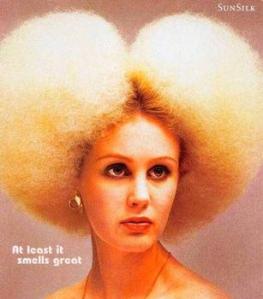
The folks at Patheos: The Anxious Bench recently re-ran a consideration of this question by the accomplished historian Thomas Kidd of Baylor University.  But does this conservative criticism assume too much about America’s public school system?  Are bad schools more like bad haircuts than anything else?

Source: Sodahead

Source: Sodahead

More on haircuts later.  The question of public schools and Christian students has long exercised conservative intellectuals.  I’ve described the history of this perennial concern among American conservatives in general and among conservative evangelical Protestants in particular in a couple of academic articles and in my 1920s book.  As Professor Kidd notes, this question of separate “Christian” schools has long been a central concern among conservative religious thinkers.

Professor Kidd lays out the case: even in his hometown of Waco, “where parents can pretty reasonably assume that Christian students at public schools will not be harassed for their faith,” public-school values do not pretend to match the values of evangelical Protestantism.  The problem, as Kidd notes, has been trumpeted by conservative Christian intellectuals for generations.  Kidd cites J. Gresham Machen, Christopher Dawson, Douglas Wilson, and Anthony Esolen as varied exemplars of this intellectual tradition.

Kidd cites Christopher Dawson’s 1961 accusation that public schools were only fit to produce “worker ants in an insect society.”  The problem, Kidd argues, is not simply the familiar laundry list of evangelical complaints.  It is not simply that public schools teach evolution, or that they discourage prayer, or that they teach a skewed secularized history.  The deeper problem is an utter lack of purpose in public education.

As Kidd puts it,

Public education, and private secular education, is floundering to identify any purpose these days, other than perhaps “math and science” training, and the ever-popular “critical thinking skills.” (Excellent standardized test scores and successful football teams are also good.) The modern public school system was originally intended to form citizens for democratic citizenship; perhaps that purpose lingers in some public schools today. But Christians should be wary even of education for democratic citizenship, which can easily shade into nationalism and cloud a child’s understanding that her ultimate citizenship is in the city of God.

At a fundamental level, Kidd argues, parents must spend more time asking what purpose they hope their children’s education will serve.  For conservative evangelical Protestants, in general, even the most efficient public schools may seem only efficient paths to damnation.

Here at ILYBYGTH, we must ask: Are public schools really so profoundly anti-Christian?  And, perhaps more important, what does any of this have to do with poodle haircuts?

After all, the public schools also take their share of accusations from the left.  Liberal watchdogs such as the Texas Freedom Network blast politicians for using schools as catspaws in a rabid anti-leftist witch huntAmericans United for Separation of Church and State warns of the “Religious Right’s Plan to Force Fundamentalism on Our Public Schools.”  Academic leftists such as Michael Apple accuse twenty-first century public schools of being profoundly dominated by the conservative shibboleths of “Markets, Standards, God, and Inequality.”

Is this only a matter of perspective?  Are public schools centrist institutions, forced to muddle down the middle of cultural controversies?  From the left, schools appear dominated by conservatism.  From the right, they look like secularist left-wing indoctrination centers.

Or could this be the oldest public-school question in the book?  That is, could these critics be making the mistake of treating public schools as if they were a single ideological entity, when in fact they are a ten-thousand-member cluster with no discernible goals or guiding ideology?  In other words, if you want to attack the ideology of the public school system, you’ll be able to find convincing and terrifying examples of all sorts of ideas.  With such an incredible diversity of schools and school districts, it is all too easy for commentators to accuse “public schools” in general of problems that may not trouble the majority of real schools.

Now, at long last, let’s consider what schools have to do with haircuts:

Blasting “the ideology of the public schools” in general might be like attacking America’s hairstyles in general.  Of course, there are fashions and historic trends.  And of course, anyone can pull up terrifying examples of how they can go wrong.  But America’s hairstyles, like America’s public schools, have no controlling central intelligence.  Both are the result of thousands, millions, of decisions by individuals on a daily basis.

Of course, parents and pundits of any religious or political persuasion should make the decisions that fit them best.  But when those decisions are pushed as a simple rule about the ideological nature of the public schools in general, we may have veered off into poodle-haircut territory.


Science, Schools, and Scientism

School science is different from research science.

Duh.

But this obvious truth seems out of the grasp of some commentators on the creation/evolution controversies.

Here’s what I mean:

School science is not simply science that goes on in schools.  School science is, like all school subjects, inextricably bound up in the necessarily complex process of formal education.  As such, it is inseparable from questions of morality, authority, sexuality, religion, and culture.

Anyone who has ever spent time teaching in a K-12 classroom knows this.  The formal curriculum is only one element of the constant intellectual ballet in which good teachers engage daily.  Teachers are responsible for considering everything about their students.  Are they tired?  Do they speak English?  Do their parents help with their homework?  Is this content too easy?  Too hard?  Easy for some, hard for others?  Is this a good time to introduce new material?  Is this a compelling way to introduce it?

These questions are only tangentially related to the curriculum as dictated by district, state, Jesus, or any other entity.

Nevertheless, this obvious fact is consistently ignored by participants in the creation/evolution debates.

To cite just one example, the witty and engaging science pundit Jerry Coyne often condemns the “accommodationist” tactics of science educators at the National Center for Science Education.  In one recent essay, for instance, Coyne denounced the “purely political” and “purely tactical” argumentation of NCSE leaders Eugenie Scott and Kevin Padian.

Coyne’s implication is that science should not be muddied with such non-scientific thinking.

Fair enough.  But this demonstrates the difficulties of the debates.  SCHOOL SCIENCE must necessarily be discussed in political terms.  And pedagogical terms, and developmental terms, and publishing terms, and scheduling terms, and moral terms, and historical terms, and ethical terms.

Asserting that such things are not scientific, and therefore not part of a proper science classroom, is only itself a political argument.

For those of us interested in education issues, it can be frustrating to see the ways this simple truth can be ignored.  Recent writing from all sides, for example, does not address the ways “science” is not the same as “school science.”

One essay by Steven Pinker in the New Republic, for example, defends the role of science against charges of overweening “scientism.”

Another article in First Things defends religious conservatism against charges of anti-scientism.

For those of us interested in understanding the cultural meanings of science, these are all worth reading.  But they do not help much when it comes to understanding the debates swirling around school science.

School science needs a different language.  School science—as a school subject—cannot be separated from ideas about morality and youth.  It cannot be separated from notions of proper ethics, proper family structures, or proper activities for young people.

For example, we spend time fussing and feuding over whether or not it is good to teach evolution.  Such debates are worthwhile, but they can lead to dead-ends, cultural trenches whose walls no one can see over any more.  If we want to make real progress teaching good science in real classrooms, we need to talk about a wider range of topics.  We need to discuss where it should fit in a curriculum.  How it will be introduced.  What ideas will be emphasized, at what ages.

As the old cliché goes, teachers don’t teach academic subjects, they teach children.  And the complexity of teaching decisions will necessarily be as complicated as the nature of each individual child, crowded together into classrooms with dozens of other infinitely complicated children.

We need a more distinct language with which to address these issues.  This is not simply a question of “Science,” “Religion,” or “Scientism.”  This is a question of teaching young people.  It must allow room for the full complexity of the process.

This is not a plug for creationism.  This is not a plug for teaching watered-down science.

This is a plug for a more effective language to discuss school science.  A plug to recognize the distinct nature of school science and to stop wasting time saying school science should be something it is not.  It is nonsensical—except as a political ploy—to bemoan the fact that creationism is a religious idea and therefore improper in a science classroom.  If students have religious ideas about science, those ideas will automatically be part of a science classroom, whatever research scientists or science-education experts may say.

Classrooms do not parcel out bodies of information the ways research laboratories at the Universities of Chicago or Cambridge do.  In schools, knowledge is always tangled.

Maybe we need Professor Pinker to add another target to his subtitle.  In his recent essay, Pinker directed his “impassioned plea” to “neglected novelists, embattled professors, and tenure-less historians.”

I would like to see an impassioned plea about the complicated nature of school science addressed to school-board members, classroom teachers, PTA members, research scientists, and activist religious folks.

Telling such people that “science” does not include religion has been a losing strategy for over a century.

Why?  Because “school science” does indeed include a host of other ideas.

Spilling more ink cramming school science into the procrustean bed of research science will not help.


A Christian Teen Army in Public Schools

“High school Christian teens, Join Us!”

That is the call of a new video promoted by the evangelical Christian group Reach America.

In the video, teenagers ask a series of provocative questions, such as the following:

Why can’t I pray in school?  Why do I have to check my religion at the door?  Why can’t I write about God in my school papers?  Why do I have to tolerate people cursing my God, but I’m not allowed to talk about God and my faith? Why are they taking God out of my history books? Why do they teach every other theory in science besides creation?  Why am I called names because I believe in marriage the way God designed it?

Like many conservative evangelical educational activists, Gary Brown, founder of Reach America, believes that public schools have lost their way.  Beginning with the prayer and Bible SCOTUS decisions in 1962 and 1963, Brown insists, God has been systematically frozen out of schools.  Christian students have been targeted for bullying, indoctrination, and harassment.  Every part of public education is a threat, from pornographic sex education to mandatory dating.

Brown’s answer has been a call for youth engagement.  In the recent video, Reach America teens warn, “People who do not love our God have stolen our country. . . . We are an army.  Christ is our commander. . . . We are in a war for the hearts and souls of our generation.  And we know it.”

This culture-war army can be directed, Reach America promises, by programs such as its new Educational Partnership.  From its headquarters in northern Idaho, Reach America wants to organize a non-school school.  At this “partnership,” students will come to this non-school school every day, September through June.  In the mornings, they will work on academic work.  That work, though, will not come from the non-school, but rather from parent-directed online education or homeschool assignments.  In the afternoons, students will work on the “four Cs:” Christ-Centered Counter-Culture.

So how is this school not a school?  Parents pay tuition.  Students study there.  The program even offers “P.E. and electives.”  Do the Browns avoid calling this a school to avoid legal hassles?  It certainly looks that way.

How big is the program?  Not too big.  According to Brown, twenty-three students are enrolled for the current non-school year.  My guess is that Reach America will attract the attention of scribblers like me with the culture-war rhetoric of this video, but will soon encounter the difficulties that plague every Christian school, even non-school ones.

In any case, the message of the teens’ video is clear.  The way to prevent bullying is to fight back.  As they declare, “America will be one nation under God, again.”


What Do You Want Your 7-Year Old to Learn about Lynching?

A story yesterday from Jacksonville, Florida raises some difficult questions about what we want to teach our children.

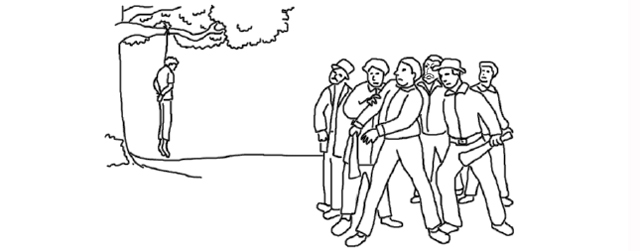
According to News4Jax.com, a parent of a second grader complained at the coloring book his child brought home.  The coloring book, “Who Was Jim Crow?” by edhelper.com, included some disturbing racial imagery.  Not least shocking was a picture of a crowd lynching a victim.

Image source: News4Jax.com

Image source: News4Jax.com

As a historian, I think we need to teach young people the sometimes-disturbing story of America’s past.  But this sort of classroom material raises all sorts of questions:

  • How old do Americans need to be to learn about racial stereotyping?
  • How should students be taught about America’s history of racial violence?
  • Should teachers be using cheap on-line teaching materials like this?  Even if the school board approved them?
  • Is this an example of racial political correctness gone wild?  Or is this an example of classroom racism?
  • Can offensive racial stereotyping ever make good teaching materials?

The Trauma of Evolution

Can we educate by banning ideas?  For one group of conservative Christian homeschoolers, proper education means banishing lots of ideas.  How can progressive educators like me understand this impulse to put up intellectual walls around young people’s minds?  I wonder if some creationists view exposure to evolutionary ideas as a form of trauma, an entirely harmful experience.

The Finish Well homeschooling conference, in the words of its organizers, “is designed to equip homeschooling families to confidently homeschool the high school years for the glory of God!”

One of the ways the conference promises to help attendees is by purging the atmosphere of any hint of evolution.  In order to secure a table at the conference, vendors are required to agree to the following statements:

“1) Scripture teaches a literal 6 day creation week, a young earth of approximately 6,000 years, and a literal understanding of Adam and Eve, the Fall, and the world-wide Flood of Noah’s day. 2) The Bible is the verbally inspired Word of God. It is inerrant and our ultimate authority in what we believe and how we live. Any speakers who contradict these two truths during their speaking session will be immediately asked to leave.”

Clearly, the goal of Finish Well is not only to keep out evolution.  Any other explanation about humanity’s origins will be verboten as well, including the evolutionary creationism of folks such as Darrel Falk or the big-tent creationism of the intelligent-design movement.

This notion of proper education is one of the hardest intellectual nuts for progressive educators like me to crack.  How are we to understand this idea that good education means hiding important ideas away from young people?  My first reaction, my gut reaction, is that this is precisely the sort of totalitarian impulse that kills any real education.  This sort of intellectual protectionism smacks of Nazi Germany or Stalinist Russia.  To me, and to lots of people, one of the first rules of true liberal education means opening intellectual doors, not bricking them up.  Real education, in my opinion, means allowing young people to explore a variety of ideas, to make up their own minds.

But in the conservative tradition, an important aspect of improving education has long consisted of the effort to remove “dangerous” ideas from the educational mix.  For generations, various types of conservative activists have insisted that simple exposure to certain ideas represented a danger—something from which young people had to be protected.

This idea played a big part in the first “creationist” controversies in the 1920s, as I explored in my 1920s book.  One of the public leaders of the anti-evolution movement of that decade was populist politician and former US Secretary of State William Jennings Bryan.  Bryan condemned the notion that good education meant a willy-nilly exposure to perfidious ideas.  In a battle with the University of Wisconsin over the teaching of evolution on campus, Bryan offered this sarcastic advertisement for the college:

“Our class rooms furnish an arena in which a brutish doctrine tears to pieces the religious faith of young men and young women; parents of the children are cordially invited to witness the spectacle.”  [SOURCE: William Jennings Bryan, “The Modern Arena,” The Commoner (June, 1921): 3.]

For my current book, I’m exploring the longer history of conservative educational activism.  This notion of proper-education-as-protection echoed throughout the twentieth century.  For instance, Grace Brosseau, President General of the Daughters of the American Revolution, argued that young children ought not be harmed by “the decrepit theory that both sides of the question should be presented to permit the forming of unbiased opinions.”  Such modern theories of education, Brosseau insisted, fundamentally misunderstood the nature of childhood and the responsibilities of education.  As she explained in 1929,

“One does not place before a delicate child a cup of strong black coffee and a glass of milk; or a big cigar and a stick of barley candy; or a narcotic and an orange, and in the name of progress and freedom insist that both must be tested in order that the child be given the right of choice.”

Instead, parents and teachers must give students only what students need to develop the “delicate and impressionable fabric of the mind.” [SOURCE: “The 38th Continental Congress, N.S.D.A.R.,” DAR Magazine 63 (May 1929): 261-271.]

More recently, the late Mel and Norma Gabler echoed this notion that proper education meant protecting young people from dangerous ideas.  In their 1985 book What Are They Teaching Our Children, the Gablers compared modern teaching to letting young children float in dangerous seas in flimsy lifeboats.  Modern teachers, the Gablers argued, too often allowed children to drift near sharp reefs and crashing waves, without offering any sort of guidance.  The teachers knew the rocks were there, the Gablers argued, yet these ‘progressive’ teachers did not see fit to warn the students.  Better for the students to ‘discover’ such dangers for themselves.  The Gablers asked, “Has the instructor gone mad?” (pg. 99).

For the Gablers, as for Bryan, Brosseau, and the organizers of the Finish Well conference, the notion that some ideas must be hidden from children made perfect sense.  For those like me who don’t agree, perhaps one key to understanding might come from the school controversies of the 1920s.  During that decade, many state lawmakers proposed bills that promised to keep certain ideas out of children’s paths.  One 1927 bill in Florida would have banned “any theory that denies the existence of God, that denies the divine creation of man, or that teaches atheism or infidelity, or that contains vulgar, obscene, or indecent matter” [Florida House Bill 87, 1927].

To the authors of this bill, evolution and atheism could be treated the same way as “obscene” material.  To those 1920s legislators, it made sense to keep obscene materials out of the hands of school children.

I agree that young people ought not be exposed to “obscene” materials.  And maybe this is the way for folks like me to understand the conservative impulse to keep some ideas out of schools.  After all, all of us—not just conservatives or fundamentalists—agree that some things must be kept from children.  No one wants young people to view a lot of hard-core porn at school, for instance.  Nor do we think that children should see graphic violence.  Exposure to such things seems traumatic.

Is this the key to understanding the conservative insistence on keeping certain ideas out?  For some young-earth creationists, mere exposure to evolutionary ideas represents a danger to their young children.  It might be that such conservatives view exposure to evolutionary ideas as an intellectual trauma, a theological trauma.  Such ideas might be ‘out there’ in the world, just like genocide, rape, and lynching might be ‘out there,’ but that does not imply that education must include graphic exposure to them.

Is this the way to understand Finish Well’s prohibition of any hint of evolution?  I’d love to hear from those who believe that young people should be protected from such ideas.

Glenn Beck’s Educational Utopia

“A place of real learning.”

What will life be like when Glenn Beck is finally made Emperor of the Universe?  More interesting for ILYBYGTH, what will education be like?

Beck recently outlined his vision of paradise.  As usual with Beck, the plan is short on details but expansive in its claims.  In short, it seems Glenn Beck’s perfect educational system would have three important components:

1.) apprenticeships;

2.) homeschooling;

3.) intellectual inoculation.

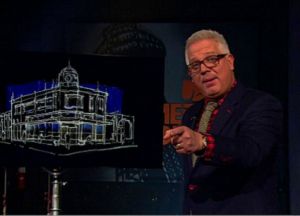
Image source: The Blaze

Image source: The Blaze

Beck described his vision of utopia in his plans for a new theme park, Independence, USA.  Like Walt Disney’s early visions, Beck wants a new kind of park, one that embodies Beck’s vision of proper American culture and society.

Parts of that vision include a radical de-schooling.  As Beck promoted it, this park would include a chance for students to learn by doing.  He asks (video 1—3:25),

“Does everybody have to go to an Ivy League university?  Or can we teach craft, can we teach business, can we teach things?  Are there people willing to teach through apprenticeships? . . . If it’s not possible, then America’s golden streets are dead.”

More profoundly, Beck insists, “Schools are a thing of the past the way we’ve designed them.”  For those who would live inside the boundaries of Beck’s Potemkin, children would learn in “neighborhood” clusters.  Children would be freed from the artificial constraints of institutional education, freed to learn by downloading content directly from the archives in Independence USA.

For those who insist on attending traditional schools, maybe even Ivy League colleges, Beck promises a handy inoculant.  Families should bring their college-age children to Independence for a week of authentic education.  Young people as well as old could receive a thorough training in Beck’s vision of American history and culture.  Such a week, Beck insists, will protect young people exposed to the lies and distortions in mainstream higher education.  Working with David Barton, Beck will teach young people, presumably, that the United States was created as an explicitly Christian nation, and that such Christian principles ought to remain at the center of American public life.  As Beck puts it (video 2—9:11),

“Before you send your kids to college, you come with us.  And you come here.  You spend a week.  You have a kid that’s going into college, you spend a week with us.  We’re going to tell them exactly, we will show them the truth, we will tell that what they’re going to try to do.  And we will deprogram them.  Every summer if you care.”

One is tempted to ask if any of this makes sense, as several commenters have done (see here and here for examples).  In this video, he offers only the vaguest sketches of his utopia, several aspects of which sound at best contradictory and at worst totalitarian.  More intriguing is the combination Beck demonstrates of a fairly radical anti-institutionalism with a keen, combative patriotism.  Beck combines an aggressive distrust of some of the central institutions of American life with an in-your-face defense of the American way of life.  Schools and colleges can’t be trusted, Beck insists, yet American traditions and culture are the strongest in the history of the world.  Young people need to be freed and protected from mainstream education, yet the theme-park plans—if they are to succeed at all—must appeal to large numbers of presumably mainstream folk.

For students of conservative education thinking in the United States, Beck’s paradoxes offer a unique window into the complex attitudes toward education among many American conservatives.  Beck, of course, is enough of an odd duck that his nostrums must not be taken as representative.  Yet he is popular enough that we can assume his fantasies resonate with at least a large number of his followers.

School, in this vision, has become something intellectually dangerous.  Young people, at the very least, need an intense counter-training, an intellectual inoculation against the false notions peddled in colleges.  If possible, in this plan, children should be freed from the outmoded walls of brick-and-mortar schools entirely.  Such institutions, Beck implies, have outlasted their usefulness.  Schools, Beck argues, have become the problem, not the solution.  Yet unlike the unschoolers of the cultural left, such as Ivan Illich, Paul Goodman, or John Holt, Beck’s deschooling promises a return to his vision of authentic American values of hard work, thrift, patriotism and religion.

Progressive Education Hurts Poor Kids: E.D. Hirsch’s “Wealth of Words”

Progressive Education hurts poor kids.  For those familiar with E.D. Hirsch’s work over the past twenty-five years, that argument won’t sound new.

In a recent piece in the conservative Manhattan Institute’s City Journal, Professor Hirsch lays out his case for why progressive attitudes and policy toward vocabulary education inflicts the most damage on those it claims to help: students from families with fewer resources.

Hirsch, a literary critic and scholar, first came to fame with his 1987 book Cultural Literacy.  The book and Hirsch shared a public career somewhat similar to Allan Bloom and his Closing of the American Mind.  Though both authors identified as politically and culturally liberal, their books became favorites of cultural conservatives.  Like Bloom, Hirsch claimed that American education had “progressed” in woefully misguided directions.

In brief, Hirsch argued that every American ought to master a certain core of cultural knowledge.  Critics charged Hirsch of elitism and even bigotry.  Insisting on an exclusive body of important cultural knowledge, critics insisted, blocked out too many vital cultural voices, voices that had not made the canon but that represented authentic elements of the real American experience.

In Hirsch’s new essay, “A Wealth of Words,” he argues that the best way to improve life chances for all Americans is to insist on a rigorous and systematic curriculum of vocabulary improvement.  In a nutshell, here is the argument:

1.) College degrees represent the best single path to economic well-being.

2.) The verbal section of the SAT college-entrance exam is largely a vocabulary test.

3.) Therefore, to bring people out of poverty, we need to improve vocabulary education.

Most interesting to ILYBYGTH readers will be Hirsch’s idiosyncratic combination of an attack on “progressive education” with a progressive-sounding prescription for improved schooling.

Like nearly every conservative educational activist of the past fifty years, Hirsch takes progressive education to task for dumbing-down American education.  As I’ve argued in an essay in Teachers College Record, a variety of leading conservative educational activists—with very different ideas about education—all agreed that America’s educational system had been hijacked by progressivism.

In Hirsch’s telling, this progressive coup took place roughly one hundred years ago.  This “well-meant but inadequate” progressivism, according to Hirsch, included the following poison pills:

“optimism about children’s natural development, a belief in the unimportance of factual knowledge and book learning, and a corresponding belief in the importance of training the mind through hands-on practical experience.” 

Once these “progressive educational theories” took over school publishing and teaching, vocabulary education suffered bitterly, Hirsch argues.  In response, Hirsch calls for “an intellectual revolution . . . to undo the vast anti-intellectual revolution that took place in the 1930s.”  Most important, Hirsch believes, is the need to overcome the notion that schools should not teach factual knowledge.  For a century, the “progressive” notion that school should teach students how to learn, instead of mere facts, has come to dominate education policy.  That, Hirsch believes, is a terrible mistake.

For those familiar with the twentieth-century development of conservative educational activism, it is easy to see how Hirsch could have become a favorite of conservatives.  Educational conservatism has largely centered itself on the notion that schools must remain true to their traditional purpose; schools must dedicate themselves to transmitting knowledge from one generation to the next.

However, a closer read of Hirsch’s prescriptions might give some conservatives pause.  True enough, Hirsch calls for a renewed focus on teaching children a rich vocabulary.  He insists that an emphasis on “literacy” rather than good “literature” hurts the life chances of those students who need schooling the most.

But Hirsch also calls for a profound investment in government-run and tax-funded preschooling.  He cites French studies of intensive instruction for students as young as two.  Such intense schooling, Hirsch claims, will allow students from lower-income homes to match the educational opportunities of those from more affluent ones.  Furthermore, Hirsch dismisses the notion that improved vocabulary instruction will come from more time spent with word drill.  Instead, Hirsch advocates “domain immersion,” in which students learn vocabulary as part of an immersion in interesting and important reading.

Thus, in his goal and his method, Hirsch still sounds provocatively “progressive.”  Yet even in his outlet, the conservative City Journal, we can see that Hirsch still finds his most eager audience among conservatives.  In the end, this might come as no surprise.  No critic of progressivism is more appealing than one who comes from the progressive camp itself.  In education as anywhere, a whistle-blower can claim a certain credibility others cannot.

In his recent essay, Hirsch continues his long career as progressive education’s leading whistle-blower.  The best way, Hirsch insists, to determine whether any education policy will help poor kids is simple.  We do not need elaborate justifications of “pedagogies of the oppressed” or “dreamkeeping” teaching strategies.  All we need do, Hirsch argues, is ask one simple question: “Is this policy likely to expand the vocabularies of 12th-graders?”

Plumbers and Teachers

What is a teacher? A hired hand?  Or an independent scholar?  A functionary enrolled to help parents?  Or a professional charged to form young minds as she or he best sees fit?

Students of conservative educational activism like me often list the same litany of complaints made by conservatives about public schooling in the past century.  Schools, conservatives often complain, must not warp their students’ minds.  Schools should teach patriotism.  Schools should teach respect for religious values and traditional notions of right and wrong.  Some conservatives believe schools must not teach atheism and call it science.

But there remains one hugely important conservative issue that rarely gets the same amount of attention: conservative concern with the overweening authority of teachers and educational experts.

As part of his recent series on education at Front Porch Republic, Anthony Esolen articulates this traditional conservative frustration.

Esolen frames the question in a provocative fashion: What if teachers were plumbers?

Here is one of Esolen’s scenarios:

“Jones pokes his head into the basement. He hasn’t done that in two years. He’s told himself again and again that they must know what they are doing, they are the experts and he isn’t, they are from the government, and he must mind his own business. But the devil gets into him.

“‘What is that?’

“‘What is what?’

“‘That – that tangle of pipes! Why so many? It’s a maze! It takes up half the room. In some places you can’t stand up straight. It’s like what happens to a hundred foot extension cord. The whole contraption is in knots!’

“‘I fail to see what you are so concerned about. Presumably you wanted us to do your plumbing. Well, so we have. We’ve done a great deal more than you expected.’

“‘But it’s leaking all over the place! Why didn’t you just do the simple but necessary thing? Why didn’t you do what I hired you to do?’

“‘Hired, Mr. Jones?’”

In the research for my current book about twentieth-century conservative educational activism, I’ve seen this argument repeated with a variety of emphases.  For generations, conservative activists have argued that schools and teachers have taken too much authority over children.

For instance, during the 1920s school controversies, William Jennings Bryan famously argued, “The hand that writes the paycheck rules the school.”

A generation later, in 1951, Ernest Brower, a conservative leader from Pasadena, California, complained to a state senate investigating committee that “progressive” education had seized too much control.  In their citizen investigation, Brower reported,

 “Well, you might liken public education, in Pasadena at least, and I think probably in other sections of the country as well, to a patient who is very sick, and so, naturally, the proper thing is to start looking for symptoms, and we found several symptoms of the disease. . . . we noticed there was a definite elimination of parental authority, undermining of parental influence.”

For Brower, as for Bryan and Esolen, this undermining of parental influence signaled the underlying “disease,” of which other educational problems were merely symptoms.

In 1968, conservative California school superintendent Max Rafferty agreed.  “Children,” Rafferty warned,

“do not belong to the state.  They do not belong to us educators, either.  They belong to their parents and to nobody else.  And don’t you forget it.

“Because if you do forget it and let the kids become wards of an all-powerful government, you won’t have to look forward with fear and trembling any more to that dread year 1984.  It will be here, considerably ahead of schedule.”

In 1980, free-market economist Milton Friedman lent his considerable influence to this central conservative notion.  “Parents,” Friedman wrote,

“generally have both greater interest in their children’s schooling and more intimate knowledge of their capacities and needs than anyone else.  Social reformers, and educational reformers in particular, often self-righteously take for granted that parents, especially those who are poor and have little education themselves, have little interest in their children’s education and no competence to choose for them.  That is a gratuitous insult.”

We could multiply examples of this sentiment almost endlessly.  From the early years of the Heritage Foundation’s work, Connie Marshner insisted,

“A parent’s right to decide the direction of his child’s life is a sovereign right, as long as the child is subject to his parent.  Educators have no business creating dissatisfaction with and rebellion against parental wishes.”

Similarly, Texas school watchdog Norma Gabler echoed this sentiment in the 1980s,

“Number one, my sons belong to my husband and I.  They do not belong to you and the state—yet.”   

For all these leading conservative intellectuals and activists, one foundation of schooling is that it is a service provided for families by educators.  It has long been a source of intense frustration that progressive educators presume glibly to arrogate total control over children’s lives.

As Professor Esolen reflected in his recent essay series, this arrogance is all the more exasperating when it seems utterly unaware of its own ridiculousness.  We would not accept the fact that a plumber would ignore our wishes and have his way with our pipes.  Why, Esolen asks—echoing generations of conservative intellectuals—why do we accept this brazen arrogance from teachers?