A Trip to a Catholic-School Science Fair

Science Fairs are great.  At their best, they allow students some freedom to experiment and learn on their own.  At their worst, they still provide hilarious examples of wacky adolescent science.  Recently, we saw a field report from the National Center for Science Education blog.  Peter Hess asked the question: What passes for “science” at a Catholic science fair?

In these pages, we’ve eagerly read reports from the field as science mavens visit various sorts of science fairs.  P.Z. Myers has argued that creationist students actively use science fairs to subvert the mind-numbing mental boundaries imposed by creationism.  Greg Laden visited a creationist homeschool science fair and found that some of the science was not bad.  At least not much worse, Laden thought, than the crappy science on display at non-creationist science fairs.

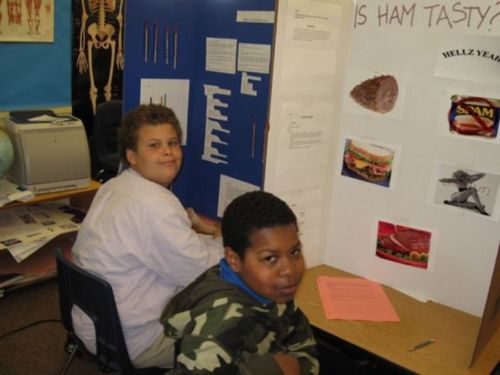
Cutting-edge science from a non-religious science fair...

Cutting-edge science from a non-religious science fair…

Hess found to his great relief that his kids’ Catholic school promoted mainstream science, without adulteration from theology.  Students came up with ambitious projects, such as measuring the distraction levels posed by cell phones and texting.

How distracted are drivers? This kid was not looking to the Bible for answers...

How distracted are drivers? This kid was not looking to the Bible for answers…

Hess also talked with some of the teachers.  Those teachers, too, did not see any conflict between Catholicism and teaching mainstream science in their classes.  One teacher offered an opinion that echoed the view of the late Stephen Jay Gould.  As middle-school teacher Joseph Nagel told Hess,

I sometimes consider science to be the constant investigation of the external world, a quest to analyze and understand the physical world, exclusive of human experience.  Religion I see as the eternal internal investigation, a search to explore and understand what lies within and between us, an examination of the human experience.  If science is our understanding of the world, religion is our understanding of us.  Maybe science is the ‘how’ and religion is the ‘why.’

Of course, different Catholic schools might have different approaches.  But my experience matches up closely with that of Hess.  I taught for a decade in Catholic schools in Milwaukee.  Though we sometimes had arguments about the novels we’d teach or the theology we’d teach, there was never any glimmer of controversy over the science we’d teach.

In fact, at least one of our science teachers also taught biology (or was it chemistry?) at a local public, secular community college.  When I asked him if he taught science differently at our Catholic school, he responded just as did the teachers Hess talked to: “Why would I?”


Kicking Christians Out of College

Does being an evangelical Christian automatically make one an anti-gay bigot? If so, can tolerant universities still allow such groups among their students? Those are the tricky questions highlighted in a recent New York Times article about evangelical culture and higher education. As the NYT story noted, this clash between pluralist campuses and “exclusivist” religious groups seems like a tough nut to crack.

But is it fair to assume that all evangelical students are bigots? That opposition to gay marriage pushes students beyond the bounds of polite society? To put it in the most provocative terms: Are evangelical student clubs being ousted because they are seen—sometimes unfairly—as being anti-gay?

The story opens with an update from Bowdoin College in Maine. At that elite liberal-arts school, the tiny evangelical student club has been cut off from official university support. Why? Because, like many evangelical student groups, the Bowdoin group insisted that leaders must be Christians themselves. This led to what the NYT article called a “collision between religious freedom and antidiscrimination policies.” At Bowdoin, as at many other schools, leadership at university-sponsored clubs must be open to all students, regardless of race, religion, or sexual identity.

The official question in the Bowdoin case is not about homosexuality or same-sex marriage. But it would be easy for a casual reader to miss that. The article mentions other schools in which evangelical students have gotten into trouble for anti-gay activity. At Vanderbilt, for instance, one Christian fraternity kicked out a gay member. Indeed, it was precisely that anti-gay activism that led Vanderbilt to force student groups to sign antidiscrimination pledges.

But Bowdoin’s student group does not seem particularly fervent about issues of homosexuality or same-sex marriage. At least according the article, the evangelical club at Bowdoin does not have a single party line about the morality of gay marriage. It’s hard to see a group as anti-same-sex marriage if some of its members support same-sex marriage.

Some studies have suggested that the faculty leaders at universities tilt decidedly against evangelical students. One 2007 study of university faculty concluded that evangelicals were “the only religious group about which a majority of non-Evangelical faculty have negative feelings.” And, as Rice sociologist Elaine Howard Ecklund found, faculty at elite schools often have a very skewed notion of evangelical belief. It does not seem like a stretch to think that these faculty prejudices might tip university policy.

For their part, evangelical intellectuals have struggled long and hard to prove that their opposition to gay marriage and, in some cases, to homosexual sex does not make them bigots. Perhaps the most vocal pundit on the issue, Ryan T. Anderson, insisted that conservatives had legitimate reasons for opposing gay marriage. But too often the other side wouldn’t listen. “Marriage re-definers,” Anderson complained in 2013,

don’t tend to say what many opponents have said, that this is a difficult question on which reasonable people of goodwill can disagree. No, they’ve said anyone who disagrees with them is the equivalent of a racist. They’ve sent a clear message: If you stand up for marriage, we will, with the help of our friends in the media, demonize and marginalize you.

Don’t get me wrong: I am personally fervently in support of same sex marriage rights. I’m opposed to locking anyone out of access to influence because of their sexual identity, religion, race, or other causes. But it seems as if universities would do well to uncouple these issues of club leadership, religious belief, and homosexual rights.

Could a student club demand religious beliefs of its leaders, while still welcoming gay and lesbian students to become leaders? Is it fair for universities to assume that evangelical belief automatically implies anti-homosexual attitudes?


Hobby Lobby-ing for Religion in Public Schools

Has God been kicked out of America’s public schools?  The most common answer among religious conservatives is yes.  But a better answer might be that God has been kicked out as a host, but earnestly welcomed in as a guest.

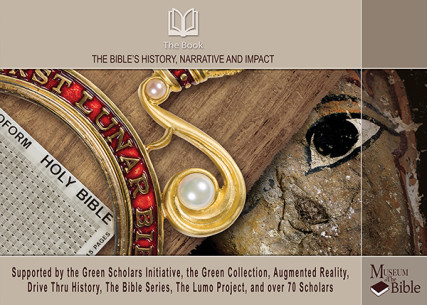
A new Bible curriculum for public schools hopes to reverse that trend.  As we’ve reported, Steve Green, conservative evangelical leader of the Hobby Lobby store chain, has funded a new Bible curriculum for public schools.  A recent study from the Texas Freedom Network insists that Green’s curriculum crosses the line.

Hobby Lobby's Promotional Image for Its New Bible Curriculum

Hobby Lobby’s Promotional Image for Its New Bible Curriculum

The study of the Hobby Lobby Bible curriculum was undertaken by Mark Chancey of Southern Methodist University.  Chancey is a religious-studies professor with considerable expertise in the question of religion in public schools.

As Chancey reviews, it is entirely permissible for public school students to read and study the Bible.  The US Supreme Court has encouraged such study.  The problem comes when public schools attempt to teach a certain interpretation of the Bible.  In short, public schools can and should teach students about religion.  But they err when they teach students religion.

Chancey asks if the Hobby-Lobby-funded curriculum, The Book: The Bible’s History, Narrative and Impact, keeps on the constitutional side of this divide.  For several reasons, Chancey concludes that it does not.

First, though Chancey notes this is not conclusive, Steve Green himself has publicly stated his intention to spread his religion.  As Chancey notes, Green makes no secret of his evangelical ambition.

Simply because Green wants to spread his faith, of course, does not mean that this Bible curriculum tries to do so.  But Chancey argues that the Bible curriculum repeatedly insists or implies that a certain evangelical-friendly interpretation of the Bible is correct.  For one thing, the Bible curriculum suggests that the Bible is historically accurate.  The authors tell readers

that the Bible, especially when viewed alongside other historical information, is a reliable historical source.

Also, Chancey argues that the curriculum privileges a Protestant vision of the Bible.  And the curriculum suggests that the real story of the Bible is salvation, a narrative that points unerringly toward the salvation offered by Jesus Christ in the Gospels.

As Chancey concludes,

The combination of a religious purpose, pervading sectarian bias, and frequent factual errors demonstrates that this curriculum has a long way to go before being appropriate for a public school classroom.

What’s next?  Since a public school district in Mustang, Oklahoma has already adopted this Bible curriculum, it appears we are headed for another lawsuit.  If Chancey’s review of this curriculum is accurate, my guess is that this material will be ruled unconstitutional for public schools.


Required Reading: Faces of Fundamentalism

When I first saw notice for Jona Frank’s book I worried it was another callow safari-style tour of fundamentalism in America.  I worried that the photographer hoped to shock and titillate non-fundamentalists with photographs from a bizarre subculture.  While Right: Portraits from the Evangelical Ivy League does include some elements of that cultural-tourist mindset, overall Frank offers a rich collection of portraits that are well worth exploring.

The book is a collection of portraits of the students at the new Patrick Henry College.  The students at PHC usually come from conservative religious homeschooling families.  The raison d’etre of the school, after all, is to get conservative kids into influential positions in politics and culture.  When I first saw promo photographs from the book, it looked to me as if Frank hoped to emphasize the distinctive subcultural elements of these students.  Many of the students appear awkward and over-dressed.  Some look distinctly overstuffed and uptight, as if they are surprised to find themselves in twenty-first century America.

Juli, whose career goal is to be a homeschooling mom.

Juli, whose career goal is to be a homeschooling mom.

After spending some time with the book, I feel Frank deserves more credit.  She wrestles explicitly with these issues in her conclusion.  As she writes, the “assuredness” of PHC students “confuses me.”  As she put it,

I had vague notions that I would marry and have a family when I was twenty-two, but both were far off.  What I wanted was exploration, travel, stories, youth hostels and road trips, part-time jobs and film school.  Before commencement I yearned for freedom.  This is part of being young in American, or so I believed until I went to Patrick Henry.

It has to be a lot of pressure to have a daily conversation with yourself about how you will impact the world.  In some ways, it’s the summer of ’69 at PHC, and they experiencing their own counterculture.  Of course, they are not ripping off their shirts and taking LSD.  It’s much quieter, but it’s not less complex.  The world is a complicated place.  It’s at odds with the homes they grew up in, and they are holding fast to the ideals of a life they believe is right.

In this passage and elsewhere, Frank demonstrates her awareness of her own limited perspective.  Just because we make certain assumptions about what “college” is supposed to be like, we must not impose those assumptions on everyone.  This is true whether students attend a button-down fundamentalist school like Patrick Henry or whether students are working two jobs while taking classes at a local community-college campus.

For those of us trying to understand conservative thinking and practice in education, Frank’s book also contains valuable samples of student work and wonderfully lengthy interviews with students.  One student sample, by “Grace M.,” reported on David Aikman’s biography of George W. Bush.  As this student reported dutifully, as “Dubya” matured,

It became obvious that his faith and religious convictions were a pleasant aroma to Americans.

Maybe not the best prose, but no worse than much of the student work from the non-fundamentalist schools in which I’ve worked.

Some of the students sound as if they are simply parroting the party line.  Jeremiah, for example, related his understanding of the purpose of PHC.  The school’s mission, he told Frank, included

Impacting government, impacting the media, impacting Hollywood, the culture, the arts. . . . Now our heaviest focus is on government, but the long-term goal is to impact the media, the arts, television, and the movies.

To my ears, this sounds like the sort of indoctrination I’d fear at a fundamentalist school.  Teachers say something, and students repeat it.  But, to be fair, when I listen to many of my undergraduate students here at a highly selective pluralist public university, they often also sound as if they are just repeating back what they’ve been told.

And we see some evidence that PHC dives deeper into true intellectual diversity than do many secular schools.  Another student, Juli, explained why they read so many non-Christian and even anti-Christian writers.  Such writers as Nietzsche, Juli explained

May be absolutely wrong, but they are not foolish, so we can’t just mock them.

How many students at pluralist universities would say the same thing about writers they disagree with?  How many students even read the work of conservative intellectuals as part of their training?  As former New York mayor Michael Bloomberg recently accused, have too many mainstream colleges turned into liberal indoctrination mills?  Have fundamentalist schools like PHC become more intellectually diverse than mainstream colleges?

To be sure, Frank’s book also contains glimpses of more disturbing tendencies at PHC.  One student accused the leadership of being “Draconian, totalitarian, in regard to students and faculty.”  And Frank includes an image of a repressive-sounding “Bride’s Guide.”  Young women are offered the following tidbit of complementarian advice: “Be a Woman Who Is Willing to Give Up All your Dreams.”

To outsiders like me, that sounds shockingly sexist.  To her credit, Frank includes this sort of depressing anti-feminism alongside photographs of an engagement party in which the women seem joyful and wholly at peace with their complementarian commitments.  Frank seems aware that the “Bride’s Guides” might fulfill my stereotypes of harsh fundamentalist impositions, but she also seems aware that the students at PHC often confound my stereotypes by embracing such rules freely and healthily.

Of course, a book can only be so long, but I wish that Frank had explored the theme of institutional growing pains more deeply.  She notes the generational divide at work here.  Many of these students came from families who see themselves as homeschooling pioneers.  But in being part of the first decade of life at PHC, these students also take a role as pioneers.  As I explored in my 1920s book and plan to treat at more length in my upcoming higher-ed book, fundamentalist universities are similar to other organizations in many ways.  The first generation, under the direct leadership of a charismatic founder, has a unique set of challenges and problems.  PHC still lingers in that first phase of development.  It seems to me that Frank could have taken more time to explore that tension.

She might have looked at the history of evangelical higher ed, in which each successive generation has opened a new school meant to be a “fundamentalist Harvard.”  In the 1920s, it was Bob Jones University.  In 1970, it was Liberty University.  How does PHC echo those experiences?  How is it unique?  Frank seems disappointingly uninterested in those questions, or unaware of them.

Instead, Frank seems to play along with the school’s claim to be part of something new, a new “evangelical Ivy League.”  Why, when she is careful to hold the school’s other assumptions at arm’s length, does Frank simply accept this kind of description?  After all, a school founded in the past five years can’t fairly be compared to the Ivy League.  Those institutions have a unique place in elite circles.  No student from the real Ivy League would say that no one knows about their college, as one of the PHC students complained about PHC.  Though PHC’s students might have ambitions of taking a fast track to elite positions, the school itself is more bluster than reality at this point.  To accept the founder’s (and students’) claim that PHC represents the very best of evangelical higher education is to make a woeful misapprehension of the state of American evangelical culture.

Such quibbles should not deter readers from getting their hands on a copy of Frank’s book.  For those interested in exploring the world of conservative education, Right will be well worth your time.

 

Zombie Science on Noah’s Ark

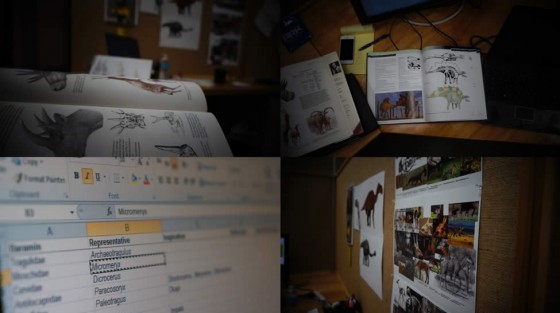
Smart people don’t say it’s not science.  Some call creation science “dead science.”  But anyone with eyes to see and ears to hear can see the bustling activity in the world of creation science.  A recent blog post from Answers In Genesis offered an introduction to what creation science can look like.  If it’s not dead, but not quite alive in the normal sense, maybe the best term for this sort of research is “undead science” or “zombie science.”

Alternative Science in Action

Alternative Science in Action

As those of us who follow the creation/evolution debates are well aware, Answers In Genesis is planning a big new museum project.  They want to build a replica of Noah’s Ark to prove its practicality.  Indeed, this ark project has attracted a sub-controversy of its own, with secularists complaining about public tax benefits going toward this explicitly sectarian religious project.

In a recent blog post, AIG explained some of the scientific challenges of their Ark project.  AIG demonstrated some of the unique features of the sort of creation science practiced by AIG scientists. As the post explained, one of the challenges of designing a replica Ark is figuring out how many animals would be on board.  Most believers in a literal world-wide flood do not insist that Noah’s Ark contained two of every species we have today.  Rather, they say that the Ark contained two of every “created kind,” as described in Genesis.  That is, the Ark did not have two wolves, two dingoes, two foxes, two dogs, etc.  Instead, the Ark had two of the “kind” of canine.

The term AIG scientists use to describe these “created kinds” is “baramin.”  In the recent blog post, AIG uses the example of the mule deer to show how scientists can figure out what kind of created kinds were on the Ark.  Creation scientists hypothesize that fossils from the baramin must be in a certain fossil layer, since those fossils were predictably laid down at a certain point in the Genesis flood.  In this case, the most likely fossil deposits, according to AIG, were from “moschids buried in rock layers deposited by localized catastrophes just after Flood.”  Those samples allow creation scientists to figure out what the baramin on the ark would likely have looked like.

Is this science?  It’s tempting for those of us outside the circle of creationism to pooh-pooh this sort of thing as outlandish non-science.

But more thoughtful non-creationists have offered more subtle explanations.  Philosopher Philip Kitcher, for example, argued that we should understand this not as non-science, but as “dead science.”  This sort of thinking, Kitcher said, had a long and influential career as mainstream science.  However, it has been replaced by better science.

Historian George Marsden also offered an explanation of this sort of scientific thinking.  Marsden argued that early creationists worked in a Baconian framework.  Science, according to this way of thinking, must begin with an authority.  From that firm starting point, scientists can collect and classify information.  This is not non-science, but rather a certain form of dissenting science.

Throughout the twentieth-century history of creationism, creationists themselves have insisted on the scientific legitimacy of their projects.  The leading creation scientist of the 1920s, George McCready Price, repeatedly argued that non-creationists were behind the times.  As Price told an audience in London just a few months after the 1925 Scopes trial,

I am perfectly confident that any competent person who will take the time to traverse the evidence now available on this side will reach the same conclusion that I have reached—namely. That the theory of Organic Evolution was a very plausible theory for the times of comparative ignorance of the real facts of heredity and variation and of the facts of geology which prevailed during the latter part of the nineteenth century; but that this theory is now entirely out of date, and hopelessly inadequate for us, in view of the facts of geology and of experimental breeding as we know them.  We are making scientific history very fast these days; and the specialist in some corner of science who keeps on humming a little tune to himself, quietly ignoring all this modern evidence against Evolution, is simply living in a fools’ paradise.  He will soon be so far behind that he will wake up some fine morning and find that he needs an introduction to the modern scientific world.

Mainstream scientists in the 1920s and ever since would dispute Price’s prediction.  But in every generation since the 1920s, creationists have developed and honed their distinct version of science and of scientific research.  As this Ark Encounter article makes clear, over the past century creationists have identified research problems and research methodologies that are utterly foreign to mainstream science.  They have built schools, museums, and academic publications.  They have changed and honed their thinking.

“Dead” science does not grow and change in this way.

So if this sort of creation science is thriving and changing, it seems misleading to adopt Kitcher’s label of “dead science.”  I know creationists won’t like the idea of calling it “zombie science” or “undead science.”  But is there a better term to describe this unique sort of active-but-dead kind of research?


Bloomberg Bashes College Liberal Orthodoxy

It’s not news when conservative intellectuals complain about liberal orthodoxy at America’s colleges.  But recently former New York Mayor Michael Bloomberg told Harvard’s commencement audience that colleges needed to include more conservative voices.

The conservative intellectual world has long been aghast at the purported liberal bias of American higher education.  After all, it was in many ways William F. Buckley Jr.’s enfant-terrible critique of Yale that launched the post-war conservative fusion movement.  More recently, as we’ve noted in these pages, conservatives in Colorado managed to insert a prominent conservative into the faculty of that state’s flagship university.  And conservatives have offered prescriptions to heal America’s blighted leftist ivory towers.

In this commencement season, the world of higher education has been aflutter with commencement cancellations.  Rutgers pulled the plug on Condoleeza Rice, Brandeis said thanks but no thanks to Ayaan Hirsi Ali, and Asuza Pacific University cancelled Charles Murray’s talk.

Mayor Bloomberg warned that universities must welcome a real intellectual diversity.  Chanting and protesting to shut out conservative voices, Bloomberg warned, threatened the very purpose of the university.  “In the 1950s,” Bloomberg told Harvard,

the right wing was attempting to repress left-wing ideas.  Today on many college campuses it is liberals trying to repress conservative ideas even as conservative faculty members are at risk of becoming an endangered species.

Not surprisingly, conservatives have embraced Bloomberg’s theme.  Richard D. Land of the Southern Evangelical Seminary agreed heartily in the pages of the Christian Post.  Bloomberg, Land enthused,

has done the nation a great service by speaking bold truth to intolerant power.

Liberal intolerance was prevalent when I was a Princeton undergraduate in the 60s. It has become far worse in the intervening decades. Too many students are being brainwashed and indoctrinated, instead of educated, in our nation’s colleges. Unless such dangerous trends are reversed, it will increasingly imperil everyone’s liberties – personal, civil, and religious.

Similarly, Glenn Beck gushed, “you have to respect his willingness to speak so definitively about the intolerant culture at far too many universities and colleges.”

As I argue in my upcoming book, conservatives have worried about the ideological slant of America’s elite colleges throughout the twentieth century.  Now they have a prominent ally in former mayor Bloomberg.

The Handwriting on the Wall

Conservatives have been proven right!  About handwriting, at least.  A recent article in the New York Times suggests that teaching handwriting might be a good way to help students learn.

In the research for my upcoming book about educational conservatism, I kept coming across conservative complaints that schools were abandoning the traditional subject of handwriting, often called “penmanship.”

In the pages of the Pasadena Independent, for example, editor T.G. Wood complained in 1950 that “progressive” education fads had led to less learning of traditional subjects.  Parents were increasingly starting to wonder, Wood wrote acerbically,

why little Johnny puts two and three together and comes up with nine, why his penmanship shows little or no improvement, and why his reading is poor or backward.

An angry Pasadena reader agreed.  Back in the old days, one letter-writer explained, Pasadena’s schools had benefited from the work of teacher Albert P. Meub, “a penman of national note.”  Meub had tried to keep the subject of penmanship in the schools, the letter-writer complained, but to no avail.  The rush for progressivism in schools had led to the willy-nilly abandonment of traditional subjects such as penmanship.

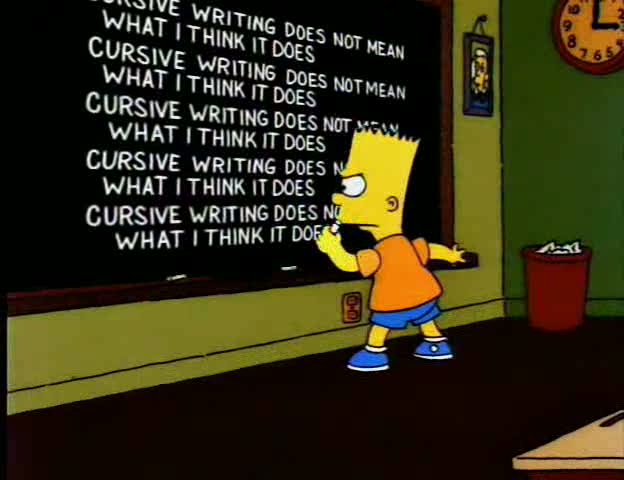
I can’t help but think of the Simpsons episode in which Bart’s new teacher asks him if he knows cursive.  “Well,” Bart replies, “I know hell, damn, and fart.”

Hell, Damn, and Fart

Hell, Damn, and Fart

According to the research review in the New York Times, both Bart and the children of Pasadena would have done better if they had spent more time learning to write by hand.  Some of the research compares writing by hand to writing by computer.  But some psychologists have also studied the difference between learning to write in cursive or by writing block letters.  Some think that students will do better when they learn cursive.

Why?

Karin James of Indiana University suggests that writing by hand helps students learn about the infinite complexity of letter variability.  Every Times-New-Roman “A” may look the same, but not every hand-written one.

Another study suggests that learning cursive may actually stimulate more brain activity and help fight language problems.

The crusty conservative editor T.G. Wood of the Pasadena Independent might have argued from his perch in 1950 that such studies only belabor the obvious.  Educational fads that abandon tradition out of a misguided trust in the superiority of the new and shiny will always lead young people astray.  Traditional education, conservatives have long insisted, has lasted so long for an obvious reason: It works.

Bad News for Everyone

Have you seen it yet?  The new Gallup poll on creationism and evolution is out.  The numbers are about the same as they have been for the past thirty years.  But beyond those numbers, the backgrounds of Gallup’s respondents has some bad news for creationists.  It also has bad news for evolution-lovers.

Stable Numbers Since the 1980s

Stable Numbers Since the 1980s

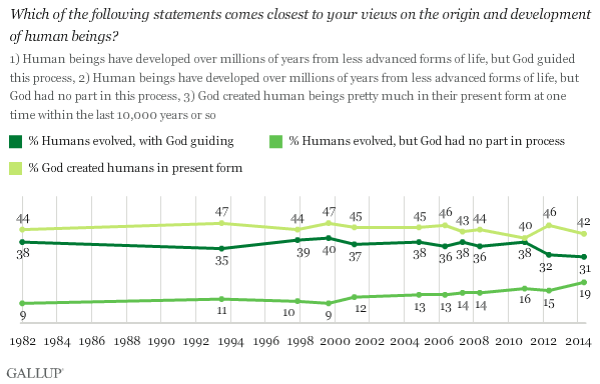
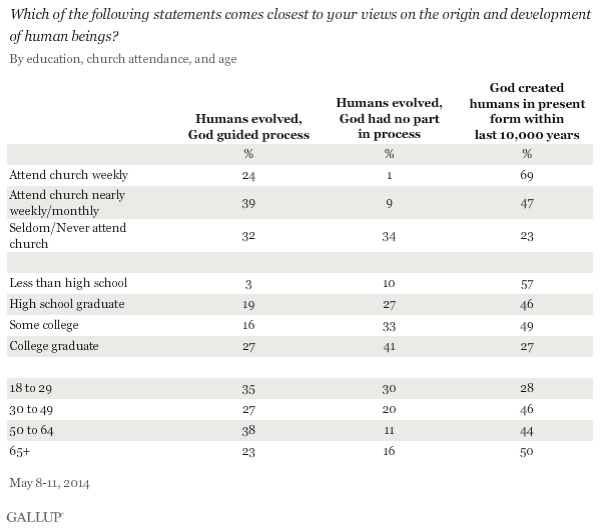
Since the 1980s, Gallup’s pollsters have been offering respondents three options about the origins of humanity.  This time, 42% chose the young-earth creationist option: “God created human beings pretty much in their present form at one time within the last 10,000 years or so.”  In contrast, 31% chose “Human beings have developed over millions of years from less advanced forms of life, but God guided the process.”  A whopping 19% selected “Human beings have developed over millions of years from less advanced forms of life, but God had no part in the process.”

Those numbers have remained fairly stable for the past generation.  But another result of the recent poll numbers needs some examination.  The young-earth position is much more common among less educated adults.  For those with less than a high-school diploma, 57% selected the young-earth option.  A far smaller proportion, only 27%, of Americans with a college degree chose the young-earth explanation.

"Organized Ignorance?"

“Organized Ignorance?”

This is bad news for everyone.

For creationists, these numbers suggest that more education means less creationism.  Throughout the lifespan of American creationism, creationist intellectuals have fought a rearguard action against accusations of ignorance.  In 1927, for example, Minneapolis fundamentalist leader William Bell Riley told a reporter,

Every time I hear the argument that this is a controversy between experts on the one hand, and, as someone has said, ‘organized ignorance,’ on the other, I smile.  This is not a debate between the educated and the uneducated.

Riley’s smile grew more and more strained as the 1920s wore on.  And later generations of creationists found it even more difficult to take the intellectual high ground.  These numbers mean bad news for them.

But the numbers mean bad news for evolution mavens, too.

Though more college grads embrace a non-young-earth understanding of the origins of humanity, 27% is still a significant number.  It means that over a quarter of adults who have been to college—educated adults, that is—select a young earth as the best explanation.  Over a quarter!  Some of those, to be sure, may attend what young-earth creationists embrace as “Creation Colleges.”  Ken Ham of Answers In Genesis, for example, publishes a list (and a map!) of schools that he views as faithful to the Bible’s obvious meaning.

But many of those college-educated young-earth creationists likely attend non-creationist colleges as well.  As anthropologist David Long demonstrated in his study of creationists at a large public university, studying biology at a secular university does not tend to shake the faith of creationist students.  Of his interview subjects, only one abandoned her creation faith as she majored in biology.  And it wasn’t the science that convinced her.  She had already begun to move away from her faith in high school, due to an early pregnancy and the sour reaction of her church community.

As I argued a while back in the pages of the Chronicle of Higher Education, anti-creationists are too fond of calling all creationists “ignoramuses.”  Certainly, some folks must embrace creationism because they just don’t know better.  But many educated adults DO know about evolution.  They simply choose young-earth creationism instead.  That is a troubling fact that anti-creationists have always had a hard time dealing with.


Sex Ed and the Diseased Children of the Revolution

HT: KC

What do Americans want their children to learn about sex?  Throughout history, two conservative authors recently argued,[*] most Americans have wanted children to learn the values of abstinence and purity.  Only the 1960s sexual revolution turned perversion and license into mainstream public-school how-to lessons.

The essay, by National Abstinence Education Association President Valerie Huber and Cedarville University psychology professor Michael Firmin, appeared in the recent issue of the peer-reviewed journal International Journal of Educational Reform.  For those of us who are interested in understanding conservatism in education, this article offers a chance to see conservative thinking in action.

There are a few odd copy errors.  Prominent education historian Milton Gaither, for example, is called “Milton Caither.”  But far more interesting than these flaws are the interpretative implications of the authors’ historical vision.

Before I describe them, though, I should point out my own biases.  I have a difficult time understanding conservative opposition to comprehensive sex education.  In my upcoming book about the twentieth-century career of educational conservatism, I describe such opposition, especially in my chapter about the 1970s.  But I still have a hard time understanding it.  To me, it seems like simple common sense that schools should provide thorough, accurate information about sex to young people.  Public schools should not moralize about sex, but whether or not students choose to have sex, they should know about the facts of life.  With the huge public-health implications of pregnancy and sexually transmitted diseases, it seems to me a simple matter of common sense that schools should teach everyone about sex.

However, as I’ve struggled to understand conservative opposition to comprehensive sex ed in public schools, I feel I’ve gained some insight.  Though I want public schools to teach kids all the facts and let the kids and their families determine the morality involved, I can sympathize with conservatives who feel that such an approach tips the discussion too far in the “pro-sex” direction.  I consider the following analogy: if your spouse were traveling on business, would you make sure he or she had condoms along in case s/he decided to have sex while s/he was gone?  That doesn’t make much sense.  Or this one: could a teacher tell students, “If you’re planning on robbing a bank, here are some ways to do it safely?”  In other words, if a behavior is obviously morally unacceptable, we shouldn’t teach young people how to do it safely.  We shouldn’t imply that we condone such immorality by helping children (or spouses) do it without consequence.  Some conservatives think that pre-marital sex is precisely this sort of immoral behavior.  Such conservatives insist that by telling young people about sex in a morally neutral fashion, we suggest that premarital sex is okay.

Huber’s and Firmin’s history of sex ed portrays an American people deeply convinced that sex is best saved for marriage.  Only perverts and revolutionaries challenged that notion.

For instance, the first prominent “pro-sex” campaigner Huber and Firmin describe is Margaret Sanger.  In the 1920s, the authors note, Sanger advocated birth control as a way to empower women and to limit the numbers of undesirable births.  Sanger’s recreational approach to sex was “radical,” the authors contend, but it became an “early influence” on sex ed in schools.

In the 1940s and 1950s, Alfred Kinsey took the study of sex to new extremes, according to Huber and Firmin.  Kinsey studied the sexual practices of a “nonrepresentative proportion of sex offenders and participants in the homosexual bathhouse community,” the authors contend.  Kinsey proffered his witches’ brew of demented sexual proclivity as unbiased research, including outlandish claims that infants had orgasms.  As did Margaret Sanger, Kinsey laid the foundations for a morality of “sexual experimentation,” according to Huber and Firmin.

It was not until the 1960s, however, that such radical notions about sex and sex education became mainstream.  The sexual revolution of that decade, Huber and Firmin argue, “turned America’s moral sensibility on its head.”  During the late 1960s and early 1970s, a new culture of sex education took America by storm, midwived by the “[l]ong hair, open-air sexual orgies, drugs, student rebellions, Vietnam, and racial tensions” of the period.

By the 1980s, luckily, “innovative organizations” had organized a sensible and effective “counterrevolution.”  These groups promoted the American tradition of sex education as abstinence-only education.  Only such education combined information about sex with the moral underpinnings that young people need.

Today, according to Huber and Firmin, most Americans agree with an abstinence-only approach to sex-ed in public schools.  Though the “public relations” efforts of “pro-sex” groups such as Planned Parenthood have had some success, the authors note that “the majority of parents, regardless of race or political party, strongly endors[e] all the major themes presented in an abstinence education class.”  As evidence, they cite a 2012 survey from the National Abstinence Education Foundation.

As I’ve argued in the pages of Teachers College Record, conservative activists have an intense interest in educational history.  It makes sense.  Whoever controls the history can make policy recommendations that claim to be in synch with American tradition.  In this case, Valerie Huber and Michael Firmin give us a history in which Americans want their children to learn the values of abstinence and purity.  Throughout the generations, some radicals such as Sanger and Kinsey have strummed a minor chord of recreational sex and gleeful perversion.  Only with the irresponsible sexual revolution of the 1960s, though, did such attitudes enter public schools in any significant number.  Thanks to the work of earnest abstinence-only “counterrevolutionaries,” however, America’s schools have hope.  Today’s schoolchildren, these conservative authors argue, can learn the real tradition of American sex ed.

——————————————————————————————————————————-

[*] The article does not seem to be available without a subscription.  For those with access to a decent library, here’s the citation to help you find the full article: Huber, Valerie J., and Michael W. Firmin. “A history of sex education in the United States since 1900.” International Journal of Educational Reform 23.1 (2014): 25+.


Our Children: Evil & Successful

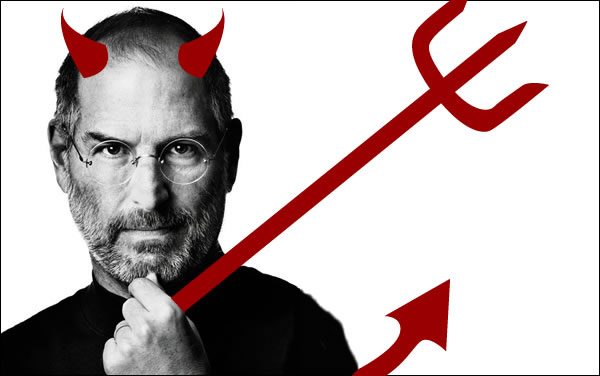
What have we done?  By giving our children everything, we’ve made them into self-centered, grasping monsters.  At the Imaginative Conservative, Bruce Frohnen accuses our culture of eating its own children.  As the perfect terrifying example, Frohnen uses the life and rapacious career of the late Steve Jobs.  Perhaps unconsciously, Frohnen dips into one of the strongest traditions of educational conservatism.

Spoiled Children, Spoiled Society

Spoiled Children, Spoiled Society

Frohnen, Professor of Law at Ohio Northern University, castigates Jobs as the exemplar of all things rotten in our culture.  Jobs, Frohnen writes, lived as

a mean-spirited narcissist who translated a certain aesthetic sensitivity and capacity for bullying and hucksterism into a colossal waste of money and collective time, further separating Americans from one another in pursuit of a false control over their environment. As bad, his personality and corporate ethos furthered highly damaging political and economic structures of a kind best described as libertarian socialism, in which corporations and rich individuals behave without conscience, expecting the social programs they vote for but seek to escape funding to pick up the pieces from their own “creative” destruction. I also see him as in many ways a sad character, emotionally and spiritually stunted in part because of the failings of the infantilizing environment in which he grew up.

Frohnen’s arch analysis of Jobs’ character serves as more than a brutal post-mortem on a unique American life.  Frohnen wants us to see Jobs as typical, the predictable result of American culture gone off the tracks.

Why was Jobs such a grasping bully?  Because he came out of the 1960s American culture that had wilfully abandoned its own traditions of child-raising.  Jobs, like so many of his generation, was relentlessly coddled, given everything and asked for nothing.

This was more than just a question of parenting.  Frohnen examines the college education on offer at Reed College in Oregon, where Jobs briefly took classes and where Frohnen briefly taught.  The faculty at Reed, Frohnen argues, deliberately discarded educational tradition and encouraged students to wallow in self-love.  As Frohnen remembers it,

Reed College in Portland, Oregon is one of those places where students dress in black to show how depressing it is to be young and well-off; lots of Volvos in the parking lot when I was there. And the drug culture remained. By my second semester at Reed several students had overdosed on illegal drugs. When the President, a “good” leftie from Oberlin, decided to take the minimal action of proposing a faculty resolution decrying the self-destructive behavior he was in for a surprise. At first I thought the principal opposition speaker was a bag lady. It turned out she was just some English professor in a poncho. She was nearly in tears as she argued that “we” could not hope to engage productively with students if we began with such a “superior attitude.” The resolution failed by an overwhelming margin.

Though Frohnen ties his bitter eulogy to a specific time and place—the 1960s lax parenting and education of the San Francisco era—conservative intellectuals and activists have made similar arguments throughout the twentieth century. As I argue in my upcoming book, at least since the 1920s conservatives have lamented the tendency of political liberals and educational progressives to coddle children. Parents and educators make a mistake, conservatives have insisted, when they offer too much to children.

Consider, for example, the educational vision of Grace Brosseau in 1929. At the time, Minor served as the President General of the Daughters of the American Revolution. She insisted, as Frohnen does, that parents and teachers must not abandon their duty to impose on children. “Flagrant cases of un-American tendencies have been brought to light and exposed,” Brosseau warned. America had gone to hell in a handbasket. And why? Too many teachers believed in the “decrepit theory that both sides of the question should be presented to permit the forming of unbiased opinions. This may be the proper system for the seasoned adult,” Brosseau warned, but

With the young, the chances are too great, for there a dangerous inequality exists.  One does not place before a delicate child a cup of strong black coffee and a glass of milk; or a big cigar and a stick of barley candy; or a narcotic and an orange, and in the name of progress and freedom insist that both must be tested in order that the child be given the right of choice.  Instead, one carefully supplies only what will make for the development of the young body and assure its normal growth.  Why then apply the very opposite theory when dealing with the delicate and impressionable fabric of the mind?

Writing in the 1980s, conservative activists Mel and Norma Gabler repeated this warning that too much choice spoils a child.  “The only absolute truth in modern humanistic education,” the Gablers warned,

is that there are no absolute values.  All values must be questions—especially home- or church-acquired values.  Discard the experience gained from thousands of years of Western civilization.  Instead, treat the students as primitive savages in the area of values.  Let them select their own from slanted, inadequate information.

By giving everything to our children, these conservative writers have insisted for generations, we’ve taken everything from them.  In the case of Steve Jobs, Frohnen argues, we see the perverted results that ensue from too much too soon.