…but God IS My Hero

“But God IS my hero.” That’s a dramatic reconstruction of what ten-year-old Erin Shead told her teacher in October. Her teacher had asked her to do a writing assignment about a hero. When Erin turned in an essay about God, her teacher told her she couldn’t write about God, she had to write about her personal hero.

Source: WRCB Chattanooga

Source: WRCB Chattanooga

The resulting kerfuffle pushed Tennessee lawmakers to pass the Religious Viewpoints Anti-Discrimination Act. According to this bill, which now goes to Tennessee Governor Bill Haslam for a signature to become law, students must be allowed to voluntarily express religion viewpoints “on an otherwise permissible subject in the same manner [the school] treats a student’s voluntary expression of a secular or other viewpoint.” In other words, students must be allowed to write about God as their hero.

Here at ILYBYGTH, we have to wonder if this sort of law might represent a powerful new conservative tactic in America’s ongoing educational culture wars.

Tennessee is not alone in passing this sort of school rule. Texas has such a law on the books. Missouri has a similar rule enshrined in its constitution. And Oklahoma is considering something along these lines.

Today, I’m not going to argue the merits of these sorts of laws. In short, though, I’m against them. As I’ve argued in places such as Education Week and the Washington Post’s Answer Sheet blog, these kinds of bills threaten to impose an utterly unmanageable free-for-all in our nation’s classrooms. IMHO. Other commentators, too, have worried that these laws will impose a renewed theocracy in public schools. If students can use class time to make religious statements, some worry that religious students might turn classrooms into religious battlegrounds. What if a creationist student insisted that she could answer questions about evolution with references to Genesis? What if a Muslim student made a speech in which he denied that Jesus was God? It’s not hard to imagine dicey situations these new laws might encourage.

Today, though, instead of arguing against these kinds of bills, I’d like to make a different point. It seems educational conservatives can win politically by protecting students from a perceived overreach by educational leaders. In the case of Tennessee, the senate bill passed unanimously. In the assembly, only two representatives voted against it.

Why did this bill have such overwhelming political support? Two reasons. First, there is not much new in these laws. Students already had the right to engage in self-directed religious activity in public-school classrooms. Erin Shead already had the right to write about God as her personal hero. Second, conservative educational thinkers and activists have long worried about school as a potential threat to young people’s faith. Anything that looks to support religious young people from what many people see as an aggressively secularizing public-school establishment will win political points among religious conservatives.

So liberal-leaning lawmakers can vote for these laws as mere clarifications of already-existing rules. And conservative-leaning lawmakers can promote these votes as an effort to protect religious youngsters from the sinister aggression of secularizing teachers and schools. Together, that is a powerful political coalition.

If I were a conservative activist, I would be watching very closely. Bills that underscore the religious rights of students in public schools have a powerful symbolic effect, if nothing else. And politically, they may be hard to stop.

Why shouldn’t conservatives push these sorts of school laws all over the country?
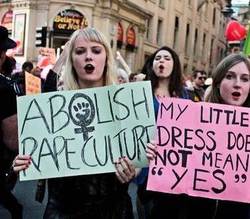
 

Conservatives Blast the “Myth” of Rape Culture

Why do some conservative thinkers insist that anti-rape-culture activism is a fraud? That “rape culture” itself is a myth?

As we’ve seen in these pages, talk about rape culture is often tied to the atmosphere of colleges and universities. And it is understandably an incredibly sensitive subject. Even asking about the nature of rape culture can be seen as truckling to rapists and those who hope to explain rape away.

Full disclosure: I am one of those who thinks that denying this problem is part of the problem. I agree that colleges and universities need actively to confront cultures that encourage sexual assault. For too long, college administrators have winked at the “boys will be boys” attitudes that lie at the heart of rape culture. In these pages, I have asked whether this is worse at conservative Christian colleges. I have wondered if non-denominational Christian schools, “fundamentalist” schools such as Bob Jones University, Patrick Henry College, and Pensacola Christian College have a harder or easier time dealing with these issues. In those cases, I was accused of apologizing for sexual assault myself.

And watch: I won’t be surprised if I am accused of supporting rape culture for writing these words as well.

But I’m going to do it anyway. Because there’s a new question that stumps me. Why do some conservative intellectuals attack the very notion of rape culture? What is “conservative” about dismissing the existence of rape culture on college campuses?

Minding the Campus Blasts Rape-Culture Activism

Minding the Campus Blasts Rape-Culture Activism

This past week, we’ve seen Caroline Kitchens of the American Enterprise Institute denouncing the “hysteria” over rape culture in the pages of Time Magazine. Kitchens asserted that there is no rape culture. There is no culture, that is, in which rape is apologized for and excused. America as a whole loathes rape and despises rapists, Kitchens points out. “Rape culture” only exists in the imaginations of over privileged college students and their tame faculty. Colleges such as Boston University and Wellesley ban pop songs and harmless statues as an overblown response to such rape-culture myths, Kitchens writes.

Kitchens claims the support of the Rape, Abuse, & Incest National Network (RAINN). She cites a recent RAINN letter to a White House Task Force. In order to help victims of sexual assault on college campuses, this RAINN letter asserts, administrators should understand that these are the acts of criminal individuals, not the result of a nebulous cultural trend.

It is rape-culture stereotypes themselves that absolve abusers of responsibility, Kitchens argues. “By blaming so-called rape culture,” she concludes, “we implicate all men in a social atrocity, trivialize the experiences of survivors, and deflect blame from the rapists truly responsible for sexual violence.”

Kitchens is not alone. In the pages of the conservative higher-ed watchdog Minding the Campus, KC Johnson has agreed recently that “rape culture” is a “delusion,” the product of overheated leftist imaginations. Johnson, a high-profile historian from Brooklyn College, worries that campuses from Dartmouth to Occidental to Duke suffer from an overabundance of intellectual cowardice and groupthink. “Fawning” media coverage has allowed for “transparently absurd allegations,” Johnson writes. Plus, harping on “rape culture,” Johnson argues, allows “activists to shift the narrative away from uncomfortable questions about due process and false accusations against innocent male students, and toward a cultural critique in which the facts of specific cases can be deemed irrelevant.” Finally, the blunt instrument of “rape-culture” accusations provides activists with “a weapon to advance a particular type of gender-based agenda.”

Such claims are intensely controversial. But before we examine the legitimacy of these arguments, we need to ask a more basic question: Why do conservative intellectuals make them? Now, I understand Johnson is no conservative himself. But it is telling that conservative organizations such as the American Enterprise Institute and Minding the Campus are the ones hosting these anti-rape-culture accusations.

Is there something “conservative” about disputing the existence of rape culture? Is “rape culture” a leftist ploy to assert (more) control over college campuses? To tighten the screws of the academic thought police? Or is something more profound at work? Do these conservative voices dispute the existence of rape culture in order to perpetuate traditional gender roles?


California: No Rock Concerts, No Evolution, and No Spiders

Science pundit Jerry Coyne has discovered something rotten in the state of California.  To graduate from California high schools, students must pass the state high-school graduation exam.  That exam, Coyne discovered, is not allowed to ask students any questions about evolution.  Or “rock concerts.”  Or spiders.  Really.

As Coyne points out, students must pass the test at some point in order to graduate from high school.  The rules of the test are clear: to level the playing field, any intimation of controversial ideas must be kept out of this minimum-competency exam.  As a result, the California Department of Education has published a list of topics that should be avoided:

  • Violence (including guns, other weapons, and graphic animal violence)
  • Dying, death, disease, hunger, famine
  • War
  • Natural disasters with loss of life
  • Drugs (including prescription drugs), alcohol, tobacco, smoking
  • Junk food
  • Abuse, poverty, running away
  • Divorce
  • Socio-economic advantages (e.g., video games, swimming pools, computers in the home, expensive vacations)
  • Sex
  • Religion
  • Complex discussions of sports
  • Slavery
  • Evolution, prehistoric times, age of solar system, dinosaurs
  • Rap music, rock concerts
  • Extrasensory perception, witchcraft
  • Halloween, religious holidays
  • Anything disrespectful, demeaning, moralistic, chauvinistic
  • Children coping with adult situations or decisions; young people challenging or questioning authority
  • Mention of individuals who may be associated with drug use or with advertising of substances such as cigarettes or alcohol
  • Losing a job, home, or pets
  • Rats, roaches, lice, spiders
  • Dieting, other concerns with self-image
  • Political issues
  • Any topic that is likely to upset students and affect their performance on the rest of the test

As Coyne protests,

[Evolution] is science, and those are important things for children to know!

We could imagine making this point even more boldly.  Students should be REQUIRED, we might say, to be able to handle potentially controversial or upsetting issues.  Not only should California high-school students be allowed to field questions about evolution, they should be expected to!  And questions about fundamental issues such as slavery and religion.  And spiders.  Indeed, how could the Great State of California consider someone adequately educated if he or she could not handle the merest whiff of controversy?

We might say all that, but it would miss the point.

Students in California schools already have to know plenty of evolution.  The state’s standards these days have oodles of evolution in them.  [Though as Ron Numbers argues, the history of California’s science standards has played a key role in promoting the “minority-rights” argument of creationists since the late 1960s.] This minimum-competency graduation test is not meant to test whether or not students have adequate skills or knowledge.  Rather, it is meant to test whether they have minimum proficiency in reading, writing, and ‘rithmetic.

The goal—if I understand it correctly—of these anti-controversy rules is not to protect students from rock music, evolution, or spiders.  Rather, the goal of these rules is to ensure that the minimum-competency exam does not favor some groups of students over others.  The anti-controversy rule is intended to minimize the amount of differential treatment certain student groups might get.

For example, it is not difficult to imagine students from certain religious groups having a sincere disadvantage if asked a question that assumes much cultural knowledge about rock music.  If a student had been told her whole life that rock music was from the devil, she would likely know less about it, and have a different attitude about it, than would students who listened to rock music at home with their parents.  The same is obviously true about evolution.  A creationist student who had been exposed to evolutionary science, but who rejected those ideas, would have a harder time passing an exam if those evolutionary ideas played a central role.

Though it might be more satisfying to use this bizarre list as an opportunity to kvetch, to complain that schools these days don’t make kids walk ten miles barefoot uphill both ways, this California policy seems like a sensible attempt to treat all students equally, as much as possible.

Binghamton University On Top!

You all can take your college basketball and shove it.  My beloved employer, Binghamton University, has topped the college charts this week in the only way that really matters: annual snowfall.  We Bearcats come in sixth overall, trailing behind only Syracuse, Northern Arizona (?), Montana State, University of Colorado—Boulder, and SUNY Buffalo.

They Couldn't Have This Much Fun with a Mere 85.2 Inches of Snow!

They Couldn’t Have This Much Fun with a Mere 85.2 Inches of Snow!

Don’t get me wrong: students come here for more than the snow.  Binghamton has consistently ranked among the top schools for its combination of academic excellence and affordability.  The university is home to unique and marvelous institutions such as David Sloan Wilson’s EvoS program.  Without leaving snowy Binghamton, it’s possible to meet and greet some of the most exciting minds in the world of evolution/creation debates.

But as I look out my window this spring afternoon at a sheet of ice and crusty snow in my backyard, I realize that such top academic rankings and fancy special programs can only get people to CONSIDER Binghamton.  We STAY for the snow.


Can You Find the Conservative Education in This Picture?

Gracy Olmstead doesn’t mind tweaking the noses of her fellow conservatives.  She has encouraged them to relax about the dangers of the new(ish) Common Core State Standards, for example.  And now she wants conservatives to embrace Finland’s progressive-education model.

In today’s battles over classroom teaching and school organization, progressives often point to Finland as a guide.  Olmstead wants to claim Finland’s model as one for thinking conservatives.  I’ll admit: I’m stumped.  I can’t find the “conservative” elements Olmstead wants me to see in this picture.

A Conservative Model?

A Conservative Model?

Famously, Finland’s schools shun standardized tests.  Finland’s teachers are an elite cadre of highly trained professionals.  Students in Finland’s schools spend little time cramming or regurgitating information.  Students are encouraged to play, to think, to roam outside the boundaries of classrooms and textbooks.

Most progressives love this model.

Olmstead does too.  She says it embodies the core conservative principle of subsidiarity.  For those of us who haven’t been paying attention to conservative rhetoric for the past couple of years, “subsidiarity” is an old term that has attracted some new conservative devotees lately.  Paul Ryan, for instance, famously invoked the Catholic notion of subsidiarity as the moral justification for his 2012 budget plan.  Though other Catholic intellectuals disputed Ryan’s definition, Ryan used the term as shorthand for Reagan-esque encouragement of localism in government.  The best solutions were those closest to the problems.  Central governments should play only a subsidiary role, tackling issues local folks cannot.

Olmstead finds this principle at the heart of Finland’s school plan.  No centrally imposed curriculum, no dictatorial imposition of one-size-fits-all schooling.  She notes that some conservatives might not like the lack of private options for schooling.  But she does not stress the fact that American conservatives will likely also rebel at the very practices of schooling in Finland.  Olmstead quotes progressive guru Linda Darling-Hammond’s description of Finnish schooling:

In a typical classroom, students are likely to be walking around, rotating through workshops or gathering information, asking questions of their teacher, and working with other students in small groups.

Now, Olmstead’s enlightened conservatism may find this image appealing.  But many American conservatives (not all!) connect traditional classroom practices with effective schooling.  Indeed, one of the constant themes of conservative educational activism throughout the twentieth century, I argue in my upcoming book, has been this connection between traditionalist classroom practice and traditionalist social morality.

I applaud Olmstead’s open-mindedness.  But I wonder how many other conservatives will join her in her embrace of the Finnish model.


A Patriot’s History: The Movie!

What’s a patriotic conservative to do?  So often, history textbooks have been accused of peddling a leftist mishmash of America-bashing and skewed intellectual flag-burning.  As we’ve argued in these pages, for generations conservatives from the American Legion to David Barton have attempted to publish their own history textbooks that tell a more patriotic, more Christian story.

One of the most successful of those textbook efforts has been Larry Schweikert’s and Michael Allen’s 2004 A Patriot’s History of the United States. The book tells the story of the United States in a way that celebrates the triumphs and tragedies of America from a traditionalist patriotic viewpoint.  According to the book’s Wikipedia page, one reviewer from the Heritage Foundation wrote in 2005 that the book centered on a simple premise: “that there are principles and purposes reflected in American history that make this imperfect country worthy of our affection.”  Other reviewers had more hostile opinions.  David Hoogland Noon wrote in the pages of the History Teacher that this book was “written for an audience of the previously converted . . . hardly worth anyone else’s time.”

Via Andrew Palmer at Conservative Teachers of America we see that Schweikert is hoping to turn the book into a movie.  Schweikert has published a four-and-a-half minute trailer.  Tellingly, the dramatic intro promises the film will tell viewers “the history you always knew.”  In other words, the approach of Schweikert and Allen has been to confirm the traditional story of America’s greatness.  Not that this story has been one of unalloyed heroism, Schweikert and Allen might say, but overall the sweep of history has proven the United States to be the greatest nation on earth.

The choice of bits and pieces for this trailer tells us something about the movie’s approach.  First of all, it begins and ends with fireworks.  It includes scenic panoramas of cherry blossoms on the Mall in Washington DC, Ansel-Adams-like vistas of rocky outcroppings, and other traditional American eye candy.  As I watched, I took sketchy notes of some of the featured elements:

  • Happy colonists
  • Heroic suffering in the Revolutionary War
  • Heroic racing in wagons to settle the West
  • The Civil War
  • An Industrial Revolution with awesome achievement
  • D-day and Iwo Jima
  • Immigrants as ardent patriots
  • The Green Bay Packers!
  • Mount Rushmore
  • The Moon Landing
  • Martin Luther King Jr.
  • A jet in Vietnam napalming a field
  • Reagan calling on Gorbachev to tear down this wall
  • Baseball
  • The hockey “Miracle on Ice” of 1980
  • Lots of Fireworks.

Clearly, any movie trailer tells only part of the story.  This one certainly skews toward the positive elements of American history.  Unlike some academic histories, the story of the settling of the West is told as a heroic race to fill in land with settlers, not as the invasion of Europeans and the genocide of the native inhabitants.  As much as what was included, this trailer leaves out some important elements.  I saw no suggestion of race slavery, for example, nor of the systematic extermination of native peoples.

Will conservative teachers and schools embrace the film as conservatives embraced the book?  I don’t see why not.  In my experience, conservative intellectuals don’t want children to read patriotic lies about America’s past, but they do want children to read patriotic truths.  In the case of the American Legion’s 1926 textbook series, for example, as soon as the Legion leadership found out that the book was riddled with errors, the Legion pulled its support.  And as soon as David Barton’s book The Jefferson Lies accumulated accusations of inaccuracy, its original publisher yanked it.

My hunch is that the makers of A Patriot’s History would argue that they do tell the full story of America’s past.  The trailer, for example, did include clips of America’s troubling policy of napalming villages in the Vietnam War.  To be a success, I’m guessing, this film will have to convince conservative audiences of two things.  First, it must seem like a full and true history of these United States.  Second, it must make clear that this country—despite its historical blemishes—is the greatest nation on the earth.

The hard question remains: Would you want your kids to watch it?


Hating the Haters

Should Fred Phelps’ funeral be a protest site?

Insta-pundits have debated the issue.  With the anti-homosexual founder of the Westboro Baptist Church possibly on death’s door, would it be proper for gay-rights activists to protest at Phelps’ funeral?

fredphelps

Fred Phelps in Action

Phelps attracted the most attention, after all, for his policy of hateful protests at the funerals of US servicemen and –women.  His “God Hates Fags” signs became a byword for extremist fundamentalism.

Should those opposed to Phelps’ awful tactics engage in those tactics?  We think not.

While it might be satisfying to stand with “God Hates Haters” signs, it would only exacerbate the culture of hate.


Conservative Education for Dummies

How can a conservative person in America be sure her kids are getting a good education?  Relax, says Anthony Esolen in a recent article in the Imaginative Conservative.  It’s easy.  Just follow a few simple steps.

1.) Don’t give up on memorization.

2.) Read good books.

3.) Relax: your kids will get a good education.

Esolen advises conservative parents and school leaders to trust in the natural learning capacities of young people.  Children learn.  If we trust in our instincts, we will help.

One thing that works is to have children memorize things.  Too often, Esolen writes, educators look down their noses at “mere” memorization.  “For fifty years,” Esolen laments, “we have been cowed by the educational ‘experts’ into believing that it is contemptible, simplistic, backward, and ineffectual.”  But memorizing things—whether it’s the multiplication tables or Milton—lies at the heart of education.  Esolen relates the tale of a farmer who memorized Paradise Lost.  This was more than just rote memorization.  This was “getting it by heart,” a process of imbibing a priceless intellectual resource to spark real human-scale education.

What should be the content of this sort of real education?  Esolen wants conservative parents to relax.  There are good books everywhere that can form the base of an effective education.  Too often, Esolen says, educators focus on the crass, the cynical, or even the pornographic in a misguided attempt to expose children to the latest intellectual fads.  Why pervert your children’s minds by assigning Slaughterhouse Five, Esolen asks, when the list of good books is so long and so readily available?  Why not pick from any of the good books all around us:

Heidi, Treasure Island, The Wind in the Willows, The Jungle Book, The Secret Garden, The Yearling, David Copperfield, Silas Marner, Black Beauty, Kim, The Adventures of Robin Hood, Little Women, Oliver Twist, Tom Sawyer, Hans Brinkerthe fairy tales of the Brothers Grimm, and of Hans Christian Andersen.

For older students, pick from

Chaucer, Spenser, Shakespeare, Milton, Keats, Tennyson, Browning, Whittier, Dickinson, Frost, and many more. We have all of the wonderful novels of Jane Austen and Dickens and Eliot and Mark Twain and Walter Scott. There’s the great literature of the western world—Virgil and Dante and Cervantes and Tolstoy.

Relax.  Esolen insists, this process is “not like going to the moon. It is like looking up at the stars.”

If you educate your children this way, Esolen writes, no standardized test will have the power to frighten or dismay them.  They will know more than children educated by the most modern methods.  Indeed, they will know things, and other children will not.

What is a conservative parent to do?  According to Esolen, the answer is clear: Relax.  The tried-and-true methods and content of schooling are still the best.


What Would Bryan Do?

H/t KT

Would William Jennings Bryan support the recent move by the president of Bryan College?  That’s the question Bryan’s great-grandchildren are asking these days.

As we’ve reported, Bryan College’s leadership has imposed a new, stricter faculty policy.  From now on, faculty must believe that Adam and Eve were real, historical persons and the real, genetic origins of all subsequent humanity.  As science pundit Jerry Coyne has pointed out, that puts evangelical scientists in a pickle, since genetic evidence indicates that the smallest possible pool of original humans had to be at least 2,250 people.  Bryan College is home to science-curriculum innovators Brian Eisenback and Ken Turner, who hope to show evangelical students that evolution does not necessarily disprove their Biblical faith.

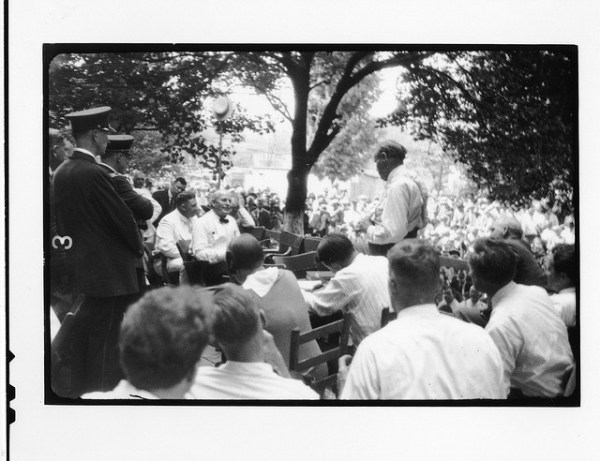
What would the original Bryan say about all this?  The college, after all, was founded as a memorial to Bryan’s last decade of work defending the centrality of Biblical wisdom in American life and politics.  As I argued in my 1920s book, though, Bryan himself held some beliefs about both the beginnings and the end of time that have made other conservative evangelical Protestants uncomfortable.  Bryan did not believe in a young earth, nor in a literal six-day creation.  Nor did Bryan think Jesus had to come back before the earth experienced its promised thousand-year reign of peace and justice.

Bryan Gets Grilled by Darrow at the Scopes Trial

Bryan Gets Grilled by Darrow at the Scopes Trial

Other historians, too, have noted Bryan’s complicated relationship with the fundamentalist movement in its first decade, the 1920s.  Lawrence Levine’s Defender of the Faith and, more recently, Michael Kazin’s A Godly Hero both get into the gritty details of Bryan’s anti-evolution crusade.

Historians might disagree, but we all will get nervous about trying to predict what Bryan would say about today’s dust-up at Bryan College.  Because Bryan’s ideology and theology remain necessarily part of his life between 1915 and 1925.  It is mostly meaningless to ask what he would say today, because the situation today is so wildly different from what it was back then.

For example, when Bryan led his anti-evolution movement in the 1920s, the scientific jury was still out on the mechanism of evolution.  Darwin’s explanation—modified descent through natural selection—had been roundly criticized and nearly dismissed by the mainstream scientific community.  So when Bryan led the charge against the teaching of evolution, he could claim with scientific legitimacy that natural selection was not established scientifically.  It was not until years after Bryan’s death that biologists and geneticists such as Theodosius Dobzhansky, Ernst Mayr, R.A. Fisher, J.B.S. Haldane, Sewall Wright, and others solved the problem of genetic “swamping” that seemed to make Darwin’s idea of natural selection a non-starter.

I’ve spent my time with Bryan’s papers at the Library of Congress.  I like Bryan.  He was a successful politician, but I don’t hold that against him.  I believe he was also sincere and devoted to justice.  I came to believe that Bryan was profoundly shocked and surprised when he could not produce his dream team of scientific experts at the Scopes Trial to put evolutionary scientists in their place.

Of course, Bryan died just a few days after the trial.  I can’t help but wonder how he might have “evolved” in his thinking if he had lived.  Would his experience at the Scopes Trial have caused him to re-think his confidence that evolutionary science would soon be disproven?  And, more intriguing, how would Bryan have responded if he had lived for an even longer stretch?  An Old-Testament sort of lifespan?

Would Bryan have embraced the “new evangelicalism” of Carl Henry and Billy Graham?  Would he have worked to make sure Biblical religion remained in conversation with mainstream American culture and politics?

I can’t help but think that he would.  I agree with Bryan’s great-grandson Kent Owen, who told reporter Kevin Hardy, “My view of Bryan is that things weren’t set in stone. . . .  He was pragmatic.”

What does this mean for today’s leadership at Bryan College?  On one hand, they are continuing the legacy of their school.  Bryan College was never bound too tightly to the thinking of the original William Jennings Bryan.  From its outset, Bryan College took a firmer, more “fundamentalist” position than Bryan himself ever did.  But on the other hand, the insistence of today’s leadership that Bryan College faculty sign on to a specific understanding of the historicity of Adam & Eve does not sound like something the Great Commoner would have supported.  As long as the principle of respect and reverence for the Bible was maintained, the original Bryan thought, people of good will could disagree on the details.

Is This Child Abuse?

Is it a crime to keep young people isolated from the wider community?  To teach them nothing that will allow them to thrive as independent adults?

From Frimet Goldberger in the Jewish Daily Forward we hear accusations that Hasidic communities in Ontario perpetrate educational crimes on their own children.  She shared a disturbing video in which a journalist asked young men basic questions.  Do you know the name of the Prime Minister?  The names of Canadian provinces?  Do you know anything about Canadian history?  The parts of the body?

The students, all apparently members of the Lev Tahor community—a group of about 40 families—did not seem to understand much about what they were being asked.  Most of the difficulty seemed related to their lack of English language skills.  But the boys did not seem able to answer in Hebrew, either.  One student, for example, asked to explain what he had learned about biology, explained haltingly that it is not healthy to jump too much right after eating.

The Lev Tahor community faces more serious challenges, too.  Some of the members are on the run from Canadian police, facing charges of child neglect and abuse.  Goldberger asks the question we want to hear: Does failing to teach children English or French count as abuse?  As Goldberger puts it, “These boys are lacking the basic language tools to take one step out of the community, to communicate with anyone outside their community.”

The United States has long wrestled with these questions, too.  Most notably, the US Supreme Court ruled unanimously in 1971’s Wisconsin v. Yoder that dissenting parents had the right to remove their children from public school.  These days, accusations of abuse in the growing homeschooling community have prompted calls for more government oversight.

Does a dissenting community have the right to restrict their children’s future?  If so, how can the wider society make any claims to regulate religious schooling?  And if not, who gets to decide what knowledge (or lack of knowledge) constitutes a limit?  Is young-earth creationism a limit on children’s futures?  Is a belief in faith healing?