Will protests and activism follow? Will risk-averse administrators at major college programs decide that a game against Liberty is not worth the trouble? Will elite black high school athletes decide they don’t want to play for Trump University?
Should teachers exhort their students to vote for a particular candidate? No. Do teachers have the right to discuss controversial political issues in their classroom, without being forced to present opposing views? Of course they do– imagine a class a teacher must explain how Nazis and slave owners had valid points of their own.
Professor Putz got me wondering: How often has football—not just sports in general, but specifically football—thrown evangelical colleges into a tizzy? Turns out, it’s more common than you might think. The allure of all the trappings of college life has always been a challenge for evangelicals, especially back in the early decades of the fundamentalist movement.
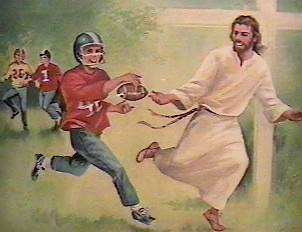
…to the ten…to the five…JESUS CHRIST with the TOUCHDOWN!!!!!
As Professor Putz pointed out, Liberty University has always slavered for the kind of prestige that comes with football victories. The Falwells have built their dreams around the successes of other religious schools such as Brigham Young University and Notre Dame.
And, as Prof. Putz notes, Liberty may be in for more than it bargained for. At BYU, for example, sports has been the lever that LGBTQ and anti-racist activists have used to apply pressure to the LDS church as a whole.
As I found out in the research for Fundamentalist U, it was ever thus. Back in the 1920s when the fundamentalist movement was born, some of its new flagship colleges found out how hard it was to have a football program.
At Des Moines University, for example, the hard-to-love fundamentalist leaders Edith Rebman and T.T. Shields found they could control a lot of things, but not the gridiron. First of all, when they played rival schools, the fans mocked DMU’s fundamentalist fervor by chanting “Darwin! Darwin! Darwin!” And even though the new administrators fired all the science faculty, they retained their football coach, even though the coach publicly expressed a cynical attitude toward evangelical religion. When reporters asked the coach if he had been converted, “born again,” the coach sneered, “Yeah, lots of times.” To critics, the lesson was obvious: A hypocritical fundamentalist administration could do without its science faculty, but it had to keep its football coach.
In Florida, too, the fledgling Bob Jones College struggled to figure out the football dilemma. In its first years, the fundamentalist school fielded a squad, the Swamp Angels. However, they wouldn’t allow the team to travel, worried about the moral influence other campuses might have on the players. In 1931, Bob Jones Sr. canceled the athletic program, purportedly after finding whiskey bottles on campus after a big game. Critics charged that Jones was more nervous about having to meet league rules than about the moral problems of football fans.
Up in Illinois, the first outside-fundamentalist president of Wheaton College also ran into trouble with the football program. J. Oliver Buswell became unpopular for sparring with football coach Fred Walker. Walker had apparently used foul language with the players, but Buswell resisted firing him. Eventually, Buswell agreed to fire the coach, but the trustees switched their position and decided Buswell had to go instead.
For almost a century, then, football has provided yet another challenge to evangelical college leaders. Without it, their schools might seem inauthentic. Students, parents, and alumni all want to have winning teams to cheer for. But including football has always meant including a wild card. It has meant giving some measure of administrative power away to a coach. It has meant going by league rules, instead of listening only to the dictates of authoritarian school leaders. Most of all, it has meant that fundamentalist schools had to breach their carefully constructed defensive wall against the outside world.
Is it worth it? Time and time again, evangelical college leaders have leaped into the football scrum, only to emerge bruised and battered. As Prof. Putz points out, Liberty U is only the latest of a long string of evangelical hopefuls. What will big-time football mean for Jerry Falwell Jr.?
Here’s what we know: Greene describes a recent bill in Arizona to limit teachers’ ability to talk politics in the classroom. The bill would combat teachers’ alleged aggressive political posturing. What would it do?
Teachers may not endorse, support or oppose any candidate or elected or appointed official. Teachers may not bring up any “controversial issues” not related to the course. . . . Teachers may not advocate for one side of a controversial issue; they must always present both sides.
Greene argues that this bill is not just an Arizona quirk but rather part of a vision to restrain teachers from voicing progressive opinions.
And it won’t come as any surprise to SAGLRROILYBYGTH that the fear of progressive teachers has a long history in the US of A.
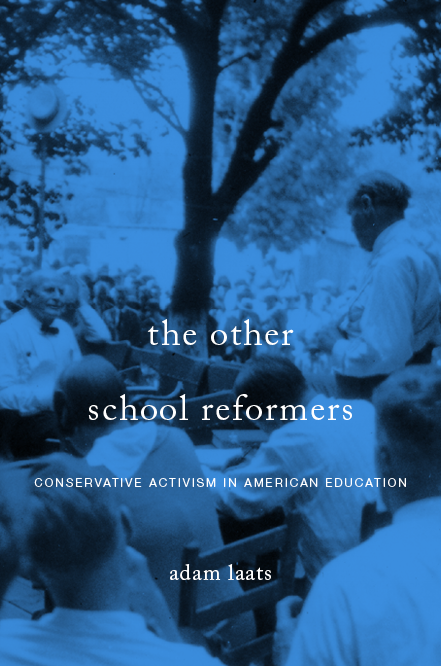
Back in the 1930s and 1940s, for example, Harold Rugg of Teachers College Columbia earned the ire of many conservative activists with his progressive textbooks. It wasn’t only Rugg that conservatives worried about. As I noted in my book about conservative educational activism, people like Alfred Falk of the Advertising Federation of America and Homer Chaillaux of the American Legion warned one another that the problem was bigger than any single teacher or textbook. Rather, as Falk told Chaillaux privately in 1939, it was all part of a vast left-wing teacher conspiracy,
a deliberate plan worked up by a well-defined group of left-wingers and educators, collaborating for a number of years on this huge project of reconstructing our society.
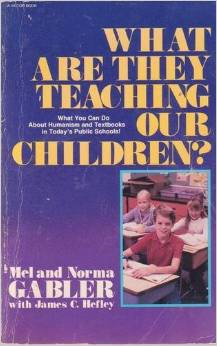
In the 1960s, too, conservative activists assumed that teachers were part of a progressive plan to use their classroom authority to push left-wing ideas on unsuspecting youth. The Gablers asked their fellow conservatives some pointed questions about the proper role of teachers. As they put it,
Do educators have the right to use our children as guinea pigs in behavior modification experiments? Should our children be under the direction of ideologues hostile to Judeo-Christian values and American constitutional liberty?
Look out kids, it’s a…teacher!
For many conservatives, the notion that teachers are “ideologues” cramming Leninist doctrine down the throats of America’s schoolchildren is a hallowed truth. But why? Why do so many conservatives worry so unnecessarily about teachers’ political activism?
After all, ask any teacher, and they’ll tell you: We worry about far more prosaic issues in our classrooms. We worry if students are learning the material, and if there’s a better way we could present it. We worry that students aren’t understanding things, and if there’s something we could be doing to help.
We worry mostly about our students as people, not as partisans.
Moreover, as every study has shown, teachers do not swoop in from outside to cram politics down students’ throats. For example, as political scientists Michael Berkman and Eric Plutzer found, when it comes to teaching evolution and creationism, most teachers reflect the majority values of their communities, because most teachers are products of that same community.
Here it is at last: ILYBYDDTR, Christmas Steve edition! If you need a little extra ed stuff to read over the holidays, here are a few of the stories that caught our attention this week:
Success stories suggest that, even among the poor children of color who face pervasive societal burdens, the truly deserving can prevail in the end. When inequality is defeatable, it stops feeling so much like injustice.
It was a very depressing story. When the New York Times broke the ugly truth about Louisiana’s T.M. Landry school, the real question was why so many people believed the lies of the school’s leaders. Today, Will Stancil connects the dots. And as I’m arguing in my new book, this scam is no exception; it is the oldest story in the checkered history of American school reform.
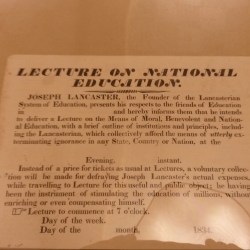
Magic-bean level school reform, c. 1834.
You’ve heard the story by now. T.M. Landry College Preparatory School in small-town Louisiana seemed to have found the magic recipe. Its viral videos told the heart-warming stories of low-income African American students who beat the odds and went to elite universities such as Harvard and Princeton.
In reality, the school falsified transcripts, made up student accomplishments and mined the worst stereotypes of black America to manufacture up-from-hardship tales that it sold to Ivy League schools hungry for diversity. The Landrys also fostered a culture of fear with physical and emotional abuse, students and teachers said.Students were forced to kneel on rice, rocks and hot pavement, and were choked, yelled at and berated.
We make a mistake if we just shake our heads and lament the gruesome conditions of this single scam school. The real problem is much deeper. Given the remarkable claims of the school’s leaders, Will Stancil asked recently, why did so many of us believe them for so long? As he puts it, all of us need to take a hard look at ourselves. Americans treasured the unbelievable success stories coming out of T.M. Landry, Stancil writes,
because it offered something that a lot of people wanted to believe. Their viral videos told a story of black children magically beating the odds. . . . people took solace in the idea that such a transformation was possible, and moved on.
Other commentators have made similar points. As Casey Gerald noted recently,
When we highlight those few against-all-odds stories, we send the message that all it takes to succeed is grit and resilience and willpower.
For those who hope that the right school reform can offer a quick and easy fix to social inequality, the reality gets even worse. As I’m finding in the research for my current book, America’s head-in-the-sand addiction to Horatio Alger stories has always been a problem.
Two hundred years ago, Joseph Lancaster promised America’s elites a T.M. Landry-style solution to their burgeoning urban anxieties. As one industrial leader fretted in 1817, new cities and factories threatened to become
disgusting exhibitions of human depravity and wretchedness.
If they had the right schools, however, all could be well. As this industrialist explained, with only a small financial investment, American cities could install Lancasterian schools,
where good instruction will secure the morals of the young, and good regulations will promote, in all, order, cleanliness, and the exercise of the civil duties.
Just like T.M. Landry in 2018, back in 1817 these promises were obviously too good to be true. Yet, as one commentator described at the time,
The extent of the delusion . . . was so widely and so energetically advocated that thousands of intelligent men believed that a final and immediate remedy had been found for the evils of popular ignorance and that the era of universal intelligence had begun.
Things didn’t end any better for the students in Lancaster’s schools than they did for T.M. Landry’s. In a few years, parents, children, teachers, and eventually elite reformers realized that the promises of these school reforms couldn’t match the challenges of social inequality. Lancaster was exposed as a fraud. School leaders noted with chagrin that their miracle schools were not miracles at all. At the end of his rope, in 1838 Joseph Lancaster stepped out in front of a rushing horse carriage in New York and ended his life.
These scams and cons work because we want them to be true. We want to believe that society is fundamentally fair. We want to think that with a little gumption, a little “grit,” everyone can make it. What we don’t want to admit is the ugly truth: America has always been unequal. Some people are freer than others. Some live in a land of opportunity, but many don’t.
As Will Stancil makes so painfully clear, our addiction to these sorts of fairy tales allow scammers to get us to believe the unbelievable. Americans like to hear about low-income African-American students “beating the odds,” because we can’t figure out how to make those brutal odds more equitable.
And as I’m finding out in my current research, it is America’s oldest educational fantasy. We need to reckon instead with the sobering truth: Schools can’t save society; schools ARE society. Unless and until society itself gives everyone a fair chance at success, schools won’t be able to.
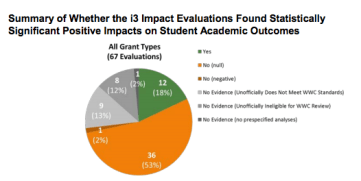
Why is it so difficult to find out if school reforms are working? Journalists tell us that big investments often don’t lead to big results. Why not? The real “dirty secret” of ed reform isn’t the difficulty involved. It is that reformers tend to fall into the Keto-diet trap. Instead of promoting things that work, they scramble for headline-grabbing new labels and gimmicks. Then they are forced to use skewed ways to measure their own success.
What works? We need less flash and more uncomfortable conversations
The researcher charged with measuring the success of this school reform investment explained,
That’s the dirty secret of all of education research. . . . It is really hard to change student achievement. We have rarely been able to do it. It’s harder than anybody thinks.
As she lamented,
We are desperate to find what works.
Except we’re not. Not really. We KNOW what works to improve schools and educational outcomes. Schools work better when they are connected to healthy communities. Schools work better when families and students have abundant resources, including flexible work schedules and access to community resources.
The problem is that those things are more difficult to talk about. As I’m arguing in my new book, it has always been easier to slap flashy “innovations” on schools for low-income kids than it has been to address the topics of inequality and poverty in the USA.
What does this have to do with Keto dieting? Just this: Like healthy eating, healthy schools are not really all that mysterious. They require investments of time and resources. They need involved teachers, families, students, neighbors, and administrators. They need to be connected to their communities and in touch with the dreams and backgrounds of their families and students.
Let’s be real: No one buys books titled, “Good Food Is Good for You.”
It’s not a mysterious recipe, but it is a difficult one to pitch to grant programs. Instead, like the Keto diet, reformers are forced to create new names and new programs that highlight their “innovations.” Like the Keto diet, they are forced to focus—to an obviously unhealthy degree—on short-term, quantifiable outcomes.
What would be better? How about measuring education reforms by something other than student test scores? Why not survey families to see how happy they are in their schools? Why not hire trained researchers to gather qualitative data about a fuller range of improvements in students’ lives?
Like the authors of fad-diet books, too many grant funders are tied to flashy headlines and quick-but-fake improvements. What we need instead is a willingness to focus on the non-flashy things that we know will work.
The jingle bells are getting louder, but we are still hard at work here in the offices of ILYBYGTH International, scouring the interwebs for stories of interest. Here are a few:
For decades, women and children have faced rampant sexual abuse while worshiping at independent fundamental Baptist churches around the country. The network of churches and schools has often covered up the crimes and helped relocate the offenders, an eight-month Star-Telegram investigation has found. More than 200 people — current or former church members, across generations — shared their stories of rape, assault, humiliation and fear in churches where male leadership cannot be questioned.
Among the up-is-down, night-is-day practices of the Trump administration, one of the most dangerous and disturbing is its habit of turning America’s leading science agencies into hives of anti-science policymaking.
“The moral burden of history requires a more direct and far more candid acknowledgment of the legacy of this school in the horrifying realities of American slavery, Jim Crow segregation, racism, and even the avowal of white racial supremacy,” wrote R. Albert Mohler Jr., the president of the seminary, which is now in Louisville, Ky.
Is college right for everyone? Of course not. But a recent commentary in the New York Times ignores the biggest historical elephant in the room when it comes to vocational education.
…it’s not like this book is hard to find.
The Manhattan Institute’s Oren Cass argues that spending all our public-school dollars on college prep has turned public ed into
one of our nation’s most regressive institutions.
And Cass makes a good case, as far as he goes. Not everyone needs college. And college is super expensive. Why don’t we invest more in alternative educational pathways that benefit students? As he argues,
For the roughly $100,000 that the public spends to carry many students through high school and college today, we could offer instead two years of traditional high school, a third year that splits time between a sophisticated vocational program and a subsidized internship, two more years split between subsidized work and employer-sponsored training, and a savings account with $25,000, perhaps for future training. Any American could have, at age 20, three years of work experience, an industry credential and earnings in the bank.
Sounds good, right?
The problem is so obvious that I can’t help but wonder why Cass doesn’t mention it. The history of vocational education has always pointed in the same direction. In spite of the best intentions, “voke” has always been used as a holding pen for less affluent, less white students.
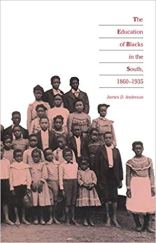
Perhaps the strongest demonstration of this case was made by Professor James D. Anderson in his classic book The Education of Blacks in the South, 1860-1935. Time after time, Anderson found, even philanthropists who arguably wanted the best for African-American students shunted them off to manual training instead of academic education.
Students and parents clamored for academic education, partly as a path to the highest-paid and most-prestigious professional careers and partly as a recognition of their intellectual and political equality. Vocational training was always offered instead.
Voke advocates insisted that they wanted only the best for students. They insisted, a la Cass, that they were being practical, that not everyone needed or wanted a collegiate education. And they always pleaded that their schemes were what students and families really wanted. Or should have wanted.
So what’s wrong with vocational education? In theory, nothing. In real life, everything. As Cass concludes about the decision to go voke,
Certainly, the choice should remain theirs.
That is, parents and students should only pick the voke track if they really want to. In practice, though, only families with financial resources are given any real choice. In practice, whiter, richer students have always had choices. Poorer, blacker students never have.
I may disagree with what you say, but I’ll defend to the death my ability not to hear it…
As I’m arguing in my new book, the usual explanations just don’t hold water. The Richard Dawkinses of the world tend to think of creationism—at least the radical young-earth kind—as a kind of simple deficit. As Dawkins famously opined in 1989, creationists would have to be
ignorant, stupid or insane (or wicked, but I’d rather not consider that).
For those of us who understand the history and nature of America’s radical young-earth creationists, Dawkins’ dismissal doesn’t fit the evidence. Even if we are staunchly anti-creationist, if we’re paying attention we can’t help but notice that plenty of creationists know a lot about evolutionary theory. They are clearly intelligent and in possession of their mental faculties. And they might be wicked, that doesn’t seem to be a primary factor in their creationism.
Why? Hugo Mercier and Dan Sperber argue that human reason is not the engine of pure enlightenment it is often considered. Instead, reasoning evolved as a way to encourage group cooperation. In their words,
What reason does . . . is help us justify our beliefs and actions to others . . . and evaluate the justifications and arguments that others address to us.
What does this have to do with the durability of radical young-earth creationism? In spite of the accusations of angry Oxonians like Richard Dawkins, creationists have not abandoned their ability to reason and weigh evidence. Rather, if these cognitive psychologists are correct, human reasoning ability will tend to lead to greater in-group cohesion.
The brains of radical creationists tend to favor evidence that supports the dominant views of their group. They tend to dismiss evidence and arguments that go against them. This isn’t something unique to creationists. All our brains work in similar fashion. We don’t weigh facts evenly or dispassionately. We don’t even hear them that way. Rather, our brains seem hard-wired to accept facts that help us fit in with our groups.
In short, why are so many Americans creationists? Because they evolved that way.
How? How? How? That’s the question we’ve been asking for the past few years: How is it possible that four out of five white evangelical voters support President Trump? After all, love him or hate him, it is fair to say that Trump is not well known for his clarity of moral purpose. A new CNN poll suggests the obvious answer.
Red Votes
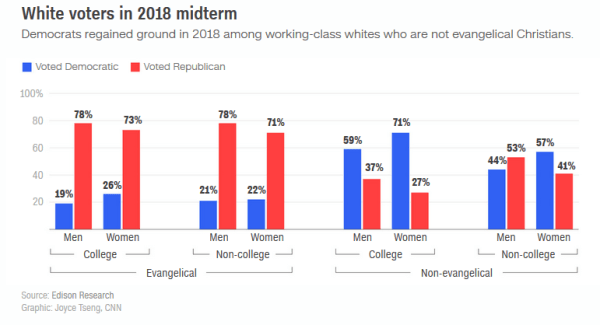
Here’s what we know: CNN’s poll sliced and diced some numbers to offer a few suggestions. It surveyed voters in the recent mid-term elections and found that white people who call themselves “evangelical” or “born-again” voted Republican in huge numbers.
As they found,
At least 77% of white evangelicals without a college degree voted against the Democratic Senate candidates in Florida, Missouri and Tennessee, while 72% opposed defeated Democratic incumbent Joe Donnelly in Indiana, the exit polls found. In the Georgia governor’s race, a breathtaking 89% of non-college white evangelicals voted for Republican Brian Kemp over African-American Democrat Stacey Abrams; 84% of those voters picked Ted Cruz over O’Rourke in Texas. Only Democratic Sen. Joe Manchin in West Virginia ran competitively, losing those voters by a narrow 52% to 46% margin.
The numbers weren’t much different for white evangelicals who had been to college. As CNN put it,
Nationally, Republicans again won almost exactly three-fourths of them in the House races, with relatively small differences between the men and the women. Results on that group were not available in as many states, because they comprised a smaller share of the total vote, but Republicans carried about 70% of them in the Tennessee, Indiana and Missouri Senate races; in Georgia, 83% of college-educated white evangelicals voted for Kemp.
It’s tempting to conclude that white evangelicals voted Republican with large majorities. If we really want to understand these polls, though, we need to add an important qualifier. These polls don’t actually tell us how white evangelical Christians voted. Rather, they suggest only that white people who call themselves evangelical do so.
CNN writes that those younger voters are “the most likely to leave the faith,” but that’s not a fair conclusion. After all, CNN’s poll didn’t find out anything about respondents’ faith. Rather, it only asked them one question: “Would you describe yourself as a born-again or evangelical Christian?”
These days, people who answer “yes” to that question likely connect those labels to a set of political beliefs. They are choosing to identify with a label that has come to imply political conservatism, not just a certain cluster of religious beliefs.
In short, this poll helps dramatize the trend among American evangelicals. Instead of the word “evangelical” meaning primarily a set of religious ideas and theological commitments, it has become a political and culture-war marker. If you call yourself an “evangelical” these days, it usually means you think of yourself as white, Christian, and politically conservative.
So it’s no surprise that big majorities of people who call themselves evangelical voted Republican. Choosing to call yourself an evangelical these days usually means endorsing a set of conservative political beliefs associated these days with the Republican Party.
What do evangelical Christians think about Trump and the GOP? This poll doesn’t tell us. To be an “evangelical Christian” can mean a whole bunch of different things. There are lots of non-white people who have religious beliefs that have historically been associated with evangelical Protestantism. There are white liberals who no longer call themselves evangelical but who retain their evangelical religious beliefs.
What this poll does tell us is that the word “evangelical” has come to imply a set of political beliefs, not only religious ones. People who embrace the label tend to embrace those politics. Are they still religious? Sure. But we make a mistake if we try to understand how someone with evangelical religious beliefs could support politicians who seem to go against those beliefs. Calling yourself “evangelical” these days is more about those political leanings than any specific religious commitments or theological ideas.







 I Love You but You're Going to Hell