What Does Education Look Like from 1600 Penn. Ave?

It doesn’t mean much, but Trump’s official statement for “Education Week” tells us a little more about the hopes and dreams of America’s conservative education activists. It also includes one stumper.
OLYMPUS DIGITAL CAMERA

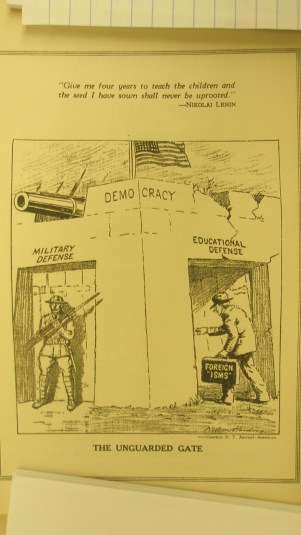
The roots of “Education Week,” c. 1941

First, a little background on “Education Week.” As I found out in the research for my book about educational conservatism, Education Week started roughly a century ago as an effort to bring conservatives and progressives together for a whole-community focus on public schools.

The leading players were the American Legion for the conservative side and the National Education Association for the progressives. The Legion hoped to use Education Week to fight socialist subversion in America’s public schools. They hoped the week would give a much-needed shot of patriotism and community oversight to possibly subversive teachers.

These days, Education Week mostly passes unnoticed by everyone. In line with tradition, however, President Trump issued a formal proclamation in support of it. Predictably, he hit a few notes calculated to warm the hearts of conservatives.

First, he included conservative educational dog-whistle #1:

Parents are a child’s first teacher.

At least since the 1920s, conservative activists have looked askance at the role of the teacher and school in forming children’s characters. Harping on the leading role of parents has long served as a promise to respect conservatives’ vision of proper education. As I argued in the pages of Newsweek, though, it’s not always as simple as people tend to think.
americanism address

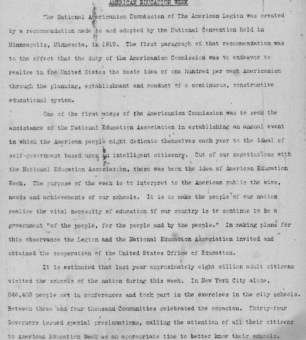
The plan, c. 1934

Second, he used the c-word a lot. As Trump proclaimed,

We are also protecting and expanding parents’ access to a wide range of high-quality educational choices, including effective public, charter, magnet, private, parochial, online, and homeschool options.

Next, Trump’s proclamation noted that the primary goal of school should be to prepare students for employment. In the words of the proclamation,

My Administration is committed to ensuring that America’s students and workers have access to education and job training that will equip them to compete and win in the global economy.

As SAGLRROILYBYGTH recall, Trump made headlines last summer with a proposal to roll together the Departments of Education and Labor into a giant “workforce” department. It hasn’t always been the dream of conservatives to abolish the federal role in public education (see this Time article for my longer explanation of the history) but since the 1940s it has been a reliable conservative vote-getter.

So far, so good. Trump’s proclamation hit the notes calculated to encourage conservative education activists. But what about his oddball third paragraph? Here it is in all its glory:

Each student is unique, with their own distinct experiences, needs, learning styles, and dreams.  Thus, education must be customized and individualized as there is no single approach to education that works for every student.  My Administration encourages parents, guardians, educators, and school leaders to rethink the way students learn in America to ensure that every American receives a high-quality education that meets their needs.  We empower teachers to create learning environments that are challenging, relevant, and engaging.  When families are free to choose where and how their children learn, and when teachers are free to do their best work, students are able to grow and explore their talents and passions.

On the face of it, this paragraph seems to be balancing the ideological teeter-totter a little bit. Trump seems to be speaking to the progressive crowd, calling for student individualization and teacher empowerment.

How are we supposed to take it?

When I channel my inner curmudgucrat, this paragraph sounds like just another use of phony “personalized” buzzwords to sneakily privatize public education. Or if I remember the lessons of Larry Cuban and David Tyack, it might sound like a bureaucratic recognition of the eternally conflicted goals of public education.

Or maybe, just maybe, the proclamation simply doesn’t deserve this much parsing. Maybe it is merely the product of a group of Trump-bots who wanted to say something without saying anything.

I would love it if someone could explain it to me.
I Love You but You Didn’t Do the Reading

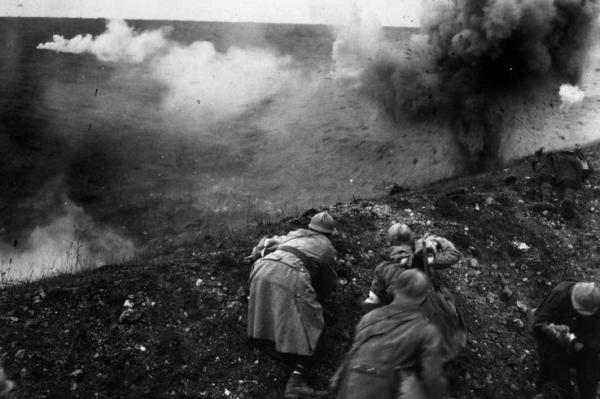
Armistice Day, a century later. Subterranean rivers of ecstasy and violence, a generation later. This week saw a lot of remembrance and few new shockers:

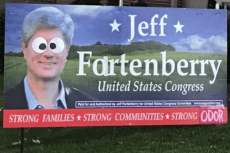
Fart jokes land a professor in hot water at CHE.

fartenberry CHE

Ha ha ha…you’re fired.

How many people go to Ark Encounter? Parsing the attendance numbers at FA.

We’ve been here before: Andrew Bacevich’s lessons from the Sixties at AC.

Once more the subterranean river has unleashed the forces of ecstasy and violence. . . . And as in 1968, little evidence exists to suggest that the nation’s political class has the capacity to comprehend what is occurring, much less the wit and courage needed to address the problem. . . . [Yet] the center will ultimately hold. The market for ecstasy and violence will once more prove to be limited and transitory.

When is personalized learning not? Peter Greene at Forbes.

Young evangelicals and politics at NYT.

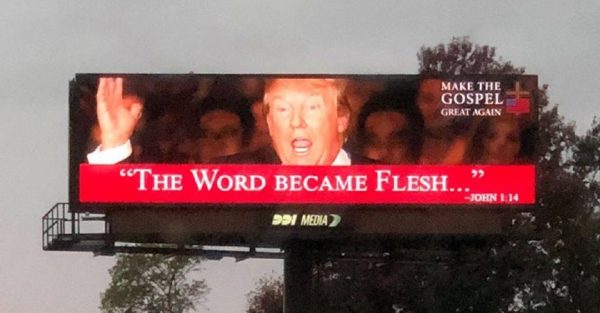
…gulp. Is this billboard real? At Snopes.

trump christ

…really?

Wisconsin university spends $5,000 to bring porn star to campus, at JS. HT: MM

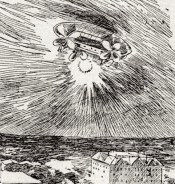
UFOs, 19th-century style. The Great Airship Delusion at RCP.

great airship delusion

It’s a bird, it’s a plane…

Trump bans CNN reporter from White House, at CNN.

Why don’t people put their money where their kids are? At TIASL.

From “no excuses” to “restorative justice” at some KIPP schools. Chalkbeat.

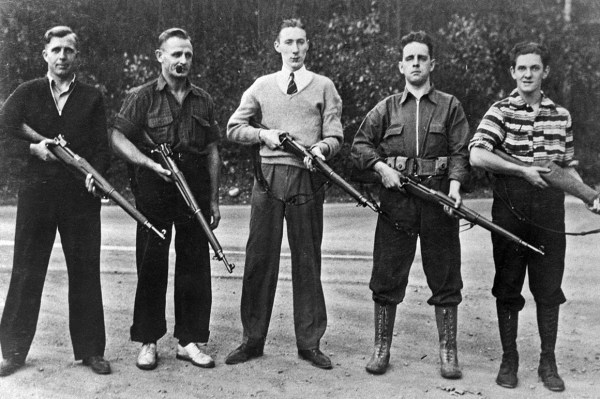
It DID happen here: The history of American pogroms at Politico.

Christian Front

Christian Fronters, c. 1940

Teacher strikes move north: Anchorage teachers walk out of school-board meeting. At ADN.

Is Bucky back? Gov. Walker’s ouster in Wisconsin provides glimmer of hope to UWisconsin, at CHE.

Armistice Day recollections:

Fundamentalism’s Retreating American Horizon

It’s not about Darwin. It’s not even about Jesus. We see again this morning that radical young-earth creationism—at least Ken Ham’s Answers In Genesis brand—is built on a vision of American history in which fundamentalists are always under more and more attack.ken ham on the moon

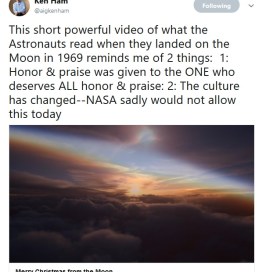
Here’s what we know: This morning Ham tweeted a nostalgic video about Apollo 8. On that mission, astronauts circled the moon for the first time on Christmas Eve, 1968. In a live broadcast, astronauts read the opening verses from Genesis.

We can ignore the obvious stuff, like the fact that Ken Ham misdescribed this 1968 moon circling as the 1969 moon landing. We’re more interested this morning in Ham’s take-away from the video itself. What lesson did Ham draw?

2: The culture has changed–NASA sadly would not allow this today

Of course, as historians and SAGLRROILYBYGTH are well aware, back in the 1960s, Ham’s predecessors were articulating very similar laments about the dangerous trends in American culture. In early 1963, for example, Samuel Sutherland of the Bible Institute of Los Angeles (BIOLA) warned of the dangerous effects of the recent SCOTUS ruling against Bible-reading and teacher-led prayer in public schools.

What would happen now? Sutherland warned the SCOTUS decision might

Make our country an atheistic nation, no whit better than God-denying, God-defying Russia herself. . . . in prohibiting the name of God to be used in any form of prayer, [SCOTUS] are in effect advocating that the children be taught atheism.

Sutherland wasn’t alone in warning that 1960s America had gone to the atheist dogs. In 1965, for example, in the pages of Carl McIntire’s Christian Beacon magazine, one writer warned that the banishment of teacher-led Christian devotions from public schools

will mean the division even more sharply of this nation into communities of the secular and the Church, which will inevitably lead to more expression of the secular and more repression of the Christian. When this happens, repression, restriction, harassment, and then outright persecution will be the natural course to follow in secular opposition to Christian witness.

In the glorious 1960s, then, Ken Ham’s predecessors were making the same kinds of warnings that Ham is making today: Things used to be better for conservative evangelical Protestants. Public schools and public policy used to speak in the tones of evangelicalism.

Over and over again, across the decades, fundamentalist Cassandras have articulated a similar historical vision. The past was always better. The present–no matter what year–is characterized by a bitter sense of loss, by a grief for a glorious Christian past stripped away by scheming secularists and soft-minded false Christians.

It doesn’t have much to do with actual creationism, of course, or with evolutionary science. But this relentless alarmist nostalgia does a lot to help us understand why some evangelicals yearn to Make America Great Again.

If It’s Been Worse, Will It Get Better?

It’s not all that comforting, really. But as historians and old people with good memories know, today’s violent political climate is depressingly not new. With synagogue shootings and Trump-fueled mail bombings, it’s hard not to panic. Yet Andrew Bacevich thinks there is some grounds for wary optimism. Should we agree?

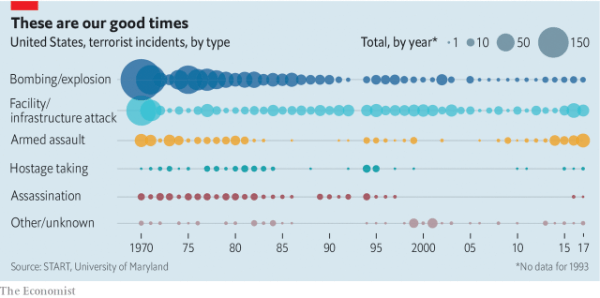
We don’t need to go all the way back to the earliest days of our nation when rebels took up arms against the fledgling federal government. We don’t even need to go back to the ugliest days of American political history, when a US Congressman beat a US Senator into a coma on the floor of the US Senate. No, we only need to remember events in our lifetimes (for those of us of a certain age). In the 1970s, political bombings were a regular feature of American life.

economis political violence

Comforting? …or terrifying?

Whatever your political beliefs, there’s no doubt that the left-wing violence of the groups such as the Weather Underground in the 1970s threatened the fabric of American civil life. As Bacevich points out, back then the left succumbed to a despairing, violent “nihilism.” The Weather Underground issued a call to

Amerika’s youth to use our strategic position behind enemy lines to join forces in the destruction of the empire.

doern

Public Enemy #1

They tried, but they failed. And Bacevich hopes today’s alt-right will sputter as well. As he puts it,

The ebb and flow of events in the 1960s should give us confidence that the center will ultimately hold. The market for ecstasy and violence will once more prove to be limited and transitory. Today’s alt-right is no more likely to win the support of ordinary Americans than did the Weather Underground during the infamous Days of Rage.

I’d like to agree, but I admit I’m skeptical. I get nervous when I see our President ejecting journalists from the White House on trumped-up accusations. I get nervous when elections return avowed neo-Confederates to office—in Iowa of all places.

What do you think? Do you share Bacevich’s cautious optimism? Or do you think that Norman Mailer’s ‘“subterranean river of untapped, ferocious, lonely and romantic desires,” expressing the “concentration of ecstasy and violence which is the dream life of the nation”’ will overwhelm its banks one time too many?

Heresy and the Death of the Sniff Test

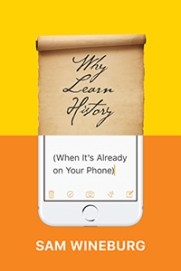
It can’t be real. That was my first impression when I saw pix of the blasphemous billboard circulating around the interwebs. It just looked too hokey and too perfectly outrageous. But, as Sam Wineburg is telling us, we need to be asking different questions these days. Our old-fashioned sniff tests are way out of date. What’s worse, even Wineburg’s hopeful prescription can’t help us with some problems. Namely, as with this billboard, political realities have gotten so bizarre I’m losing hope that any of us will have much luck discerning the true from the troll.

trump christ

This can’t possibly be real…can it?

It looks so perfectly anti-Christian that I was sure it had to be a spoof. And spoof it may be, but at the very least it seems to be a real billboard. According to Snopes,

The billboard is undoubtedly real, though it is not yet clear who paid for it and when it was erected. A spokesperson for DDI Media, the St. Louis company which owns the billboard itself, told us they could not share such information.

As SAGLRROILYBYGTH know, I personally don’t care about heresy, but I am absolutely flummoxed that any self-identified Christian would equate the Donald with The Christ. The entire episode seems like more proof of Sam Wineburg’s new argument. We can no longer trust our sense of what “looks” and “feels” real and legitimate. It’s just too easy to fake it.

Among other things, Professor Wineburg describes his study of internet readers. He asked ten academic historians to decide which group was more trustworthy based on their websites, the American College of Pediatricians and the American Academy of Pediatrics. One (ACP) is a legitimate professional organization of doctors. The other (AAP) is an anti-gay splinter group.

Turns out, these historians—all of them hyper-trained to read and decode complicated texts—weren’t very good at figuring out how to evaluate on-line legitimacy. As Wineburg writes,

Typically, the historians would size up a site within seconds.  Snap judgments were often based on a site’s “look” or its official-sounding name. . . . [one] chose the established American Academy of Pediatrics, not because of differences in the organizations’ stature or pedigrees (he never ventured beyond the two sites to learn about these organizations respective backgrounds), but because of the fonts on their webpages.

As Wineburg points out, evaluating online information based on these sorts of impressions is woefully out of date. Back in the wild 1990s, we used to be able to evaluate information based on the look of the website. Shoddy graphics, sketchy organizational details, and over-long web addresses were all easy give-aways.

These days, those markers are simply too easy to fix. A fly-by-night extremist organization can have a website that looks and feels legit.wineburg why learn history

Wineburg has hope. Students and the rest of us can learn better tools to detect online fraud and fakery. We can learn to read the web laterally instead of trusting any one website.

As this billboard episode shows us, though, perhaps we need to be more concerned than that. For me, the billboard appeared fake not only because it looked poorly made, but because its message was so outrageous. So, yes, I thought it was fake because it looked kind of blurry and because it didn’t include any information about its source. But I also thought it was fake because no Christian could possibly have intended to advertise such a blatantly blasphemous message.

Yet someone did. Clearly, the old fashioned sniff tests can’t help us anymore. Fake information can look real. Even worse, though, ideas that would have been too hateful to see bruited about in public spaces now seem common.

Fundamentalist U at HES

Maybe I should have taken a quantitative turn at Albuquerque! I was honored and delighted to have a group of top historians discuss Fundamentalist U at the recent History of Education Society meeting in sunny Albuquerque. They raised some tough questions and we had a great discussion about the need for a better historical understanding of evangelical higher education.

The panel was put together by Professor Andrea Turpin of Baylor University. She invited academic heavy-hitters AJ Angulo, Milton Gaither, and Katrina Sanders. The inestimable Jonathan Zimmerman served as our chair.

HES 2018

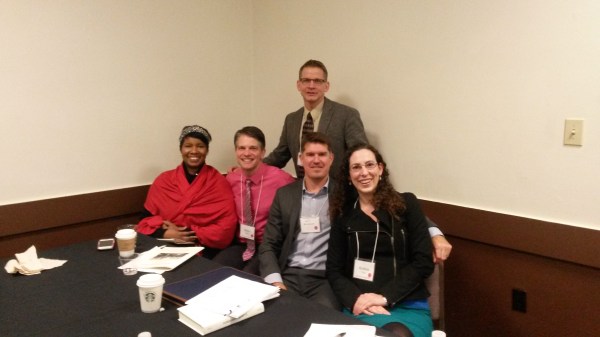
Professors Sanders, Gaither, Angulo, and Turpin. Yours truly in the back.

All of the panelists had nice things to say about the book, which was great to hear. But they also raised insightful questions. For example, why doesn’t the book include a clearer description of the numbers of institutions involved? It would have been fairly easy to do and it would have helped readers get a sense of the scope of the evangelical-college movement over time.

Also, the book claims to examine the history of evangelical higher education, but it leaves out large swathes of evangelical schools. Where are the Pentecostals? The Peace-Church schools? It’s a fair point and one I readily acknowledge. The focus of my book is on a subgroup of the evangelical tradition, schools that called themselves “fundamentalist” at some point in time.

We talked about the top-down focus of the book, too. Yes, I tried hard to include student experiences as much as possible, but the central theme of the book, as Professor Gaither pointed out, was

the narrow channel administrators had to navigate between the Scylla of angry fundamentalists watching their every move for signs of creeping secularization and the Charybdis of parents, students, and accreditation bodies who wanted to make sure that the education being provided was respectable.

Last but not least, we discussed the challenges of my sources. In some cases, I was only given access to small parts of archival collections. I wasn’t allowed at all into some archives, like at Bryan College. How did this curated set of papers influence my ability to draw fair conclusions?

All fair questions. And, as I particularly appreciate, questions that demonstrate a keen understanding of the book and my goals. Even given these limitations, I consider the book to be worthwhile. (To be clear, the panelists agreed on this point as well.)

First of all, for historians and others interested in American higher ed, we absolutely must include this family of institutions in our considerations. Too often, we hear pundits and policy-makers talk about the ideological draft of “American higher ed” in ways that seem willfully blind to the true diversity of the higher-ed landscape.

Second, though this wasn’t the focus of these educational historians, we will never understand religious bodies and religious identities if we don’t do a better job of studying affiliated educational institutions. As I argued in Fundamentalist U, too often observers and historians have assumed that we should understand fundamentalism and conservative evangelicalism on theological grounds. That’s useful, but it’s not enough. If we really hope to get a handle on what it has meant to be an evangelical, we need to see what evangelicals have done with their schools. And we need to ask why.

[Oh, and I also saw a roadrunner. I guess they’re like pigeons down there…]

HES 2018 roadrunner

meep meep.

I Love You but You Didn’t Do the Reading

Top ILYBYGTH-themed stories from the past week:

Wait…what? Can Trump eliminate birthright citizenship? HNN collected historians’ comments.

How have textbooks portrayed climate change? At TC.

It’s not college that frightens conservatives, it’s just the wrong type of college–a conservative plea for more evangelical colleges, at NR.

If anything, we should be sending more students to college — opening up further avenues of funding, both public and private, even as we pursue policies that might lower tuition or challenge the progressive domination of our campuses. Colleges will have to change, to be sure, but in the meantime conservatives would be wise not only to celebrate but to actively advance the interests of those institutions that are educating students properly right now.

Diversity training is good, says Eboo Patel at CHE. But why doesn’t it include religion?

What’s the deal with “messianic Judaism?” Neil J. Young describes the unique meanings at HuffPost.

When did evangelicals get involved in politics? Clyde Haberman tells the old myth about the 1970s at NYT.

The new digital divide, at NYT.

It could happen that the children of poorer and middle-class parents will be raised by screens, while the children of Silicon Valley’s elite will be going back to wooden toys and the luxury of human interaction.

Atheism in America: A review essay in the New Yorker.

The radical-creationist view on climate change: It’s not a shame, it’s not a crisis…it’s a sin, at AIG.

How many people really believe in a flat earth? NCSE’s Glenn Branch takes another whack at the poll numbers, at SA.

Class war or culture war? The divide in the Democratic Party, at Politico.

Ocasio-Cortez, the young Latina who proudly identifies as a democratic socialist, hadn’t been all but vaulted into Congress by the party’s diversity, or a blue-collar base looking to even the playing field. She won because she had galvanized the college-educated gentrifiers who are displacing those people. . . . Energized liberals, largely college-educated or beyond, have been voting in a new breed of activist Democrat—and voting out more established candidates with strong support among the party’s largely minority, immigrant, Hispanic, African-American and non-college-educated base.

Have schools become a “Constitution-free zone?” Interview with Justin Driver at Slate.

Academia as a cult at WaPo. HT: MM.

Where Progressivism Dies

Country-club Democrats are willing to make a lot of sacrifices. As David Freedlander reminds us, rich progressives have long been eager to pay for benefits for other people, such as cheaper college or higher minimum wages. When it comes to school, however, affluent progressives have always had a much harder time denying their own kids the vast privileges that come with rich-kids’ educations.

goslin-2

Goslin at work.

Progressive coalitions have always been held together loosely, and today’s Democratic Party is no exception. As Freedlander points out, most of the energy of the “Democratic Socialist” wing comes from the more educated, more affluent, whiter wing of the party. As Freedlander puts it,

Energized liberals, largely college-educated or beyond, have been voting in a new breed of activist Democrat—and voting out more established candidates with strong support among the party’s largely minority, immigrant, Hispanic, African-American and non-college-educated base.

When it comes to educational privilege, however, we see the coalition breaking down. Freedlander mentions

Upscale parents in Democratic neighborhoods whose liberalism vanishes when it comes to bringing in students from poorer neighborhoods (as on Manhattan’s Upper West Side) or pooling PTA funds between richer and poorer schools (as in Santa Monica, California).

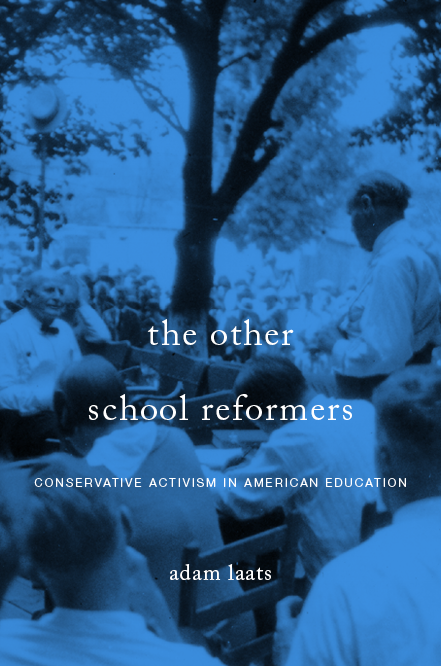
It was ever thus. As I argued in The Other School Reformers, for example, progressive reforms in places such as Pasadena, California lost steam when conservatives “proved” that progressive pedagogy meant worse schooling.

In the early 1950s, in Pasadena at least, progressive superintendent Willard Goslin enjoyed enormous popularity among the affluent residents. He maintained a lot of that support even when conservative activists began to accuse him of introducing progressive reforms, including racial desegregation. When conservative activists accused Goslin of sneaking socialism into the schools, progressive Pasadenans still supported Goslin.

His support collapsed, however—even among politically progressive affluent white Pasadenans—when those affluent supporters were told that Goslin’s school reforms threatened their children’s privileged educations. In Goslin’s case, it was the abolition of traditional report cards that sealed his professional fate. Progressive Pasadenans supported racial integration, in many cases. They even supported socialist ideas, to a limited extent. But they would never support schools that didn’t prove that kids were learning.

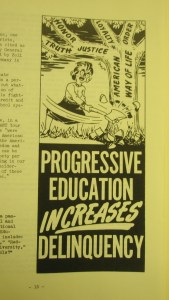
Zoll, Progressive Education Increases Delinquency

Progressives didn’t even mind a little delinquency, but they couldn’t stand lower test scores…

As David Freedlander writes, affluent progressives these days balk at any change that threatens their children’s educational privilege. We probably shouldn’t be surprised at the durability of this issue. When so many Americans view education as the key to achieving or maintaining economic status, it would be hard to imagine things any other way.

In other words, it’s easy to imagine a progressive parent happily paying a little more in taxes to support progressive causes, but it’s hard to imagine many people—progressive or otherwise—sacrificing the best interests of their children, no matter how good the cause.

The Myth of Evangelical Political History Just Won’t Die

It happens sometimes. Academic historians think they have consigned a myth safely to long-deserved oblivion, only to see it pop up again and again. This time, New York Times journalist Clyde Haberman repeats the tired old falsehood that conservative evangelicals only got into politics in the 1970s. What do we have to do to get rid of this misleading but popular timeline?

Gods own party

Read a book…

Here’s the story the way it is often told: White evangelicals had always steered clear of politics, but when Jimmy Carter was elected president in 1976, conservative white evangelicals rallied against him. Jerry Falwell Sr. led them out of their churches and into polling booths to elect Ronald Reagan and become a political force.

It’s a compelling timeline, but it’s just not true.

So why do intelligent journalists keep taking the myth at face value? As Haberman puts it incorrectly,

American evangelicals had long steered clear of politics, but with the advent of Moral Majority that was no longer so.

It just didn’t happen that way. Even the celebrity historians Haberman talks to could have told him that. For example, in the long video, Dartmouth’s Randall Balmer gives the real story. In the late 1970s, Balmer explained,

For really the first time in any significant way, evangelicalism becomes interlocked with the Republican Party.

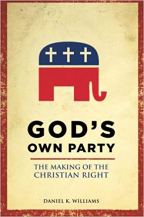
Getting into bed with the GOP is not at all the same thing as getting into politics. I thought historians such as Daniel K. Williams had long made this point clear to everyone. As Williams put it in God’s Own Party,

evangelicals gained prominence during Ronald Reagan’s campaign not because they were speaking out on political issues—they had been doing this for decades—but because they were taking over the Republican Party. It was an event more than fifty years in the making.

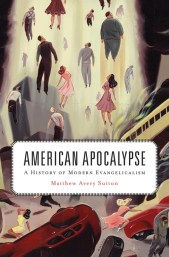
Similarly, Matthew Sutton underlined the point that white evangelicals had never really been out of politics. As Professor Sutton put it in American Apocalypse, the “rise-fall-rebirth” story of evangelical involvement in politics was beloved by fundamentalist leaders such as Jerry Falwell Sr., but it doesn’t match the historical record. As Sutton explained, fundamentalists’

Sutton

…for Christ’s sake!

agenda was always about more than correct theology; it was also about reclaiming and then occupying American culture.

I told a similar story in Fundamentalist U. Especially at Bible Institutes, the long-held and cherished myth that evangelicals were above politics is just not true. Even at the other-worldliest of schools, Moody Bible Institute, leaders in the 1920s such as James M. Gray always considered themselves ardent political operatives. Sorry to quote myself, but as I wrote in Fundamentalist U, in 1928,

When MBI’s radio station came under political pressure . . . Gray came out swinging. “The time for fighting has begun,” Gray intoned ominously. If MBI’s lawyer was not powerful enough to protect the school’s rights, Gray insisted, then the school should enlist the political support of allies such as Missouri senator James M. Reed. There was no doubt in Gray’s mind that his institution must engage with mainstream politics. Retreat and withdrawal, Gray reasoned, would compromise his school’s missionary testimony.

As the savvy historians quoted in the NYT piece are very well aware—leaders in the field such as Randall Balmer and John Fea—there has never been a time when white evangelicals were really out of politics. Rather, unique among American religious groups, America’s white evangelicals have always considered themselves both outside the world and, in America at least, the proper people to be in charge of it.

It has been white evangelical leaders who have promoted this myth that they were once outside of politics, and only reluctantly got involved in the scary secular seventies. If we really want to understand American history and politics—let alone the enormous support for Trump among white evangelicals—we need to stop re-telling this convenient evangelical myth as if it were true.

From the Archives: Halloween at the Huntington

Forget vampires, ghosts, and Trumpies. The Huntington Library has put together a truly terrifying collection of monsters, from the 1600s through the 1800s. Check out the whole batch here.

huntington ipes

Jacques-Albin-Simon Collin de Plancy (1794–1881), “Ipes,” a demon in Dictionnaire infernal: Repertoire universel des etres, Paris: H. Plon, 1863

huntington bear head

Ulisse Aldrovandi (1522–1605), “Cynocephalus (dog-headed man) in Vlyssis Aldrouandi …Monstrorum historia: Cum Paralipomenis historiae omnium animalium, Bologna, 1642.

huntington buer

Jacques-Albin-Simon Collin de Plancy (1794–1881), “Buer,” a demon in Dictionnaire infernal: Repertoire universel des etres, Paris: H. Plon, 1863

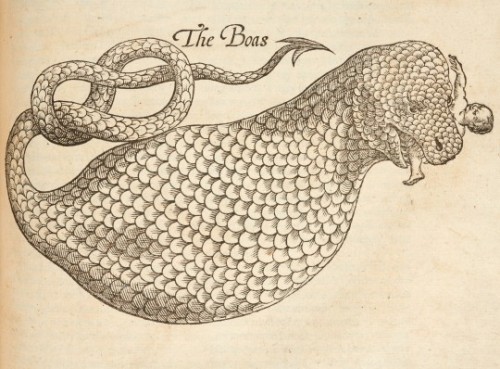
huntington boas

Edward Topsell (1572–1625),“The Boas” in The historie of foure-footed beastes, London: William Iaggard, 1607.

huntington amon

Jacques-Albin-Simon Collin de Plancy (1794–1881), “Amon,” a demon in Dictionnaire infernal: Repertoire universel des etres, Paris: H. Plon, 1863

Boo.