Hate Speech: The Blog Defense

I know, I know, it is not the main point of the story. I can’t help but be amazed, though, at one of the defenses this embattled professor gave. So, yes, he compared sexual-assault accusations to “spin the bottle.” And he called the Democrats the “sissy party” and suggested that all judicial appointees be required to commit sexual assault. He defended his comments as satirical, but he also gave, to my mind, a much more poignant defense.

langbert

Sure, I said it, but I didn’t think anyone was listening…

Here’s what we know: according to Inside Higher Ed, Brooklyn College Professor Mitchell Langbert made some pretty outrageous public comments after the Kavanaugh hearings. For example, Prof. Mitchell opined,

If someone did not commit sexual assault in high school, then he is not a member of the male sex.  The Democrats have discovered that 15-year- olds play spin-the-bottle, and they have jumped on a series of supposed spin-the-bottle crimes during Kavanaugh’s minority, which they characterize as rape, although no one complained or reported any crime for 40 years.

The Democrats have become a party of tutu-wearing pansies, totalitarian sissies who lack virility, a sense of decency, or the masculine judgment that has characterized the greatest civilizations: classical Athens, republican Rome, 18th century Britain, and the 19th century United States. They use anonymity and defamation in their tireless search for coercive power.

The Kavanaugh hearing is a travesty, and if the Republicans are going to allow the sissy party to use this travesty to stop conservatism, then it is time found [sic] a new political party.  In the future, having committed sexual assault in high school ought to be a prerequisite for all appointments, judicial and political.  Those who did not play spin-the-bottle when they were 15 should not be in public life.

Predictably, students at Brooklyn College protested. Such hateful speech, they insist, should be grounds for Langbert’s termination.

In his defense, Prof. Langbert revised his blog post, adding an introductory disclaimer describing his post as satirical, that his point was precisely to underscore the ridiculousness of the current political climate. As he put it,

It is intended to be taken in the same light as Swift’s claim that Irish children should be eaten. I was surprised to learn that some readers took me literally, claiming that I advocate rape.

To this reporter, the satire in Prof. Langbert’s original post is pretty easy to miss. I might call it an example of hyperbolic rhetoric, but as a high-school English teacher, I would never use this example to illustrate the complicated genre of satirical writing.

SAGLRROILYBYGTH might disagree about whether or not this counts as satire, but this morning I’d like to focus on a different aspect of this case. When asked about his controversial blog post, Prof. Langbert offered a much sadder defense as well. Not only was it meant to be satirical, Langbert said, but usually only about twenty people per week visited his blog.

Does that make it okay? We all know some forms of speech are not protected. For example, shouting “Fire” in a crowded theater is not acceptable. However, what if you shouted “Fire” to an empty room?

Is THIS Okay?

It’s not easy to be a social-studies teacher these days. We are supposed to inspire our students to love history and to become active citizens, but we’re not supposed to dictate political beliefs to students. We are encouraged to share our own biases and political commitments with students, but we’re not encouraged to tell students what to think. Our job is to help form moral persons—real empowered humans—but we aren’t hired to cram our morality down anyone’s throats.

pa liberal indoctrination

Civics ed? Or sinister indoctrination?

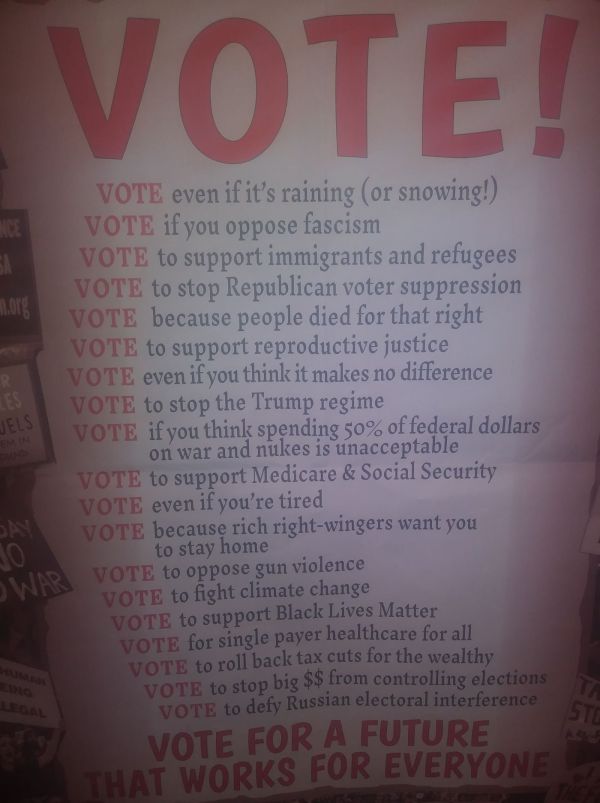
Given all that, we ask today: Did this Philly school teacher go too far? The chair of Pennsylvania’s Republican Party says yes. He says a flyer handed out by Philadelphia Central High teacher Thomas Quinn crosses way over the line.

The flyer encourages students to vote. Nothing very controversial there. But it also tells students to support Black Lives Matter, abortion rights, and to oppose the “Trump regime.”

It will come as no surprise to SAGLRROILYBYGTH that I support this whole platform. I would love it if every student voted this way. But that’s not the most  important point here. The real question is about the proper political role of a good teacher.

What do you think? Should social-studies teachers encourage students to vote a certain way?

Penn Puzzles

Can anyone REALLY teach students how to know and understand something without believing it? That’s one of the questions that sharp students brought up yesterday at the University of Pennsylvania.penn gse logo better

Some context: I headed down to Philadelphia yesterday to talk about evolution, creationism, and the goals of public education. My friend and hero Jon Zimmerman had asked his class to read Teaching Evolution in a Creation Nation.

As usual, readers were generally more interested in the philosophical arguments of my co-author Harvey Siegel than with my historical chapters about evolution education. Is it really possible, students wondered, to teach students to know evolutionary theory in a deep way, to understand it, without insisting that they believe it?

Harvey and I make the case that it is, but as yesterday’s lively seminar proved, it is a difficult distinction to imagine in many cases.

For example, think about the reverse. What if a public-school history teacher wanted to teach students that American history should be understood as the triumph of “JudeoChristian” values? What if the teacher assured secular parents that he was not trying to force students to “believe” in any particular religious values, but only to “know” and “understand” the importance of Christianity in the forming of United States government and society?

Or consider the challenge for any person—especially a young person—of separating out her desire to please an authority figure from her personal religious beliefs. Is it really practical to tell teachers that they don’t want to influence students’ religious beliefs? That teachers should somehow be able to separate out such closely related concepts?

Most challenging, we considered yesterday other sorts of student belief that teachers DID want to challenge. What if a student in history class, for example, argued that her racist beliefs were acceptable, because they were her personal beliefs? Could a teacher really not challenge them?

I think a teacher not only can, but must. And I think a teacher can do that without therefore insisting that he must challenge every student belief with which he disagrees. As Harvey and I argued in TECN, and as I’m elaborating in my new book about creationism, even though such real-world challenges are intense, it is still vital to clarify our goals and our mission when it comes to creationism and evolution education.

It’s Not about Evolution

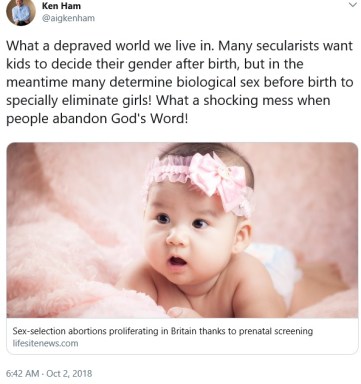
What makes young-earth creationists fight so hard against mainstream science? Hard as it is for outsiders like me to understand, it’s not really about evolutionary theory itself, as today’s headlines remind us.ham sex selection

Here’s what we know: This morning, young-earth impresario Ken Ham warned the twittersphere about the dangers of sex-selective abortions. And his warning helps us understand the real issue at stake for most young-earthers.

Ham was referring to a recent article about sex-selective abortions. As Ham fumed,

What a depraved world we live in. Many secularists want kids to decide their gender after birth, but in the meantime many determine biological sex before birth to specially eliminate girls! What a shocking mess when people abandon God’s Word!

As SAGLRROILYBYGTH will notice right off the bat, there’s nothing about evolution involved in these claims. Ham, of course, would likely say that evolutionary theory is lurking in the background of everything, but this morning Ham doesn’t actually talk about evolution. As usual, today the issue for Ham is not specifically the science of evolution, but something else. So if Ham and other YEC pundits aren’t really anxious about evolutionary theory itself, what are they worried about?

As I’m arguing in my new book about American creationism, radical young-earth creationism isn’t actually about evolution. It is about drawing a line.

As Ken Ham often points out, the dangers come from two directions. First, there are lurking “secularists” who are trying to deprive Christians of both their civic rights and their religious beliefs. Second, ever since the days of Bernard Ramm (1956), some conservative evangelical Christians have worried that any open consideration of the theological implications of mainstream evolutionary theory will lead to a galloping retreat from faith.

As they have since the days of The Genesis Flood (the 1961 book, not the event), radical young-earth creationists have argued that the only way to preserve true Christian belief is to draw a hard line against mainstream evolutionary science.

As today’s updates show, most of the arguments in favor of young-earth creationism are not really about evolutionary theory itself. Instead, they warn Christians about the likely results of considering the merits of mainstream science.

Instead of asking, “What are the theological implications of mainstream science?” YEC pundits ask, “Do you want to kill more girl babies?”

I Love You but You Didn’t Do the Reading

October already…feeling spooooky. Here are some articles that caught our attention this past week:

Our lead story this week: Asuza Pacific University on a LGBTQ+ roller coaster:

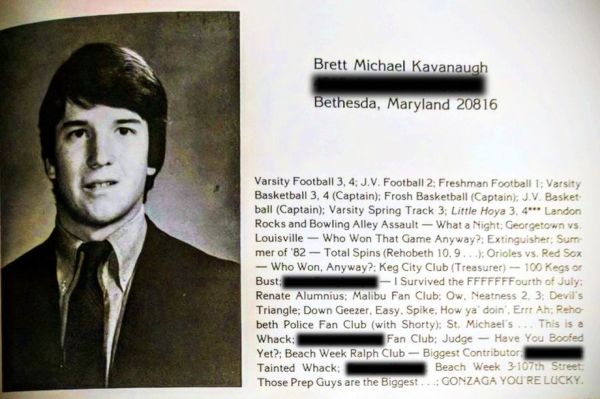
Creepy prep schools and the future of the Supreme Court, at The Atlantic.

kavanaugh yearbook photo

Does going to an elite prep school have ANYTHING to do with all this mess?

Will this school-integration plan work? At T74.

Researcher claims Protestantism still promotes schooling, at Phys.org.

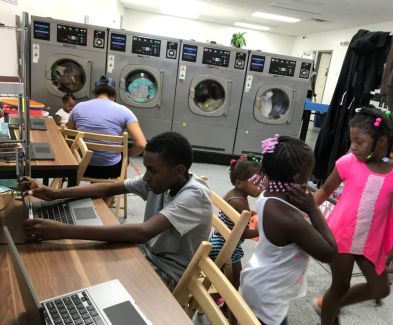
Improving schools by improving lives, or vice versa? At Chalkbeat.

many policies with a shot at changing the experience of low-income students in school don’t have anything to do with the schools themselves.

Principal out after planning to “embarrass” a student who reported sexual assault, at WaPo.

Keeping a “Nazi” student after Charlottesville, at IHE.

He has a right to pursue his education at a state institution. . . . He’s a Nazi — it doesn’t mean he doesn’t get to have an education.

cvjetanovic

Should the school have kicked him out?

Why Can’t Evangelical Colleges Change?

Who decides the rules at evangelical colleges? In Fundamentalist U, I argued that school leaders were tightly constricted by a lowest common denominator of populist evangelicalism. Yes, deep theological ideas mattered, but more important was the absolutely non-negotiable need for colleges to be perceived by the broader evangelical public as absolutely “safe.” The events at Asuza Pacific University this week seem to confirm my thesis.

asuza pacific

[No] Ch-ch-ch-ch-changes…

Here’s what we know: A few days ago, Asuza Pacific announced a new policy for LGBTQ+ students. Like all students, they could now freely engage in romantic relationships, but sex was out of bounds. It was a bit of an odd decision to outsiders, since APU maintained its insistence that the only proper sexual relationship was a heterosexual marriage. Nevertheless, it represented a pretty big change for a conservative evangelical college.

As we’ve reported in these pages, the question of homosexuality on evangelical campuses has driven a wedge between conservative evangelical schools. I’ve argued recently that the issue of homosexuality, along with other culture-war bloody shirts such as young-earth creationism, is leading to the creation of a “new fundamentalism” in some colleges.

And so, predictably, APU’s announcement led to conservative pushback. Pundits such as Rod Dreher called the policy switch

a feeble attempt by one of the country’s largest conservative Evangelical colleges to satisfy the Zeitgeist while maintaining the fiction that the school is still conservative and Evangelical on human sexuality. . . . some APU students leave college with their faith in tatters, having been transformed into Social Justice Warriors by a college that sells itself as conservative and Evangelical[Emphasis in original.]

As I pointed out in Fundamentalist U, no evangelical college is immune to this kind of pressure. Throughout the twentieth century, conservative gadflies have been able to influence the goings-on at evangelical schools by warning that students might not be “safe” on their campuses.

No matter what administrators might like to do, maintaining their public image as impeccably safe spaces for conservative evangelical youth is absolutely essential. This is not a quirk of Asuza Pacific or a relic of the twentieth century. Just ask Larycia Hawkins. Or Randy Beckum. Or Stephen Livesay.

We should not be surprised, then, to find out this morning that APU reversed its decision. The board announced that the policy change had never been approved. APU, the board declared, was still an unquestionably safe place for conservative evangelical students. As the board put it,

We pledge to boldly uphold biblical values and not waver in our Christ-centered mission. We will examine how we live up to these high ideals and enact measures that prevent us from swaying from that sure footing.

In the language of evangelical higher education, yesterday and today, “change” might be good. But “wavering” has always been beyond the possible. If a university hopes to survive, it must pander to popular conservative ideas about sexuality, politics, race, and any other difficult topic. It absolutely must continue to attract student tuition dollars and alumni donations. Any threat to that bottom line, no matter how theologically sound or spiritually attractive, will always be crushed.

Chicken? Egg?

At the very least, it has to be in the top five least surprising headlines for any experienced classroom teacher: “Home Life Influences School Performance.” Yet the idea that students’ lives outside of school are decisive parts of their school performance has had a surprisingly contentious history. This week we see a renewed interest in the interaction between educational performance and alleviation of poverty.chicken and egg

As I’m finding in the research for my new book, Americans have long assumed that improving schools would simply and quickly eradicate poverty. In the early 1800s, school-reform celebrity Joseph Lancaster promised that he could eradicate poverty with his simplistic school plan. His fans believed him. For example, New York Governor DeWitt Clinton lauded the Lancasterian reform

as creating a new aera [sic] in education, as a blessing sent down from Heaven to redeem the poor and distressed of this world from the power and dominion of ignorance.

Or, as the New York Free School Society wrote in 1814, thanks to the “Lancasterian system of education,”

the darkness, which has overshadowed the minds of the poor, will gradually disappear.

The assumption that better schools could “fix” poverty has been so strong that a fifty-year old sociological report on the subject remains controversial. As historian Leah Gordon has noted, the Coleman Report of 1966 suggested, in part, that changes in schooling could do little to improve students’ lives.

As James Coleman wrote,

For most minority groups, then, and most particularly the Negro, schools provide little opportunity for them to overcome this initial deficiency; in fact they fall farther behind the white majority in the development of several skills which are critical to making a living and participating fully in modern society. Whatever may be the combination of nonschool factors poverty, community attitudes, low educational level of parents-which put minority children at a disadvantage in verbal and nonverbal skills when they enter the first grade, the fact is the schools have not over-come it.

Coleman’s work was controversial at the time and it remains so. Can it really be true that schools don’t hold the golden ticket to economic mobility? That making schools better isn’t the first and best way to help people improve their lives, economically?

Or, as Coleman suggested, was the key to improving lives and increasing equality to be found outside of school, in factors such as family income, family education levels, and other non-school factors?

wash-learn-edited-900x0-c-default

This just in: Benefits for students benefit students.

Writing in Chalkbeat recently, Matt Barnum reviewed studies of the relationship between improving students’ living conditions outside of school and those students’ educational achievement. Not surprisingly, when students had better home conditions, their school performance improved. As Barnum wrote,

A large and growing body of research . . . [shows] not only that poverty hurts students in school, but that specific anti-poverty programs can counteract that harm. These programs — or other methods of increasing family income — boost students’ test scores, make them more likely to finish high school, and raise their chances of enrolling in college.

Seems obvious, right? As every teacher knows, though, it really isn’t only one thing or another. In order for students to thrive in both school and life, it makes the most sense to improve everything at once.

If we want students to do better in life, we should work to improve schools. And if we want students to do better in school, we should work to improve their lives.

Higher Ed as a Weapon

Looks like the tradition continues. As the Brett Kavanaugh hearings sweep over Washington DC like a brushfire, Liberty University is back to its old 1970s tactics. Turns out clean-cut well-dressed conservative Christian students are a potent political weapon.

liberty busses at kavanaugh hearing

From Jack Jenkins…

Here’s what we know: Jack Jenkins has reported that two Liberty University busses pulled up to the Kavanaugh hearings this morning. Presumably, Jerry Falwell Jr. is pulling a few pages from his dad’s political playbook.

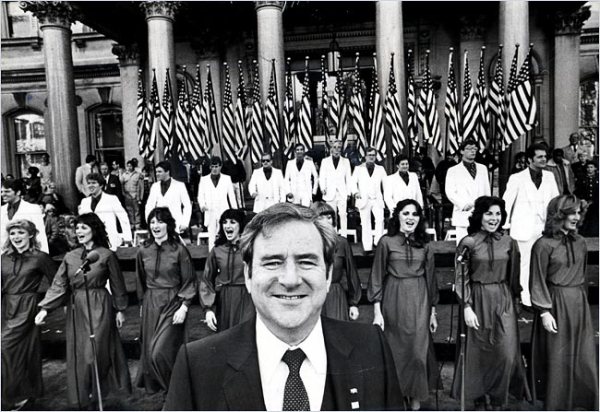
Back in the 1970s and 1980s, Jerry Falwell Sr. was fond of using Liberty University students to twist arms on Capitol Hill. Most famously, he sent his “I Love America” bus tour around to various state houses to sing and dance about America.

The goal was to attract attention to Falwell’s conservative policy plans. He hoped to get headlines and push politicians to get on the Liberty bus. Politically, that is.

That wasn’t all.

I didn’t have room to include much of this in Fundamentalist U, but Falwell Sr. employed students as smiling lobbyists. In early 1980, for example, he had students hand-deliver his “95 theses for the 1980s” to US Representatives.

falwell i love america tour

La la la…we love Americaaaaa

Charles F. Bennett, of Florida’s 3rd district, told Falwell that Bennett was delighted to receive the information directly from a

Fine young Christian student.

And Carroll Hubbard, of Kentucky’s 1st district, wrote to Falwell to say that he was posting the 95 theses on his desk. As Rep. Hubbard put it,

You are an inspiration to my family and me. 2 Chronicles 7:14.

For Jerry Falwell Jr., then, sending busloads of students to support Judge Kavanaugh is anything but a surprise.

Religious Extremists Capture Major Political Party

Old news, right? SAGLRROILYBYGTH won’t be surprised to hear that the Republican Party is addicted to the political support of conservative evangelicals. These days, though, we have a sad reminder of the fact that both major parties can fall victim to special-interest lobbies, lobbies that put children in a terrible educational position.

yeshiva

Who is watching out for the kids?

For Republicans, this is nothing new. For a long time now, Republicans have been trembling at the thought of angering evangelical creationists. The most egregious example, IMHO, was the waffling of former Governor Bobby Jindal.

Jindal, you may recall, was the popular governor of Louisiana who briefly made a bid for the GOP nomination in 2016. No matter what you might think of his politics, Governor Jindal is no dummy. He graduated from Brown with a degree in biology. He went on to Oxford, turning down acceptances at Harvard Medical School and Yale Law School. He may not have made much of a splash in the 2016 presidential race, but we can safely assume that Jindal knows plenty about evolution and many other things.

Yet in spite of all his knowledge, when asked what he thought about evolution in 2014, Jindal hedged. Yes, he wanted his own kids to learn about evolution. When it came to public schools, though, Jindal defended the rights of creationists. If a local school district wanted to teach creationism as science, Jindal argued, that should be up to them.

Bad thinking, but good politics, I suppose.

We see a similar tragedy unfolding these days in Arizona. To win election in the Republican Party, it seems, candidates felt pressed to endorse a bigger role for creationism in public schools.

It’s been true for a long time and it doesn’t seem like it is going to change any time soon. The Republican Party forces candidates to ignore their own ideas and truckle to the desires of radical young-earth creationist supporters.

Recent news from my adopted home state shows that this is not only a problem for the GOP. The Democratic Party, too, seems to have entered into a deal with religious extremists. Just as Republican pandering hurts schoolchildren in Louisiana and Arizona, so too does Democratic deal-making hurt kids in New York.

Here’s what we know: Governor Andrew Cuomo is accused of a sordid educational quid pro quo. He allegedly promised prominent Hasidic leaders that he would not interfere with their religious schools in exchange for a vital political endorsement.

If it’s true, it’s more than a shame. Politicians of every party have a duty to safeguard the educational chances of students. The schools in this case don’t seem to do that at all. As a lawsuit this summer charged, significant numbers of yeshiva students in New York aren’t adequately taught secular subjects such as English, history, and science. Their curricula for boys focus almost exclusively on studying ancient religious texts.

As the New York Times reported, the state has promised to investigate these schools.  As they wrote last summer,

In 2015, the city Department of Education said it was opening an investigation into about 36 private yeshivas to see if they were providing adequate secular education according to state law. But in the three years since that announcement, the city has not released any results. Jaclyn Rothenberg, a spokeswoman for the mayor, said the investigation is still active and the department would deliver the report “soon.” The city has visited 15 schools so far, according to Ms. Rothenberg.

A year ago, when asked when the education department planned to release a report on its investigation, a spokeswoman, Toya Holness, said the investigation is continuing. “We are treating this matter with utmost seriousness,” she said.

This month, Governor Cuomo was accused of promising the Hasidic community that the investigation would continue to languish in exchange for the political endorsement of an influential leader in the Hasidic community.

If true, the charges show how difficult it is to protect the educational rights of children. Children don’t vote.  Children don’t meet with governors to insist the law be obeyed. Children can’t promise a solid block of political support in exchange for special favors.

To be fair, I think the GOP problem is worse. But this story demonstrates that the problem is not only a “conservative” one. Rather, any political party risks being held in thrall to special-interest groups, groups that might not have the best interests of children at heart.

I Love You but You Didn’t Do the Reading

This week’s review of the latest news ‘n’ views from around the interwebs:

Atheists for Jesus: Pulling evangelical voters to the left at FA.

Peter Greene on why teachers join unions.

rockwell teacher union thugTexas school board gives history another once-over, and Hillary Clinton is out. At DMN.

Surviving purity culture at NPR.

In this culture, men and boys are talked about as being sexually weak and women and girls are supposed to be the holders of all sexual purity. So ultimately women and girls are responsible for the sexual thoughts and feelings and choices that men make, and it’s women and girls’ responsibility to dress right, to act right, to talk right, to do everything just right to ensure non-sexuality for all people — and if they don’t, they potentially risk being categorized as impure or as a harlot.

Parents in Leiyang riot over school quality, at The Economist.

A liberal ex-evangelical finds a church home, at NR.

Still no-go for yoga in many public schools, at The Atlantic.

What is behind the coddling of the American mind? It’s not just “safetyism,” says reviewer at IHE.

Students have not been coddled, they’ve been defeated.

Concerned scientists weigh in on removal of climate change and weakening of evolutionary theory in Arizona standards, at NCSE.

Queen Betsy misquotes Professor Haidt, at CHE.

Let’s call it ‘Haidt’s choice’: Pursue truth or pursue harmony.