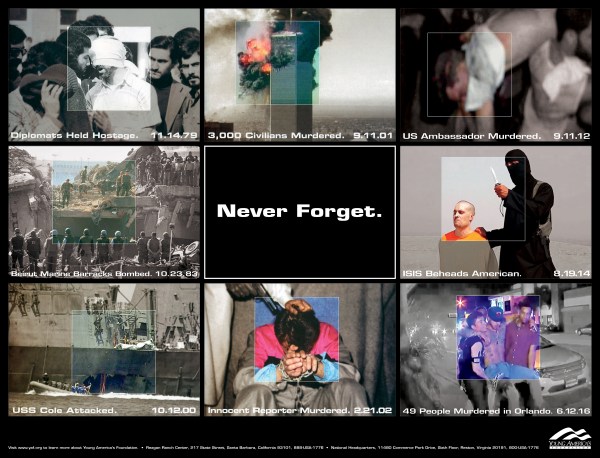
In this case, the memorial at issue was not the standard display of 2,997 American flags to memorialize the people murdered on 9/11. Instead, YAF wanted to put up a graphic “Never Forget” poster. The school charged that the posters targeted Islam unfairly and would make Muslim students feel unwelcome and attacked.
Most campuses don’t hold special ceremonies for Pearl Harbor Day, Emmett Till’s lynching, the Oklahoma City bombing, or Benedict Arnold’s switching teams.
What do you think? Should a college ban violent posters as memorials? Or do students have every right to free speech as long as they are not making threats?
When we say we want students to remember 9/11, or the Civil War, or any of the many other tragedies that dot American history, we must accept that worthwhile remembering takes work. Colleges are one place where that work takes place, in the form of historical research, critical writing, and, above all, teaching new generations to think carefully through history in its full context. Students engage with difficult questions that challenge conventional wisdom and undermine the kinds of easy answers that lead amateur critics of academia to tweet about rip-offs. It may sometimes be uncomfortable, but that’s a necessary element of confronting, considering, rethinking, and growing.
Every day in class, I see my students struggle with the past, with all its uncertainty and all its consequences. This does not happen only once a year, and it is not easy, but that’s what it means to never forget 9/11.
No more wearing white, I guess. Around here, we’ve already had to turn on the heat. The interwebs stayed hot, though. Here is our weekly roundup of ILYBYGTH-themed stories:
Both reactionary pundits mocking campus speech codes and the social-justice warriors they love to hate are complicit in reproducing the kinds of inequality that tribalism feeds on.
Some might say that COE’s uber-patriotism is just an odd outlier in the world of evangelical higher education. Today it looks like COE might have more company. According to President Jerry Falwell Jr., Liberty University in Virginia is considering scrapping its sponsorship deal with Nike. Unlike College of the Ozarks, Liberty is a cash-rich up-and-comer in the world of NCAA athletics.
We’re exploring the situation. . . . If Nike really does believe that law enforcement in this country is unfair and biased, I think we will look around. If we have a contract, we’ll honor it, but we strongly support law enforcement and strongly support our military and veterans who died to protect our freedoms and if the company really believes what Colin Kaepernick believes, it’s going to be hard for us to keep doing business with them.
But if it’s just a publicity stunt to bring attention to Nike or whatever, that’s different. We understand that. We understand how marketing works. But they’re going to have to convince us that they’re not proactively attacking law enforcement officers and our military. If that’s the reason behind using this ad, we’re going to have a hard time staying.
For many Americans, Falwell’s defiant conservative patriotism makes sense. For a lot of people, it’s probably even admirable. But how is it part of evangelical religion?
In short, it’s not, if we try to define evangelicalism only by theological notions such as a reverence for Scripture and an emphasis on soul-winning.
But! If we understand American evangelicalism—the Falwell/Liberty kind, at least—as a conservative cultural mish-mash, including conservative ideas about religion, but also about race, the South, gender rules, sexuality, and so on, then Falwell’s aggressive militarism fits perfectly.
As I argued in Fundamentalist U, during the twentieth century aggressive conservative patriotism played a large role at all the evangelical colleges I studied. At some, such as The King’s College and John Brown University, it became a central focus. In the mid-1960s, at least, notions of fusing traditional patriotic conservatism with evangelical conservatism held a lot of appeal for many evangelical academic types.
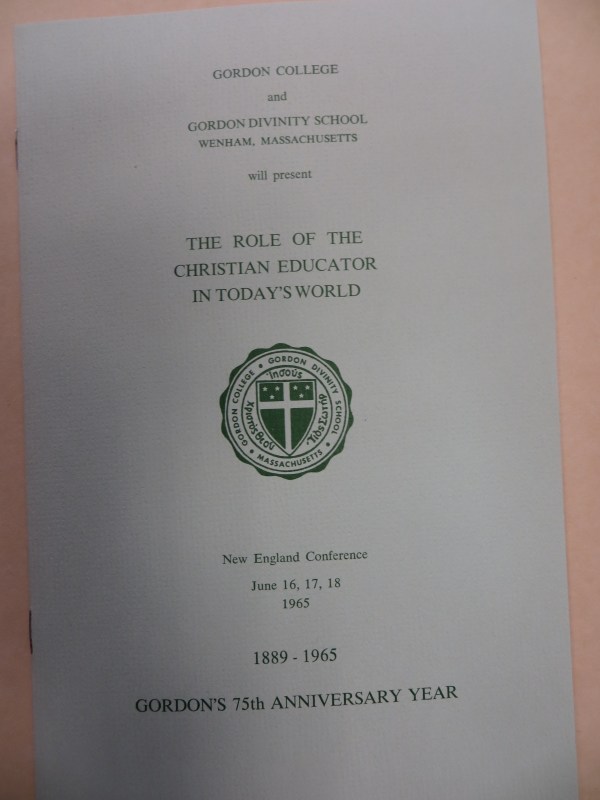
A “Freedom Forum” planned at Gordon College in 1965, for instance, offered the following rationale:
What philosophy shall give direction to the material world we are developing? Shall the long-felt influence of the Christian ethic be brought to bear on current history? Dare we succumb to the seemingly plausible suggestions that in our time government-over-man is preferable to America’s long proven concept of man-over government?
Can we survive as a people, even with our unparalleled abundance of things, if our thinking excludes our traditionally motivating intangibles . . . . [sic ellipsis in original] reverence for God, total human concern for the individual, an abiding dedication to preservation of our Constitution and a cherishing regard for personal Freedom? [sic]
The Christian educator occupies a unique position of leadership from which emanate those spiritual emphases which give salutary meaning and purpose to life, not only individual but national. Waiting for that leadership are millions of earnest Americans who need help in their endeavor to ‘prove all things and hold fast that which is good.’ . . .
Objective: Inclusion in the curricula and teaching emphasis in Christian colleges of a pervading high regard for Freedom in its spiritual, economic and political dimensions and to create an informed student-citizen leadership needed to safeguard and extend Freedom in the years ahead.”
In the end, under pressure from Gordon faculty to avoid too close collusion with the political “extreme right,” the vaunted Freedom Forum didn’t happen. But there was always—and I think still is—a very strong push among many evangelicals to tie their conservative patriotic impulses to their religious beliefs.
For God and Country…or Country and God…?
This is true not only for uber-patriotic schools such as Harding, John Brown, and the College of the Ozarks. Giants like Liberty University and smaller schools such as Mid-America Nazarene still have a hard time figuring out the relationship between religion and patriotism, with patriotism often coming out on top.
In this case, College of the Ozarks certainly seems like a Nike-hating outlier. But is the impulse to in-your-face conservative patriotism really so out of bounds for other conservative evangelical colleges? I don’t think so.
I had grown up a young-earth creationist, even defending the position in college and my early days as a church planter. Slowly, though, I grew dissatisfied with the scientific credibility of young-earth explanations. Also, it gradually became less and less obvious to me that Genesis was intended to be read as a scientific description of events in natural history. And the scientific evidence for evolution and an old earth grew steadily more compelling.
None of this really challenged my faith, which is not rooted in a certain interpretation of Genesis, but (among other things) in the historical resurrection of Jesus and my personal encounter with divine grace. In fact, opening myself up to the scientific consensus gave me a new pair of glasses through which to see the beauty and truth of Christian doctrine.
Before he came out as an “evolutionary creationist,” his church had been split, he explained, between young-earth creationists, evolutionary creationists like himself, and undecided creationists. He thought that meant he could safely reveal—as a staunch Christian and creationist—his new acceptance of evolutionary theory.
For radicals, evolutionary theory itself isn’t the problem. It’s what they think evolution supports that troubles them…
He was wrong.
When he recommended a book supporting evolutionary creationism on Facebook, his church splintered. There was gossip, anger, hard feelings, and eventually a sizeable faction of young-earthers left the church. Why?
In Rev. Herndon’s opinion, the young-earthers left because they were afraid of what their church would become. They were afraid of what would happen to any church without a firm young-earth pastor. As Herndon explained,
To them, evolution isn’t one issue among many that Christians should deal with. It is THE issue that Christians must NOT “compromise” on. For a pastor to “compromise” on a literal reading of Genesis is, in their minds, not a disagreement. It’s a heresy.
In the end, it was not the science or theology that the young-earth radicals were afraid of. After all, they had long been members of a church that was divided between different types of creationism. But when the pastor came down on the moderate side, the radicals left. They didn’t stay to debate the science of radical creationism or mainstream evolutionary theory. They didn’t try to help Herndon see the theological problems inherent in his new ideas about evolution.
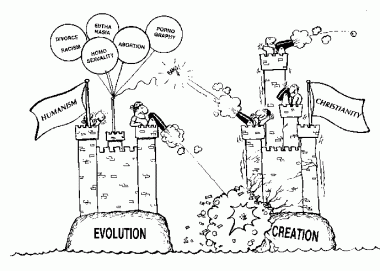
To radical young-earth creationism, mainstream evolutionary theory is mainly a problem for what it implies, not what it says. For generations now, radicals have told one another that mainstream evolutionary theory is a gateway drug, a slippery stepping stone to a devil’s brew of pernicious ideas and trends.
Back in the 1970s, for example, in the Kanawha County (WV) school controversy I’ve written about in my book about educational conservatism, one of the creationist protest leaders explained what he disliked about a new set of textbooks. The Rev. Avis Hill explained to an interviewer that there was not just one thing wrong with the books.
Yes, the books were bad, Hill explained. They were full of “that garbage, that trash, that four-letter words.” They encouraged students to “act out a street riot.” They encouraged the sorts of delinquency Hill deplored,
students drinking and . . . smoking their dope. . . . leaning against the wall with their feet on the wall dirtying and defacing the school with initials and names all over it.
Some of the people who liked the new books, Hill admitted, were Christians, but they were the sorts of Christians who were friendly to “gays and homosexuals . . . and being proabortion.”
When pressed, the Rev. Hill had a quick shorthand that he thought captured all these dire cultural trends. In the end, Hill explained, the problem with the new textbooks was that they were contaminated by “attitudes of evolution and all that.”
Avis Hill was far from the only radical creationist to bundle together a host of cultural issues under the vague but all-encompassing label of “evolution and all that.” National young-earth leaders such as Henry Morris and Ken Ham do the same.
In a recent edition of his book The Long War Against God, for instance, Henry Morris argued that evolutionary thinking was bad science, but more important, it had
Practically eliminated the semblance of Bible-based behavior from American life.
Evolutionary thinking, Morris insisted, could be blamed for increased rates of
premarital sex, adultery, divorce, and homosexuality. . . .Unrestrained pornography. . . . Prostitution, both male and female, is at an all-time high, as is its attendant criminal activity. . . . [and] this rapid change in abortionism from criminality to respectability. . . . [plus] the modern drug crisis (rock music, peer pressure, organized crime, etc.)
Morris is not the only radical creationist leader to make these connections. As Ken Ham is fond of arguing, evolutionary theory is the foundation on which all other social ills are built. Unless creationists take a radical, fundamentalist stance against moderate forms of creationism, Ham insists, their churches will be lost.
Taking a firm line against Rev. Herndon’s evolutionary creationism, then, was likely about cultural issues rather than about actual evolutionary science. The radicals who left were likely asking themselves the questions they had been asked since the 1960s: Do you oppose homosexuality? Do you oppose abortion? Are you against crime? Drugs? Rock music? If the answer is yes, radicals have heard for decades, you can’t remain in a church under moderate creationist leadership.
Of course, none of those questions is really about evolutionary science itself, but together they give radicals a clear line of defense. Remaining in a church under moderate creationist leadership, radicals often believe, means supporting abortion, homosexuality, pornography, and even organized crime. The only option is to get out before the inevitable moral decline.
What are radicals afraid of? Not evolutionary science itself. They are afraid of slipping into a temptingly reasonable cultural position. They are afraid of being too soft on abortion rights, homosexuality, rock music, and drug use. The radicals who left Herndon’s church did not mind praying with non-radical creationists. But when their pastor came down against radical creationism, they felt they had to get out fast. Accepting mainstream evolutionary science, for many radicals, is not really about evolution, but about opening the door to a slew of cultural trends they find abhorrent.
As brainy observers such as Larry Cuban and Peter Greene have reminded us recently, when we can’t agree on the fundamental goals of education, we won’t be able to formulate sensible plans to improve it.
The case raised difficult questions: Can education be considered a fundamental right? Do undocumented Americans have a right to send their kids to public schools, the way they have the right to fire protection if their house is ablaze?
As historians like Prof. Cuban have long pointed out, the question of whether or not education is a basic right needs to take its place in line with all the other fundamental questions about education. Is it a right? Is it a public utility? Is it a tool of class domination?
In every tough case, these multiple visions of the basic goals of education bump uncomfortably along together. Partisans of various political agendas and reform proposals usually insist on one or more definition of the fundamental purpose of education, even though they almost never notice that they are doing so.
The Plyler v. Doe case was no exception. As Prof. Lepore’s review demonstrates, leading voices in that case relied on different unexamined assumptions about the true nature of American education. Consider the following excerpts:
Education is a Right:
Prof. Lepore asks,
Is education a fundamental right? The Constitution, drafted in the summer of 1787, does not mention a right to education, but the Northwest Ordinance, passed by Congress that same summer, held that “religion, morality, and knowledge, being necessary to good government and the happiness of mankind, schools and the means of education shall forever be encouraged.” By 1868 the constitutions of twenty-eight of the thirty-two states in the Union had provided for free public education, open to all. Texas, in its 1869 constitution, provided for free public schooling for “all the inhabitants of this State,” a provision that was revised to exclude undocumented immigrants only in 1975.
Education is a Public Good:
During the Plyler hearings,
Witnesses presented testimony about economies: educating these children cost the state money, particularly because they needed special English-language instruction, but not educating these children would be costly, too, in the long term, when they became legal residents but, uneducated, would be able to contribute very little to the tax base.
Education is An American tradition:
As one lawyer in the Plyler case put it,
An educated populace is the basis of our democratic institutions. . . . A denial of educational opportunities is repugnant to our notions that an informed and educated citizenry is necessary to our society.
Education is A vehicle for fixing social inequities:
In a related recent case, Lepore writes,
the Detroit plaintiffs . . . identified the absolute denial of education as a violation of the equal-protection clause, and ruled that no state can “deny a discrete group of innocent children the free public education that it offers to other children residing within its borders.” Dismissed by a district court in June, the case is now headed to the Sixth Circuit on appeal.
Education is An imposition on non-White/non-middle class children:
Lepore notes,
If the schoolhouse is a mini-state, it has also become, in many places, a military state.
Education is A public utility:
She records this interchange during the Plyler hearings:
Marshall: Could Texas deny them fire protection?
Hardy: Deny them fire protection?
Marshall: Yes, sir. F-i-r-e.
Hardy: Okay. If their home is on fire, their home is going to be protected with the local fire services just—
Marshall: Could Texas pass a law and say they cannot be protected?
Hardy: —I don’t believe so.
Marshall: Why not? If they could do this, why couldn’t they do that?
Hardy: Because . . . I am going to take the position that it is an entitlement of the . . . Justice Marshall, let me think a second. You . . . that is . . . I don’t know. That’s a tough question.
Marshall: Somebody’s house is more important than his child?
Who is correct? They all are. Education is a right, a public good, a public utility, a means for economic advancement, a tool of class domination . . . all at the same time.
With all these unrecognized assumptions about the basic nature of education, it is hardly surprising that improving education has remained such a chimera. Even regarding a SCOTUS case explicitly dedicated to figuring out if education is a right, lawyers, activists, and historians all appealed unreflectively to all the other fundamental goals of education as well. And, of course, there are many others we could add to the list. Depending on whom you ask and on the case at hand, the basic nature of American education can and has been defined as all of the following:
A private matter;
A religious affair;
A consumer product;
A national security imperative…
And many more.
Is education a fundamental right? Yes. Is it also all those other things? Also yes. Whenever Americans have a disagreement about the goals of education, they pull from this bubbling cauldron of conflicting and confusing fundamental goals to make their cases. And none of them are wrong.
In the end, they point to the reason why it is so difficult to fix schools. Not only is it difficult to tell what is broken; it is difficult even to find out what schools should do if they were fixed.
Professor Cuban makes the crucial point: Public schools in the USA have always been driven by all the same contradictory impulses that drive political life. Some people want schools to be more progressive; others want them to be more conservative. As Cuban puts it,
The contradictory obligations of reforming schools while conserving traditional knowledge and classroom practices has been in the DNA of tax-supported public education for well over a century. It won’t go away. Those cheerleaders for the next new reform need to understand this paradox at the heart of U.S. schooling.
As I started my graduate work lo so many years ago, I was curious about the deep educational conservatism that I saw, felt, and heard as a teacher. To my surprise—and, to be perfectly frank, fueling my academic ambition—there were not shelves and shelves of scholarly work analyzing conservatism in education.
But considering the vastness of the topic, the lack of academic work about educational conservatism still baffles me. As Prof. Cuban points out, conservative ideas and impulses have always been at least as powerful as progressive ones. As Cuban writes this morning, if the first obligation of public schools was to serve as a way to change students and society,
The second obligation was for the tax-supported school to actively conserve personal, community and national values ranging from inculcating traditional knowledge, obeying authority including that of teachers, show respect for religious beliefs, practicing honesty, and displaying patriotism.
If these conservative assumptions about the proper role of school are so very influential, where are all the academic studies of them?
Of course, it’s not at all difficult to find conservative how-to books about schools. From the Gablers to Dorothy Sayers to everyone in between, there have never been a lack of guides to make schools more conservative or more authentically conservative.
When it comes to an academic understanding of the meanings and activism of conservative thinkers and activists, though, we still have a decided gap between what happens (and happened) in schools and what academics talk about.
So where are the armies of historians, anthropologists, sociologists, and classroom researchers?
To people like me, AIG’s insistence that dinosaurs and humans lived side-by-side is the most egregious and shocking example of their YEC anti-science obliviousness. Of course, if the earth is only about 6,000 years old, humans and dinosaurs would have had to have lived at the same time. But it is such an intensely counter-mainstream notion that you’d think AIG would be a little quiet about it.
No need to go all the way to Japan. They’re all over Kentucky…
They’re not.
Visitors (like me) to the Ark Encounter are impressed right away by the many exhibits featuring domesticated dinosaurs. If I understand AIG’s thinking correctly, they make such a big deal about dinosaurs because they hope dinos can serve as “missionary lizards.” As AIGster Buddy Davis explained,
Dinosaurs and the truths that they share about God’s creation, man’s sin, death, the Flood, and the Ice Age can be used by Christian young people and adults to share the gospel with unbelievers. These missionary lizards uphold the authority of Scripture, and they can be powerful tools in sharing the salvation message, which should be the ultimate goal of every Christian.
As non-Christians hear the biblical explanation of dinosaurs, many have been, and will be, challenged to listen to the rest of what the Bible states. We rejoice that many have been won to the Lord using the true history of these missionary lizards.
I can’t imagine that any secular folks or non-Christian religious people really have been converted to YEC by these missionary lizards. I can’t help but wonder, though, what Ken Ham and his AIG colleagues will make of this dino hotel:
The front desk staff are a pair of giant dinosaurs that look like cast members of the Jurassic Park movies, except for the tiny bellboy hats perched on their heads.
The robo-dinos process check-ins through a tablet system that also allows customers to choose which language—Japanese, English, Chinese or Korean—they want to use to communicate with the multilingual robots.
The effect is bizarre, with the large dinosaurs gesticulating with their long arms and issuing tinny set phrases. Yukio Nagai, manager at the Henn na Hotel Maihama Tokyo Bay, admits some customers find it slightly unnerving.
This might be a stretch, but is it possible that the hotel might become a YEC tourist attraction? That YECs might flock to the hotel to see what it must have been like to cavort with dinosaurs before the flood?
So, could God not have created the world 6000 years ago and just made it look like it was very old? Personally, I believe he could have, had he wanted to, but does that idea fit the traditional Christian view of the character of God?. . .
In a world where cause and consequences are arbitrary, no evil can be committed and in a world without knowledge no evil can be understood. A universe that pretends to have been evolving and to have continually grown in size, but instead was made in discrete unrelated steps, would be such a world where cause and consequence are not to be trusted anymore.
Sometimes the devil doesn’t wear Prada. Sometimes she wears clunky oversized glasses and ostentatiously kitschy t-shirts. At least, that’s the lesson I’m getting from the sad stories oozing out of New York University’s latest scandal. What I don’t understand is why so many academic commentators think the situation is somehow unique to elite academic life. To this reporter, it seems that condemnations of grad studies as “cultish subjection” seem to sidestep the most important point.
Here are the basics: NYU’s comparative literature department is roiled by accusations and counter-accusations in the case of Professor Avital Ronell. Ronell is accused by former graduate student Nimrod Reitman of harassment and abuse. The accusation is littered with kooky emails [here are some examples] and trainwreck-level details about their relationship.
Is this a story a condemnation of elite academic culture? As Corey Robin has argued, is this about more than sex, more than feminism? Professor Robin has argued the case was really about
the question of power. This is a grad student trying to make his way in an institution where everything depends on the good (or bad) word of his adviser.
To my mind, that sounds true enough, but I don’t see how this problematic relationship is unique to academic life. It seems to me that anytime employees are dependent on their boss’s good opinion, exceptions like this will pop up.
I don’t see how this sad scandal tells us anything that we didn’t already know. Namely, in any job in which the employee is willing to do anything to get ahead, some exceptional bosses will take cruel advantage.










 I Love You but You're Going to Hell