Why Would Trump Talk about School Prayer?

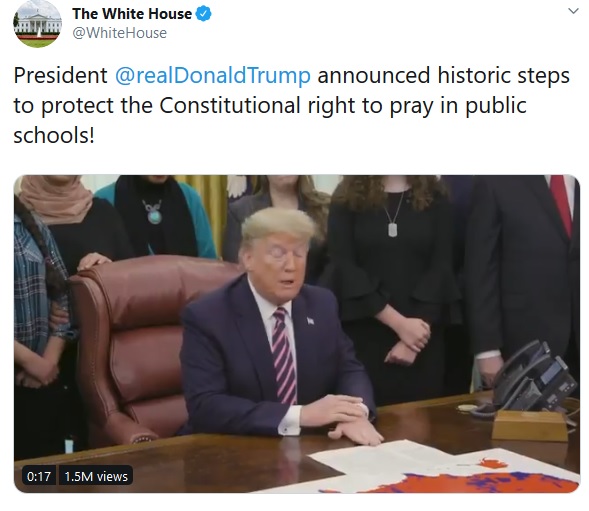
On the face of it, the statement was meaningless, or even weirdly insulting to evangelical activists. Yet President Trump announced yesterday that he was taking “historic steps to protect the First Amendment right to pray in public schools.” If students already had that right, why would Trump bother?Trump prayer anncment tweetThis move is not a new one for Trump. SAGLRROILYBYGTH will recall he made similarly meaningless promises to defend the use of the Bible in public schools. In his announcement yesterday, Trump declared,

in public schools around the country, authorities are stopping students and teachers from praying, sharing their faith, or following their religious beliefs. It is totally unacceptable.

Such a statement might seem ill-advised. After all, Trump has always bent over backwards to court support from evangelical Protestants. And evangelicals have long bent over backwards to prove that students DO have the right to pray, share their faith, and follow their religious beliefs in public schools.

For example, the See-You-At-The-Pole movement is all about demonstrating students’ continuing right to pray in their public schools. One might think that these evangelical activists would be offended at Trump’s assumption that they have not been praying in schools already.

I don’t think they will. Instead, I think a lot of MAGA Christians assume that their children are under threat. And to be fair, if you were to read only MAGA/Christian news, you’d get plenty of support for that mistaken notion.

Consider a couple of examples of the things some conservative Christians are hearing. Organizations such as Focus on the Family warn readers of experiences like the following:

  • A father expresses concern after his daughter, a high school student, tells him an education official stopped her from bowing her head to silently pray before eating lunch.

  • A fifth-grade student brought his favorite book, the Bible, with him to class to read during a free reading period. But according to news reports, the teacher had him come up to her desk and, in front of the class, left a message for his parent explaining that she noticed he had a religious book and was not “permitted to read those books” in her classroom.

Sadly, none of these scenarios are fiction.

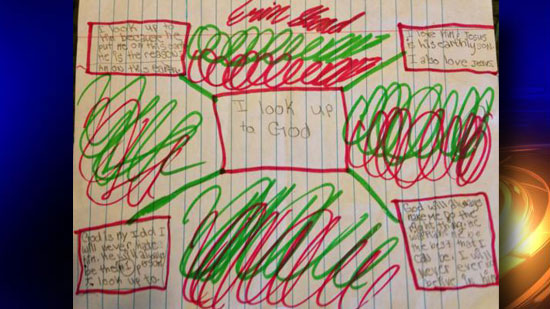
Or what about the sad story of ten-year-old Erin Shead? Erin was told by her teacher to think about her hero. She did. It was God. But then her teacher told Erin that God could not be her hero.god-is-my-hero

We could go on. Plenty of conservative Christians read stories like this and they fret about the state of prayer in America’s public schools. They might even send their own kids to public schools like the ones in Greenwood, Indiana, where old-fashioned evangelical Christianity still dominates the school. As the superintendent in Greenwood explained,

I don’t think any of us leave our faith at the door because the bell rings. . . . Jesus Christ is my Lord and Savior and that doesn’t stop just because the school bell rings. . . . As a leader, I’m hoping that we’re promoting what people would call Christian values.

What does Greenwood, Indiana have to do with 1600 Pennsylvania Avenue? I don’t want to accuse President Trump of thinking strategically, but I think his announcement about school prayer might make political sense even if it makes no policy sense.

Yes, students are free to pray in their public schools if they want. And plenty of public schools—like the ones in Greenwood, Indiana—incorporate Christian values deeply into everything they do. It doesn’t really matter. When Trump voters read that a fourth-grader got in trouble for announcing that God was her hero, Trump wins. And when voters read that school officials are stopping students from praying, Trump wins.

It doesn’t matter that students actually have plenty of prayer rights already. Trump stumbled onto an issue that matters to a lot of people. Students’ right to pray is beyond dispute. But people still think it is under attack.

Why Won’t This Myth about Teachers Go Away?

It won’t be easy, but I’m going to avoid defending graduate programs for teachers. Instead, I want to take issue with a persistent myth about teacher pay that showed up once again in this article about teacher education. I can’t help but think that popular understandings of the history of teacher pay have had a bad influence on the way we think about teaching today.

If you’re involved in teaching you’ve probably seen the article. Too often, Grace Gedye alleges, hard-working teachers are forced to pay for useless graduate degrees. As Gedye charges,

the teachers I interviewed told me that they had spent too much time on theory and not enough on practical teaching skills; professors were too far removed from the classroom and using out-of-date pedagogy; and many programs simply weren’t rigorous.

I’m super biased so I won’t push the point too hard, but I have to briefly disagree with this premise. Feel free to discount my point, because I spend my days working with graduate students in a teaching program. The classes I teach focus on diving deeply into US history. Do my classes help my students on Sunday night with their plans for Monday morning? No. But knowing more about history and historical thinking can’t help but make them better history teachers. Right?

We can argue about graduate programs if we want, but instead I’d like to focus on a lil nugget buried deep in the heart of the article. Gedye mentions that teacher pay has long been tied to graduate education. As she recounts,

American teachers weren’t paid salaries at all well into the 19th century. Schools were largely community organized, and teachers’ compensation mostly consisted of free room and board.

Now, I’m not taking the author to task for this inaccurate summary of the history of teacher pay. She isn’t claiming to have done research about this history; she isn’t basing her argument on it. No, the problem is much bigger than that. The author is merely rehashing what she thinks is a commonly accepted truth. And she’s right: Generally, people tend to assume that this history of teacher pay is correct. It’s not. These assumptions about teacher pay are wildly false and hugely hurtful.

The assumption that teachers were historically unpaid or underpaid shows up all the time. For example, SAGLRROILYBYGTH may recall a recent flap about it from the Hoover Institution’s Eric Hanushek. Hanushek argued a few months back that teachers were generally underpaid because they went into the field “for love of kids, for feeling of social purpose, or for what-have-you.”

Certainly, plenty of teachers choose the field for those reasons. I did. But historically, teaching did not begin as a “service” profession, driven by low pay but high emotions. It’s no secret: In the USA, at least, teaching in the 1800s began as a highly paid, highly respected, highly unequal/hierarchical profession.

As I’m finding in the research for my upcoming book about the first big urban school reform, teachers originally had status as entrepreneurial businessmen and women. (Mostly men.) In the first decades of the 1800s, teachers ran schools as independent enterprises, making handsome incomes—not salaries—by attracting large numbers of tuition-paying students.

To be sure, there were also teachers who did not make big money, working at schools for lower-income students. Teachers at these “church schools” or “charity schools” were certainly the model for Dr. Hanushek’s vision of teacher motivation. But they were the exception.

What happened? When did teachers stop making big bucks? Here’s the important historical truth, the reason why this myth about teacher pay is so destructive: Teachers stopped making big paychecks when the government started paying for schools for all students. Once the taxpayers began footing the bill for low-income students, the race was on to find teachers who would work for peanuts.

Where could such teachers be found? It’s not a pretty story. First, cities like New York tried to get defenseless children to do it. In New York in 1818, the school board even flirted with the idea of making their youthful teachers indentured servants, to force them to work for free until they turned twenty-one.

When children proved unable to handle the task of teaching, reformers turned to another disempowered group, women. By the mid-1800s, child teachers were out of favor and women-teachers were in. Hiring women had the huge advantage of lower salaries, salaries that taxpayers would agree to pay.

Sorry to belabor this point, but I think this history of teacher pay matters. Why?

Well, first, I think it’s generally better to know the truth than to believe a convenient myth. But even aside from that lofty goal, we’ve got teacher pay back in the headlines, thanks to the presidential race. If we’re going to talk about teacher pay, we need to stop pretending that teachers have always been given skimpy salaries.

Imagining a past in which teachers worked for free is common, but leads to terrible assumptions. Namely, if teachers always worked for diddly, then we’ve made big progress. But it’s just not historically true. In fact, teachers went from highly paid experts to low-paid drones, exploited by their status as lower-powered members of society. First children, then women.

Knowing the real history clarifies what happened. There was a specific time when teacher pay dipped and respect for teachers dwindled—when the government took over paying for low-income students’ tuition. And knowing that history gives us a clear path to follow. Better teacher pay will happen only when the government stops trying to get something for next to nothing. Better teacher pay will come about through a saner government commitment to fully funding schools for all students.

When Is a Gay Cake Enough?

Have you seen the story from Louisville? To people unfamiliar with the world of evangelical education, the story might seem incomprehensible. To this reporter, it looks like a savvy 15-year-old (and her mom) just outfoxed her school principal.

gay cake

Out, vile monster!

Here’s the little that we know: Whitefield Academy, a conservative evangelical school in Louisville, just expelled a freshman. Why? The immediate cause was that the student posted a picture of herself wearing a rainbow sweater and smiling in front of a rainbow-colored birthday cake.

Even super-conservative Christians such as Rod Dreher have expressed their disapproval. As Dreher tweeted,

Unless there’s something not in the story, this sure sounds like an idiotic, even cruel, move by the Christian school

Moreover, the story has drawn unwelcome attention to the school from other sources. Curmudgucrat Peter Greene doesn’t mind if conservative Christians embrace their values, but he does care if public tax dollars fund it. And as Greene wrote recently,

This is some first rate bluegrass bullshit (and the type preferred by Secretary DeVos). . . . the end result is exactly precisely the same as spending tax dollars on vouchers for private schools. Private schools just like Whitefield Academy.

Why would Whitefield Academy do it? I have zero inside knowledge, but my guess is that Bruce Jacobson, the head of the school, simply goofed. He played right into the student’s hands. Jacobson tried to explain that the student was not kicked out only for the cake/sweater “incident.” He explained that she had been in trouble for two years, following a series of unspecified “lifestyle violations.”

I’m guessing Jacobson overestimated his own power. He assumed people would take his word for it. Instead, he faces a teenager and her mom who know how to generate bad publicity for the school. And instead of being known in Louisville as a serious Christian school with well-behaved students, now Whitefield Academy will be known as the kooky right-wing anti-gay school who kicked out a kid for a cake.

Love the History Textbook Story? Some Resources for Further Reading

It is a great day in the offices of ILYBYGTH International when a study of US History textbooks makes the front page of the New York Times. Dana Goldstein’s comparison of textbooks from Texas and California has been a big hit. My fellow nerds and I have been swapping books and sources we’ve used to teach this kind of thing. I thought I’d collate them here to make it simple.

NYT TExtbooks CA TX

What students see in CA is not what they see in TX.

Outside of academic sources, anyone who wants a quick intro to Texas textbook policies could start with Trey Kay’s podcast about the Gablers. They were a powerful couple who pushed Texas textbooks in more conservative directions, with impressive results.

If you’re more of a watcher than a listener, check out The Revisionaries. This great documentary tells the story of Texas’s school board in 2010.

If you’re in the mood for an academic look at these issues, here is a short list of a few great books in no particular order.zimmerman robertson case for contention

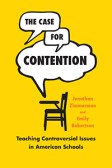
#1: Jonathan Zimmerman and Emily Robertson, The Case for Contention: Teaching Controversial Issues in American Schools.  From the publisher:

From the fights about the teaching of evolution to the details of sex education, it may seem like American schools are hotbeds of controversy. But as Jonathan Zimmerman and Emily Robertson show in this insightful book, it is precisely because such topics are so inflammatory outside school walls that they are so commonly avoided within them. And this, they argue, is a tremendous disservice to our students.

#2: Ronald W. Evans, Social Studies Wars: What Should We Teach the Children? From the publisher:

The history of social studies is a story of dramatic turf wars among competing political camps. In this volume, Ronald Evans describes and interprets this history and the continuing battles over the purposes, content, methods, and theoretical foundations of the social studies curriculum.

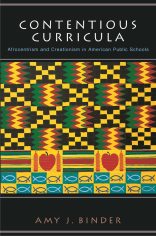
binder contentious#3: Amy Binder, Contentious Curricula: Afrocentrism and Creationism in American Public Schools. From the publisher:

Both [Afrocentrism and creationism] made similar arguments about oppression and their children’s well-being, both faced skepticism from educators about their factual claims, and both mounted their challenges through bureaucratic channels. In each case, challenged school systems were ultimately able to minimize or reject challengers’ demands, but the process varied by case and type of challenge.

#4: John Fea, Was America Founded as a Christian Nation? John Fea has long been one of the most astute and penetrating scholars studying the history culture wars. In this book he examines the claim that America’s history proves that it was meant to be a specifically Christian nation. If you don’t have time for his whole book, you can get a taste at his blog.

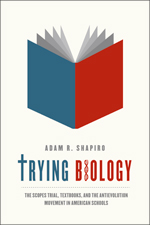
#5: Adam Shapiro, Trying Biology: The Scopes Trial, Textbooks, and the Antievolution Movement in American Schools. Okay, it’s not about US History, but Shapiro’s analysis of the process by which textbooks authors, editors, and publishers come up with a final product is an absolute must-read.

#6: Natalia Mehlman Petrzela, Classroom Wars: Language, Sex, and the Making of Modern Political Culture. Also beyond a narrow focus on history textbooks, Prof. Petrzela looks at the culture-war history of California schools in the twentieth century.

Trying Biology

#7: Sorry to include a book of my own, but The Other School Reformers looks hard at the politics of history textbooks. Conservative reformers spent a lot of time examining textbooks. They complained about progressive-sounding ones and successfully had them removed. They had less luck when they tried to publish textbooks of their own, as I recounted recently in these pages.

What else? This list is just a start. What other books and resources would you recommend for people interested in the culture-war politics of history textbooks?

I Love You but You Didn’t Do the Reading

Well, it looks like the holidays really are over. This week was full of action, from ineffective left-wing college brainwashing to God’s endorsement for 2020:

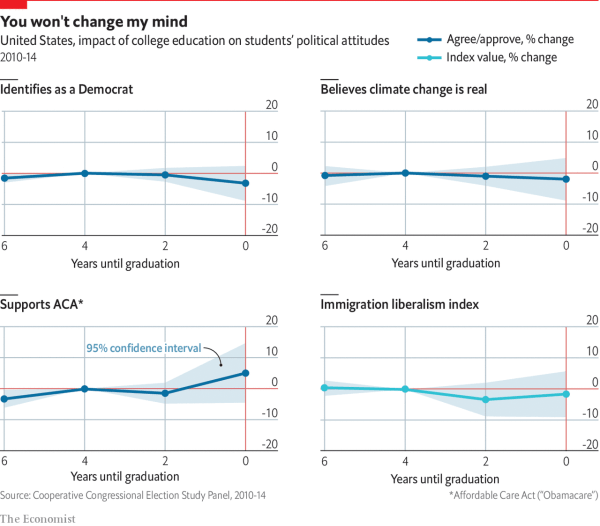
Are lefty professors turning college students liberal? Short answer: No. The Economist.

Although the survey responses oscillated from year to year, the effects were not big enough to be statistically significant. Such a lack of evidence should discourage people from believing that academic elites push their left-wing agenda onto their impressionable young pupils. But given how often conservative-leaning media rail against leftist indoctrination in universities, it almost certainly will not.

economist college influence

Not a lot of change there…

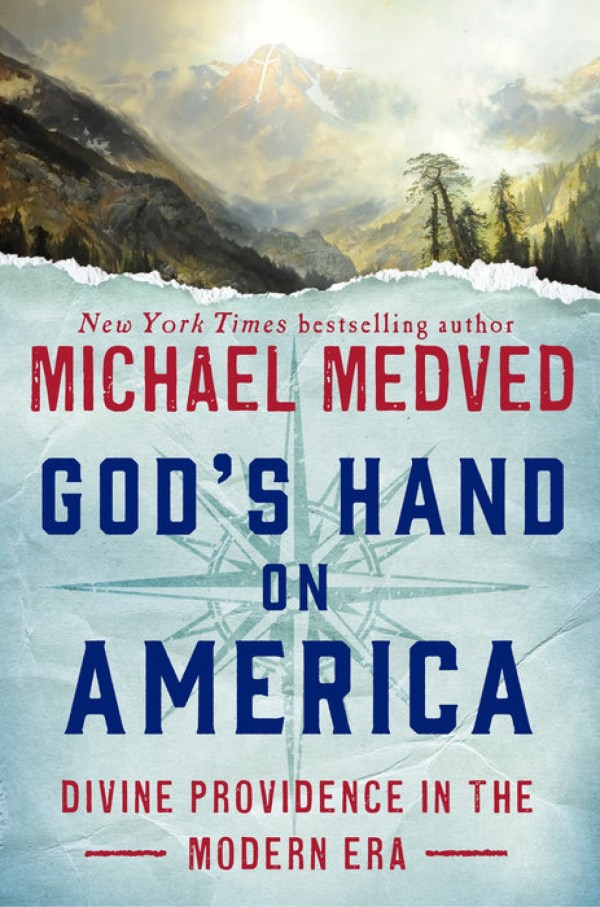
IS God’s hand on America? A review of Michael Medved’s new book at WaPo.

With every bullet that didn’t hit an intended target and every carriage or car accident that did not end in a fatality, [Medved] sees the hand of God. . . . The shameful, racist, violent aspects of the American narrative are swept away or excused. . . . for good or ill, the book will mostly appeal to listeners of right-wing radio and viewers of Fox News.

medved gods handSome people think it is. A skeptical look at the Evangelicals for Trump rally at USAT.

Trump the strongman was on display. Like autocratic leaders before him, he stirred fear among his people and offered them safety under his regime. . . . I was stunned when I witnessed evangelical Christians — those who identify with the “good news” of Jesus Christ —raising their hands in a posture of worship as Trump talked about socialism and gun rights.

Bernie: Ban high-stakes testing, at USAToday.

The most serious flaw of high-stakes testing . . . is that it ignores the real problems facing our teachers and students: social inequality and underinvestment in our schools.

How to teach history right, at EdWeek.

[Baltimore’s] emphasis on this [local history] approach that allows students to see themselves in history puts their own lives and people they know at the center of what can feel detached and distant. The consequences for this approach, if done right, can be profound, [Superintendent Sonja Santelises] argued. . . . it allows children to see complexity in history and not just (in the case of black Americans, for example) one long and painful struggle against oppression.

Well….yeah. More secure housing helped students do better on high-stakes tests, at Chalkbeat.

“Housing policy is education policy,” said Amy Ellen Schwartz, one of the researchers and a professor at Syracuse University. “We want to improve kids’ outcomes — sometimes what we’re going to have to do is look outside of the schoolhouse door and think about housing.”

God weighs in on 2020 elections:

“Evangelical Christians of every denomination and believers of every faith have never had a greater champion, not even close, in the White House, than you have right now,” Mr. Trump said. “We’ve done things that nobody thought was possible. Together we’re not only defending our constitutional rights. We’re also defending religion itself, which is under siege.”

Student #2 sues evangelical Fuller Seminary for anti-LGBTQ bias, at CT.

“It’s a very important case at this time in our nation’s history,” said Paul Southwick, the attorney representing Maxon and Brittsan. “This case could set an important legal precedent that if an educational institution receives federal funding, even if it’s religiously affiliated, even if it’s a seminary, that it’s required to comply with Title IX prohibitions on sex discrimination as applied to LGBT individuals.”

Richard Mouw comes out against Trump, at R&P.

When Trump’s evangelical supporters tell us that in presidential elections we are not voting for candidates for sainthood, I agree. . . . But Christians do have a responsibility to promote the cause of moral leadership in public life. And I do want Christian leaders to be guided in their decisions by keeping the “What would Nathan do?” question clearly in mind. The writer of the Christianity Today editorial has now done just that in the case of President Trump. I am grateful for the prophetic message.

Methodist split over LGBTQ also a split among colleges, at IHE.

“The younger generation will not want to continue to be involved in a church that continues to discriminate against the LGBQIA community,” said the Reverend Kah-Jin Jeffrey Kuan, the president of Claremont School of Theology. “This will allow for our seminaries to focus on our mission in training leaders regardless of human sexuality.”

Same publisher. Same authors. Different states = different textbooks, at NYT.

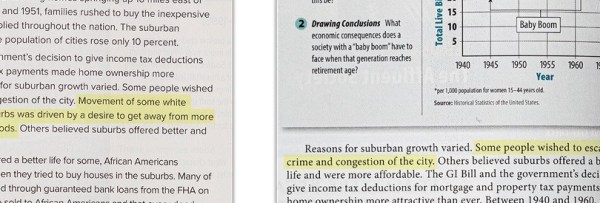
Texas says that white Southerners opposed Reconstruction because of tax increases as well as racial resentment. California instead includes primary-source quotations from black historical figures about white resistance to civil rights.

NYT TExtbooks CA TX

What students see in CA is not what they see in TX.

Conservative History Textbooks: The Rest of the Story

Have you seen it yet? The New York Times just published Dana Goldstein’s comparison of US History textbooks from California and Texas. The results won’t shock SAGLRROILYBYGTH. This morning I’ll offer a little additional history of the long feud over US History textbooks.

NYT TExtbooks CA TX

What students see in CA is not what they see in TX.

As Goldstein documented, US History textbooks look very different in the two states, even though they come from the same publisher and include the same authors. Yet the differences can be glaring. For example, in a section on the Constitution, the California edition notes that there have been some restrictions on Second Amendment gun rights. The Texas edition leaves that part blank. The California editions emphasize African American struggles and LGBTQ history far more than do the Texas ones.

It’s not only US History textbooks that have experienced this sort of regional culture-war editing. As Adam Shapiro explained in Trying Biology, science textbooks have long been an awkward weapon in evolution/creation culture wars.

As I argued in The Other School Reformers, in the twentieth century conservatives worked hard to promote a more-conservative textbook option. Their record was mixed. At times, conservative history-textbook activism flopped in embarrassing ways.

For example, in 1925 the American Legion commissioned a new, patriotic history of the United States. Too often, the Legion complained, American youth “grow up ignorant or anarchistic or otherwise ‘destructive.’” They needed a textbook that told the nation’s history as it really was. Namely, the Legion insisted, despite “occasional mistakes,” American history has been “so glorious that its proper study must inspire any child to patriotism.”

horne rejection AL

From the Legion commission’s report, 1926

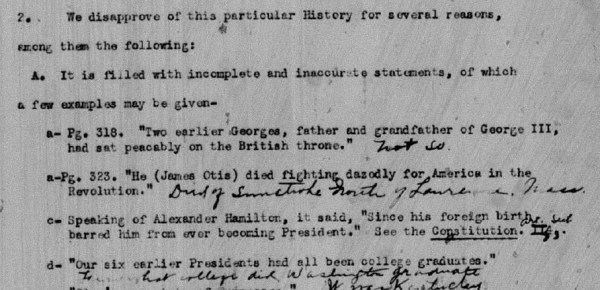
Unfortunately for the American Legion, the actual textbooks they commissioned were terrible. Like, Jefferson Lies terrible. After a prominent historian called them “perverted American history” in The Atlantic, the Legion appointed a special commission to analyze the books. After this Legion commission concluded that the books were “filled with incomplete and inaccurate statements,” the Legion withdrew their support and the textbooks stayed in their warehouses.

Other conservative activists have had far more success with their history activism. Most famously, the roots of the Texas bias that Dana Goldstein uncovered can be traced to the Daughters of the American Revolution. Journalists tend to focus on the textbook activism of Mel and Norma Gabler, which began in the 1960s. That activism mattered, but the Gablers got their ideas from the Texas DAR.

For decades, the DAR—at both national and state levels—made history textbooks the focus of their activism. For instance, in 1928 the national President General told the annual gathering that some state DARs had chosen

to look into the matter of textbooks used in some of the schools.  Individuals have sounded a warning that many books deny the Christian faith and contain sacrilegious and scornful sentences which will have a disastrous effect upon the impressionable minds of the young.

In 1941, a new President General repeated this call, in more gendered terms. As Helen Pouch exhorted her DAR audience,

Do all that women can do to eradicate questionable textbooks from the schools. This can and has been done in many cities.  It should be done in every city where these books are used.

Similarly, in 1950 new President General Marguerite Patton told the assembled DAR:

members should be especially aware of the schools in their own communities.  They should know the teachers who instruct their children; they should know the wording of textbooks, especially those pertaining to American history; and they should be cognizant of the manner in which the teachers present the subject matter to the pupils.  The interpretation of historical data can be, and often is, twisted erroneously, if a teacher is inclined to do so.

These decades of DAR activism paid off. DAR members were in a position to send uninvited “inspectors” to local schools to read textbooks and listen in on classroom teaching. They had the energy and drive to read through history textbooks to sniff out evidence of progressive politics or anti-patriotic teaching.

By the 1960s, their activism had become an expected part of textbook politics, especially in Texas. It lasted well into this century. If you haven’t seen The Revisionaries yet, it’s worth a watch. The documentary examines the conservative takeover of the Texas State Board of Education in the early 2000s.

Science and history were both targets of the new conservative majority. Creationist Don McLeroy wanted the science textbooks to help students reject mainstream evolutionary theory. McLeroy and his conservative allies also hoped to skew the history textbooks in a more conservative direction. From the list of required terms, the conservatives cut out “hip-hop” and inserted “country music.” They insisted on more about Reagan and the NRA.

More recently, too, Texas tweaked its list of required historical terms. In 2018, “Hillary Clinton” was out, but “Billy Graham” stayed in as terms Texas students needed to know.

It might seem shocking to some, but Texas’s careful curation of its history textbooks has a long and checkered history. Conservatives haven’t always won in Texas or elsewhere. When they did win, it was by harping on two points.

1.) Conservatives won by insisting their patriotic, conservative history was truer than other options. Conservatives haven’t won by saying kids should be kept ignorant. They’ve won by arguing that their vision is closer to historic fact. And,

2.) Conservatives won by insisting those other histories were at best misleading and at worst downright subversive. As always, any whiff of danger to students always makes parents and school administrators nervous. Conservatives have won their history-textbook wars when they’ve convinced enough people that their version of history is safer for both students and society.

Fundamentalist U & Me: Justin Lonas at Bryan College

Welcome to the latest edition of Fundamentalist U & Me, our occasional series of memory and reflection from people who attended evangelical colleges and universities. [Click here to see all the entries.] The history I recounted in Fundamentalist U only told one part of the complicated story of evangelical higher education. Depending on the person, the school, and the decade, going to an evangelical college has been very different for different people.bryan college logoThis time, we are talking with Justin Lonas. Justin is an editor and content developer for a non-profit organization near Chattanooga, Tenn. He is also working on an M.Div degree at an evangelical seminary in Atlanta.  
ILYBYGTH: When and where did you attend your evangelical institutions?

From 2002-2006, I attended Bryan College in Dayton, Tenn., graduating summa cum laude. I majored in communications (journalism emphasis) with minors in history and Spanish.

ILYBYGTH: How did you decide on that school? What were your other options? Did your family pressure you to go to an evangelical college?

I first heard about Bryan when I was 16 through a speaker at a homeschool convention in North Carolina who was on their faculty. His thoughtful engagement with cultural issues intrigued me, so I added the school to my mental list.  After visiting Bryan about a year later, I felt like it would be a good place to pursue—it was small (a very attractive point to someone who grew up in a crowded university town), and the students and faculty I met seemed very down-to-earth. Moreover, it was 4 hours from home so I could enjoy not having to go home all the time without quite fully “rebelling” by choosing a college on the other side of the country.

The other schools I considered were a mix of small-to-mid sized evangelical schools and public universities. Though I didn’t want to go to my hometown school (Appalachian State University), the other schools I seriously considered were all in NC: Mars Hill College (where I was offered a scholarship to study botany), Gardner-Webb University, and UNC (Chapel Hill).

As to family pressure, growing up in an evangelical family, and being educated both in private Christian schools and homeschooling, going to an evangelical college was, if not expected, at least not a surprise for me. Both my parents went to a state school and had found good Christian community through campus ministry groups, so they weren’t dead-set on any particular school for me. The only thing that I always felt was non-negotiable was that I go to college and do well. Where was secondary.

ILYBYGTH: Do you think your college experience deepened your faith? Do you still feel connected to your alma mater? What was the most powerful religious part of your college experience?

On balance, yes, my Christian faith was strengthened during my time at Bryan. The semi-compulsory chapel times were usually interesting, with many gifted outside speakers and often student-led music. The school’s baseline curriculum forced me to study the Bible at a deeper level than Sunday school, which I found fascinating. I was also able to connect with a local church in a nearby city (Chattanooga) that I actually joined and continued to attend for many years post-college as well. Many of the friendships forged on campus have lasted to the present, and though there were plenty of typical college shenanigans among us, there were also plenty of deep conversations about life and faith. Faculty routinely ate meals in the dining hall with students, and hosted students at their homes, seeing opportunities for spiritual discipleship as an extension of their educational mission.

Probably the most powerful religious aspect of my years at Bryan was not so much any particular high point as the consistency with which I saw Christian faith lived out by students and faculty alike (with plenty of exceptions, to be sure—including some pretty massive moral failures).

Connection to the school is a bit of a different question. On many levels, yes, I do feel very connected. Friendships with classmates and current and former faculty are still very much a part of my life, but I feel no particular connection to the school itself as an institution. I live just 40 minutes down the road, and I’ve been back to campus maybe 5 times in the past 13+ years. A large part of this has to do with some of the very public recent failings of the school (as referenced in the epilogue of Fundamentalist U). [Editor’s note: also discussed in these pages. See here or here.]

ILYBYGTH: Would you/did you send your kids to an evangelical college? If so, why, and if not, why not?

It’s an open question. My wife & I have four daughters, the oldest of whom is still a few years out from college, so I’d like to think I’d be willing to trust their judgment on which school is the best fit for them and the path they’re embarking on for life, career, etc. At the very least, I’d probably offer some strong cautions about any school they chose, as I don’t think you can ensure life outcomes through institutional structures—i.e. I don’t expect a school to do the work of the Holy Spirit in keeping them in the faith. I do think we’d be OK if they chose a Christian college, but these days, I’d feel better about a denominationally affiliated school with transparency and oversight than about an independent evangelical college. I’ve seen from Bryan in recent years how easy it is for an administration to gaslight people and become autocratic (even co-opting the board of trustees) without a much larger web of accountability at play.

ILYBYGTH: Do you still support your alma mater, financially or otherwise? If so, how and why, and if not, why not?

Neither my wife (who is also an alum) nor I have never financially supported Bryan College beyond one small gift to a regional scholarship fund some years ago. We both have felt for years (even during our time as students) that the current administration of the school was untrustworthy, and have had no confidence that any gifts would be spent wisely. We have also counseled friends away from sending their children to Bryan (in spite of some good things still going on there in several departments). We might be inclined to support the school in the future, if changes are made to how it is run. Time will tell.

ILYBYGTH: If you’ve had experience in both evangelical and non-evangelical institutions of higher education, what have you found to be the biggest differences? The biggest similarities?

I’m a “lifer” in evangelical schools, I suppose.  I do get to spend a lot of time with the faculty and administration of a denominationally accountable college now because of my job, and there are important distinctions there. The chief difference seems to be the level at which faculty are given academic freedom and encouraged to go deep into their disciplines with excellence rather than threatened when they don’t tow the party line.
On balance, campus life is culturally very similar to Bryan, and certainly when compared to a secular college.

ILYBYGTH: If you studied science at your evangelical college, did you feel like it was particularly “Christian?” How so? Did you wonder at the time if it was similar to what you might learn at a non-evangelical college? Have you wondered since?

I only took a couple of science classes during my time at Bryan (since I was in a B. A. humanities track). The botany class I took was very straightforward, proceeding in much the same way as I’d expect a similar introductory class to go anywhere, with the exception of a devotional at the beginning of each class. The professor (who is still a personal friend) really emphasized the historic role of wonder and religious awe in driving scientific inquiry, quoting people like Newton and Kepler, and reading George Herbert’s poetry.

I did also take a non-lab science course on physical origins—i.e. the origin of the material world—from Kurt Wise. Dr. Wise was no intellectual slouch, having earned a Ph.D. in paleontology at Harvard under Stephen Jay Gould, but was firmly a young earth creationist. In that course, though, he taught the first seven weeks from a materialist perspective, refusing to admit any religious or biblical arguments, and focusing on evidence and mainstream scientific theory. In the second half of the course, he made a case, based on his own work, for how the evidence could be read in such a way as to affirm a literal reading of the Genesis narrative. It was fascinating, really.

It is telling that both science professors I had left the school under the current administration, which has used an accusation of unfaithfulness to literal young-earth creationism as a pretext to purge several faculty. I suppose that even teaching alternate perspectives for the sake of intellectual honesty and ensuring students were well-informed was a bridge too far. I do feel, though, that the scientific education offered at Bryan was quite solid, given that several classmates who majored in sciences have gone on to become doctors or work at research institutions like the WHO and the CDC.

ILYBYGTH: Was your social life at your evangelical college similar to the college stereotype (partying, “hooking up,” drinking, etc.) we see in mainstream media? If not, how was it different? Do you think your social experience would have been much different if you went to a secular institution?

Social life was generally bounded by a Christian ethos—a fact which I’m actually quite grateful. Sex outside of marriage was very taboo, but dating couples weren’t required to be chaperoned. Public displays of foul language, drinking, smoking, drugs, etc. weren’t seen (though you could find them in private). Friends and I spent plenty of time camping, hiking, and rock climbing at a local wilderness with lax campus “sign-out” policies and late curfew. I never felt like someone was watching me to ensure compliance with social life standards. Most of our free time was spent in recreation—card games, fishing, intramural sports, etc.—but the school was academically rigorous, so free time was limited if you wanted good grades. It was a small place, where everyone knew everyone, so community accountability more than anything else served to enforce standards. About the most transgressive things I did was going out to smoke cigars in the shadow of a nearby nuclear power plant (which seemed, I guess, like a safe place) and partaking in the god-awful “wine” a hallmate made from Welch’s grape juice.

ILYBYGTH: In your experience, was the “Christian” part of your college experience a prominent part? In other words, would someone from a secular college notice differences right away if she or he visited your school?

Bryan was unmistakably a Christian school. There was a 50 ft. tall cross at the top of the entrance road, for one thing. The rhythms of church and chapel punctuated student life, and every class had some tie-in to faith. Nobody would’ve mistaken it for a secular school.

Ironically, one of the craziest run-ins I had with administrative autocracy while a student was the school’s attempt to change its motto from “Christ above all” to “faithful brilliance.” Our student newspaper (where I was an editor) ripped the administration over the issue, and helped spark an alumni backlash against the shift. This was one of many instances that helped convince me that the school’s president cared more about authority than any actual issues of “defending the faith.”

ILYBYGTH: Did you feel political pressure at school? That is, did you feel like the school environment tipped in a politically conservative direction? Did you feel free to form your own opinions about the news? Were you encouraged or discouraged from doing so?

There was definitely political pressure at school, but far more of it came from fellow students than faculty or administrators. There was a definite sense that God must be a Republican, and it was hard to imagine how anyone could be anything other than pro-life and anti-same-sex marriage. Capitalism was in vogue, too. It was also the heady post-9/11 and Iraq War days, so there was a strong pro-military vibe going around, and a busload of students volunteered to go canvas for Bush in Florida during the 2004 election. If anything, several faculty tried to be moderating influences on rampant student conservatism, hoping to get us to widen our lenses a bit. I did not try very hard to form my own political opinions, and when I did (considering the legacy of racism in evangelicalism and conservative politics, for instance) I found ready encouragement from faculty. These days, I’d consider myself much more politically liberal than my collegiate self, not because I’ve drifted from my faith, but precisely because I’ve gone deeper into studying and applying the teachings of Scripture (particularly around care for the poor).

ILYBYGTH: What do you think the future holds for evangelical higher education? What are the main problems looming for evangelical schools? What advantages do they have over other types of colleges?

The future of higher education in general in the U.S. seems to be in doubt. Student loans have been a crushing weight on so many of my friends that many of us have openly considered whether college is worth it, and shared that we’d be perfectly happy if our kids went into a trade or other career that didn’t require a degree. Evangelical schools aren’t immune to these general pressures, either.

In addition to these general problems, I think a whole generation of Christians (and people of other or no religion who were raised Christian) have soured greatly on evangelical institutions due to repeated scandals of sexual abuse and coverups, financial malfeasance, and other legal problems. We see “leaders” supporting a manifestly corrupt and immoral president like Donald Trump at the expense of Christian witness to people in the rest of the world, and the whole edifice of evangelicalism starts seems like a fig leaf for power worship and egotism. If evangelical schools are going to survive by attracting the children of this generation to attend, it will be because they are able to cultivate an atmosphere of intellectual honesty and academic freedom within a culture gone crazy. When they feel like just so much more tribalism and cult-like authoritarianism, what’s the point?

If there is any advantage to evangelical schools over other colleges, it directly correlates to their willingness to be open and honest. Even secular schools have their ideological shibboleths and inquisitions, so evangelical colleges that are confident enough in their faith to assume that it is not the school’s responsibility to force social and spiritual outcomes may be able to rejuvenate the whole enterprise of higher ed. This hope is on an ideal plane, though. Most evangelical schools are in no wise prepared to pursue that vision.

Thanks, Mr. Lonas!

Did YOU attend an evangelical college? Are you willing to share your experiences? If so, please get in touch with the ILYBYGTH editorial desk at alaats@binghamton.edu

The DeVoses Have Always Been Wrong about College

You’ve probably seen the graph floating around the interwebs this week. The Economist reported that–despite jeremiads by Betsy DeVos–higher education in America does not seem to be turning students into left-wing drones. As SAGLRROILYLBYGTH know, conservatives have always fretted about it. And they’ve always been wrong. Their schemes to infiltrate left-wing colleges have never panned out and today’s college conservatives should pay attention.

economist college influence

Not a lot of change there…

In a speech a few years back, Queen Betsy warned students that college was trying to brainwash them. As she put it,

The fight against the education establishment extends to you too. The faculty, from adjunct professors to deans, tell you what to do, what to say, and more ominously, what to think. They say that if you voted for Donald Trump, you’re a threat to the university community. But the real threat is silencing the First Amendment rights of people with whom you disagree.

Were QB’s worries fair? The Economist dug through a study of political thinking among college graduates. Either college professors—who really do skew to the left—are not “ominously” trying to tell students “what to think,” or they’re bad at it. As The Economist summarized,

Between 2010 and 2014, survey respondents were asked every year which political party they identified with. The share identifying as Democrats did not shift significantly between freshman year and graduation. Similarly, when asked about their political viewpoints, the share of students identifying as conservative changed little during their time at university. The same pattern held for questions about climate change, health care and immigration.

Yet Queen Betsy’s vision of the college threat is anything but idiosyncratic. Throughout the twentieth century, the conservative educational activists I’ve studied uniformly agree that left-wing professors are a deadly threat to students’ faiths and America’s chances.

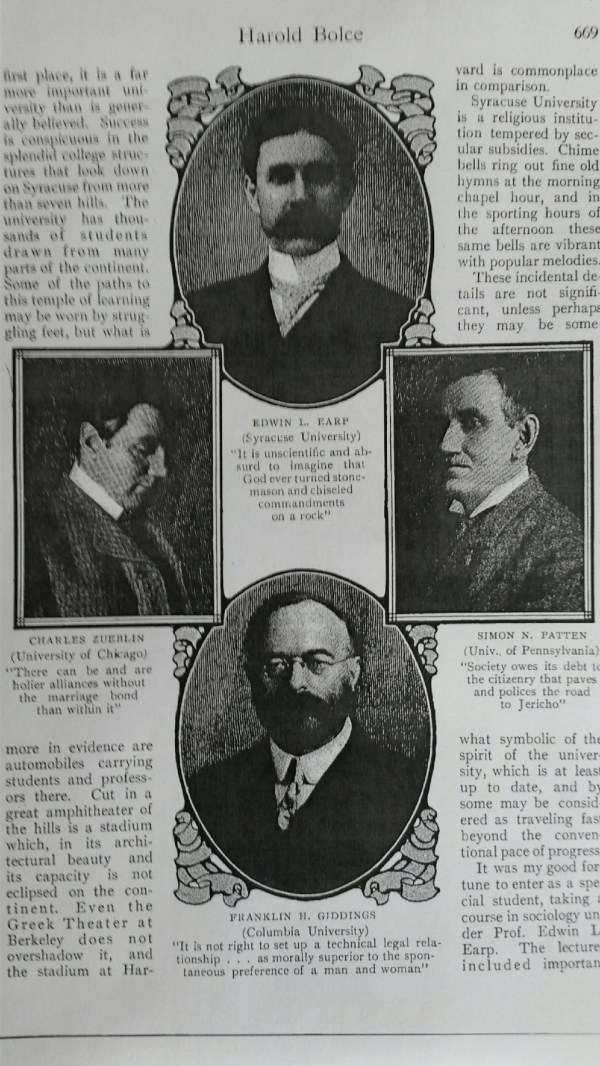
In 1909, for example, journalist Harold Bolce scored a major scoop when he interrogated college professors about their secularism and anti-Christian ideas. For example, Bolce quizzed Syracuse sociologist Edwin L. Earp and reported to America that the professor no longer valued traditional religion. As Bolce wrote in Cosmopolitan (yes, Cosmo),

‘Do you not believe, Professor,’ I asked, ‘that Moses got the ten commandments in the way the Scriptures tell?’

The professor smiled.  ‘I do not,’ said he.  ‘It is unscientific and absurd to imagine that God ever turned stone-mason and chiseled commandments on a rock.’

bolce page image

Left-wing professors, c. 1909.

Earp was not alone, Bolce warned. At all leading colleges, issues such as “marriage, divorce, the home, religion, and democracy,” were studied and propounded “as if these things were fossils, gastropods, vertebrates, equations, chemical elements, or chimeras.”

Conservative anxiety about college professors never went away. In the 1920s, for example, William Jennings Bryan often warned about the dangers of higher education. He liked to cite a study by psychologist James Leuba, which found that more than half of “prominent scientists” in the USA no longer believed in a “personal God and in personal immortality.” The upshot on college campuses where those scientists taught? Though only 15% of freshman had discarded Christianity, Leuba found, 30% of juniors had and 40-45% of graduates did.

It hasn’t only been religious conservatives like Bolce, Bryan, and DeVos that have worried. In 1939, the obstreperous leader of the American Legion’s Americanism Commission schemed with a business ally to disrupt the goings-on at Columbia University. Both men—Homer Chaillaux of the American Legion and Alfred Falk of the National Association of Manufacturers—assumed that colleges were ideologically dangerous places. Professors at Columbia had been spewing their left-wing propaganda into the ears of students for too long.

What could they do about it? Chaillaux told Falk that he had some spies “on the inside at Columbia University.” Chaillaux planned to have those “friends” conduct a campaign against leftist professors among students. As Chaillaux optimistically predicted,

possibly we can make the classes of such instructors as George S. Counts and Harold O. Rugg sufficiently unpopular to reduce their present drawing power.

It might sound nutsy to dream of sending secret right-wing agents onto college campuses to denounce and dethrone popular leftist professors, but Queen Betsy and the rest of the Trump regime are engaged in similar stuff these days.

Perhaps most famously, Charlie Kirk and Turning Point USA have made a career out of provoking leftist backlash from college students and professors. And now, Kirk has teamed up with Trump’s favorite evangelical Jerry Falwell Jr. to open a new kind of campus center, one devoted to promoting Trumpist ideas in higher ed.

Will it work? No. It wasn’t necessary or effective in 1939 and it won’t happen today. I don’t doubt the sincerity of Queen Betsy (though I’m iffy these days about Kirk or Falwell). For a century and more, conservatives have fretted that colleges in general were left-wing indoctrination factories. They’re not. At least, they’re not very good ones.

Were You Trumpared, Part Deux

Thank you, The Internet! Yesterday I asked you if you were surprised by the rise of Trumpism. Over on The Twitter, some topnotch academic historians shared their experiences. I’ll share a few highlights here for those SAGLRROILYBYGTH who don’t tweeter.

It started with an offhand comment by blogger Peter Greene. As he reflected on the end of 2019, he noted,

In many ways, becoming a student of ed reform prepared me for a Trump presidency, because it made me really confront the degree to which many of my fellow citizens do not share values that I had somehow assumed were fundamental to being a citizen of this country.

Unlike The Curmudgucrat, my experiences in the 2010s left me utterly unprepared for the rise of Trump. The archives I explored for my book The Other School Reformers led me to conclude that Trumpish tendencies were usually quashed by conservative organizations, in the name of “respectability” and “mainstream” appeal.

It appears I wasn’t alone. As Rick Perlstein shared, he had to re-calibrate his thinking. He had written back in 2016,

I’ve been studying the history of American conservatism full time since 1997—almost 20 years now. I’ve read almost every major book on the subject. I thought I knew what I was talking about. Then along comes Donald Trump to scramble the whole goddamned script.

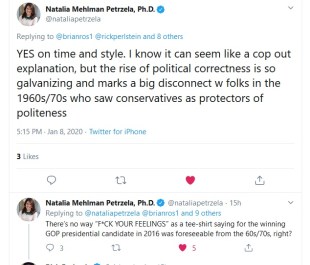
And, as Natalia Mehlman Petrzela noted, the “time and style” of Trumpish conservatism feels a lot different from the conservatism of the later twentieth century. As Prof. Petrzela asked,

There’s no way “F*CK YOUR FEELINGS” as a tee-shirt saying for the winning GOP presidential candidate in 2016 was foreseeable from the 60s/70s, right?

natalia on TrumpIt seems that Trump’s ascendancy has changed the way historians of conservatism approach the topic, or at least pointed us in slightly different directions. As Kevin Kruse wrote, he is now working on a new book about

“law and order” politics as seen through NYC[.]

It doesn’t usually work this way, but yesterday at least Twitter helped me learn a lot about a complicated topic and gave me a new reading list. I just ordered a copy of Timothy Lombardo’s book about Frank Rizzo and blue-collar conservatism in Philadelphia.

From the Archives: Were You Trumpared?

I wasn’t. Studying populist conservatism taught me the wrong lessons—I thought conservatives would never tolerate an anti-strategic leader like Trump, even if they liked his policies. I wrongly believed more conservatives would do anything to maintain their reputations as respectable mainstream traditionalists. Did anything in your background prepare you to have a president who flits from tweet to tweet and treats foreign policy like a reality-TV ratings sweep?

Peter Greene says his did. As he wrote recently,

In many ways, becoming a student of ed reform prepared me for a Trump presidency, because it made me really confront the degree to which many of my fellow citizens do not share values that I had somehow assumed were fundamental to being a citizen of this country.

Here’s where I went wrong: In my 2015 book The Other School Reformers, I looked at the kind of populist conservatism to which Trump appeals so strongly. I didn’t study conservative intellectuals, but grass-roots activists who tried to push schools in conservative directions.

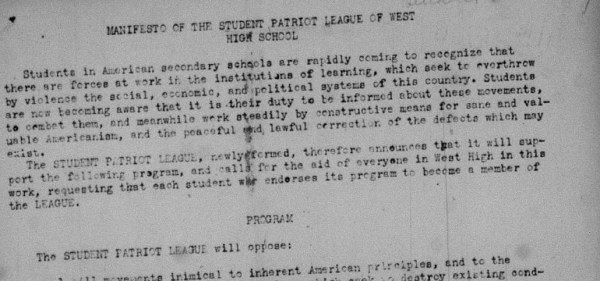
SPL 1

From the American Legion Archives, c. 1936.

Throughout the twentieth century, conservatives refused to be dominated by the anti-strategists in their camp. Time after time, conservative organizations carefully curated their public image to avoid the “extremist” label. Not all of them, of course, but the ones that really mattered. I thought—wrongly—that this pattern would continue.

My surprise is not about Trump’s specific policies. I can see how any conservative would love having Neil Gorsuch and Brett Kavanaugh on SCOTUS. My surprise is about style and strategy. In the history of American grass-roots conservatism there has always been an element we might call “Trumpish.” Meaning mercurial, impulsive, and unwilling to think through the likely consequences of any given action. Meaning acting first—speaking without reflection—heedless of accusations of radicalism or extremism. In Krusty-the-Klown terms, Trumpism means saying the quiet part loud and the loud part quiet.

In the past, that element was always held in check. Not by “faculty lounge” conservatives, but by practical, hard-nosed activists who wanted to win votes long-term.

This morning I’ll share an example from the archives that I hope will illustrate the tradition and demonstrate why I was so un-prepared for the triumph of Trumpism among American conservatives.

Exhibit A: The American Legion and the Student Patriot League, c. 1935. In the mid-1930s, the American Legion had a hard-earned reputation as a tough defender of a conservative patriotism and flag-waving militarism. The Student Patriot League was formed separately as part of a desire to get young people involved in fighting—literally fighting—for those values. The unofficial goal of the SPL was to send uniformed brigades of conservative youth to leftist rallies to disrupt them.

How did the American Legion respond? At the time, the obstreperous head of the Americanism Commission, Homer Chaillaux, engaged in a careful two-sided interaction. Officially, the American Legion had no relationship with the SPL. Chaillaux was worried that any violence would ruin the Legion’s already-shaky reputation as a reputable mainstream group. Publicly, Chaillaux maintained a careful distance between the SPL and the Legion. He told SPL leaders that he could not officially endorse their activities.

Unofficially, however, Chaillaux distributed SPL materials among his friends and allies. Chaillaux privately told his friends the SPL was a

splendid organization of scrappy young Americans who are students in high schools and colleges of the United States.

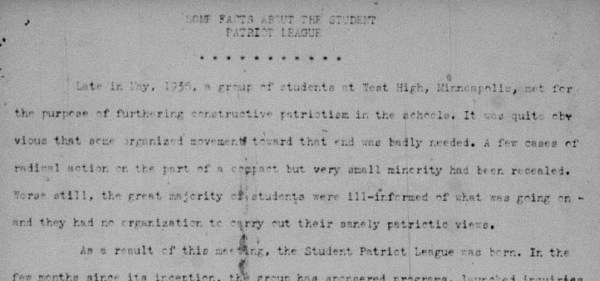
So what? The interactions between the Legion and the SPL demonstrate the ways grassroots conservative organizing used to work. There is no doubting Chaillaux’s dedication to his conservative principles. When it came to a new and untested youth organization, however, Chaillaux maintained a cautious official distance.

SPL 2

Conservatives used to care about their reputations for mainstream respectability.

That has always been the strategy of (most) conservative organizations. They have thought carefully and deliberately about their public image. They have been leery of losing credibility and ending up dismissed as extremists, like the Ku Klux Klan or eventually the Birchers. Or even Barry Goldwater or Curtis LeMay. Mainstream respectability used to matter to conservatives. A lot.

Trump doesn’t seem to care about his respectability. He doesn’t seem to mind the outrage and consternation caused by his last-minute decisions, even when the outrage comes from his own conservative allies. Instead, Trump does Trump and lets the chips fall where they may. That’s what I was unprepared for.

How about you? Were you like Peter Greene, prepared for the triumph of Trumpism? Or were you more like me, expecting GOP leaders to care primarily for their public image as respectable maintainers of the mainstream status quo?