What They Missed about Liberty Online

Want to understand evangelical higher education these days? Then you need to read the recent exposé of Liberty University’s online program in the New York Times. But when you do, remember that they left out a central piece of the picture.

moody literature mission

Early distance-learning programs at MBI claimed to reach the world with cutting-edge technology, c. 1947. These “mountaineers” got free Gospels if they read them in school. And, yes, that is their school building.

The Liberty Online story is a big one. As the Times article describes, Liberty now claims $2.5 billion (yes, that’s B-illion with a B) in net assets, largely from its online department. Because Liberty is a non-profit, it is not subject to the same oversight as for-profit schools such as Corinthian and the University of Phoenix.

Some online students, the article describes, felt pressured to sign up and ripped off with the results. As one unhappy former Liberty student told the Times,

What’s killing me is that I went into this program to try to change my situation . . . and I’m worse off than I was at the beginning.

It’s an ugly story. There is no doubt that Liberty’s online program has been a cash cow. As we’ve noted here at ILYBYGTH, there’s also no doubt that Liberty’s Jerry Falwell Jr. has plowed his online profits back into the brick-and-mortar campus. Sports, star faculty, and campus facilities all get plenty of funding. Recently, the Liberty football squad used that money to fulfill one of the school’s long-standing dreams by defeating top-ranked Baylor.

But the Times story leaves out a crucial part of the historical context. The way they put it, Liberty’s online program came about as part of an experiment, an “educational novelty.” As the article explains,

One educational novelty that Falwell dabbled in, starting in the mid-’70s, was an early form of distance learning. Liberty would mail lecture videotapes and course packets to paying customers around the country — at first just certificate courses in Bible studies, and by the mid-’80s, accredited courses in other subjects as well.

The inspiration, according to the NYT, was the work of John Sperling and the University of Phoenix. I don’t doubt that President Falwell Jr. admired Sperling’s business model. I don’t dismiss the importance of the notion that Falwell has treated his school, as he told NYT, “like a business.”

However, if we really want to understand Liberty’s online success, we have to also understand its context as part of the history of evangelical higher education. It is difficult for some secular people (like me) to notice or acknowledge, but evangelical schools and missionary institutions have always led the way with finding new ways to use new technology to deliver distance education.
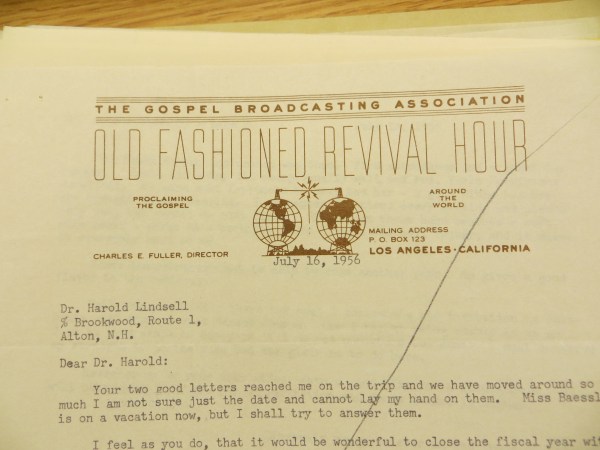
letterhead from BGC 3

Check out the 1950s-era “high-tech” logo! More evidence of the evangelical obsession with technology and distance learning, from Fuller Seminary, c. 1956.

Perhaps the best example might be the Moody Bible Institute in Chicago. No matter the decade, no matter the technology, the Moody educational empire has found ways to expand its reach using new technological means. The drive is obvious: For MBI and other evangelical institutions, the primary goal is to deliver the Gospel to as many human eyes and ears as possible, as fast as possible. If new technology will help accomplish that mission, all the better.

To note just a few of the best-known programs, MBI was a pioneer in early radio, with its WMBI established in 1926 to bring the Word to the world. By 1940, WMBI’s Radio School of the Bible had over 10,000 registrants. In 1942, WMBI claimed to broadcast its programs through 187 radio stations across the USA, Canada, China, and Latin America.

In the 1940s, MBI set up its Moody Institute of Science, distributing missionary science films to a wide audience.

At the same time, MBI carried out less-well-known distance-learning programs as well. As I discovered in the MBI archives, from the 1920s through the 1960s the Moody Literature Mission delivered millions of books and tracts to readers throughout the country and throughout the world.

The point of these distance-learning programs was always the same. MBI, like all evangelical colleges and universities, had a mission of missions. It was dedicated to training young people to carry the Gospel around the world. And, unlike some people’s image of stuffy Luddite conservatives, evangelical institutions were always pioneers in every type of technology: print, radio, film, and internet.

So when the Jerry Falwells experimented with distance education, they weren’t innovating at all, really. Rather, they were merely continuing the long tradition of evangelical higher education—using all available means to deliver the Gospel around the world.


Biblical Peanut Butter at the Museum of the Bible

What is the Museum of the Bible for? Its conservative-evangelical founders insist it is supposed to be more like the Smithsonian than the Ark Encounter, but recent revelations have left me puzzled.motb-peanut-carver.jpeg

Here’s what we know: Thanks to the generosity and diligence of an ILYBYGTH correspondent who prefers to remain anonymous, your humble editor recently came into possession of some MOTB publications.

Most intriguing, MOTB publishes a glossy booklet, 99 Earth-Shattering Events Linked to the Bible. As the title promises, this publication offers biblical connections to 99 key events in human history, from the Magna Carta to Nelson Mandela.

Some of them have left this reader scratching his head. They certainly seem more Ark Encounter than Smithsonian. Am I missing something?

For example, the book credits the Bible for inspiring George Washington Carver to “Unlock . . . Peanut’s Potential.” We all know Carver’s remarkable story. In this telling, though, it was not grit or genius or perseverance that fueled Carter’s career, but rather the text of Genesis I. “To Carver,” the booklet explains,

This Bible passage revealed the potential of what he could do with the peanut to help others be lifted from poverty—particularly, the struggling African American farmers.

To this reader, the connection seems…strained, to say the least. Dr. Carver may have been an earnest Bible-believing Christian and he may have given his faith credit for his work. But so did the white-supremacist politicians and their violent allies who forced African American scientists into segregated institutions.

How can we credit the Bible for one, without also blaming it for the other? To me, this seems like Wallbuilders history–not a sincere attempt to understand the past, but rather a collection of awkward celebrations that distort the historical record.

Keeping the Faith in Evangelical Colleges

Thanks to Eric Miller and Religion & Politics for publishing an interview this afternoon about Fundamentalist U.Bob-Jones-GettyImages-50615822-780x508

Professor Miller asked questions that got right at the heart of the book: What does it mean to be a “real” college? How did students react to the strict rules at evangelical colleges? Do evangelical schools have academic freedom?

Click on over to read the entire thing.

At first, I thought Professor Miller was simply a peculiarly acute reader, but it turns out he himself spent some time in evangelical higher ed, so he really knew what he was talking about.

Are Christians Allowed in New York?

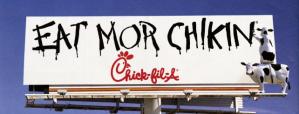
It makes conservatives furious, but is Dan Piepenbring right? Piepenbring recently blasted Chik-fil-A’s “creepy infiltration” of New York City in the pages of the New Yorker. The brouhaha shows how little most of us understand about New York’s real status in our continuing culture wars. It has never really been the Great Sodom that conservatives excoriate and progressives celebrate.

chickfila20160721billboard2

The Christians that never sleep?

Piepenbring is mad that Chik-fil-A is sneaking into his city. He dislikes the conservative evangelical politics of the chain’s founder. More than that, though, he seems put out by the Midwestern aw-shucks-ism at play. Piepenbring seems offended by the way Chik-fil-A imported a family-values vibe into his grunge-chic citycape. The company’s trademark Cows exemplify the problem. As Piepenbring puts it,

The joke is that the Cows are out of place in New York—a winking acknowledgment that Chick-fil-A, too, does not quite belong here.

Conservatives reacted with predictable hauteur. For example, American Conservative’s Rod Dreher blasted Piepenbring’s “Yankee bigot[ry].” “In terms of parochial, un-self-aware narrow-mindedness,” Dreher opened,

it is hard to beat this piece from the New Yorker on how the a [sic] popular purveyor of delicious chicken and waffle fries is making Manhattan into an unsafe space.

It should be funny, Dreher notes, to read anything that soberly invokes phrases such as “suburban piety.” In actual fact, Dreher concludes, Piepenbring’s half-baked screed is more than a sad joke; it serves as yet more evidence of widespread “anti-Christian bigotry.”

I can’t agree with Dreher’s main point about anti-Christian bigotry, but I do think that Piepenbring’s brand of “keep New York weird” rhetoric misses some important truths. Full disclosure: I share the desire to sponsor local over chain. Up here in sunny Binghamton, I go to Laveggio instead of Starbucks; Consol’s instead of Olive Garden. But even though I share Piepenbring’s anti-corporate aesthetics, I can’t help but think he is willfully ignoring some fundamental truths about his city.

It’s beyond obvious, of course, that New York City is the headquarters of America’s financial and corporate culture. Less obvious, perhaps, is that New York has also served as a center of conservative evangelical intellectual culture and activism.

A century ago, progressive New Yorkers were similarly riled by the fiery fundamentalism of New York’s John Roach Straton, pastor of Calvary Baptist and one of the undisputed national leaders of the 1920s fundamentalist movement. I spent some time with Straton’s archived papers a few years back and they are chock-full of ardent correspondence with all the top conservative evangelicals of his generation.

Again and again, fundamentalist intellectuals and activists praised Straton and acknowledged his New-York-based leadership of the national fundamentalist movement. In 1922, for example, the president of fundamentalist Wheaton College in Illinois wrote to Straton

to thank you for the attack you are making on the infidel teaching of our time.

Beyond any dispute, Straton used his New York City headquarters to fight evolution and theological liberalism. He used the cultural clout of his big-city address to add oomph to his fundamentalist activism. Yet even his fundamentalist admirers tended to assume that fundamentalism was not a true product of the Big Apple. Straton himself sometimes agreed. In spite of the fact that he had built his fundamentalist empire from Manhattan, Straton told the New York Times in 1925 that fundamentalism was a Southern thing. As Straton put it, fundamentalism represented

a rising tide of spiritual earnestness preparing in the South and West which will sweep the country.

Even today, New York City is home to some of conservative evangelicalism’s most vital institutions. Most notably, The King’s College moved downtown in order to exert its presence in the heart of Gotham. As one enthusiast put it, by moving to New York, TKC could be

a counter cultural Christian college in New York City that leads with academic excellence and ‘convictional civility.’

Though both conservatives and progressives have tended to assume that conservative evangelicals don’t fit in New York’s hurly-burly cultural landscape, both sides have frequently missed the long, continuing tradition of New York’s role as a capital city of conservative evangelicalism.

They don’t agree on much, but both sides seem to ignore New York’s real role as an international headquarters of conservative evangelical religion. Why?

Cheapskate Corner!

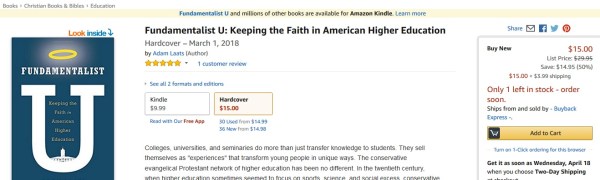
Okay, SAGLRROILYBYGTH: No more excuses. You can’t afford NOT to buy your copy of Fundamentalist U now.

amazon saleApparently sales have been brisk. By the mysterious logarithms of our Amazon overlords, that means they lower the sticker price. I noticed this morning that Amazon has lowered the price to a measly fifteen bucks! So get yr copy today.

I Love You but You Didn’t Do the Reading

Racist Simpsons and other stories that came across our desks this week…

The White House Bible study group, at BBC. HT: MC

  • A “high-protein diet” of conservative evangelical Christianity for the Cabinet.

Much Apu about Something: The Simpsons punts on its racial stereotypes, at EW. HT: MM

How much public school can you buy for $25 million? Not as much as this billionaire wanted, at PI. HT: MM.

The “free-speech crisis” is worst at evangelical colleges, says Sarah Jones at NR.

Peter Greene asks: Why are we still giving Big Standardized Tests?

“Teaching for homecoming:” Why Wendell Berry thinks education is dangerous, at Forma.

  • “I know you all are learning a lot of methods about how to teach, and I’ll tell you something: None of them will work.”

Pro-choice “callous and violent,” says Ross Douthat at NYT.

The progressive perfidy of “dialogue:” Rod Dreher at AC.

There Is No Free-Speech Crisis at Evangelical Colleges

Have you seen it yet? Sarah Jones recently excoriated evangelical higher education as the home of the real free-speech crisis. Students and faculty alike, Jones reported from experience at Cedarville University in Ohio, are continually deprived of any right to authentic self-expression. She’s right. But that doesn’t mean there’s a free-speech crisis at evangelical colleges. There can’t be.

cedarville-logo-social-media-default

No one said it was for freedom of speech…

Why not? It’s not for the reasons Pietist Schoolman Chris Gehrz describes, though he makes an important point. As he argues, different evangelical schools have hugely different records and policies when it comes to free speech.

And it’s not because Jones misses the boat on the ways evangelical colleges restrict student and faculty speech. I agree with her entirely that the environments of many evangelical campuses can be restrictive, oppressive, and even dangerous. When students don’t feel free to report sexual assault or abuse, for example, they are put in a horrible position.

Yet even granting the truth of Jones’s alarming exposé, I don’t agree that evangelical colleges represent the real free-speech crisis in American higher education. They can’t. Evangelical colleges don’t have a free-speech crisis any more than my school faces a religious crisis for not adequately teaching students how to be good Christians. We don’t want to train good Christians. And evangelical colleges have never wanted to open their chapels, classrooms, and cafeterias to unrestricted speech.

Rather, as I argue in my recent book about evangelical higher education, restricting free speech is a central, defining element of the tradition. It sounds sinister when I say it like that, but it’s true. Professor Gehrz is absolutely correct that some schools today have stricter rules than others, but for almost a century now, the point of evangelical higher education is precisely to impose certain restrictions on faculty and students, restrictions abandoned by mainstream colleges.

To suggest that these restrictions are part of a “crisis” misses the point. Please don’t get me wrong: I sympathize whole-heartedly with Jones and the other students and faculty who dislike their alma maters’ heavy hand. I would dislike it, too. But that heavy hand is not a “crisis.” It can’t be. It is the entire raison d’etre of evangelical higher education.

Consider the promises of evangelical leaders throughout the twentieth century. Explaining the purpose of his new college in Florida, founder Bob Jones Sr. explained it this way in 1928:

Fathers and mothers who place their sons and daughters in our institution can go to sleep at night with no haunting fear that some skeptical teachers will steal the faith of their precious children.

At Bob Jones College, as at all the schools that joined the fundamentalist movement in the 1920s, restricting faculty speech was a primary purpose, not an unfortunate necessity. Unlike mainstream colleges, including mainline Protestant ones, fundamentalist colleges would willfully impose strict lists of mandatory beliefs for faculty members. They would impose long list of behavioral rules for students. And they insisted always that their goal was to shape students’ hearts in a certain religious direction.

Lest readers think the tradition was only in the 1920s, or only at fundamentalist Bob Jones University, consider this quotation from relatively liberal Wheaton College in 1963. President V. Raymond Edman told recalcitrant students about his vision for Wheaton. “This college,” Edman told students,

will be a place Christian parents can send their children to with the confidence that their faith will be established and not shaken.

In other words, the entire point of the network of dissenting evangelical colleges was to police faculty belief and student thought. Evangelical colleges that restrict speech these days don’t face a crisis. They fulfill a promise.

Dayton Dilemmas II: The Devil Made Them Do It

SAGLRROILYBYGTH: If you want small, unsatisfying, boring meals, don’t come to Dayton. As far as I can tell, thanks to hospitable hosts, life in Dayton is a steady stream of fantastic meals and challenging, thought-provoking conversation. At a talk yesterday at the University of Dayton about the connections between white evangelicals and “Make-America-Great-Again” patriotism, one grad student brought up an absolutely essential point. Namely, when it comes to understanding fundamentalist politics, we can’t leave out Satan.dayton flyers

We’ve talked about this topic recently when it comes to the specific topic of creationism. As I’m arguing in my upcoming book about creationism, secular folks like me have often misunderstood the nature of creationist thinking. We have assumed that creationists are making decisions based on secular reasonings. We forget that many creationists understand the world in supernatural terms, at least in some measure. When we do, we give up any chance of really understanding radical creationist thought.

The same is true for understanding the politics of conservative evangelical intellectuals.

cover

From the Bob Jones University archives…

In my talk yesterday, I tried to explain the long tradition of MAGA patriotism among white evangelical intellectuals and academics. Today’s leading evangelical intellectuals often don’t like the idea, but in the twentieth century evangelical higher education was firmly committed to the notion that their schools would teach a certain sort of defiant, nostalgic patriotism.IMG_1648

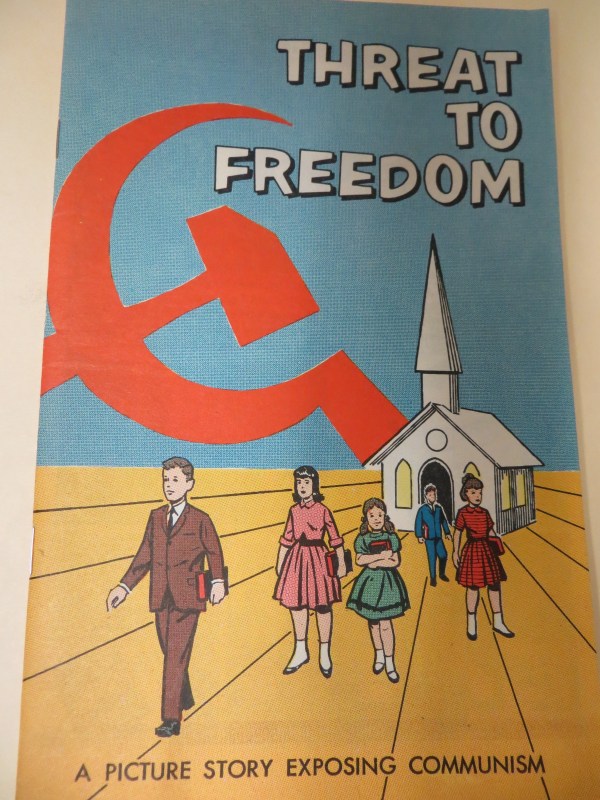
One graduate student—a self-identified “recovering fundamentalist”—brought up a key idea: If we really want to understand how conservative evangelicals could combine their faith so tightly with their nationalism, we need to remember the supernatural context. Especially in the twentieth century, this student pointed out, the cold war often took on the shape of an apocalyptic showdown between the Soviet Union and the United States.

IMG_1649

How to mix church and country, Bob Jones style…

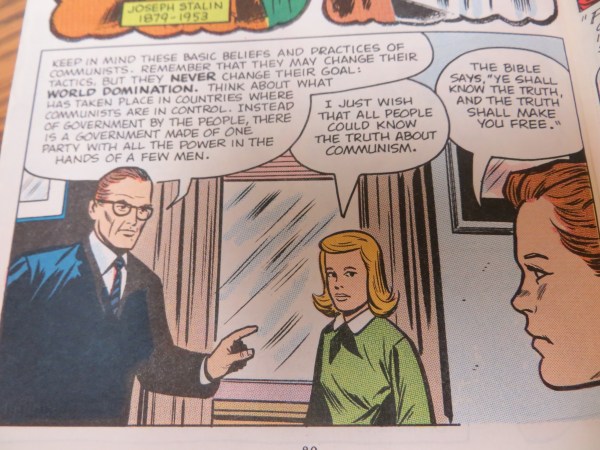
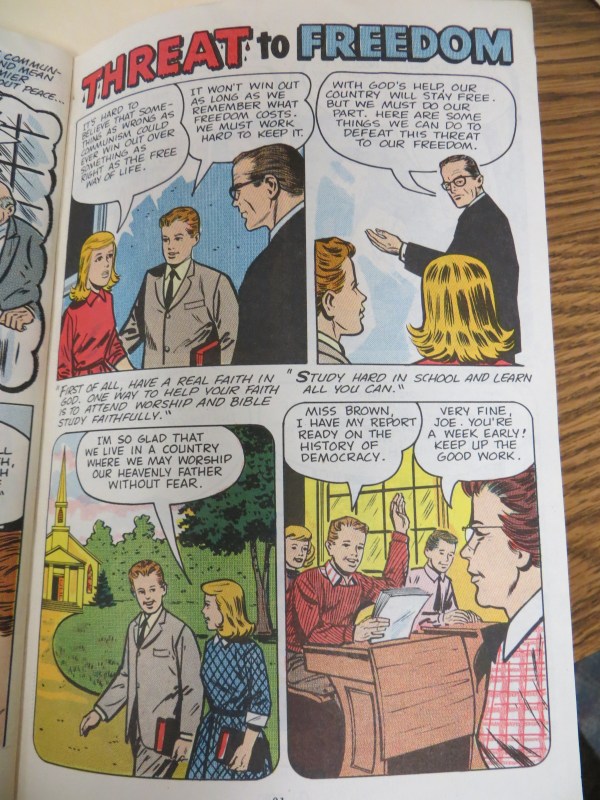
For many fundamentalists at the time, the supernatural connections were too obvious to need explaining. The Soviet Union was the political incarnation of Satan. It was a nation and empire wholly guided by the devil’s machinations. Its goals were nothing less than both worldly and eternal domination.

It wasn’t much of a leap, then, to mix together a patriotic faith in the United States with a religious devotion to evangelical Christian values. Defending traditional Americanism was entirely equal to defending true evangelical religion, and vice versa. When the eternal mixed so profoundly with the national, it was not at all difficult or unusual for white fundamentalists to mash together their religious faiths with their patriotic fervor.

Dayton Dilemmas I: WBR and Christian Nationalism

How could they do it? How could earnest, intelligent, educated Christians ever mash together their faith with their patriotism? That’s the tough question people were asking yesterday at the University of Dayton. I don’t have an easy answer, but I do think the case of William Bell Riley helps shed some light on it.dayton flyers

First, the background: Thanks to the dynamic scholarly duo of Professors Bill and Susan Trollinger, authors (among other things) of Righting America at the Creation Museum, I’m down in sunny Dayton, Ohio these days. Yesterday I talked with members of the Flyer community about my recent book, Fundamentalist U. I focused on the long tradition in evangelical higher education of combining conservative evangelical Protestant faith with a certain sort of Make-America-Great-Again patriotism.

The argument I tried to make is that white fundamentalists have always felt a deep sense of proprietary interest in the United States. For white fundamentalists, America has always been “our” country. Over the course of the twentieth century, in schools and society, fundamentalists have felt kicked out by trends toward secularism and political liberalism. They have repeatedly rallied to politicians who have promised to Make America Great Again.

righting america at the creation museumTrump’s not the first. As audience members pointed out, we can go back to Reagan and Nixon to find coded and not-so-coded appeals to “law-and-order,” the “silent majority,” and “shining cities on a hill.” For white evangelical voters, particularly the more politically conservative among them, those campaign promises have always been enormously appealing.

Some of the intellectuals in the audience—steeped in a very different tradition, the Catholic intellectual tradition—asked the tough question: How could any Christian of any denominational background ever mix up their priorities so badly? How could any Christian confuse his (primary) devotion to his religion with his (secondary) devotion to his country?

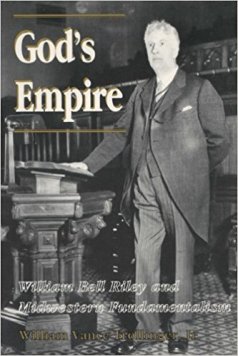
I had the chance to talk with Professor Bill Trollinger about the question. Bill is the universe’s greatest expert in the life and career of 1920s fundamentalist leader William Bell Riley. Riley, like many early fundamentalists, was a devoted Baptist. For Riley, in the early 1920s fundamentalism was a campaign to take back his denomination from the worrisome liberal trends that had begun to creep in.

American Baptists, ever since the days of Roger Williams, have placed an enormous emphasis on the freedom of the church from the government, and on the inviolate primacy of religious devotion over any political loyalty. By the twentieth century, however, Baptist fundamentalists like William Bell Riley seemed to have lost their yen for avoiding entanglement with government. Riley and other Baptist fundamentalists pushed hard to establish (or, as they would put it, re-establish) their evangelical religion in a more prominent place in public life. They wanted greater influence on public affairs. They hoped for increased influence on government decisions, such as banning alcohol, gambling, and other immoral activities.gods empire

How did that happen? How did ardent Baptists become so enthusiastic about “taking back America”?

Professor Trollinger and I came up with a short list, and I hope SAGLRROILYBYGTH will add their two cents.

How did fundamentalists like Riley combine their devotion to their religions with their devotion to the USA?

1.) Riley would always agree that church and state should be separate, but that the church must always represent the conscience of the society.

So although there must never be church control of government, government leaders should always be guided by religious leaders. Riley’s career could be characterized, in fact, by his increasing bitterness and resentment at his perceived lack of Main-Street influence. By the end of his life, Riley had become a vengeful, anti-semitic extremist, dedicated to sour conspiracy theories to explain his failure to establish himself in the level of public leadership to which he felt entitled.

2.) Riley wanted influence and was in part blinded by patriotic tradition.

Like many fundamentalists since, Riley failed in some measure to maintain his own Baptist tradition, even though he would never admit that. For Riley, as for many fundamentalists of later generations, America became representative of a Christian community. The division between church and society—if not church and state—became blurred in Riley’s mind and in his activism.

3.) The devil made them do it.

For many fundamentalists, political activism was intimately, necessarily connected and equated with religious activism. Patriotism was inseparable from faith. Why? Because of their belief in literal, incarnate supernatural entities acting through political entities. But we’ll save that for our next post.

We’ve All Got It All Wrong

Whether you call yourself a conservative, a progressive, or something else, if you’re like me you’ve probably got it all wrong. As I was reminded in a discussion last night, those of us who try to shape schools usually make a huge mistake—one we could recognize if we just thought about it for half a second.univ of hawaii

Here’s the background: I was happy last night to talk with some graduate students at the University of Hawaii. (No, I didn’t get to go there in real life. I wish. We used cutting-edge interwebs technology to talk.) They had read my book about the history of educational conservatism and they had some great questions, ideas, and experiences to share.

As I argue in the book, it’s difficult to generalize about conservative activists. Just like progressives, conservative thinkers and doers come from a dizzying array of backgrounds and they are motivated by a huge spectrum of ideas and beliefs. But one thing they do share—at least the ones I studied—is an unexamined faith that school shapes society. I hate to quote myself, but this is how I put it in the book:

Educational conservatives have insisted, in short, on two central ideas. First, schools matter. Conservatives, like their progressive foes, have rarely questioned the notion that the schools of today generate the society of tomorrow. Second, because schools matter, their content and structure must be guarded ferociously. Ideas that challenge inherited wisdom must not be crammed down the throats of young, trusting students. And teachers must not abdicate their roles as intellectual and moral authorities. Educational conservatism, in other words, has been the long and vibrant tradition of defending tradition itself in America’s schools. Without understanding this tradition, we will never truly understand either American conservatism or American education.

One idea on which everyone can agree, in other words, is that schools shape society. The reason so many of us spend so much energy on school reform is precisely because we think it matters. For some conservatives in the twentieth century, teaching kids evolution was dangerous because it threatened to take away their moral and religious compass. For others, teaching kids about sex was a bad idea because it tended to unhinge their self-control. And for yet others, teaching kids socialist ideas was obviously terrible because it would lead to the corruption of their morals and of the entire society.

OTR COVER

You can fix schools all you want, but you can’t fix the outcomes…

Last night, the Hawaii students shared stories that helped puncture those school-reform assumptions. One student, for example, reported that he came to the realization that he was conservative in high school. He was guided to that realization by his favorite teacher. At first, I assumed that the teacher was a conservative, too, and inspired the student by reading Hayek and Burke and smoking a pipe. In fact, the student told us, his favorite teacher was a heart-on-her-sleeve liberal. She taught social studies in a progressive way, one that hoped to help students examine their own ideas and decide questions for themselves. In the student’s case, that meant he came to the realization that his ideas were apparently “conservative.” The left-y teacher, in other words, didn’t indoctrinate this student into leftism, but precisely the opposite.

Another Hawaii student told a very different story. She only realized that she was a liberal when she was teaching Sunday school at her church. The goal was to help young people deepen their religious faith, but it had the opposite effect on her. Instead of becoming more religious, teaching Sunday school convinced this student that her church was full of hooey.

What’s the takeaway? Once we hear the stories, it seems pretty obvious. School doesn’t really work the way we sometimes think it will. No matter what our politics, we can’t control the future of our students by teaching them X or Y or by keeping them away from Z or A. Students are not predictable, programmable outputs. They have their own ideas and backgrounds and sometimes our best-laid plans at shaping America’s future will come out in ways we didn’t predict.