Thanks, CHE!

No, no, no, not THAT Che. I mean the Chronicle of Higher Education. Peter Monaghan recently featured my new book in their pages.

CheHigh

urm…different CHE.

Monaghan put his finger squarely on several of the most important issues in the world of evangelical higher education.

For example, as Monaghan explains, the world of evangelical higher education is not somehow trapped in the past. As he puts it,

Many newcomers to the inner workings of fundamentalist Christian colleges are surprised to learn that the institutions consider themselves not just righteous but also thoroughly “modern.”

The differences between evangelical and non-evangelical higher education is therefore not as stark as some outsiders might think. As Monaghan concludes,

Like elite secular institutions . . . fundamentalist ones seek to thrive by “developing a niche that they can exploit,” selling themselves as “experiences” that transform young people. They describe themselves as hubs of academic endeavor, with prospectuses little different from those of their nonreligious peers. Leaders also promote their institutions’ distinguishing features, like size, location, and sports programs, aware that evangelical families want to provide their children with more than doctrinal guidance during their college years.

Almost makes you want to read the whole book, don’t it?

I Love You but You Didn’t Do the Reading

Another week, another flood of ILYBYGTH-themed stories. Thanks to everyone who sent in tips…

What happens when computers grade essays, at Curmudgucation.

tank refurbish

My next dream job…

Rednecks bridge the racial divide, at FPR.

School reform? Or social reform? The “Loving Cities” plan, at The Progressive.

  • “promoting school choice as the solution is a distraction from the basic fact that parent income, along with interrelated racial and economic segregation, remain powerful determinants in the quality of education a child receives.”

Ixnay on ace-ray: Wisconsin school district bans talk of “white privilege,” at MJS.

I’ve found my next line of work, at PM.Bart reading bible

Historian John Fea on the coarsening of American culture, at TWOILH.

Has teaching changed? Larry Cuban reflects on the ways teachers taught in the past.

College cuts comedian’s mike. At CHE.

Loving Trump and hating the Age of Reasonthe long history of Christian politics in the US, at R&P.

Conservative commentator resigns in protest from Fox News, calling it a “propaganda machine.”

Why would a creationist praise an academic critic? At RACM.

Genetics and the new science-denial of race, at NYT.

human history map

New maps don’t start at the Garden of Eden…

March Madness and the history of anti-segregation in sports, at LSJ. HT: DW.

What’s wrong with new teacher-evaluation schemes? Peter Greene tees off at Curmudgucation.

  • Best line: “Reducing the evaluation of teacher quality to a “rigorous rubric” is not a positive. Academians and economists like it because it lets them pretend that they are evaluating teachers via cold, hard numbers, but you can no more reduce teaching to a “rigorous rubric” than you can come up with a rubric for marital success or parental effectiveness. . . . at the moment rubrics and checklists still take a back seat in most districts to Big Standardized Test scores soaked in some kind of VAM sauce.”

“Theoretical children . . . don’t fart:” At The Progressive, a call for less theory and more experience with real children.

The Problem with Theoretical Children

Two hundred years is a long time to bang your head against a wall. When it comes to school reform, though, that’s what we seem to do. I’m just back from an archive trip in Philadelphia and I’m spooked by the parallels between school-reform mistakes back then and those pointed out just this week by a savvy teacher in New York.

The New York teacher, Emily Kaplan, tells a story any experienced teacher can relate to. She studied at a great university, learned all she could about children and teaching. When she got to her first classroom, she immediately ran into a situation she had never prepared for: One of her students just wouldn’t/couldn’t stop farting. It’s funny, but it’s more than funny, too. As Kaplan puts it, most of our big-picture ed-reform plans are made for “theoretical children.” As she explains,

Theoretical children are useful: they are predictable, generalizable. They lend themselves easily to an agenda; nothing they do is inexplicable. Their development is linear, their roadblocks routine. They exist neatly in quantified data; they are easily essentialized. Theoretical children don’t cry for no reason, they don’t laugh out of turn; theoretical children certainly don’t fart.

Theoretical children are discussed often by scholars and policymakers, but theoretical children don’t populate our classrooms— because theoretical children don’t exist.

Kaplan is right on. Every real teacher knows that plans need to be held lightly; theories need to be embraced tentatively. As I’m learning in my new research, the effort by experts to change schools based on what children theoretically will do has always plagued our school-reformm dreams.

Last week I began the archival grunt work for my new book. I’m exploring the school-reform plans of Joseph Lancaster and his devotees. Two hundred years ago, nearly exactly, the Pennsylvania legislature passed a law mandating Lancaster-style schools for Philadelphia. Why were the lawmakers so excited about this educational plan?

lancaster schools

Nothing can go wrong if the system is right.

In large part, Lancaster convinced politicians that he had figured out a perfect system. He pitched a school set-up that would deliver cheap, effective literacy, numeracy, punctuality, and nondenominational Protestantism to poor children. In 1803, for example, he published his flawless system, a system built on the actions of “theoretical children.”

As Lancaster explained, school discipline had long been a problem, but he had solved it. He outlined at painful length and detail the way he had supervising boys—“monitors”—track the behavior of their fellows. Students who misbehaved would have logs tied around their necks. They would be shackled together with other miscreants. If that didn’t work, they might be

put in a sack, or in a basket, suspended to the roof of the school, in the sight of all the pupils, who frequently smile at the birds in the cage.

Lancaster didn’t like shaming his students this way, but he thought it was the perfect solution. As he explained, when the misbehaving student

Finds how easily his punishments are repeated—that he himself is made the instrument—and no respite or comfort for him, but by behaving well, it is more than probable he will change for the better.

In theory, the plan was perfect. In theory, anyone could follow the simple steps laid out for good student behavior. In theory, students responded well to Lancaster’s machinations.

Guess what—it didn’t work. As Emily Kaplan points out, children don’t exist only in theory. They fart. They rebel. And sometimes, if you tie a log around their neck or hang them in a birdcage, they don’t respond well.

Bad News for Creationists

It’s no skin off my nose, but I can’t help but wonder what creationists will say now. And not just the more radical young-earth creationists, but all the dissenting scientists who insist for religious reasons that our species must have begun with two and only two ancestors in the Garden of Eden. As reported in the New York Times, the science of human origins is getting better and better. What will creationists do?

human history map

The science doesn’t come close to matching the Bible…

Here’s what we know: This weekend the New York Times profiled the work of Harvard’s David Reich. Dr. Reich and his team have plucked DNA from ancient human bones. Using new techniques, the team has been able to create new maps of human and other groups dating back tens or even hundreds of thousands of years. The ultimate goal?

Dr. Reich’s plan is to find ancient DNA from every culture known to archaeology everywhere in the world. Ultimately, he hopes to build a genetic atlas of humanity over the past 50,000 years.

Here’s the problem: for many creationists, even those who are willing to believe in an ancient universe and planet, the idea of a real, historic Adam & Eve is absolutely non-negotiable. As we’ve examined before in these pages, even creationists who accept the science of evolutionary theory in general balk at the notion of abandoning the Garden story. Even institutions such as Wheaton College that openly embrace evolutionary creationism shudder to advertise their faculty’s skepticism about a real historic Adam & Eve.

So what will creationists do now? Here’s my guess: The more radical young-earth crowd will simply dismiss the new discoveries in human origins as simply more fluff n stuff, more flawed conclusions from flawed pseudo scientists based on flawed assumptions. But among creationists who have embraced evolutionary science in its particulars, while insisting on the fundamental truths of divine creation as described by the Bible, each new scientific discovery will present a new challenge.you got some splainin to do

As the scientific evidence gets stronger and stronger for a complex, multi-site origin of the human species, creationists will have some splainin to do.

HT: HD

Last Day for a Freebie!

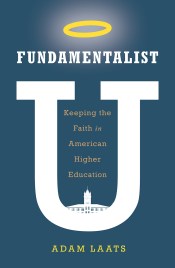
Don’t forget, the nice folks at Oxford have donated ten copies of Fundamentalist U to Goodreads for a free giveaway. There’s one more day to put your name in the hat for a gratis copy.

Cover art final

Free! And worth every penny…

At these prices, you can’t afford NOT to get a copy.

No Joke: Catholic College Cuts off Comic’s Crudeness

There’s campus free speech and then there’s campus free speech. Does a comedian have any sort of “free-speech” right to intentionally and directly violate a contract? Even if he’s trying to make a point?

hannibal buress tweet loyola

From a student tweet…

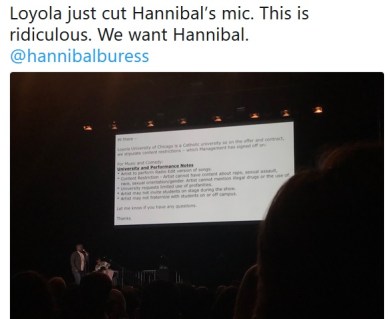
Here’s what we know: The Chronicle of Higher Education is reporting on a free-speech stunt by comedian Hamilton Buress. The well-known comic (so I’m told. I’d never heard of him, but that doesn’t mean much) had signed a contract for his bit at Loyola University in Chicago. He had agreed not to discuss certain subjects, including sexual abuse, rape, race, or sexual and gender orientation.

Buress didn’t only ignore the contract. He projected an image of the list of forbidden topics, then proceeded to make a joke about each one in turn. When he got to a joke about child sexual abuse by the Catholic church, the (Catholic) university cut off his mic.

What do you think?

Me, I’m torn. On the one hand, the guy signed a contract. He agreed not to make certain jokes.

On the other hand, Buress’s deliberate and provocative method of spurning the contract, IMHO, is more than just comedy. It makes a powerful point about the need to speak freely about sensitive topics.

Would I want him to perform at my kid’s fifth birthday party?  Probably not. But do I think his stunt was a healthy shake-up of campus stultification? I think so.

Just When I Thought I Was Out…

Okay, so long story short: I’m down in sunny Philadelphia, enjoying a talk with Jonathan Zimmerman’s students at Penn about Fundamentalist U. I planned to stay a little extra to sneak in some time in the Lancaster archives at the Historical Society of Pennsylvania.

No such luck. Springtime snowstorm shuts down the town. I’m stuck in a hotel room with a PBJ and nothing to do. So I figured I’d catch up on some Sopranos and forget about schools, culture wars, and creationism for an hour or two.

And right there in season six, Tony Soprano gets a visit in the hospital from a fundamentalist evangelist. The guy picks up Tony’s book about dinosaurs and goes off on the ways the whole dinosaur story was a big myth propagated by false scientists. The earth, he says, was created six thousand years ago. Dinosaurs and humans lived side by side, just the way Answers In Genesis says they did.

My favorite line? Tony’s sidekick reflects on the young-earth creationist message:

What’s he sayin?…there were dinosaurs back with Adam n Eve? … No way. T-Rex in the Garden of Eden? Adam n Eve would be runnin all the time scared sh*tless. But the Bible says it was paradise.

Now, SAGLRROILYBYGTH know young-earth creationists have a ready answer for this young gangster’s objections. Bonus snowstorm points for anyone who can remember how Ken Ham would clear up this seeming contradiction…

What’s Wrong with White Privilege?

You’ve probably heard about it by now. In my adopted home state of Wisconsin, a school district has effectively banned teachers and students from talking about white privilege. Why? With all the hot-button issues that could roil a school district—prayer, sex, school shootings, bullying—why is this issue so heated?

Here’s what we know: A week or so ago, Oconomowoc residents erupted in anger over a student-initiated program. The students had hoped to teach their fellows about the concept of white privilege. Due to parent anger, the principal is out and schools are officially banned from teaching white privilege except in classes dedicated to teaching white privilege.privilege test

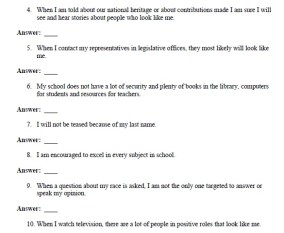
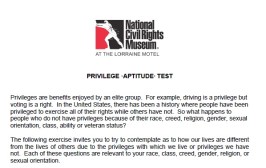
The students had asked their fellows to complete a privilege survey created by the National Civil Rights Museum. Students were asked if they felt comfortable going into stores, if they thought people in power would look like them, if they had been taught to fear walking alone at night, if their schools had good resources, and other pointed questions.

The goal, as the survey explained, was to help students notice the ways they have experienced privilege. As the survey put it,

In the United States, there has been a history where people have been privileged to exercise all of their rights while others have not. So what happens to people who do not have privileges because of their race, creed, religion, gender, sexual orientation, class, ability or veteran status?

So far, so good. For the record, I applaud these students and their supporters for trying to help themselves understand the ways American society really works.privilege test 1

Not everyone does. In Oconomowoc, Wisconsin, this exercise proved extremely provocative. Parents absolutely refused to have their kids talk about these questions in school. They ousted the high-school principal and banned further talk of white privilege.

This robust anger leads us to our question for the day: Why do some people feel so angry about these questions? Why do they feel a need to ban them from their children?

I have a hunch and I’ll be curious to hear what SAGLRROILYBYGTH think.

The school board president explained it best, IMHO. As he told the local newspaper,

white privilege is a lightning rod for some parents. . . . We have poor people in Oconomowoc who are saying they’re not privileged … and people that say, ‘Don, we worked our butts off to have what we have’

Some parents in Oconomowoc apparently feel that teaching white kids that they are privileged is like teaching them that they are to blame for society’s faults. It is refusing to notice the hard work and sacrifice that their families have made. It is nothing less than a slap in the face to every penny-pinching Grandma, every two-job-working Dad, every after-school-job having kid.

As I see it, the topic of white privilege is so ferociously controversial because it strikes at the heart of our culture-war sore spot over victimhood. In the minds of many parents—in Oconomowoc at least—telling white kids they enjoy privilege is the same as telling them their struggles aren’t real; their sacrifices aren’t meaningful; their victories are vampiric.

My Heroes Have Always Been Teachers

Now I just don’t know what to think. I have long admired heroic teachers like Susan Epperson and all the less-famous Susan Eppersons out there. Our ILYBYGTH conversations lately, though, have me wondering. Are teachers heroic if they buck the rules to teach the way they should? …what if they think they should teach Christianity or white supremacy? Or if they’re gun-toting rage-aholics?

Maybe people don’t remember Susan Epperson anymore. She was a science teacher in Arkansas in the 1960s. Due to a law passed during the 1920s evolution/creation battles, she was legally barred from teaching her students about evolution. She did it anyway.

Instead of just keeping her science subversion quiet, Epperson took her case all the way to the Supreme Court, where the anti-evolution law was tossed out.

Epperson has always been a hero of mine. Not only her, but all the teachers out there who go against idiotic system rules to teach children the way they deserve to be taught. It can be as simple as ignoring an order to focus only on test-related content and instead help a student discover what she thinks about a poem or painting. It can be as fundamental as introducing students to the real, ugly history of race relations in the USA, even though a school principal advises against doing anything “controversial.”

But with recent stories about white-supremacist teachers and the history of left-wing teacher purges I’m not sure what to think anymore. If teachers are heroic for teaching “what’s right” instead of what’s in the state-approved curriculum, how can we police creationist and other teachers for breaking the rules to teach their own peculiar moral visions?

reclaim your school

Can my heroes out-sneak your heroes?

After all, as political scientists Michael Berkman and Eric Plutzer found, the most important influence on most high-school biology teachers is not the state curriculum. It is the values of the local community. If teachers think creationism is the right thing for their students, they’ll teach it, no matter what the curriculum says.

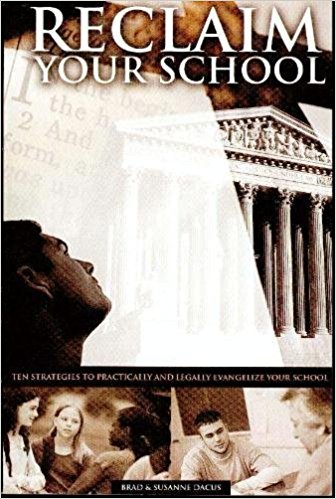
And activists on both the right and the left encourage teachers to ignore the rules and teach “what’s right.” Brad and Susanne Dacus, for example, have published a handy-dandy guide for teachers who want to inject more Christianity into their teaching. As they put it,

Worrying about your public schools changes nothing. . . Knowing how YOU can make an impact in your school can change everything!  Public schools have dramatically changed over the last several years.  Now is not the time to give up on your school.  Now is the time to stand up and be heard!

For those of us who want secular public schools, these promises sound worrisome. Yet we can’t help but recognize that the same heroic impulse to fight the system underlies both Epperson’s pro-science activism and the Dacus’s pro-Jesus work.

Is there any way we can encourage heroic teachers, but only the kinds we agree with? Sounds pretty hypocritical to me. As Professor Clarence Taylor argued recently in these pages, do we need to defend ALL teachers’ rights to political activism, even if we hate it? Or is there some way to support teacher activism for “our” side while fighting teacher activism for “theirs?”

I Love You but You Didn’t Do the Reading

Welcome to your weekly round-up of ILYBYGTH-themed stories from around the interwebs. Thanks to everyone who sent in tips.

Nun in the huddle! Sister Jean and March Madness, at NYT. HT: DW.

calvin reading

My kind of Calvinism…

White evangelicalism—the church of the “slave state,” at Forbes. [Editor’s note: The original Forbes article was taken down as “way out of bounds,” but the text is still available at this new link. Thanks to alert reader for pointing it out.]

Don’t have your copy of Fundamentalist U yet?

Campus cults and “passion plays:” “War on Cops” author Heather MacDonald talks with “What’s Happened to the University” author Frank Furedi at CJ.

What do college students think about free speech on campus? New poll numbers at KF.

What does Queen Betsy think? A tough interview at 60 Minutes.

Creationist Ken Ham praises the Oklahoma university that welcomed his lecture—see his op-ed at KHB.

The view from Greenville: An instructor at Bob Jones U explains why he voted Trump, at HNN.

Dripping Wax: Professor Amy Wax suspended from teaching mandatory class after latest disparaging racial remarks. At IHE.

Is the Museum of the Bible just an evangelical missionary outfit “masquerad[ing] as an educational institution”? That’s the charge at R&P.

Teacher pay and underpay: Check your state at Vox.

Students who walk out should be punished. So says Daniel Willingham. HT: XX

Too close for comfort? Ben Carson’s aide chummy with secretive religious charity, at the Guardian. HT: LC.