I Love You but You Didn’t Do the Reading

Fasten your seatbelts…we’re in for a rough ride. With impeachment dominating headlines, there were a bunch of stories that you might have missed. Here’s our weekly roundup of news n views:

The top Democratic contenders got together to talk about education. How did it go?

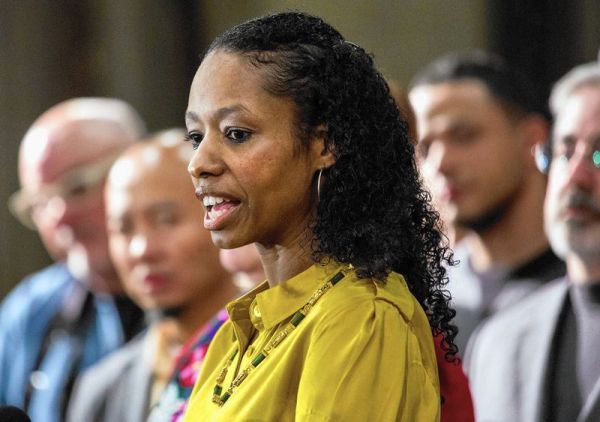
Fired/not-fired from Wheaton, Larycia Hawkins still feels the pain, at CT.

The need to give an awkward speech on the first day of class is a small detail that offers a clue to how all-encompassing the changes in Hawkins’ life have been since she left Wheaton. “The further we get out from the job that I left,” she says, “it’s easier. But one of the things it has changed is how I introduce myself on the first day.”
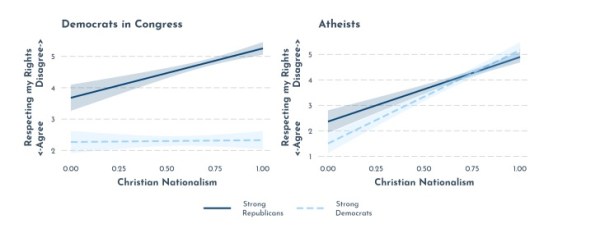
hawkins CTPoll finds that “Christian nationalists” tend to think they will be punished if Trump loses in 2020, at RIP.

there is widespread belief among Christian nationalist Protestants that atheists will strip their essential political rights if they gain political power. . . . Christian nationalists see the next election as apocalyptical. If they win, then democracy continues; if they lose under the Trump banner, then they are destined for the gulags.
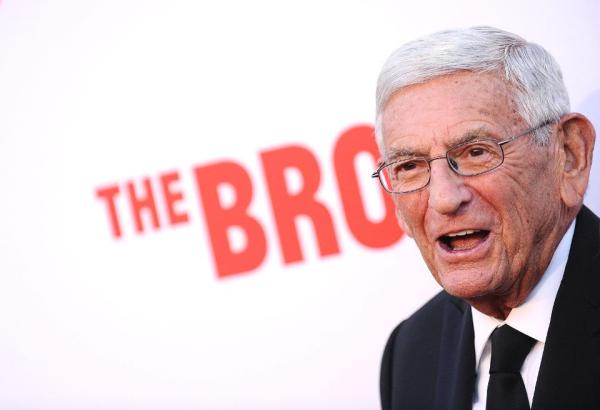
Christian nationalists 2020 RIPZoiks: Billionaire gives $100 million to Yale to start Broad school-leadership program, at Forbes.

There’s little to point to in the last twenty years that would suggest that a slightly trained educational amateur who “thinks like a CEO” is a good bet for running a school system well. Broadies have certainly found their way to positions of power and established lucrative careers for themselves, but there is little evidence that they have benefited students.

Why do teachers get creeped out by this sort of school-leadership program? My three reasons here at ILYBYGTH.
broad yale

He’s betting $100 million that I’m wrong…

Freshman at George Southern U gives a presentation on “replacement theory.”  The university backed up his right to do so. At IHE.

“‘Diversity is our strength’ is a bare-faced lie,” he said. “I don’t care if you call me a racist.”

Rochester students walk out, at RDC.

Hundreds of students across the Rochester City School District protested the recent proposed layoffs of more than 200 district employees Monday. . . . “We care about our teachers,” [junior Maya Waller] said while walking on Main Street Monday morning. “It’s not right that their mismanagement of money is negatively impacting teachers, staff and students (who) weren’t there to make the decision anyway.”

Can a “Fairness to All Act” square the circle for evangelical colleges and LGBTQ issues?

Southern Baptist Seminar boots instructor for being too anti-LGBTQ, at IHE.

[Robert Oscar] Lopez held other views outside the conservative mainstream, such as that homosexuality was inexorably linked to pederasty. Some called it hate speech. He said he based his insights on personal experience, and that being raised by a bisexual mother and her female partner made him socially awkward and led him to the “gay underworld” for a time.

Eventually, Lopez left California and secular academe for Southwestern [Baptist Theological Seminary]. The Texas institution doesn’t have tenure, but he thought he had found a permanent place among like-minded, socially conservative academics.

Things went well for Lopez for a while. But he couldn’t have predicted the events to come.
Why Do School Leaders Need Teaching Experience?

Generals don’t have to start as privates. CEOs don’t start in the mailroom anymore. For that matter, Horace Mann himself never had any classroom teaching experience. Yet a new story from New Haven raises this question again: Why is it a bad idea to put people in charge of schools if they’ve never been teachers? This morning I’ll offer my three reasons. Are they enough? Or do teachers just feel an irrational desire to be flattered into thinking that their classroom experience matters?

broad yale

He’s betting $100 million that I’m wrong…

Here’s the background: Mega-rich ed donor Eli Broad just dished out a cool $100 million to Yale. Broad (apparently pronounced “Brode”) moved his center from LA to Yale’s business school. The goal is to offer an academic center that will offer, in the words of Yale’s leadership,

a tuition-free master’s degree program for emerging education leaders, advanced leadership training for top school system executives, and an extensive research endeavor aimed at assembling the premier collection of data on public education leadership.

Just in case you missed it, this program in school leadership is not part of Yale’s teacher-training program. In fact, Yale no longer offers teaching certification. No, this program will be part of Yale’s business school. The school leaders emerging from the Broad program will plan to take over districts and operate them more efficiently and productively, more like businesses.

Will it work? As Curmudgucrat Peter Greene pointed out in the pages of Forbes Magazine, Broad’s track record in education is not great. As Greene recounts,

Many of the most familiar names [of former Broad program grads] are familiar precisely because of their level of failure. Robert Bobb had a lackluster showing in Detroit. Jean-Claude Brizard received a 95% no-confidence vote from Rochester teachers, then went on to a disastrous term of office in Chicago. Oakland, CA, has seen a string of Broad superintendents, all with a short and unhappy tenure. Christopher Cerf created a steady drumbeat of controversy in New Jersey. Chris Barbic was put in charge of Tennessee’s Achievement School District, and resigned with all of his goals unfulfilled (and recommended another Broad grad as his replacement). John Deasy’s time at LA schools ended with a hugely expensive technology failure.

Yet in spite of this record, Yale seems eager to take the money and open a program for similar leaders. To be fair, Yale’s not alone. There seems to be no general objection to elevating school leaders who have no classroom-teaching experience. It’s not only Queen Betsy. Obama’s Ed Secretary Arne Duncan also had no real teaching experience.

So why do so many experienced teachers think that leaders should have a teaching background? Why do so many clamor for our next President to install a teacher in the top ed job?

Easy. It’s not that learning general business and management skills can’t be helpful to running a school district. But having classroom teaching experience gives people three big, necessary advantages when it comes to building- or district-level school management.

First, having teaching experience cures us of the misunderstandings that we all have from our time as students. Unlike most jobs, almost everyone thinks they understand school, because we all spend a lot of time in school as students. In order to be an effective school leader, however, we have to go through a difficult process of giving up our tendency to assume that our experiences are somehow typical or representative. In every case, they are not.

One of the first lessons of a lot of new teachers—the talented group of people I get to work with—is that most of their students are not like them. A lot of new teachers remember school fondly. They often excelled in their classes and enjoyed their time in class. That’s a big part of their reason for wanting to become teachers in the first place. It is only when they start teaching that they realize how unrepresentative their own experiences are. Working with groups of students teaches teachers that there is no single one-size-fits-all approach to learning and growth.

And that brings us to the second necessary lesson that teachers learn. Unlike business leaders, teachers do not plan to ignore parts of their “market” that are not “productive.” Unlike business leaders, teachers do not expect that some of their “customers” will not buy in. Unlike business leaders, teachers learn to help every single student that they work with; they don’t concentrate on the “likely buyers.”

Third, and maybe most important, teachers learn things about real schools that even smart, informed civilians never seem to understand. Let me give you one example that helped me understand this lesson. I get to teach different classes. I teach an undergraduate course that introduces juniors and seniors to basic issues in American education, such as charter schools, unions, and the role of religion, race, gender, and economics. I also work with people who are completing their student-teaching experiences. Both groups of students are intelligent and informed. In fact, they are very similar groups of students. The biggest distinguishing factor is that the student teachers have taught for a few weeks, while most of the undergrads have not yet.

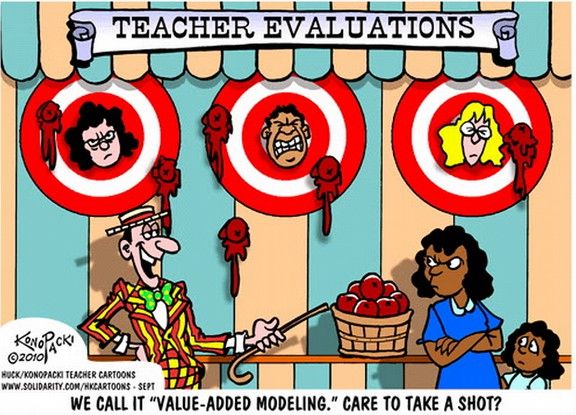
Though these two groups of students are very similar, they have very different reactions to certain issues. In general, the undergrads are enamored of ideas such as using value-added measures to gauge teacher effectiveness. To them, it makes sense: If you want to know how good a teacher is, test their students at the beginning and end of the year. The difference = what the kids learned that year.VAM

Sounds good to smart, informed people. Yet ALL of the student teachers react with horror to the idea. Why? Because after even just little bit of experience as a classroom teacher, students learn that their students are living complicated lives. There is no simple way to slap a number on the changes that students will go through in one academic year. To assume that their teachers are the ones who are driving those changes—to teachers with even a little bit of experience—seems obviously kooky.

For all three of these reasons, it seems obvious to teacher-philes like me that school leaders should have experience as teachers, classroom aides, or paraprofessionals. They might learn important stuff at the Broad Center, but they will miss out on things they can only learn by working with students.

LGBTQ and Evangelical Colleges: Can We Please Just Skip to the End?

It might sound good to some, but a recent “Fairness for All” bill will not solve evangelical colleges’ problems with LGBTQ issues. With respect to all the smart, loving, sincere supporters of these half-measures, the historical record is glaringly clear on this one. Evangelical universities cannot fudge the issue of LGBTQ rights and the issue will end up splitting evangelical institutions. Again. But evangelical tradition has plenty of room to accommodate changing times. Can we please just skip to that part of this story?

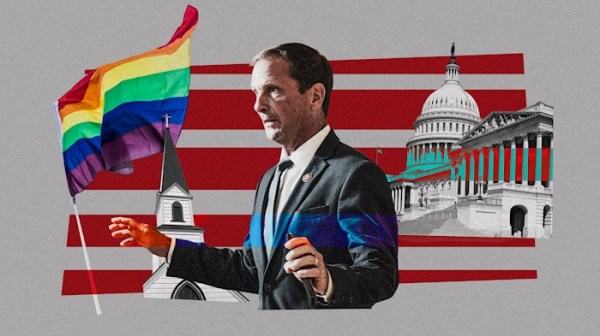
Here’s what we’re talking about: Utah Representative Chris Stewart introduced recently a “Fairness for All Act.” The bill has the ardent support of evangelical organizations such as the Council for Christian Colleges and Universities. In short, the act would ban discrimination against LGBTQ persons, except at institutions that have a religious reason for discrimination or at small businesses.

Will it work? No. And not only for the usual political reasons. In short, this attempt to square the LGBTQ circle for evangelical institutions is another half-measure that will not satisfy anyone. It is similar to the ways many evangelical institutions these days make an impracticable distinction between LGBTQ “identity”—which is approved—and LGBTQ “practice”—which is not. Or the weird ruling recently at Fuller Seminary that same-sex “relationships” are okay, but same-sex “marriages” are not.

Based on the history I uncovered in the research for Fundamentalist U, these half-measures will end up being a curious footnote in the story of evolving LGBTQ rights in the evangelical world. Here’s my prediction—hold me to it—of what the end result will be.

First, though, let me be as clear as I can be on this point: I do not equate the evolving policies about LGBTQ rights with the 20th-century history of decreasing racism at evangelical colleges. The two cases are distinct. But what is similar is a central fact that many prominent historians have pointed out. Namely, evangelical Americans are still Americans, and their ideas about changing cultural norms are in line, more or less, with the rest of the country. As Daniel K. Williams put it, like many other white Americans, white evangelicals in the mid-20th century worked “to distance themselves from the overt racism that had characterized their churches.” And, as Molly Worthen argued similarly, “the moderate middle” of white evangelicalism “experienced a genuine change of heart about the meaning of skin color,” similar to what the moderate middle of white people in general experienced.

Again, racism is different from anti-LGBTQ ideas. Intelligent evangelicals will tell me that sexual morality is an inherent part of true Christianity, while racism was a deviation from true Christianity. I get that. Nevertheless, the point remains—evangelicals have shifted their ideas about LGTBQ identity along with the rest of the country. They will continue to do so.

So what will happen? If history is any guide here, we will end up with (yet another) split among evangelical institutions on this issue. Most universities will find a way to double-down on their traditional sexual morality while making room for LGBTQ rights. How? Not by today’s compromises, but rather by falling back on the heart of evangelical sexual morality, insisting that sexuality must be reserved only for monogamous marriage. The definition of “marriage,” though, will expand to include same-sex marriage. No more false distinctions between “identity” and “practice.” No more meaningless opining about the importance of sexless same-sex relationships. No, in the end, most evangelical institutions will basically embrace LGBTQ rights, but re-frame them in a traditional way, with an emphasis on marriage. Sex outside of marriage will still be forbidden. But marriage will come to include same-sex marriage.

At other schools, hard-liners will double-down on anti-LGBTQ tradition. They will not only ban same-sex relationships, but any element of LGBTQ inclusion. If necessary, they will fight against all comers, including the US government, to preserve their discriminatory anti-LGBTQ policies.

What do you think? Should we agree to meet back here in thirty years to find out if this prediction comes true?

I Love You but You Didn’t Do the Reading

Two big anniversaries this week and a whole lot of other stuff, too. Welcome to our weekly review of ILYBYGTH-themed stories from around the interwebs:

“How do we have a safe conversation about unsafe ideas?” Using biology class to fight racism, at NYT.

Utah Congressman introduces new LGBTQ discrimination law, at CT.

The law would prohibit anti-LGBT discrimination in employment, housing, and places of public accommodation, including retail stores, banks, and health care service providers. Currently, under federal law and in the majority of states, LGBT people can be evicted from rental property, denied loans, denied medical care, fired from their jobs, and turned away from businesses because of their sexual orientation. . . . The Fairness for All Act exempts religious groups—both churches and nonprofits—from the anti-discrimination rules. . . . The anti-discrimination rules would not apply to for-profit businesses with 14 or fewer employees, excluding them from the definition of “public accommodation.”

chris stewart CT

Okay, so here’s the deal: No one can discriminate against LGBTQ people, unless they REALLY want to…

At what point does kooky political conspiracy theory become legally insane? At NYT.

“You’ve got a real, real tradition of insanity defense cases of very, very seriously mentally ill people who committed their crime out of some kind of utterly bizarre political motivation,” he said.

Embracing charters = embracing Queen Betsy, at WaPo.

To embrace charter schools in 2020 is to embrace Betsy DeVos, Donald Trump and other Republicans who stand to gain more politically from charter support than black communities have gained in jobs and educational benefits.

Gay pizzazz at George Fox University: RNS.

George Fox spokesman Rob Felton noted that the university already dedicates a section of its website to “Supporting LGBTQ students at George Fox.” It affirms the “dignity of every person” and calls for civility and “better communication,” but maintains that “God has intended sexual relations to be reserved for marriage between a man and a woman.”

“This is a hard and emotional issue,” Felton told RNS in an email. “It is not an ‘us versus them’ issue, it’s a ‘we’ issue. It’s personal for everyone involved. George Fox students come from various faith traditions so we understand that they may hold different views on LGBTQ issues.”

Why do nice Christians love Trump? A new insider look at RS.

[Trump] affirmed and evangelized the belief that it is not only acceptable but actually advisable to grant cultural dominance to one particular religious group. . . . “I don’t think he’s godly, Alex,” my aunt tells me. “I just think he stands up for Christians. Trump’s a fighter. He’s done more for the Christian right than Reagan or Bush. I’m just so thankful we’ve got somebody that’s saying Christians have rights too.”

What does it mean to be “evangelical?” NT Wright takes a crack at an explanation at the Atlantic.

I’ve taken the view that the word evangelical is far too good a word to let the crazy guys have it all to themselves, just like I think the word Catholic is far too good a word for the Romans to keep it all to themselves. And while we’re at it, the word liberal is too good a word for the skeptics to have it all for themselves. It stands for freedom of thought and exploration.

New international test scores are out. The USA doesn’t look so good, at NYT.

It starts by tapping into the universal anxiety about the future. . . . [but] there is no evidence to justify, let alone prove, the claim that PISA indeed measures skills that are essential for life in modern economies.

A different kind of school “choice” helps richer, whiter areas resegregate their schools, at Forbes.

In recent years, another approach has appeared–the splinter district. These occur when a community aims to secede from their current district; these new districts frequently adopt a new border that corresponds to racial and/or economic borders–a sort of school district gerrymandering. It’s white flight, without the actual flight.

nat geo pearl harbor mapPearl Harbor remembered:

nat geo attack viewThe other anniversary this week–Fifty years after Altamont, at HNN:

In what was to become, quite literally, a fatal mistake, the event organizers hired the Hells Angels motorcycle gang to serve as security guards. As noted in Joel Selvin’s book, Altamont, the biker group was hired (for $500 worth of beer) on the recommendation of Rock Scully, the Grateful Dead’s manager.

Today, the event is remembered by the shocking images of violence that occurred at the climax of the concert, as the Rolling Stones took the stage surrounded by Hells Angels. As the drug-fueled young men and women in the crowd surged forward, the leather-jacketed gang members beat many senseless with pool cues and motorcycle chains. Dozens were taken to the hospital and one young black man was stabbed to death.

Common Core: The Rest of the Story

Where did Common Core standards come from? Where did they go? Recent reporting in the New York Times asks these questions, but the real answer is a little murkier. The story of the Common Core standards can tell us a lot of things, but at heart the story provides more proof—if any more were needed—that schools thrum to the beat of people, not policy. It can tell us, too, why Cory Booker will not have a lot of luck with his current ed proposals.

So…what happened to the Common Core? As Dana Goldstein puts it,

The disappointing results have prompted many in the education world to take stock of the Common Core, one of the most ambitious education reform projects in American history. Some see the effort as a failure, while others say it is too soon to judge the program, whose principles are still being rolled out at the classroom level.

And that’s all true enough. But the origins and career of the common-core idea can tell us about more than just high-stakes tests and math instruction. The history of the Common Core can tell us, for example, why Betsy DeVos matters more than almost anything else when it comes to current ed thinking.

As SAGLRROILYBYGTH know, the Common Core did not have its roots in a reaction to the No Child Left Behind Act of 2002. Rather, the Common Core had a much longer history as a conservative dream, a fantasy of restoring American schools to a mythic golden age of rigorous learning and non-nonsense testing. If anything, the most immediate precursor of Common Core was a conservative reaction to 1983’s Nation at Risk report. Leading educational conservatives such as Lamar Alexander and William J. Bennett began pushing rigorous, uniform standards as the proper way to save America from squishy progressive thinking.

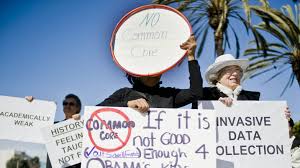
common core hate it

Lots of haters, but what happened to the lovers?

It’s not a hidden history. As I’ve argued every chance I’ve gotten, conservatives have a long history of embracing federal power in ed policy when it suits their interests. Back in the 1980s, Bill Bennett and Lamar Alexander thought that common standards and high-stakes tests were the best way to make their conservative dreams come true.

I’m certainly not the only one to try to bring this history to light. From the Right, free-marketeers such as Michael Petrilli tried hard to convince conservatives to love Common Core. Petrilli and Chester Finn Jr. told the story over and over—Common Core represented a conservative win, a big one. Christian conservatives such as Karen Swallow Prior endorsed the standards, too.

From the Left(ish), too, analysts pointed out the true roots of Common Core. Writing for the Brookings Institution, for example, David Whitman hit the nail on the head:

The conservative roots of the Common Core are little known today. Even among reporters who cover the education beat, few are familiar with, and even fewer have written about, the efforts of Ronald Reagan’s secretary of education, William Bennett, to develop and promote a model core curriculum while in office. Nor have they recounted, except in passing, the sweeping, self-described “crusade” that Senator Lamar Alexander launched to promote national standards and voluntary national assessments when he was secretary of education in the elder Bush’s administration.

So what happened? How did Common Core become just as despised on the Right as it was on the Left? All kinds of conservatives stood up against this conservative reform, from culture-war street-fighter Phyllis Schlafly—who blasted the standards as “pornographic” and “encrusted with lies”—to high-brow Professor Patrick Deneen—who said the standards were based on a “desiccated and debased conception of what a human being is.”

Why? Because when it comes to ed politics, people matter more than policy. And when the Common Core standards were rolled out, it was during the Obama years. In the minds of many conservatives–both intellectuals and real people alike—the Common Core effort came to represent the crass overreach of the Obama White House. So instead of rallying behind the standards, conservatives joined progressives in trashing them. In the end, the high-profile support of standards by President Obama mattered more than the well-articulated support offered by prominent conservatives.

Why should Cory Booker care? Because a similar story is unfolding right now. For many years, charter schools and voucher funding enjoyed broad bipartisan support. Senator Booker was a big proponent, but so was Senator Warren and other leading Democratic lights. Queen Betsy has changed all that. By promoting charter schools so energetically, Secretary DeVos has made it difficult for people like Senator Booker to support them, even if they are basically a good idea in many cases.

What’s the takeaway? When it comes to schools, people matter more than policy. Voters and politicians care about who supports an idea more than what the idea actually is. And just like conservatives found it impossible to rally conservative support for “Obama-Core,” Senator Booker will not be able to rescue the charter-school baby out of the Queen Betsy bathwater.

Blind Football Faith in Comparative Testing

To all the parents and policymakers out there who are anxious about the USA’s performance on recent PISA tests, I’ll quote Wisconsin’s St. Aaron Rogers: R-E-L-A-X. As progressive-ed guru Alfie Kohn, Curmudgucrat Peter Greene and  Yong Zhao of the University of Kansas all pointed out recently, there are plenty of reasons for calm. History tells us, though, that Americans won’t listen. Why not? The answer comes back to St. Aaron and Americans’ shared vision of what proper schooling should look like.

You probably heard the kerfuffle about the most recent international PISA scores. American kids as a whole did only okay. Most worrisome, rich kids improved while poor kids did worse. About 20% of American high-schoolers can read only at a fourth-grade level.

Time to panic? Not really.

As Alfie Kohn put it,

for whatever these comparisons (and the exams that drive them) are worth, U.S. students actually do reasonably well, contrary to popular belief. But it makes no more sense to talk about the “quality of American schools” than it does to talk about the quality of American air. An aggregate statistic is meaningless because test scores are largely a function of socioeconomic status. Our wealthier students perform very well when compared to other countries; our poorer students do not. And we have a lot more poor children than other industrialized nations do.

Peter Greene agreed. As he asked in Forbes Magazine,

PISA coverage tends to overlook one major question—why should anyone care about these scores? Where is the research showing a connection between PISA scores and a nation’s economic, political, or global success?

In the Washington Post, Yong Zhao offered three big reasons why these PISA scores should not be used as evidence of anything other than PISA performance itself:

First, there is no evidence to justify, let alone prove, the claim that PISA indeed measures skills that are essential for life in modern economies. Second, the claim is an imposition of a monolithic and West-centric view of societies on the rest of the world. Third, the claim distorts the purpose of education.

All solid reasons for calm. Yet it doesn’t take much savoir-faire to know that pundits won’t be calm. Anyone with a complaint about our current system of schooling will use these scores to warn that the sky is indeed falling and we need to invest in ______ [insert flavor-of-the-day reform/tech here].

We have to ask: Why won’t Americans heed the advice of these ed experts? Why won’t we simply ignore the results of a fairly meaningless test?

As I found in the research for my book about educational conservatism, there is plenty of culture-war disagreement about what and how schools should be teaching. But there is widespread agreement about one thing. Throughout the twentieth century and into our twenty-first, everyone has largely agreed that one of the primary purposes of schooling is to fill kids with facts.

Although I agree with Yong Zhao that this is a “distorted and narrow definition of the purpose of schooling,” it is one that has persisted largely unquestioned throughout the history of education. Consider just a few pieces of historical evidence from our leading ed historians. (And one from me.)

testing wars in the public schoolsExhibit A: As William J. Reese demonstrated in his 2013 book The Testing Wars, back in the mid-1800s Boston reformers effected a sweeping revolution in schooling. How did they do it? By appealing to the public’s intuition that a standardized test would be a useful way—maybe the ONLY useful way—to evaluate teaching and learning.

Exhibit B: Twenty-plus years ago, Stanford’s David Tyack and Larry Cuban argued that high-stakes standardized tests often formed an unshakeable pillar of the “grammar of schooling.” As they put it, there is a tension between “Americans’ intense faith in education—almost a secular religion—and the gradualness of changes in educational practices.” One reason for that tension is that reformers have never been able to convince Americans that tests don’t matter, that learning could go on without ever-increasing SAT scores.

tyack cuban tinkering

Exhibit C: As I argued in The Other School Reformers, conservatives have had a lot of success in their arguments for more traditional classrooms. They have relied, historically, on both explicitly conservative arguments and on assumptions shared by people who are not particularly conservative. For example, they have often won political contests by insisting that only their preferred reforms could keep kids safe in school. That’s not a particularly conservative idea, but rather an assumption shared by most people. Similarly, conservatives have won by painting progressive reforms as an abandonment of traditional ideas of testing. Real schools, conservatives have insisted, are places that young people go to acquire knowledge they did not have before. And tests are the proper way to measure that process. This vision of the proper purpose of schooling may be “narrow and distorted,” but it is also extremely common, so common that most Americans don’t question it.

And that brings us back to St. Aaron. One way to understand Americans’ reluctance to relax about PISA scores might be familiar to lots of parents. We might want our kids to play sports just to have fun, get some exercise, and make friends. In most cases, however, those youth sports are also fiercely competitive.

If you wonder why it is so difficult for Americans to relax about PISA scores, just go to any youth soccer, football, or basketball tournament. Ask any parent in attendance if they know what the score is. Of any game. I’ll bet dollars to donuts no one will give you the answer that Alfie Kohn, or Peter Greene, or Yong Zhao, or I prefer. They won’t say, “Who knows? It’s only a game.” They won’t say, “We’re only here to promote social bonding among youth.” They won’t say, “We don’t keep score, because that would be a meaningless way to put unnecessary competitive pressure on our kids.”

No. Go to any game anywhere. Try to explain to the person sitting next to you why you don’t care about the score. Even if you’re Aaron Rodgers, you will get nothing but mean looks and sullen silence. And that’s why PISA scores will continue to matter. Despite experts’ best efforts, most Americans still view test scores as a fair measure of educational quality. And most Americans will want to win.

Trump-ing Academic Life

A Miss USA, a bachelor, a gun-toter, a filmmaker, and a MAGA youtuber, all clumped together on a college campus to promote “Judeo-Christian values.” What could go wrong? If it were a reality show, I’d watch it. But it’s not. Instead, this group of culture-war B-listers is the first cohort of Liberty University’s Falkirk Center Fellows. These Trumpish all-stars promise/threaten to upend a long tradition of alternative academic institution-building in conservative evangelical higher ed.

As SAGLRROILYBYGTH are well aware, we’ve been following developments at Liberty’s new Falkirk Center with a lot of interest. The founders—Jerry Falwell Jr. and Turning Point’s Charlie Kirk—warned us that they plan to put “Judeo-Christian values” back in the center of American political life via an “aggressive social media campaign.” Given the history of ambitious academic centers at conservative evangelical universities, there’s not much of a chance the Falkirkers will achieve their goals. Given the recently announced line-up of founding Falkirk Fellows, I’m starting to think that they might, in fact, have a totally different goal in mind. Namely, they might want to trash the entire evangelical academic tradition, or at least not mind if they do.

As I argued in Fundamentalist U, since the 1920s conservative evangelical colleges, institutes, and universities faced a formidable task. They had to create an entirely separate academic system of prestige, one that rewarded scholars outside of mainstream academic channels. As part of their effort to do so, many universities poured scarce resources into the painstaking effort to build their own independent network of academic prestige, one that did not rely on mainstream ideas. For example, institutions such as Wheaton College and Gordon College heaped honors on creationists such as Harry Rimmer. Authors such as Arthur Brown scrambled to compile impressive-sounding lists of academic “experts” who scorned mainstream science.

To be sure, these alternative academic “experts” often had extremely shallow credentials. When evangelical universities gave them honorary doctorates and other academic honors, however, they were signaling to the conservative evangelical community that their universities shared the religious and political values of their honored experts. The universities were creating, in essence, a world of academic prestige outside the entire system of mainstream academics.

The recent move by Liberty University seems as different from that kind of thinking as Trump is from Reagan. What does it take to earn a coveted spot as an inaugural fellow at the Falkirk Center? Let’s take a look:

Frantzve

Adding a little sparkle to academic life…

First, we have Erika Lane Frantzve, Miss USA 2012. Ms. Frantzve claims a “background” in political science and is dedicated to charity work. Next, there is Josh Allan Murray, best known from his appearance on The Bachelorette. These days, in spite of the quick break-ups of his TV nuptials, Mr. Murray is apparently “bouncing back better than ever.” Third comes Antonia Okafor Cover, who works to get more guns on college campuses. She claims to have been told she should not feel free to speak her mind, but as she puts it, “I didn’t listen.” Another fellow will be David J. Harris, Jr., a vlogger and Trump enthusiast who preaches the dangers of the “crazed left.” Last but not least is Jaco Booyens, filmmaker and opponent of sex trafficking.

https://www.youtube.com/watch?v=KigxQRspRE0

I don’t mean to be a campus snob, but what kind of achievements can a group like this hope to achieve? To quote Charlie Kirk, how can this assemblage “‘play offense’ against efforts by liberals to water down Judeo-Christian values in the Bible and Constitution”?

The short and obvious answer is, they can’t. This is a group of second-rate conservative media presences, not a group of alternative academics. Unlike people like Harry Rimmer in an earlier generation, they have no coherent ideas to promote. They are not scientists frozen out of mainstream science, or theologians pushed out of mainstream institutions. Those kinds of non-mainstream intellectuals used to be the ones to win academic honors from the evangelical academy. This group looks decidedly different.

Even from within the alternative academic tradition of conservative evangelical schools, a tradition in which non-traditional intellectuals were often awarded traditional academic honors, this group of Falkirk Fellows looks remarkably intellectual weak. Instead of building an independent system of academic prestige as earlier evangelical colleges have done, the Falkirk Center seems to be merely leaping aboard the Trump Train to trash the entire idea of academic prestige.

I Love You but You Didn’t Do the Reading

We’ve got snow up to our eyeballs up here, but the interwebs haven’t shut down yet. Here are some of the top ILYBYGTH-themed stories from the past holiday week:

NYT charters

Good schools are good schools…right?

Are charters the best hope for low-income urban students? At NYT.

Max Lyttle, director of instruction at Eagle Academy Public Charter School in Washington, D.C., argued that pitting schools against one another misses the point.

“It shouldn’t be about what’s better: charter schools or neighborhood schools,” he said. “It should be about what schools will help our children succeed.”

At the school’s campus in southeast Washington, where more than 90 percent of students are black, Eagle Academy seeks to provide the same resources that white, affluent children have: a swimming pool, a chef who serves fruits and vegetables and a “sensory room” modeled on private medical facilities where students can calm down. The school was recognized this year for its improvements on standardized test scores.

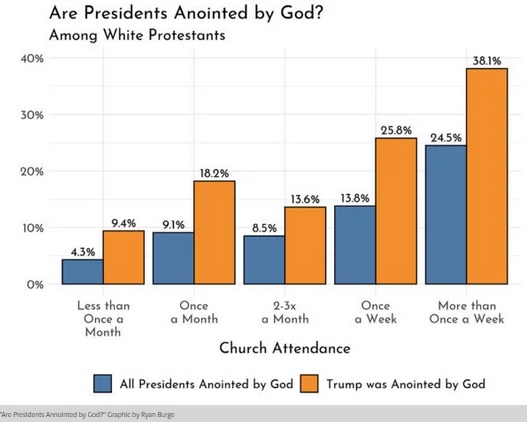
Burge rns anointed by godRyan Burge asks: How many Americans believe Trump was “anointed by God?” At RNS.

White Protestants’ belief in Trump’s anointing tracks with church attendance. Among those who attend less often than once a month, just 1 in 10 thinks that Trump was anointed. Of those who attend church multiple times a week, 4 in 10 agree that Trump was anointed by God.

Views of the Bible also affect how Americans responded. Among those who consider the Bible inspired by God, just 11% believe Trump was anointed, while those who believe the Bible to be the literal word of God are more than three times as likely to think so.

Liberty University sets up a new academic center, at WE.

The Falkirk Center for Faith and Liberty, a combination of their names [Jerry Falwell Jr. and Charlie Kirk], will “play offense” against efforts by liberals to water down Judeo-Christian values in the Bible and Constitution in their bid to build support for big government, said Kirk. . . . He said that the center hopes to answer a question he gets often, “was Jesus Christ a socialist?”

Fizzle Alert: New Campus Center Will Try to Prove that Jesus Was Not a Socialist

The history is not particularly encouraging. Nevertheless, Liberty University plans to open a new academic center, one devoted to promoting Judeo-Christian values in American society. How do we know it won’t work? Three reasons, plus one counter-point.

Here’s what we know: Liberty University recently announced its new Falkirk Center. The name comes from a combo of Jerry Falwell Jr—Liberty’s president—and Charlie Kirk, leader of Turning Point USA. The goal of the center will be to blitz social media with traditional Christian messages. As Falwell and Kirk described,

Said Kirk, “We’re in a culture battle right now where you have to fight and play offense, and part of this effort is to try and play offense against the secular Left.”

Falwell added, “As attacks on traditional Judeo-Christian beliefs grow in frequency and intensity, the need has never been greater for a national revival of our foundational principles throughout our society and institutions in America.”

The center will use an aggressive social media campaign to push back against what Kirk described as the Left’s effort to “try to convert young Christians into socialism and to intentionally misrepresent the gospel and the teachings of the Bible to try to convert young people to be further on the left.”

Will it work? No.

First of all, there are a few big established conservative think-tanks that don’t leave much room for a new one. Why would anyone go to work at the Falkirk Center when they could go the Heritage Foundation instead?

Second, the name itself spells doom. Generally, any academic center or think-tank needs a clear and unified purpose. Often, that takes the form of a charismatic leader. In this case, trying to balance the big egos of both Falwell and Kirk will mean that neither of them gives the center his full attention and support.

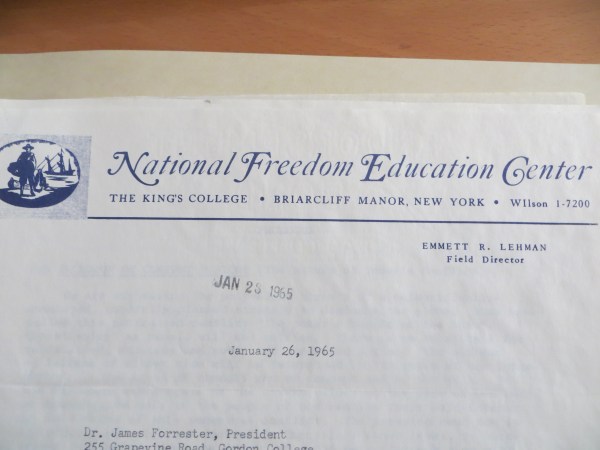
Third, as I found in the research for Fundamentalist U, when conservative evangelicals have tried to establish alternative academic centers in the past they haven’t had a lot of success. Consider the ill-starred National Freedom Education Center (NFEC). It was an organization based at The King’s College in New York (now in New York City).

national freedom education center letterhead

They had enough money for letterhead, but that’s about it…

One of the NFEC’s goals was to spread “American Studies” programs on evangelical campuses. As their promo materials put it,

What philosophy shall give direction to the material world we are developing?  Shall the long-felt influence of the Christian ethic be brought to bear on current history?  Dare we succumb to the seemingly plausible suggestions that in our time government-over-man is preferable to America’s long proven concept of man-over government?

Can we survive as a people, even with our unparalleled abundance of things, if our thinking excludes our traditionally motivating intangibles . . . . reverence for God, total human concern for the individual, an abiding dedication to preservation of our Constitution and a cherishing regard for personal Freedom? [sic]

Did it work? Nuh-uh. A few institutions, such as Azusa Pacific, signed up. They received a few hundred dollars and some books for their libraries. Other schools blanched. Gordon College in Massachusetts, for example, rejected the overtures of the NFEC. The faculty at Gordon did not want to turn their conservative religious school into merely a conservative political school.

There’s no doubt, however, that the NFEC would have had more luck if it had had deeper pockets. And that’s where the Falkirk Center might get its glimmer of hope. Liberty University has bajillions of dollars to spend from its online empire. Could that $$$ make a difference? Maybe.

After all, the Falkirk Center is NOT trying to build academic prestige. That takes time, vision, and patience. It is only trying to mount an “aggressive social media campaign,” which is quick, dirty, and easy. It seems at least possible that the Falkirk Center might splash out money on a blitz of popular media, and that the blitz might reinforce already-existing stereotypes. It COULD become, even, a new sort of academic center, one that doesn’t care much about traditional academics but has a big social-media footprint.

I don’t think it will happen, because President Falwell has always been more invested in football than academics, but it seems at least possible that the Falkirk Center might take advantage of a fat wallet to do more than talk about making a difference. I’m not going to worry too much about it, yet.

Thanksgiving, ILYBYGTH Style

Ah…Thanksgiving. The holiday that brings us together to yell at each other and watch football. How can one Thursday fire up so much culture-war angst? How can it help explain both Rush Limbaugh and creationism?

simpsonsturkey

This year, as your humble editor prepares to head to an undisclosed location somewhere in upstate NY to avoid any hint of culture-war histrionics, we stumbled across the ILYBYGTH Thanksgiving archives. Check out some of the ghosts of ILYBYGTH Thanksgivings past:

First, how does Thanksgiving help us understand the way schools really work? For everything from sex ed to evolution, Thanksgiving dinners can serve as metaphors for the real reasons why it is so hard to get schools to dive into controversial issues.

Second, were the Pilgrims really communists? And why do conservative pundits say they were? It seems to me conservatives would want to defend the tradition of friendly buckle-wearing Pilgrims.

Next, how does Thanksgiving play a role in climate-change culture wars? Some advice from the folks at National Center for Science Education.

Finally, some bad Thanksgiving advice on how to outsmart your crazy right-wing (or left-wing) uncles.