Saddle Sore at the Ark Encounter

I just don’t get it. No, no, no, I’m not talking about the seemingly obviously false idea that the entire earth was really deluged in a flood and that eight humans survived on a floating zoo. And no, I’m not talking about the diorama at Ark Encounter depicting humans fighting dinosaurs and giants in a kind of Colosseum of Doom. I’m not talking even talking about young-earth creationist notions that humans and dinosaurs lived together, or that the earth and everything is only a few thousand years old.
20171226_113134

Dinos dinos dinos…

I can’t say I really understand those things, but that’s not what’s been bothering me since my trip to the Ark Encounter. Here’s the riddle that’s on my mind: If Ken Ham is embarrassed by the notion of people joy-riding on dinosaurs, then why does the Ark Encounter make such a big deal about the dinosaur angle? Why don’t they downplay it? I have a hunch, but I’d be happy to be educated on the subject by SAGLRROILYBYGTH.

We know Ken Ham is touchy about mockery related to dinosaurs wearing saddles. A few years back, for example, he reacted furiously to journalist Charles P. Pierce’s jokes about the Creation Museum. For Pierce, the idea of dinosaurs with saddles was the perfect epitome of “Idiot America.” Never one to back away from a fight, Ham huffed,

Those who oppose the Creation Museum, having by and large given up on trying to argue logically and scientifically against the information presented in its exhibits, are resorting more and more to a mocking, scoffing, and a ridiculing approach. . . . The dinosaur with the saddle is obviously just a fun part for kids—it has nothing to do with any of the teaching exhibits, and nothing to do with the first-class dinosaur exhibit and all the teaching signs.

Fair enough. But it doesn’t answer my question. If Mr. Ham knows that so many people find the idea of dinosaurs and humans living together ridiculous and laughable, why does he harp on it so incessantly? The Ark Encounter, for example, prominently features dinosaurs in cages next to other sorts of animals.

20171226_115231

Lots of dinos on board…

Ham’s publications, too, willfully emphasize the notion that people must have put saddles on dinosaurs. A book I picked up in the gift shop features questions about radical creationism from kids. One ten-year-old from Michigan asked, “Did we use dinosaurs for transportation?”

How did Ham respond?

I know the Bible doesn’t specifically address this question, but . . . we can use the reasoning skills God gave us and His Word to come up with an answer. . . . I can think of many animals that have been tamed. . . . why not some of the dinosaurs? Who knows what they were doing? It seems to me we should at least allow the possibility that some could have been tamed to help with transportation, maybe even farming, hauling heavy loads (the strong ones!) and other things.

Not just dinos with saddles, but dinos with plows, carts, and all sorts of other bizarre combinations. Why, oh why, would a radical creationist harp on this notion, when he knows that it will lead to mockery and contumely from the outside world?

aig dino question book

Did people ride dinosaurs? Yes, Virginia…

I have a hunch. First of all, I think many of us never rise above a Flintstones level of understanding the real relationship between dinosaurs and later life forms. For many people—creationist or not—it is not shocking to think of dinosaurs and humans living side by side, attending drive-in movies together.

But there’s more going on than just an appeal to ignorance. I think the Answers In Genesis crowd is convinced that dinosaurs are the key to their creationist kingdom. If they can show people dinos and humans living together, it might shake up people’s assumptions that the earth is far older than 6,000 years or so. If people see dinos wearing saddles and plowing fields, it might prompt them to say, “Hey, weren’t dinosaurs extinct long before people started farming?” The question, AIG might hope, would lead to a healthy shake-up of people’s thinking; it would give AIG missionaries a chance to offer their young-earth answer.

At least, this is the explanation from AIG stalwarts such as Buddy Davis. Davis calls dinosaurs “missionary lizards.” As Davis explains,

As non-Christians hear the biblical explanation of dinosaurs, many have been, and will be, challenged to listen to the rest of what the Bible states. We rejoice that many have been won to the Lord using the true history of these missionary lizards.

For AIG’s radical creationists, then, the notion of humans and dinosaurs living together is not something to be embarrassed about, but something to be trumpeted. If enough people see dinosaurs with saddles, the thinking goes, then they will be compelled to explore AIG’s creationist ideas.

Is it working? Not really. As George Bishop of the University of Cincinnati found, radical creationists aren’t any more consistent than the rest of us. Professor Bishop poked the usual poll numbers and found some strange results. Of people who said that humans had been created recently, over half also believed that dinosaurs had gone extinct over 65 million years ago.

Nevertheless, if my recent trip to the Ark Encounter is any guide, the creationists at AIG have confidence that their focus on dinosaurs will help people see the light.

Eden and Zion

When you picture radical creationists, what do you think of? As I’m arguing in my new book about American creationism, it’s all too easy to fall into misleading stereotypes. Instead of asking about “creationism,” we need to get into the habit of talking about “creationisms.” After all, creationism in the USA and in the world is not one thing, but many. A new survey of LDS (Mormon) beliefs about creation and evolution gives us yet another reminder of this diversity.

Benjamin Knoll and Jana Reiss asked a sample of LDS members two questions about evolution. Here is a breakdown of their results:

God created Adam and Eve sometime in the last 10,000 years and humans did not evolve from other life forms.”

  • 53% “I am confident and know this is true.”
  • 21% “I believe and have faith that this is probably true.”
  • 13% “I believe this might be true, but I have my doubts.”
  • 7% “I believe this is probably NOT true.”
  • 6% “I am confident and know this is NOT true.”

“Evolution is the best explanation for how God brought about the emergence and development of life on Earth.”

  • 24% “I am confident and know this is true.”
  • 25% “I believe and have faith that this is probably true.”
  • 17% “I believe this might be true, but I have my doubts.”
  • 13% “I believe this is probably NOT true.”
  • 20% “I am confident and know this is NOT true.”

As always, the poll numbers leave us hankering for more. Some of the most contentious issues among American creationists were left out. We see that huge majorities of LDS members think our species was created as the Bible describes. But what do LDS members think about the age of the earth and universe? Do they think there might have been a long “gap” between creations? Or maybe that the “days” of creation were really long “ages?”

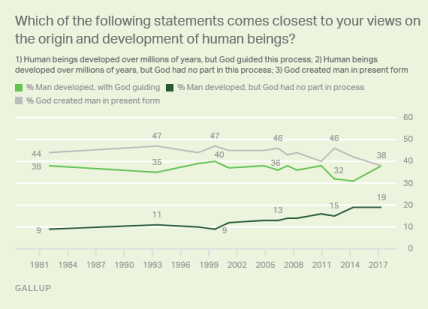
This survey just doesn’t say. However, it does give us some very helpful insights into LDS thinking on these questions. Not surprisingly, a large majority of LDS respondents agrees that humanity was created specially and recently. Also not surprisingly, the notion of God-guided evolution seems very divisive among LDS members.gallup creationism poll may 2017

Though the questions and possible responses don’t match up perfectly, it seems from this survey that LDS members are more likely than Americans as a whole to embrace a recent, special creation of our species. As Gallup has reported for the last few decades, the number of Americans in general who choose a recent special creation of humanity has fluctuated between 38 and 47%.

LDS respondents also seem a little less likely than Americans as a whole to take God out of the process. The Gallup numbers suggest that more and more respondents choose a God-free explanation. Among LDS respondents, only 13% didn’t think a recent special creation was likely.

Though they represent only 1.5% of all Americans, LDS members have unique clout in Utah. We shouldn’t be surprised, then, that evolution remains a contested topic in Utah’s public schools.

I Love You but You Didn’t Do the Reading

Welcome to 2018! You might think the last week of the year would be quiet, but you’d be wrong. Here are a couple of the ILYBYGTH-style stories that jumped out at us over the past week:

Issue in review: Has Trumpism killed evangelicalism?

Conservatives and the higher education “scapegoat,” by Catherine Rampell at WaPo.

The thing white professors won’t talk about, by Robert Cherry at RCEd.

Want to avoid a “death of despair?” Go to college. At CHE, research about the link between higher education and better health.Bart reading bible

Jeffrey Salkin admires LDS (Mormons). But he wants them to stop baptizing dead Jewish people, at RNS.

Why one evangelical leader left Trump’s evangelical council. AR Bernard explains his departure to Samantha Bee: “Better think carefully what you are given in exchange for your life, your reputation.”

What’s wrong with the pseudo-intellectual Right? Paul Gottfried tees off on D’Souza, Prager, and Goldberg at AC. Gottfried’s conclusion:

  • “there is . . . a plague of genuinely ridiculous writings on historical subjects coming from conservative media celebrities that surpass in their arrogant stupidity almost anything I’ve encountered in professional journals. As for people who yap about the ideologically tainted work that originates in our universities, one might hope they’d be somewhat better than those they declaim against. That’s not always the case.”

Year in Review: Top ILYBYGTH Stories of 2017

I told myself I wasn’t going to do it. But as the thermometer plunges to thirty below outside, my computer and I are spending too much quality time together. As a result, I’ve cobbled together a list of the most popular ILYBYGTH posts of 2017. All the usual suspects show up: Creationism, evangelical higher ed, conservatism, school reform, Joseph Lancaster, Trump, and, of course, gyrovague.

pence trump clown car

There have been a few bumps in the road in 2017…

So if you’re stuck inside too, why not take a stroll with ILYBYGTH down memory lane?

Have a safe and happy new year, everyone! See you in 2018.

Making Ararat Great Again

What does Noah have to do with homosexuality? For that matter, what does creationism have to do with Donald Trump? The connections might seem jagged, but those of us who hope to understand the real contours of radical American creationism need to understand the connections between the Rainbow Covenant and Trump’s hat. My recent visit to the Ark Encounter gave me a sharp reminder of the cultural politics of creationism.

Trump make america great again

It’s the hat, stupid.


SAGLRROILYBYGTH are sick of hearing it, but I can’t help repeating myself: Lots of white evangelicals have always harbored a Trump-ish white nationalist attitude. Not all of them, of course. White evangelicals have also been the most ferocious critics of their coreligionists on this score.

Moreover, the relationship between evangelical religion and chest-thumping American nationalism has always been complicated. White evangelical Americans have tended to think of the USA as both a uniquely Christian country and a dangerously sinful one. As I argued in an academic article a while back, the “establishment-or-outsider paradox” that George Marsden described so long ago has always been a constant source of tension when it comes to evangelical thinking about schools and culture.

For many conservative evangelicals—especially those on the harder-right end of the broad evangelical spectrum—public schools in particular have been the leading symbol of this tension. In the white evangelical imagination, public schools used to be great. They used to lead children in prayer and Bible reading. In the past fifty years, one popular conservative-evangelical story goes, public schools went terribly awry. In practice, evangelical pundits warn one another, America kicked God out of the public schools.

For a large and influential segment of the white evangelical public, this scary story has a silver lining. In spite of the frightening changes in American public education, there is hope. Conservative evangelicals have told one another, for example, that they can “reclaim” their local schools.

reclaim your school

Good news/Bad news…

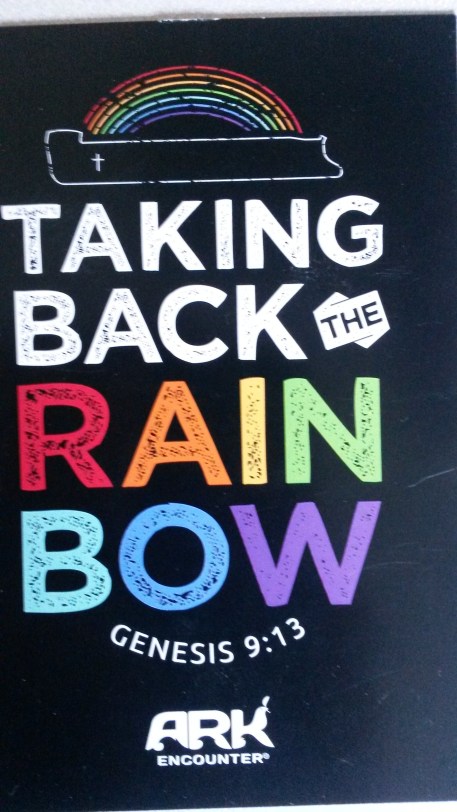
The notion of reclaiming, of taking back, resonates with radical creationists, too. As I browsed the gift shop at the Ark Encounter, I found a fat stack of postcards. Many of them harped on the theme of “taking back” the symbol of the rainbow. Instead of representing gay pride, the Kentucky creationists hope, the rainbow can once again symbolize conservative evangelical faithfulness.

20171228_090906.jpg

Reclaim your rainbow…

It is a central theme for American young-earth creationism, and one that has very little to do with theology or science. The language of many radical creationists is peppered with talk about the good old days, when evangelical Christianity WAS mainstream American religion, when “Merry Christmas” WAS the thing to say to each other in December, when public schools DID reinforce evangelical faith.

Once we grasp this enduring theme among radical creationists, it’s not so difficult to see the appeal of Trump. Any candidate who promises to make America great again will get the white-evangelical vote, or at least the vast majority of it.

Arking the Right Questions

John Oliver thought it was just quirky. There’s a more obvious explanation.

john oliver ark manure

For the full scoop on poop, go to 6:20.

As I discovered on my recent trip to the creationist Ark Encounter, the displays spend a LOT of time explaining where all the poop went. They also explain in great detail how Noah crammed huge dinosaurs on a boat.

There’s more going on here than simple scatophilia. Other radical creationists, too, like to focus on some sorts of questions for sensible reasons. If we spend all our time talking about HOW Noah handled all the dinosaur manure, for example, we’ve already conceded the most important point, which is that Noah really existed with his real ark surviving a real world-wide flood. With dinosaurs on board.

PACE 1096 diplodocus

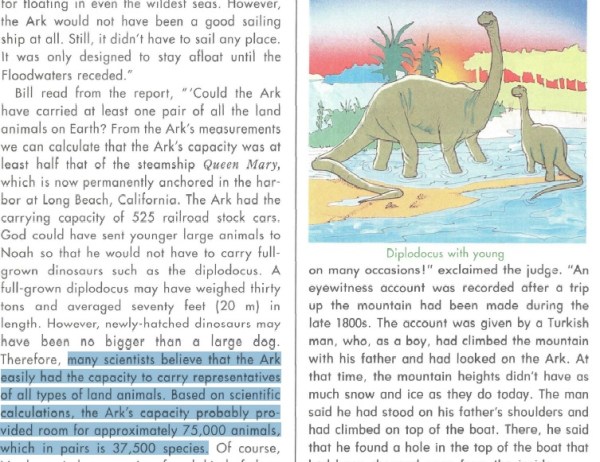
How do SCIENTISTS think Noah squeezed dinosaurs onto his ark? From PACE 1096 (1986 edition)

The folks at Answers In Genesis aren’t the only ones to ask HOW questions instead of WTF questions. The fundamentalist curriculum specialists at Accelerated Christian Education, too, like to help young creationists focus on the details of their creationist vision. In PACE 1096, for example, creationists will read that Noah could easily have solved the problem of fitting huge dinosaurs on his ark if he simply used juvenile dinosaurs.

20171226_113428

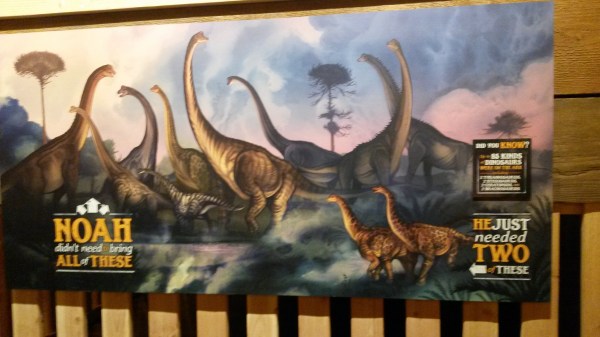
From the Ark Encounter: It’s easy if you just use the small dinosaurs…

That’s the general argument at Ark Encounter, as well. Visitors will see charts and graphs of various species, explaining clearly how enormous dinosaurs could have been squeezed onto the ark. The dinosaurs themselves were comfortably situated in roomy cages on the deck.

20171226_114712

Plenty of room for all kinds of dinosaurs on board…

What about all the poop? The Ark Encounter offers an extensive explanation. In their vision, Noah and his crew fitted their boat with an elaborate system of pipes and pulleys. Excrement could easily be flushed into the floodwaters. Fresh water was collected on the roof, thanks to the endless rain.

20171226_114853

From the Ark Encounter: Focus on the HOW…

By focusing on these sorts of detailed, science-y sounding explanations, young-earth creationists can reassure themselves and their children that the ark really could have worked. I have to imagine that such conversations serve a vital function: By talking at length and in detail about HOW these things happened, creationists can rest assured that they DID happen.

20171226_114917

A #2 solution…

How I Spent My Christmas Vacation

For family reasons, I spent Christmas this year in scenic Florence, Kentucky. florence yallOnce the presents were opened and the piñatas destroyed, I snuck off to see the newish jaw-dropper from Ken Ham’s Answers In Genesis: The Ark Encounter.

It really was a remarkable sight—an enormous ark rising out of the Kentucky fields. For the next few days, I’ll be sharing my reflections about the trip.

20171226_112046

Wowzers.

As SAGLRROILYBYGTH know, I’m no creationist, but I’m not interested in poking fun at the young-earthers. I don’t even want to get into a shouting match about why this kind of science doesn’t make sense to me. Rather, as I finish up my new book about American creationism, I wanted to use my visit to understand radical creationism better. And it worked, sorta. My trip has my head whirling with questions like the following:

  • How does the Ark museum help explain why so many white evangelicals love Trump?
  • If the idea of dinosaurs hanging around with people is so radically different from mainstream science, why does AIG harp on it so much?
  • Why the fascination with poop?
  • Do other museums these days put huge blown-up comic books on the walls?
  • Who are the young-earth creationists competing with?
  • Why are the AIG folks so obsessed with college?

Right off the bat, though, I can’t help but remark on the most obvious lesson I learned from my field trip: In many ways, the Ark Encounter is at least as much about making money as about saving souls. Like all museums everywhere, we had to overpay for parking—ten bucks in a mostly-empty lot. And like all museums everywhere, for some reason we could have coughed up fifty-one cents for a squashed-penny Ark Encounter memento.

20171226_115845

Squeezing every penny out of visitors…

I Love You but You Didn’t Do the Reading

Well, it’s Christmas, but the ILYBYGTH elves never take a day off. Here are some stories you might have missed as you stuffed your face with candy canes and eggnog:

Why don’t evangelicals care about the latest scientific discoveries? A review of Elaine Howard Ecklund’s new research, at CT.

Why is it so hard to root out sexual abuse at schools? At NYT, a story of an investigation gone nowhere.Bart reading bible

Pinterest preaching: At R&P, Katelyn Beaty asks why white evangelical women leaders don’t talk about politics more.

How can we stop school segregation? The answer has been just a bus-ride away since the 1970s.

How can we solve our history culture wars? Rick Hess and Brendan Bell say stop fighting over which heroes to teach and teach about heroism itself.

When principals cheat: At EdWeek, an update from Atlanta’s cheating scandals.

What should learning mean? Conservative college leader calls for a return to the great values of the Western tradition.

What is Chicago doing right? Measuring urban schools—an interview with Stanford’s Sean Reardon.

Mississippi history classes still avoid civil rights, at The Atlantic.

Healing Our History Culture Wars

It has become a life-and-death question: Who are the heroes of American history? In Charlottesville, we’ve seen that terrorists are willing to kill to defend the primacy of Confederate leaders like Robert E. Lee. This morning Rick Hess and Brendan Bell offer a better way to teach about the heroes of history. But it won’t be as easy as we might think. As historian Jonathan Zimmerman argued a while back, heroism in history is a kind of one-way valve. It is easy to add new heroes, but it is extremely difficult to question the essential notion of heroism itself.

Depending on how old you are and where you live, you likely heard one or another of the standard hero explanations of American history. If you’re old enough, you might have learned that the young George Washington couldn’t tell a lie. If you’re Southern enough, you might have learned that honorable Jacksons and Lees valiantly defended the Southland from rabid northern aggression. If you’re young enough, you might have learned that Rosa Parks and Martin Luther King Jr. bravely defeated racism. If you’re hippie enough, you might have learned that heroic natives fearlessly resisted European imperialism.charlttesville confederate t shirt

In every case, though, the focus of most public-school history classes has been on the heroic accomplishments of great Americans of the past. The type of heroism varies over time and place, but the notion that the real story of the USA is a heroic one rarely does.

jay z che guevara

It’s not hard to see the problems with this process. Whether we wear Che t-shirts or Confederate flag ones, we’re forcing real history into a cartoonish good-vs-evil pattern. And that’s bad for two reasons.

As Hess and Bell point out, black-and-white history is boring. As they put it,

We take influential yet complicated figures like MLK and Lincoln and turn them into plaster saints. When history is taught this way, debates about who gets to be a hero will inevitably feel winner-take-all, since it becomes an exercise in deciding who gets to serve as shorthand for all that’s right and just.

However, that’s not how Homer, Ovid or Shakespeare thought about “heroism,” and it’s not how we should either. We should learn just as much from heroes about what not to do as about what to do. If being an icon means careful attention to Jefferson’s slave-owning as well as his magisterial writing, if it means considering MLK’s philandering and plagiarism as well as his towering moral courage, then being on that pedestal is more of a mixed bag. And this is just good teaching, anyway. After all, the most gripping and instructive accounts of iconic figures are those that depict their humanity, their indecision and the price they paid along the way.

The best recent example of teaching heroes well may be the wildly popular musical “Hamilton.” One of the things that creator Lin-Manuel Miranda masterfully did was marshal a warts-and-all portrayal of Alexander Hamilton, Thomas Jefferson and Aaron Burr in a way that imbued these often starchy figures with immediacy and humanity. Hamilton is at once brilliant and licentious; Jefferson, elitist yet principled; Burr, murderous but complex. Though their flaws are apparent, so too is their greatness – indeed, their greatness is entwined with their flaws.

There’s an even more important reason to avoid good-vs-evil history. Good-vs-evil history teaches us to hate the people we disagree with. Why else would someone drive a car into a crowd to defend the honor of a long-dead Confederate general?

It would be terrific if we could teach history better. It won’t be easy, though. Professor Zimmerman argued that history culture wars are usually resolved by an intellectually vapid but politically expedient process. Every politically powerful group is allowed to add its heroes to the story. That’s easy. Taking away a hero, though, as we’ve seen in Charlottesville and elsewhere, is extremely difficult.

Creation Cold War

Maybe we’ll get a creationist James Bond out of it. After all, the US/USSR Cold War was horrible in a lot of ways, but it created fertile ground for great spy stories. Now, it seems radical creationists are worried about their own inter-creationism cold war. Beyond Kentucky and Austin, Texas, the spiritual battlefields have spread to Latin America and beyond.

This represents a different sort of global creationism. SAGLRROILYBYGTH are well aware that creationism has always been a global phenomenon, despite the mistaken proclamations of Bill Nye and others. News from Korea and Turkey, to cite just two examples, is unmistakable on that point.

Today we see evidence that creationism is also globalized in a different kind of way. Like the USA and USSR in the twentieth century, it looks like some creationist ministries are conducting a global cold war for the hearts and minds of evangelical believers.

At leading young-earth ministry Answers In Genesis this morning, Ken Ham celebrates a new Mexican outpost. According to Ham, AIG has been conducting considerable outreach in Latin America already. As he explains, AIG has been

sending speakers to over 30 conferences each year in Central America and South America. We’re also teaching in four seminaries and eight secular universities each year.

I’d love to know more about the teaching in those secular universities! But that is question for a different day. Today, we’re curious about Ham’s cold-war warning. As he writes,

Sadly, two apologetics ministries that teach a compromised view of Genesis chapters 1–11 now have representatives teaching throughout Latin America. They will lead many churches and their leaders astray by encouraging the church to compromise the clear teaching of God’s Word in Genesis.

It certainly seems as if AIG is girding its loins for a proxy fight in Mexico and other Latin-American countries. But who are the other two creationist groups he’s talking about? I looked at a few of the usual suspects and came up with only one likely possibility.

It seems the evolutionary creationists at BioLogos have also been conducting Latin American outreach. Among the different sorts of creationists, none rile up Ken Ham more than BioLogos, so I’m guessing that’s one of Ham’s two creationist competitors.

Who is the second? I looked first at Hugh Ross’s Reasons to Believe. They are usually the second creationist foe of the AIG crowd. I couldn’t find any reference to Latin American outreach by RTB, though. I did find a reference to an RTB “partner,” which may be on Ham’s list. Ravi Zacharias International Ministries claims to preach the conservative-evangelical Word in Latin America. A quick look at their website wasn’t satisfying, though. It was hard to tell the degree to which RZIM focuses on creationism in its outreach. Could RZIM be the second of Ham’s creationist competitors? Or is he worrying about a different group?

Whoever the creationist competition is, if history is any guide, AIG may have spectacular successes in its efforts. Other conservative evangelical outreach programs have made astounding inroads into formerly Catholic-dominated areas. Perhaps AIG will follow that pattern.