Why Go to Fundamentalist U? To Get a Better Job!

Why should students go to a fundamentalist university? For about a century, the argument has always been the same. A new marketing campaign by fundamentalist behemoth Bob Jones University shows that the times, they are a’changin.
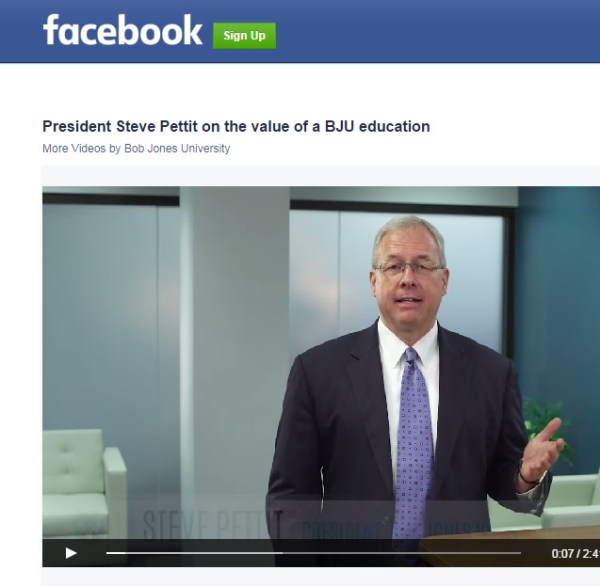
Pettit on BJU

What is school for? Careers!

To be fair, Bob Jones University has always insisted that its graduates would have the absolute best academic education. Back in its earliest days, founder Bob Jones Sr. insisted that the school would keep children both theologically safe and academically privileged. As he put it in 1928,

The fathers and mothers who place their sons and daughters in our institution can go to sleep at night with no haunting fear that some skeptical teacher will steal the faith of their precious children.

Jones’s very next line, though, showed that he understood what parents really wanted in a college. Not only should it keep kids Christian, but it should also prepare them for professions. In his words,

Your son and daughter can get in the Bob Jones College everything that they can get in any school of Liberal Arts.

In 1949, Bob Jones Sr. re-emphasized the point that his school—now a University—would always insist on the very best academics. As he put it,

We have always insisted that an educational institution with the right kind of spiritual standards will maintain the highest possible academic standards.

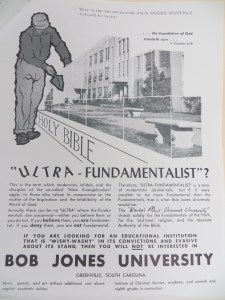
It’s fair to say, however, that for marketing purposes, the biggest selling point of BJU in the past was its staunch commitment to fundamentalist Protestantism. Other schools may waver, the Bob Joneses have always promised, but BJU would never budge.

If you wanted your child to have a college experience firmly dedicated to fundamentalism and only fundamentalism, the message was, BJU is for you.

In the 1950s, for example, as “fundamentalist” schools were separating from “neo-evangelical” colleges, BJU sold itself as the unapologetic fundamentalist choice. So unapologetically, in fact, that leading evangelical magazines such as Moody Monthly refused to run its advertisements for fear of alienating good evangelical readers.bju canceled MM ad full again good one RIGHT SIDE UP
Today, in contrast, BJU’s President Steven Pettit offers fundamentalist families a very different primary reason for attending his school. Why should they attend BJU? For its unbeatable record of preparing students for high-flying professional careers. BJU students, President Pettit promises, do better at passing med-school exams, accounting exams, nursing exams, and engineering exams.

As Pettit puts it,

If you’re looking for a college worth the investment of your time and money, a college that will prepare you well for future employment, and help you to grow spiritually in the process, Bob Jones University is the place for you. . . . I think you’ll find BJU provides the value you’re looking for.

Why go to Fundamentalist U? To get a better job!

More proof that schools such as Bob Jones University are not quite as different as other colleges and universities as we might think.
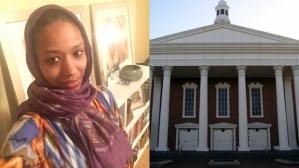

Hijab & Halloween

Well, that just proves it, you might be tempted to say. When Wheaton College can suspend a tenured professor for saying that Muslims and Christians worship the “same God,” it just goes to show that the “Fundamentalist Harvard” is (still) more “Fundamentalist” than “Harvard.”

Hawkins Wheaton

Whose God?

But wait just one minute. If we look at this episode another way, we see that Wheaton’s recent strange action puts it smack dab in the mainstream of elite higher education these days.

You’ve probably seen the story by now. As Christianity Today reports, political science professor Larycia Hawkins was suspended recently. Professor Hawkins planned to wear a traditional Islamic headcovering—the hijab—during Advent this year to express her Christian solidarity with Muslims.

That’s not why she was suspended, at least not officially. The college suspended her, officially, for her statements about God. In a Facebook post on December 10, Professor Hawkins explained the reasons for her act of sartorial solidarity: “as Pope Francis stated last week, we worship the same God.”

Non-evangelicals like me might not see the problem. But as Christianity Today pointed out, the question of Muslims and Christians worshipping the same God is intensely controversial among some Christians.

It is tempting to see this episode as proof of Wheaton’s continuing status as a school outside of the higher educational mainstream. As I’m arguing in my new book about the history of conservative evangelical higher education, however, the truth has always been more complicated. Wheaton is NOT outside the mainstream here. Rather, this is exactly the sort of action that is taking place at elite colleges across the nation.

Of course, the details are different; the specific issues are different. In Wheaton’s case, the administration acted to suspend Professor Hawkins because, in their words,

As a Christian liberal arts institution, Wheaton College embodies a distinctive Protestant evangelical identity, represented in our Statement of Faith, which guides the leadership, faculty and students of Wheaton at the core of our institution’s identity. Upon entering into a contractual employment agreement, each of our faculty and staff members voluntarily commits to accept and model the Statement of Faith with integrity, compassion and theological clarity.

This final problem of “theological clarity” seems to be the rub. Wheaton’s administration said they sympathized with Prof. Hawkins’s sympathy for Muslims. But, they repeated, “our compassion must be infused with theological clarity.” Professor Hawkins, in short, was suspended for “theological statements that seemed inconsistent with Wheaton College’s doctrinal convictions.”

Obviously, no pluralist, liberal, or secular school would suspend a professor for an act of theological un-clarity. As we’ve seen over the past few months, however, elite colleges everywhere are suspending professors and administrators for actions and statements that seem inconsistent with their non-theological convictions.

Like Professor Hawkins, for example, Erika Christakis at Yale has left her teaching duties. Why? Because she wrote an email that many students found unsettling. We might say that Christakis’s suspension was due to her lack of sufficient “clarity” about her racial ideology.

Or, we might consider the case of Mary Spellman at Claremont McKenna College. Did Dean Spellman make racist comments? No, but her attempt to care for one non-white student seemed to lack clarity to many students and activists.

SAGLRROILYBYGTH are sick of hearing it. But I think it is true, and I think this episode is further proof: Mainstream colleges today are moving more toward the “impulse to orthodoxy” that has been the hallmark of conservative evangelical colleges like Wheaton.

It’s easy enough to point out differences, of course. At Wheaton, pressure came from conservative alumni and administrators. At the other schools, pressure came—at first—from students. At Wheaton, the statement of faith is explicit and official, whereas the other orthodoxies are implicit and tentative.

In the end, though, I think the parallels are striking. At elite colleges these days, instructors, students, and administrators are expected to do more than agree generally and in principle with their schools’ current orthodoxy. They are expected, rather, to agree with forceful clarity. They are expected to avoid any statement or action that “seem[s] inconsistent” with dominant moral ideas.

To this reporter, it looks as if Wheaton College continues to be more similar than different from other elite schools these days.

HT: EH

Breaking Up Is Hard to Do

The fracturing continues. Recently The Master’s College in California announced its departure from the Council of Christian Colleges and Universities. The reason? The organization, according to TMC, had veered too far away from real evangelical Christianity. To this reporter, it looks like the handwriting is on the wall for the CCCU.

masters college

Quitsville, meet Splitsville

It wasn’t hard to see it coming. As we noted in these pages, the US Supreme Court decision in Obergefell v. Hodges made it clear for all with eyes to see and ears to hear that changes were coming soon. It’s not an easy position. Conservative evangelical colleges have been put in an impossible situation, a “do you still beat your dog” dilemma.

On the one hand, colleges such as Goshen College and Eastern Mennonite University have decided that real Christianity requires a changing of rules about homosexuality. They decided to welcome homosexual faculty members. In order to save the CCCU from rancorous disputes about the issue, both schools eventually withdrew.

On the other hand, school leaders worry that they will be giving in to social pressure–betraying their religious principles–if they change their policies about homosexuality. In the eyes of some school leaders, the CCCU didn’t act quickly enough to expel Goshen and EMU. As the drama unfolded last summer, Union University and Oklahoma Wesleyan University both quit, dismayed that the CCCU would even consider including Goshen and EMU.

Now The Master’s College has decided that it will no longer be part of the CCCU, even though Goshen and EMU have left the organization. In its recent announcement, TMC explained that the recent controversy proved that the CCCU had gone soft on core issues of creation and sexuality. As TMC put it,

We have increasing concerns about the direction of the CCCU, given that the vast majority of member schools do not accept the Genesis account of creation or the inerrancy of Scripture.

Two former CCCU schools have demonstrated that opinions are also shifting away from the Bible’s teaching on marriage and sexuality. There are likely other member institutions that are not faithful to the biblical position. The CCCU’s willingness to offer affiliate status to these two schools and the affirmation of 75 percent of member college presidents, raises serious questions as to whether the organization still holds to biblical Christianity.

What is the future of the CCCU? We historians are famously bad predictors, but I will say it anyway: The CCCU is already dead, even if it doesn’t know it yet.

As I’m finding in the research for my new book about the history of evangelical higher education, evangelical colleges can survive most storms. But the current crisis is one that is familiar throughout that history, and one that has wrecked earlier efforts at unity.

As has happened in the past, the current dilemma gives evangelical college leaders questions they will not be able to agree on: Is your school for bigots? Or is it for apostates?

I Love You but You Didn’t Do the Reading

[Editor’s Note: We at ILYBYGTH are happy to announce a new feature, “I Love You but You Didn’t Do the Reading.”  In this weekly column, we’ll point out stories of interest to SAGLRROILYBYGTH, a sort of “in case you missed it” list.  Will we be able to keep it up?  Who knows.  But let’s give it a try and see if people like it.  Suggestions for readings are always welcome to our editorial desk: alaats AT binghamton DOT edu .]

December Fourteenth, 2015

reading medieval island

Words, words, words…

What did you miss out there? A few stories that caught our eye this past week:

If this Texas girl was not really banned from praying in school, why does Senator Cruz keep saying she was?

Peter Greene: Every Student Succeeds Act woefully misunderstands the art & science of teaching.

Seth Rogen says Christians don’t mind his blasphemous humor. Christians disagree.

John Fea: It’s not hypocritical to pray after a tragedy.

What is happening to No Child Left Behind?  Is the reauthorization really a conservative victory?

Should scholars focus on producing knowledge about climate change or on swaying politicians’ opinions about it?

Christian Colleges Find LGBT Loophole

What are conservative Christians to do? Since the US Supreme Court has ruled that same-sex marriage must be recognized nationwide, some conservatives have called for retreat, for the “Benedict Option.” Christian colleges, some fret, are in a particularly difficult position, since they could be forced to violate their own religious principles in order to include same-sex couples, transgender students and faculty, and unmarried homosexual students and faculty. Some schools, however, have taken advantage of a loophole in federal law that seems to alleviate some of these fears. This loophole, however, only sidesteps the real problem; it leaves the most important questions unaddressed.

First, a little background: As we noted in the run-up to the Obergefell decision, conservative religious colleges worried that the SCOTUS ruling could force them into an impossible position. It would not be theologically possible for many schools to introduce housing for same-sex couples, for instance. Yet if they did not, they would be in violation of non-discrimination rules.

As I predicted based on my current research into the history of conservative evangelical higher education, this kind of thing would likely lead to another fracture among the network of conservative colleges and universities.

Once the decision was passed, it did indeed prompt a split among conservative Christian schools. Some schools immediately changed their policies about homosexuality to accommodate the ruling. Others doubled down on their existing policies banning homosexuality.

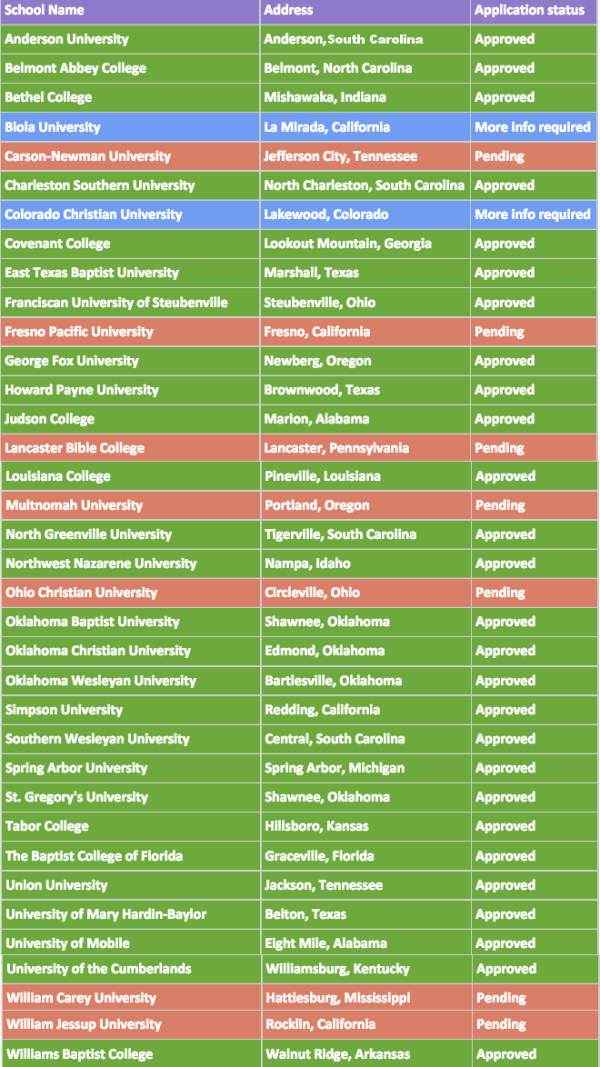
We read with interest this week that some three dozen religious schools have applied for a waiver from Title IX. Via the New York Times, we see news from The Column that handfuls of Christian college have successfully applied for waivers.

Column list of schools

Waivers for all?

As The Column reports, the original language of Title IX banned sex- and gender-based discrimination at institutions of higher education. But it included a vital loophole. Such rules, the law stated, could be waived in some cases. As Andy Birkey of The Column puts it,

When Title IX was passed in 1972 to combat discrimination based on sex, Congress added a small but powerful provision that states that an educational institution that is “controlled by a religious organization” does not have to comply if Title IX “would not be consistent with the religious tenets of such organization.”

Apparently, thirty-six schools have applied for these waivers, and twenty-seven have been approved. For many of the schools, the Christian Legal Society has provided a how-to guide to apply for such waivers.

For conservative colleges, this waiver might seem to solve their legal and religious pickle. But it will not heal the rift between such schools. Schools such as Goshen College and Eastern Mennonite University, have already left the Council for Christian Colleges and Universities. They changed their policies to welcome homosexual faculty, and presumably transgender faculty as well.

This loophole might provide wiggle room for some conservative religious schools. It leaves the most important questions on the table, however. What is the proper religious attitude toward non-heterosexual sex? Toward non-traditional marriages? Toward gender identity and sexuality as a whole?

Experts Agree…

I’m delighted to report that we’ve got some blurbs up for our new book, Teaching Evolution in a Creation Nation.  I’m thrilled to see such great recommendations from two people who know the most about America’s evolution/creation debate.

glenn branch

You know it’s big when you have your own cartoon portrait…

First, some background.  As SAGLRROILYBYGTH are well aware, I have a new book coming out in February, co-authored with philosopher Harvey Siegel.  In this book, we discuss the history of America’s modern evolution/creation debates.  We also explore the philosophical issues involved with teaching evolution and creationism.  Finally, we offer a recommendation or two for teaching evolution in a way that is scientifically credible and culturally sensitive.

The_Creationists_by_Ronald_Numbers

Have you read it yet?

Thanks to the work of our publisher, University of Chicago Press, we now have blurbs from Glenn Branch of the National Center for Science Education and Ronald Numbers of the University of Wisconsin–Madison. You may know Branch’s work on the Science League of America blog.  Or you may have read his book Not in Our Classrooms.  In any case, nobody has a better sense of the issues involved in today’s evolution/creation debates than does Glenn Branch.

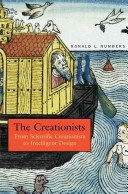
And nobody knows the history better than Professor Numbers.  I’m biased, of course, because Ron was my grad-school mentor and he continues to be my friend and role model.  But you can ask anyone: Ron’s book The Creationists is the first and last word on the subject.

So of course I’m tickled pink to share their blurbs for our new book:

Glenn Branch, deputy director, National Center for Science Education
“What do you get when you cross a historian and a philosopher? If it’s Laats and Siegel, the answer is Teaching Evolution in a Creation Nation. Thoughtful and provocative, historically detailed and philosophically informed, this book is a must for anyone interested in understanding the conflict over evolution education in the United States.”
Ronald L. Numbers, author of The Creationists: From Scientific Creationism to Intelligent Design
Teaching Evolution in a Creation Nation provides not only a readable and reliable survey of past encounters but a sensible guide to future practices. Rather than promoting public-school classrooms as pulpits for converting skeptical students to evolution (which has rarely proved an effective technique in any case), they recommend helping students to understand the arguments and evidence for evolution. This book should be required reading for all evolution educators.”

Pshaw!

Just When You Thought It Was Safe to Be a Creationist on Campus…

Who’s the racist? In creation/evolution debates these days, you’re likely to hear creationists tar evolution as a racist idea. Recently, however, young-earth creationist impresario Ken Ham complains that creationist anti-racism has now been labeled a racial “microaggression.”

It has long been a favorite claim of creationist activists. At the end of the twentieth century, for example, veteran creationist campaigner Jerry Bergman argued that Darwin’s evolutionary ideas led in a direct line to the Nazi Holocaust. From the Institute for Creation Research, too, Henry Morris insisted that creationists were the true anti-racists, since they believed all humans came from the same original two ancestors.

Small wonder, then, that creationists today are flummoxed by their renewed role as racists. Ken Ham took umbrage at a new list of microaggressions published by the University of California. As have many campus commentators, the UC list warns that some statements intended to be innocent or race-neutral may actually carry undertones of white privilege. For instance, to say that race doesn’t matter, or that one does not believe in race, can be seen by some as a fair-minded anti-racist statement. For others, however, such “color-blind” statements de-legitimize the unique difficulties experienced by racial minorities.

Ken Ham does not seem interested in those sorts of distinctions. Rather, he tackles the UC accusation head-on, insisting that his creationist anti-racism is the only truly scientific position. As he puts it,

Really, “races” is just an “evolutionized” term we shouldn’t use anymore because the idea is simply not true. So for the University of California to say that we shouldn’t say there’s only one race flies in the face of what observational science has clearly shown to be true! And of course, the Bible makes it obvious there is only one race because all humans are descended from Adam! The University of California (and many other campuses) is trying to suppress certain ideas and promote only one worldview—even contrary to observational science. Our starting point really does matter!

To this reporter, Ham’s umbrage seems to miss the point. By the time California students had time to be offended by his creationist anti-racist microaggression, wouldn’t they already be even more put out by his macro-aggressive creationist evangelism?

Creation, Christians, and the Deadlock Myth

Whoops! There it is again—another commentator implying that we have been trapped in an endless deadlock over evolution and creation. It’s just not true, as we argue in our new book. That doesn’t stop it from being a very popular thing to say.

groundhog-day-spring

Six more decades of creationist debate…

To be fair, Pastor Ryan Gear is more interested in Christian attitudes than in educational policy. He laments the fact that so many conservative Christians continue to doubt evolution and climate change. He points out that such skepticism is not necessary, from a religious viewpoint.

Fair enough. Gear goes off the rails, however, when he implies that things have not changed for Christians when it comes to evolution and creation. As he puts it, if Darwin were alive today, “he would observe that Christians have not evolved much in relation to his theory.”

Hold the phone. In terms of both education policy and religious belief, such statements woefully misrepresent the history of the evolution/creation debate.

First, as I argue in my upcoming book, co-authored with philosopher extraordinaire Harvey Siegel, evolution education has experienced radical changes across the decades. Over long decades, evolution education has made enormous advances. In the 1920s, several states banned the teaching of evolution in public schools entirely.

As I argued in my first book, the fight over evolution in the 1920s was a fight—successful in many ways—to make explicit and legally binding the traditional evangelical Protestant domination of American public life.

These days, the goals of creationists are much tamer. Even the most vociferous young-earth advocates insist they don’t want creationism taught in public schools. Intelligent-designers have scrubbed the explicit religious references out of their arguments.

The_Creationists_by_Ronald_Numbers

Have you read it yet?

Also, the very meanings of creationism itself have changed dramatically. As our leading historian of creationism (and my grad-school mentor) Ronald Numbers has demonstrated, today’s popular young-earth creationism was itself a novelty of the mid-twentieth century. In early evolution battles, very few anti-evolutionists insisted on a young earth.

In 1927, for example, fundamentalist activist William Bell Riley insisted, there is not

an intelligent fundamentalist who claims that the earth was made six thousand years ago; and the Bible never taught any such thing.

Back then, Riley was the hard edge of creationist activism. He was the founder and leader of the World [or World’s] Christian Fundamentals Association. He founded a thriving school in his adopted home city of Minneapolis. He represented, to many contemporaries, the extreme, uncompromising wing of 1920s anti-evolutionism.

And he did not believe in a young earth. He did not think it mattered.

Today, of course, the religious landscape of American creationism is much different. Not only do many Christians in big conglomerations such as the Southern Baptist Convention insist on belief in creationism, but they also believe that real creationism means belief in a young earth and a literal six-day creation.

That is new.

We have not been deadlocked for generations in the same ol’ evolution/creation battles. In terms of public policy and private belief, everything has changed. Utterly.

Why does any of this matter to us? Deadlock suggests a need for drastic action. It suggests a stalemate, one that can only be broken by decisive, radical action. The truth, however, is not quite so exciting.

In the past hundred years, the evolution/creation debates have not been stymied in a go-nowhere morass. Rather, people like me who want more and better evolution education have consistently scored important victories. People like Pastor Gear, on the other hand, have been forced to argue against growing percentages of evangelical Christians who insist on a scientifically outlandish young-earth creationism.

From the perspective of public policy, the prescription is clear. We should keep going with our efforts to improve real evolution education in public schools. Evolution, and only evolution, should be taught as our best current scientific understanding of the way species came to be.

At the same time, we should adopt a determinedly neutral stance toward the creationist debates among evangelical Christians. If young-earth advocates want to square off against evolutionary creationists, so be it. Such religious debates are outside the realm of public-school policy.

This kind of nuanced, non-alarmist policy argument does not make for good headlines. That’s why we will likely continue to see every creation/evolution article and op-ed opened with a lament that things have not changed.

If we really want to move forward, however, on questions of evolution, creationism, and education, we need to get beyond the headlines. We need to get beyond the ahistorical assertion that we are trapped in a never-ending evolution/creation Groundhog Day.

I Love You but You Didn’t Do the Reading

[Editor’s Note: We at ILYBYGTH are happy to announce a new feature, “I Love You but You Didn’t Do the Reading.”  In this weekly column, we’ll point out stories of interest to SAGLRROILYBYGTH, a sort of “in case you missed it” list.  Will we be able to keep it up?  Who knows.  But let’s give it a try and see if people like it.  Suggestions for readings are always welcome to our editorial desk: alaats AT binghamton DOT edu .]

December Seventh, 2015

READING man in chair

Words, words, words…

What did you miss out there? A few stories that caught our eye this past week:

Should this conservative professor be fired?

The politics of math education, or, 2 + 2 = culture war.

High-school students debate bullying, coddling, and identity politics. Is it bullying for students to insist that only certain students can ever REALLY understand the harm of white male privilege?

Bernie Sanders wants “college for all.” Do you agree with his argument?

Is the GOP dominated by extremists? NYT readers put in their two cents.

Can college professors teach about slavery without using language that is “extremely insensitive and hurtful?”

Everett Piper at Oklahoma Wesleyan University tells students to stop whining.

Rod Dreher shares: Academic history is not real history.

Today’s college protests as religious revivals.

Shoot ‘em Up at Fundamentalist U

Christians, get yr guns. That’s the message this week from Liberty University President Jerry Falwell Jr. The message for us fundamentalism-watchers is that we’ll never get the whole picture about conservative evangelical religion if we limit ourselves to theology alone.

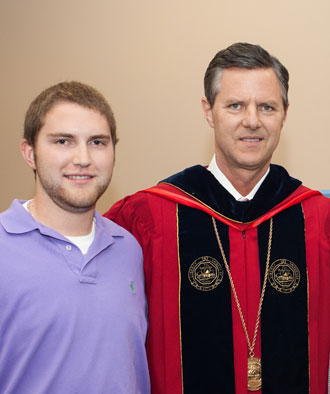
In response to shootings in San Bernardino and elsewhere, Falwell told students at his booming megaversity that they could “end those Muslims.” He told students about the concealed .25 in his own back pocket, joking that he didn’t know if it was illegal or not.

Cole-Withrow-Jerry-Falwell-Commencement-Liberty-University-20130517

Jerry, Get Your Gun

For Liberty watchers like me, this is not the first time the school has taken an aggressive pro-gun position. And for fundamentalism watchers like me, it is more proof that a fundamentalist is never only a fundamentalist.

To put it in nerdy terms, some historians have suggested a theological definition of fundamentalism. Fundamentalist Protestantism has been explained as the tradition of millennialism. It is best understood, others say, as “radical apocalyptic evangelicalism.” These definitions are helpful for distinguishing fundamentalism from close cousins such as Pentecostalism, Holiness Wesleyanism, and conservative Anabaptism.

Such definitions fail to explain, however, outbursts like the one from President Falwell. There’s nothing about the apocalypse in his yen for guns. Rather, it is a product of the simple fact that fundamentalists—like all people—are amalgams of multiple identities. Falwell is a fundamentalist, true, but he’s also an American. He’s also a Southerner. He’s also a conservative. And, of course, he’s also a gun-lover.

It is not only Liberty U that has struggled with this conundrum of fundamentalist identity. As SAGLRROILYBYGTH may recall, a popular administrator at Mid-America Nazarene University took considerable heat for reminding students that Christian religion did not always come wrapped in the American flag. From a theological position, what Dean Beckum said was utterly unremarkable. But conservative evangelical religion in America is more than just religion. It is also conservative. It is also American.

President Falwell and Liberty University, as I’m arguing in my current book, are emblematic of the complicated nature of conservative evangelical higher education. As institutions, they are driven by humdrum factors such as tuition, enrollment, athletics, and accreditation. As evangelical institutions, they’re driven by a desire to maintain a religiously pure, “safe space” for their students. As conservative institutions, they’re driven by a wide variety of political impulses, including the overpowering urge to shoot em up.