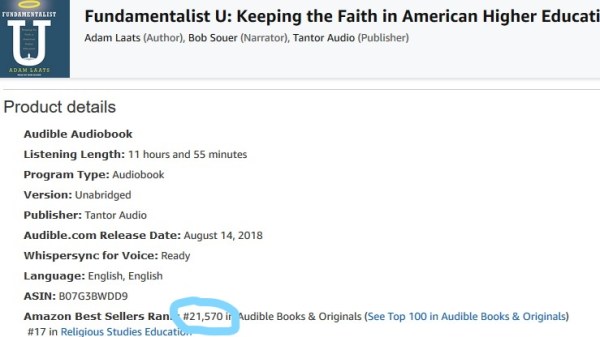
The numbers seem pretty clear, but I still have a hard time believing it. Based on the Amazon.com reports, the audio version of Fundamentalist Uis its most popular format.Maybe I’m just an old out-of-touch codger, but I’m surprised. I can understand why someone would want to listen to an exciting novel, but do people really listen for twelve hours to a book about the history of evangelical higher ed in the USA?
Maybe it’s a quirk of the Amazon ranking system. Perhaps there are not as many Audible books to choose from, so the ranking of the audio format of this book looks a lot higher than the ranking of the hard-copy format.
Even if so, my question remains. I’m not saying Fundamentalist U isn’t a good enough book and all, but I can’t imagine listening to ANY academic history. Am I out of step? Are the kids these days really listening to academic titles along with their podcasts and tik toks and whatnot?
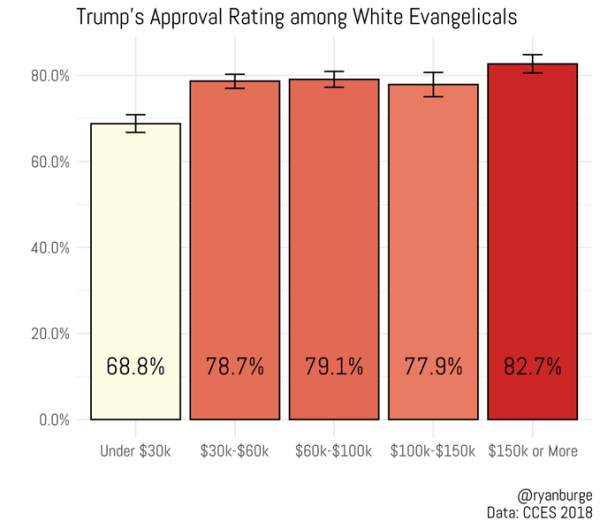
I know, I know: you’re as sick of reading about white evangelical support for President Trump as I am. We keep seeing over and over again that white evangelicals are among Trump’s strongest supporters. But I can’t help it—this morning I came across another bit of evidence that evangelical Trumpism goes deeper than mere strategic considerations. This seems like more proof that some conservative evangelicals feel a much deeper connection to Trumpism than we might think.
Those explanations are helpful, as far as they go. But this morning I stumbled across more evidence that confirms my ILYBYGTH hunch: White evangelicals–some of them, at least–don’t just stick with Trump for strategic reasons. They don’t cling to Trump because they like Trump’s racism.
For a lot of the most conservative white evangelicals, Trump isn’t just the least-worst option, he is a rare leader who really gets them.
Exhibit A: This morning, radical creationist leader Ken Ham tweeted out his disgust with mainstream science. As the fundamentalist faction of evangelicalism has done for a hundred years now, Ham protested against the basic assumptions of mainstream thinking. This morning, Ham objected to new findings that might explain the story of Noah’s Ark and the flood.
When scientists wonder if a new discovery of shipwrecks could help explain widespread myths about global flooding, Ham counters that such thinking is clearly ignorant. The real story of Noah Ark and the flood, Ham explains, is in the Book of Genesis.
There’s nothing new about that part of Ham’s argument. Ham’s Trumpish conclusion, however, is telling. As Ham explains,
the author of this article says there was a Flood in Noah’s day as the Bible records, but then the author either didn’t read or totally rejects the details of the account that make it clear Noah’s Flood was global–covering the entire globe. This article is more fake news. [Emphasis added.]
There you have it, folks! “Fake news.” For the most conservative members of the white evangelical network, Trump’s approach to reality matches their own. For decades, fundamentalists have warned that mainstream ideas about sexuality and science were balderdash. Radical creationists like Ken Ham and his mentors have scrambled to prove that the “evidence” of mainstream science can be dismissed.
When Trump stumbled into power, fundamentalists liked more than just Trump’s anti-abortion stance. They liked more than just his support for white racism. In addition to all that, Trump’s vision of reality resonates deeply with white fundamentalists. For them just as much as Trump, the ability to dismiss evidence as “fake news” is deeply satisfying.
Depending on where you sit, this could be a case of wildly disproportional panic by school administrators or a reasonable move to protect student safety. From the cheap seats, I can’t help but think that this case called for a different solution.
Here’s what we know: Two eighth-graders were talking in class. One asked the other which of their classmates she would kill first. The student made a pretend gun and pretended to shoot four specific students, then pretended to shoot herself.
Disturbing, for sure. Here’s the question for this morning: What would you do about it if you were the teacher or principal?
In this case, the principal called the student to his office. The student was handcuffed and arrested. She was charged with a felony for making a criminal threat. As a youthful first offender, her maximum sentence if found guilty would be a period of probation.
Was arresting the student the right move? I hate to second-guess the people who actually know her and the situation, but it seems like this should have been handled differently. Why not have counseling for both the arrested student AND the other student who prompted her with the question about shooting classmates?
I don’t take this kind of threat lightly, but it seems as if dragging this student out of school in handcuffs, then eventually allowing her back in school with everyone knowing this story will only increase the chances that this student will act on her threat.
What do you think? What would you have done if you were the principal?
I don’t find it at all difficult to imagine a future in which the scorched earth folks work to take down charter schools right along with the public system (the one that charters insist they’re part of). If I were a scorched earth person, my plan would be first to split the funding stream into several streams (public this way, vouchers over there) and then just slowly pinch off the public stream. The techniques that we’ve already seen work just fine– starve the schools, create a measure to show that they’re failing, use their failure as justification for starving them further.
“Trying to memorize John 3:16 in the car on your way to the event and then quote that is probably not the best way to connect with faith-based voters,” he said. He had seen a candidate try this trick on the way to a rally in Kansas and then struggle to remember the phrase onstage.
According to the suit, West Reading, Pa.-based Service Caster subjected two assemblers and one assembly line supervisor to a hostile work environment because of their national origin, Puerto Rican, and religion, Pentecostal. The plant manager routinely made derogatory remarks about their national origin. The EEOC says the plant manager also made disparaging comments about their Pentecostal faith, including calling it a “cult.” The EEOC said the harassment continued even after the workers complained to the company owner.
In some ways, the schools are very similar. Both recruit large portions of their student body from Tennessee, and are especially appealing to conservative Christians. . . . full-time enrollment at Trevecca has grown by 3 to 6 percent each year since 2013. . . In that same time frame, Bryan saw enrollment decline. The number of full-time undergraduates decreased between 6 and 13 percent in 2013, 2014, and 2015, according to IPEDS. Enrollment numbers rebounded a bit in 2016, but then declined again in 2017.
institutional self-preservation isn’t our mission. And if we can’t fulfill our mission except with the economic assistance of the state, perhaps this model of Christian education is ready to join others on the dust heap of history.. . . Are we [Christian colleges] doing something necessary and good for our neighbors that couldn’t be done as well by other nonprofit educational agencies that don’t impose a religious test that may discriminate against a category of citizens?
real leadership on this issue would consist of steering the conversation beyond problems with how the tests are used, to problems with the tests themselves; and from talking about how often students are tested to talking about whether these tests are needed at all (in light of the harm they do as well the availability of more informative and less destructive alternatives).
Justice in education isn’t realized through uniformity; it’s realized by ensuring that every single child has the best shot at reaching his or her highest potential.
Big Government fighting for persecuted Christians…
After all, this seems to be good news for conservative Christians. In this case, the EEOC alleges that three workers were insulted and treated badly. Their Pentecostal religion was demeaned as a “disgusting cult.” The suit points out that creation of a “hostile work environment and disparate treatment” due to the workers’ national origin and religion constitutes “unlawful practices.”
On its face, this diligent protection of conservative Christians might seem like good news for anxious religious conservatives. Very different types of conservative Christians have lamented the fact that mainstream society and government persecute traditional Christians.
the cultural left—which is to say, the American mainstream— has no intention of living in postwar peace. It is pressing forward with a harsh, relentless occupation, one that is aided by the cluelessness of Christians who don’t understand what’s happening.
It’s not enough to just tell students, ‘Believe in Jesus!’ Faith that is not founded on fact will ultimately falter in the storm of secularism that our students face every day. . . . Our country has forsaken its Christian soul. We need to see that for what it is.
Rod Dreher and Ken Ham probably wouldn’t agree on much, but as Christian conservatives they agree that mainstream society has turned hopelessly anti-Christian. Yet I’m guessing they won’t take this story as good news. Why not?
First, it is simply bad strategy for them to notice. Like a lot of conservative cassandras, Dreher and Ham have both put all their chips on a persecution story. A more complicated version of that story won’t help them much.
If more thoughtful folks like Dreher DO comment on this story, they could explain it a couple of ways. First, they might claim that conservative religion was more of a free-rider in this case. The government was really interested in protecting these particular Christians because they were also insulted for their Puerto Rican heritage. Plus, intellectuals like Mr. Dreher might point out that this sort of legal protection is beside the point. Sure, the EEOC might fight against insults and harassment, but the EEOC will then turn around and persecute Christians who do not recognize LGBTQ rights. The actual beliefs of conservative Christians, Dreher might say, are nowhere protected.
So although these three plaintiffs might have the government on their side when they are mocked for being Puerto Rican Pentecostals, Mr. Dreher might retort, when they actually try to live their lives as demanded by their Christian faith, they become instead the target of the EEOC.
Or maybe conservative pundits just won’t say anything at all.
You probably remember Waiting for Superman. To the chagrin of pro-public-school folks like me, the movie told a compelling story of low-income students hoping against hope to find a spot at a charter school. Now a new movie is telling another pro-charter story, a compelling one. Does the anti-charter crowd have any stories that can compete?
First, a little full disclosure: I’m not neutral about charter schools. Like a lot of public-school advocates, I have long hoped to maintain funding and oversight of schools within the public-school system. But I recognize that plenty of charter-school advocates had good ideas and good intentions. I agree that some charter schools have done great things. No matter what our disagreements about school funding and oversight, though, the politics of charter schools have devoured the reasonable policy discussions about them.
This morning, though, I’d like to ask a different question: Why do the charter-school folks seem to have all the best movies? Waiting for Superman was emotionally compelling. And Miss Virginia sounds like it is, too. The story, as I hear it told by the charter-lovers at Fordham, is one of a heroic mother struggling against all odds to save her child from an inadequate public-school system.
She works her fingers to the bone to raise money for private-school tuition, all for naught. Finally she finds a political ally to help her in her Erin-Brockovich-style campaign. As the Fordham review describes,
[Virginia] Walden joins forces with an unlikely ally—white, Harvard-educated Congressman Clifford Williams, played by Matthew Modine. While most of the black elected officials fight against Miss Virginia’s efforts to increase educational options for the children in her community, this Ivy League–educated white dude who loves long-shot legislation and golf becomes invaluable to her efforts.
It’s not like we don’t lack the material for emotional, powerful, human-scale stories explaining why we need to maintain funding and oversight in the public-school system. But where are the movies/books/memoirs? Am I just not aware of them? And if they’re not out there, why not?
[Editor’s Note: To commemorate Columbus/Indigenous People’s Day, we’ve pulled up this post from the ILYBYGTH archives, originally posted in 2014.]
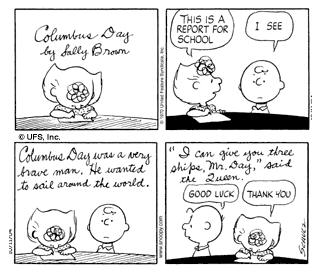
Christopher Columbus used to vote Democratic, but now he’s a leading voice among America’s cultural conservatives. Not the man himself, of course. But celebrations of Columbus’ life used to be lean to the left. These days, conservatives have become the leading celebrants. How did that happen?
In these United States, today is officially a federal holiday. Columbus Day was only established as a federally recognized holiday, though, due to the complicated politics of Franklin D. Roosevelt’s New Deal in the 1930s. Italian immigrants had long lobbied for recognition of their greatest ethnic hero. As Roosevelt cobbled together his powerful but shaky New Deal coalition, he couldn’t afford to alienate any urban constituency. Establishing a federal holiday was a politically cheap way to symbolize Roosevelt’s sympathy with Italian-American voters.
At the time, Christopher Columbus represented Italian pride. Columbus stood for the fact that Italy had produced world-beating explorers and scientists. By the early 1900s, of course, Italy had become a leading source of poor, sometimes-desperate immigrants to the United States. The image of Italian-Americans in the yellow press at the time had become one of poorly educated “garlic-eaters.” Columbus Day’s federal recognition in the 1930s represented both a repudiation of those stereotypes and a recognition of the increasing political clout of Italian-Americans in the Democratic Party.
Today, of course, Christopher Columbus has acquired entirely new meanings as a cultural symbol. Instead of representing the heroic triumph of Italians, Columbus has come to embody the culture war over the settlement of the Americas. On the left, Columbus personifies the nature of that settlement. To leading leftist historian Howard Zinn, for example, Columbus’ quest was for loot, and his method was rapine. As Zinn wrote in his popular People’s History of the United States:
The Indians, Columbus reported, “are so naive and so free with their possessions that no one who has not witnessed them would believe it. When you ask for something they have, they never say no. To the contrary, they offer to share with anyone….” He concluded his report by asking for a little help from their Majesties, and in return he would bring them from his next voyage “as much gold as they need … and as many slaves as they ask.” He was full of religious talk: “Thus the eternal God, our Lord, gives victory to those who follow His way over apparent impossibilities.”
Because of Columbus’s exaggerated report and promises, his second expedition was given seventeen ships and more than twelve hundred men. The aim was clear: slaves and gold. They went from island to island in the Caribbean, taking Indians as captives. But as word spread of the Europeans’ intent they found more and more empty villages. On Haiti, they found that the sailors left behind at Fort Navidad had been killed in a battle with the Indians, after they had roamed the island in gangs looking for gold, taking women and children as slaves for sex and labor.
In response, conservative intellectuals have tried to maintain Columbus’ place in the halls of heroes. As the recent controversy over the new Advanced Placement United States History framework has demonstrated, conservatives will unite against anything they perceive as a smear of America’s traditional heroes. For example, long before Dinesh D’Souza rolled out his recent patriotic film, he bashed the left’s tendency to bash Columbus. As D’Souza argued in 1995, Columbus had the moxie to cross a dangerous ocean. And Columbus may have misunderstood Native Americans, but he admired them. The violence came from the native side. As D’Souza put it,
While the first Indians that Columbus encountered were hospitable and friendly, other tribes enjoyed fully justified reputations for brutality and inhumanity. On his second voyage Columbus was horrified to discover that a number of the sailors he left behind had been killed and possibly eaten by the cannibalistic Arawaks.
For many conservatives, as for D’Souza, Columbus has come to represent more than just the beginning of the European colonization of the Americas. For conservatives, Columbus has become the poster child for the proper attitude toward the past. Historians on the left, many conservatives believe, have been very successful in spreading their anti-patriotic smears. The proper thing for conservatives to do, then, is rally around those symbols of traditional American exceptionalism.
Greetings from beautiful Madison, Wisconsin! Even though the Badgers are 6-0, people are still fighting about schools n Jesus n stuff. Here are some of the top stories to catch our attention this past week:
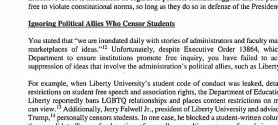
Despite Executive Order 13864, which directs the Department to ensure institutions promote free inquiry, you have failed to act in cases of suppression of ideas that involve the administration’s political allies, such as Liberty University. . . Given that Liberty’s violations are public and longstanding, we are left to conclude that the Department’s failure to act is deliberate and that it is only interested in enforcing free speech policies against institutions it deems unfriendly.
Professor E. David Davis called on a female student who couldn’t answer a question and jokingly asked if she was dropped on her head as a baby by her mother. . . Davis called on another female student who was also unable to answer the question. His response, a student told ABC11, was “’Well, the women are useless today. So maybe I should ask a man.’”
The speaker list alone made that clear — a Christian who’s-who of black, brown, LGBTQ and female voices. At a time when many Christian conferences have come under fire for having primarily cis-gender, straight white men on stage, Evolving Faith featured only one: Pete Enns, who, during the “Evolving Faith & Bible/Theology” session, described his own journey toward becoming an “agnostic Christian.”
Teaching is one of those weird things where everybody thinks they understand it because everybody was a student at some point, but actually doing it is different,” [MA elementary school teacher Megan] DiScicio said. “I am really tired of having people making all of the decisions in education reform and education funding who just fundamentally don’t understand what we do every day.”
While one year in the classroom might not give Warren enough experience to guide her education policy, DiSciscio is heartened by the senator’s pledge to appoint a teacher as U.S. education secretary. “It is enough experience to know the importance of choosing the right person to make those [education policy] decisions,” she said.
Though it may be lost on those with a bad case of impeachment brain, the logical implication of those two strands of research is that an increase in the percentage of students in a community who enroll in charter schools should lead to systemic gains—that is, to an overall increase in achievement across all public schools—including those in traditional public schools.
As SAGLRROILYYBYGTH are aware, the discussions at evangelical universities and colleges about LGBTQ rights have been intense. By stating that he would revoke the tax-exempt status of religious institutions that did not recognize same-sex marriage, O’Rourke raised the specter of Bob Jones University v. USA. Back in the 1980s, that SCOTUS case proved that the government really could deny tax-exempt status to schools that insisted on maintaining racial segregation. Might the government make a similar move about LGBTQ rights?
Beto has no chance of winning the Democratic nomination. His campaign has been on life support for a long time and last night he probably killed it. You better believe that his comment will rally the Trump base and legitimate the fears of millions of evangelical Christians.
In my opinion, too, Beto’s comment was a poorly considered response to a badly worded question. I’m no evangelical, but like Friendly Atheist Hemant Mehta, I disagree with Beto on two counts. First of all, the government should not be in the business of policing religious belief. (When we want to talk about federal funds for student loans, we will need to have a different conversation.) Second, though, simply strategically, Beto goofed. In short, when the clown car of Trumpism is on fire, opponents should do everything they can to help people escape. It makes no strategic sense to lock people in.
As they noted, President Trump signed an executive order threatening to withhold grants from universities that do not welcome free speech. The idea was to punish public universities such as the University of California that de-platformed conservative speakers. As the congresspeople noted, however, the worst offenders against campus free speech are conservative evangelical colleges like Liberty University.
Despite Executive Order 13864, which directs the Department to ensure institutions promote free inquiry, you have failed to act in cases of suppression of ideas that involve the administration’s political allies, such as Liberty University.
It’s not just Liberty U., which by any standards is an outlier in the field of evangelical higher ed. As I’ve argued in these pages and in Fundamentalist U, free speech presents a unique challenge to conservative evangelical higher education as a whole. Restrictions on speech and belief are the defining feature of evangelical universities. Unlike mainstream colleges, evangelical colleges do not claim to represent forums for all sorts of controversial ideas.
Dear Queen Betsy:
Threatening to revoke the tax-exempt status of religious institutions that don’t believe in same-sex marriage might sound scary to conservative evangelicals. But Trump’s warning to revoke student grants from institutions that don’t recognize free-speech rights should be of more immediate concern. To be fair, Trump’s executive order specified that private institutions should only be pushed into
compliance with stated institutional policies regarding freedom of speech.
Presumably, that wouldn’t help Liberty much, but it would give cover to conservative evangelical colleges that respect their own official rules restricting student and faculty speech. However, in the big picture, by threatening to take federal action against schools that restrict free speech, Trump might be planting the seeds of a longer-term problem for evangelical institutions.
After all, the language of LGBTQ rights has some wiggle room. Plenty of evangelical institutions could plausibly claim to recognize the rights of LGBTQ students and faculty while still embracing their religious skepticism about LGBTQ “practice.”
When it comes to free speech, however, evangelical universities have been built on a promise of restriction. If they were forced to abandon those rules, it would force them to give up the biggest single feature that distinguishes them from mainstream higher ed. It is free speech, not LGBTQ rights, that is the most important thing separating evangelical colleges from others.
Beto is talking a lot, but the real danger to evangelical higher ed might come from the other side. It might be Trump, in the end, who blunders into undermining the very foundation of evangelical higher ed.
What’s the problem? That’s the question I’ve heard from interested evangelical-higher-ed watchers the last couple days. Since I warned that Gordon College’s ‘uge new donation could put them in a difficult position, people have asked me to explain my concern. What is so bad about a gigantic donation? In short, I worry that huge donations—and even the promise of huge donations—has always threatened the religious mission of evangelical universities and colleges.
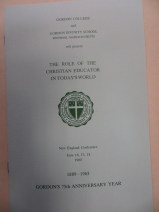
…the plans for the canceled NFEC conference at Gordon:
Second, a disclaimer: I have absolutely no inside information about the goings-on at Gordon. I do not know anything about the goals of the anonymous donor. I don’t know if there were any formal strings attached to the donation. Plus, I have no skin in this game. I am not an alumnus or financial supporter of any evangelical colleges. I’m just a mild-mannered secular historian with a lot of respect for evangelical academic life.
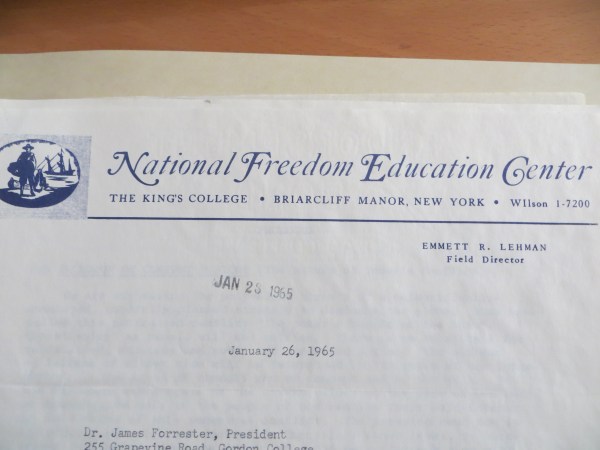
Third, the history: Back in the 1960s, Gordon faced a similar dilemma, as did many conservative evangelical colleges. As I described in Fundamentalist U, Gordon’s president in the 1960s was excited about a new funding source. The National Freedom Education Center offered evangelical colleges financial support if presidents signed their schools up. Participating schools would agree to align their teaching with free-market/free-enterprise conservatism. As the NFEC leaders put it,
Objective: Inclusion in the curricula and teaching emphasis in Christian colleges of a pervading high regard for Freedom in its spiritual, economic and political dimensions and to create an informed student-citizen leadership needed to safeguard and extend Freedom in the years ahead.
President Forrester was on board. Faculty members on campus pushed back. When President Forrester announced his plans for a big free-enterprise conference on Gordon’s campus, faculty rejected the plan. One influential faculty leader said Gordon was against a merely political program. He insisted Gordon would not ever indoctrinate students with “a program of education in conservative thinking”. His vision, and the vision of most faculty members at the time, was that their conservative religion was far broader than mere political conservatism. Even if many of them personally supported free-market ideas.
There are ALWAYS strings attached…
Fourth, the problem: Back in the 1960s, evangelical intellectuals at Gordon and elsewhere rejected the pressure to adapt their teaching to only one secular conservative goal. They also rejected the funding that went along with it.
In my view, this presents a 2019 version of Gordon’s 1965 dilemma. If they take money from people who want them to over-emphasize only one part of their evangelical mission, it is a dangerous move. It threatens to narrow their traditionally broad evangelical emphasis to only one issue. Yes, many conservative evangelicals today hope to emphasize traditional sexual morality and marriage rules, but that has never been the sole defining issue of their religion. It has certainly never been the sole defining issue of a Gordon College education.
Back in the 1960s, faculty leaders had the power to reject the free-marketeering imposition of the National Freedom Education Center. They rejected the pressure and temptation to turn their Christian college into a single-issue education center.
Today’s faculty members at Gordon and other schools might not have the same power. They are very aware of the effects of financial hard times, with programs slashed and faculty positions eliminated. But the danger seems the same. To survive, will Gordon and other evangelicals schools take money that pushes them to emphasize only one aspect of their complex Christian goals? Will they give up their goal of being an evangelical Christian college to focus on being primarily a Traditional-Marriage University?

 Maybe I’m just an old out-of-touch codger, but I’m surprised. I can understand why someone would want to listen to an exciting novel, but do people really listen for twelve hours to a book about the history of evangelical higher ed in the USA?





 I Love You but You're Going to Hell