“I Love Studing Dinosaurs:” Everyday Creationism

Folks like me often ask why there are so many young-earth creationists in America.  How is it possible, we wonder, that nearly half of American adults agree humanity was created in “pretty much its present form” within the past 10,000 years?

The answer seems simple: Creationism is passed along just like any other idea.  Children learn a complex bundle of understandings from their homes, schools, parents, friends, and acquaintances.  In the case of young-earth creationism, kids learn what they are taught.

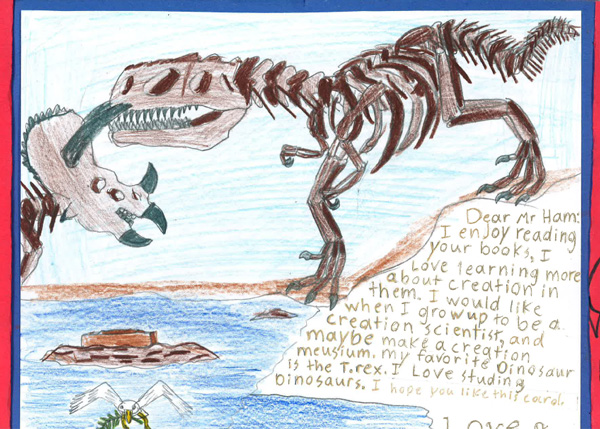
Leading young-earth creationist Ken Ham shared recently some of the cards he’s received from children.  Like the image here, these cards mostly included pictures of dinosaurs and adorably misspelled sentiments of support.  The cards give us outsiders a glimpse into the ways young people adopt the ideas of their home communities.

I Love Studing Dinosaurs

Source: Ken Ham’s Around the World Blog

Ken Ham calls his outreach “Rescuing the Children.”  Ham promised that his organization, Answers in Genesis, would continue to do “our best to reach more kids than ever to help raise up a generation that will stand on the authority of God’s Word, defend the Christian faith, and proclaim the gospel.”

For most evolution educators, this is precisely the problem.  Answers in Genesis is doing a good job.  Lots of children are learning that Biblical birds and dinosaur skeletons somehow roamed the earth together.  Thousands of children are learning an impossible science.

For those of us outside the circles of young-earth creationism, the mechanism by which these outlandish ideas are passed down can seem mysterious and even sinister.  But cards like the one above show the everyday, banal nature of creationist education.  Like non-creationist kids, creationist kids learn what they are taught.  They imbibe the culture of their homes, families, and churches.  There is nothing mysterious and sinister about the process, even if we do not think the ideas passed along are correct.

The lesson for evolution education is clear: pouring more mainstream science on people will not do the trick.  What is needed is a thoroughgoing cultural campaign that understands creationism on its own terms.

Gay Marriage and School Bathrooms

Will same-sex marriage turn public schools into orgies of sexual confusion?  Ken Ham of Answers in Genesis has connected the dots.

The Supreme Court is wrestling with two cases about same-sex marriage.

Conservatives have long insisted that same-sex marriage would lead to a breakdown in the value of marriage itself.  One commenter recently called same-sex marriage the threshold of an “abyss of nihilism.”

Ham’s analysis sexualizes that nihilism and brings it right into public schools.  Ham, America’s leading young-earth creationist, insists that same-sex marriage is only part of an “evolving sexual agenda.”  (Ham is a smart guy, so I am confident he chose that word—“evolving”—intentionally.)

In Ham’s recent piece, he argues that the next step after gay marriage will be a profound and aggressive attack on all traditional gender norms.  As evidence, he cites recent public-school guidelines in Massachusetts.  As we’ve noted on ILYBYGTH, these new school rules allow students to identify their own gender identity and require schools to respect those identifications.

As Ham writes, the trickiest part of this school rule has become bathrooms.  If a student was born a boy but identifies as a girl, Massachusetts schools must respect that choice. Ham worries about a boy who pretends to identify as a girl just to get access to the girls’ locker room.

Ham is not the first conservative thinker to make this connection between same-sex marriage and a sexual free-for-all in public schools.  But for those of us non-conservatives who try to understand conservatism in American education, Ham’s argument offers two important reminders.  First, schools are tied into every culture-war argument.  Though marriage laws seem relatively distant from education policy, conservative (and liberal) arguments against same-sex marriage often rely on the harmful effects gay marriage will have on children and schooling.  Second, for those outside the orbit of American creationism, Ham’s argument underscores the fact that creationism is an outgrowth of conservative Christianity, not the root.  Besides Ham’s use of the word “evolving” to damn the same-sex marriage “agenda,” this article does not talk about creationism or evolution.  Rather, Ham concludes that the main reason to oppose same-sex marriage and the abandonment of gender rules is more broadly Christian.  As Ham argues,

As Christians, we should affirm our children’s God-given genders and cultivate godly masculinity and femininity in them, rather than encouraging them to abandon the gender God gave them in the womb . . .

For Ham, as for many creationists, Christianity comes first.  Creationism is only one important element of the crusade.  Ham himself has often reminded readers of this fact.  Nevertheless, it is common for outsiders like me to pigeonhole Answers in Genesis as narrowly interested in establishing the case for a young earth.

As Ham’s recent argument proves, AiG’s sort of young-earth creationism has a much broader conservative agenda.


Creationist Mom Reaches Out to Evolution

Sometimes stereotypes have some truth to them.  Then there’s “D.”

D first got in touch with me a couple of months ago.  As she described herself, she is a Christian young-earth creationist homeschooling mom.  She had read about my blog on Ken Ham’s Answers in Genesis page.  I’ll include our brief correspondence to let D speak for herself:

From: D
Sent: Monday, January 21, 2013 8:36 PM
To: alaats@binghamton.edu
Subject: thank you

Hi Dr. Laats,
I have to say that it is very refreshing that you don’t think creationists like myself are complete idiots.  Really, I appreciate that. 
As a young earth creationist that homeschools, I wouldn’t give any Richard Dawkins books the time of day.  If someone is THAT hostile towards me, then I have no interest in what they have to say.  But I look forward to reading your blog when I have a chance because you try to understand where I am coming from, and you don’t think we are completely unable to do any science. 
Thank you,
“D”

I suggested that D might give Dawkins a shot.

From: D
Sent: Monday, January 22, 2013 9:48 PM
To: alaats@binghamton.edu
Subject: Re: thank you

Dear Dr. Laats,
I also agree that we should be looking at the other side, and I do plan to do that.  As a Christian homeschool Mom I am not trying to protect my sons from learning evolution.  The public school is not a place we feel comfortable putting our children because their thoughts and beliefs are not welcome in the classroom.  They would have to follow the advice my father in law got from his father before he joined the Navy, “keep your eyes and ears open and your mouth shut”.  Learning can not take place, in my opinion, in that kind of environment.
I am going to teach my kids about evolution, somehow.  There is a lot of material out there.  I would read Dawkins if I had to, but the amount of information out there that he has published alone is way too much to look at, sort through, and figure out what to teach.  For the sake of time, I’m looking for something comprehensive and succinct, and what a child in high school should know about the subject.  I am familiar with the NCSE website and that is what I plan to use as of now, though it will be guess work to know what all to cover.  
Thanks for your time,
D

I was surprised and happy to hear that D was using materials from the National Center for Science Education to teach her kids.  I think the folks at NCSE would be happy to hear it, too.  The NCSE is a leading voice for evolution education and a staunch opponent of creationism in public schools.  And too often, people like me tend to suggest a stark division between two sides: either Answers in Genesis OR the National Center for Science Education.  D has reminded me that smart people make all kinds of decisions about what to read and what to do with that material.  People choose public schools, private schools, or homeschools for all sorts of different reasons.  D’s work reminded me how quickly and easily we can oversimplify the many approaches people make to these snarled questions of evolution, religion, and education.

Yesterday, I heard back from D:

From: D
Sent: Monday, March 18, 2013 5:09 PM
To: alaats@binghamton.edu
Subject: Hi

Hi Dr Laats,
Well, I wanted to let you know that I checked out the [Dawkins] book The Greatest Show on Earth.  I never would have considered it except for your response.  Dawkins says on page 155 ” it would be so nice if those that oppose Evolution would take a tiny bit of trouble to learn the merest rudiments of what it is that they are opposing.”  I couldn’t believe that I totally agreed with Dawkins about something!  I am happy to listen, minus the hostility.  I don’t sense hostility in this book, which makes it readable.  This has made me realize that I can not get my head wrapped around what evolution IS.  He says we did not descend from monkeys, but we have a common ancestor.  I do understand that we would find no missing links because of the extreme gradual process, that is what I understand from the book, hopefully that is correct.  So I looked on Internet, and I guess I don’t understand phylogenies.  So we did not descend from monkey, but have a common ancestor, and then branched off to chimpanzees and humans etc.  So, it seems to me that we descended from something “monkey like”.  I guess I don’t understand how he can say that we did not evolve from monkeys, whether it was monkeys or monkey like, it seems similar.  Can you shed any light on this please?  As you can see, I am making an honest attempt to understand this so I don’t teach it incorrectly.  Thanks for the help,
D

First of all, my hat’s off to D for engaging with Richard Dawkins’ writings.  It is far too easy for all of us to read only those materials that confirm our own beliefs.  I am optimistic that there may be far more “Ds” out there than we might think: people who have strong beliefs, yet hope to find out as much as they can about the other side.  How many of us can say–like D–that we have taken the time to puzzle through books and websites of people with whom we totally disagree?

As for D’s question about phylogenies, I suggested she check out Dennis Venema’s series about evolution theory on recent pages of the BioLogos Forum.

Any other suggestions for someone like D?


Creationists Love The Bible

The young-earth creationists of Ken Ham’s Answers in Genesis endorse The Bible.  Not just the Good Book, but now also the Good Movie.

Dr. Elizabeth Mitchell (MD) reviewed the new ten-hour History Channel film on the AiG website today.

I believe the folks at AiG will agree with me when I say this: they have a tendency to be extremely particular about the company they keep.  They only endorse those who agree on the importance of a young earth and a six-day creation.  Even other conservative Christians will come into AiG disfavor if they dispute those ideas.  Recently, for instance, founder Ken Ham took the 700 Club’s Pat Robertson to task for making nice with evolutionary science.

So when an AiG reviewer praises the new Bible film as something that “allows the plain truths of biblical history from the time of our origins to speak and connects those truths to the relevant issues of life,” it says a great deal about the content of the film.

Mitchell notes that the film depicts a literal world wide flood.  “Even in its opening scene,” Mitchell writes,

“a believable Noah recounts the six days of creation for his seasick family in a massive, storm-tossed Ark in a Flood that is clearly global. The worldwide scope of the Flood is portrayed by the graphic of a flooded planet and the narrator’s confirmation that the floodwaters had ‘engulfed the world.'”

Mitchell notes the necessary shortcuts that a ten-hour film must make in condensing such a massive set of books.  In the end, however, Mitchell believes that the film is true to the original.  The best proof of the film’s merit will be, in Mitchell’s words, that

“The Bible will likely lead many to Christ. Why? Because it presents the Bible’s history as real history—instead of eroding trust in God’s Word from the very first verse. Because it demonstrates the relevance of the Fall of mankind soon after creation to all the evil that has ever cursed our world. Because it depicts the Old Testament sacrifices that God intended to prefigure the ultimate sacrifice of Christ, the Lamb of God who takes away the sin of the world (John 1:29). And because it presents the Bible’s history as a continuous narrative of God’s plans for us from creation through the covenant people of Abraham and Moses to Christ and the early church, thus showing how Jesus Christ is indeed God’s answer for the sin-guilt of the entire world.”

As long as important doctrine is respected, it seems, including the truths of a young earth and a six-day creation, Answers in Genesis is happy to endorse any work that will lead to more conversions.

As we’ve been discussing lately, the Hollywood Christian power couple behind this film have advocated for more Bibles (books, that is, not films) in public schools.  If ardent young-earth creationists can endorse the film, what does that tell us about the sectarian intentions of the filmmakers?

Evolution for Christians

How are evangelical Christians supposed to understand evolution?  This morning at BioLogos, evangelical scientist Dennis Venema begins a series that hopes to explain why evolutionary ideas do not conflict with a Bible-based evangelical faith.

One of the trickiest aspects of understanding American creationism is that there are potentially as many “creationisms” as there are creationists.  Many outsiders like me tend to use the term “creationist” as a catch-all term, when in fact the differences among and between types of creationism are perhaps the key to bridging many of our evolution-creation culture-war divides.

Some “creationists,” for instance, embrace the young-earth creationism promulgated by organizations such Answers in Genesis or the Institute for Creation Research.

Others might find an old-earth version more compelling, one such as that defended by Hugh Ross and Reasons to Believe.

Yet others might prefer the big-tent creationism of the intelligent-design movement, promoted most assiduously by the Discovery Institute.

Still others might prefer the sort on offer by Dennis Venema in this series.  BioLogos calls its brand of creationism “evolutionary creationism.”  In general, BioLogos’ creationism embraces the tenets of evolutionary science.  Such evolution, many evolutionary creationists insist, is simply God’s method of creation.
I’m looking forward to following Venema’s series.  Venema describes it this way:

“The goal of this course is straightforward: to provide evangelical Christians with a step-by-step introduction to the science of evolutionary biology. This will provide benefits beyond just the joy of learning more about God’s wonderful creation. An understanding of the basic science of evolution is of great benefit for reflecting on its theological implications, since this reflection can then be done from a scientifically-informed perspective. From time to time we might comment briefly on some issues of theological interest (and suggest resources for those looking to explore those issues further), but for the most part, we’re going to focus on the science.”     


Science at the Creation Museum

Thanks to the ever-watchful Sensuous Curmudgeon, we came across a recent article in Scientific American in which an evolution-believing science teacher journeyed to Answers in Genesis’ Creation Museum outside of Kentucky.

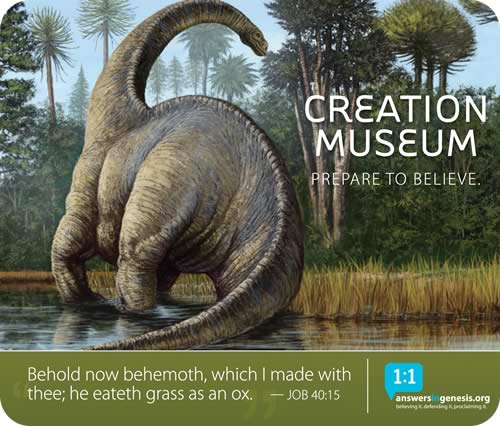
Image Source: Answers in Genesis Creation Museum

Image Source: Answers in Genesis Creation Museum

For folks like me and the author Jacob Tanenbaum, the scientific claims of the museum are impossible to accept.  A science teacher, Tanenbaum recoiled at the misleading scientific claims made by the museum.  “What disturbed me most,” Tanenbaum reported,

“was the theme . . . that the differences between biblical literalists and mainstream scientists are minor. They are not minor; they are poles apart. This is not to say that science and religion are incompatible; many scientists believe in some kind of higher power, and many religious people accept the idea of evolution. Still, a literal interpretation of Genesis cannot be reconciled with modern science.”

Fair enough.  During my trip to the Creation Museum, though, what struck me most powerfully was simply how plausible it all seemed.  For those who did not set out to debunk the information, the museum seemed just as authoritative as Chicago’s Field Museum or any other natural-history museum.

But what Tanenbaum wrote makes sense: the Creation Museum presents a misleading picture of the differences between creation science and mainstream science.

My beef with Tanenbaum is with his own misleading conclusion.  The problem with such creation science education, Tanenbaum argues, is “that 40 percent of the American electorate seems to have forgotten what science is. Considering that our nation put a man on the moon and invented the airplane and the Internet, this development is extraordinary.”

Tanenbaum may be a gifted teacher of mainstream science, but this conclusion suggests that he is not deeply versed in the culture of creation science that he condemns.  For those of us who want to understand creationism, we need to get beyond this naive assumption that creationists don’t know what science is, or that they are somehow hypocritical in their use of technology.

As I argued in a recent commentary in the Chronicle of Higher Education, simple ignorance does not explain American creationism.  Many creationists have studied mainstream science.  In many cases, such as that of leading creation science author Henry Morris, they have earned advanced technical degrees.  And, beyond such stand-out leaders such as Morris, many rank-and-file creationists have extensive science educations.  As political scientists Michael Berkman and Eric Plutzer discovered in their National-Science-Foundation-funded study of high-school biology teachers, of those teachers who espoused a belief in young-earth creationism (i.e., the Creation-Museum type of creationism), fully 55% had earned college degrees in science.   Furthermore, Berkman and Plutzer’s review of other such surveys led them to the following conclusion: “the overall evidence suggests that the high support for creationism in the classroom cannot be attributed primarily, or even substantially, to overall scientific illiteracy in the United States” (pg. 52).

Also, as creationists often remind themselves and their evolutionist foes, belief in evolution is not necessary for sophisticated engineering.  Dobzhansky’s claim that nothing in biology makes sense except in the light of evolution may be true, but that would not stop creationists from traveling to the moon, perfecting airplanes, or inventing the internet.

In the end, I think it makes a big difference whether Americans with creationist beliefs have “forgotten what science is” or if they have a distinctly different definition of science.  Building an anti-creationist argument on the foundation that creationism disables technical education, as does Tanenbaum and other prominent pro-science voices such as Bill Nye, is both a false claim and poor strategy.

Please don’t misunderstand me: this is not a brief for creationism.  However, if those of us, like me, Bill Nye, and Jacob Tanenbaum–who stand outside the borders of creationism looking in–if we really want to understand creationism, we must abandon our own naive assumptions about the meanings of that creationist belief.

Creation Colleges

Where did you go to school?  Did you learn about evolution?  WHAT did you learn about it?

Non-creationists like me are often dumbfounded by the notion that so many educated Americans believe in a young human species.  But a quick look at the large number of young-earth-creationist colleges shows us how easy it is to earn a college degree without leaving the intellectual boundaries of young-earth creationism.

As recent Gallup polls consistently demonstrate, almost half of American adults agree that humanity was formed in “pretty much its present form” within the past 10,000 years or so.  And of those young-earth creationist adults, the same proportion went to college as non-creationist adults.  That is, believers in a newish human species are just as likely to have a college degree as believers in a long history for the species.

As always, it’s vitally important for outsiders like me to recognize the many different sorts of creationist belief.  Young-earth creationism, the notion that the earth has only been in existence for about as long as is described in the Bible’s Book of Genesis, is only one version.  Intelligent design theorists, like those of the Discovery Institute, or evolutionary creationists, like those of Biologos, also oppose mainstream evolutionary science, but without insisting on a young earth.

And, to be fair, this Gallup question only asks about the age of the human species, not the age of the earth.

Nevertheless, the notion that such large percentages of educated Americans agree that humanity is so new, and so un-evolved, always makes me wonder what kind of education Americans are receiving.

The leading young-earth creationist organization Answers in Genesis provides a handy guide.  To be fair, the map of creationist colleges provided by AiG makes no claims to be an exhaustive guide to all creationist institutions of higher education.  Rather, this map only includes those schools whose presidents have signed AiG’s statement of faith.

A quick glance at the map shows how easy it will be for most college-bound young people to find a college that affirms young-earth beliefs.  Even in my neighborhood of sunny Binghamton, NY, two schools made the AiG map, Davis College and Baptist Bible College.

The sponsoring schools include such fundamentalist heavy-weights as Bob Jones UniversityLiberty University, and Pensacola Christian Colleges.  Other sponsors include smaller schools such as Jackson Hole Bible College and Ohio Christian University.

For those of us trying to understand creationism from the outside, this thriving culture of creationist higher education provides a crucial clue.  We can’t know what all the students, or even all the professors at these schools believe, but the schools themselves devote themselves to promulgating the notion of a young human earth and divine creation by fiat, as described in Genesis.

Strange Bedfellows: Creationists and the “Cults”

Here’s a stumper: Why do proudly orthodox Protestant young-earth creationists embrace non-orthodox writers?

If anyone were to be touchy about the theological bona fides of their friends, it would seem to be the YECs, the defiantly literalist readers of Genesis.

But for generations, creationists have enthusiastically promoted the work of anti-evolution writers from outside the world of conservative Protestantism.

These days, the best example is the work of Jonathan Wells.  Wells’ 2000 Icons of Evolution received an enthusiastic reception even among the fiercest and most combative young-earth creationists.

Wells has credentials to back up his frontal assault on the scientific establishment.  In addition to his PhD in theology from Yale, Wells earned a doctorate in molecular and cell biology from Berkeley.  He currently holds a fellowship at the intelligent-design mothership Discovery Institute.

It’s not surprising that the big-tent anti-evolutionists of the Discovery Institute would welcome Wells.  But it may come as a shock to see him embraced by the fiercer separatists at the young-earth Answers in Genesis.  Yet, in its review of Wells’ Icons, AiG only describes Wells as follows:

“Wells is a man with indisputable intellectual gifts who does not bow to intimidation. Having been opposed to serving with the American armed forces in Vietnam, he chose jail rather than compromise his convictions. He then went on to earn a Doctorate in Theology (Yale) and a second Doctorate in Molecular and Cell biology (Berkeley).”

Fair enough.  But conspicuously unmentioned is Wells’ leadership role in Rev. Moon’s Unification Church, the once-booming religion often called “the Moonies” by outsiders.

Wells himself makes no secret of his Unification belief.

At best, most conservative evangelical Protestants would likely agree that the Unification Church lies somewhere outside the borders of true Christianity.  One evangelical theologian defined the Unification Church as “a pseudo-Christian cult.”  Less prominent evangelical bloggers have called the Unification Church “the anti-Christ,” and a dangerous, greedy, opportunistic organization peddling “wacky theology.”

Most intriguing, this orthodox embrace of the non-orthodox is nothing new.

As I argued in my 1920s book, the first generation of Protestant fundamentalists eagerly snapped up the anti-evolution writings of authors from far outside the pale of acceptable theology.  Most prominently, early American fundamentalists read the work of Catholic authors such as Alfred McCann.  McCann’s God or Gorilla earned him an invitation from William Jennings Bryan to come to the 1925 Scopes Trial as an anti-evolution expert.

Though Bryan himself had a tetchy relationship with fundamentalism, Bryan saw no reason not to publicly embrace the Catholic McCann.  McCann, however, did not want to play along.  He told Bryan privately in June, 1925 that a big public trial would not solve the problem.  Likely, McCann did not feel comfortable on the side of the prosecution.  In that era, Protestant fundamentalists regularly denounced the Pope as the anti-Christ, and Catholicism as a deadly soul-crushing abomination.

For those like me outside the intellectual world of conservative religion, it might make perfect sense for anti-evolutionists to ally with anyone who fights evolutionary theory.  After all, the enemy of my enemy is my friend.

But when we get inside theological logic, such pragmatism is often denounced as moral compromise and sinful truckling.  Consider, for instance, Answers in Genesis’ recent denunciation of conservative Protestant leader Pat Robertson.  Over the course of his career, Robertson has proven himself to be a staunchly conservative, thoroughly dedicated evangelical Protestant.  Yet when he repudiated the notion of a young earth, the young-earth creationists pounced on him.  In the words of AiG pundit Tommy Mitchell, “It is compromisers like Robertson who actually lead our children astray.”  If creationists accept an ancient earth due to the mainstream scientific evidence, Mitchell asked,

“Why not adopt the views of the secular world about abortion, about marriage, about homosexual behavior, about premarital sex, about child-rearing, and about morality? After all, if the secular world is wise enough to tell us how to interpret our Bibles, it must be wise enough to guide us in other areas, too.”

To my mind, this is the puzzle: Among some young-earth creationists, a thoroughly heterodox Jonathan Wells can be lauded as an exemplar of correct thought.  But a deeply conservative Protestant leader like Robertson can be denounced as leading children into abortion and homosexuality by insisting that Biblical belief does not mandate belief in a young earth.

How are we outsiders to make sense of this?

The first obvious answer is not satisfying.  We might say that young-earth creationists care only about protecting their “brand,” the notion of a young earth.  Any evidence from any source that confirms this will be lauded; any argument from any source that denies it will be attacked.  To believe this, however, we would have to deny that young-earth creationists have a theological reason for insisting on a young earth.  We’d have to think that YECs don’t really care about the wider theological implications of an ancient earth.  That doesn’t fit the evidence.  Leading YECs often argue that only a young-earth allows for true orthodox belief.  Only a literal reading of Genesis, they insist, solves the problem of death before the introduction of sin into the world.  Only a literal reading of Genesis solves the problem of Jesus’ vouching for the veracity of the Genesis account.  The arguments for a young earth consistently point toward the promotion of orthodox Christian belief.  If we think that YECs don’t care about such broader issues of Biblical orthodoxy, we don’t really understand YEC belief.

The second obvious answer also does not work.  Some outsiders might glibly conclude that YECs don’t know about the non-orthodox nature of Jonathan Wells’ Unification Church.  Maybe some don’t, but leading YEC intellectuals are trained to sniff out heresy.  The notion that someone with a proud public history of leading the Unification Church might sneak past YEC heterodoxy detectors doesn’t make sense.

So what is it?  I don’t believe for a minute that many Protestant YECs accept the theological legitimacy of the Unification Church.  Nor do I find the notion of a conspiratorial political pragmatism among YEC leaders plausible.

So why is it okay to follow the Reverend Sun Myung Moon, but not the Reverend Pat Robertson?


Pat Robertson and an Ancient Earth

On a recent episode of the 700 Club, [to see the specific section, fast-forward to 56:43] host Pat Robertson warned a viewer that “If you fight science, you are going to lose your children, and I believe in telling them the way it was.”

Pat Robertson on The 700 Club

Pat Robertson on The 700 Club

This extraordinary statement from one of the America’s leading televangelists can teach us a lot about the nature of religious conservatism and education.

A viewer had asked what to do about her children who came to doubt the Bible due to scientific evidence.  Robertson told her that a young earth was not part of the Bible.  Children, he argued, should be taught the truth about the age of the earth.  Robertson prefaced his remarks about the age of the earth by noting that people would try to “lynch” him for saying it.

The truth, Robertson insisted, was as follows:

“You go back in time, you’ve got radiocarbon dating. You got all these things, and you’ve got the carcasses of dinosaurs frozen in time out in the Dakotas. . . .  They’re out there. So, there was a time when these giant reptiles were on the Earth, and it was before the time of the Bible. So, don’t try and cover it up and make like everything was 6,000 years. That’s not the Bible.” 

To be clear, Robertson said nothing about evolution, human or otherwise.  What he did endorse was the mainstream scientific understanding that the earth has been around for far longer than 6000 years.

What does this matter for those of us outsiders trying to understand “fundamentalism” in American education?

First, it demonstrates the complexity of religious conservatism.  Those progressives who insist on a unified, monolithic, even conspiratorial “Religious Right” in education misunderstand the profoundly fractious nature of conservative religion in America.

Robertson understands it.  As he noted, some folks will likely want to “lynch” him for acknowledging the validity of the scientific evidence for an ancient earth.  One response from the leading young-earth group Answers In Genesis ferociously condemned Robertson’s “compromise.”  First, AiG writer Tommy Mitchell argued, the evidence for a young earth does not come only from one theologian, as Robertson implied.  The Bible itself, Mitchell insisted, must be read as advocating a literal young earth.  The scientific mainstream is simply misleading, and when religious leaders endorse mainstream mistakes, it only leads more young people away from true religion.

Second, for those evolution educators who hope to improve science education, Robertson’s statement demonstrates that many devout Bible Christians are open to the central idea of an ancient earth.  Most mainstream scientists and science educators will agree that we do not know the real origin of life.  But we do know that the earth is more than 6000 years old.  Perhaps Robertson’s statement will allow science educators to think more strategically.  Instead of calling creationists ignoramuses and child abusers, those who hope to improve science education can refer creationists to devout Christians like Robertson who agree on the facts of an ancient earth.

Ken Ham Is Right!

No, not about a young earth.  But Ken Ham, the obstreperous mastermind of Answers in Genesis, is right to complain about the language directed at him and his campaign.

I’ll say it again: I don’t agree with Ken Ham’s theology.  I don’t agree with his notion that a young earth is a central idea of Christian faith.  More important, I think Ham’s angry, combative tone drowns out much of the productive and respectful conversation that could go on about the issues of faith, science, creation, and evolution.

But Ham is right to complain recently about the ways his ministry has been attacked.  In his AiG blog, Ham pointed out the rhetorical excesses of some of his foes.  In a post on an Australian atheist blog, one Simon Doonar attacked Ham intemperately.  Here’s Doonar’s post in full:

“I hope that sometime in the future this kind of deliberate misleading of people and especially kids can be treated as a criminal breach of the law, and those who commit such breaches are excluded from society permanently.

“What these type of people are doing is damaging our species by inhibiting our ability to free our minds from superstition and the dream like notions of how we came to be and where we are going.

“And to think that this idiot believes that all the research and evidence which proves evolution can be simply brushed away by the simple answer of ‘where you there’. How can you possibly deal with this type of person, they are psychologically ill and like all dangers nut casers should be put somewhere to reduce the risk of them harming others.”

Doonar also included an angry frowny-face emoticon, but I’m not sure how to reproduce that here.

Now, I understand that such blog posts lend themselves to extravagant emotion.  But still, Doonar’s assertion that creationists should be rounded up and locked up terrifies me.  The notion that we need to criminalize ideas with which we disagree inches frighteningly close to lynch law.

If it were only one kooky Australian who had had a few too many Foster’s and allowed himself to do some angry blogging, we should perhaps pay no attention.  But Ham correctly points out that these sentiments, though usually expressed more calmly, haunt the edges of the creation/evolution debates.

For instance, Bill Nye “The Science Guy” recently implied that creationists should not be allowed to pass their ideas on to their children.  Less famous thinkers ask, apparently sincerely, if creationism equals “child abuse.”  Other hotheads call creationism “terrorism” and “child abuse.”

Again, I understand the Wild-West rules of the blogosphere.  People will say all kinds of stuff to get attention.  The more extreme, the more attention.  And I understand that Ken Ham loves this kind of extremism, since it allows him to play the misunderstood victim.

But as a historian, I get nervous when any group is talked about in these dehumanizing ways.  We don’t need to go all the way back to Quakers executed in colonial Boston to find examples of religious groups targeted for military-style attack due to allegations of “child abuse.”

Just a few years ago, the government raided the Yearning for Zion ranch of the Fundamentalist Church of Jesus Christ of Latter-day Saints.  The raid was utterly illegal, utterly unconstitutional.  Yet it was approved and carried out due to accusations of child abuse, along with deeper cultural suspicions about the breakaway LDS sect.

Talking about creationists as child abusers and criminals does not help defang thinkers such as Ken Ham.  Ham thrives on such attack.  But it does reduce the possibility of constructive, respectful dialogue about creationism.