Does Reading the Bible Make Children Violent?

Does reading the Bible lead to violent crime?  That’s the question nobody is asking these days.

Here at ILYBYGTH, we have to ask: Why not?

After all, it seems violent crime has been falling in the past few decades.  Those have been the decades in which American children no longer prayed or read the Bible in their public schools, officially at least.

Religious conservatives have long bemoaned the social dangers of kicking God out of public schools.  Is it only fair, then, to blame God for all the rapes, burglaries, and assaults that haven’t been happening lately?

That doesn’t seem like a comfortable suggestion for most religious conservatives.  Yet thoughtful conservatives must recognize that they have long warned about the dangers of removing traditional religion from public schools.  Some of those warnings, at least, seem to have been flipped on their heads.  Without mandatory Bible-reading in public schools, American society has grown noticeably less violent.

This is not what religious conservatives have predicted.

In 1942, for example, Bible activist W. S. Fleming insisted that more states must pass mandatory Bible laws for their public schools.  As I noted in my 1920s book, these mandatory Bible laws were a prominent but little-noticed element of 1920s educational culture wars.  Fleming, a former Chicago pastor and full-time activist for the National Reform Association, claimed that Bible laws for public schools would enable society to maintain basic morality.  Fleming pointed out that most states gave Bibles to prison inmates.  Why not skip the middle man, he asked, and deliver the Bibles to the schools?  If Ohio had followed this suggestion in 1925, he recalled, “as her neighbor, Pennsylvania, did, with the same result, more than half of her present 9,310 convicts would now be law-abiding citizens.”[*]

Two decades later, just after the Schempp decision by the US Supreme Court seemed to eliminate Bible reading from public schools, William Culbertson of Chicago’s Moody Bible Institute warned that the decision did not bode well for America’s public safety.  “No nation can turn its back on God without tragic consequences,” Culbertson cautioned.  “We have traveled a sorry road of unbelief in the less than two hundred years of our country’s history.  The Supreme Court decision—and our willingness in many cases to justify it—say plainly that a sorrier road may lie yet ahead!”[†]

Similarly, in the early 1980s, Donald Howard, creator of the Accelerated Christian Education curriculum and an energetic supporter of independent evangelical schools, preached a fiery jeremiad about the dangers of removing Bibles from public schools.  Because “the Bible by judicial review [had been] legislated out of the schools,” Howard warned, schools in the 1970s suffered from an array of terrible problems, including “X-rated textbooks,” 70,000 assaults on teachers in one year, violence, vandalism, alcohol and drug abuse, a profusion of “witchcraft and the occult,” and rampant deviant sexuality.  This lamentable situation, in Howard’s opinion, underscored the need for independent evangelical schools.  Only there, he argued, could students be safe from the perils of the now-Godless schools.[‡]

In the 1990s, prominent conservative intellectual William J. Bennett published his blockbuster Index of Leading Cultural Indicators.  This collection of worrisome statistics demonstrated, Bennett claimed, what happened when a society abandoned its traditional moral teachings.  Crime soared, despair ruled.  Though Bennett noted a dip in crime during the 1990s, he argued that since 1960 the trend was clear: less traditional morality meant more violent crime.

Less prominent conservatives, too, warned that schools without prayer and Bibles led directly to a wave of violent crime.  By “kicking God out of public schools,” Americans traipsed foolishly down the path to Sodom and Gomorrah.

Without prayer and the Bible, religious conservatives have insisted, public schools had turned into sin factories.  Young people did not learn to check their carnal instincts.  They killed and fornicated with abandon.

So what does it mean about Bibles in schools if violent crime has dropped precipitously in recent decades?

As reviewed in a fascinating article in this week’s Economist, violent crime has plunged in industrialized nations around the globe in the past twenty-five years.  As the article describes, talking heads have ascribed this happy circumstance to an array of possible causes: more abortions, fewer young men, better policing, even better violent video games.

Back in the 1950s, when the US Supreme Court had not yet “kicked God out of public schools,” violent crime skyrocketed.  To be consistent, we must ask: Did all that violent crime result from students reading the Bible?  Saying the Lord’s Prayer?  If conservatives predicted that removing Bibles from schools would cause more violent crimes, must they now acknowledge that the USA is a safer place without all that school Bible-reading?


[*] W. S. Fleming. God in Our Public Schools. 3rd ed. (1942; repr., Pittsburgh: National Reform Association, 1947), 90.

[†] William Culbertson, “Is the Supreme Court Right?” Moody Monthly 63 (July-August 1963): 16.

[‡] Donald Howard, “Rebirth of a Nation,” Facts About A.C.E. (Lewisville, TX: Accelerated Christian Education, n.d. [1982?]), 25.

 

Teen Rebels, Creationism, and the Real History of Kicking God Out of the Public Schools

The Abington School District v. Schempp (1963) case is not usually remembered as a case of teenage rebellion or creationist science.  But as the man at the center of the case recalled recently in the pages of Church & State, we can’t separate out such issues from the Bible, school prayer, or “The Man in the Gray Flannel Suit.”

Image Source: Wikipedia

Image Source: Wikipedia

As I’ve written in these pages and in the pages of the Journal of Religious History, it is difficult to overestimate the importance of this case for American schooling, religion, and culture.  In its decision, the US Supreme Court decided that public schools must not mandate the recitation of the Lord’s Prayer or the reading of the Bible.  Among many religious conservatives, this decision has taken on enormous symbolic significance as the moment that the United States “kicked God out of the public schools.”  In reality, the decision specified that religion still belonged in public schools.  It was only teacher-led devotional religion to which the Court objected.

Ellery Schempp, who went on to a highly successful career as a physicist, remembered his teenage decision to contact the American Civil Liberties Union to protest his treatment in his Pennsylvania public high school.

As Schempp recalled, his protest came partly from principle, and partly from “teen rebellion.”  The sixteen-year-old Ellery resented being squeezed into a conformist mold.  Schempp recalled his lightbulb moment:

“It was one day when some kid read Genesis in 10th grade,” Schempp continued. “I thought, ‘This is nonsense; this does not fit with the science that I know.’ I began to pay more attention.

For those like me who hope to understand the meanings of conservatism and conservative religion in American education, Schempp’s memories offer two important reminders.

First, we must keep in mind that we cannot easily separate out issues such as Bible reading, prayer, evolution, sex ed, or progressive pedagogy.  For activists and pundits on both sides of these culture-war divides, there is no bright line dividing them.  In this case, we see that the young Schempp was offended both by the Christian heavy-handedness of his school’s policy and by the anti-science of Biblical creationism.

Second, we must never forget the hidden vector of school issues: youth.  In most cases, protagonists such as the young Schempp are not only activists, they are young activists.  In his memories, at any rate, Schempp protested against the implied coercion to become another cog in the soulless wheel of American corporate governance.  As Schempp recalled, “There was enormous pressure to conform as the greatest goal in life – to be ‘The Man in the Gray Flannel Suit.’”  Fighting against this conformist compulsion was just as important a motivator as any civil-liberties principle.

Of course, folks like me sometimes assume that all teen rebellion must push against revealed religion and social traditions.  But we must remember that teenage pushback often pushes back in a variety of directions.  As we’ve noted before, in some cases conservative young Christians rebel by embracing a much more radical young-earth creationism than do their moderate Christian parents.

In whatever direction young people rebel, the youthfulness of that protest must be part of our analysis.  We can’t forget that schools are full of a specific type of people—young people.  As such, they may have very different attitudes and perspectives than the rest of their families.  They may be more likely to protest against traditional religion, OR more likely to fight for more traditional religion.

Rednecks and the Bible

H/t: H.T.

From the I-can’t-believe-I-haven’t-heard-about-this-til-now desk: The American Bible Challenge, a TV game show in which contestants go head-to-head on their knowledge of Bible trivia.  This show, in which a famous redneck asks teams about the Bible, has proven to be enormously popular.

Generally, I can’t say I’m a big fan of comedian Jeff Foxworthy.  His schtick seems to rely only on a single tired question: Are you a redneck?

But Foxworthy has parleyed his aw-shucks routine into major stardom.  First, he starred as part of a painful Blue Collar Comedy Tour.  Then, he asked game-show viewers if they were smarter than fifth-graders.

Now, as host of the Bible quiz show, Foxworthy has participated in the most popular game show in the history of the Game Show Network.

With contestants such as “The Rockin Rabbis” and an evangelical pastor with the nickname “The Walking Bible,” contestants seem to come from a variety of faith backgrounds.  As a segment from the news show Rock Center described, the show seems to be more than just Jesus Jeopardy.  With an on-stage gospel band and a prayer-service-like studio audience, this Bible show feels more like a worship service than a chance to win thousands of dollars.

More proof, if more were needed, that American religiosity is an infinitely malleable thing.  Not a vestige from some imagined past, but part and parcel of the everyday changes in American culture.

Required Reading: Learning to Hear Why Evangelical Christians Hear God

Guest Post by David Long

Tanya Luhrmann, When God Talks Back

Tanya M. Luhrmann, When God Talks Back: Understanding the American Evangelical Relationship with God (New York: Vintage, 2012).

Adam Laats’s testimonial for his creation of I love you but you’re going to hell was one of the most refreshing perspectives I’ve read in a long time.  Laats’ roots in Boston—having, what those of us living in the “fly-over” states might skeptically be inclined to see as the judgment of a  limited, Northeastern Liberal metropolitan view—make for interesting reading given his apparent surprise at thoughts and tendencies of ‘Red State’ America. In short, the general tone sounds something like—”these creatures really still exist?!”  In fact, as I suppose Laats has encountered through reader feedback, such creatures not only exist but make up a good bit of the Union.Countering Laats, those of us raised where ‘olde-timey’ religion has never faded, and where it remains an assumed keystone of responsible civic participation, raise an eyebrow to what we see as shortsighted judgment of those disinclined to ever value living in the interior.  Calming our nervous eye, Laats is on the right track.  His earnestness rings true.  Try to figure these curious people out.  Know where people are coming from.  But then what?  Historians are great at drawing on the past to inform the present.  Often, due to the normal purview of their back-looking view, they’re not as good at analyzing the dynamics of here and now.

The American relationship to God has not been static as historians show well.  Unabashed liberal  theologians such as Marcus Borg and sociologists such as Robert Putnam and David Campbell show that the American response to the sacred has been changing.  As Putnam and Campbell show most clearly, the old “Mainline” Christianity of Laats’ and many other’s childhood has eroded.  Congregations reduced by half in many cases over the past half century, the “Mainline” is Main no longer.  American Protestantism has changed dramatically in recent decades, ever more and more defined by the new Evangelicalism featured in T.M. Luhrmann’s When God Talks Back.

As Luhrmann sees it, “this is an important story because the rift between the believers and non-believers has grown so wide that it can be difficult for one side to respect the other.  Since evangelical Christianity emerged as a force in American culture, and especially since the younger George Bush rode a Christian wave into office, non-evangelical observers transfixed by the change in the American religious landscape.  Many have been horrified by what they take to be naïve and unthinking false beliefs, and alarmed by the nature of this modern God” (p. xv).

When God Talks Back follows the emergence of the rapidly growing neo charismatic evangelical movement in the U.S. through the lives, thoughts, and hopes of dozens of fellow church goers.  Luhrmann, a psychological anthropologist, presents a salient answer to those ILYBYGTH readers who wonder not only how such people exist, but how such views are cultivated.  Luhrmann’s work is ethnographic—she became a congregant of the Vineyard Church in a number of U.S. cities over a few years.  Countering some of Laats’ personal narrative, and further deflating modernist hopes that science and theories of progress would dissolve American religious commitment in time, Luhrmann shows that neo charismatic Evangelicalism is spreading throughout the U.S.—including major urban areas.  “There are pockets of liberal Christianity left in America and Europe,  but Christianity around the world has exploded in its seemingly least liberal and most magical form—in charismatic Christianities that take Biblical miracles at face value and treat the Holy Spirit as if it had a voltage” (p. 302).

Underscoring Luhrmann’s work, and worth what is a sometimes lengthy and ranging ethnographic treatment of Vineyard Church members, is the strongly theorized, yet easily digestible insight about science, faith, and the near American future.  The neo-Evangelicalism explored in Luhrmann’s work points strongly to a theory of religious practice—of knowing from doing religion—rather than the usually scientistic efforts of explaining Evangelicalism through evaluation of epistemological pathways of coming to know.

As Luhrmann explains, “…what I saw was that coming to a committed belief in God was more like learning to do something than to think something.  I would describe what I saw as a theory of attentional learning—that the way you learn to pay attention determines your experience of God.  More precisely, … people learn specific ways of attending to their minds and their emotions to find evidence of God, and that both what they attend to and how they attend changes their experience of their minds, ad that as a result, they begin to experience a real, external, interacting living presence” (p. xxi).

What unfolds chapter by chapter is a unique and deeply insightful look into the social practice of being an Evangelical Christian in early 21st century America.  As Luhrmann sees it, and given my own experience working and talking with creationists, such views are much more saliently explainable once you come to acknowledge the social support evangelicals get from their churches, appended by the reality of time allocation.  As Luhrmann makes a convincing case, being an Evangelical in today’s charismatic style—through the many, emotionally exuberant hours of praise and worship—changes one’s style of thinking.  Like Aristotelian phronesis, one can become quite good—a master—at the virtues of evangelical worship regardless of whether liberal America thinks it’s silly, backward, or indicative of sloppy thinking.

“They seemed to think about sensing God more or less the way we think about sophisticated expertise in any field: that repeated exposure and attention, coupled with specific training, helps the expert see things that are really present but that the raw observer cannot, and that some experts are more expert than others.  A sonogram technician looks at the wavy grey blur on the screen and sees a healthy boy.  This is not a matter of taste or aesthetic judgment: there is, or is not, a boy in the woman’s womb, and the technician can see evidence for the fact in a picture that leaves the expectant mother bewildered.  And a very good technician sees details that a merely competent one cannot” (p. 60).

In fact Luhrmann’s work offers another compelling insight into the durability of evangelical christianity in the early 21st century American milieu.  Countering the shrillness of some “New Atheists” such as Richard Dawkins, etc., Luhrmann repeatedly follows evangelicals through life trials for which their church homes offer not only a sense of purpose, but a foil to those who might critique religious practice as being an inadequate explanatory matrix to respond to the world.  As Luhrmann makes clear, “in some quite fundamental way, modern believers don’t need religion to explain anything at all.  They have plenty of scientific accounts for why the world is as it is and why some bodies rather than others fall ill.  What they want from faith is to feel better than they did without faith.  They want a sense of purpose; they want to know that what they do is not meaningless” (p. 295).

Luhrmann’s book then is an invitation to those willing to suspend their critique of Christian America’s current form in favor of a an exploration of how and why it currently comes to be.


DAVID LONG is an anthropologist who studies the American relationship towards science, particularly as it unfolds in schools and universities.  His work examines the role of religious faith, social class, ethnicity, and gender in people’s lives as they relate to science.   He is the author of Evolution and religion in American education: an ethnography (Springer 2011), where he followed a cohort of college students, many of whom were Creationists, documenting the rationales and anxieties they encountered while thinking and talking about evolution.  He is currently conducting longitudinal research on the administrative decision making in K-12 schools which does or does not support science teaching.  Dr. Long currently directs implementation research for the Virginia Initiative for Science Teaching and Achievement at George Mason University.  He can be reached at dlong9@gmu.edu


‘Pentecostal Hairdos’ and Teaching the Bible

Kudos to Mark Oppenheimer.

Oppenheimer tells New York Times readers about Mark Chancey’s study of Bible-reading in Texas public schools.  For ILYBYGTH readers, there’s not much news there.

As we noted here weeks ago, Professor Chancey found lots of Bible evangelism going on in public-school Bible classes in Texas.  At the time, we opined that we shouldn’t be too surprised at those findings.

But Oppenheimer explored a little deeper, and spoke with Gay Hart, a 77-year-old Bible teacher from Eastland, Texas.  Hart offered the best Bible-teacher stereotype-busting quotation I’ve seen:

‘“I go to First Baptist,” she said. “I wear a Pentecostal hairdo. I play the organ at the Episcopal church. When I could sing, I was the alto at Church of Christ. I have taught in a Catholic school. I am 77, and I am not a little old lady with a 15-year-old car that has 3,000 miles on it. I sky-dived last summer. I have a life, and I love this class.”’

I don’t know about you, but I had to look up “pentecostal hairdo” to see if that was a real thing.  As usual, turns out I’m the last to know.  Thanks to Erika, I now know how to do it myself!

You Might Be a Fundamentalist If…

What does it mean to be a “fundamentalist” in America? And what does “fundamentalism” mean for American education?

Theologian Roger E. Olson offers a great introduction to the intricate theological and cultural boundaries of American fundamentalism.

As with any theological tendency, the definition of “fundamentalism” has long been fraught with bitter disputation.  As I learned in my study of 1920s American fundamentalism, there will be exceptions to every rule and protestations of every boundary.

Olson offers outsiders like me a convenient double list.  First, he gives his carefully hedged list of theological determinants.  In the context of American Christianity, someone is likely a fundamentalist if he or she agrees with some or all of the following list:

  • Embrace of traditional conservative Christian doctrine, such as divinity of Christ, the trinity, inspiration of Scripture, salvation by grace through faith, and so on;
  • Refusal to fellowship with those who are not similarly theologically aligned;
  • Refusal to fellowship with those who fellowship with those who are not similarly theologically aligned;
  • Embrace of Biblical inerrancy—the notion that the original autographs of the Bible are without error;
  • Belief that the King James Version is the proper English translation;
  • Belief that young earth creationism and premillennial eschatology are central to true Christian faith;
  • Belief that America is “God’s Nation;”
  • An insistence that good education must be Bible-based;
  • Belief that Catholics are not real Christians.

Does Professor Olson insist on this list as the ultimate definition?  No.  As he warns, “These are not absolute litmus tests. It’s theoretically possible that a person might hold most of these beliefs and, for some unforeseen reason (a fluke) not be a fundamentalist.”

Most helpful of all, Professor Olson notes that the label “fundamentalist” is often used in looser ways.  The list above describes a certain tradition among American Protestantism.  But “fundamentalism,” as Olson argues, has long been used to describe other phenomena as well.

Olson gives us four of these other traditional uses of “fundamentalism.”

First, there’s a sense that “anyone considered religiously conservative and fanatical” is a fundamentalist.  Second, some people use “fundamentalism” to describe any sort of religiously motivated anti-modernism.  Third, some folks call anyone they don’t like a fundamentalist.  If you are conniving, or manipulative in your dealings with other church folk, even if you are theologically liberal, you might be called a fundamentalist.  Finally, Olson offers his “historical-theological meaning:” “militant defense of conservative Protestantism against liberal theology and higher biblical criticism.”

Many thanks to the good professor for offering this nuanced public definition.  My summary here doesn’t do justice, and I suggest reading the article in its entirety.  Outsiders to the world of conservative American Christianity like me often have a very difficult time decoding the dense layers of meaning attached to such labels.  Yet for many within the porous boundaries of “fundamentalism,” many of the distinctions remain more inherited and implied than intellectually understood.

Olson relates one anecdote that reveals some of these implicit meanings, the sort of meanings that might often be lost on outsiders.

“About fifteen years ago I noticed that a seminary historically noted for being fundamentalist (in the historical-theological sense) had set up a table in the evangelical college where I then taught to recruit undergraduates. I approached the recruiter, a relatively young (early middle aged) employee of the seminary. I told him I would have difficulty recommending that any of my students attend his seminary. He asked why. I told him that the seminary had a reputation for being fundamentalist. He said ‘No, we’re changing. We’re evangelical now.’ So I asked him this question: ‘If Billy Graham volunteered to preach in your seminary’s chapel free of charge, no honorarium expected, would your president allow it?’ His slightly red-faced response was ‘We’re moving in that direction.’ Enough said.”

Before I started my academic research into American religion, I wouldn’t have made much sense of this encounter.  For insiders, though, it is just obvious, even humorous, that some seminaries just would not have Graham.  And some might claim to be “evangelical” while everyone knows they are still “fundamentalist.”

Before we move on, let’s consider some of the implications of this definition of fundamentalism for American education.  If, as Olson argues, his list includes broad and widely shared tendencies among conservative Protestants, we can see why such folks have long been so keenly interested in educational issues.  Some of the connections are obvious.  Professor Olson suggests that young-earth creationism is considered a “crucial Christian belief…” among many fundamentalists.  Supporters of creationist school policies, then, would have ardent supporters from the fundamentalist community.  Second, Olson’s fundamentalists often believe “the Bible ought to be the basis of an entire educational curriculum, including studies of science, philosophy, psychology, etc.”  Again, the educational implications are obvious.

But beyond creationism and Bible, elements of Olson’s definition offer insights into the intersection between American fundamentalism and American education.  For instance, the notion of “secondary separation” should deflate some of the ever-present suspicion of a vast fundamentalist educational conspiracy.  As Olson describes, many fundamentalist types refuse to work with those with whom they disagree.  More than that, fundamentalists often refuse to associate with those who fellowship with those with whom they disagree.  That is, a fundamentalist must be very careful to associate only with those who are free of any connection to any organization or church that has any sort of suspect connection.

In educational politics, this sort of rigid separationism can have important consequences.  Many fundamentalists might sternly oppose policies, for instance, that promote teaching intelligent design in public schools.  Or fundamentalists might (and have) fought against prayers in public schools, when those prayers become broad and ecumenical.

Finally, the rigid separationist tradition has led to a long history of separate educational institutions.  From Bob Jones University and Dallas Theological Seminary in the 1920s, through a host of new colleges and schools throughout the twentieth century, fundamentalists have often been keen to found their own schools.  After all, if education must be based on the Bible, and young people must be taught to avoid the dangers of less-strict separationism, then many fundamentalists would insist on their own schools, their own textbooks, their own teachers, and so on.

As with any theological or cultural definition, Professor Olson’s attempt to give a brief and readable account can be disputed endlessly.  But for those of us outsiders trying to understand the complicated landscape of conservatism in American education, Olson’s article is a good place to begin.


Teaching the Bible, Texas Style

A new report from the Texas Freedom Network warns that some public schools in Texas are teaching religion.  Not all religions, but the Bible-loving, apocalypse-watching, evolution-denying type of conservative evangelical Protestantism.

How do these public schools justify it?  According to the TFN report, public schools fold these sectarian doctrines into their Bible courses.  Public-school courses about the Bible are explicitly constitutional.  US Supreme Court Justice Tom Clark made very clear in his majority opinion in Abington Township v. Schempp (1963) that public schools can teach the Bible, if they did so in a non-devotional way.  As Clark specified,

“Nothing we have said here indicates that such study of the Bible or of religion, when presented objectively as part of a secular program of education, may not be effected consistently with the First Amendment.”

However, the TFN report argues that many of the Texas school districts are using Bible classes to teach religious doctrine, including the notion that the Bible demands a young earth.  The report’s author, Mark A. Chancey of Southern Methodist University, reports that the courses are generally poorly taught, with low academic rigor, by underprepared teachers.

Professor Chancey includes excerpts from some of the teaching materials.  In the Dalhart Independent School District, for example, one student information sheet included the following information:

“Since God is perfect and infallible, an inspired book is absolutely infallible and errorless in its facts and doctrines as presented in the original manuscript” (pg. 28).

In the Bible courses of Lazbuddie, Texas, students will read the following:

“We should have an understanding of what happened in Noah’s day if we are to know when the coming of our Lord is near.  What are the similarities between the days of Noah and the days preceding the coming of Jesus Christ (Matthew 24:37-39)?” (pg. 32)

In Dayton schools, students watch the Left Behind movie, fundamentalist author Tim LaHaye’s dramatization of the rapture and final days (pg. 19).

As Chancey points out, these doctrines are intensely sectarian.  They teach a specific interpretation of the Bible as eternally true.  Students in these public school classes would be told that the doctrines of conservative evangelical Protestantism are the correct and only interpretation of the Bible.

Are we shocked?

We shouldn’t be.

Here’s why not:

First of all, the numbers of schools and students involved is very small.  Professor Chancey found 57 districts plus three charter schools who taught Bible courses in 2011-2012, a small percentage of the 1037 districts in Texas.  Not all of these districts taught the Bible in such heavy-handed sectarian ways.  And of the districts that reported their student numbers, only three had more than fifty students enrolled in Bible class.  Six districts had fewer than five students in Bible (pg. 5).

Second, the practice of teaching sectarian religion in public-school Bible classes has a long and surprisingly uncontroversial history.  As I explored in my 1920s book, while public attention was focused on anti-evolution laws, between 1919 and 1931 eleven states quietly passed mandatory Bible-reading laws for public schools.

Finally, even after the anti-Bible SCOTUS ruling in 1963, many public schools simply continued the practice.  As political scientists Kenneth Dolbeare and Philip Hammond found in their survey of schools in a Midwestern state, the Supreme Court rulings against public-school Bible reading made absolutely no difference in school practice.  Where students had read the Bible before, they continued to do so, without raising any controversy.

So Professor Chancey’s findings that a few students in a few public schools in Texas learn a sectarian interpretation of the Bible should come as no surprise.  As Chancey notes, similar Bible classes go on in several other states as well (pg. v).  Moreover, as political scientists Michael Berkman and Eric Plutzer have convincingly argued, public school teachers usually teach ideas that are locally uncontroversial.  In some places, that means teaching creationism as science.  In others, it means teaching the Bible as history.


School Shootings and the “Crime of ‘62”

Governor Mike Huckabee is not alone.

As we’ve noted, the former governor of Arkansas and prominent conservative radio personality denounced the lack of prayer and Bible-reading in public schools.  Such a-religiosity, Huckabee declared, must be part of the reason for last week’s terrible school shootings in Connecticut.

More recently, Bryan Fischer, public face of the conservative American Family Association, echoed Huckabee’s sentiments.  In this video posted by the watchdog group RightWingWatch, Fischer intoned, “Back when we had prayer, the Bible, the Ten Commandments in school, we did not need guns.”  In a follow-up article on the AFA website, Fischer offered similar explanations:

“The truth may be that God was made unwelcome and left. God submits himself to the law of faith, and will not go where he is not wanted. He will not force us to put with him if we don’t want him around. It may be that his protective presence is being removed from our land and from our schools because he has been told repeatedly that his protective presence is not wanted.

“We have, as a culture, systematically booted God from our public schools for over five decades.. In 1962, the Supreme Court issued a diktat that American schools could no longer seek his help and protection. In 1963, the Supreme Court issued a second diktat prohibiting the reading of his Word in our public schools. And in 1980, the Supreme Court issued a third diktat prohibiting the display or teaching of the Ten Commandments, God’s abiding and transcendent moral standard for human conduct.

“So God is no longer prayed to, his counsel is no longer sought and his standards are no longer respected. Is it any wonder that he might not be around when we need him? If we have spent 50 years telling him to get lost, it should not come as a surprise that we eventually begin to feel the absence of his powerful presence.”

Fischer’s evocation of 1962 as a major turning point in American culture is one that resonates deeply among conservative evangelical Protestants in the United States.

Yet among the broader culture, the year does not have the same dramatic power.  This was noticed by conservative evangelicals at the time, as well.

First of all, for evangelicals at the time, it was not 1962, but 1963 that was the real watershed.  In 1963, after all, the US Supreme Court’s decision in Abington Township School District v. Schempp ruled that public schools may not lead devotional Bible readings or teacher-led classroom prayers.

The similar but distinct 1962 decision, Engel v. Vitale, was actually welcomed by many evangelical leaders.  In that decision, SCOTUS ruled that the state could not impose an ecumenical state-written prayer on public schools.

As I argue in my recent article in the Journal of Religious History, evangelical intellectuals at the time could not understand the widespread mainstream indifference to the US Supreme Court’s Schempp decision in 1963, especially when contrasted with the popular uproar that met 1962’s Engel decision.  The article is subscription-only, but here is a small snippet:

“A Moody Monthly poll of evangelical editors in early 1964 found that they considered the Schempp decision the most important event of 1963, outranking the year’s civil-rights activism and Birmingham’s 16th Street Baptist Church bombing in importance to American culture and society.[i]  Yet compared to the popular outrage against the Engel decision, the Schempp decision caused less public protest.[ii]  As the editors of Christianity Today noted in the aftermath of the Schempp decision, ‘Why church leaders and the public at large took the broader 1963 decision more calmly deserves nomination for the mystery of the year.’”[iii]

It is difficult to know what to say in the wake of an event like the recent school shootings.  The public remarks of prominent conservative Christians such as Governor Huckabee and Bryan Fischer demonstrate the deeply held feelings among many Americans that the SCOTUS decisions of 1962 and 1963 put America on a woeful path.  Public schools, many feel, must embody the religious traditions of the nation.  Not only as history or literature, but as guideposts for morality and prayer life.

As Fischer’s comments illustrate, it is not the specifics of the SCOTUS decisions of 1962 and 1963 that matter to conservatives, but the notion that mainstream America has turned its back on God by kicking God out of public schools.


[i] “Report: The Month’s Worldwide News in brief,” Moody Monthly 64 (January 1964): 8.

[ii] Donald E. Boles, The Two Swords: Commentaries and Cases in Religion and Education (Ames, IA: Iowa State University Press, 1967), 111-112.

 [iii]  “Compliance, Defiance, and Confusion,” Christianity Today 8 (11 October 1963): 34.

CS Lewis: You Don’t Know Jack

WWAD: What Would Aslan Do?

A new essay series at the BioLogos Forum by Intervarsity Christian Fellowship NC State staffer David Williams insists on a more complex understanding of CS Lewis’ theology.

This essay series arose in part as a response to a new collection of essays about Lewis and science. As we’ve noted, editor John G. West of the intelligent-design-friendly Discovery Institute presented a portrait of an evolution-skeptical Lewis in The Magician’s Twin.

Williams argues for a more nuanced understanding of Lewis’ work. Williams gives us a CS Lewis–“Jack” to his friends—that might not be comfortable to many of Lewis’ new best friends in the American evangelical community. As Williams writes,
“Lewis is no safer a lion than Aslan, and he will not go quietly into our tidy evangelical boxes. To be frank, American Evangelicalism’s infatuation with Lewis is in many respects somewhat odd. For here is a pathologically populist movement with a penchant for Big Tent Revivalism, an obsession with liturgical innovation, a deep-seated suspicion of ecclesiastical tradition, and a raw nerve about the doctrine of justification, falling head-over-heels for a tweed-jacketed, Anglo-Catholic Oxford don—a curmudgeonly liturgical traditionalist who was fuzzy on the atonement, a believer in purgatory, and, as we shall see, whose views on Scripture, Genesis, and evolution position him well outside of American Evangelicalism’s standard theological paradigms. All of that is to say that Lewis was not ‘just like us’—any of us—and if we would do him justice, we must be prepared to be surprised by Jack.”

In the first essay of the series, Williams notes that Lewis was not as hostile to modern methods of Biblical criticism as many American evangelicals might like. And the Bible, Lewis felt, must be understood as a human product. For those evangelicals who insist on the theological centrality of a young-earth interpretation of Scripture, Williams offers this warning: For Lewis, “Apart from the Incarnation, then, much of the Old Testament would be but ‘myth,’ ‘ritual,’ and ‘legend.’”

For an evangelical movement that has clung tenaciously to its nineteenth-century hostility to much of this sort of Biblical criticism, Williams’ Lewis presents some challenges. Just as other heroes from outside of the evangelical tradition might make things intellectually difficult for their evangelical fans, so a fuller portrait of Lewis’ intellectual world might generate some healthy confusion.

A Long Way from Texas…

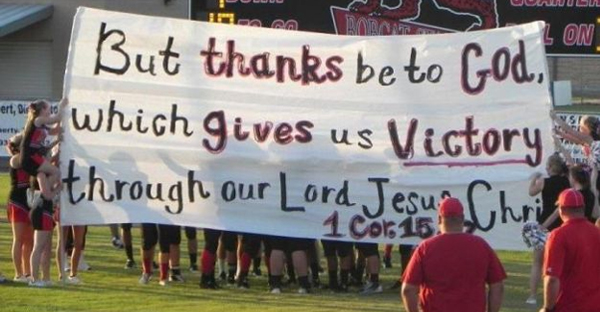
Can cheerleaders at a public school sport Biblical phrases on banners?

The cheerleaders in Kountze, Texas, think so.  So does the Texas Attorney General.  So do tens of thousands of Facebook supporters of the cheer team.

But an important part of this story is often being left out by coverage in some mainstream media outlets. Why?

We’ve reported on this story before.  In short, this group of cheerleaders sued when their school superintendent banned their religious banners from football games.  So far, the cheerleaders have been allowed to keep on cheering for Jesus at their games.

Recently, we’ve noticed a puzzling trend in the reporting about this story.  An editorial in yesterday’s New York Times, for instance, bemoaned the situation in Kountze.  “In this country — including in Texas — the Constitution does not leave religious freedom up to majority rule,” the editors insisted.

I agree with the NYT‘s basic position: the SCOTUS precedent in 2000’s Sante Fe ISD v. Doe speaks directly to this case.  Even student-led prayer, if sanctioned by the school district, implies an endorsement of particular religious beliefs by the government.  Though the Kountze cheerleaders insist that their banners represent purely private speech, this seems a stretch.

However, I’m puzzled by the way NYT coverage has left out a vital part of this story.  For those of us who want to understand the ways conservatism works in American education, whether it be about evolution, school prayer, sex education, or other issues, the skewed coverage in the NYT makes the job much harder.

Here’s the problem:  In yesterday’s editorial and in earlier reporting on this Kountze story, the NYT left out an important key player in the drama.  The NYT neglected to mention the role of the Freedom from Religion Foundation.  This Wisconsin-based group warned the school superintendent of its plans to sue over the banner issue.  Only then did the superintendent ban the cheerleaders’ religious practice.

The NYT misled readers with its description of the reasoning in Texas.  The editors described the case as follows:

“Those banners are not merely personal expressions of belief, but in that setting become religious messages endorsed by the school, the school district and the local government.       

“That’s why officials of the school district last month prohibited the banners at football games.”

But the way the story really played out, the school district only prohibited the banners under pressure.  In fact, as the Los Angeles Times reported, the school superintendent himself supported the cheerleaders.

If we hope to understand the dynamic, in this case or in the many other school-prayer cases in history and in the news, we must not omit such an important element.

Please do not misunderstand: I am not denouncing the Freedom from Religion Foundation.  I do not think that sectarian prayers belong at public-school events.  But I do want to understand these cases, and ignoring important elements such as the role of outside organizations leaves us unable to understand the situation.

As political scientists Michael Berkman and Eric Plutzer have argued in their books Ten Thousand Democracies and Evolution, Creationism, and the Battle to Control America’s Classrooms, teachers and school districts respond to local culture.  When communities want prayer and creationism in public schools, schools include prayer and creationism.

As Berkman and Plutzer proved with their survey of high-school biology teachers, the beliefs of those teachers usually closely match those of their local communities.

In the Kountze case, the school district, including even the superintendent who banned the banners, supports the cheerleaders.  As superintendent Kevin Weldon told the LA Times, the judge in this case “was in a pretty tough predicament, like myself. . . . I personally applaud the kids for standing up for their beliefs in such a bold way.”

If we hope to understand the ways issues such as creationism and school prayer play out in America’s schools, we can’t let ourselves miss the way schools, teachers, and school districts actually function.  Teachers, as Berkman and Plutzer insist, are “street-level bureaucrats.”  They represent majority opinion in their communities.  The same is often true for superintendents such as Kevin Weldon in Kountze.

None of this is new.  In the Scopes Trial in 1925, the prohibition of evolution in Dayton, Tennessee only became controversial when the American Civil Liberties Union became involved.  More recently, as political scientists Kenneth Dolbeare and Phillip Hammond demonstrated in the 1970s, US Supreme Court decisions about school prayer and Bible reading often have no discernable effect on school practice.  After the 1962 and 1963 Supreme Court decisions against the reading of the Bible and reciting of the Lord’s Prayer in public schools, Dolbeare and Hammond found that all the schools in their survey continued to pray and read the Bible.  Most important, those practices caused absolutely no controversy in the communities they studied.

If we hope to understand school prayer controversies, we can’t allow ourselves to leave out the role of key players such as the Freedom from Religion Foundation.  Perhaps the NYT editors hoped to avoid the old chestnut that only “outside agitators” brought about this sort of school controversy.  Whatever their reasons, they misrepresent the story and make it more difficult for outsiders like me to understand the nature of these school battles.