How Do You Know?

It might seem sloppy or even a little slapdash. Historians claim to know things about the past, but most of us don’t have hard-and-fast proof for the arguments we make. This morning I’d like to share one small example of the way the process works, at least in the case of my upcoming book.

I just finished reading John Lewis Gaddis’s Landscape of History with my graduate class. Gaddis is a leading historian of the Cold War. In Landscape of History, he argues that academic historians don’t try to make the same claims as social scientists. And that’s okay.Gaddis landscape
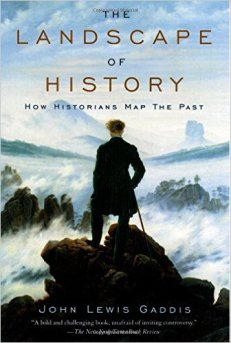
Gaddis uses a painting of a wanderer looking down on a fog-cloaked valley to illustrate his point. Historians can never be absolutely sure of their data; they are like the wanderer—looking into a distance that is cloaked and ultimately mysterious. Some social-scientists might object that the process makes claims it can’t back up with real data. Gaddis describes one such encounter:

Some years ago I asked the great global historian William H. McNeill to explain his method of writing history to a group of social, physical, and biological scientists attending a conference I’d organized. He at first resisted this, claiming that he had no particular method. When pressed, though, he described it as follows:

“I get curious about a problem and start reading up on it. What I read causes me to redefine the problem. Redefining the problem causes me to shift the direction of what I’m reading. That in turn further reshapes the problem, which further redirects the reading. I go back and forth like this until it feels right, then I write it up and ship it off to the publisher.”

McNeill’s presentation elicited expressions of disappointment, even derision, from the economists, sociologists, and political scientists present. “That’s not a method,” several of them exclaimed. “It’s not parsimonious, it doesn’t distinguish between independent and dependent variables, it hopelessly confuses induction and deduction.”

Gaddis liked the method anyway, and so do I. As I’m reviewing my research files for my upcoming book about the history of evangelical higher education (available for preorder now!) I came across a few items that didn’t make the final cut, but they do help illustrate the way I came to make the arguments I’m making.

One of the central arguments of the book is that evangelical and fundamentalist colleges have always been subjected to furious scrutiny from the national network of fundamentalists. There has always been a strong sense among the evangelical public that evangelical colleges must be held to a high standard of religious purity. Naturally, parents and alumni of every sort of college watch their schools closely. After all, they might be spending big bucks to send their kids there. In the case of evangelical higher education, even unaffiliated busybodies feel entirely justified—even compelled—to intrude.stenholm notes in controversial Kodon
Another key argument of the book concerns the feud between the fundamentalist and evangelical branches of the conservative-evangelical family. Beginning in the 1940s and 1950s, the fundamentalist network split into fundamentalist and new-evangelical camps. Some historians have called this a “decisive break” or an “irreparable breach,” but at institutions of higher education, it always felt more like a continuing family feud. At least, that’s the argument I make in the book.

How do I know?

As Professors McNeill and Gaddis insist, it is mostly a question of time. I spent long hours and days in the archives of various schools. I read everything. As I did so, ideas about these themes developed. As they did, I went back and reread everything. Did the idea seem to match the historic record? Over and over again, I noticed that school administrators fretted about the eternal and invasive fundamentalist scrutiny to which they were subjected. Over and over again, I noticed the tones of betrayal, hurt, and intimate outrage that characterized the disagreements between “fundamentalist” and “evangelical” schools.

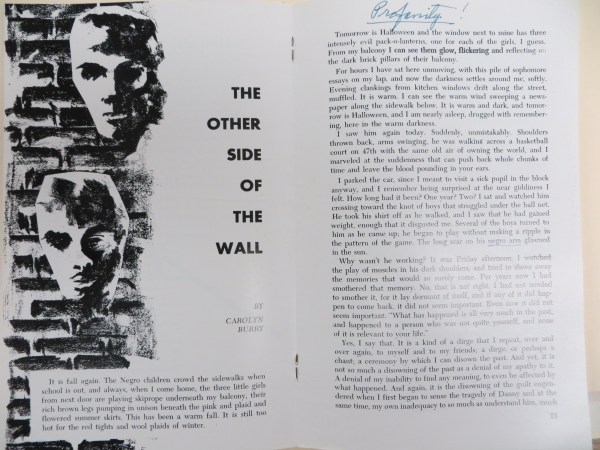
Not all the evidence made it into the book. One episode I do discuss is a controversial student publication from Wheaton College in Illinois. Back when he was an earnest evangelical student in the early 1960s, Wes Craven—yes, the Nightmare on Elm Street guy—was the student editor of Wheaton’s literary magazine. As part of his intellectual revolt against fundamentalism, Craven published two stories that he knew would ruffle fundamentalist feathers. In one, an unmarried woman wonders what to do about her pregnancy. In another, a white woman is sexually attracted to an African American man.

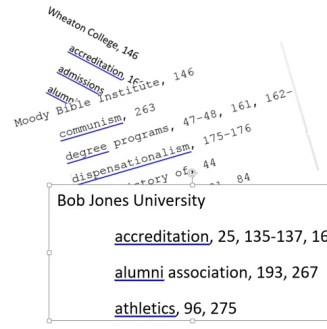
A quirk of the archives helped me see the ways the controversy unfolded. At the time Craven’s magazine came out, Gilbert Stenholm had been working at fundamentalist Bob Jones University for quite some time. He kept everything. His archive files are full of unique documents that helped me see how fundamentalist higher education worked in practice.

For example, he saved his copy of Craven’s controversial student magazine. His notes in the margins helped me understand the ways fundamentalists were outraged by their new-evangelical cousins. Along the edges of one story, an outraged Stenholm penned in one shocked word: “Profanity!” Elsewhere, Stenholm filled the margins with exclamation points.

What did this one-of-a-kind archival find tell me? It helped me see that fundamentalist schools like Bob Jones University had never really washed their hands of evangelical schools like Wheaton. For Stenholm, at least, the goings-on at Wheaton were always of intense interest. And it helped clarify to me the ways members of the far-flung fundamentalist community watched one another. They were always nervous about slippage—always anxious that trustworthy schools could slide into the liberal camp.

Stenholm’s outrage in the case of Craven’s student magazine didn’t make the book’s final cut, but this copy of Wheaton’s student magazine in Stenholm’s collection told me a lot. It doesn’t serve as the kind of “parsimonious,” independent-variable method that Gaddis’s social scientists would prefer. But taken all together, bits and pieces of archival gold like this one guided me to the argument I finally “ship[ped] . . . off to the publisher.”

Ready for Pre-Order!

I know, I know, a lot of eager readers were planning to dress up as their favorite evangelical university president and camp out at their local bookstore when the new book was released.

harry potter camp out

I’m pretty sure she’s dressed as Wheaton’s Hudson Armerding…

I’m happy to say that’s not necessary. You can put in pre-orders now for Fundamentalist U. Oxford is saying the books will ship February 1, 2018.

Blurbed!

I was never much of a baseball player, but there was a brief time in the late 1970s when I would have totally plotzed if Carl Yastrzemski told me I had a good swing.

Carl_Yastrzemski_at_Fenway_Park_2

He’s no Roger Geiger or Joel Carpenter, but Yaz was my hero for a while…

That’s about what I’m feeling like today, reading the blurbs for my upcoming book.

I don’t know how they did it, but the folks at Oxford Press have cajoled some heavy hitters in the fields of higher-educational and evangelical history into writing a few words for the book jacket.

Roger Geiger is the undisputed Grand Pooh-Bah of higher-ed history. His recent book The History of American Higher Education has become the new go-to source on the topic. Joel Carpenter packs a double punch as author and academic organizational wizard. He now works at Calvin College as director of the Nagel Institute for the Study of World Christianity. He’s also a prolific author, and his book Revive Us Again defined the parameters of the study of twentieth-century evangelical history in the USA.  Daniel K. Williams is a younger historian, but he has already distinguished himself as a leading scholar of our generation. His two best-known books are God’s Own Party and Defenders of the Unborn. I lean heavily on God’s Own Party in Fundamentalist U and Dan helped me a great deal as I was writing and revising my book.

Here’s what these three larger-than-life nerd heroes had to say about my book:

“Adam Laats’s history of the development of evangelical and fundamentalist higher education reveals a complex interaction between religious and academic values. The colleges, universities, and Bible Institutes that he examines contained deep differences regarding both spheres. As a sympathetic observer and an objective reporter, Laats captures the conflicts and the abiding strengths of faith-based institutions as they wrestle with the challenges of modernity and their own internecine quarrels.” –Roger L. Geiger, author of The History of American Higher Education: Culture and Learning from the Founding to World War II

“Fundamentalist and conservative evangelical colleges face unique tensions. They represent volatile movements plagued by internal struggles and ever-shifting boundaries. They pursue higher learning on behalf of a movement that accused America’s universities of betraying God’s truth and righteousness. And they function as halfway houses for evangelical students who are called to be in the world, but not of it. Adam Laats went deep into the archives of Bob Jones University, Wheaton College, Moody Bible Institute, Biola University, Liberty University and Gordon College, and he tells their stories with great integrity. The result is a major contribution to the history of Christian higher education and to the understanding of fundamentalism and evangelicalism in America.” –Joel Carpenter, Director of the Nagel Institute for the Study of World Christianity, Calvin College

“Adam Laats’s nuanced, detailed, and exceptionally well researched history of twentieth-century conservative Protestant higher education offers a plethora of fascinating information and perceptive insights. It is essential reading even for those well versed in American evangelical history, because it offers a fresh analysis of the complex ways in which fundamentalist colleges reflected (and shaped) their religious movement’s tenuous balance between the demands of the world and the tenets of faith.” –Daniel K. Williams, author of God’s Own Party: The Making of the Christian Right

Almost makes me want to read it myself!

Whew…

It wasn’t pretty, but it got done. I just sent in my proofs and index for Fundamentalist U: Keeping the Faith in American Higher Education. It’s a huge relief—that’s the last step for me before the book comes out.

index mash up FUndy U

How the sausage gets made…

Making an index is a weird job. There are professional indexers you can hire, but to me it seems like an intrinsic part of an author’s job. Nobody knows the book as well as the author; no one can tell what sections need to be emphasized in the index and which ones can be cut out.

Making this index wasn’t particularly fun, but it was a good chance for me to pore over the proofs one last time. It allowed me to think about the book’s argument from a new perspective and get a new take on writing I did quite a while ago.

So what’s next? I just sent it all in to the Oxford folks and they will put it all together. We’re hoping the book will come out in early 2018. I’ll keep you posted!

Creationist College History, Part II: Parting the Waters

I know, I know, it has been hard to sleep for the last couple days. With the cliff-hanger ending of my last guest post about evangelical colleges at Righting America at the Creation Museum, I’m sure it has been difficult to wait for the sequel.genesis flood 1961 ed

Well, wait no longer: Today at RACM you can read the second half of my argument about the way evangelical higher education influenced the career of American creationism.

What Goes on at Creationist Colleges?

Thanks to Bill and Sue Trollinger, the wizards behind Righting America at the Creation Museum, I’ve had a chance to share a few of my ideas about the vital role played by higher education in the evolution of American creationism.

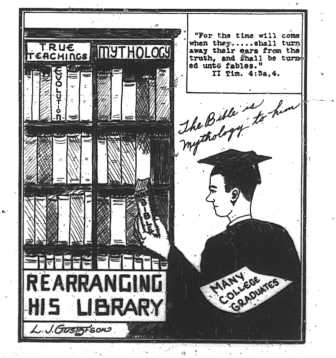
Gustafson chimes cartoon bible a myth at many colleges

Evolution has always been forbidden fruit, but not always in the same ways. This cartoon came from Biola University’s student paper, c. 1939.

This morning RACM has kindly published the first half of my argument about the tangled and troubled history of creationism at America’s evangelical and fundamentalist colleges and institutes. As you might suspect, even though fundamentalists all agreed that evolution was bad, they didn’t agree on much more than that.

Check out the full two-part argument at Righting America at the Creation Museum.

If You Don’t Think It Matters, then YOU’RE the Idiot

Liberty 48, Baylor 45. Bam. Jerry Falwell Jr. might be an idiot for investing unwisely in athletics and brick-and-mortar campus facilities, but at least his investments have paid off. The long-held dream of Jerry Falwell Sr. and his successors seems to be coming to fruition.

As I’ve been working on my upcoming book about the history of evangelical higher education, I couldn’t help but wonder: Why do so many schools invest so much money in seemingly antiquated relics of higher-educations past? If the future of higher ed is online, why do schools make such sacrifices to have winning sports teams and ivy-covered buildings?

In the case of Liberty University, it would make sense if they avoided pricey campus investments. They made all their money, after all, in the flashy world of online education. And it was a lot of money. Instead of presenting themselves as a new, more modern-than-thou online institution, though, Liberty plowed those winnings back into the trappings of traditional higher education.

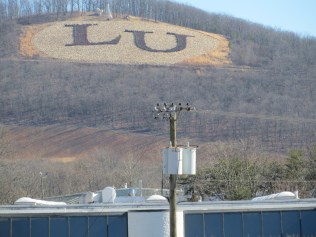
The campus is beautiful and growing fast. It even has an all-year snowboarding hill built into Liberty Mountain. Harvard doesn’t have one of those.

LU sign on mountain

Mountain-sized ambitions…

We might think—as I have—that Liberty’s leaders are merely missing the boat. We might think that they are trapped in a dead-end vision of higher education.

If they are, however, at least they are making that vision come true. Their recent upset win over football powerhouse Baylor was treated on campus as a major miracle. Students were given an official holiday to rub Baylor’s noses in it. President Falwell even relaxed the famous curfew rules in order to encourage Liberty’s students to celebrate.

All the hoopla shows how much athletics means to Liberty. As then-president Pierre Guillermin crowed way back in 1982, Liberty Baptist College (it only became Liberty University in 1985) planned to be

the Notre Dame of the Christian world athletically and the Harvard of the Christian world academically.

This recent football triumph brings that vision one step closer. And it tells us something about the nature of higher education. College has never been only about professional preparation. Yes, in order to be a teacher or a doctor or an engineer one needs a college degree. But “college” as a whole has never been limited merely to that sort of thing.

When Americans think of higher education, we tend to think of a bundle of things all wrapped together. We want to earn a degree, true, but we also want to have an “experience.” We want to attend a “real” college, one that has ivy and winning sports teams.

To a great degree, this unarticulated assumption is the reason why MOOCs flopped. The ability to take challenging classes online can’t replace the allure of a full-bore college experience.

At some level, President Falwell grasps this key fact in a way policy nerds have not. He sacrificed a great deal (not personally, but in institutional terms) to have a winning football team.

For Falwell, as for generations of scrimping and struggling evangelical colleges, the looming, nagging worry has been that they have not been seen as real colleges. They’ve been seen as dumpy little church schools, though they’ve dreamed of being taken seriously.

The win over Baylor means—at least for today—Liberty’s dreams have come true.

From the Archives V: “No, He Is a Fundamentalist”

Editor’s Note: As SAGLRROILYBYGTH are sick of hearing, I’m just about finished with my book about the history of evangelical higher education. As always, there was a ton of great material I couldn’t fit in. I’ll share some of the archival gems here.

What is a fundamentalist? It’s not as easy a question as it might seem. As we’ve explored in these pages, any attempt at a simple definition quickly runs up against big problems. One quirky document from the archives of the Moody Bible Institute helped me understand how the term “fundamentalism” was really used during the twentieth century.

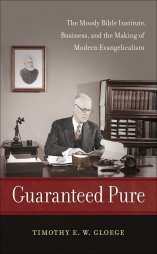
The biggest problem—at least to my way of thinking—is that fundamentalism said it was one thing, when it was actually something quite different. As Tim Gloege has argued convincingly in his book about the early history of the Moody Bible Institute, fundamentalists tended to talk about themselves as defenders of orthodoxy, but their views were in fact quite un-orthodox or even anti-orthodox.

Gloege Guaranteed Pure

Or maybe a “grammar. . . a corporate evangelical framework.”

They had to be.

Especially in the first half of the twentieth century, fundamentalism was something theologically new, a lowest-common-denominator coalition dedicated to fighting against theological modernism. Unlike real orthodoxies, fundamentalism could never agree on a set of hard and fast theological doctrines.

Instead, fundamentalism served, in Gloege’s words, as “the performance of ortho­doxy facilitated by modern promotional techniques.”

Fundamentalism, in other words, wasn’t a specific set of beliefs or practices, but a loud and often belligerent clubbishness in favor of conservative attitudes about church and culture. The kicker comes from the fact that early fundamentalists such as William Bell Riley said over and over again—loudly and often belligerently—that fundamentalism WAS a set of specific theological doctrines.

Riley wasn’t lying, but he was wrong. Riley wanted to insist on his nine-point creed as the one and only definition of true fundamentalism, but he couldn’t impose such a definition. Not for lack of trying, but because as a coalition of conservatives, fundamentalism itself could never be hemmed in by mere theology.

That’s the argument I’ll be fleshing out in more detail in my upcoming book anyway. On the campuses of fundamentalist colleges, universities, seminaries, and Bible institutes, the tenuous and ill-defined nature of fundamentalism was always starkly evident, if not often politely discussed.

As I was reviewing my files the other day, I came across one document that underlined the ways “fundamentalism” was used in real life. For admission to the Moody Bible Institute, students were required to submit recommendation forms. Like all higher-ed institutions, MBI wanted to know if potential students were good students. Unlike students at secular schools, though, potential MBI students had to provide evidence that they had good missionary potential.

One question asked recommenders if a potential student had any “doctrinal, or other peculiarities that would unfit him for Christian work”.reference he is a fundamentalist BETTER

One recommender’s response to that question can give us some insight to how the idea of “fundamentalism” worked in practice. Did the potential student have any “peculiarities”? “No,” the recommender wrote, “he is a fundamentalist.” To this recommender, at least, calling someone a “fundamentalist” meant that the person was vouched for, that the person was solid theologically, that he could be trusted as a missionary.

It did NOT mean that he or she shared a certain set of ideas about Christianity or about the proper way to read the Bible. It did not mean that he or she agreed with William Bell Riley’s nine-point list of fundamentals. It meant only that he or she had no “peculiarities.” He or she was within the circle of fundamentalist trust, even thought the exact outline of that circle could never be agreed upon.

What did being a “fundamentalist” mean? In practice, in this case at least, “fundamentalism” was an affiliation more than an orthodoxy. It was an in-group marker rather than a doctrinal platform. It identified someone as trustworthy without going into specifics about their theological or denominational beliefs.

From the Archives IV: The View from 1944

Editor’s Note: As SAGLRROILYBYGTH are sick of hearing, I’m just about finished with my book about the history of evangelical higher education. As always, there was a ton of great material I couldn’t fit in. I’ll share some of the archival gems here.

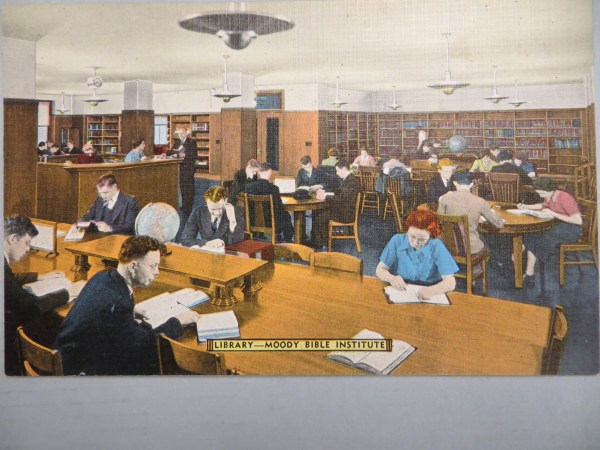
What did life look like at Moody Bible Institute in the 1940s? Thanks to one student scrapbook preserved in the archives, we have a couple of great souvenir postcards from the era to give us a hint.

1940s postcard dining room

Students fought hard to be able to eat with members of the opposite sex.

1940s postcard library

Getting those dispensations right…

1940s postcard proposed auditorium

Big plans for the future…

1940s MBI banner and patch

Rah rah.

Christian Culture Warriors Come in from the Cold

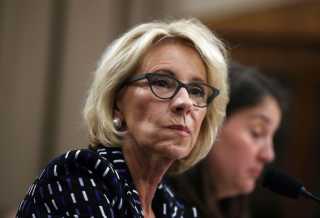
It has not been easy to be anti-gay lately. In a rush, support for same-sex marriage went from fringe to front-and-center. Many conservative religious people have felt flash-frozen out of the mainstream. When it comes to LGBTQ issues, many evangelicals have been surprised to hear themselves called bigots. In her continuing role as conservative dream-maker, Ed Secretary Betsy DeVos recently moved to bring anti-LGBTQ religious activists back into the mainstream. Will it work?

DeVos lgbtq

Welcoming anti-welcomers

First, let me lay out the required clarifications. SAGLRROILYBYGTH are sick of hearing it, but new folks might not know where we’re coming from here at ILYBYGTH. So here they are: I personally feel strongly about LGBTQ rights, in school and elsewhere. But in these pages—as in my recent book about educational conservatism—I’m more interested in understanding the politics involved than scoring political points one way or the other.

Second, a little background: In the past three years or so, many conservative religious folks have been surprised to find themselves so quickly tossed from the precincts of respectability when it comes to LGBTQ issues. As I’ve been working on my book about evangelical higher ed, I’ve noticed how often university leaders have bumped up against the question. At Gordon College near Boston, for example, President Michael Lindsay was surprised by the ferocious response to his reminder about Gordon’s policy against homosexuality. The issue of same-sex rights threatened to split the world of evangelical higher education in two.

As traditional evangelical notions about homosexuality were kicked out of the mainstream, evangelical intellectuals were confronted again with their perennial dilemma. Do they maintain their dissident notions and deal with the consequences? Or do they adapt their ideas as mainstream culture changes?

Today, we see that Ed Secretary Betsy DeVos has moved to reverse the tide. As reported by BuzzFeed, she invited two unapologetically anti-LGBTQ groups to an official Ed Department meeting. Focus on the Family and the Family Research Council both participated in a recent Father’s Day event. The signal couldn’t be clearer: Opposing expanding LGBTQ rights and protections does not make conservatives unwelcome in Queen Betsy’s regime.

We should not be surprised. In the twentieth century, according to progressive critics, Queen Betsy’s family foundation gave sizeable donations to both Focus on the Family and its offshoot Family Research Council. And there is absolutely no doubt that the two groups are stridently opposed to LGBTQ rights. Founder James Dobson views homosexuality and transgender as transgressions, pathways to “orgies” and sin.

Will such notions move back into the mainstream? Will groups who hold such views be allowed to participate in federally funded projects? It’s a frightening prospect, and the Trump White House makes it seem frighteningly realistic.

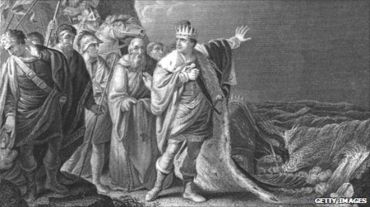
canute

I command you, tide…

In the end, though, I think DeVos’s Canute strategy is doomed. She seems blithely unaware of her own separation from mainstream notions, but she will nevertheless be forced to deal with it. By including Focus and FRC, for example, she alienated the national Parent-Teacher Association, hardly a group known for its culture-war extremism.

As with her recent remarkable comments about discrimination in schools, Secretary DeVos will find herself apologizing for her inclusion of these anti-LGBTQ groups. There is no doubt she would like to welcome their ideas back into the mainstream, but she doesn’t have the power to reverse the tide.