Sex Ed and the Diseased Children of the Revolution

HT: KC

What do Americans want their children to learn about sex?  Throughout history, two conservative authors recently argued,[*] most Americans have wanted children to learn the values of abstinence and purity.  Only the 1960s sexual revolution turned perversion and license into mainstream public-school how-to lessons.

The essay, by National Abstinence Education Association President Valerie Huber and Cedarville University psychology professor Michael Firmin, appeared in the recent issue of the peer-reviewed journal International Journal of Educational Reform.  For those of us who are interested in understanding conservatism in education, this article offers a chance to see conservative thinking in action.

There are a few odd copy errors.  Prominent education historian Milton Gaither, for example, is called “Milton Caither.”  But far more interesting than these flaws are the interpretative implications of the authors’ historical vision.

Before I describe them, though, I should point out my own biases.  I have a difficult time understanding conservative opposition to comprehensive sex education.  In my upcoming book about the twentieth-century career of educational conservatism, I describe such opposition, especially in my chapter about the 1970s.  But I still have a hard time understanding it.  To me, it seems like simple common sense that schools should provide thorough, accurate information about sex to young people.  Public schools should not moralize about sex, but whether or not students choose to have sex, they should know about the facts of life.  With the huge public-health implications of pregnancy and sexually transmitted diseases, it seems to me a simple matter of common sense that schools should teach everyone about sex.

However, as I’ve struggled to understand conservative opposition to comprehensive sex ed in public schools, I feel I’ve gained some insight.  Though I want public schools to teach kids all the facts and let the kids and their families determine the morality involved, I can sympathize with conservatives who feel that such an approach tips the discussion too far in the “pro-sex” direction.  I consider the following analogy: if your spouse were traveling on business, would you make sure he or she had condoms along in case s/he decided to have sex while s/he was gone?  That doesn’t make much sense.  Or this one: could a teacher tell students, “If you’re planning on robbing a bank, here are some ways to do it safely?”  In other words, if a behavior is obviously morally unacceptable, we shouldn’t teach young people how to do it safely.  We shouldn’t imply that we condone such immorality by helping children (or spouses) do it without consequence.  Some conservatives think that pre-marital sex is precisely this sort of immoral behavior.  Such conservatives insist that by telling young people about sex in a morally neutral fashion, we suggest that premarital sex is okay.

Huber’s and Firmin’s history of sex ed portrays an American people deeply convinced that sex is best saved for marriage.  Only perverts and revolutionaries challenged that notion.

For instance, the first prominent “pro-sex” campaigner Huber and Firmin describe is Margaret Sanger.  In the 1920s, the authors note, Sanger advocated birth control as a way to empower women and to limit the numbers of undesirable births.  Sanger’s recreational approach to sex was “radical,” the authors contend, but it became an “early influence” on sex ed in schools.

In the 1940s and 1950s, Alfred Kinsey took the study of sex to new extremes, according to Huber and Firmin.  Kinsey studied the sexual practices of a “nonrepresentative proportion of sex offenders and participants in the homosexual bathhouse community,” the authors contend.  Kinsey proffered his witches’ brew of demented sexual proclivity as unbiased research, including outlandish claims that infants had orgasms.  As did Margaret Sanger, Kinsey laid the foundations for a morality of “sexual experimentation,” according to Huber and Firmin.

It was not until the 1960s, however, that such radical notions about sex and sex education became mainstream.  The sexual revolution of that decade, Huber and Firmin argue, “turned America’s moral sensibility on its head.”  During the late 1960s and early 1970s, a new culture of sex education took America by storm, midwived by the “[l]ong hair, open-air sexual orgies, drugs, student rebellions, Vietnam, and racial tensions” of the period.

By the 1980s, luckily, “innovative organizations” had organized a sensible and effective “counterrevolution.”  These groups promoted the American tradition of sex education as abstinence-only education.  Only such education combined information about sex with the moral underpinnings that young people need.

Today, according to Huber and Firmin, most Americans agree with an abstinence-only approach to sex-ed in public schools.  Though the “public relations” efforts of “pro-sex” groups such as Planned Parenthood have had some success, the authors note that “the majority of parents, regardless of race or political party, strongly endors[e] all the major themes presented in an abstinence education class.”  As evidence, they cite a 2012 survey from the National Abstinence Education Foundation.

As I’ve argued in the pages of Teachers College Record, conservative activists have an intense interest in educational history.  It makes sense.  Whoever controls the history can make policy recommendations that claim to be in synch with American tradition.  In this case, Valerie Huber and Michael Firmin give us a history in which Americans want their children to learn the values of abstinence and purity.  Throughout the generations, some radicals such as Sanger and Kinsey have strummed a minor chord of recreational sex and gleeful perversion.  Only with the irresponsible sexual revolution of the 1960s, though, did such attitudes enter public schools in any significant number.  Thanks to the work of earnest abstinence-only “counterrevolutionaries,” however, America’s schools have hope.  Today’s schoolchildren, these conservative authors argue, can learn the real tradition of American sex ed.

——————————————————————————————————————————-

[*] The article does not seem to be available without a subscription.  For those with access to a decent library, here’s the citation to help you find the full article: Huber, Valerie J., and Michael W. Firmin. “A history of sex education in the United States since 1900.” International Journal of Educational Reform 23.1 (2014): 25+.
 

Our Children: Evil & Successful

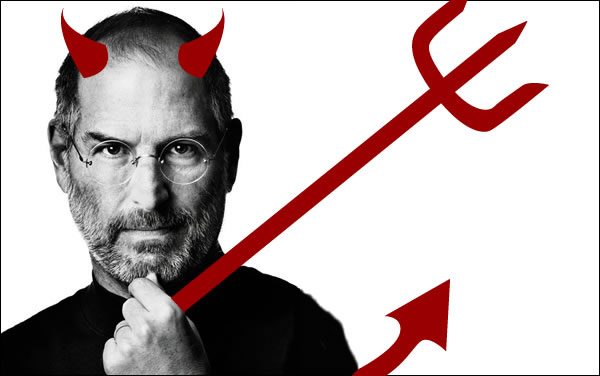
What have we done?  By giving our children everything, we’ve made them into self-centered, grasping monsters.  At the Imaginative Conservative, Bruce Frohnen accuses our culture of eating its own children.  As the perfect terrifying example, Frohnen uses the life and rapacious career of the late Steve Jobs.  Perhaps unconsciously, Frohnen dips into one of the strongest traditions of educational conservatism.

Spoiled Children, Spoiled Society

Spoiled Children, Spoiled Society

Frohnen, Professor of Law at Ohio Northern University, castigates Jobs as the exemplar of all things rotten in our culture.  Jobs, Frohnen writes, lived as

a mean-spirited narcissist who translated a certain aesthetic sensitivity and capacity for bullying and hucksterism into a colossal waste of money and collective time, further separating Americans from one another in pursuit of a false control over their environment. As bad, his personality and corporate ethos furthered highly damaging political and economic structures of a kind best described as libertarian socialism, in which corporations and rich individuals behave without conscience, expecting the social programs they vote for but seek to escape funding to pick up the pieces from their own “creative” destruction. I also see him as in many ways a sad character, emotionally and spiritually stunted in part because of the failings of the infantilizing environment in which he grew up.

Frohnen’s arch analysis of Jobs’ character serves as more than a brutal post-mortem on a unique American life.  Frohnen wants us to see Jobs as typical, the predictable result of American culture gone off the tracks.

Why was Jobs such a grasping bully?  Because he came out of the 1960s American culture that had wilfully abandoned its own traditions of child-raising.  Jobs, like so many of his generation, was relentlessly coddled, given everything and asked for nothing.

This was more than just a question of parenting.  Frohnen examines the college education on offer at Reed College in Oregon, where Jobs briefly took classes and where Frohnen briefly taught.  The faculty at Reed, Frohnen argues, deliberately discarded educational tradition and encouraged students to wallow in self-love.  As Frohnen remembers it,

Reed College in Portland, Oregon is one of those places where students dress in black to show how depressing it is to be young and well-off; lots of Volvos in the parking lot when I was there. And the drug culture remained. By my second semester at Reed several students had overdosed on illegal drugs. When the President, a “good” leftie from Oberlin, decided to take the minimal action of proposing a faculty resolution decrying the self-destructive behavior he was in for a surprise. At first I thought the principal opposition speaker was a bag lady. It turned out she was just some English professor in a poncho. She was nearly in tears as she argued that “we” could not hope to engage productively with students if we began with such a “superior attitude.” The resolution failed by an overwhelming margin.

Though Frohnen ties his bitter eulogy to a specific time and place—the 1960s lax parenting and education of the San Francisco era—conservative intellectuals and activists have made similar arguments throughout the twentieth century. As I argue in my upcoming book, at least since the 1920s conservatives have lamented the tendency of political liberals and educational progressives to coddle children. Parents and educators make a mistake, conservatives have insisted, when they offer too much to children.

Consider, for example, the educational vision of Grace Brosseau in 1929. At the time, Minor served as the President General of the Daughters of the American Revolution. She insisted, as Frohnen does, that parents and teachers must not abandon their duty to impose on children. “Flagrant cases of un-American tendencies have been brought to light and exposed,” Brosseau warned. America had gone to hell in a handbasket. And why? Too many teachers believed in the “decrepit theory that both sides of the question should be presented to permit the forming of unbiased opinions. This may be the proper system for the seasoned adult,” Brosseau warned, but

With the young, the chances are too great, for there a dangerous inequality exists.  One does not place before a delicate child a cup of strong black coffee and a glass of milk; or a big cigar and a stick of barley candy; or a narcotic and an orange, and in the name of progress and freedom insist that both must be tested in order that the child be given the right of choice.  Instead, one carefully supplies only what will make for the development of the young body and assure its normal growth.  Why then apply the very opposite theory when dealing with the delicate and impressionable fabric of the mind?

Writing in the 1980s, conservative activists Mel and Norma Gabler repeated this warning that too much choice spoils a child.  “The only absolute truth in modern humanistic education,” the Gablers warned,

is that there are no absolute values.  All values must be questions—especially home- or church-acquired values.  Discard the experience gained from thousands of years of Western civilization.  Instead, treat the students as primitive savages in the area of values.  Let them select their own from slanted, inadequate information.

By giving everything to our children, these conservative writers have insisted for generations, we’ve taken everything from them.  In the case of Steve Jobs, Frohnen argues, we see the perverted results that ensue from too much too soon.


Comedy & Conservatism

–Knock knock.

–Who’s there?

–A smaller government, a vigorous military presence abroad, and traditional values.

Get it?  According to Frank Rich, no one does.  Conservatism just isn’t funny.  In a terrific essay last week in New York Magazine, Rich explores the tortured relationship between conservatism and comedy.

Rich wonders why there are no big conservative comedians out there, no flipside to the Jon Stewarts and Stephen Colberts.  He mentions a couple of contenders, such as Dennis Miller and even South Park.  But they are either not very funny or not very conservative.  And, as Rich points out, it seems like there would be plenty of funding for a vigorous conservative comedy effort.  But the few that have been made, such as the lamentable ½ Hour News Hour, are only embarrassing for us all.

Rich doesn’t make the case, but it seems as if conservatism, as a rule, should have the upper hand when it comes to laffs.  After all, as Hannah Arendt argued long ago, conservatives in general have the easier job in cultural polemics.  They can joke about each new innovation.  They can skewer new trends and rely on long-standing traditions to pillory liberal excesses.

But, as Rich points out, they don’t.  Why not?  Why aren’t conservatives funny?

Rich argues that too many conservative comedians are conservatives first and comedians second.  After all, “liberal” jokesters such as Jon Stewart don’t hesitate to joke about liberal heroes.  Stewart puts the jokes first and the politics second.

More Preachy than Funny

More Preachy than Funny

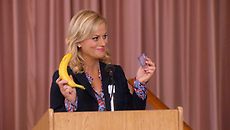
When liberals forget this simple rule, they are just as unfunny as conservatives.  Remember Leslie Knope’s (Amy Poehler’s) stilted attempt at sex-education humor?  It just wasn’t funny.

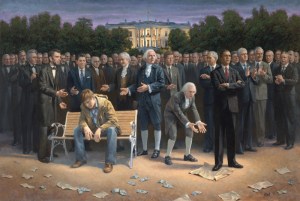
This rule applies outside of comedy, of course.  Some conservative intellectuals embrace the paintings of the late Andrew Wyeth, for example, as “conservative” masterpieces.  Consider the vast difference, though, between Wyeth’s brand of painting and the conservatism-on-his-sleeve style of Jon McNaughton.

As Rich notes about comedy, art of any sort seems to suffer when pundits put ideology first and art second.

Wyeth's "Christina's World" (1948).  Is this good art?  Or just good "conservative" art?

Wyeth’s “Christina’s World” (1948). Is this good art? Or just good “conservative” art?


Jon McNaughton's "The Forgotten Man." Politics first, art second.

Jon McNaughton’s “The Forgotten Man”

The Files Are In!

Well, there’s nothing more to be done about it now.  I’ve just sent my final draft of my next book manuscript to the publisher.  There’s a sense of relief at being done, but also trepidation at the impossibility of further revisions.  After years of researching, writing, then revising, revising, revising, it’s hard to believe I won’t be able to keep tweaking and improving.

Pre-order your copy today!

Pre-order your copy today!

In general, though, I’m extremely pleased with the shape of the manuscript.  In a nutshell, I try to make the case that we’ve seen a potent tradition of educational conservatism in the United States, one that has had a decisive impact on the structure and content of schooling.  And, I argue, that tradition has not been recognized by historians or education scholars.

To make this case, I examine in four looooong chapters the four biggest school controversies in twentieth-century America: the Scopes Trial of 1925, the Rugg textbook controversy of 1939-41, the Pasadena superintendent ouster of 1950, and the Kanawha County textbook battle of 1974-75.  What did conservatives say and do in these controversies?  In each case, the attention-grabbing events attracted conservative participation from both locals and national leaders.  In each case, the issues prompted conservatives to articulate their visions of proper schooling.  To me, that’s the interesting question.

We’re still a ways from final publication.  The publisher will send me proofs in July.  At that stage, I’ll put together the index and fine-tooth-comb the proofs for any typos.  But I won’t be able to make substantive changes at that point, just minor corrections.

During these last weeks, as I’ve been going over the copy-edited chapter files, I’ve been very grateful for the careful work of the editor.  She or he pointed out some embarrassing errors on my part and I’ve been able to make changes in the argument.  Hopefully this draft is as crystal-clear as I can make it.

I’m looking forward to hearing what readers think of the book.  For that, I’ll have to wait until 2015.  The press will release the book on January 12, 2015.  Pre-orders are available!


Christian College Leader Admits Wrongdoing

Dinesh D’Souza broke the law.  He recently admitted it.  Some conservative pundits insist that his prosecution is politically motivated.  Is this the end for a spectacular conservative career?

Wunderkind Admits It

Wunderkind Admits It

The conservative Christian writer and celebrity has always had something of a tin ear when it comes to conservative evangelical culture.  A couple of years ago, for instance, he was ousted from his post as president of The King’s College when he appeared in public with a woman who was not his wife.

Nevertheless, D’Souza’s brand of high-sounding punditry has made him hugely popular among American conservatives.  His books and films, such as What’s So Great About Christianity and 2016: Obama’s America, have secured D’Souza’s place as a top name among conservative activists.

This week, D’Souza pleaded guilty to illegal campaign contributions.  In order to help the ailing fortunes of Republican Senate candidate Wendy Long, D’Souza set up “straw donors” in order to exceed legal limits on campaign donations.  In his plea, D’Souza agreed that this action was “wrong” and “stupid.”  He admitted that he knew his actions were illegal.  But he also complained that he was the victim of selective prosecution.

Other conservative pundits agree.  An editorial in the Washington Times lamented,

Whether guilty or not, the fact that Mr. D’Souza has been singled out for prosecution while others skate past freely reveals President Obama’s thumb on the famous lady’s scale.

Some conservative writers take a different line.  Writing in The American Conservative, Rod Dreher insisted that D’Souza must take his lumps.  As Dreher argued,

I have no trouble believing that D’Souza may have been selectively prosecuted. But even if he was, that does not justify his knowingly breaking the law. Does this really have to be explained to conservatives, of all people?  We can’t call for law and order, but carve out special exemptions for our political allies.

Does this spell the end for D’Souza’s career?  As a non-conservative, I would be surprised if any conservative institution were to clamor to be associated with D’Souza after this.  But I’ve been surprised before.


A Conservative Commencement Address

College is crap.  So says the godfather of the modern conservative intellectual movement.

Though it wasn’t technically a graduation address, Russell  Kirk’s 1978 address to Hampden-Sydney College has the feel of one.  But it’s an idiosyncratic feel.  Kirk told the assembled students that college had gone to hell in a handbasket.  What could save it?  A renewed dedication to the “higher” part of higher education.

Russell Kirk kick-started the modern conservative intellectual movement with his 1953 blockbuster The Conservative Mind.  In that book, Kirk argued for a long and illustrious intellectual history for modern conservatism, reaching back through America’s finest men of letters and founding fathers to Edmund Burke.

In his 1978 address, Kirk bemoaned the state of American higher education.  Most schools had wallowed in the “educational follies” of recent trends.  The proper purpose of college, Kirk argued, was to train leaders in both profession and morality.  Since the end of World War II and new mass enrollments, colleges had lost their sense of purpose.  Kirk offered a four-part explanation of this decadence.

First, colleges no longer knew what they were for.  Instead of keeping their sights fixed on “knowledge and virtue,” universities tried to be all things to all people.

Second, colleges no longer laid out a menu of intellectual growth for students.  Colleges gave up on prescribing a course of knowledge.  Instead, in the name of freedom, colleges offered a vapid “cafeteria-style curriculum.”

Third, colleges had grown recklessly and heedlessly.  As Kirk put it,

Culturally rootless, anonymous, bewildered, bored, badly prepared for higher studies, other-directed, prey to fad and foible, presently duped by almost any unscrupulous or self-deceived ideologue, a great many of the students at Behemoth University came to feel defrauded and lost; only the more stupid did not suspect that anything was wrong with their condition.

Fourth, the decline of primary and secondary education meant that most college students no longer came prepared. Progressive fads had enervated education to such an extent that most students only knew how to fit in, not to stand out.

The central problem has been the rush to enroll, Kirk concluded.  Too many students go to college, with too little sense of purpose and too little preparation.

The cure, Kirk insisted, is to return to proper education for leaders in all professions.  With a core of truly educated people, American society and culture could rebound.  As he put it,

I am suggesting that college ought not to be a degree-mill: that it ought to be a center for genuinely humane and genuinely scientific studies, attended by young men of healthy intellectual curiosity who actually possess some interest in the development of mind and conscience. I am saying that the higher learning is meant to develop order in the commonwealth, for the republic’s sake. I am arguing that a system of higher education, which has forgotten these ends, is decadent; but that decay may be arrested, and that reform and renewal still are conceivable.

Though critics might cry “elitism,” Kirk concluded, his vision was anything but. The current vision of college as processing-plant cranked out cadres of quarter-educated elites. These dimwits moved society in preposterous directions, madly confident all the while that their elite education had prepared them for leadership.

As we wind up commencement season, I can’t help but wonder how Kirk’s lament would have gone over as a graduation speech.  It lacks some of the traditional encouraging rhetoric of that genre.  Would be-gowned professors and deans be able to sit on the stage and nod sagely as Kirk blasted their life’s work?


Holocaust Denial, Evolution Denial, and “Teaching the Controversy”

Should students learn to think critically in schools?  Should they learn about both sides of controversial issues?  This morning at the National Center for Science Education blog, Glenn Branch compares creationists’ fondness for “teaching the controversy” to an explosively controversial history lesson from California.  For those of us interested in conservative ideas about schooling, this recent flap again demonstrates the ways “conservative” and “progressives” have swapped sides on this issue.

In the Rialto (California) Unified School District, eighth-grade students were asked to evaluate the arguments for and against the existence of the Holocaust.  “When tragic events occur in history, there is often debate about their actual existence,” the assignment reads, according to the San Bernardino County Sun.

For example, some people claim the Holocaust is not an actual historical event, but instead is a propaganda tool that was used for political and monetary gain. Based upon your research on this issue, write an argumentative essay, utilizing cited textual evidence, in which you explain whether or not you believe the Holocaust was an actual event in history, or merely a political scheme created to influence public emotion and gain. Remember to address counterclaims (rebuttals) to your stated claim. You are also required to use parenthetical (internal) citations and to provide a Works Cited page.

When the story came out about ten days ago, some conservative pundits tried to use this as proof of the moral monstrosity concealed in the Common Core State Standards.  The standards, some said, pushed school districts into adopting such terrible ideas as Holocaust denial.

Glenn Branch asks a different question.  How is this example of teaching “critical thinking” any different from creationist attempts to have students evaluate evolution and creationism side by side?  In both cases, students are encouraged to look at evidence.  Students are prompted to evaluate arguments and come to their own decisions.

But in the case of Holocaust denial, one side of the balance sheet has been thoroughly discredited.  It is not morally or educationally appropriate to ask students to decide whether or not the Holocaust happened, critics insist.  One of the sources students were given in this assignment stated the following:

With all this money at stake for Israel, it is easy to comprehend why this Holocaust hoax is so secretly guarded. In whatever way you can, please help shatter this profitable myth. It is time we stop sacrificing America’s welfare for the sake of Israel and spend our hard-earned dollars on Americans.

Offering students these sorts of false, hateful lies as “sources,” critics say, demeans the idea of pushing students to think critically.  If creationists thought that students should really explore every side of every issue, even sides with no intellectual or moral legitimacy, Branch argues,

then they should have been enthusiastically supporting the Rialto assignment. It’s to their moral credit that they weren’t, of course, but it proves—as if proof were needed by now—that “teach the controversy” and the like are merely rhetorical legerdemain intended to distract the spectator from the intellectual hollowness of the proposals they are supposed to support.

To suggest that schools ought to “teach the controversy” when there is in fact no controversy among mainstream scientists, Branch concludes, is just as bogus as having students evaluate the claims of Holocaust deniers.

The historian in me can’t help but notice the flip-flop we’ve seen over the course of the twentieth century.  In 1925, it was the pro-evolution side who pleaded with America to consider both sides in public schools.  Most famously, Scopes-trial attorney Dudley Field Malone begged the nation to allow the teaching of evolution.  “For God’s sake,” Malone implored, “let the children have their minds kept open.”  Ironically, as historian Ronald Numbers pointed out in Darwin Comes to America (pg. 91), later creationists adopted Malone’s plea as their own.

This is one of the themes I’m working with in my upcoming book.  Back in the 1920s, it was the conservative side of school battles who protested that these were false choices.  In 1929, for instance, the staunchly conservative leader of the Daughters of the American Revolution warned DAR members that progressives sneakily insisted on teaching both sides of every issue.  Such choices, she warned, were false ones.  Even to ask the questions tipped students away from truth and morality.  As she memorably argued,

Flagrant cases of un-American tendencies have been brought to light and exposed.  Exotic theories are promulgated in the name of science.  Disdain for law and order, and contempt for our accepted form of Government are subtly injected into the teachings of history.  Such practices are defended by the advancement of the decrepit theory that both sides of the question should be presented to permit the forming of unbiased opinions.  This may be the proper system for the seasoned adult who presumably can, if he will, revoke his errors when faced with the consequences of an unwise choice.  With the young, the chances are too great, for there a dangerous inequality exists.  One does not place before a delicate child a cup of strong black coffee and a glass of milk; or a big cigar and a stick of barley candy; or a narcotic and an orange, and in the name of progress and freedom insist that both must be tested in order that the child be given the right of choice.  Instead, one carefully supplies only what will make for the development of the young body and assure its normal growth.  Why then apply the very opposite theory when dealing with the delicate and impressionable fabric of the mind? (Emphasis added.)

With this historical lens, it seems doubly apparent that the argument for teaching both sides of any tricky issue has always been politically popular among Americans.  If there’s a controversy, many Americans have always agreed, let children hear both sides.

Back in the 1920s, progressives and evolution educators tried to make this case.  Let children hear about socialism and evolution, progressives pleaded.  At least allow schools to teach the controversy.  Back then, conservatives made the case that one side of those ideas was not equal.  To offer students both candy and cigars to choose from, as our DAR leader insisted, was a false choice, a false controversy.

Today, the sides have switched but the argument has not.  One side argues to let children hear both sides of a controversial issue and decide for themselves.  The other side insists that only one side has any truth, any intellectual legitimacy.

Me personally, I agree that Holocaust denial and evolution denial ought not be offered as equals to better history and better science.  But I know many readers might disagree.  How can creationists defend the legitimacy of “teaching the controversy” when most scientists agree that there is no controversy?  Is it like offering children a choice between heroin and citrus fruits?  Milk and coffee?  Candy or cigars?


Children Prefer Conservatives

Don’t take my word for it.  Check out the rankings from the Seventh Annual Children’s Choice Book Awards.  You’ll see that this group voted Rush Limbaugh their “author of the year” for his Rush Revere and The Brave Pilgrims: Time-Travel Adventures with Exceptional Americans.

Talk Radio and Talking Horses

Talk Radio and Talking Horses

What’s the book about? A substitute teacher and his talking time-traveling horse travel back to the Mayflower to travel with the Pilgrims. As Limbaugh introduces it to young readers, he wants “to try to help you understand what ‘American Exceptionalism’ and greatness is all about.” It does not mean that other countries aren’t just fine, too. But as Limbaugh puts it for his young readers, “American Exceptionalism and greatness means that America is special because it is different from all other countries in history. It is a land built on true freedom and individual liberty and it defends both around the world.”

Limbaugh has made efforts to introduce his vision of heroic history to schoolchildren everywhere. As of early 2014, Limbaugh claimed to have donated over 15,000 copies of his book to schools across America. As he told the conservative news site World Net Daily,

The mission is to connect with people that normally wouldn’t and don’t listen to a program like this but who someday will, and maybe their parents and grandparents do. I’m very proud of what I do, and I want as many people to be aware of it as possible. I’m very proud of what I believe. I’m very proud of my country. I want everybody to be. I really do. It may sound like pie-in-the-sky, but I want everybody to love this country as I do.

Academic historians might pooh-pooh this sort of thing. But America’s kids seem to like it. At the annual meeting of the Children’s Book Council, young attendees cast over 1,261,000 votes, and Limbaugh’s effort to introduce children to the wonders of America’s historical greatness came out on top.


Liberalism Leads to Campus Rape

Well-intentioned liberal rules—plus “binge drinking”—led us to an epidemic of campus sexual assaults.  That is the equation offered recently by conservative intellectual Patrick Deneen.  Deneen argues that the abdication of control by universities in the 1960s, meant to liberate students, has pushed the federal government to step in.

In recent days, we at ILYBYGTH have wondered about the connection between conservative Christianity and campus sexual assault.  Do overzealous reporters try to use uniformed bluster about “fundamentalism” to smear conservative religious peopleOr does there seem to be something peculiarly dangerous about authoritarian institutions such as fundamentalist colleges?

Professor Deneen has different concerns.  He notes the recent announcement by the federal government that it is investigating fifty-five universities for their handling of sexual-assault cases.  When universities and colleges fail to maintain the safety and security of their students, the Office of Civil Rights will step in.

As Deneen points out, this responsibility for the sexual morality of students used to be the responsibility of the universities themselves.  College graduates of a certain age may remember the elaborate rules that enveloped college-student social lives before the 1960s.  Female students at mainstream colleges—even at public institutions—often had to check in with “dorm mothers” at nine o’clock.  In every aspect of student life, the college took on the role of the parent.  In every way, the college acted in loco parentis—in place of the parent.

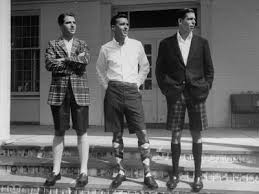
Of course, in the 1960s campuses in the US and around the world became hotbeds of political and cultural upheaval.  Students demanded more freedom, and they got it.  At many schools, in loco parentis rules were scrapped.  In many schools, indeed, core curricula were also scrapped in the name of freedom.  For instance, at my own beloved school, Binghamton University, students staged the “Bermuda Revolution.”  Not quite up to the office occupations and shotgun-wielding demands that rocked our neighbors at Columbia University or Cornell, but Bearcats managed to come together to protest strict student rules.  At Binghamton, the Bermuda Revolution brought students out to our Peace Quad clad in Bermuda shorts.  At the time, this was against the stern, traditional dress code that required shirts and ties for men and skirts and blouses for women.  As a result, the university changed those rules, giving students more freedom over their own lives.

Campus Revolutionaries, Binghamton Style

Campus Revolutionaries, Binghamton Style

One unintended consequence of this freedom is that more young people on college campuses have been exposed to sexual violence.  When students have more opportunity to drink alcohol and stay out late, more students find themselves in situations that lead to sexual assault.  As a result, the federal government has stepped in to investigate the way universities respond to charges of rape and sexual assault.

Professor Deneen argues that this tale of freedom gone awry can be seen as the history of liberalism in a nutshell.  As he puts it,

Longstanding local rules and cultures that governed behavior through education and cultivation of certain kinds of norms, manners, and morals, came to be regarded as an oppressive limitation upon the liberty of individuals. Those forms of control were lifted in the name of liberation, leading to regularized abuse of those liberties. In the name of redressing the injustices of those abuses, the federal government was seen as the only legitimate authority for redress and thereby exercised powers (ones that often require creative interpretations of federal law to reach down into private institutions) to re-regulate the liberated behaviors. However, now there is no longer a set of “norms” that seek to cultivate forms of self-rule, since this would constitute an unjust limitation of our freedom. Now there can only be punitive threats that occur after the fact. One cannot seek to limit the exercise of freedom before the fact (presumably by using at one’s disposal education in character and virtue); one can only punish after the fact when one body has harmed another body.

Conservative Christian colleges may have a unique set of challenges when dealing with the issue of sexual assault.  But Professor Deneen argues that sexual assault on other campuses has been a result of liberalism, not traditionalism.  Loose rules and permissive attitudes, Deneen notes, have led to an anything-goes culture.  The resulting “sexual anarchy” has left victims vulnerable to attack, with little recourse after the fact.


Required Reading: Wal-Mart and Fundamentalist U

A recent exposé in the New York Times attacked Wal-Mart’s funding of charter schools. Conservative pundits defended Wal-Mart. But neither side took notice of a more profound tradition of educational activism by the leaders of the mega-retailer.

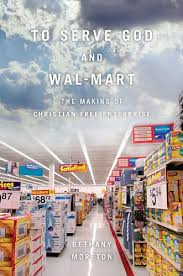
Historian Bethany Moreton, in her not-so-recent-anymore book To Serve God and Wal-Mart, describes a different sort of educational work by the founders and leaders of Wal-Mart. In addition to funding charter schools, the Waltons and Wal-Mart developed a network of fundamentalist colleges and universities that may have had far more long-term impact on American society and culture than any charter school.

How did capitalism, Christianity, and college combine?

How did capitalism, Christianity, and college combine?

The 2009 book garnered plenty of rave reviews from academic historians. I won’t try to offer a full review here, but if you’re interested, you can check out this one in Church History, or this one in the American Historical Review. Instead, I’ll sketch a few of Moreton’s points about the links between the Wal-Mart fortune and a network of evangelical colleges in the Ozark region. As I move into the research for my next academic book, a twentieth-century history of conservative evangelical colleges and universities, it seems clearer and clearer to me that these colleges have played a huge role in determining some of the basic culture-war landscape of recent United States history.

As Moreton describes, Wal-Mart and Walton money helped support some schools that desperately needed financial help. Especially close to Wal-Mart were the University of the Ozarks, John Brown University, and Harding University. Each of these schools embraced a Wal-Mart friendly combination of evangelical Protestantism and free-marketeering. And each benefited from substantial financial support from the Wal-Mart empire. Indeed, as Moreton relates, University of the Ozarks students joked that they should just change the name of their school to “Wal-Mart U” (pg. 144).

In the mid-1980s, as Moreton tells the story, with help from the Waltons, the faculty of the University of Ozarks spelled out the connections between traditional evangelical higher education and an intellectual embrace of the values of capitalism. In 1983, Mrs. Walton launched a series of “Free Enterprise Symposia” to trumpet the achievements—both moral and economic—of capitalism (pg. 154). A few years later, the faculty agreed that a new student concentration in entrepreneurship would include traditional courses in Old and New Testament, government, and liberal-arts electives. But the focus would be on business and the moral triumph of capitalism over “socialism/marxism” (pg. 155).

Students at these capitalist/Christian colleges embodied a very different sort of student identity from those of the hippies and leftists dominating headlines at other schools. For instance, Moreton describes one example of student activism at the University of the Ozarks in the late 1970s. Students joined with downtown merchants to encourage Christmas shopping. Students combined patriotic displays of red, white, and blue with traditional Santas to connect Jesus, America, and consumerism (pg. 143).

Wal-Mart also supported student organizations such as Students In Free Enterprise (SIFE). These pro-Christian, pro-capitalism student groups claimed to enroll 40,000 college students at 150 campuses nationwide. Together, SIFE bragged that it reached 100,000,000 people with its message of Christian free enterprise. Moreton described one example of that sort of student outreach by the SIFE chapter at Harding. Harding students tromped about the region with a student in a giant pencil costume. They spoke at schools, club meetings, and any other venue that would have them. Their message? Following the work of pundit Leonard Read, the students explained that worldwide capitalism managed to produce goods and services for all without central guidance. The humble pencil, for example, took materials and know-how from all around the world, bringing profit and uplift to all involved. Yet the invisible hand of the market accomplished this incredibly complex task without oversight from bumbling and greedy governments (pp. 193-197).

Leonard Read's Free-Enterprise Tale

Leonard Read’s Free-Enterprise Tale

As Moreton tells it, Wal-Mart’s college activism did not limit itself to the borders of the United States. In the late 1980s, the Waltons funded scholarships for students from Central America to study at colleges such as Harding, John Brown, and the University of the Ozarks. The goal was to train managers and workers in the pro-business, pro-Christian approach to big-block retailing and worldwide supply chains (pp. 222-247).

Moreton rightly emphasizes the centrality of higher-educational activism by conservatives such as the Waltons. Throughout the twentieth century, as I argue in both my 1920s book and my upcoming book on educational conservatism more broadly, the nature and purpose of higher education remained a central focus of American conservatism. As Moreton’s study reveals, the brains behind the Wal-Mart phenomenon took an active part in sponsoring the sorts of college and university “experience” that they thought would promote proper, traditional Americanism.

If I were to quibble with this book, I’d note that Moreton sometimes seems unaware of the longer, broader connections between pro-business groups and educational institutions. She describes what she calls the “national context of business colonization of education generally” (pg. 151) in the 1970s, but she doesn’t adequately note that the roots of that colonization go back into the 1930s, at least. Groups such as the National Association of Manufacturers, for example, actively conducted the same sorts of pro-business educational outreach that Moreton describes. A quick consult with Jon Zimmerman’s Whose America? would have helped Moreton flesh out the longer history.

But this sort of historian’s quibble does not detract from the importance of Moreton’s book. As the recent New York Times attack makes clear, conservative activism in K-12 education will always get plenty of attention. But the more profound cultural work of changing higher education may have much bigger impact on the nature of America’s culture wars. Who teaches the many conservative teachers in K-12 schools, for instance? Where do Christian executives learn to combine Jesus with Milton Friedman? Moreton’s look at the connections between Wal-Mart and higher education help illuminate the core intellectual premises of Christian capitalism.