Why Are Schools So Terrible?

Conservative intellectuals have long asked the question: What went wrong with America’s schools?

Of course, the question presumes that something HAS gone wrong.

We at ILYBYGTH don’t really care if America’s schools are terrible.  We’re more focused on dissecting conservative approaches to the question. How have different conservatives at different times offered different answers to this perennial question?

Now available free online is an argument I put together a few years back. The article appears in the pages of the storied Teachers College Record.

This article looks at the school-history visions of four very different conservative thinkers: Milton Friedman, Max Rafferty, Sam Blumenthal, and Henry Morris. Each of them agreed that public schools had become ineffective, even dangerous institutions. But the reasons they gave for that lamentable decline differed. Friedman, for example, blamed teachers’ unions and government control, beginning just after the American Civil War. Rafferty blasted the wrong-headed “progressive” takeover of the 1930s. Blumenfeld and Morris both looked further back, to a Unitarian coup at Harvard University variously timed either in 1805 (Blumenfeld) or in 1869 (Morris).

These conservative activists do not only differ in the timelines they gave for America’s educational decline, but also in their diagnoses and prescriptions. Friedman wanted a free-market solution. Rafferty hoped for clear-headed traditionalism. Blumenfeld wanted to scrap public education entirely. Morris hoped to heal schools with creationism.

In every case, these conservatives based their arguments about schooling on a historical vision. They are not alone. Activists of every political stripe use history to prove their points. In this essay, I outlined the ways a few prominent conservatives did so.

Public Schools and the Culture of Death

Do public schools disregard the sanctity of life?

That’s the charge recently from Answers In Genesis’ Ken Ham.  Ham responded to an article in which a public-school textbook author wondered about when life begins.  Ham’s argument can tell us a few things about religion, creationism, and public schooling.

Ham, arguably America’s leading young-earth creationism advocate, argued that Dr. Ricki Lewis failed to promote a Biblical vision of the beginnings of life.  Lewis argued that science could not offer a simple explanation of the point at which life began.

As she wrote,

that is a question not only of biology, but of philosophy, politics, psychology, religion, technology, and emotions. . . . textbooks list the characteristics of life, leaving interpretation to the reader.

Dr. Lewis offered seventeen common interpretations of the beginnings of life, from pre-conception to birth to puberty.  In her opinion, the best answer was somewhere in the middle.  Life became life, she thought, at roughly week 22 of pregnancy, the point at which most babies can survive outside the mothers’ wombs.

Ham disagreed.  “Sadly,” he argued,

Dr. Lewis’s conclusion is false. She reaches it using human reasoning rather than the Word of God, and that’s likely how biology writers and teachers across the country are instructing their students to determine when life begins. No wonder so many think that abortion is not killing a human being—or really murdering a human being!

For those of us who follow the educational culture-wars from the sidelines, Ham’s argument can tell us a few things.  First of all, it helps us understand that many creationists care about more than just evolution.  They have much broader religious visions for schooling.  Second, it shows us that many religious conservatives have already given up hope for public schooling.

For those new to the creationism/evolution scene, it may seem surprising that a young-earth creationist such as Ken Ham would be interested in issues such as abortion and the beginnings of life.  But Ham and other creationists are first and foremost conservative evangelical Protestants.  Creationism may be the issue for which they garner the most attention, but other issues such as gay marriage and abortion remain of central interest.

Also, Ham’s post shows the attitude shared by many religious conservatives about public schooling.  Ham takes it as a given that public schooling is fraught with perils to faith.  He opens his argument by reminding readers that public schools have been traveling down a dangerous road for some time.  As he puts it,

One of the major trends many of us have witnessed over the years has been the way God has basically been thrown out of the public education system, including secular colleges and universities. Students often have to contend with teaching that is contradictory to God’s Word—especially when it comes to the origin of the universe.

Abortion, climate change, evolution, gay marriage…all are of central interest to conservative activists.  And, most important for these pages, all issues in which schooling and education will continue to play a central role.


What Do Conservatives Want from Public Schools?

We often hear of conservative attacks on this or that curricular item in public schools.  Conservatives want sex ed out.  They want evolution out.  They block this and they block that.

But many conservative school activists also have a strong idea of the kinds of things they want IN public schools.  The Texas Freedom Network Insider shared recently a review form from the Texas State Board of Education.  The questions asked by the SBOE tip readers squarely in the direction of conservative, traditionalist textbooks.

These Texas conservatives might take a page from their grandparents’ playbook.  In the 1920s and 1930s, conservative activists promoted their own textbooks in America’s public schools.  Tired of seeing books that bashed capitalism or traditional family values, conservatives in those decades took matters into their own hands.

The tactics from today’s conservative activists seem more modest.  As the TFN Insider points out, the review form used by the Texas SBOE asks reviewers to respond to “politically loaded” questions such as the following:

“Does this lesson present positive aspects of US heritage?”

“Does this lesson present unbiased materials and illustrations?”

“Does this lesson present generally accepted standards of behavior and lifestyles?”

“Does this lesson promote respect for citizenship and patriotism?”

“Does this lesson promote the free enterprise system?”

These questions hint at the kinds of things conservatives would like to see in textbooks and classroom materials.

Conservatives in Texas might find inspiration from their grandparents’ generation.  There’s nothing new about conservative hopes for textbooks that promote capitalism, patriotism, traditional lifestyles, and a good attitude about the USA.  But in the past, conservative activists did more than just ask reviewers to look for such things.

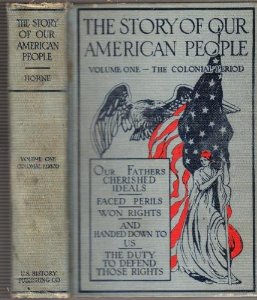
In the 1920s, for example, the American Legion sponsored a new textbook that promised to give students a patriotic yet accurate story of America’s roots.  When Charles Hoyne’s The Story of the American People appeared in 1926, conservatives lavished praise upon it.  The Klan-backed governor of Oregon, Walter M. Pierce, sent Hoyne a gushing letter.  Pierce called the volumes “the finest history of early America that we have ever had.”  Other conservatives agreed, calling the book a blessing to “the loyal and liberty-loving people of our country” and books that defended “the spirit of American patriotism.”

Unfortunately for Hoyne, for the American Legion, and for the conservatives who jumped to embrace the new textbooks, other readers had different opinions.  A Legion-appointed review committee found the books to be full of errors.  Writing in the pages of Harper’s, critic Harold Underwood Faulkner called the books “perverted American history.”

Image Source: Amazon.com

Image Source: Amazon.com

In the end, despite high hopes for schoolbooks that would finally put a positive—but accurate—spin on all things American, the Legion withdrew their support and Hoyne’s books went nowhere.

The National Association of Manufacturers had much more success producing capitalism-friendly school materials.  Starting in 1939, NAM sent educational literature and classroom posters to roughly 17,000 classroom teachers and school administrators.  Being savvy businessmen, the leaders of the NAM wanted to know if this investment was a good one.  They wanted to know if the pamphlets made people like capitalism better.  To find out, they hired pollster Henry Abt to survey the schools.  Abt reported that most of the teachers considered the NAM-produced books “primarily as an informational service; an authoritative source of economic and social data.”  From the NAM’s perspective, nothing could be better.  Students read NAM’s paeans to capitalism and took them as authoritative social science.

Perhaps the book reviewers in Texas might take a page from the lessons of the 1920s and 1930s.  If conservatives really want to see more conservative textbooks, they might have to publish them themselves.  Of course, they’d want to watch out for the Hoyne trap.  Any classroom materials must be more like the slick, glossy pamphlets and posters distributed by the National Association of Manufacturers.  Anything else will end up just an embarrassment.


College Needs Christ

What is the purpose of higher education?  Patrick Deneen argued recently that colleges lost their traditional purpose when they lost their connection to organized religion.

Deneen, the high-profile conservative professor of political thought at Notre Dame, didn’t just say this about higher education.  He argued that both health care and higher education lost their way when they became unmoored from Church control.

Both hospitals and universities, Deneen points out, had origins as charitable institutions run by the Church.  The current sense of crisis in both higher education and health care, he argues, has its roots in the fact that neither institution can function properly when cut off from its religious roots.

Deneen critiques both liberal and conservative analyses of higher education.  Many of today’s conservatives go wrong, he says, when they assume that market solutions will save colleges.  For their part, liberals pin too much faith on the ability of the state to regulate and direct higher education.

The market can’t be trusted to do the job, Deneen insists.  “The very idea,” he writes,

that doctors and teachers are or ought to act out of the motivations of self-interest, and provide services to their “consumers,” seems fundamentally contradictory to the kind of work and social role performed by each.

As for state control, Deneen thinks such leftist fantasies miss by an equally wide mark:

At the same time, the State is rightly suspected of being unable to fundamentally improve or even maintain the quality of either sphere. It is doubtless the case that it can assure access by the heavy hand of threats, but many rightly worry that, as a consequence, the quality of care and education will deteriorate as a result.

Neither side in America’s stunted liberal/conservative divide has grasped the essence of the underlying problem, Deneen says. College, like health care, must reconnect with its churchly roots.  As Professor Deneen puts it,

it seems increasingly evident that practices such as health care and education are likely to fail when wholly uninformed by their original motivation of religious charity. Neither functions especially well based on the profit-motive or guided by large-scale national welfare policies.

At their root, he writes, college and hospital must claim an authority over its students that neither a market-model nor a state-directed model can provide.  “Both spheres,” he says,

also require a concomitant shared commitment to commonweal on the part of those who benefit from the contributions of the professions. Doctors and teachers are not simply to be viewed as providing a service for pay, subject to the demands of “consumers.” Viewed through this market-based lens, the “buyers” make the demands on the providers. However, this understanding undermines the proper relationship between trustee and beneficiary—the doctor or teacher is actually in a relationship of responsible authority with the recipient, and ought rightly to make demands and even render judgments upon the one who is paying for the service. The trustee has a duty and a responsibility to enlarge the vision of the recipient—in matters of health (how certain behaviors might have led to a state of illness, in what ways the person ought to change their lives outside the doctor’s office), and formation (thus, a student should be challenged by the teacher not only to do well in the subject at hand, but to become a person of character in all spheres of life). Both the market and the State, however, increasingly regard the recipients simply as “consumers,” a view that is increasingly shared by every member and part of society.


Can Jesus Stop Kids from Trick-or-Treating in Public Schools?

Halloween time again!  Time for costumes and candy.  Time for Charlie Brown getting rocks in his sack.

Rock Candy

Rock Candy

Can public schools participate?  Does this holiday endorse some sort of religion?  And, most intriguing, are conservative Christians going to become the leading group fighting AGAINST religion in public schools?

In a recent article in Time Magazine, Nick Gillespie decries school administrators who cancel Halloween activities.  Gillespie cites the case of Inglewood Elementary, outside of Philadelphia.  The principal explained to parents that the school had canceled Halloween activities due to religious sensitivity.  “Some holidays,” the principal wrote,

like Halloween, that some see as secular, are viewed by others as having religious overtones. The district must always be mindful of the sensitivity of all the members of the community with regard to holidays and celebrations of a religious, cultural or secular nature. The United States Supreme Court has ruled that school districts may not endorse, prefer, favor, promote or advance any religious beliefs

Nertz, Gillespie responded.  “Unless there’s a particularly active group of druids in the district,” Gillespie argued, “or the parade ends with a ritual sacrifice, it seems unlikely that there’s much to worry about.”

But Gillespie’s missing the point.  The pressure to avoid Halloween comes not from druids but from conservative Christians.  Some such Christians have long viewed Halloween as a dangerously “pagan” holiday.  Why shouldn’t they pressure school administrators to ban such celebrations in public schools?  After all, conservative Christians often complain that their religion is the only religion to be banned from public schools.

Anyone familiar with the culture of conservative American Protestantism will recognize this theme.

To cite just one example, Linda Harvey of Mission: America complained that Halloween empowered demons and false gods.  “Everyone thinks Halloween is harmless fun,” Harvey warned on her radio show,

but just for a second, let’s look at from God’s perspective, at least from what He’s told us in His word. We’ve been taught not to worship or bow down to or in any way acknowledge any other gods. But Halloween is built around just exactly that. Behind the costumes and candy is a rebellious flirtation with fallen angels and deceptive spirits, and this definitely does not honor God. Where are these other spirits and gods you ask? Well, Halloween is all about fortune telling, magic, Ouija board, witches, it’s really hard to get away from all this. It’s definitely spiritual and that spirituality is not from our Lord.

This anti-Halloween sentiment is so strong among some conservative Protestants, it can be spoofed by any evangelical with a sense of humor.  Last year, for instance, the Southern Baptist Convention’s Russell Moore offered a quick field guide to anti-Halloween sentiment among evangelicals:

An evangelical is a fundamentalist whose kids dress up for Halloween.

A conservative evangelical is a fundamentalist whose kids dress up for the church’s “Fall Festival.”

A confessional evangelical is a fundamentalist whose kids dress up as Zwingli and Bucer for “Reformation Day.”

A revivalist evangelical is a fundamentalist whose kids dress up as demons and angels for the church’s Judgment House community evangelism outreach.

An Emerging Church evangelical is a fundamentalist who has no kids, but who dresses up for Halloween anyway.

A fundamentalist is a fundamentalist whose kids hand out gospel tracts to all those mentioned above.

Though Moore wrote with his tongue firmly in his cheek, the humor relies on a real sentiment among some conservative Christians.  School officials like the ones Gillespie writes about are responding to real concerns.  This time, it is conservative Protestants who are fighting to keep religion out of public schools.  As they have in other cases, such as the yoga curriculum in Encinitas, California, many conservative Christians want to keep public schools as free of what they consider false religion.


A Conservative Runs on Charter Schools

How can a Republican get votes in the Big Apple?  Mayoral candidate Joe Lhota thinks promises of charter schools will help.

In a recent advertisement analyzed in the New York Times, Lhota critiques Democratic candidate Bill de Blasio for threatening to charge rent to charter schools.  Lhota, in contrast, promises to double the number of such schools.

Why?  According to the ad, charter schools promise the best educational hope for “inner city” kids.

Charter schools also represent the first best hope for many conservative educational activists.  The free-market conservatives at the Heritage Foundation, for example, insist that expanding the number of charter schools will expand educational opportunity for all.

Lhota does not seem to support charters in order to prove his conservative credentials, however.  Just the opposite.  Charter schools, Lhota claimed, were the real “progressive education approach.”  Lhota insisted that his support for charters proved that he was the real educational progressive in this race.  “If you oppose charter schools,” Lhota told the Association for a Better New York, “and the programs and the other choices that are available for minorities and inner city children, and children of immigrants, you cannot call yourself a progressive.”

That’s educational politics for you: the more conservative mayoral candidate endorsing a school program beloved by conservatives and calling it the progressive choice.


MR or MRS Degree? Ask Jesus!

Looking for more than just an education?  For those who hope to find a life partner as part of their college experience, it seems like a Christian college might be the way to go.

In Religion News Service, Katherine Burgess reports on a recent Facebook survey.  According to those findings, of the top 25 colleges where men are likely to meet their spouse, all are Christian.  For women, sixty-four percent of the top 25 husband-finding schools are Christian.

Twelve of the schools that appear on both lists of top-25 are Christian:

  1. Faith Baptist Bible College and Theological Seminary,      Ankeny, Iowa
  2. Harding University, Searcy, Ark.
  3. Martin Luther College, New Ulm, Minn.
  4. Bob Jones University, Greenville, S.C.
  5. Brigham Young University, Provo, Utah
  6. Freed-Hardeman University, Henderson, Tenn.
  7. Maranatha Baptist Bible College, Watertown, Wis.
  8. Dordt College, Sioux Center, Iowa
  9. Baptist Bible College, Springfield, Mo.
  10. Oklahoma Christian University, Edmond, Okla.
  11. Kentucky Christian University, Grayson, Ky.
  12. Johnson University, Knoxville, Tenn.

This makes sense.

College, after all, is about much more than academics.  Where people go to school—especially when that school is strongly associated with a certain cultural identity—says a lot about who they are as people.

It also fits long-standing stereotypes about Christian schools.  As Jeff Schone, vice president for student life at Martin Luther College in New Ulm, Minnesota, told Burgess, “There’s a Lutheran boy for every Lutheran girl.”

Marlena Graves reflected on this syndrome recently in the pages of Christianity Today.  As a counselor at Cedarville University, Graves lamented the fact that so many young women seem to neglect their own personal growth in their race for a spouse.  “I can’t even count,” Graves wrote,

the number of times I’ve heard, “My mom and dad told me that if I don’t find a husband now when there are so many to choose from, then chances are slim that I’ll find one after college.”

This isn’t just true for Christians, of course.  As Charles Murray argued controversially in his recent book Coming Apart, those who attend elite schools tend to marry other people from those same elite schools.

In her Christianity Today piece, Graves quoted a letter to the Daily Princetonian by Susan Patton.  Patton gave Princeton women the same advice heard by so many young Christian collegians:

Smart women can’t (shouldn’t) marry men who aren’t at least their intellectual equal….there is a very limited population of men who are as smart or smarter than we are. And I say again — you will never again be surrounded by this concentration of men who are worthy of you.

Higher education, for many non-Christians as well as many Christians, seems to be seen as the place to find suitable life partners.  My hunch is that this trend is exaggerated at schools that attract students from self-identified subcultural or countercultural backgrounds.

This marriage tendency can help us understand the durability of cultural notions.  Why are so many Americans creationist, for instance?  It helps when creationist kids go to creationist colleges, marry other creationist kids and start creationist families of their own.


Conservatives: Flabby & Inbred

Rocky knew it.

When things get easy, people get weak.  The only way to win is to get mad, get hungry . . . get the Eye of the Tiger.

Take that, Liberal America!

Take that, Liberal America!

In a recent interview, Columbia’s Mark Lilla argues that conservatives lost their Eye.  Why?

Just like Rocky, conservatives in the 1970s and 1980s scored major successes.  Not by beating up Mr. T, in conservatives’ case, but by establishing dedicated intellectual institutions.  Those institutions could and did fund conservative research and thinking.

So what’s the problem?  According to Lilla, those plans worked only too well.  Conservatives, he argues,

created institutions that have easy sources of funding and never have to go out and argue with people who disagree with them. It’s made their world inbred, lazy, and self-satisfied. It gets harder and harder to find serious conservative books on the major issues of the day.

Following that Rocky logic, it seems the best tonic for conservative anomie would be a long winter stint out in the woods, working out with cinder blocks and being uncomfortable.


What Went Wrong with America’s Schools?

Hell in a lunchbox. 

That’s where America’s public schools have headed, according to a recent essay by the Southern Baptist Theological Seminary’s President R. Albert Mohler Jr.

President Mohler makes an historical argument for the shocking, dangerous decline in American public education.  Does his case pass historical muster?

As I’ve argued in an essay in Teachers College Record (subscription required, but summary available), this historical argument about public education has been a mainstay of conservative thinking for at least fifty years.  Different conservative intellectuals have come up with different timelines and key events to explain the demise of high-quality, morally trustworthy public education.

Mohler echoes this intellectual tradition.

He argues that public schools began as locally controlled entities.  Beginning roughly a century ago, however, “progressive” reformers attempted an ideological coup.  Such folks, led by John Dewey, openly proclaimed their intention to turn schools into secular indoctrination camps.

Luckily, Mohler believes, such plans did not accomplish much until the second half of the twentieth century.  At that point, however, most schools were “radically transformed,” separated “from their communities and families.”

The results, Mohler warns, have been sobering:

Those who set educational policy are now overwhelmingly committed to a radically naturalistic and evolutionistic worldview that sees the schools as engines of social revolution. The classrooms are being transformed rapidly into laboratories for ideological experimentation and indoctrination. The great engines for Americanization are now forces for the radicalization of everything from human sexuality to postmodern understandings of truth and the meaning of texts. Compulsory sex education, the creation of “comprehensive health clinics,” revisionist understandings of American history, Darwinian understandings of science and humanity, and a host of other ideological developments now shape the norm in the public school experience. If these developments have not come to your local school, they almost surely will soon.

Is Mohler’s diagnosis correct?  Does his historical analysis match the record?

In this historians’ opinion, Mohler is guilty of cherry-picking and over-emphasizing.  It is demonstrably true that in the early twentieth century an array of school activists and intellectuals, clustered together under the amoebic heading of educational “progressivism” did try to implement wholesale changes in the nature of American public education.  It is also true that the US Supreme Court made decisions in the 1960s that could have revolutionary implications for the religious nature of public education.  Even more, it is true that leading organizations such as the National Education Association call for school policies that might dismay stalwart conservative Protestants. 

But contrary to Dr. Mohler’s conclusions, such historical facts do not add up to a public school system that “entered a Brave New World from which no retreat now seems possible.”

Historians have examined each of these important trends in American public education.  Arthur Zilversmit, for example, looked at the implementation of “progressive” education policies in the middle of the twentieth century.  In spite of earnest, well-funded efforts to revolutionize schooling, Zilversmit found, schools remained largely the same.  Why?  Zilversmit, sympathetic to the “progressive” project, blamed Americans’ “strange, emotional attachment to traditional schooling patterns.” 

How about the claim that the Supreme Court kicked God out of the public schools?  It is true that in 1962 and 1963 SCOTUS banned school-led mandatory Bible reading and prayer.  But as political scientists Kenneth Dolbeare and Phillip Hammond found to their surprise, most communities that prayed before the SCOTUS rulings continued to pray in public schools after them.  

Similarly, political scientists Michael Berkman and Eric Plutzer have argued that local school districts continue to function as local bureaucracies.  These “Ten Thousand Democracies,” according to Berkman and Plutzer, remain responsive to local demands and local values.     

This is bad news for President Mohler’s alarmist argument, but very good news for religious conservatives in the United States.  Most of America’s public schools remain closely connected to majority impulses in their local community.  Concerning hot-button culture-war issues such as prayer, evolution, and sex ed—not to mention broader notions such as school discipline, drug use, promiscuity, and general manners—local communities still control their local public schools. 

This local influence helps explain some stubborn trends that have long frustrated progressives like me.  Why, we ask, is evolution taught only spottily?  Why can’t public-school children learn honest, practical information about sex?  Why are public schools still home to coercive prayer practices?

These are all tough questions. 

But Dr. Mohler’s jeremiad raises even tougher ones:  If American public schools are so very conservative, why do conservative intellectuals deny it so forcefully?  Why don’t America’s conservative intellectuals trumpet the continuing traditionalism of American public education?

 

War for the Core: Conservatives vs. Conservatives

Do conservatives like the new Common Core State Standards?

Yes and no.

And that tension has caused some consternation among conservative educational thinkers recently.

Writing in the Christian Post, Napp Nazworth has taken “several large international corporations” and “many Republican governors” to task for supporting the new educational standards.  At a panel discussion hosted by the Family Research Council, religious conservatives blasted GOP stalwarts such as Governors Chris Christie (NJ), Bill Haslam (TN), Rick Scott (FL), and others for “aligning their interests with those of international corporations.”

The article describes the lament of another faction of conservatives.  The Common Core Standards, conservative Glenn Jacobs worries, focus too much on “churn[ing] out young people who will be educated enough to work, consume, and pay taxes, but who are not encouraged to be creative, or to use critical thinking, or to develop anything remotely characteristic of those who possess superior minds and the ability to achieve great things.”

So what is a conservative to do?  Big-business types might embrace the promise of the new standards.  Traditionalists and religious conservatives, on the other hand, might lead the opposition.

Could inter-conservative squabbling lead to a real division in the decades-old conservative alliance?