Why School Choice?

As National School Choice Week moved into the history books, we have to ask: Is school choice a “conservative” issue?

There is no doubt that conservatives support choice.  Stalwart conservative organizations such as the Family Research Council and the Heritage Foundation make choice a centerpiece of their education policy platforms.

But the arguments conservatives usually make in favor of school choice often sound more traditionally “progressive” than anything else.  Is this mere political strategy?  Or a more profound commitment to social justice for those without economic resources?

The stereotypically “conservative” reasons for school choice are fairly simple.  First, opening up a variety of schools that receive tax dollars will enshrine the principles of free-marketism into public education.  Second, a thriving choice system will send more tax dollars to religious schools.

And we do occasionally see such arguments by conservative intellectuals.  The Friedman Foundation, for instance, legacy of free-market guru Milton Friedman, argues that choice will fix America’s public-education system.  According to Milton and Rose Friedman, that system has too often been “deprived of the benefits of competition.”

Similarly, Notre Dame’s Richard Garnett recently argued that school choice could help save struggling Catholic schools like the one that educated US Supreme Court Justice Sonia Sotomayor.

More often, however, conservative activists argue for school choice using different themes.  Most commonly, choice is presented as the best hope of low-income families in neighborhoods with sub-par public schools.  During National School Choice Week, we saw an outpouring of such rhetoric.
For instance, the Heritage Foundation publicized a speech in favor of choice by former Alabama Congressman Artur Davis.  Choice, Davis argued, could give options to a seventh-grader who submitted the following barely literate argument:

“[Y]ou can make the school gooder by getting people that will do the jod that is pay for get a football tame for the kinds mybe a baksball tamoe get a other jamtacher for the school get a lot of tacher.”

According to Davis, this student from Highland Park, Michigan was passed into eighth grade despite his struggles with basic writing.  Choice, Davis argued, could help.  It could offer parents, teachers, and students better schools now.  According to the Heritage Foundation article, Davis believed that school choice offered “the education [children] need right now, instead of simply pouring more money into the program or waiting for some new reform plan.”

Similarly, a writer at the social-conservative Family Research Council insisted that the main reason to support school choice was that “School choice gives students an opportunity to achieve a quality education and helps them not to fall through the cracks. We should all be in favor of helping children reach their fullest potential.”

Perhaps the most compelling statement of this conservative argument for the progressive virtues of school choice came over twenty years ago in an essay by Berkeley Law School’s Professor Emeritus John Coons.  As Coons argued in his 1992 essay, school choice advocates too often focus only on choice as a free-market device.  Instead, Coons insisted, such choice must be seen as “Simple Justice.”  Despite efforts to desegregate schools and make schools less imposingly Protestant, Coons wrote,

“we still arrange education so that children of the wealthy can cluster in chosen government enclaves or in private schools; the rest get whatever school goes with the residence the family can afford. This socialism for the rich we blithely call ‘public,’ though no other public service entails such financial exclusivity. Whether the library, the swimming pool, the highway, or the hospital—if it is ‘public,’ it is accessible. But admission to the government school comes only with the price of the house. If the school is in Beverly Hills or Scarsdale, the poor need not apply.

Choice is the obvious remedy for such maldistribution and discrimination.”  

Coons argued that non-elite parents deserved the right to send their children to schools that matched parents’ religious and cultural beliefs.  Such parents did not write op-eds in the New York Times.  Such parents did not have the option to influence the greater culture by making award-winning films or prize-winning books.  “Children,” Coons wrote, “are the books written by the poor.”

Yet despite such protestations among conservative intellectuals and pundits, school choice remains its reputation as a conservative issue.  As one angry commenter noted on the Family Research Council website,

“you see, school choice is really about getting as many students to pray to God each day. And, how many of these school choice advocates would have pressed for integration back in the 50’s? Very few. It’s about supporting religious schools through taxpayer dollars.”

Similarly, Americans United for Separation of Church and State has protested,

“It’s about funding religious and other private schools with taxpayer dollars and ultimately destroying the public school system.

“If you think the Heritage Foundation, the Koch Brothers and Betsy DeVos are in this just to help to some poor kid in the inner city, they’ve got a privatized bridge in Brooklyn they want to sell you.”

We ask again: Why school choice?  Do conservatives support school choice because choice will crush teachers’ unions?  Because choice will promote a freer free market?  Because choice will get more students praying in schools?

Or do conservatives support choice in order to help more children faster?  Because choice offers a way to deliver better education to low-income students?

My hunch is that, for many conservatives, the best answer is all of the above.  No doubt many conservatives want freer markets and a more Christian public square.  And school choice promises to deliver those things.  But choice might also be attractive because it gives better schools to more people faster than any other measure. 

Fundamentalist Homeschoolers Seize Control of American Pop Music!

I am happy to say I don’t know anything about the Jonas Brothers.

I survive the shame of my ignorance by putting them in a mental category along with Hannah Montana, Barney, and all other noxious pop culture targeted at America’s youth.  As far as I am concerned, these are things I do not need to know about.

So imagine my surprise to learn that this pop group has become a leading advocate of school choice.  Imagine my surprise to learn that this leading pop group learned about the world and everything in it from their conservative evangelical Protestant homeschool curriculum.  It appears the Jonas Brothers have been educated with the Accelerated Christian Education curriculum, one of the most ferociously conservative Protestant curriculum choices available.

But let’s start at the beginning.

This morning, I came across a story from the libertarian Reason TV.  The Jonas Brothers headlined a National School Choice Week kickoff event.

Curious as to why such a high-profile pop band would sign up for an event so popular among conservatives, I looked into the Jonas Brothers.  As usual, everyone but me seemed to be already aware of the Jonas Brothers’ deep commitment to conservative evangelical religion.  Slack-jawed comedian Russell Brand, for instance, earned some opprobrium for mocking the Brothers’ virginity pledges.

When I checked out a “Day in the Life of the Jonas Brothers” video, I was surprised to see (check out the video at 3:58) that the homeschool curriculum they used was from Accelerated Christian Education.

Image Source: Accelerated Christian Education

Image Source: Accelerated Christian Education

As I argued a couple years ago in the pages of History of Education Quarterly, among Christian fundamentalist school publishers, ACE stands out for its rigid traditionalism and strict sectarian notions in every subject, from creationism to the religious meanings of the US Constitution.

I have no beef with conservative religious families who choose to use ACE materials to teach their children.

But I am surprised to find that young people educated with such materials have had such a meteoric rise to the peaks of pop culture.  After all, one common theme among conservative educational activists is that American pop culture peddles filth and trash.  Long before the Beatles, long before Elvis, conservatives worried about the sex and loose morals associated with such pop singers as Jimmie Rodgers.

Yet with the Jonas Brothers, we find a group doing very well in the choppy seas of pop music.  As far as I am aware, the Jonas Brothers did not come to fame as a particularly “Christian” music group, but rather as a particularly saccharine tween-idol music group.

Is it fair to say that conservative worries about the anti-Christian nature of American pop culture are overstated?  Or are groups like the Jonas Brothers simply exceptions that prove the rule?

Revisionaries on PBS

The Revisionaries is coming next week to PBS.

In conjunction with Binghamton University’s Evolutionary Studies Program, we screened the film not too long ago.  At our screening we had a spirited discussion about the nature of science and the politics of education.  Now folks beyond the major metropolitan areas of New York, LA, and Binghamton will have a chance to see it.

Why would you want to, you ask?

For anyone interested in the teaching of American history, evolution/creation, the nature of American conservatism, or even just the functioning of educational and cultural politics, this film is a must-see.  Director Scott Thurman followed the goings-on at the Texas textbook review hearings of 2009-2010.  He spent time with conservative leaders such as Don McLeroy and Cynthia Dunbar.  Thurman gave each of them a chance to explain their educational ideology.  The film shows the campaign for non-evolution to be included in science classes.  Viewers can watch the fight to change the standards for social studies, to include more Reagan and less hip-hop.

According to the National Center for Science Education website, The Revisionaries will be shown as part of PBS’ Independent Lens series, during the week of January 28, 2013.  Check your local listings!

The Trauma of Evolution

Can we educate by banning ideas?  For one group of conservative Christian homeschoolers, proper education means banishing lots of ideas.  How can progressive educators like me understand this impulse to put up intellectual walls around young people’s minds?  I wonder if some creationists view exposure to evolutionary ideas as a form of trauma, an entirely harmful experience.

The Finish Well homeschooling conference, in the words of its organizers, “is designed to equip homeschooling families to confidently homeschool the high school years for the glory of God!”

One of the ways the conference promises to help attendees is by purging the atmosphere of any hint of evolution.  In order to secure a table at the conference, vendors are required to agree to the following statements:

“1) Scripture teaches a literal 6 day creation week, a young earth of approximately 6,000 years, and a literal understanding of Adam and Eve, the Fall, and the world-wide Flood of Noah’s day. 2) The Bible is the verbally inspired Word of God. It is inerrant and our ultimate authority in what we believe and how we live. Any speakers who contradict these two truths during their speaking session will be immediately asked to leave.”

Clearly, the goal of Finish Well is not only to keep out evolution.  Any other explanation about humanity’s origins will be verboten as well, including the evolutionary creationism of folks such as Darrel Falk or the big-tent creationism of the intelligent-design movement.

This notion of proper education is one of the hardest intellectual nuts for progressive educators like me to crack.  How are we to understand this idea that good education means hiding important ideas away from young people?  My first reaction, my gut reaction, is that this is precisely the sort of totalitarian impulse that kills any real education.  This sort of intellectual protectionism smacks of Nazi Germany or Stalinist Russia.  To me, and to lots of people, one of the first rules of true liberal education means opening intellectual doors, not bricking them up.  Real education, in my opinion, means allowing young people to explore a variety of ideas, to make up their own minds.

But in the conservative tradition, an important aspect of improving education has long consisted of the effort to remove “dangerous” ideas from the educational mix.  For generations, various types of conservative activists have insisted that simple exposure to certain ideas represented a danger—something from which young people had to be protected.

This idea played a big part in the first “creationist” controversies in the 1920s, as I explored in my 1920s book.  One of the public leaders of the anti-evolution movement of that decade was populist politician and former US Secretary of State William Jennings Bryan.  Bryan condemned the notion that good education meant a willy-nilly exposure to perfidious ideas.  In a battle with the University of Wisconsin over the teaching of evolution on campus, Bryan offered this sarcastic advertisement for the college:

“Our class rooms furnish an arena in which a brutish doctrine tears to pieces the religious faith of young men and young women; parents of the children are cordially invited to witness the spectacle.”  [SOURCE: William Jennings Bryan, “The Modern Arena,” The Commoner (June, 1921): 3.]

For my current book, I’m exploring the longer history of conservative educational activism.  This notion of proper-education-as-protection echoed throughout the twentieth century.  For instance, Grace Brosseau, President General of the Daughters of the American Revolution, argued that young children ought not be harmed by “the decrepit theory that both sides of the question should be presented to permit the forming of unbiased opinions.”  Such modern theories of education, Brosseau insisted, fundamentally misunderstood the nature of childhood and the responsibilities of education.  As she explained in 1929,

“One does not place before a delicate child a cup of strong black coffee and a glass of milk; or a big cigar and a stick of barley candy; or a narcotic and an orange, and in the name of progress and freedom insist that both must be tested in order that the child be given the right of choice.”

Instead, parents and teachers must give students only what students need to develop the “delicate and impressionable fabric of the mind.” [SOURCE: “The 38th Continental Congress, N.S.D.A.R.,” DAR Magazine 63 (May 1929): 261-271.]

More recently, the late Mel and Norma Gabler echoed this notion that proper education meant protecting young people from dangerous ideas.  In their 1985 book What Are They Teaching Our Children, the Gablers compared modern teaching to letting young children float in dangerous seas in flimsy lifeboats.  Modern teachers, the Gablers argued, too often allowed children to drift near sharp reefs and crashing waves, without offering any sort of guidance.  The teachers knew the rocks were there, the Gablers argued, yet these ‘progressive’ teachers did not see fit to warn the students.  Better for the students to ‘discover’ such dangers for themselves.  The Gablers asked, “Has the instructor gone mad?” (pg. 99).

For the Gablers, as for Bryan, Brosseau, and the organizers of the Finish Well conference, the notion that some ideas must be hidden from children made perfect sense.  For those like me who don’t agree, perhaps one key to understanding might come from the school controversies of the 1920s.  During that decade, many state lawmakers proposed bills that promised to keep certain ideas out of children’s paths.  One 1927 bill in Florida would have banned “any theory that denies the existence of God, that denies the divine creation of man, or that teaches atheism or infidelity, or that contains vulgar, obscene, or indecent matter” [Florida House Bill 87, 1927].

To the authors of this bill, evolution and atheism could be treated the same way as “obscene” material.  To those 1920s legislators, it made sense to keep obscene materials out of the hands of school children.

I agree that young people ought not be exposed to “obscene” materials.  And maybe this is the way for folks like me to understand the conservative impulse to keep some ideas out of schools.  After all, all of us—not just conservatives or fundamentalists—agree that some things must be kept from children.  No one wants young people to view a lot of hard-core porn at school, for instance.  Nor do we think that children should see graphic violence.  Exposure to such things seems traumatic.

Is this the key to understanding the conservative insistence on keeping certain ideas out?  For some young-earth creationists, mere exposure to evolutionary ideas represents a danger to their young children.  It might be that such conservatives view exposure to evolutionary ideas as an intellectual trauma, a theological trauma.  Such ideas might be ‘out there’ in the world, just like genocide, rape, and lynching might be ‘out there,’ but that does not imply that education must include graphic exposure to them.

Is this the way to understand Finish Well’s prohibition of any hint of evolution?  I’d love to hear from those who believe that young people should be protected from such ideas.

Glenn Beck’s Educational Utopia

“A place of real learning.”

What will life be like when Glenn Beck is finally made Emperor of the Universe?  More interesting for ILYBYGTH, what will education be like?

Beck recently outlined his vision of paradise.  As usual with Beck, the plan is short on details but expansive in its claims.  In short, it seems Glenn Beck’s perfect educational system would have three important components:

1.) apprenticeships;

2.) homeschooling;

3.) intellectual inoculation.

Image source: The Blaze

Image source: The Blaze

Beck described his vision of utopia in his plans for a new theme park, Independence, USA.  Like Walt Disney’s early visions, Beck wants a new kind of park, one that embodies Beck’s vision of proper American culture and society.

Parts of that vision include a radical de-schooling.  As Beck promoted it, this park would include a chance for students to learn by doing.  He asks (video 1—3:25),

“Does everybody have to go to an Ivy League university?  Or can we teach craft, can we teach business, can we teach things?  Are there people willing to teach through apprenticeships? . . . If it’s not possible, then America’s golden streets are dead.”

More profoundly, Beck insists, “Schools are a thing of the past the way we’ve designed them.”  For those who would live inside the boundaries of Beck’s Potemkin, children would learn in “neighborhood” clusters.  Children would be freed from the artificial constraints of institutional education, freed to learn by downloading content directly from the archives in Independence USA.

For those who insist on attending traditional schools, maybe even Ivy League colleges, Beck promises a handy inoculant.  Families should bring their college-age children to Independence for a week of authentic education.  Young people as well as old could receive a thorough training in Beck’s vision of American history and culture.  Such a week, Beck insists, will protect young people exposed to the lies and distortions in mainstream higher education.  Working with David Barton, Beck will teach young people, presumably, that the United States was created as an explicitly Christian nation, and that such Christian principles ought to remain at the center of American public life.  As Beck puts it (video 2—9:11),

“Before you send your kids to college, you come with us.  And you come here.  You spend a week.  You have a kid that’s going into college, you spend a week with us.  We’re going to tell them exactly, we will show them the truth, we will tell that what they’re going to try to do.  And we will deprogram them.  Every summer if you care.”

One is tempted to ask if any of this makes sense, as several commenters have done (see here and here for examples).  In this video, he offers only the vaguest sketches of his utopia, several aspects of which sound at best contradictory and at worst totalitarian.  More intriguing is the combination Beck demonstrates of a fairly radical anti-institutionalism with a keen, combative patriotism.  Beck combines an aggressive distrust of some of the central institutions of American life with an in-your-face defense of the American way of life.  Schools and colleges can’t be trusted, Beck insists, yet American traditions and culture are the strongest in the history of the world.  Young people need to be freed and protected from mainstream education, yet the theme-park plans—if they are to succeed at all—must appeal to large numbers of presumably mainstream folk.

For students of conservative education thinking in the United States, Beck’s paradoxes offer a unique window into the complex attitudes toward education among many American conservatives.  Beck, of course, is enough of an odd duck that his nostrums must not be taken as representative.  Yet he is popular enough that we can assume his fantasies resonate with at least a large number of his followers.

School, in this vision, has become something intellectually dangerous.  Young people, at the very least, need an intense counter-training, an intellectual inoculation against the false notions peddled in colleges.  If possible, in this plan, children should be freed from the outmoded walls of brick-and-mortar schools entirely.  Such institutions, Beck implies, have outlasted their usefulness.  Schools, Beck argues, have become the problem, not the solution.  Yet unlike the unschoolers of the cultural left, such as Ivan Illich, Paul Goodman, or John Holt, Beck’s deschooling promises a return to his vision of authentic American values of hard work, thrift, patriotism and religion.

Progressive Education Hurts Poor Kids: E.D. Hirsch’s “Wealth of Words”

Progressive Education hurts poor kids.  For those familiar with E.D. Hirsch’s work over the past twenty-five years, that argument won’t sound new.

In a recent piece in the conservative Manhattan Institute’s City Journal, Professor Hirsch lays out his case for why progressive attitudes and policy toward vocabulary education inflicts the most damage on those it claims to help: students from families with fewer resources.

Hirsch, a literary critic and scholar, first came to fame with his 1987 book Cultural Literacy.  The book and Hirsch shared a public career somewhat similar to Allan Bloom and his Closing of the American Mind.  Though both authors identified as politically and culturally liberal, their books became favorites of cultural conservatives.  Like Bloom, Hirsch claimed that American education had “progressed” in woefully misguided directions.

In brief, Hirsch argued that every American ought to master a certain core of cultural knowledge.  Critics charged Hirsch of elitism and even bigotry.  Insisting on an exclusive body of important cultural knowledge, critics insisted, blocked out too many vital cultural voices, voices that had not made the canon but that represented authentic elements of the real American experience.

In Hirsch’s new essay, “A Wealth of Words,” he argues that the best way to improve life chances for all Americans is to insist on a rigorous and systematic curriculum of vocabulary improvement.  In a nutshell, here is the argument:

1.) College degrees represent the best single path to economic well-being.

2.) The verbal section of the SAT college-entrance exam is largely a vocabulary test.

3.) Therefore, to bring people out of poverty, we need to improve vocabulary education.

Most interesting to ILYBYGTH readers will be Hirsch’s idiosyncratic combination of an attack on “progressive education” with a progressive-sounding prescription for improved schooling.

Like nearly every conservative educational activist of the past fifty years, Hirsch takes progressive education to task for dumbing-down American education.  As I’ve argued in an essay in Teachers College Record, a variety of leading conservative educational activists—with very different ideas about education—all agreed that America’s educational system had been hijacked by progressivism.

In Hirsch’s telling, this progressive coup took place roughly one hundred years ago.  This “well-meant but inadequate” progressivism, according to Hirsch, included the following poison pills:

“optimism about children’s natural development, a belief in the unimportance of factual knowledge and book learning, and a corresponding belief in the importance of training the mind through hands-on practical experience.” 

Once these “progressive educational theories” took over school publishing and teaching, vocabulary education suffered bitterly, Hirsch argues.  In response, Hirsch calls for “an intellectual revolution . . . to undo the vast anti-intellectual revolution that took place in the 1930s.”  Most important, Hirsch believes, is the need to overcome the notion that schools should not teach factual knowledge.  For a century, the “progressive” notion that school should teach students how to learn, instead of mere facts, has come to dominate education policy.  That, Hirsch believes, is a terrible mistake.

For those familiar with the twentieth-century development of conservative educational activism, it is easy to see how Hirsch could have become a favorite of conservatives.  Educational conservatism has largely centered itself on the notion that schools must remain true to their traditional purpose; schools must dedicate themselves to transmitting knowledge from one generation to the next.

However, a closer read of Hirsch’s prescriptions might give some conservatives pause.  True enough, Hirsch calls for a renewed focus on teaching children a rich vocabulary.  He insists that an emphasis on “literacy” rather than good “literature” hurts the life chances of those students who need schooling the most.

But Hirsch also calls for a profound investment in government-run and tax-funded preschooling.  He cites French studies of intensive instruction for students as young as two.  Such intense schooling, Hirsch claims, will allow students from lower-income homes to match the educational opportunities of those from more affluent ones.  Furthermore, Hirsch dismisses the notion that improved vocabulary instruction will come from more time spent with word drill.  Instead, Hirsch advocates “domain immersion,” in which students learn vocabulary as part of an immersion in interesting and important reading.

Thus, in his goal and his method, Hirsch still sounds provocatively “progressive.”  Yet even in his outlet, the conservative City Journal, we can see that Hirsch still finds his most eager audience among conservatives.  In the end, this might come as no surprise.  No critic of progressivism is more appealing than one who comes from the progressive camp itself.  In education as anywhere, a whistle-blower can claim a certain credibility others cannot.

In his recent essay, Hirsch continues his long career as progressive education’s leading whistle-blower.  The best way, Hirsch insists, to determine whether any education policy will help poor kids is simple.  We do not need elaborate justifications of “pedagogies of the oppressed” or “dreamkeeping” teaching strategies.  All we need do, Hirsch argues, is ask one simple question: “Is this policy likely to expand the vocabularies of 12th-graders?”

Plumbers and Teachers

What is a teacher? A hired hand?  Or an independent scholar?  A functionary enrolled to help parents?  Or a professional charged to form young minds as she or he best sees fit?

Students of conservative educational activism like me often list the same litany of complaints made by conservatives about public schooling in the past century.  Schools, conservatives often complain, must not warp their students’ minds.  Schools should teach patriotism.  Schools should teach respect for religious values and traditional notions of right and wrong.  Some conservatives believe schools must not teach atheism and call it science.

But there remains one hugely important conservative issue that rarely gets the same amount of attention: conservative concern with the overweening authority of teachers and educational experts.

As part of his recent series on education at Front Porch Republic, Anthony Esolen articulates this traditional conservative frustration.

Esolen frames the question in a provocative fashion: What if teachers were plumbers?

Here is one of Esolen’s scenarios:

“Jones pokes his head into the basement. He hasn’t done that in two years. He’s told himself again and again that they must know what they are doing, they are the experts and he isn’t, they are from the government, and he must mind his own business. But the devil gets into him.

“‘What is that?’

“‘What is what?’

“‘That – that tangle of pipes! Why so many? It’s a maze! It takes up half the room. In some places you can’t stand up straight. It’s like what happens to a hundred foot extension cord. The whole contraption is in knots!’

“‘I fail to see what you are so concerned about. Presumably you wanted us to do your plumbing. Well, so we have. We’ve done a great deal more than you expected.’

“‘But it’s leaking all over the place! Why didn’t you just do the simple but necessary thing? Why didn’t you do what I hired you to do?’

“‘Hired, Mr. Jones?’”

In the research for my current book about twentieth-century conservative educational activism, I’ve seen this argument repeated with a variety of emphases.  For generations, conservative activists have argued that schools and teachers have taken too much authority over children.

For instance, during the 1920s school controversies, William Jennings Bryan famously argued, “The hand that writes the paycheck rules the school.”

A generation later, in 1951, Ernest Brower, a conservative leader from Pasadena, California, complained to a state senate investigating committee that “progressive” education had seized too much control.  In their citizen investigation, Brower reported,

 “Well, you might liken public education, in Pasadena at least, and I think probably in other sections of the country as well, to a patient who is very sick, and so, naturally, the proper thing is to start looking for symptoms, and we found several symptoms of the disease. . . . we noticed there was a definite elimination of parental authority, undermining of parental influence.”

For Brower, as for Bryan and Esolen, this undermining of parental influence signaled the underlying “disease,” of which other educational problems were merely symptoms.

In 1968, conservative California school superintendent Max Rafferty agreed.  “Children,” Rafferty warned,

“do not belong to the state.  They do not belong to us educators, either.  They belong to their parents and to nobody else.  And don’t you forget it.

“Because if you do forget it and let the kids become wards of an all-powerful government, you won’t have to look forward with fear and trembling any more to that dread year 1984.  It will be here, considerably ahead of schedule.”

In 1980, free-market economist Milton Friedman lent his considerable influence to this central conservative notion.  “Parents,” Friedman wrote,

“generally have both greater interest in their children’s schooling and more intimate knowledge of their capacities and needs than anyone else.  Social reformers, and educational reformers in particular, often self-righteously take for granted that parents, especially those who are poor and have little education themselves, have little interest in their children’s education and no competence to choose for them.  That is a gratuitous insult.”

We could multiply examples of this sentiment almost endlessly.  From the early years of the Heritage Foundation’s work, Connie Marshner insisted,

“A parent’s right to decide the direction of his child’s life is a sovereign right, as long as the child is subject to his parent.  Educators have no business creating dissatisfaction with and rebellion against parental wishes.”

Similarly, Texas school watchdog Norma Gabler echoed this sentiment in the 1980s,

“Number one, my sons belong to my husband and I.  They do not belong to you and the state—yet.”   

For all these leading conservative intellectuals and activists, one foundation of schooling is that it is a service provided for families by educators.  It has long been a source of intense frustration that progressive educators presume glibly to arrogate total control over children’s lives.

As Professor Esolen reflected in his recent essay series, this arrogance is all the more exasperating when it seems utterly unaware of its own ridiculousness.  We would not accept the fact that a plumber would ignore our wishes and have his way with our pipes.  Why, Esolen asks—echoing generations of conservative intellectuals—why do we accept this brazen arrogance from teachers?

R.R. Reno on the Future of Conservatism

This month’s Commentary Magazine includes a forum about the future of conservatism.  Fifty-two prominent conservatives opine on the best path forward for American conservatism in the wake of President Obama’s reelection.  As editor Elliott Abrams notes in his introduction, that future might not always seem bright.  “Some conservatives,” Abrams argues, “seem almost to frolic in their pessimism.”

In his short offering, R.R. Reno, editor of the conservative journal First Things, argues that conservatism must avoid a single-minded focus on free-marketism.  More important, Reno believes, will be a focus on moral values.  Since the 1960s, Reno writes, America’s “cultural revolution” has undermined its traditional values.  These days, according to Reno, “Round-the-clock irony and cynicism make old-fashioned values like working hard, paying your debts, and keeping your word seem, well, old-fashioned and even foolish.”

The solution, in Reno’s vision, is a conservatism that focuses on morals and culture.  Reno insists,

“Unless we reinforce and support clear norms for adulthood–marriage, family, work, community involvement, patriotic loyalty–then the disoriented middle of the middle, no matter how economically self-sufficient, will become increasingly dependent on bureaucratic and therapeutic support and guidance, which means more government.”

What does all this have to do with schooling and education?  Everything.  Though Reno does not make this connection explicitly, his call for a renewed morality serves as a pithy articulation of the educational ideology of many American conservatives since at least the 1920s.  After all, if conservatives hope to “reinforce and support clear norms for adulthood,” as Reno hopes, one obvious way to do this will be—has always been—to insist on clear moral standards in American schools.

From the Archives: Bobby Squirrel, Billy James Hargis, and the Counter-Subversive Imagination

Quick: What’s the most anti-communist animal?  The ass-kicking bald eagle?  The industrious ant?

Fifty years ago, prominent Mississippi conservative leader Edna Whitfield Alexander lamented the subversive communist takeover of another likely forest-dwelling Cold Warrior: the nut-hoarding squirrel.

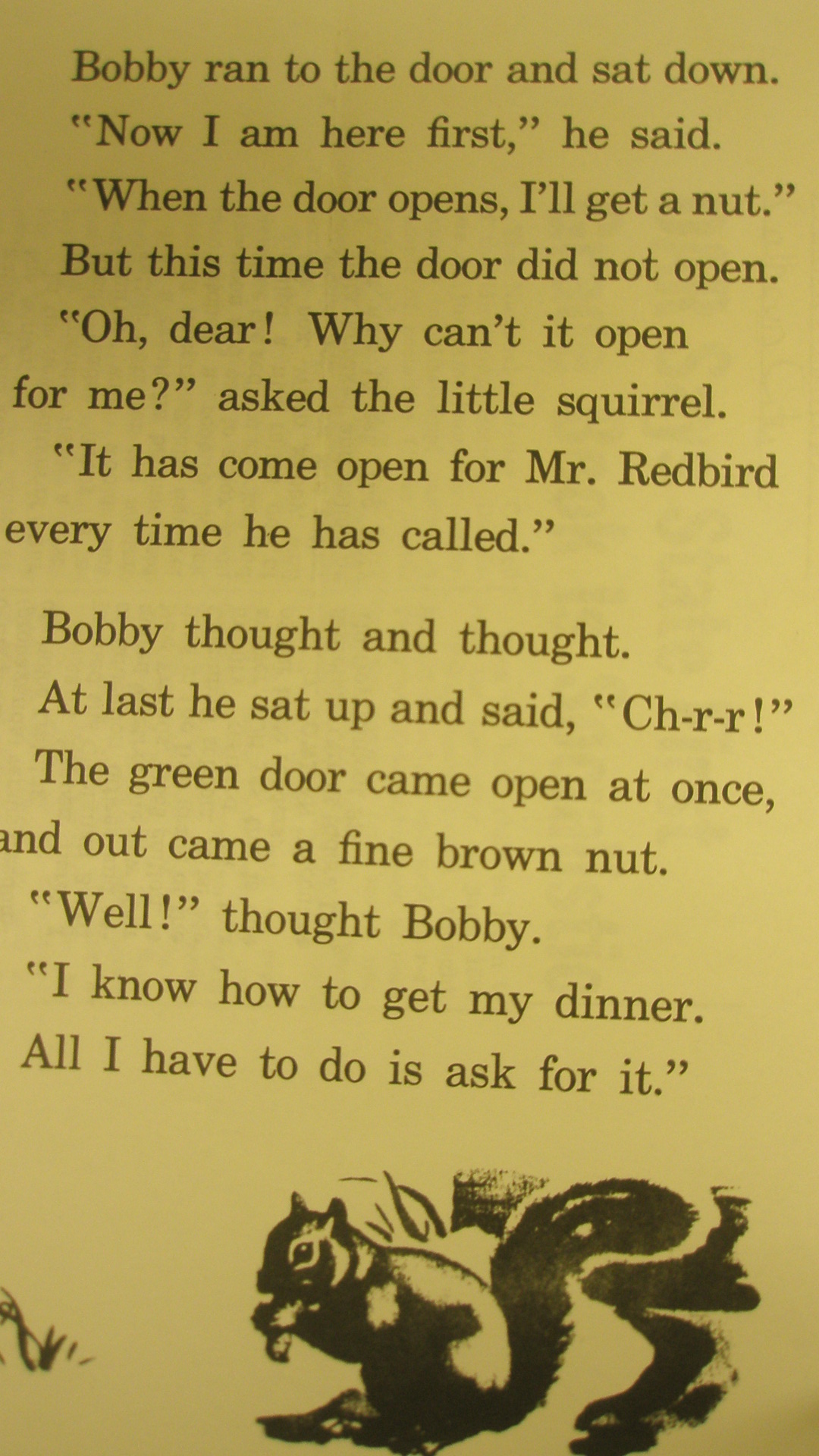
At the time, Alexander chaired the Mississippi Daughters of the American Revolution’s Committee on National Defense.  She complained that a story in one of Mississippi’s first-grade textbooks subverted the naturally capitalistic image of the squirrel.  In “Ask for It,” Alexander charged, “socialistic” authors used a tale of Bobby Squirrel insidiously to undermine the idea of hard work and thrift among Mississippi’s impressionable young school children.

In a pitch-perfect example of what historian Ellen Schrecker has called the “counter-subversive imagination,” Alexander blasted the textbook The New Our New Friends.  Among the seemingly innocuous just-so stories, Alexander sniffed out the “socialistic” message this book included about Bobby Squirrel.

OLYMPUS DIGITAL CAMERA

From “Ask for It,” The New Our New Friends, by William S. Gray, Marion Monroe, A. Sterl Artley, and May Hill Arbuthnot, (Chicago: Scott, Foresman and Co., 1956). Adopted as a school textbook by the State of Mississippi, 1963.

As Alexander asked in the pages of the Monitor Herald (Calhoun City, MS), January 3, 1963, “Have you ever heard or read about a more subtle way of undermining the American system of work and profit and replacing it with a collective welfare system?”

From a twenty-first-century perspective, it is difficult to remember the prominent role anti-communism played in American conservatism throughout much of the twentieth century.  As historian George Nash has argued, anti-communism often served as the intellectual glue that held together a disparate conservative movement, linking free-market activists with libertarians, Catholic intellectuals, and Protestant social traditionalists.

I came across this story in the Billy James Hargis Papers at the University of Arkansas in Fayetteville.  All historians interested in the history of conservatism in twentieth-century American education, religion, and culture should make this one of their first destinations.  Not only did the Reverend Hargis keep his own voluminous collection of small magazines, newsletters, and ephemera from various conservative evangelical and fundamentalist Protestant and anti-communist sources, but he also apparently bought up other collections, such as Allen Zoll’s.  As a result, the Hargis Papers in Fayetteville provide a one-stop reading shop for a vast collection of rare archival gems.

Unfortunately, Hargis did not keep much personal material.  It is not easy to get a sense of Hargis’ own thinking.  But the many boxes of newsletters and clippings include a wide array of pieces like Mrs. Alexander’s attempt to purge Mississippi schoolbooks of creeping, hopping Squirrel socialism.

Persecution and the Conservative Academic

Do conservative academics suffer persecution?

NYU professor of history and education Jonathan Zimmerman recently called for affirmative action for conservative college professors, even though, Zimmerman insisted, such professors hadn’t suffered from historic discrimination.

That hit a nerve.

Writing in the higher-education blog Minding the Campus, a publication of the conservative Manhattan Institute, Ronald Radosh called foul.

Radosh took exception to Zimmerman’s insistence that liberal professors like himself were not the “wild-eyed Marxists” many conservative pundits had accused them of being.

Radosh disagreed.  “NYU,” Radosh wrote, “is most egregiously guilty of precisely such a bias. Their own history department is dominated by precisely those types, and some of the institutes and centers they have established have gone out of their way to make that crystal clear.”

Radosh complained that his career had suffered for purely political reasons.  At George Washington University, for instance, Radosh claimed that he had been subjected to questions mainly “about my politics, and not about my approach to history or how it should be taught.”  At another school, Radosh said he was buffeted in a job interview with a series of “hostile questions” about his views on Cold-War spies Ethel and Julius Rosenberg.

In the end, Radosh concluded that most history professors discriminate actively and self-consciously against conservative academics.  As Radosh wrote,

“The reason such professors will not hire conservatives is precisely because they do not want ‘other right-leading students’ to ‘follow them, into the academic profession,’ as Prof. Zimmerman hopes they will once conservative professors are hired. Does he really think people like Marilyn Young and Linda Gordon at NYU want anyone to challenge the ideological hegemony they now hold over molding students’ minds?”

Other sorts of conservative academics have long claimed to suffer from similar persecution.

The case of Teresa Wagner, for instance, still bubbles along.  Wagner had applied for jobs at the University of Iowa’s law school.  She was one of five finalists, but was passed over for the most desirable tenure-track job.  Was it due to prejudice against Wagner’s loud-and-proud conservative activism?  Wagner had made no secret of her pro-life and traditional-marriage stances.

One unique element of Wagner’s case was the existence of a smoking gun.  Unlike most hiring-discrimination cases, Wagner was able to produce a document that seemed to make her case.  Associate Dean John Carlson had written in an internal email, “Frankly, one thing that worries me is that some people may be opposed to Teresa serving in any role in part at least because they so despise her politics (and especially her activism about it). I hate to think that is the case, and I don’t actually think that, but I’m worried that I may be missing something.”

That email made Wagner’s case complicated.  A group of jurors agreed that Wagner had been treated unfairly.

These conservative claims of academic persecution are nothing new.

Creationist Jerry Bergman collected cases of such discrimination in his 1984 book The Criterion.  Bergman, who claimed to have been denied tenure at Bowling Green State University in the early 1980s due to his creationist beliefs, described the stories of academics such as Clifford Burdick.  Burdick was allegedly refused his PhD at the University of Arizona in 1960 for including a consideration of divine creation as an explanation for discrepancies in the fossil record.  Bergman argued that such attitudes had no place in a university setting.  Firing a creationist for speaking to students about his or her beliefs, Bergman argued, would be like “if a black were fired on the suspicion that he had ‘talked to students about being black,’ or a woman being fired for having ‘talked to students about women’s issues.’”

Even further back, anti-evolution leader T. T. Martin complained in 1923 that the universities had been taken over.  “We sent our young men to the great German universities,” Martin lamented, “and, when they came back, saturated with Evolution, we made them Presidents and head-professors of our colleges and great universities.”

Of course, the academic politics of evolution are much different than the politics of communism, which are different from the politics of abortion.  I think it is safe to say that a mainstream school will be more open about its discrimination against a creationist than against a neo-conservative anti-communist or a traditional-marriage supporting legal scholar.

However, Professor Zimmerman’s claim that conservatives have not been the subject of historic discrimination still rankles among conservative academics of various backgrounds.  One of the most closely treasured beliefs among conservative intellectuals, after all, is that American universities have been largely captured by a totalitarian and essentially anti-liberal left.