A Trip to a Catholic-School Science Fair

Science Fairs are great.  At their best, they allow students some freedom to experiment and learn on their own.  At their worst, they still provide hilarious examples of wacky adolescent science.  Recently, we saw a field report from the National Center for Science Education blog.  Peter Hess asked the question: What passes for “science” at a Catholic science fair?

In these pages, we’ve eagerly read reports from the field as science mavens visit various sorts of science fairs.  P.Z. Myers has argued that creationist students actively use science fairs to subvert the mind-numbing mental boundaries imposed by creationism.  Greg Laden visited a creationist homeschool science fair and found that some of the science was not bad.  At least not much worse, Laden thought, than the crappy science on display at non-creationist science fairs.

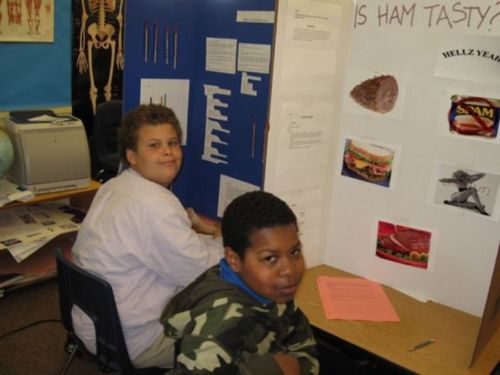
Cutting-edge science from a non-religious science fair...

Cutting-edge science from a non-religious science fair…

Hess found to his great relief that his kids’ Catholic school promoted mainstream science, without adulteration from theology.  Students came up with ambitious projects, such as measuring the distraction levels posed by cell phones and texting.

How distracted are drivers? This kid was not looking to the Bible for answers...

How distracted are drivers? This kid was not looking to the Bible for answers…

Hess also talked with some of the teachers.  Those teachers, too, did not see any conflict between Catholicism and teaching mainstream science in their classes.  One teacher offered an opinion that echoed the view of the late Stephen Jay Gould.  As middle-school teacher Joseph Nagel told Hess,

I sometimes consider science to be the constant investigation of the external world, a quest to analyze and understand the physical world, exclusive of human experience.  Religion I see as the eternal internal investigation, a search to explore and understand what lies within and between us, an examination of the human experience.  If science is our understanding of the world, religion is our understanding of us.  Maybe science is the ‘how’ and religion is the ‘why.’

Of course, different Catholic schools might have different approaches.  But my experience matches up closely with that of Hess.  I taught for a decade in Catholic schools in Milwaukee.  Though we sometimes had arguments about the novels we’d teach or the theology we’d teach, there was never any glimmer of controversy over the science we’d teach.

In fact, at least one of our science teachers also taught biology (or was it chemistry?) at a local public, secular community college.  When I asked him if he taught science differently at our Catholic school, he responded just as did the teachers Hess talked to: “Why would I?”


Zombie Science on Noah’s Ark

Smart people don’t say it’s not science.  Some call creation science “dead science.”  But anyone with eyes to see and ears to hear can see the bustling activity in the world of creation science.  A recent blog post from Answers In Genesis offered an introduction to what creation science can look like.  If it’s not dead, but not quite alive in the normal sense, maybe the best term for this sort of research is “undead science” or “zombie science.”

Alternative Science in Action

Alternative Science in Action

As those of us who follow the creation/evolution debates are well aware, Answers In Genesis is planning a big new museum project.  They want to build a replica of Noah’s Ark to prove its practicality.  Indeed, this ark project has attracted a sub-controversy of its own, with secularists complaining about public tax benefits going toward this explicitly sectarian religious project.

In a recent blog post, AIG explained some of the scientific challenges of their Ark project.  AIG demonstrated some of the unique features of the sort of creation science practiced by AIG scientists. As the post explained, one of the challenges of designing a replica Ark is figuring out how many animals would be on board.  Most believers in a literal world-wide flood do not insist that Noah’s Ark contained two of every species we have today.  Rather, they say that the Ark contained two of every “created kind,” as described in Genesis.  That is, the Ark did not have two wolves, two dingoes, two foxes, two dogs, etc.  Instead, the Ark had two of the “kind” of canine.

The term AIG scientists use to describe these “created kinds” is “baramin.”  In the recent blog post, AIG uses the example of the mule deer to show how scientists can figure out what kind of created kinds were on the Ark.  Creation scientists hypothesize that fossils from the baramin must be in a certain fossil layer, since those fossils were predictably laid down at a certain point in the Genesis flood.  In this case, the most likely fossil deposits, according to AIG, were from “moschids buried in rock layers deposited by localized catastrophes just after Flood.”  Those samples allow creation scientists to figure out what the baramin on the ark would likely have looked like.

Is this science?  It’s tempting for those of us outside the circle of creationism to pooh-pooh this sort of thing as outlandish non-science.

But more thoughtful non-creationists have offered more subtle explanations.  Philosopher Philip Kitcher, for example, argued that we should understand this not as non-science, but as “dead science.”  This sort of thinking, Kitcher said, had a long and influential career as mainstream science.  However, it has been replaced by better science.

Historian George Marsden also offered an explanation of this sort of scientific thinking.  Marsden argued that early creationists worked in a Baconian framework.  Science, according to this way of thinking, must begin with an authority.  From that firm starting point, scientists can collect and classify information.  This is not non-science, but rather a certain form of dissenting science.

Throughout the twentieth-century history of creationism, creationists themselves have insisted on the scientific legitimacy of their projects.  The leading creation scientist of the 1920s, George McCready Price, repeatedly argued that non-creationists were behind the times.  As Price told an audience in London just a few months after the 1925 Scopes trial,

I am perfectly confident that any competent person who will take the time to traverse the evidence now available on this side will reach the same conclusion that I have reached—namely. That the theory of Organic Evolution was a very plausible theory for the times of comparative ignorance of the real facts of heredity and variation and of the facts of geology which prevailed during the latter part of the nineteenth century; but that this theory is now entirely out of date, and hopelessly inadequate for us, in view of the facts of geology and of experimental breeding as we know them.  We are making scientific history very fast these days; and the specialist in some corner of science who keeps on humming a little tune to himself, quietly ignoring all this modern evidence against Evolution, is simply living in a fools’ paradise.  He will soon be so far behind that he will wake up some fine morning and find that he needs an introduction to the modern scientific world.

Mainstream scientists in the 1920s and ever since would dispute Price’s prediction.  But in every generation since the 1920s, creationists have developed and honed their distinct version of science and of scientific research.  As this Ark Encounter article makes clear, over the past century creationists have identified research problems and research methodologies that are utterly foreign to mainstream science.  They have built schools, museums, and academic publications.  They have changed and honed their thinking.

“Dead” science does not grow and change in this way.

So if this sort of creation science is thriving and changing, it seems misleading to adopt Kitcher’s label of “dead science.”  I know creationists won’t like the idea of calling it “zombie science” or “undead science.”  But is there a better term to describe this unique sort of active-but-dead kind of research?


Bad News for Everyone

Have you seen it yet?  The new Gallup poll on creationism and evolution is out.  The numbers are about the same as they have been for the past thirty years.  But beyond those numbers, the backgrounds of Gallup’s respondents has some bad news for creationists.  It also has bad news for evolution-lovers.

Stable Numbers Since the 1980s

Stable Numbers Since the 1980s

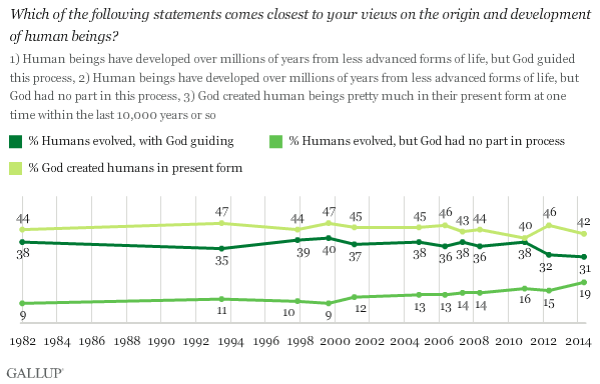
Since the 1980s, Gallup’s pollsters have been offering respondents three options about the origins of humanity.  This time, 42% chose the young-earth creationist option: “God created human beings pretty much in their present form at one time within the last 10,000 years or so.”  In contrast, 31% chose “Human beings have developed over millions of years from less advanced forms of life, but God guided the process.”  A whopping 19% selected “Human beings have developed over millions of years from less advanced forms of life, but God had no part in the process.”

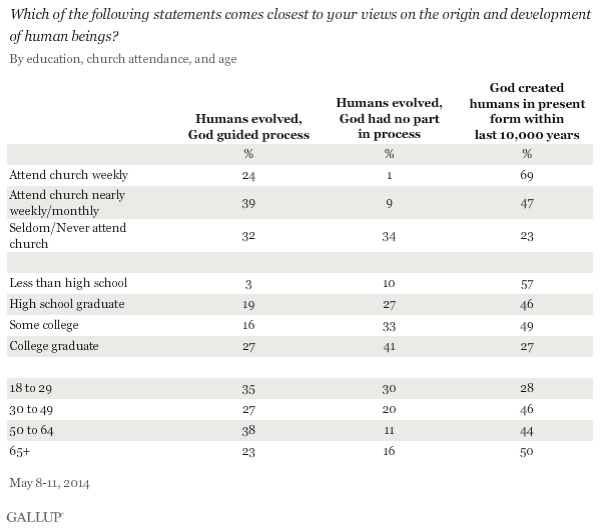
Those numbers have remained fairly stable for the past generation.  But another result of the recent poll numbers needs some examination.  The young-earth position is much more common among less educated adults.  For those with less than a high-school diploma, 57% selected the young-earth option.  A far smaller proportion, only 27%, of Americans with a college degree chose the young-earth explanation.

"Organized Ignorance?"

“Organized Ignorance?”

This is bad news for everyone.

For creationists, these numbers suggest that more education means less creationism.  Throughout the lifespan of American creationism, creationist intellectuals have fought a rearguard action against accusations of ignorance.  In 1927, for example, Minneapolis fundamentalist leader William Bell Riley told a reporter,

Every time I hear the argument that this is a controversy between experts on the one hand, and, as someone has said, ‘organized ignorance,’ on the other, I smile.  This is not a debate between the educated and the uneducated.

Riley’s smile grew more and more strained as the 1920s wore on.  And later generations of creationists found it even more difficult to take the intellectual high ground.  These numbers mean bad news for them.

But the numbers mean bad news for evolution mavens, too.

Though more college grads embrace a non-young-earth understanding of the origins of humanity, 27% is still a significant number.  It means that over a quarter of adults who have been to college—educated adults, that is—select a young earth as the best explanation.  Over a quarter!  Some of those, to be sure, may attend what young-earth creationists embrace as “Creation Colleges.”  Ken Ham of Answers In Genesis, for example, publishes a list (and a map!) of schools that he views as faithful to the Bible’s obvious meaning.

But many of those college-educated young-earth creationists likely attend non-creationist colleges as well.  As anthropologist David Long demonstrated in his study of creationists at a large public university, studying biology at a secular university does not tend to shake the faith of creationist students.  Of his interview subjects, only one abandoned her creation faith as she majored in biology.  And it wasn’t the science that convinced her.  She had already begun to move away from her faith in high school, due to an early pregnancy and the sour reaction of her church community.

As I argued a while back in the pages of the Chronicle of Higher Education, anti-creationists are too fond of calling all creationists “ignoramuses.”  Certainly, some folks must embrace creationism because they just don’t know better.  But many educated adults DO know about evolution.  They simply choose young-earth creationism instead.  That is a troubling fact that anti-creationists have always had a hard time dealing with.


Take the Creation Museum Challenge

We can gnash our teeth.  We can pull our hair.  But no matter what we do, the Creation Museum of Answers In Genesis has pulled it off.  With its new $1.5 million dinosaur exhibit, the flagship museum of young-earth creationism has successfully mimicked the outward appearance of mainstream scientific museums.

Big Valley Creation Science Museum

Big Valley Creation Science Museum

It used to be easy.  Creationist museums used to be only sad little affairs.  They used to look like this one from Alberta, Canada.  The Big Valley Creation Science Museum, pictured here, may do a great job in spreading the creationism gospel.  But no idle tourist would be likely to confuse it with mainstream museums such as the Smithsonian’s Museum of Natural History or Boston’s Museum of Science.

It used to be easy for outsiders like me to mock the lame pretensions of the many creation museums that dotted our great land.  And Canada.  As one angry visitor noted, even the bigger creation museums used to have strange, sad displays like this one from San Diego’s Creation and Earth History Museum.

Not a Lot of Big Bang for your Buck

Not a Lot of Big Bang for your Buck

But here’s the new challenge: Can you tell which of the three pictures below comes from Kentucky’s Creation Museum display and which come from the Smithsonian and Boston’s Museum of Science?  As arch-creationist Ken Ham explained gleefully recently, this new display of a million-dollar Allosaurus fossil puts Ham’s Creation Museum in the same league as those mainstream museums.  As Ham put it,

For decades I’ve walked through many leading secular museums, like the Smithsonian in Washington, D.C., and have seen their impressive dinosaur skeletons. But they were used for evolution. Now we have one of that class, and it will help us defend the book of Genesis and expose the scientific problems with evolution.

So take the Creation-Museum challenge.  Just by looking, can you tell which of these images comes from a young-earth creationist museum and which come from mainstream ones?  (Don’t cheat.  But once you’ve given it a try, you can click on each image to see its provenance.)

Is this "real" science?"

Is This “Real” Science?”

Or Is It This One?

Or Is It This One?

Millions of Years?  Or Millions of Dollars?

Millions of Years? Or Millions of Dollars?

This successful mimicry is important.  In creationism’s twentieth-century struggle to establish alternative educational institutions to rival those of mainstream science, young-earth creationists often wrestled with significant disadvantages.  Not least of these were questions of funding, as historian Ron Numbers described in his must-read book The Creationists and I detailed in my 1920s book.  In the case of this priceless fossil, rich creationists Michael and Stephen Peroutka donated it to help the Creation Museum with its work.

It would be nice to think that America’s public would make its decisions about the age of the earth and the origins of humanity by weighing evidence and considering counter-claims.  To people like me, the Creation Museum’s claim that this well-preserved fossil serves as proof of a worldwide flood 4,300 years ago seems absurd.

But I don’t think we need to be very cynical to guess that appearance matters.  As Dan Kahan argues, what people believe about creation and evolution usually has more to do with their cultural identity than it does with scientific evidence.  If Answers In Genesis can make their museum LOOK like the Smithsonian, many visitors will assume it is just as good.  And if Answers In Genesis can crank out peer-reviewed science publications that attest to the scientific veracity of their claims, many readers will assume their science is just as good.

So take the Creation Museum challenge.  If you can’t tell the difference, how can you expect anyone else to?


Evolution Rock

I ran into some mysterious evolution-related lyrics in a trademark song by my favorite band ever.

Of course, this is not the first time rockers have messed with evolutionary themes.  ILYBYGTH readers may remember our ponderings about Bruce Springsteen’s muddled ideas about evolution.  And thanks to Jonny Scaramanga we all learned something about the vibrant creation-rock scene.

But I guess I had never listened closely enough to the lyrics of MC5’s “Sister Anne.”  The Detroit outfit’s signature song starts out like this, the best I can decode:

Sister Anne don’t give a damn about evolution

She’s a liberated woman, she’s got her solution

Like a dinosaur, she’s going off the wall

She’s gonna make it her own crusade

It raises two obvious and difficult questions.  First, how much more evolution-rock is out there?  Not to be too nerdy about it, but how deeply do the questions of evolution and creationism sink into the marrow of American culture?  If we hear the echoes of creationism even in the skudjiest of Motor City rock anthems, is there anywhere we won’t find them?

The second question is much simpler: What the *@#% do these “Sister Anne” lyrics mean?  The title character seems to be some sort of soul-saving, evolution-hating, sexy Catholic nun.  I know she can…but can what?


Bryan College and the Grey Lady

Bryan College is in the news again. A recent New York Times article describes the hullabaloo over creationism and college creeds. But here’s the problem: journalist Alan Blinder seems all too willing to cast today’s struggles as only warmed-over reiterations of the 1925 Scopes trial. That doesn’t do justice to the history nor does it help today’s readers understand the kaleidoscopic world of evangelical higher education.

ILYBYGTH readers will remember that Bryan has been back-and-forth on the issue of Adam and Eve. The school has always been friendly to young-earth creationism. But President Stephen Livesay pushed through a clarification of the school’s traditional creed. From here on out, faculty members must affirm their belief in a literal, historic Adam and Eve. Most recently, the college has been sued by two faculty members who have refused to sign the clarified statement of faith.

I’m glad to see that journalist Alan Blinder has paid some attention to the controversy in the pages of the New York Times. But I can’t help but complain about Blinder’s framing of today’s story. For instance, Blinder calls today’s fight a “similar debate” to the 1925 Scopes trial. He says, “The continuing debate at Bryan College and beyond is a reminder of how divisive the issues of the Scopes trial still are…”

I’m not complaining because Blinder does not name the two professors who are actually suing Bryan—Stephen Barnett and Steven DeGeorge. I’m not complaining because Blinder focuses instead on Brian Eisenback, who had become controversial due to his evolutionary creationism.

No, I’m complaining because this sort of coverage implies that the issue at hand is the teaching of evolution or the teaching of creationism. I’m complaining because so many writers—not just Blinder—feel a need to call every new example of evolution/creation controversy “Scopes II” or something similar.

It would be entirely plausible, I think, for a casual reader to walk away from Blinder’s article thinking that Bryan College is becoming a religious school that teaches creationism, when it used to be a more secular school that taught evolution. It would also be plausible for readers to think that the issue at Bryan College today is the same issue that motivated the Scopes trial so many years ago. Both of these are woefully misleading implications.

First of all, Bryan College is now and has always been a friendly environment for young-earth creationism. Until recently, Bryan hosted the Center for Origins Research and Education. This center was lead in turn by prominent YEC intellectuals such as Kurt Wise and Todd Wood. Today’s controversy at Bryan College is decidedly not between a “creationist” mindset and a “secular” one. Today’s controversy is between a pluralist sort of big-tent creationism and a stricter young-earth-only vision. The school may be tightening its definition of acceptable sorts of creationism, but that is a very different thing than imposing creationism on a pluralist school.

Also, the controversy in 1925 was about whether or not evolution could be banned from public schools. As I argued in my 1920s book and in my upcoming Other School Reformers, due to such controversies, many conservative Christians founded schools like Bryan College. But today’s debate is vastly different. The debate today is over what sort of creationism counts as creationism at a private evangelical college.

Just because it brings journalists from New York down to Dayton again, there is no need to imply that this is somehow a return engagement for Clarence Darrow, H.L. Mencken, William Jennings Bryan, and John Scopes. What we’re seeing today is worlds apart from what Dayton saw in 1925.


The Creation Debate We Need

Ken Ham, creationist debater extraordinaire, has again thrown down the gauntlet. This time, Ham has challenged conservative evangelist Pat Robertson. More than watching Ham battle Science Guy Bill Nye, America needs to hear this debate between conservative evangelical Protestant creationists.

Apparently, according to Mr. Ham and the folks at Right Wing Watch, Robertson has been taking pot-shots at young-earth creationism lately. On his television show The 700 Club, Robertson recently announced, “You have to be deaf, dumb and blind to think that this Earth that we live in only has 6,000 years of existence.”

As he has done recently with other conservative colleges such as Calvin and Bryan, Ham wondered pointedly if Robertson’s colleagues at Regent University really support Robertson’s old-earth position. Ham asked if the school followed Robertson in “compromis[ing] the Word of God with the pagan ideas of fallible men.”

Ham offered to debate these issues with Robertson. As Ham put it,

I wonder if Pat Robertson would be prepared to discuss these issues with me or one of our AiG scientists on the 700 Club? Or maybe in some sort of debate format at Regent University? We are certainly willing to do that…. I wonder if Pat Robertson, who is allowed to state these things so publicly through CBN will agree to have his statements publicly challenged and tested!

Both conservative religious folks and outsiders like me would benefit from such a debate. We outsiders would learn more about the issues that matter to creationists. None of us were particularly surprised by the arguments Bill Nye put forward. But many of us would be enlightened to hear the reasons for and against belief in a young earth, since both sides would be arguing from a relatively similar religious perspective. We outsiders could learn about the kaleidoscopic world of creationism. For some people, this might be the first time they heard that not every creationist embraces the idea of a young earth.

And evangelicals would benefit enormously. After all, belief in a young-earth as creationist orthodoxy is a very recent phenomenon. As historian Ron Numbers demonstrated so powerfully, until the second half of the twentieth century, belief in a young earth was restricted to a relatively small percentage of conservative evangelicals. At the time of the Scopes trial in 1925, for example, leading fundamentalists differed in their beliefs about the age of the earth. At that time, no one looked askance at anti-evolutionist leaders such as William Jennings Bryan who believed in an ancient earth. Only with the publication of Henry Morris’ and John Whitcomb’s creationist blockbuster The Genesis Flood did young-earth creationism become a dominant theme in conservative American evangelical thought.

Many young evangelicals these days don’t know this history. They often assume they must either accept the doctrine of a young earth or abandon their religion entirely. A debate between two conservative evangelical leaders would demonstrate the possibilities.


Holocaust Denial, Evolution Denial, and “Teaching the Controversy”

Should students learn to think critically in schools?  Should they learn about both sides of controversial issues?  This morning at the National Center for Science Education blog, Glenn Branch compares creationists’ fondness for “teaching the controversy” to an explosively controversial history lesson from California.  For those of us interested in conservative ideas about schooling, this recent flap again demonstrates the ways “conservative” and “progressives” have swapped sides on this issue.

In the Rialto (California) Unified School District, eighth-grade students were asked to evaluate the arguments for and against the existence of the Holocaust.  “When tragic events occur in history, there is often debate about their actual existence,” the assignment reads, according to the San Bernardino County Sun.

For example, some people claim the Holocaust is not an actual historical event, but instead is a propaganda tool that was used for political and monetary gain. Based upon your research on this issue, write an argumentative essay, utilizing cited textual evidence, in which you explain whether or not you believe the Holocaust was an actual event in history, or merely a political scheme created to influence public emotion and gain. Remember to address counterclaims (rebuttals) to your stated claim. You are also required to use parenthetical (internal) citations and to provide a Works Cited page.

When the story came out about ten days ago, some conservative pundits tried to use this as proof of the moral monstrosity concealed in the Common Core State Standards.  The standards, some said, pushed school districts into adopting such terrible ideas as Holocaust denial.

Glenn Branch asks a different question.  How is this example of teaching “critical thinking” any different from creationist attempts to have students evaluate evolution and creationism side by side?  In both cases, students are encouraged to look at evidence.  Students are prompted to evaluate arguments and come to their own decisions.

But in the case of Holocaust denial, one side of the balance sheet has been thoroughly discredited.  It is not morally or educationally appropriate to ask students to decide whether or not the Holocaust happened, critics insist.  One of the sources students were given in this assignment stated the following:

With all this money at stake for Israel, it is easy to comprehend why this Holocaust hoax is so secretly guarded. In whatever way you can, please help shatter this profitable myth. It is time we stop sacrificing America’s welfare for the sake of Israel and spend our hard-earned dollars on Americans.

Offering students these sorts of false, hateful lies as “sources,” critics say, demeans the idea of pushing students to think critically.  If creationists thought that students should really explore every side of every issue, even sides with no intellectual or moral legitimacy, Branch argues,

then they should have been enthusiastically supporting the Rialto assignment. It’s to their moral credit that they weren’t, of course, but it proves—as if proof were needed by now—that “teach the controversy” and the like are merely rhetorical legerdemain intended to distract the spectator from the intellectual hollowness of the proposals they are supposed to support.

To suggest that schools ought to “teach the controversy” when there is in fact no controversy among mainstream scientists, Branch concludes, is just as bogus as having students evaluate the claims of Holocaust deniers.

The historian in me can’t help but notice the flip-flop we’ve seen over the course of the twentieth century.  In 1925, it was the pro-evolution side who pleaded with America to consider both sides in public schools.  Most famously, Scopes-trial attorney Dudley Field Malone begged the nation to allow the teaching of evolution.  “For God’s sake,” Malone implored, “let the children have their minds kept open.”  Ironically, as historian Ronald Numbers pointed out in Darwin Comes to America (pg. 91), later creationists adopted Malone’s plea as their own.

This is one of the themes I’m working with in my upcoming book.  Back in the 1920s, it was the conservative side of school battles who protested that these were false choices.  In 1929, for instance, the staunchly conservative leader of the Daughters of the American Revolution warned DAR members that progressives sneakily insisted on teaching both sides of every issue.  Such choices, she warned, were false ones.  Even to ask the questions tipped students away from truth and morality.  As she memorably argued,

Flagrant cases of un-American tendencies have been brought to light and exposed.  Exotic theories are promulgated in the name of science.  Disdain for law and order, and contempt for our accepted form of Government are subtly injected into the teachings of history.  Such practices are defended by the advancement of the decrepit theory that both sides of the question should be presented to permit the forming of unbiased opinions.  This may be the proper system for the seasoned adult who presumably can, if he will, revoke his errors when faced with the consequences of an unwise choice.  With the young, the chances are too great, for there a dangerous inequality exists.  One does not place before a delicate child a cup of strong black coffee and a glass of milk; or a big cigar and a stick of barley candy; or a narcotic and an orange, and in the name of progress and freedom insist that both must be tested in order that the child be given the right of choice.  Instead, one carefully supplies only what will make for the development of the young body and assure its normal growth.  Why then apply the very opposite theory when dealing with the delicate and impressionable fabric of the mind? (Emphasis added.)

With this historical lens, it seems doubly apparent that the argument for teaching both sides of any tricky issue has always been politically popular among Americans.  If there’s a controversy, many Americans have always agreed, let children hear both sides.

Back in the 1920s, progressives and evolution educators tried to make this case.  Let children hear about socialism and evolution, progressives pleaded.  At least allow schools to teach the controversy.  Back then, conservatives made the case that one side of those ideas was not equal.  To offer students both candy and cigars to choose from, as our DAR leader insisted, was a false choice, a false controversy.

Today, the sides have switched but the argument has not.  One side argues to let children hear both sides of a controversial issue and decide for themselves.  The other side insists that only one side has any truth, any intellectual legitimacy.

Me personally, I agree that Holocaust denial and evolution denial ought not be offered as equals to better history and better science.  But I know many readers might disagree.  How can creationists defend the legitimacy of “teaching the controversy” when most scientists agree that there is no controversy?  Is it like offering children a choice between heroin and citrus fruits?  Milk and coffee?  Candy or cigars?


Was I Fair to Ken Ham?

Ken Ham complains that I was not precise enough.  I think I was.

Here’s the issue: On his blog today, leading young-earth creationist Ken Ham chided yours truly for saying “Ken Ham” when I really meant something like “conservative Christians.”  Ham was reacting to a recent post of mine in which I asked about Ham’s inordinate influence over some conservative Protestant colleges.  In that post, I noted Ham’s recent pronouncements about leading evangelical schools such as Calvin College and Bryan College.  I wondered if conservative schools had to bend over backwards to satisfy Christian critics like Ham.  Did schools like Bryan College have to toe the Ham line in order to maintain their support base among conservative evangelical Protestants?

Be More Precise, Please

Be More Precise, Please

Ham said I needed to be “more precise.”  Ham made the fair point that Science Guy Bill Nye often used the unfair rhetorical strategy of reducing all creationism to simply Ken Ham.  Of talking about creationism as if it were just a one-man crusade to bilk taxpayers and fool schoolchildren.

When it comes to Bill Nye’s language, I agree with Ham.  Bill Nye–with whom I generally agree–does not always seem to understand creationism.  In a recent post, for instance, I agreed with Mr. Ham that Bill Nye “Misse[d] the Boat on Creationism.”  I have also agreed with Mr. Ham that Mr. Nye’s use of phrases such as “Ham’s followers” is sneaky and unfair.

But in this case, I was not doing any such thing.  In my essay about Mr. Ham’s influence on conservative Christian colleges, I was talking precisely about the work of Mr. Ham and Answers In Genesis.  If I was incorrect about the influence of Ham in the recent controversy at Bryan College, I’ll apologize.  But I won’t apologize for mistakes I didn’t make.

Ham also notes that I expand my questions to include the state of conservative evangelical colleges and sexual assault.  As ILYBYGTH readers know, this is a question that has been bandied about here recently.  Those who are new to the blog will not be aware that we do not simply attack “fundamentalist” schools as rape havens.  Indeed, our recent string of commentary began with questions about a journalist’s unschooled presumptions about the nature of fundamentalism.  We do not assume that sexual assault is somehow unique to conservative religious colleges, but it does seem that there is a connection between the opaque authoritarian cultures of many conservative colleges and a culture that blames the victims of sexual assault.

The central point of interest to me, though, then and now, is whether and how Mr. Ham has come to wield such authority over conservative evangelical colleges.  In the case of Bryan College, at least, Ham’s worries led to changes at the school.  I can’t help but wonder if Ham’s say-so is of enormous influence at similar colleges and universities.  This is not a question about conservatism in general.  This is not a question about creationism in general.  This is a specific question about the influence of Mr. Ham’s Answers In Genesis ministry.


Evangelicals and Evolution: A Closer Look

We all know large numbers of evangelical Protestants disbelieve in evolution, right? But among evangelicals, who does and who doesn’t? Thanks to Professor Thomas Jay Oord and the Nazarenes Exploring Evolution project, we can see a breakdown of evolutionary disbelief in one large evangelical denomination. In the Church of the Nazarene, at least, most academics allow for God-guided evolution and an ancient earth, while among the laity there is a more pronounced split.

For those outside of the kaleidoscopic world of American evangelicalism, the Church of the Nazarene is part of the Holiness tradition. That means, in a very crude nutshell, they are part of a tradition that emphasizes an experience of sanctification and sanctified work. In the analogy of one early holiness evangelist, sinful human nature is like a weight, but that weight can be lifted up by the hot-air balloon of the Holy Spirit. The sin is still there, but earnest Christians can be buoyed up to perform missionary work if they open themselves to the Holy Spirit.

In more mundane terms, according to its Wikipedia page, the Church of the Nazarene claims 2,263,249 members in 29,007 churches around the world. That’s a lotta Nazarenes. And while we can’t make any claims that Nazarenes somehow represent the totality of evangelicals, we can learn something about evangelicalism and evolution by looking in close detail at what Nazarenes say on the subject.

In general, American evangelicals are one of the most skeptical groups about evolution. As a recent Pew survey found, sixty-four percent of white evangelical Protestants believe that humans “have existed in their present form since the beginning of time.” Only a small minority (15%) of white mainline Protestants hold that view. And while it is notable that so many self-identified “evangelicals” don’t believe in human evolution, we can see that a significant minority of evangelicals DO believe.

Oord’s more nuanced look at one evangelical denomination allows us to get a better inside scoop on this breakdown.

In brief, Oord and his colleagues found that most Nazarene academics believed that evangelicalism and evolution could co-exist without traumatizing Nazarene theology. Your regular Nazarene-in-the-street, however, is much more likely to insist on a young earth and on hostility to evolutionary theory.

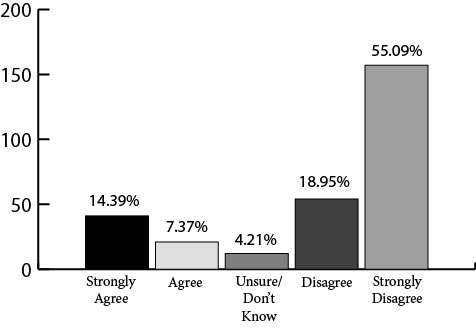
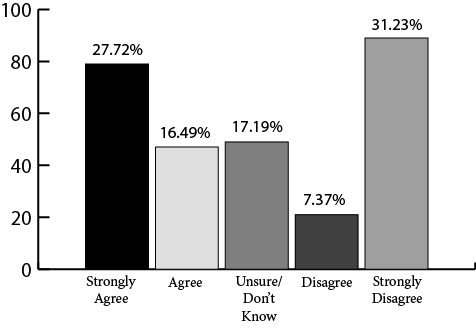
For example, among Nazarenes as a whole, 14.39% strongly agree, and 7.37% agree, that the Bible requires “Christians to believe the earth was created less than 15 thousand years ago.” Among lay Nazarenes, 18.95% disagree with that statement, and 55.09% strongly disagree. We see that this evangelical denomination does not, by and large, go in for “young-earth” creationism, though clearly a significant minority of its members does.

Lay Nazarenes and a young earth

Lay Nazarenes and a young earth

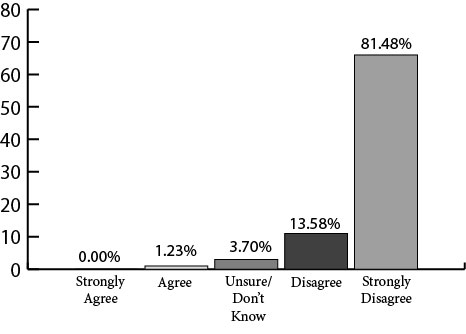
But look at the results when Nazarene academics answer that same question. Absolutely ZERO strongly agreed that biblical beliefs require belief in a young earth, and only 1.23% agreed. In contrast, a whopping 81.48% strongly disagreed with the notion that Christianity requires belief in a young earth.

Academic Nazarenes and a Young Earth

Academic Nazarenes and a Young Earth

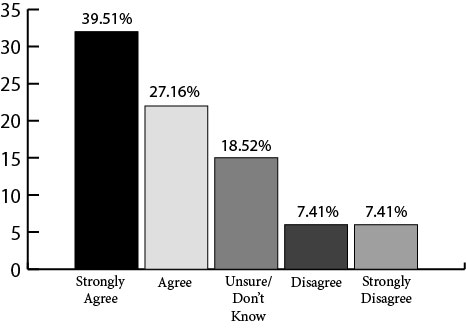
Check out Professor Oord’s essay in the BioLogos Forum for more details. You will see, for example, that among lay Nazarenes there is much more hostility to the notion that “Humans likely became a species as God worked with the evolutionary process.” Academic Nazarenes feel much more comfortable and confident with that idea.

Lay Nazarenes on God-guided Human Evolution

Lay Nazarenes on God-guided Human Evolution

Academic Nazarenes on God-guided Human Evolution

Academic Nazarenes on God-guided Human Evolution