Do YOU Need Evolution?

Our intrepid editor sat down this week with Prajwal Kulkarni, the genius behind Do I Need Evolution?  Praj agreed to offer some reflections on his recent career as culture non-warrior.

Does He Need Evolution?

Does He Need Evolution?

ILYBYGTH: Why do you care about creationism?

Praj: Thanks for agreeing to interview me Adam. I’m quite honored.

I actually care about creationists much more than I do creationism. They are real people, and many of them are among the smartest, kindest people I know. Also, contrary to popular belief, not all of them want creationism in public schools.

Ta-Nehisi Coates, one of my favorite writers, once described how he did not want more “positive” writing about black Americans. Instead he simply wants to portray them as complex human beings: “I do not wish it to show us “in a more positive light.”…I would have us depicted in all our rancid splendor–boastful and marvelous, rhythmic and self-interested, dumb, clear, hateful, and, on occasion, brave.”

I’m not suggesting an equivalence between media bias against Christians and African-Americans. But I do think we should have a similar goal for evangelical Christians. Creationists can be as complicated and contradictory as all of us, and they are not merely a problem to be solved. The media and scientific community, to put it mildly, do not realize this. I’ve spent a fair amount of time in various church communities. As I’ve gotten to know evangelical Christians as real human beings, I now see that rejecting evolution is not necessarily something to worry about.

Now that I’ve gotten that off my chest, let me finally answer your question about creationism. There are two big reasons I care about the issue.

First, as a (former?) scientist, I’m horrified at our irrational, unscientific arguments. Where did we get the idea that believing in creationism will prevent someone from becoming a doctor or a physicist? Scientific thinking and rationality cannot be modeled as an on-off switch, and suggesting otherwise is unscientific.

Second, I think creationism is really a proxy for deeper disagreements about public education, scientific literacy, scientific authority and expertise, democratic decision-making, religion, etc. I’ve always found those deeper philosophical issues fascinating, and I can’t think of another topic that touches on all of them so strongly.

ILYBYGTH: Can you tell us something about your intellectual background and education?

Praj: Growing up, I think there was an implicit expectation I would be a science person. Both of my parents are doctors, and pretty much everyone on my mom’s side of the family studied science in some way. But even when I was very young, I was attracted to philosophical issues. I also always had somewhat of an unorthodox streak in me. I remember arguing Hindu philosophy with family and friends.

At Penn State, I initially thought I would get a bachelors in engineering of some form and then work in industry. But I fell in love with a modern physics class at the end of my sophomore year. I did my undergraduate thesis in numerical relativity, one of the most abstract and theoretical branches of physics. I thought I wanted to do physics the rest of my life.

Pretty early in grad school, however, I realized that I did not want to do physics research my whole life. I started realizing that I’m much more of a breadth rather than depth person. And so I started studying policy and politics in my spare time. After grad school I worked in Washington, DC in science policy for two years.

I look at my current obsession interest in evolution and creationism as an extension of those previous interests in philosophy, politics, and policy.

ILYBYGTH: As a trained physicist, what’s your opinion on the relationship between “creation science” and “mainstream science?”

Praj: Oh boy…you just opened an ugly can of worms. Philosophers have been debating the “demarcation problem” (how to demarcate science from non-science) for literally thousands of years. You can spend a lifetime reading the scholarship. I’ve just spent several weeks myself!

The short, cop-out (but honest) answer is that I actually don’t find the question very interesting. I realize it’s the question for most people. But suppose tomorrow everyone agrees that creationism isn’t science. The deeper issues I raised above would still exist. That’s where the action is as far as I’m concerned.

But to not cop out and give a real answer…creationism is not science. I do think the science/not-science distinction is a lot more complicated than typically portrayed in the media (you can give yourself a headache reading the debates on naturalism), but that’s true for lots of issues. Since I don’t want to swim in afore-mentioned can of worm, I’m going to leave it at that for now!

ILYBYGTH: Okay, now for the hard one: If there is a creation/evolution culture war going on, aren’t you a traitor?  That is, doesn’t your work with DINE offer aid and comfort to creationists?

Praj: I really don’t think there should be a war. If there is one going one, I guess I’m a conscientious objector. I don’t view either creationists or scientists as the enemy, and it’s problematic to conceive of our fellow citizens this way.

And if I am giving aid and comfort to creationists, then I’m quite happy and proud of myself! I want everyone to be engaged in science and feel they are a part of it. A single belief doesn’t disqualify anyone. I find this with-us-or-without-us mentality is grotesque. Dick Cheney should not be our role model.
Creation, Evolution, and College Marketing

Bryan College is having a rough time.  The school is experiencing angst as it wrestles with a new policy about the origins of humanity.  The leadership is insisting that members of the school community must adhere to a newly rigid position on origins.  All members of the college community, it seems, will be asked to sign off on a doctrinal statement recognizing that Adam & Eve represented the real, historical ancestors of all humanity.  Traditionally, faculty and students had been encouraged, or at least permitted, to embrace a relatively wide scope of Biblical opinions about the age of the earth and the historicity of Adam & Eve.

Some commentators have argued that this represents a false dilemma for Christians, or even that Bryan’s misery proves the failure of religion in the modern world.  But there is a simpler explanation.

Those familiar with the history of Bryan College can’t help but note the ironies here.  As I point out in my 1920s book, the founding of Bryan College was stymied by William Jennings Bryan’s unorthodox brand of conservative evangelical Protestantism.  Not only did the original Bryan not embrace the notion of a young earth, but Bryan was loud and proud about his postmillennial interpretation of Scripture.  For the growing fundamentalist movement in the 1920s, Bryan’s old-earth position was not remarkable or problematic.  Many leading fundamentalist thinkers in the 1920s had “liberal” positions about the age of the earth.  But Bryan’s postmillennial beliefs caused some worry.  Could “fundamentalists” be postmillennialists?  Such debates threatened to derail the funding of the new university in the 1920s.

Such arguments based on the history of Bryan College are relevant in today’s disputes.  The current leadership of the school insists that their new statement of faith is really only a clarification of their traditional creed.  Indeed, it would have to be, since part of that original charter stipulated that the creed could never be altered.

Faculty members at Bryan differ, however.  As we’ve noted in these pages, faculty members such as Bryan Eisenback have crafted innovative school curricula that hope to teach evolution to Christians in a Christian way.  As described in a recent article in Chattanooga’s Times Free Press, Eisenback has been accused of teaching both evolution and creationism.  As Eisenback described to the TFP,

In my view, God gave us science to learn about the physical world.  When people embrace that, science is our way of understanding God’s handiwork, so to speak, then science isn’t threatening. It becomes exciting.

As usual, Josh Rosenau of the National Center for Science Education offered a sensible argument in the pages of the TFP.  Bryan’s leadership, Rosenau noted, seemed to be staking out a hard-line position unnecessarily.  “The evangelical position,” Rosenau argued, “doesn’t have to be an outright rejection of human evolution. There are ways to be a Bible-believing literalist without being at odds with science.”

Less convincing was the cackling triumphalism of science pundit Jerry Coyne.  In the pages of The New Republic, Coyne argued that the mess at Bryan College resulted from a necessary clash between advancing science and retreating religion.  “Bryan is fighting a losing battle,” Coyne crowed,

but it will be a long battle. These vestiges of superstition, and of blind adherence to it, will eventually disappear as America becomes more secular. There will always be Biblical literalism, but I’m confident it will slowly wane. But it will wane not with the changing of minds, but over the corpses of its adherents, as the older generation dies off and the younger, exposed to secularism and doubt on the internet, begins to ask questions.

I’m an avid reader of Coyne’s blog, but I don’t see how his argument makes sense.  The “older generation” he refers to is many generations derived from the founders of Bryan College.  A pile of the corpses of adherents to Bryan College’s conservative theology would be too high for any young people to climb over!

Corpse imagery aside, there’s a more important point to be made here.  College presidents want most of all to see their institutions thrive.  As the Chattanooga TFP article makes clear, the problem at Bryan College started when prominent young-earth creationist Ken Ham accused the college of falling away from Biblical orthodoxy.  The leadership of Bryan College faces a worrying prospect.  What if conservative evangelical parents no longer trust the orthodoxy on tap at Bryan?  What if they no longer agree to send their children and their tuition dollars to the school?

More than nuances in Biblical scholarship or evolutionary theory, college presidents must consider such things.  The dangers to the bottom line from the condemnation of Ken Ham are real and substantial.  Unless the leadership acted to shore up the impression of orthodoxy, they must have worried that their institution would become just another failed small religious college.

Let me be clear: I have no inside knowledge of the goings-on at Bryan College.  But it seems as if the simplest explanation here is probably the right one.  Beyond keeping the faith true, college presidents must worry about keeping the lights on.  In today’s climate, a bad review from the likes of Ken Ham could easily spell the end of any conservative evangelical school.


Creationism for Liberals

We know the problem with science in America, right?  Ignorant groups cluster around pseudo-scientific claims; people cling to outdated and disproven ideas out of a false sense of moral purity and righteousness.  Worst of all, scheming charlatans profit off this manufactured ignorance.

Same old, same old.  But what if we’re not talking about religious creationists, but rather about secular liberals?  In The Daily Beast, Michael Schulson recently accused shoppers at fancy-pants Whole Foods supermarkets of succumbing to pseudo-scientific claims.  Worst of all, Schulson writes, such folks often do so while feeling intellectually superior to the rest of benighted America.

As Schulson puts it,

From the probiotics aisle to the vaguely ridiculous Organic Integrity outreach effort (more on that later), Whole Foods has all the ingredients necessary to give Richard Dawkins nightmares. And if you want a sense of how weird, and how fraught, the relationship between science, politics, and commerce is in our modern world, then there’s really no better place to go. Because anti-science isn’t just a religious, conservative phenomenon—and the way in which it crosses cultural lines can tell us a lot about why places like the Creation Museum inspire so much rage, while places like Whole Foods don’t.

Read the entire piece.  Schulson describes the more-than-questionable claims of many of the products on sale at Whole Foods.  When he invited a biologist to look at some of the probiotic claims, she offered a quick conclusion about their scientific accuracy: “‘This is bullshit,’ she said, and went off to buy some vegetables.”

Most compelling, Schulson asks why creationist institutions such as the Creation Museum cause such outrage among the mainstream scientific community, while the anti-science on display at Whole Foods doesn’t.  One thing he doesn’t consider is the difference of scale here.  Young-earth creationists claim that the earth is somewhere between six and ten thousand years old.  Such an idea is utterly at odds with the fundamental premises of today’s science.  Claims that probiotics can work medical wonders might be false, but they’re not so enormously out of sync with mainstream science.

But that doesn’t mean that the parallel between young-earth creationism and organic-food fetishism isn’t important and valid.  As I have argued elsewhere, too often anti-creationists take false comfort from calling their creationist foes “ignorant.”  Certainly, some creationists might be naively ignorant, but more significant are those who know modern science and simply reject it.  The real question, IMHO, is not simply who is more ignorant, but rather a question of which cultural authorities people on each side choose to believe.

Along those lines, I appreciate Schulson’s stirring conclusion:

The moral is not that we should all boycott Whole Foods. It’s that whenever we talk about science and society, it helps to keep two rather humbling premises in mind: very few of us are anywhere near rational. And pretty much all of us are hypocrites.

Stuff It, Perfesser…

Ouch.  This is what biologists and geologists must feel like when young-earth creationists get aggressive. In the past, I’ve chided mainstream scientists for their unwillingness to sympathize with creationists.  Now that the topic is US History and I’m the one under attack, I feel more sympathetic to the biologists in the room.

Here’s the story: A couple days ago I posted a short essay in the pages of the History News Network.  I compared the history of neo-Confederate attacks on mainstream US history to the decades of creationist attacks on mainstream science.  Why do textbooks still include hackneyed old myths, I asked.  Why insist that slavery was not a leading cause of the Civil War?  Why claim that thousands of slaves fought loyally for the Confederacy?  Such things just aren’t true, and I reminded my history colleagues (and myself) that we must remain active supporters of real history in America’s classrooms.    

A few commenters took me to task for swallowing the myths of false history.  “Whoever this Laats character is,” one James Bendy remarked,

he’s definitely drinking the Kool-aid of the history revisionists. What he calls “revised history’ is actually the unvarnished truth. Yes, there were thousands of free blacks who fought FOR the South, along with thousands of Asians, Spaniards, Jews, Italians, all kinds of Europeans, and several entire tribes of Native Americans. It’s all documented and proven beyond any doubt.

Another commenter accused me of “egotistical presumption and condescension” along with “narcissism and moral blindness.”

Really?

I hadn’t meant to be provocative, really.  I hoped to remind other historians that they needed to remain actively involved in history education in their local communities.  It was an historian from William and Mary College, after all, who discovered woeful mistruths in a textbook used by fourth-grade public-school students in Virginia.  All of us need to serve as this sort of watchdog.   

My surprise reminds me of the ways generations of mainstream scientists felt after engaging for the first time with anti-evolutionists.  As I note in my 1920s book about the first generation of Protestant fundamentalists, when University of Wisconsin President Edward Birge disputed the scientific accuracy of anti-evolutionism in 1921, he found himself under political attack by the wily William Jennings Bryan.  President Birge went on to warn Princeton biologist Edwin Conklin, if you mention evolution, “you will receive an enormous number of letters and much fool printed stuff.”  

President Birge was one of the first mainstream scientists to tangle with anti-evolutionists.  His lesson to Conklin has been repeated by generations of mainstream scientists who engage with the issue of creationism.  Lamentably, in these durable culture-war controversies, conversation has always taken a backseat to accusations.

The same certainly seems to be true in this case.  There really isn’t a controversy here; not a real one.  Neo-confederate histories rely on half-truths and outright fabrication to “prove” their preferred stories.  Activists rely on political pressure to crush out dissent and promote politically palatable myths instead of real history. 

To be fair, I don’t dispute the notion that this sort of anti-historical meddling goes on from the left, as well.  There’s also not much disagreement among historians that the leftist history peddled by the late Howard Zinn is full of misleading half-truths and exaggerations as well.  Yet Zinn’s People’s History continues to be used by activist teachers in America’s schools.  That’s a shame as well. 

So what’s an historian to do?  Do I have to swallow these insults in order to build bridges across culture-war divides, as I have suggested mainstream scientists need to do?  Or is it more important to fight back, to take on neo-Confederate historians and activists on a point-by-point refutation?

What would Bill Nye do?


150 Years Without History Are Enough!

It’s not a “conservative” thing, really.  Or a “progressive,” “liberal,” or “traditionalist” thing.  But I’ve mounted up on my high horse in the pages of History News Network to complain about the sad state of American history education.

Specifically, I’m stumped and saddened by the continuing prevalence of neo-Confederate histories in America’s public schools.  Or, at least, by the continuing desire of some activists and authors to keep neo-Confederate histories alive.

In the HNN essay, I argue that there are clear parallels between this sort of history education and the long campaign against the teaching of evolution in public-school science classes.   Just as in that case, I think there are plenty of conservative intellectuals who will agree with me that neo-Confederate myths shouldn’t be taught as real history, just as there are lots of conservative evangelicals who dispute the young-earth style of creationism peddled by Ken Ham.  Just as I wouldn’t want history teachers to use Zinn’s woefully slanted leftist People’s History of America in their classrooms, I bet there are plenty of conservatives who don’t want American kids to learn that the Civil Rights Movement was no big deal, or that lots of slaves fought FOR the Confederacy in the Civil War.

Take a look and offer your comments over there.  Bonus points if you can make sense of my oh-so-clever title BEFORE reading the essay on HNN!


Creationist Kids Subvert the Bible

The kids are alright.  That’s the conclusion, anyway, of the Happy Atheist PZ Myers.

Myers took a tour of a recent creationist science fair.  What did he find?  Creationist kids seem to be using the tools of creationist parents against them.

Myers went to the smallish Twin Cities creationist science fair.  Most of the student presentations, he found, seemed like regular science with just a required Bible verse appended.  And that combination, Myers argued, undercut the intended creationist brain-washing of these young Minnesotans.

One student seemed to be comparing the absorbency of diapers to the spiritual absorbency of Jesus.  Another seemed to disprove her Bible verse by feeding a wild bird out of her hand.

Myers’ conclusion:

Whether they like it or not, these kids are being given the tools to kick their tired Christian ideology to the curb.


You Won’t Believe What This Poll Found Out About Dumb Americans

Thanks to the ever-watchful Sensuous Curmudgeon, we see a new poll: Only ¾ of Americans know that the Earth goes around the sun.  Dur.  But this sort of ignorance raises important questions about what it means to know something and, crucially, what it means to not-know.

The poll was conducted in 2012 by the National Science Foundation and apparently shared at the recent meeting of the American Association for the Advancement of Science.  [Editor’s note: we couldn’t find the original poll results themselves, but we found reports of them from sources such as National Public Radio and Phys.Org.]

According to this survey of 2,200 American adults, only 74% correctly answered that the Earth goes around the sun.  For those of us who get depressed about the great US of A, we might take some comfort that similar results have been reported from similar polls in the European Union and China.

But here’s the kicker: There are lots of ways to not-know something.  As Robert Proctor called it a few years back, there are many different meanings to agnotology, the science of not-knowing.  In the case of this survey, we see a crucial detail of great interest to all of us interested in American education and culture.

Though Americans, Europeans and Chinese displayed similar levels of what Proctor might call “native-state” ignorance about the fact that the Earth goes around the sun, Americans had much higher levels of “non-knowledge” about human evolution.  According to the NPR report, 66% of Chinese respondents thought humans had evolved from other animals.  Seventy percent of European respondents thought so.  But only 48% of Americans did.

For those of us interested in education and culture, this suggests a different sort of non-knowledge.  Americans who don’t “know” that humans evolved from animals might simply not know it.  They might be simply, naively ignorant.  But those folks will be joined by large percentages of Americans who don’t “know” humans evolved from animals because they firmly “know” that God created humanity by fiat.

So are Americans dumb?  Yes, of course we are.  But are we DUMBER than Chinese people or Europeans?  This is where it gets tricky.  When knowledge is simply absent, that’s one thing.  But when correct knowledge is knowingly replaced by counter-knowledge, we have a much more complicated situation.


How Richard Dawkins Begat Ken Ham

Why is there creationism?  Marc Barnes at Bad Catholic makes the argument that today’s young-earth creationist movement is nothing more nor less than a theistic outgrowth of Richard Dawkins-style materialism.

Today’s sort of Ken-Ham-style creationism, Barnes correctly observes, is an entirely modern phenomenon.  Barnes doesn’t make the point, though he could have, that ignorant partisan anti-creationist hack jobs like that of Mark Stern in Slate miss the boat entirely when they accuse creationism of being “medieval.”  Nonsense.  Today’s creationism is a thoroughly modern affair.  Even the briefest familiarity with the history of the movement makes that point abundantly clear.

Today’s creationism, Barnes argues, is not a wholesale repudiation of the materialist viewpoint, though it falsely claims to be.  Materialism, after all, in this sense, means the assumption that life and everything has purely material origins.  Primordial soup somehow got a transformative spark, perhaps from undersea volcanic vents.  Life came from non-life due to purely material causes.  Similarly, life itself, though it may feel like it has transcendent spiritual meaning, is nothing more than biochemistry.  When the switch goes off, the magic ends.  Back to carbon.

Such a view of life separates God out entirely, Barnes points out.  And Ken-Ham-style creationists make the woeful mistake of simply plugging God back in, from the outside.  In other words, Barnes argues, young-earth creationists stupidly think that by insisting on a God who popped into time, created life and the universe, inspired a Bible, and sent his kid in to fix things, they have refuted materialist assumptions.  Not so, Barnes contends.  That sort of outsider God, a God who creates, judges, and saves, all from somewhere outside of, beyond the creation itself, actually endorses the materialist vision of life.  Instead of electricity as the prime mover, though, Ken Ham’s style of creationism plugs in a Bearded-Guy-in-a-Throne sort of God.

God, in this YEC vision, is a mere competitor with electricity for the role of life’s spark.  God, in this YEC vision, is simply the materialist understanding of life with a quick substitution of God for an unintelligent spark.

Instead of falling for this materialist presumption, instead of simply rebutting one part of materialist assumptions about life, real creationism needs to posit an entirely different relationship between the world and its Creator, Barnes argues.  As he puts it,

God is not simply the Creator of the material order, and the theistic tradition has never made such laughable claims. The concept of God as Creator has always been the source of existence as such. This means that God does not just answer the material question of “Where came this rock, that plant, or the entire conglomerate of material thingmabobs we call the universe?” He answers the ontological question: “Why is there something rather than nothing?”


Creation? Evolution? Both? Neither?

Those of us who follow the creation/evolution debates bump up against a frustratingly common factoid.  Article after article, both scholarly and popular, cite Gallup polls as proof that nearly half of American adults espouse a young-earth creationist position.  In fact, we might be better off thinking of a much smaller number.

In the pages of Christianity Today, sociologist Jonathan Hill suggested that the real numbers are much more complicated.  The problem with the Gallup polls are that they force people to pick the position on creation that comes closest to their belief.  We do not find out, for example, how much they care about the issue, or how certain they are about their beliefs.  Most tellingly, we do not find out what other views they also find convincing.  As any social scientist can tell us, people tend to say one thing about their beliefs and believe another.

Hill is not the only nerd to question Gallup’s high numbers.  Josh Rosenau of the National Center for Science Education noted recently that poll numbers change as questions change.  Similarly, political scientists Michael Berkman and Eric Plutzer survey the surveys in their must-read Evolution, Creationism, and the Battle to Control America’s Classrooms.  Not surprisingly, they conclude that the structure of the survey and the wording of the questions can deliver very different perspectives on the numbers of Americans who believe in evolution or various types of creationism.

For example, two polls from 2005 came up with different results on the issue of teaching creationism in public schools.  One poll from Virginia Commonwealth University found that 21% of respondents favored teaching only creationism; one from Harris found 23% support for that position.  Pretty similar.  But the VCU poll concluded that 43% of Americans preferred public schools to teach a combination of evolution and creation in science classes.  The Harris poll put that number at 55%.  That’s a significant difference, one that can’t be explained away by hanging chads.  (For younger readers, “hanging chads” is an hilarious reference to an ancient election conundrum in the USA.)

Furthermore, when pollsters ask Americans different questions, they get—no surprise—different answers.  Gallup pollsters in 1999 asked if people would favor or oppose teaching creationism INSTEAD OF evolution in public schools.  Depending on who did the asking and when (Berkman and Plutzer review a handful of polls from 1999-2005), either a slim majority or a near-majority oppose such teaching.  The numbers vary from 54% opposed to 44% percent opposed.  That’s a big difference.

When Jonathan Hill conducted his BioLogos-funded survey, he found similar complications.  As he explains in the pages of CT, a better survey will allow respondents to separate out their specific beliefs about origins.  A better survey will allow respondents to explain how important each belief is to them.  Hill’s National Study of Religion and Human Origins asked respondents to specify their belief in each of three ideas.  Did humans evolve from other species?  Was God involved?  Were humans created within the last 10,000 years?  The familiar Gallup poll question lumps together all these notions into one young-earth creationist position.

But when Hill separated out these beliefs into three separate questions, he found that only 14% of respondents agreed with all three.  Only 10% called themselves “certain of their beliefs.”  And only 8% said that “it was important to them to have the right beliefs about human origins.”

Hill found similar dwindling numbers on the evolution side.  When pressed, the number of people who firmly and cantankerously cling to a belief that life came from evolution without the interference of any divine entity shrinks considerably.

What does it all mean?  Hill offers a stirring conclusion.  “If only eight percent of respondents,” he suggests,

are classified as convinced creationists whose beliefs are dear to them, and if only four percent are classified as atheistic evolutionists whose beliefs are dear to them, then perhaps Americans are not as deeply divided over human origins as polls have indicated. In fact, most Americans fall somewhere in the middle, holding their beliefs with varying levels of certainty.

Of course, Hill is not just a neutral observer.  As do I, Hill hopes to find a middle ground, and his surveys find one.  Evangelical Christians, Hill suggests, would do well to put battles and controversies to the side, and focus on their broad shared beliefs.  For the wider society, I wonder if we might be able to do the same.


Evolutionists Roast Ham

HT: AS

Thanks to the brilliant Matt Stopera, we also have a series of 22 questions evolution-believers would like to ask Ken Ham.

[If you’re just joining us, you can catch up on the details of the Ham-on-Nye debate here; some analysis here; and some of Stopera’s creationist questions here.]

As a preamble, let me remind readers that I am a “self-identified evolutionist” myself, so my comments here will be more along the lines of family disagreements than were my comments about the creationists’ questions.

I cringe the most when I see the snark inherent in some of these questions.  Worst of all, one questioner asked about the Flintstones.  This kind of question just poisons the well.  If I were a young-earth creationist reading this, it would reassure me that everything I believed about mainstream intellectual/scientific culture is correct. First, this kind of question demonstrates a determinedly hostile attitude toward creationist belief.  Second, it implies that creationists believe things they don’t really believe.  Third, it doesn’t demonstrate any knowledge about evolution or science, only a knowledge of kitschy old TV cartoons.  Finally, it proves that only creationists are willing to talk politely and civilly to those with whom they disagree.  As Ken Ham tried to prove in the debate itself, many creationists believe that evolution believers are “indoctrinated” into believing evolution by fake science that has “hijacked” the name science for its own anti-God purposes.  Closed-minded burns like this Flintstones question demonstrate first and foremost–to any intelligent creationist–that Ham was right.  Evolution, this question implies, is something we’re not even willing to talk about.  All we can do is make fun of those with whom we disagree.  A shameful repudiation of liberal civil values.

Also sad, some questioners chose to make only assertions.  One woman wrote happily, “Science rules!”  Not exactly a proud demonstration of the clear intellectual superiority of the modern evolutionary synthesis.

Happily, other evolutionists asked better questions.  The best point Nye made during the debate, IMHO, was the irrefutability of the fossil record.  Find a single exception, Nye repeated, and you’ll convince me.  The evidence is clear.  Several questioners challenged Ham to address that issue more clearly and directly.

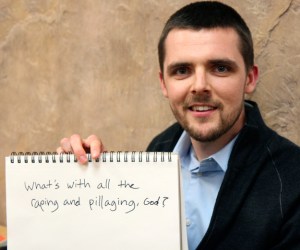
Other evolutionists, surprisingly, focused on religious themes.  As one guy put it, “What’s with all the raping and pillaging, God?”  Now, this doesn’t have anything to do with evolution directly, but I think religious questions are the proper field of discussion here, not scientific ones.  It makes the most sense to me for evolutionists to challenge creationists–especially Ham’s brand of young-earth creationist–on the theological and logical problems with the religious attitudes at the heart of YEC.  Why should we believe in a six-day creation, in other words, and not the rest of the Old Testament?  Of course, intelligent YECs have answers to those questions, but by asking religious questions, IMHO, we keep this discussion where it properly belongs.

Stoperas HamOther questions seem less well thought out.  One person asked, for example, how one could doubt evolution, since there were entire disciplines devoted to it?  That seems like an ignorant question to me.  Why would anyone assume that something that gets studied a great deal must be true?  The history of science can give us plenty of examples of radically untrue notions that attracted lots of academic attention: quantity of angels on pins, phlogiston, phrenology…the list could go on and on.

Some smart questions demonstrated a more understandable ignorance.  One person, for instance, asked, “How can you deny microevolution?”  A good question, but one that shows a lack of knowledge about today’s young-earth creationism.  Creationist scientists these days are actually some of the most ardent advocates of the distinction between “micro-” and “macro-” evolution.  Creationists eagerly agree that microevolution occurred.  In the debate, Ham referred to this as the changing of God’s original “kinds.”

Finally, several of the questions asked about educational issues, the questions near and dear to our hearts here at ILYBYGTH.  Some were silly, such as one who said he required his textbooks to be newer than 4,000 years old.  This is not only silly in the obvious sense that creationists use lots of new textbooks, but in the deeper sense that YECs would call the Bible a “textbook” only in a unique sense.  The Bible to many YECs is indeed a storehouse of knowledge, but it is much more than that.  As Ham argued in the debate proper, the Bible has a unique status, something much more than a textbook.

Another made the great argument, “Keep religion out of my science classes!”  Even better would be if this person added, “Keep YOUR religion out of my science classes.”  This is indeed a strong point.  Whatever one may say about it, even Ken Ham agrees that YEC is a belief based in religion.  Indeed, he goes through verbal (and mental) gymnastics in his efforts to prove that evolution is also a religion.  Both sides agree, though, that science classes in public schools ought not teach religion.  And intelligent YECs admit that their evolutionary beliefs are frankly religious.

OK, nuf sed.  Three cheers for Matt Stopera.  This 22-vs-22 has been at least as illuminating as the debate itself.