Radical Creationists Fall into the Poetry Trap

Want to understand American creationism? Then don’t dig into Charles Darwin or even Bill Nye. The key to American creationism isn’t science, not even its peculiar “zombie” science. No, to understand radical American creationism, we need to look instead to poetry and the fundamentalist impulse.

Here’s the latest: today’s leading radical creationist Ken Ham recently defended his young-earth position against charges of flat-earthism. As Ham bemoaned,

now it’s not just atheists arguing the Bible teaches a flat earth—it’s some Christians, too, who’ve sadly fallen for flat-earth arguments and now believe that’s what the Bible teaches. But does it?

No, it doesn’t. Now, flat earthers will frequently bring up poetic passages, such as verses from Psalms or Job, and say those verses teach a flat earth because phrases like “ends of the earth” or references to a setting sun appear. But those passages are poetry—by definition poetry is filled with literary devices such as metaphors, similes, and figures of speech. The biblical text is meant to be interpreted naturally, according to the genre. And poetry is clearly intended to be understood within the context of abundant literary devices that are not meant to be taken so woodenly and literally (i.e., God does not literally lie us down in green pastures as per Psalm 23:2).

For those who know the history of American creationism, Ham’s use of the “poetry” defense must seem either brutally cynical or woefully ignorant. Here’s why: Back in the 1950s, fundamentalist Protestant scholars tried to move away from Ham’s preferred sort of radical young-earth creationism. They wanted to remain creationists, but they didn’t want to be bound to scientifically outlandish notions such as a 6,000-year-old earth or a literal world-wide flood.

How did they interpret the creation passages in Genesis? You guessed it: as poetry.

Most influentially, Bernard Ramm argued in his 1954 book The Christian View of Science and Scripture that simple young-earth creationism made a huge theological mistake. As Ramm wrote,

If the theologian teaches that the earth is the center of the solar system, or that man first appeared on the earth at 4004 BC, or that all the world was submerged under water at 4004 BC and had been for unknown millennia, he is misinterpreting Scripture and bringing Scripture into needless conflict with science.

When the Bible describes creation, Ramm argued, it was speaking poetically, in popular, accessible language. Such language, Ramm thought, did not “theorize as to the actual nature of things.” Rather, it explained God’s role as a personal, engaged Creator in poetic language that people everywhere could understand.

AIG fortress cartoon

For radical creationists, the problem with evolution is what it supports…

The modern American radical-creationist movement was born as an attempt to directly refute Ramm’s ideas. John Whitcomb Jr. and Henry Morris set out in their blockbuster creationist hit The Genesis Flood to prove that Genesis was not poetry, but history.

As always, though, poetry is in the eye of the beholder. How were conservative evangelicals supposed to choose where to draw the line? How were they supposed to decide if talk about a flat earth was meant to be read poetically or literally? Or passages about a world-wide flood? Or the age of the planet?

In the end, the answers came down to something besides science or even theology. For Whitcomb and Morris in the 1960s and 1970s, or Ken Ham today, insistence on a literal young earth and literal world-wide flood is not a scientific decision or a theological one, but rather a very popular kind of draw-the-line-ism, a fundamentalist promise that traditional beliefs must be protected at all costs.

For example, when John Whitcomb Jr. and Henry Morris made their first case for radical young-earth creationism, they insisted that there were only two ways to see the world—young-earth creationism or “evolutionism.” On the creationist side stood Jesus and the Scriptures. On evolution’s side were only “ancient idolatries or primitive animism or modern existentialism or atheistic communism!”
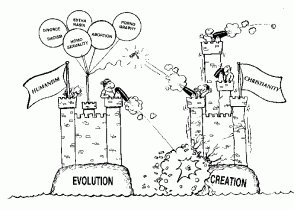
AIG foundations

Supporting evolution, for Ken Ham, means supporting abortion and homosexuality.

Throughout his long career, Henry Morris insisted that only a rigid, literalistic, radical creationism stood between true religion and a host of pernicious ideas. In The Long War Against God, for example, Morris warned that a poetic reading of Genesis would mean an endorsement of “premarital sex, adultery, divorce, and homosexuality” as well as ”Unrestrained pornography. . . . [and] Prostitution, both male and female.” Don’t forget, Morris warned, that “evolutionary thinking” lead to “abortionism.” And the Holocaust. As well as, presumably, cannibalism, not to mention “the modern drug crisis (rock music, peer pressure, organized crime, etc.)”

When Henry Morris insisted on reading Genesis as literal rather than poetic, he wasn’t making a theological statement. He was not making a scientific statement. Rather, Morris was appealing to America’s fundamentalist impulse, the desire of many conservative Christians to draw the line somewhere.

For Morris and his erstwhile protégé Ken Ham, the threat of evolution isn’t really theological or scientific. Rather, as Ham never tires of repeating, evolutionary thinking is the foundation of a host of modern social ills, from abortion rights to LGBTQ rights; from youthful disrespect to internet pornography.

I can’t help but wonder if Ham is aware of the long history of his poetry defense. Does he know that Bernard Ramm used the same argument against his mentor’s radical young-earth beliefs? Does Ham just not care? Or, rather, does he understand that his followers don’t really care about science or theology, they are just looking for someone to tell them where to draw the line, where to take up a fundamentalist defense of traditional values?


I Love You but You Didn’t Do the Reading

Hot enough for ya? Even in this July heat wave, the interwebs kept cranking out stories about schools and dinosaurs n stuff. Here are some of the top items in this week’s news roundup:

“We Believe in Dinosaurs:” the new radical-creationist documentary is out. A review at LHL.

Lots of talk about Biden, busing, and the 1970s.

Israel’s minister of education comes out in favor of LGBTQ “conversion” therapy, at Newsweek.

Interview with Elaine Howard Ecklund on the love affair between science & religion, at BBC.

Divinity is out at Liberty U., but pop music is in, including The Jonas Brothers’ dad. At RNS.

The passion we have is not just to train a bunch of people to go into the music industry — or just go into the Christian music industry, for that matter — but to be equipped as musicians that go into the music industry fully equipped to do what they believe God’s called them to do, whether it’s the mainstream market or the faith-based market.

What should an online teacher do when she sees a child being abused on the other side of the planet? At EdSurge.

What do you call yourself when you’re Catholic but you feel evangelical? How about “born-again Catholic”? At RIP.

East Carolina University couldn’t have denied Trump a forum to “send her back” even if they wanted to, at CHE.

Feminist “hate speech:” The gender wars roil academic philosophers, at IHE.

Can Massachusetts Ban Creationism?

Or maybe the more important question is this: Will this bill work? Its goal is to keep “science denialism” out of the Massachusetts curriculum. I’m all for it, but I don’t think it will actually do the job.

AIG camp

They may be kooky, but radical creationists are also “age-appropriate.”

Here’s what we know: According to the National Center for Science Education and the Lowell Sun, a bill before the state legislature would ban climate-change denialism, anti-vaxxism, and creationism from the state’s curriculum. The bill’s sponsor said that his goal was to prohibit teaching that climate-change denialism deserves equal consideration to climate-change science.

As one supporter put it,

The fact that there are many people who believe and insist the earth is flat — enough to fill a whole cruise ship, it turns out — or that vaccines are deadly or who believe evolution is not real and that climate change is not taking place and that more carbon dioxide in the atmosphere doesn’t matter is all evidence that science education needs to be strengthened and kept understandable against those who would deliberately sew [sic] confusion.

As always, the devil will be in the details. The mechanism of this bill would be to insist on only “peer-reviewed” and “age-appropriate” materials in science classes.

And there’s the rub.

As SAGLRROILYBYGTH are well aware, radical young-earth creationists are not simply science “denialists.” They do not pooh-pooh peer-reviewed research or age-appropriate materials. The radical group Answers In Genesis, for example, operates its own clunky “peer-reviewed” research journal.

aig peer reviewed

If “peer-reviewed” is the rule, they can follow it…

And whether you love them or hate them, the fundamentalist creationist missionaries at AIG produce plenty of “age-appropriate” materials. They are always trying to convince and convert America’s children to their Flintstones-level science. It might not be good science, but there’s no doubt that it is “age-appropriate.”

I support Massachusetts’s efforts to keep their public-school science classrooms secular. I agree that we should not teach zombie science or other forms of theologically motivated science in public schools. Unfortunately, however, I don’t think this bill will do the trick.

Dragging Creationism into the Twenty-First Century

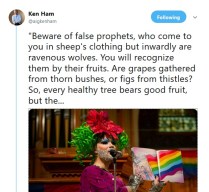
At first, it might seem confusing. Why is radical-creationist pundit Ken Ham so upset about men in heels? It might seem like “Sparkle Leigh” has nothing to do with evolution or creationism or any of that. If we want to understand young-earth creationism, however, we need to understand that these sorts of culture-war standoffs are absolutely central to radical creationism itself.Ken Ham drag school

Here’s the latest: Ken Ham of Answers In Genesis has been warning about the looming threat of men in drag reading books to schoolkids. As Ham warned last year,

If you think our Western culture can’t get any more perverse than it already is, think again! In a new trend, public libraries in America are hosting “Drag Queen Story Hours,” where drag queens (generally, men who wear feminine clothing or makeup to entertain people) come and read books, sing songs, and do crafts with children in the library.

What does that have to do with the idea of a young earth, a literal world-wide flood, and the rejection of modern evolutionary science? Well, nothing, from one perspective. Accepting the power of evolutionary theory does not somehow force people to endorse drag culture. Accepting a non-literal reading of the Book of Genesis doesn’t either.

On the other hand, if we hope to understand radical creationism, we have to understand the fact that things like drag culture, changing gender norms, and even pedophilia are absolutely central. Radical young-earth creationism has always been about building walls to fend off looming cultural changes, not building labs to produce new scientific ideas.

As I’m arguing in my new book (exciting news on that front coming soon), radical creationism is not really a protest against the science of evolutionary theory as such. Rather, radical creationism is all about holding the line against changing cultural norms. Back in the 1950s, when conservative-evangelical Bernard Ramm promised his evangelical friends that science should not scare them, fundamentalists disagreed.

The radical-creationist movement was born out of a deep-seated feeling that traditional American culture was threatened. Evolutionary theory became the canary in the devil’s coalmine, but the real threats came from elsewhere. Changing sexual norms, changing gender relations, and changing attitudes about everything from proper dress to proper politics fueled the movement.

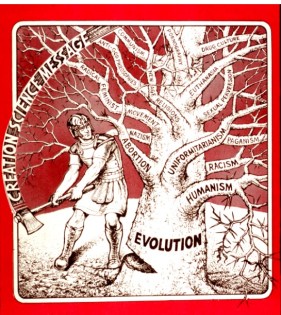
evil tree new

Why attack evolutionary theory? Let me count the ways…

At its heart, however, radical creationism has never actually been about evolution itself. Rather, as cartoons and pamphlets have shouted for decades now, evolution is only the convenient place to draw the line, the convenient place to defend against everything from feminism to abortion to communism.

So why is Ken Ham so upset about men with sparkles and heels? It’s not really about evolutionary theory, but it is absolutely central to radical creationism.

What Is Pat Robertson Up To?

You heard it here last: Pat Robertson has come out against Alabama’s new anti-abortion law. It is not an isolated incident. As SAGLRROIYBYGTH recall, Robertson has also recently criticized radical creationism. We have to ask: What is Robertson doing?

Here’s what Robertson said:

I think Alabama has gone too far. They passed a law that would give a 99-year prison sentence to people who commit abortion. There’s no exception for rape or incest. It’s an extreme law. They wanna challenge Roe versus Wade, but my humble view is this is not the case we wanna bring to the Supreme Court because I think this one’ll lose.

On its face, this could be a simple strategy statement. Fight abortion rights? Sure—but do it in a way that will win. Given Robertson’s other recent culture-war positioning, however, I can’t help but wonder if there is something else going on.

Consider Robertson’s recent statements about young-earth creationism. Not only has he mocked young-earth beliefs as “nonsense” and “embarrassing,” but he has promised to add a class at his Regent University to help conservative Christians combat young-earth ideas.Ham v robertson

Is Robertson trying to situate himself as a reasonable Christian conservative, different from the hard-right folks? Is he willing to bet his culture-war credentials against radicals such as Answers In Genesis’s Ken Ham and Alabama’s Terri Collins? And, if so…do you think it will work? Can Pat Robertson create political space for a not-quite-so-radical Christian Right?

Why Progressives Should Cheer for Creationism

Good news for science, but bad news for progressive culture warriors: We’ve got a smart conservative voice preaching to the creationist choir. In National Review this week, geneticist Razib Khan makes the obvious case that conservatives should not paint themselves into a science-denial corner.  If conservatives were to listen to Dr. Khan, progressives would be in trouble, but there’s no need for my fellow progressives to fret.

jindal

Why won’t Dr. Khan’s argument get anywhere? Exhibit A:

As I’m arguing in my new book about creationism (more news on that front soon), there is no logical reason for evolutionary theory to be so scary to American conservatives. As Dr. Khan sensibly explains,

evolutionary biology is nothing for conservatives to fear, because it is one of the crowning achievements of modern Western civilization. It should be viewed not as an acid gnawing at the bones of civilization, but as a jewel. The science built upon the rock of Charles Darwin’s ideas is a reflection of Western modernity’s commitment to truth as a fundamental value. And many Christians well-versed in evolutionary science find it entirely compatible with their religious beliefs.

Absolutely true. Moreover, Dr. Khan points out a strategic truth that should leave progressives trembling. Namely, if conservatives ever got over their evo-phobia, they would have a powerful new weapon with which to fight culture-war battles. As Khan puts it,

the political implications of evolutionary biology do not favor the Left. Today many on the Left reject the very idea of human nature, to the point of effectively being evolution deniers themselves. They assert that society and values can be restructured at will. That male and female are categories of the mind, rather than of nature. In rejecting evolution, a conservative gives up the most powerful rejoinder to these claims.

Khan hopes to turn the culture-war tables. For example, if conservatives could put together credible arguments against same-sex marriage based on science rather than the Bible, they would have a far stronger political case. After all, almost all American voters revere the idea of science (even if they sometimes define ‘science’ in odd ways), but only a minority care about the Bible.

Moreover, Dr. Khan has history on his side. Historically, evolutionary theory has been used politically to fight for a wide range of political ideologies. Back in the 1920s, for example, it was the politically progressive pro-evolution side that used evolutionary theory to fight for eugenics and “scientific racism.” There is no logical reason–theological or otherwise–why today’s conservatives could not use evolutionary theory to fight for their conservative political beliefs.

However, there is one enormous flaw in Dr. Khan’s argument. Yes, conservatives should embrace evolutionary science. They should turn the idea of ‘evolution’ into a battle field instead of merely retreating from it. But they won’t.

Consider the case of former Louisiana Governor Bobby Jindal. Jindal is a smart cookie—Ivy League degree, biology major, Oxford graduate degree…the works. There is no doubt that Governor Jindal understands the scientific power of evolutionary theory. Yet when he was asked about his policy on creationism, Jindal hedged. He hemmed and he hawed and he finally agreed that he wouldn’t want to tell anyone that they should learn about evolutionary theory.

What does any of that have to do with Dr. Khan’s argument? Plenty. Evolutionary theory is a simple no-go for American conservatives. It’s a third rail. Conservative politicians will have no more luck embracing Dr. Khan’s suggestion than progressive ones would have with Larry Summers’ ideas about gender.

So for that reason, progressives should celebrate the political power of creationism. In many ways, the conservative coalition’s addiction to fighting evolutionary theory is one of its greatest weaknesses. Progressives’ only hope is that smart conservatives like Dr. Khan remain lonely voices shouting into the anti-science conservative wind.

I Love You but You Didn’t Do the Reading

Dive in to the latest collection of stories from the interwebs of interest to SAGLRROILYBYGTH:

Pat Robertson mocks young-earth creationism on his 700 Club, at CN.

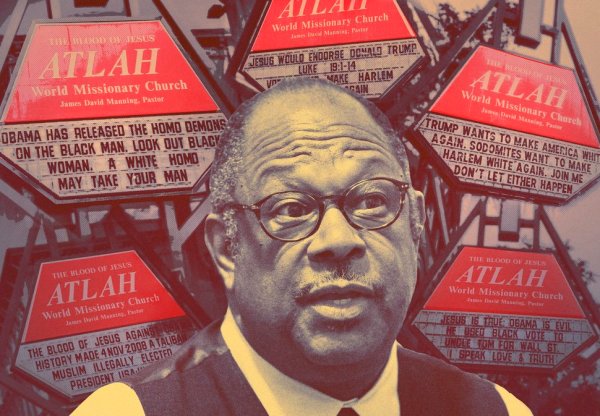
manning atlah

Westboro, NYC.

Westboro, NYC: Stories of child abuse from religious school leader, at HP.

People who attended the school describe its leaders as being rabidly homophobic. Manning would often talk about evil “faggots.” Teachers would echo those sentiments, describing gay people as demons who were doomed to go to hell. A message from Manning on the school’s website directs parents to “Stop the homosexual brainwashing of your children!”

Christians under attack, at AC.

Such ideological efforts have spawned not only attempted social ostracism, but a culture ripe for anti-Christian violence by the mentally unhinged.

Methodist colleges face LGBTQ dilemma: Should they stay or should they go? At CD.

Will Senator Warren’s college-debt plan lift her chances in 2020? Large majorities support the plan, even if they don’t support Warren. At TH.

Why are evangelical megachurches adopting Catholic traditions? At America.

old school Catholic practices are in. Yes, that celebrity Protestant pastor is wearing a stole with Our Lady of Guadalupe on it.

Synagogue shooting: Is the Orthodox Presbyterian Church to blame?

Did Common Core work? Not really, at Chalkbeat.

Creationists Lovin Trump

I admit it: I don’t get out much. And when I do, I mostly hang out with people a lot like me. And people like me don’t understand how anyone could like President Trump. So I’m always curious about the people who are lovin Trump.

Creationists lovin trump

Young-earthers agree: GOAT!

I got a clue this afternoon–turns out at least one young-earth creation aficionado agrees with Rachel. I couldn’t help myself and I scanned through some of the other comments. Why do Americans love Trump? people lovin trump

For some of them, at least, Trump is a real hero, not just someone who will stack SCOTUS with anti-abortion justices. As “Funkfuzz” contributed, some see Trump as the hardest-working, toughest-talking “lover of America” we’ve ever had in the White House.

I don’t see it, but I do understand why some radical creationists love Trump so much. After all, as I’m arguing in my new book about American creationism, radical young-earth creationists don’t really disagree with other creationists about theology. That is, young-earth creationists are usually not more conservative in their theology than are other types of creationists.

The thing that distinguishes young-earth creationists most sharply from other evangelical creationists is not their theology. Rather, it is a deep cultural conservatism, a nostalgic yearning for a Christian America that never was. It’s no surprise, then, that radical young-earth creationists would hop on board the Trump train, hoping to Make America Great Again.

The Creationist Debate We Really Need

Finally! I hope Pat Robertson takes him up on it. Far more than the meaningless 2014 debate between Bill Nye and Ken Ham, a face-to-face discussion between different types of Christian creationists would pack a lot of punch.

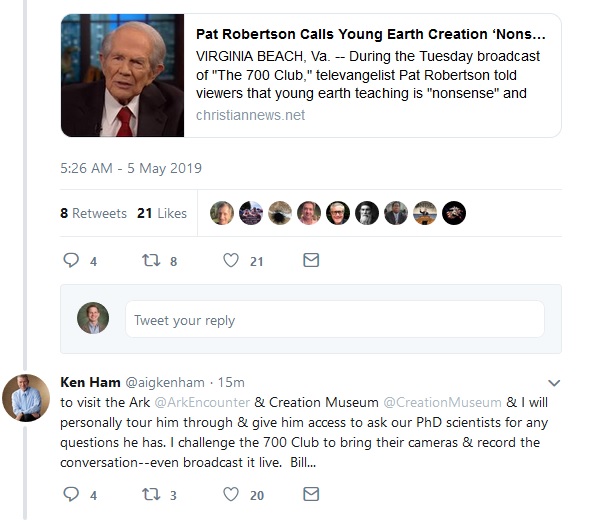
Ham v robertsonHere’s what we know: As he has done in the past, aged Christian culture warrior Pat Robertson has publicly mocked young-earth creationism. On his apparently-still-a-thing TV show 700 Club, Robertson offered the following tidbit,

You know, this universe that we live in is about 14 billion years old and there’s no question about it. . . . And we have tremendous geological records and all the rest of it. And that 6,000-year stuff just doesn’t compute. But we, as Christians, we need to know the truth.

Robertson has also put his college where his creationism is. He has added a course in anti-young-earth-creationism for students at his Regent University. Is he still a creationist? Absolutely! Is he still conservative? Definitely! And does he oppose the idea that “real” Christians need to shut themselves off from modern science? Yes he does.

And that’s why Robertson’s version of creationism is such a deadly threat to radical young-earthers like Ken Ham. And Ham knows it.

So this morning Ken Ham challenged Pat Robertson to an intra-creationist debate. To this non-creationist observer, it seems like a much more important kind of debate than the one between Ham and Nye.

As SAGLRROILYBYGTH will recall, back in 2014 both Ken Ham and Bill Nye could afford to be affable and courteous. Neither of them had much chance of convincing people on the other side of the issue. That is, Ham’s young-earth creationists weren’t likely to be suddenly converted to a secular scientific mindset. And Nye’s “Science Guy” fans were not about to become radical young-earth creationists.

bill-nye-ken-ham-debate-wide

Snooze-a-riffic.

A Ham/Robertson debate would be much different. As I’m arguing in my new book about creationism (stay tuned for exciting news on that front soon), the real trench lines in America’s long culture war about creationism are not between secular Science Guys and radical young-earth creationists. Rather, the most bitter fights are between different types of Christian creationists, fighting to establish their specific vision of creationism as The Real Christian position.

That’s why Ken Ham is so terrified of Pat Robertson. Any credible conservative evangelical has the chance to steal Ham’s creationist followers. In the past, you may recall, Ham flatly refused to even meet with the conservative evangelical creationists at BioLogos.

Why? Because unlike Bill Nye, competing Christian creationists speak the same language as Ken Ham. They value the same Biblical precepts. They cherish the same theological commitments. If conservative Christians hear from competing creationists, they might realize that the young-earth emperor doesn’t really wear any clothes.

Conservatives Should Be Nervous About This

I’m no conservative, but if I were I wouldn’t be celebrating this recent essay by David French. I’d be quaking in my penny loafers. If we’ve learned nothing else from the history of the culture wars, it’s that this kind of talk heralds the bitter end.

Here’s what we’re talking about: In the pages of National Review this week, conservative pundit David French made the case for freer conservative speech on college campuses. He decried the tactic used by progressive students to declare conservatives beyond the pale of civil discourse. Too often, French lamented, aggressive progressives freeze out any conservative challenge by labeling it “dehumanizing.”

As French puts it,

An atmosphere that is devoid of truly meaningful debate is one that is more likely to give birth to bankrupt ideas. And the woke progressive monocultures in quarters of academia and Silicon Valley have advanced and protected both the idea that speech is violence and the idea that disagreement is dehumanizing — especially when disagreement touches on matters of race, gender, and sexuality.

As SAGLRROILYBYGTH are aware, I’m no conservative myself, yet I’m on the record as agreeing with French that college campuses should welcome real culture-war debates. If I were a conservative, though, I would be terrified to hear French talking this way. If I knew my culture-war history, I’d know that this line of argument is always a memorial to a battle lost long ago.

Consider the case of creationism in public schools. A hundred years ago (ish), at the Scopes Monkey Trial in Dayton, Tennessee, the defenders of evolution education pleaded with America to allow evolution to be heard. As lead attorney Dudley Field Malone made his case,

For God’s sake let the children have their minds kept open — close no doors to their knowledge; shut no door from them. Make the distinction between theology and science. Let them have both. Let them both be taught. Let them both live….

It was a desperate argument for a losing side. Evolution education was not popular in 1920s America, at least not in places such as Dayton, Tennessee. As I discovered in the research for my first book, anti-evolution laws were usually only the sharp point of a much vaster campaign to impose theocratic rule on America’s public schools.

Fast forward seventy years, and the argument had switched sides. By the 1990s, it was the radical creationists who were pleading to have children’s minds kept open. They made their case for inclusion because by the 1990s creationists were just as desperate as Dudley Field Malone was in the 1920s. In 1995, arch-creationist Duane Gish told crowds it was now the creationists who were frozen out. Gish insisted he only wanted to fight against the “bigotry” of excluding creationism.

If you aren’t at the table, you’re on the menu…

What does any of this have to do with David French? A lot. Evolution-lovers like Dudley Field Malone only pleaded for inclusion when they were frozen out. Radical creationists like Duane Gish only begged for inclusion when they had already decisively lost the creationism culture war. By the 1990s, Gish’s brand of young-earth creationism had already become a relic of an imagined fundamentalist past, a fossilized idea that no longer had any real chance of returning to its spot in the American mainstream. It was still popular in fundamentalist pockets, but it had zero chance of returning to its former glories in the Princetons and Harvards of these United States.

If I were a conservative, I’d worry that French’s let-me-in rhetoric heralds the same sorry state for his outdated ideas about sexuality, gender, and race. Don’t get me wrong: I think there are strong conservative arguments that can be made in favor of greater inclusion of traditional sexual norms, but French ain’t making em.

The idea that traditional gender ideas should be included because all ideas should be included won’t convince anyone. Moreover, the fact that French feels obliged to make this case shows how desperate he is. If I were a conservative, these kinds of arguments would make me very nervous about the current state of conservatism in America.