You Don’t Need a Young Earth to Get to Heaven

Do creationists use intimidation and spiritual threats to coerce young people to believe?  Not as often as some critics assume.

Young-earth creationist leader Ken Ham of the organization Answers In Genesis repeated his call recently that Christians do not need to believe in a young earth.

For outsiders like me, this can appear puzzling.  After all, those of us outside the circle of conservative evangelical belief often assume that all conservative evangelical Protestants spend their time sweating over their eternal fate.  We might make the mistake of assuming that conservative evangelicals thrive by threatening sinners with hellfire, brimstone and damnation.

Take, for example, the Christian beliefs of young-earth creationists.  From the outside, it’s tempting to assume that the more insistent YECs must somehow bully new generations into embracing their beliefs.  After all, those beliefs are so radically different from the ones embraced by mainstream science that it seems impossible for young people to become YECs unless compelled.

This is why some prominent atheists have called this kind of creationism “child abuse.”  As we’ve seen in these pages, smart young people brought up in the faith have wondered why their trusted adult leaders sold them a scientific bill of goods.  As Anna wondered recently in her illuminating ILYBYGTH series about her youth as a YEC, “It is still a bit difficult for me to look back on authority figures and members of my community that I looked up to and respected and wonder: are they just ignorant, or are they purposely deceptive?”

For us outsiders then, it can seem surprising that arch-creationist Ken Ham takes time to point out that young-earth belief is not a salvation issue.  That is, Ham insists that good Christians can disagree about the age of the earth.  As he puts it,

Many great men of God who are now with the Lord have believed in an old earth. Some of these explained away the Bible’s clear teaching about a young earth by adopting the classic gap theory.

Others accepted a day-age theory or positions such as theistic evolution, the framework hypothesis, and progressive creation.

Scripture plainly teaches that salvation is conditioned upon faith in Christ, with no requirement for what one believes about the age of the earth or universe.

Ham hastens to add that discarding a belief in a young earth can have “very severe consequences.”  In sum, since the Bible clearly describes the origins of earth, disregarding that message puts Christians on the very slippery slope to disregarding Biblical authority as a whole.

“All biblical doctrines,” Ham concludes, “including the gospel itself, are ultimately rooted in the first book of the Bible.”

Make no mistake: Ken Ham wants you to believe in a young earth.  But this is not a threat.  This is not a tent-preacher warning that only YEC can save your soul.

Too many outsiders like me ignore these kinds of nuance in the intellectual world of conservative evangelical Protestantism.  We end up calling YECs child abusers or worse, without taking the time to understand the real culture of young-earth creationism.  That might make for good headlines, but it does so at the heavy cost of relying on caricature rather than reality.

Allmon at EVoS

Clear your calendars!

Next week Professor Warren Douglas Allmon will be traveling down scenic Route 96 from Ithaca to talk about creationism.

Allmon’s talk, “Creationism in 2013: Not in the Headlines but Never Far Away,” will be on Monday, November 18, at 5:00 in room AG008 on the beautiful campus of Binghamton University in sunny Binghamton, NY.  The talk will be free and open to the public; no registration is required.

It will be part of the continuing series of Monday seminar talks hosted by the Evolutionary Studies program here on campus.

Allmon is the Hunter R. Rawlings III Professor of Paleontology at Cornell.  He also runs Ithaca’s Museum of the Earth.

I’m excited to hear what Professor Allmon has to say.  A couple years back, Allmon argued in the pages of Evolution: Education and Outreach that evolution educators must begin by understanding the reasons for resistance, not just riding roughshod over it.  As he put it,

This multiplicity of causes [for rejecting evolution] is not sufficiently appreciated by many scientists, educators, and journalists, and the widespread rejection of evolution is a much more complicated problem than many of these front-line practitioners think it is.

Hear hear!  If you want to hear what Allmon has to say, come on down.  Hope to see you there.

Faith & Physics, Part II

ILYBYGTH is happy to continue our series of guest posts from Anna.  In her first post, Anna described her shift from creation science to mainstream science.  Today she tells us a little bit about the way she learned her creationist science as a kid.  Anna blogs about her experiences leaving the fundamentalist subculture at Signs You Are a Sheltered Evangelical.  She holds an M.Sc. degree in Astroparticle Physics and currently lives in Virginia with her fiance Chelsey and a cat named Cat.

Creationist Curriculum

I am a conservative, anti-government-educator’s dream.  Because I was homeschooled, my family had the unique opportunity to control every aspect of my education completely.  Part of this included being taught with a Christian science curriculum that supported Biblical 6-day creation, denied Evolution, described scientific evidence for a global flood, and opposed modern environmental policies.  When I tell my secular peers this, the reactions of shock, horror, and amazement are often rather comical.  Very often, I am told that I must be remarkably resilient or intelligent to be able to make a successful science career for myself after being handicapped by my early education.  As much as I’d love to accept the accolades, I simply don’t see it that way.  My seemingly-bizarre education did not hamper me much at all, and in some ways, I must credit it for inspiring me to become a scientist in the first place.  Although I cannot defend the inaccuracies in the curriculum, I still have fond memories of it, and I can highlight both the shortcomings and successes of the book series.

My formal science education, I believe, started around age 10 or 11 (since I was homeschooled, I did not progress through formal grades, so it is sometimes very difficult for me to track the passage of time without these milestones to help.)  I was started on an A-beka book, which I remember little of besides loathing.  It was spiral bound with wire and the pages were made of cheap paper, meaning that they were constantly tearing out, scattering across the floor, and getting lost.  Besides that, the text itself was dry, the pages were cluttered with illustrations that illustrated nothing, and the quizzes (aptly named “brain drains”) never seemed to pertain to the actual text and would often quiz you in facts only found in the illustration captions.

For the rest of my pre-college education, I used Apologia‘s Christian-centered curriculum by Dr. Wile, and I loved it.  Over the years, I worked through Exploring Creation with General Science, Exploring Creation with Physical ScienceExploring Creation with Biology, Exploring Creation with Chemistry, Exploring Creation with Physics, and Advanced Physics in Creation.  I wish that I had a copy of some of these books still with me… especially the 1st edition of General Science and Physical Science (if anyone feels like getting me an early Christmas present… I won’t say no) because I recall those two books having the most absurdities in them.  Obviously, I cannot cover all of the curriculum in detail, but I can shed some light on the divergences from science that I recall.
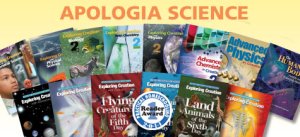
Image Source: Apologia

Image Source: Apologia

I have to laugh now recalling that one of the books (General Science, I think) had an entire chapter devoted to attempting to validate the Bible as an accurate scientific and historical record.  This would seem grossly out of place in any standard science text.  For a creationist, however, it is perfectly reasonable and, indeed, necessary to discuss this in depth.  I recall in my early years of college, seeing my peers and professors laugh at the absurdity of creationism.  “Scientists start with evidence and draw a conclusion from it.  Creationists start with a conclusion and draw evidence for it,” was posted on my professor’s office door.  I felt a little defensive.  “We all tend to accept conclusions that come from reputable, repeatedly-tested sources,” I thought.  “If the Bible were not reputable and repeatedly-tested, then obviously accepting claims from it would be absurd, but that is not the case.”  Much of my conviction on the validity of the Bible originated from the early Apologia texts.  It’s important to remember that Creationists do not see themselves as anti-science… they want to find compelling evidence for their claims.  As a result, I waded through a chapter discussing the accuracy of Bible translations, similarities between different Biblical manuscripts, refutations of Biblical contradictions, etc.  The purpose of this was to prove that the Bible could be reliably used as a basis for scientific theory.  To exclude this chapter would be grossly negligent if claims in the Bible are indeed the basis of your theory.  Even so, the whole conversation bored me; I wanted to learn science.

The Physical Science textbook spent an inordinate amount of time condemning modern environmental policies as fraudulent.  I recall the book passionately opposing the ban on CFC’s, claiming that the ozone hole was a scare tactic used by politicians to promote a hysterical agenda, and predicting that people would suffer from increased rates of infection now that medical tools could no longer be sterilized by the chemical.  These political discussions now irritate me more than any of the other inaccuracies in the books.  I had been raised when I was young in a very rural area and had developed a great love of nature.  I was fiercely protective of the environment, and all of the flora and fauna in it.  I wrote an article to my local newspaper about reducing litter when I was 11 years old or so which I was very proud to see published.  As such, it angers me in retrospect that I was taught so many lies about proper stewardship of the environment and that I believed them for so long.  I have never fully understood why Christian Fundamentalism is so opposed to environmental protection, and yet it seems to be a common theme.  Apologia science chose to start kids on that path early.

The Biology text book focused on disproving Evolution.  Of course.  In all honesty, as silly as 6-day-creation seems to me now, my Bible-based text book really did not deprive me of a decent education on evolutionary biology.  Because of the sheer amount of information I was provided with to refute Evolution I came away with a pretty darned good understanding of it.  I disbelieved it, of course, but once I came around to accepting true science, I was no further behind in understanding than any of my secular peers.  This is why the shock-and-horror response to my anti-evolution education makes me chuckle a little.  If one truly wants to argue effectively against an opponent, one must know his position at least as well as he does.  Thus, I truly believe that my anti-evolution text served me surprisingly well.

Now that I’ve discussed all of these lies, distortions, and absurdities, you might wonder how I can have a favorable memory of Apologia at all.  Well, for one, the books were very well written.  Their style was conversational, without sacrificing content.  The illustrations were meaningful and placed sparingly to complement the text, rather than cluttering the book.  Learning felt like learning… like you were truly on a road to discovery, rather than simply memorizing information for a test.  And, perhaps most awesome of all, if you emailed the author, he would email you back within 24 hours.  If I ever found myself confused by a concept or curious about some theory, I would write to him and eagerly await his response.  He was always friendly and informative with his replies.  Perhaps my enthusiasm over this simple email contact seems exaggerated but, remember, I was homeschooled.  I was almost entirely in charge of my own education by the time I reached higher sciences.  My mother did not have the education to help me in science or math, and none of the other homeschooling moms in my group were any better.  Whenever I was uncertain about something, I would have to figure it out myself.  Thus, having an authority figure to direct my questions to was amazing.  I felt like I was talking to a celebrity.  My childish enthusiasm aside, I think that it also highlights Dr. Wile’s admirable dedication to education.  It meant a lot to me at the time, and I still think back on it fondly.

Dr. Wile was one of my inspirations to become a scientist.  I loved his enthusiasm for the subject, I loved his dedication to the students using his books, and I wanted to emulate that.  Honestly, I still do.  As an instructor, I strive to let my enthusiasm show, to infect others with it, and to always make myself available to my students for questions and assistance.  But what about the science-denial?  It is still a bit difficult for me to look back on authority figures and members of my community that I looked up to and respected and wonder: are they just ignorant, or are they purposely deceptive?  How can a scientist be completely honest with him- or herself and still make the claim that ALL evidence points to a 6-day creation, without question or doubt?  I give myself a lot of grace for my early ignorance because I was young and had little access to any information outside of the pre-approved worldview that I was being fed.  But creationists like Ken Ham, Dr. Wile, and others have no such excuse.  So, without being able to see inside their minds, can I offer them the grace of assuming that they are truly honest in their seeking and have just been misled?  I think the answer is both yes and no, and it is greatly complicated by a wide array of cultural factors involved in the creation/evolution debate.  In order to begin to tackle this, I need to first discuss the factors and pressures that surround a creationist belief in the first place.  For that, however, you will have to wait for the next installment.


Public Schools and the Culture of Death

Do public schools disregard the sanctity of life?

That’s the charge recently from Answers In Genesis’ Ken Ham.  Ham responded to an article in which a public-school textbook author wondered about when life begins.  Ham’s argument can tell us a few things about religion, creationism, and public schooling.

Ham, arguably America’s leading young-earth creationism advocate, argued that Dr. Ricki Lewis failed to promote a Biblical vision of the beginnings of life.  Lewis argued that science could not offer a simple explanation of the point at which life began.

As she wrote,

that is a question not only of biology, but of philosophy, politics, psychology, religion, technology, and emotions. . . . textbooks list the characteristics of life, leaving interpretation to the reader.

Dr. Lewis offered seventeen common interpretations of the beginnings of life, from pre-conception to birth to puberty.  In her opinion, the best answer was somewhere in the middle.  Life became life, she thought, at roughly week 22 of pregnancy, the point at which most babies can survive outside the mothers’ wombs.

Ham disagreed.  “Sadly,” he argued,

Dr. Lewis’s conclusion is false. She reaches it using human reasoning rather than the Word of God, and that’s likely how biology writers and teachers across the country are instructing their students to determine when life begins. No wonder so many think that abortion is not killing a human being—or really murdering a human being!

For those of us who follow the educational culture-wars from the sidelines, Ham’s argument can tell us a few things.  First of all, it helps us understand that many creationists care about more than just evolution.  They have much broader religious visions for schooling.  Second, it shows us that many religious conservatives have already given up hope for public schooling.

For those new to the creationism/evolution scene, it may seem surprising that a young-earth creationist such as Ken Ham would be interested in issues such as abortion and the beginnings of life.  But Ham and other creationists are first and foremost conservative evangelical Protestants.  Creationism may be the issue for which they garner the most attention, but other issues such as gay marriage and abortion remain of central interest.

Also, Ham’s post shows the attitude shared by many religious conservatives about public schooling.  Ham takes it as a given that public schooling is fraught with perils to faith.  He opens his argument by reminding readers that public schools have been traveling down a dangerous road for some time.  As he puts it,

One of the major trends many of us have witnessed over the years has been the way God has basically been thrown out of the public education system, including secular colleges and universities. Students often have to contend with teaching that is contradictory to God’s Word—especially when it comes to the origin of the universe.

Abortion, climate change, evolution, gay marriage…all are of central interest to conservative activists.  And, most important for these pages, all issues in which schooling and education will continue to play a central role.


BioLogos: Comments Are Back

Good news for those who want to see more open dialogue on vexing questions of God, creation, and evolution.  The “evolutionary creationist” group BioLogos has reinstated its open-comment policy on its blog.

As we reported recently, BioLogos decided to nix those comments.  After reader uproar, they’ve decided to put them back.  As Content Manager Jim Stump explained,

While we want to introduce new paths for dialogue via a “Letters to the Editor” feature, we see now that we didn’t need to shut down an existing forum for communication. We’ve heard stories of how the comments section has been a haven for gracious dialogue, and of how it continues to be a key part of our witness to the church and the world. We want to build on that dialogue, not close it off. So the comments section is back.

Hear hear.  As Stump explained, the comments on a site such as BioLogos provide a unique forum.  In his words,

There are too few organizations that allow the free flow of discussion about these issues; we want to continue to be one of them.

Let’s give the folks at BioLogos credit for being willing to change their policies.  Too often in these kinds of discussions, petty resentments and stiff backs prevent sensible shifts like this one.


Should Adults Lie to Children?

I’ll say it: Lying to children is a vital part of a good education.

Adults lie to children all the time.  Santa Claus. Easter Bunny. Tooth Fairy. Daddy will eventually come home again…

But can such lies be considered “education?”  Our attitude toward this question might tell us a thing or two about the continuing culture wars over American education.

The question came up again in Professor Jerry Coyne’s review of Jonny Scaramanga’s Salon article.  For those of you who just joined the party, Professor Coyne is an irascible atheist and scientist.  He is an inveterate campaigner against creationism and delusional religionism.  Scaramanga is a recovering fundamentalist, blogger, and sometime contributor to these pages.  Scaramanga’s Salon article decried the repackaged fundamentalist curricula that are being taught in some publicly funded charter schools in Texas.

In response, Coyne thundered,

Adults have the right to be as stupid as they want, but I don’t think they have the right to tell lies to children. Those lies include not only religious dogma, but the antiscience attitudes that come with it. How sad that a group of bright and curious children can become ignorant, superstitious ideologues simply because they were born into the wrong families.

Professor Coyne is not the first science pundit to take this position.  In his 1964 anti-creationism book This View of Life, paleontologist George Gaylord Simpson blasted the lies that had thwarted evolution education.  “Even now,” Simpson argued,

a hundred years after The Origin of Species, most people have not really entered the world into which Darwin led—alas!—only a minority of us.  Life may be considerably happier for some people in the older worlds of superstition.  It is possible that some children are made happy by a belief in Santa Claus, but adults should prefer to live in a world of reality and reason.

But as anyone involved with education knows, adults lie to children all the time.  Doing so is a vital part of every good education.  Let’s look at a couple of examples.

1.) “This is what we believe.” 

Every education, in every culture, whether it means formal schooling, apprenticeships, or informal instruction, includes the passing along of central ideas.  Professor Coyne meant that adults should not tell young people things that are untrue.  But what if the adults believe it fervently?  Is that a lie?  Or, to complicate the matter, what if the adult isn’t sure if she believes it fervently, but is convinced that it will be good for the young person to believe?  For example, in the world of religious faith, an adult may have had serious doubts about her faith, but decide that a young person is not yet mature enough to consider those gray areas.  She might then tell young people that certain religious mysteries are simply truths, knowing that later the child will and should wrestle with the more complicated questions about it.

2.) “You can do this.”

This can be a flat-out lie.  Teachers and parents often work to inspire confidence in their children and students, even when the adults are very unsure of the truth of their statements.  Adults may have serious doubts that young people can, indeed, accomplish certain goals.  Yet the adults might tell the children that such goals are definitely, absolutely, 100% achievable.  It’s a lie.  But it is something good parents and teachers do.

3.) “I hate phonies.”

In our culture, many of the biggest truths are best understood through lies.  I’m no Salinger fan, but I still remember reading Catcher in the Rye in high school.  I remember Holden’s struggle with phonies.  It taught me important truths about the ways people interact with one another.  None of it was “true,” of course.  It was all fiction, all lies.  But my teacher taught me those lies.  And I’m very glad she did.

Our attitude about lying to young people can tell us a lot about our positions on key educational culture-war issues.  Professors Coyne and Simpson think it is not okay for young people to learn creationism or other religious falsehoods.  But that position doesn’t include room for the complexities of real education.  Adults lie to children all the time, for the children’s benefit.  Sometimes they do so deliberately.

But more often, adults tell children things that the adults think are true.  Creationists don’t set out to deceive their children; they hope instead to protect their children from the deceptions of mainstream science.

But what if we don’t agree that creationism is true?  Are those creationists guilty of lying to children?  Professor Simpson said yes.  Professor Coyne says yes.  Jonny Scaramanga, I’m guessing, would say yes.

I disagree.  Teaching children our core beliefs is not lying.  Even if I think those beliefs are untrue (and I do think young-earth creationist beliefs are untrue), parents who teach such things to their children are guilty of nothing more than educating their offspring.

There is no parental right more fundamental than that.


Commenting, Evolution, and Public Forums

Another prominent website in the evolution/creation debates has changed its comment policy.

As you may recall, Popular Science announced recently that it was shutting off public comments entirely.  Now BioLogos has decided to vet, edit, and publish only select comments, along with author response.

For those new to the scene, BioLogos has made itself the leading voice for theistic evolution, what its leaders often call “evolutionary creationism.”  Founded by evangelical scientist Francis Collins, the organization has hoped to spread the idea that good science and good religion do not need to conflict.  Bible-believing Christians, BioLogos believes, can still embrace evolutionary science.

But that does not mean, apparently, that good manners and blog commenting can go together.  BioLogos’ Content Manager Jim Stump explained their reasoning for changing their public comment policy.  Too much of the online discussion, Stump said, was dominated by a few voices.  Instead of merely leaving comments open, editors will solicit email comments.  Those comments will be organized into a more coherent back-and-forth between commenters and original authors.  The hope is that this model will encourage more participation from more people than the open-forum approach.

Will it work?

If it does, is it worth the price of restricting open dialogue?

Ferocious critic Jerry Coyne called this a “desperation move” by an organization foundering on the shoals of reality.  Too many commenters, Coyne argued, were asking awkward questions and making persuasive arguments.  The real questions—about how God interacts with the world—proved threatening to BioLogos’ position on the compatibility of science and faith, Coyne said.  Too wide a chasm yawned between real science—which recognizes the extremely unlikeliness of humanity deriving from only two people—and evangelical religion—which insists on an historical Adam & Eve.

I don’t share Professor Coyne’s contempt for the BioLogos mission.  I believe the evolution/creation debates have plenty of room for scientific belief that rubs along with religious belief.

But I agree with Coyne that shutting down comments to preclude dominance by a few voices doesn’t make much sense.  The purpose of this sort of online publication is precisely to allow a free flow of ideas and discussion between people who might not otherwise meet one another.  If a few vociferous voices dominate that discussion, so be it.

A better way to include the unincluded would be actively to solicit short columns and opinion pieces by a wide spectrum of readers.  That way, more voices could be included from people who might shy away from the hurly-burly of an active and combative open-comment forum.


Charter Schools Teach Fundamentalism

Can fundamentalist Protestant educators change their packaging and call their new schools charters?

Leaving Fundamentalism’s Jonny Scaramanga argued recently in the pages of Salon that some fundamentalist leaders are doing just that.

As we’ve seen, publicly funded charter schools elsewhere have been accused of simply re-branding religious schools and siphoning off public money.

Scaramanga, a product of the fundamentalist Accelerated Christian Education curriculum and now its fiercest critic, uncovered Texas charter schools in which ACE’s rigid fundamentalist materials are paid for with taxpayer dollars.

Check out the full article.  Scaramanga describes ACE-derived textbooks that promote skepticism toward mainstream evolutionary science.  He found evidence that ACE-influenced charter schools guided students by the Ten Commandments but called them non-religious “success principle[s].”  Most headline-grabbing, the ACE-ish books blamed evolution for the rise of Hitler.

Scaramanga even cites yours truly as a source, so you know his article’s gotta be good.


Do Rich Creationists Deserve the Awesome Fossil?

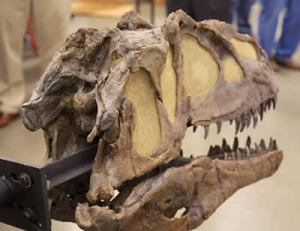
Everyone agrees on one thing: It’s an awesome fossil.

Image source: Answers In Genesis

Image source: Answers In Genesis

So awesome, mainstream scientists complain, it shouldn’t be used to preach the anti-science on tap in Answers In Genesis’ Creation Museum.

Not so fast, creationists retort.  They insist the rare fossil helps make the scientific case for a young earth and a real global flood.

According to a news release from the young-earth creationist ministry Answers In Genesis, a wealthy benefactor donated the half-million-dollar Allosaurus skull fossil to the Creation Museum.  That benefactor wanted the fossil to be used to help make the case for Biblical young-earth creationism.

The skull will be prominently displayed in the Creation Museum.  AIG scientist Andrew Snelling claims that the skull helps prove the historicity of Noah’s global flood.  Since the skull was so well preserved, Snelling argues, it proves an extremely rapid burial, which fits with a catastrophic flood.

Mainstream scientists complain that the skull should reside elsewhere.  Happy Atheist PZ Myers, for example, laments the fact that such a priceless scientific find should be “locked up in a non-research institution and used to gull the rubes.”

In an Associated Press report, Kentucky paleontologist Dan Phelps worried that the Creation Museum would not let mainstream scientists use the skull for research.

This mainstream complaint raises an interesting question: Would mainstream paleontologists conduct research on the skull, even if they were invited?  After all, the presence of scientists from non-creationist research institutions would be a huge boost for AIG’s claims to be a legitimate scientific institution.

Would any mainstream scientists agree to work at the Creation Museum?


Texas Charter School Promotes Religion

Doesn’t seem like news that publicly funded schools in Texas promote religion.  But this story from the New York Times has a twist you might not have expected.

Anyone who pays attention to this stuff might expect Texas public schools to be woefully (or wonderfully, depending on your POV) entangled with religion.  Whether it is preaching in the form of Bible classes, cheerleaders with Bible verse banners, creationism in the science textbooks, or just a general Long-Game style fight for more Jesus and less Devil, Texas schools have long seemed friendly to Jesus.  Texas’ conservative “Revisionaries” have worked long and hard to make public schools friendly for faith.

A recent story in the New York Times features a different sort of religious entanglement.  In this case, it is not a question of teachers leading Protestant prayers, or students protesting against learning evolution.

In this case, a charter school has been accused of using public money to promote the Jewish religion.

The San Antonio school, Eleanor Kolitz Hebrew Language Academy, teaches in Hebrew and has classes about Israeli culture.  Doesn’t seem to be a problem there.  Lots of publicly funded charter schools focus on a specific non-English language and culture.

But according to journalist Edgar Walters, the school has drawn attention as a potential church/state problem since the new charter school seems to be nothing more than a cynical reincarnation of an existing religious school.  Critics worry that religious schools are simply conducting a name change on paper in order to win public money.

School leaders insist they don’t teach religion.  But one board member admitted they have the same head of school and most of the same staff as they did when they were an explicitly religious school.  As a private Jewish day school, the Eleanor Kolitz Academy used no public money.  But now as a charter school in the same building with the same staff, they receive public funding.

Can religious schools reinvent themselves this way?  It does not seem paranoid to assume that things will go on largely as before at the Kolitz Academy.  It seems a little iffy for religious schools to simply make a name change to start raking in public moolah.