School Punishes Girl for Modesty

It sounds like a dystopian fundamentalist fantasy: secular school wardens careening out of control, punishing religious students for having decent morals. But in France this week, a girl was really sent home because her skirt was too long.

Of course, things are different in France than they are in the United States. In France, public schools and institutions are governed by the rule of laïcité. No one may wear religious symbols to school, not headscarves, skullcaps, or big crosses.

In this case, “Sarah K.” was sent home when administrators decided her skirt represented religious garb. Like her friends and co-religionists at the school, Sarah had removed her headscarf as she went in. But her skirt still represented religious attire, school leaders believed. The principal wrote a note to her parents, according to the New York Times, warning them to “rectify her clothes if you want her to continue her schooling.”

"Ta jupe est trop longue..."

“Ta jupe est trop longue…”

In this country, we’ve seen our share of outraged religious conservatives kicked out of public schools for culture-war clothing issues. Remember the flap over the Romney shirt in Philadelphia? Or, up north, remember the kid who got kicked out for his “Life Is Wasted without Jesus” shirt?”

To this uninformed observer, Sarah K.’s case seems like an overreach by overzealous school officials. How can they decide if a skirt is part of a religious outfit, or if it is just a skirt? How can they conclude that Sarah K. intended for her maxi-skirt to be a statement of her religious faith?

Hot & Bothered in Binghamton, New York

Clear your calendars! Next Friday Jonathan Zimmerman will be coming to scenic Binghamton to give a talk about his new book.

Zimmerman is a prolific historian and public intellectual. You may have read his blockbuster books such as Whose America? Culture Wars in the Public Schools. Now you can get your hands on his latest, Too Hot to Handle: A Global History of Sex Education. You may also have seen him in the pages of the New York Times or on The Daily Show.

Who's for it?

Who’s for it?

Next Friday, May 1st, at 4:15 in the Admissions Center, Binghamton University will host Professor Zimmerman for our 23rd annual Couper Lecture. In the past, this lecture series has brought to our campus such luminaries as Bill Reese, Michael Apple, Maris Vinovskis, and many more.

As the sophisticated and good-looking regular readers of I Love You but You’re Going to Hell (SAGLRROILYBYGTH) are well aware, sex ed is one of the touchiest topics in America’s continuing culture wars. What should schools tell students about sex? How much is too much?

In his new book, Professor Zimmerman explodes the boundaries of these debates. The culture war over sex ed, Zimmerman argues, is not merely between conservatives and liberals in the USA. Rather, worries about the right relationship between sex and children spread from the US to cover the globe during the twentieth century.

So slip on your smarty-pants and come on over to our scenic campus. All are welcome, but registration is requested.

Bizarre Attacks on Conservatives

Watch out! Conservative ideas might subject you and your family to thuggish home invasions. Even more creepy, conservative ideas might get you erased from your own personal history. As we observe American conservatism from the outside here at ILYBYGTH, we’ve noticed the steady stream of conservative complaints about persecution. Today’s crop of victim alerts, though, rises to a new level of weirdness.

As one sophisticated and good-looking regular reader of I Love You but You’re Going to Hell (SAGLRROILYBYGTH) noted recently, conservatives are not the only ones to emphasize their own status as victims. Patrick asked,

Who doesn’t emphasize their own victimhood these days? Perhaps the question should be why doing so has become an American tradition. One way of looking at it is to point out that we are an optimistic bunch, perpetually hopeful that if we consistently expose unfairness and hypocrisy, we will help solve the problem by raising awareness of it. Why else would the news always be so depressing?

It makes intuitive sense that every side in our tumultuous culture wars would complain loudly about their own suffering. It is the same dynamic as any family squabble. Victims get justice. Aggressors get punished, at least in theory.

Bubbling up from the conservative commentariat this morning we find two new claims to victimhood. In Wisconsin, we hear, conservative activists have been subjected to jackbooted attacks. And one high school has taken steps to erase its memory of one of its conservative graduates.

First, to Wisconsin: David French’s exposé of hardball culture-war politics tells the story of mild-mannered conservative families subjected to brutal attack. In the aftermath of Wisconsin’s Act 10, conservatives have been targeted as part of a concerted campaign to embarrass and humiliate them. In short, according to French, Milwaukee District Attorney John Chisholm pushed a “John Doe” investigation of Wisconsin conservatives.

In this kind of investigation, proceedings are kept secret. Investigators have wide latitude to seize relevant documents. As a result, conservative activists had their homes invaded by terrifying police agents. Doors were pounded on. Floors were stomped on. Children were shaken out of bed. Neighbors gathered and gaped. Conservatives were threatened. Computers and phones were seized. Dogs barked.

As French put it, “For select conservative families across five counties, this was the terrifying moment — the moment they felt at the mercy of a truly malevolent state.”

These raids turned at least one Wisconsin conservative into an outlaw, in her imagination at least. As she explains,

I used to support the police, to believe they were here to protect us. Now, when I see an officer, I’ll cross the street. I’m afraid of them. I know what they’re capable of.

Yikes.

Conservatives targeted for home invasions precisely because of their conservative activism. Police used as intimidation agents, to harass and intimidate political activists. All bluster aside, these are profoundly disturbing charges.

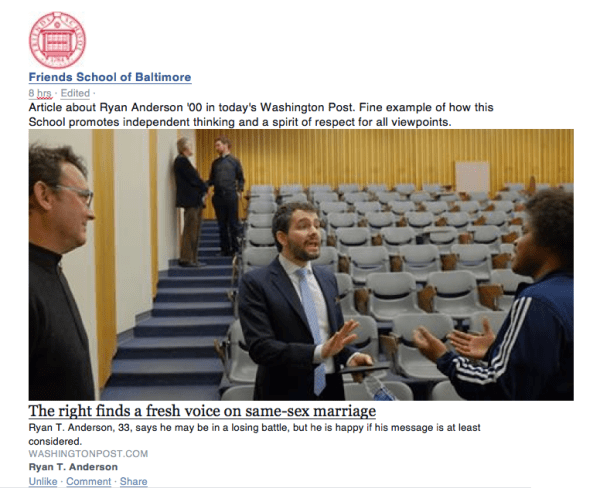
Even more bizarre, though, is the story coming from a Baltimore high school. Ryan T. Anderson, an outspoken opponent of gay marriage, was first lauded, then removed, from his high school’s Facebook page.

Anderson had been the subject of a front-page story in the Washington Post. The article called Anderson a “fresh voice” for traditional marriage.

At first, according to a story in the Heritage Foundation’s Daily Signal, Anderson’s high school posted news of this alumni success on its Facebook page. Later, the school took down the post. Why? In the words of school head Matt Micciche,

I can understand why the belief that Mr. Anderson’s views were being endorsed by the school would be deeply troubling to some members of our community. The nature of these views goes beyond the realm of abstract political ideology and calls into question the fitness of same-sex families to raise children and the right of gay and lesbian citizens to marry the person they love. While Mr. Anderson undoubtedly has the right to express such views, by posting this article we created legitimate confusion as to whether or not they were being validated by the school.

Maybe it is less scary to be removed from Facebook than to have one’s house broken into by aggressive police, but the implications of this Baltimore story are, IMHO, more sinister.

We're proud of our alumni!  Oh, wait...no.

We’re proud of our alumni! Oh, wait…no.

By removing notice of the significant conservative accomplishments of Anderson, his alma mater, in effect, suggested that conservatism is somehow shady, illegitimate, disreputable . . . even shameful.

I don’t say this as an endorsement of Anderson’s ideas. Nor do I claim to understand the intricacies of Wisconsin’s culture-war politics. For those of us trying to understand conservatism and the culture wars, though, both these stories raise important questions:

  • Is it legitimate to oppose same-sex marriage?
  • Do conservatives have a claim to victimhood?
  • Do these strange stories offer proof that conservative thinkers and activists have been uniquely and unfairly persecuted?

Required Reading: Rich Parents Are Better

You remember the old joke:

Q: What’s the best way to have a million dollars by the time you’re thirty?

A: Inherit ten million dollars when you’re twenty.

A new book by sociologist Robert Putnam underlines the traditional wisdom: The best way to succeed in life is to pick the right parents. According to reviews in The Economist and New York Times, Putnam amasses solid evidence to demonstrate that the class gap between rich and poor parents is huge and increasing.

Graphic inequality

Graphic inequality

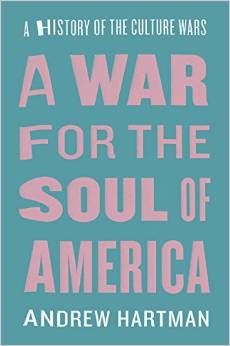
The relationship between parenting and poverty has been a culture-war flashpoint for fifty years. As historian Andrew Hartman relates in his new book, back in the 1960s sociologist and sometime-senator Daniel Patrick Moynihan raised hackles with his study of the causes of African-American poverty.

The problem with too many “Negro Families,” Moynihan argued, was that a destructive anti-family culture had set in. Kids were no longer being raised in stable two-parent households. Fathers were absent or abusive. Mothers were overworked and under stress. The result, Moynihan concluded, was that poor families—especially African American poor families—could not raise successful children.

Critics charged that Moynihan attacked poor people, not poverty. He was accused of a new crime: “blaming the victim.”

The numbers in Putnam’s new book offer some sobering suggestions that Moynihan’s warnings were correct, but not just for African American families. The real divide, Putnam says, is not between black and white parents, but between well-to-do college-educated parents and not-well-to-do parents with less education.

Some of these statistics are truly mind-blowing. Consider, for example, that a poor eighth-grade student who does very well in school still has a worse chance of completing college than a rich eighth-grade student who does very badly in school. The numbers of children living with two well-educated parents has stayed relatively stable. The number of children in single-parent households has shot up among parents with no more than a high-school education.

Traditionalists and conservatives, no doubt, will point to Putnam’s work as more evidence in favor of traditional families. The best way to fight poverty, they might say, will be to encourage stable two-parent households.

Progressives and liberals, meanwhile, will point to these numbers as proof of America’s un-level playing field. Children of parents with fewer educational advantages need extra assistance from government in order to stand any sort of chance.

The long-standing dream of American education has been that education can lead to success. Since the days of Horace Mann, education has been offered as the key to the American dream. Putnam’s study offers more evidence that education is part of the structure of inequality, not the sledgehammer to demolish that structure.

Feed ‘Em to the Lions!

HT: KP, DW

Are Christians persecuted in American culture? Two sociologists say yes. Elite attitudes, David Williamson and George Yancey say, are dominated by a vicious self-righteous “Christianophobia.”

In the pages of the Christian Post, Yancey lays out the argument of his recent book, So Many Christians, So Few Lions. There are plenty of Christians around, they say. But among certain influential elites, they noticed “unnecessary vitriol and fears” about evangelical Protestantism.

Do YOU feel persecuted?

Do YOU feel persecuted?

The problem, Yancey explained, is that this particular form of bigotry does not see itself as bigotry. Anti-Christian elites tend to see themselves as anti-bigots, fighting the forces of religious obscurantism. As Yancey put it, Christianophobes think

Christians are ignorant, intolerant and stupid individuals who are unable to think for themselves. The general image they have of Christians is that they are a backward, non-critical thinking, child-like people who do not like science and want to interfere with the lives of everyone else.

But even worse, they see ordinary Christians as having been manipulated by evil Christian leaders and will vote in whatever way those leaders want. They believe that those leaders are trying to set up a theocracy to force everybody to accept their Christian beliefs. So, for some with Christianophobia, this is a struggle for our society and our ability to move toward a progressive society. Christians are often seen as the great evil force that blocks our society from achieving this progressive paradise.

The authors note that there is also a good deal of bigotry toward atheists. It is the elite status of the anti-Christian bigots, they say, that makes it so troublesome. It is difficult to get elected to public office as an atheist, they note, because so many average voters dislike atheism. On the other hand, Christianophobia might cause Christians to have a harder time winning scholarships and admission to elite universities, where Christianophobes dominate.

Even for non-evangelicals like me, it is easy to see some intuitive truth in these claims. At a big public university like mine, it might be difficult for conservative evangelicals to avoid certain dismissive attitudes among their professors or colleagues.

Poll data also suggests some truth to these anti-Christian claims. Consider the results of a 1993 Gallup poll, for instance, in which 45% of respondents admitted they had a “mostly unfavorable” or “very unfavorable” view of “religious fundamentalists.”  Or a similar Gallup finding from 1989, in which 30% of Americans admitted they would not like to have “religious fundamentalists” as neighbors.

Such poll results, one might object, do not fairly specify the meaning of “fundamentalist.”  The folks answering such questions might have objected to living next door to Osama bin Laden as much as they did to Jerry Falwell.  The 1993 poll, for instance, found that only 25% of respondents had a “mostly unfavorable” or “very unfavorable” view of “born-again Christians” in general.  And in the 1989 poll, even 24% of the respondents who identified themselves as “evangelical” said they would not want to live next door to a “religious fundamentalist.”

Consider also, the work of prominent sociologist D. Michael Lindsay. In his 2007 book Faith in the Halls of Power, Lindsay interviewed hundreds of Christians in influential positions. If these religious folks are our leaders, we might ask, where is the Christianophobia Yancey and Williamson warn against?

Jesus at the SuperBowl: A Drinking Game

To my fellow Americans who plan to watch the Superbowl today: please join me in a fun culture-war drinking game. Every time you see or hear a coach or player wax theological, take a drink. If today’s game is anything like previous events, we will probably get good and sloshed by the end.

Everyone who watches sports knows that big-league sports is one of the most common places for conservative religion to pop into mainstream media. It’s different from other types of entertainment. If you watch Jeopardy or the Big Bang Theory, for example, you will never hear characters or contestants offering Bible verses to explain their victories.

In bigtime sports, however, it is not at all unusual to see players, coaches, and commentators invoking the wrath of Jesus as part of their pre-game planning or post-game wrap up. In today’s game, we are invited to wonder if Tom Brady will finally turn to Jesus. We know that Russell Wilson already has.

Required Reading: A Boom Year for the Culture Wars

You’ve got no more excuse. As historian Andrew Hartman pointed out recently, we used to be able to shrug our shoulders and say that we really didn’t have many historical examinations of America’s culture wars. That’s not the case anymore. Hartman gives us a list of new books coming out in 2015—including one by your humble editor—that look at key aspects of America’s long fight over morality and education.

Daddy, What did YOU do during the Culture Wars?

Daddy, What did YOU do during the Culture Wars?

Hartman’s list includes his own upcoming War for the Soul of America, as well as my Other School Reformers, Stephen Prothero’s Why Liberals Win, Natalia Mehlman-Petrzela’s Classroom Wars, and Jonathan Zimmerman’s Too Hot to Handle.

As you’ll see when you check out Hartman’s full post, these books promise to establish a new tradition among historians and the reading public.

Best of all, these books will give us plenty to read and argue about for the rest of the year.

I Love It When You Call Me Stoopid, Or, Half-Time in the Culture-War Locker Room

HT: DW

Are creationists stupid? The writers of one Saturday Night Live skit think so. The question that’s got us curious this morning, though, is why leading young-earth creationist Ken Ham is so eager to publicize the skit. To this writer, it looks eerily similar to what a coach tells a team in a good half-time speech.

To be fair, the Kat & Garth skit doesn’t say that ALL young-earth creationists are stupid. But this particularly stupid pair of vest-bedecked singin’ idiots happen to be creationists. As the news host threatens to kick them out for their stupidity, they plead, “No, please, we came all the way from the Creation Museum!”

Love the New Album!

Love the New Album!

You might think that the brains behind the Creation Museum itself might want to let this ill-begotten gag fade quietly into the Saturday night. You’d be wrong. Instead, Ken Ham has shared this video with all his many followers. Why? According to Ham, this skit is proof of the besieged nature of authentic Christianity. It proves, Ham writes, that

the mocking of anything Christian in the culture is growing. We see increasing attacks by the secularists on Christianity—they have become so bold now that they’ve been successful in removing crosses, Nativity scenes, and Ten Commandments displays, and have been imposing their own atheistic religion on the culture. Recently, they have been increasingly spreading lies in a propaganda campaign of misinformation about our future Ark Encounter project (and had been doing that in regard to the Creation Museum for many years).

As we’ve seen, this has become part of our culture-war script. Both sides in every contest rush to proclaim their own status as victim. Ham’s Ark Encounter is a good example. Until they were recently scrapped, the project had expected to receive hefty tax breaks. Progressives bemoaned these tax breaks as an example of Kentucky theocracy. The victims, progressives insisted, were Kentucky tax-payers forced to foot the bill for Ham’s fundamentalist building spree.

As with the SNL persecution, Ken Ham insisted that his ambitious Ark Encounter was the underdog. Local newspapers, Ham complained, attacked the project due to their “anti-Christian agenda.”

Why the rush to victimhood? It seems to resemble nothing more than a half-time speech. No team gets psyched up to hear that things are going fairly well and that they should relax. Rather, coaches insist either that they are just on the verge of triumph and one more big push will put them over the top, OR that they are being hammered mercilessly and unfairly and they must unite and focus all their strength.

As Ken Ham told readers in one recent blog post, the successes of a recent atheist billboard campaign proved the need for urgent action. When atheists win, Ham warned,

they have successfully removed the Christian religion and are now imposing their religion of atheism on the culture! Just because they remove a Christian message does not mean there is a neutral situation—there is no neutral position. One is either for or against Christ!

Consider how much less exciting it would be for Ham and other culture warriors to agree that their opponents make good points, but that they respectfully disagree. It is hard to get a good culture-war riled up that way.

Happy Thanksgiving: Our Culture-War Holiday

Ah, Thanksgiving…when families gather to eat birds, watch football, and shout at each other. The Thanksgiving tradition of fighting over issues such as gay rights, abortion, taxes, and school prayer has been hallowed by generations of angry get-togethers. After all, when you put a bunch of people around a table, related only by genetics, and feed them too much tryptophan and wine, culture-war fireworks are bound to happen. Today we’ll share some of the punditry about Thanksgiving culture-war battles we’ve gathered from minutes of browsing the interwebs.
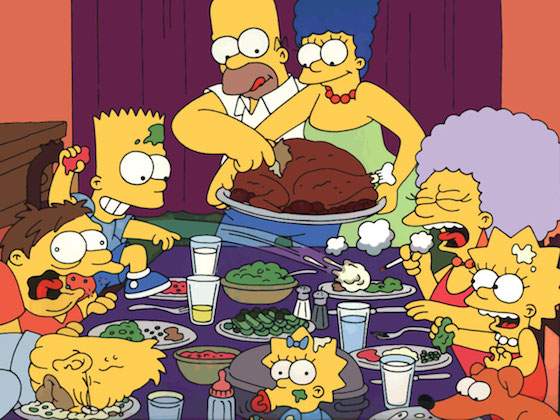
I Disagree with You, but I Respect your Commitment to your Position!

I Disagree with You, but I Respect your Commitment to your Position!

1.) Progressives Use Thanksgiving to Convert Conservatives:

At National Review Online, Katherine Timpf cocks a snook at “ridiculous” progressive suggestions for fixing conservative family members. Progressives, Timpf warns, are out to get conservatives this year. Some progressives threaten to turn the Macy’s parade into a feminist diatribe. Others will blather on about the fact that many Americans don’t celebrate Christmas. Some might seize upon the progressive missionary opportunities of the occasion, buttonholing conservative relatives on the issue of climate change, then following up with an email from the Union of Concerned Scientists. If conservative evangelical or “Tea-Party” relatives try to belittle gay marriage or Obamacare, some progressives advise their minions to take conservatives down with prepared statements from the government or the book of Leviticus. And, of course, just to make sure everyone suffers from indigestion, there is at least one progressive pundit out there advising folks to use Thanksgiving to laud the Common Core.

2.) How to Win a Thanksgiving Argument with Conservative Relatives:

At Policy.mic, Gregory Krieg offers a progressive how-to guide for culture-war arguments. Your conservative “bloviating cousin,” Krieg warns, will certainly bring up some culture-war issues. Krieg offers ways to put conservatives in their places on issues such as the Ferguson riots, Obamacare, Obama’s immigration plans, Bill Cosby’s alleged serial rapes, legalizing marijuana, and more. In each case, we’re told, there are factual, reasonable rebuttals to the sorts of “unreasonable, knee-jerk opinions” conservative relatives will be spouting.

3.) How to Publicly Shame your Conservative Uncle:

From an Iowan progressive, we see a few tips on ways to beat your conservative uncle in holiday arguments. It’s important, progressive Iowan Trish Nelson warns, not to “appear too thoughtful—conservatives may confuse this for weakness.” After pounding your conservative relative with piles of facts to explode his ill-considered myths, Nelson promises,

your conservative Uncle will be roasting in his own myths and half truths, so forgive him if he’s a bit thrown off. Take your time and be patient, let him fully cook, and patiently explain the error of his ways.

4.) Again with the “Crazy Right-Wing” Uncle!

I don’t know why uncles are the repository for conservatism this year, but from the LA Times Joel Silberman offers progressive advice on handling a conservative uncle. Don’t fall for the temptation to be polite, Silberman suggests. It is a “patriotic” act to pick fights with your conservative relatives at Thanksgiving. Why? Because these days we don’t often get a chance to engage with people from the ‘other side’ of culture war issues. [Editor’s Note: Unless, of course, we read and comment in the pages of ILYBYGTH!] To be fair, Silberman is not advising the sort of knock-down, drag-out, drumstick-wielding family kerfuffle that I remember so fondly from my childhood. Instead, he suggests that everyone guide their discussion with “respect and know when to stop, and remember that relationships are more important than righteousness.”

Good advice, and a good place to stop. But just like every Thanksgiving fighter ever, I can’t resist getting in one last word. Instead of preparing arguments to win Thanksgiving showdowns, what if we progressives all spent time learning the best arguments our conservative relatives might make? Certainly nothing is less productive in culture-war battles than sitting back smugly and assuming our mastery of “facts” will soon bring our “myth”-laden opponents to their knees.

Rather, why not take an ILYBYGTH approach? Why not do some homework to learn why intelligent, informed conservatives might hold the positions they hold? Why not assume that people of good will might disagree sincerely on abortion, Obamacare, homosexual rights, evolution, and even the Common Core?

After all, the way to quiet a jerkface loudmouth uncle is not to publicly shame him. Rather, it might be more productive if we all studied the best arguments our culture-war opponents might make. Instead of asking: How can I trounce that argument? What if we asked: Why might someone believe that? Or, most important, what if we asked: How can we enjoy all of our blessings without screaming at each other?


Binghamton: The Place to Be

If you care about our educational culture wars—and you know you do—there’ll be no better place to be in 2015 that Binghamton University in sunny Binghamton, New York. We’ll have two of the world’s best scholars coming to campus to talk about their work. They will share their research into some of the most confounding culture-war questions: Who decides how and what to teach about evolution? How has sex education spread worldwide?

In late March, Professor Michael Berkman will be coming. Along with his colleague Eric Plutzer, Prof. Berkman published a bombshell book a couple years ago about the teaching of evolution in public high schools. Berkman and Plutzer are political scientists at Penn State. They got funding from the National Science Foundation to survey high-school science teachers about their teaching. Their results attracted a good deal of attention.

Required reading for anyone interested in evolution/creation issues

Required reading for anyone interested in evolution/creation issues

In the January, 2011 issue of Science (sorry, subscription required), for example, Berkman & Plutzer described the results of their survey. They found that about 13% of teachers taught creationism in public schools as science. Another roughly 28% taught recognizable evolution. The rest, roughly 60%, are the most interesting. This large majority of teachers reported that they taught a mish-mash of watered down evolution, religious- or religion-friendly ideas about creation, or a menu of evolution and creationism.

But the book was bigger than just this survey. As political scientists, Berkman & Plutzer argued that the important question was the way these decisions were made. Who decides what gets taught? State standards don’t do it. In states with good evolutionary science standards, teachers still teach non-evolution. Textbooks don’t do it. Glittering new science books with all the evolution bells and whistles can’t teach by themselves.

For Berkman & Plutzer, the answer was simple: Teachers. Teachers function as “street-level bureaucrats,” making daily decisions about what to teach and how to teach it. In most cases, teachers fit in with their local communities. If their communities want evolution to be taught, teachers teach it. But if communities want it watered down or kicked out, teachers do that, too.

Professor Berkman will be visiting our scenic campus as part of the Evolution Studies Program. We’re not sure yet what the focus of his talk will be, but he tells us he’s got some new data he’ll be sharing. Can’t wait to see what it is.

Our second campus visit will be from Professor Jonathan Zimmerman of New York University. Over a decade ago, Prof. Zimmerman defined the historical vision of America’s educational culture wars with his book, Whose America? In that volume, Zimmerman argued that two main tensions had divided Americans’ vision of proper education. Since the 1920s, conservatives and progressives had squared off on fights over patriotism and religion. Does loving our country mean teaching students to question it? Or to support it unhesitatingly? And should schools incorporate prayer and Bible-reading? Who gets included in history textbooks, and how?

Professor Zimmerman’s new book looks at sex education as a global phenomenon. Though the United States was an early exporter of sex ed, by the end of the twentieth century the US government joined some uncomfortable allies to battle sex education. As Zimmerman has argued, sex ed has created a new and sometimes surprising worldwide network of conservative alliances. For example, at a 2002 United Nations special session on children, US delegates joined Iran, Iraq, Sudan, Libya, and Syria in condemning a sex-ed proposal.

Who's for it?

Who’s for it?

When it comes to culture-war topics, national boundaries aren’t as important as we tend to think. It’s difficult for historians to look beyond them, though, due to language barriers and the high cost of research travel. In his new book, Prof. Zimmerman hopes to overcome those prosaic difficulties and tell the story of sex ed in its full global context.

And when he journeys north to our campus in early May, Zimmerman promises to share some of his insights from this book.

So whether you care about evolution, creationism, sex ed, history, school politics, school prayer, or any other culture-war issue, there will be nowhere more exciting than Binghamton University in 2015.

Be here or be square.