Saintliest City in the USA?

Eve apparently didn’t take her bite out of the Big Apple.

According to one new survey, New York City leads the list of America’s saintliest cities.

How do they know?  This survey tallied up a list of presumably sinful institutions and events: strip clubs (lust), cosmetic surgeons (pride), violent crime (wrath), theft per capita (envy), charity (greed), obesity (gluttony), and physical activity (sloth).

By this tally, the megapolis of New York had the fewest such sinful occurrences per capita.

Does it mean much?  Not really.  In this quirky survey, New York scored big due to its relatively low levels of obesity and relatively high levels of physical activity.  Such things don’t paint a convincing picture of “saintliness.”

Nevertheless, this survey can serve as a reminder once again to watch out for simplistic assumptions about the nature of religiosity in 21st-century America.

Despite the presumptions of some culture-war pundits, the “God-fearing” America is not limited to small towns and the Midwest.  Big cities often host the most religious Americans, acting in the most religious ways.


To Win Elections, Conservatives Need to Win in Schools

What happened?

Why do conservative candidates lose elections?

That is the question Mark Bauerlein of Emory University asked in Friday’s Public Discourse.

Bauerlein finds the answer not in demographics or policy prescriptions, but in college and high-school curricula.  The revolution in teaching of the past forty years, he says, means that conservative candidates lack the intellectual heft and agility necessary to win.  Bauerlein modifies a Thatcher motto: “First you win the schools, then you win the government.”

Governor Romney, Bauerlein argues, exemplified the problem.  Romney’s famous blunder about “47%” of the electorate was a lost opportunity, Bauerlein thinks, to introduce a new generation of voters to true conservative principles.  Romney did not explain the central conservative principles of thrift, independence, and liberty that could have made his point.

The real remedy, Bauerlein insists, is not in new polls or smoother candidates.  The long-term conservative remedy will be to take advantage of the profound conservatism at the heart of American culture.  If young people receive a better education in the American tradition, they will be both more receptive to and more articulate about those conservative American principles.

“The lesson is this:” Bauerlein tells us,

Conservative candidates must possess, among other attributes, a conservative tradition in their heads, not just political principles, but great thinkers and artists of them, too. . . .

The best way, perhaps the only consistent one, to plant conservative writings and art in the formation of politicians is through the high school and college curriculum. There, individuals have the space to absorb them as common intellectual equipment, as regular facets of the world, not as political positions. . . .

What they encounter and how it is presented determine what they think is important. If English and history courses don’t include Brave New World and Fahrenheit 451 (an anti-political correctness novel) alongside multiculturalist fiction of the 2000s, if they don’t add David Horowitz’s Radical Son to celebrations of the 1960s counterculture, if James Madison doesn’t precede Malcolm X, then the conservative tradition has no place in the accepted body of cultural literacy. If The Scarlet Letter is taught as an indictment of sexual oppression in a Puritan community, not as a complicated tale in which the community has a valid claim upon Hester’s desires, then social conservatism is reinforced as an uptight, obsolete imposition.

This is to recognize the curriculum as an authorizing process. What makes it onto the syllabus has legitimacy, and the angle the teacher takes upon the materials tends to stick. If conservative donors wish to back winning candidates, to cultivate politicians who can deflect sallies of biased reporters and liberal counterparts with intelligent and informed convictions, they must reach conservative politicians not only in election years, but at impressionable ages, too.

The good news for conservatives, Bauerlein writes, is that many schools have already begun to implement this kind of strategy.  They teach conservative ideas not only in short-term intellectual boot camps, but as part of a thoughtful tradition that includes all the best thinkers from across the intellectual spectrum.

What could this look like?  According to Bauerlein, it could mimic the success of liberal efforts such as the Ford Foundation’s funding of centers for Women’s Studies.  That field went from zero to influential in a decade, thanks in part to such funding. Bauerlein thinks it’s time for conservatives to do the same.


CSCOPE and the Dustbin of History

CSCOPE is dead.

Anyone who hopes to understand the sort of conservative crusade that killed CSCOPE should draw two lessons from the news.

First: Historians should be invited to more dinner parties.

Second: The question is not why CSCOPE was suddenly targeted, but rather why so many Americans are so deeply suspicious of educational experts.

But before we talk about such things, an update: As reported by the Houston Chronicle and Texas Freedom Network Insider, leading Texas politicians announced a few weeks back that the suddenly controversial curriculum management system would no longer be offering lesson plans for Texas school districts.

CSCOPE had come under attack from conservatives in Texas and around the country as promoting a witches’ brew of “progressive,” “Marxist,” “pro-Islam” ideas for Texas schools.  Liberals such as those at the Texas Freedom Network complained in exasperated tones about an irrational “witch hunt” against lessons that had been used without controversy for years.

What does any of this have to do with the loneliness of historians?  The book I’m now finishing looks at the 20th-century history of this sort of school controversy.  Again and again, conservatives discover that the teaching in their schools has been infiltrated by nefarious ideas such as evolution, socialism, progressivism, or filthy sex and violence.  In each case, once a set of textbooks or curricular program gained attention as an example of such ideas, it was quickly tossed out by conservative activists.

I hate to quote myself, but in this case an historian’s perspective makes this outcome seem predictable. As I noted a few weeks back, “CSCOPE might offer an ideologically balanced, pedagogically efficient way for Texas school districts to streamline their teaching systems.  But once it has acquired the reputation for leftist indoctrination, the writing is on the wall.”

This is why historians should be invited to more parties.  Especially if there is food.  Not because historians can predict the future.  Every case is different. But an historical perspective eliminates much of the surprise of unfolding events.  For those who know the 20th-century history of conservative activism in America’s schools, the anti-CSCOPE crusade seems remarkably predictable.

Another important lesson should be drawn from the premature death of CSCOPE.  The career of CSCOPE illustrates the profound cultural divide at the heart of America’s continuing educational culture wars.   Personally, I sympathize with the liberal critics of the Texas Freedom Network, who noted that many of the attacks against CSCOPE seemed “bizarre” or “paranoid.”  As a parent and citizen, I worry about the exaggerated attacks made on this curricular program.

Such attacks, however, must be understood as an irruption of a profound suspicion among Americans about what any outside interference in public school curricula.  Like other commentators, I am deeply skeptical about claims that CSCOPE was a vast conspiracy to subvert patriotic Christian values in Texas public schools.  But the important question is not why this particular program was targeted for attack after years of controversy-free use in schools. The question, rather, is why so many Texans jumped so quickly to join the anti-CSCOPE bandwagon.

This has been the case with every curriculum controversy in the past.  As historians Charles Dorn[1] and Jonathan Zimmerman[2] pointed out about the Rugg textbook controversy in the 1940s, though the Rugg textbooks were banished, similar books continued to be used widely.

In the Kanawha County blow-up of the 1970s, the same sentiment surfaced.  What had seemed like a humdrum approval process for a new set of reading textbooks became a violent struggle over the content of the curriculum.  In that case as in this, many observers scratched their heads and wondered why these particular books had suddenly become such lightning rods.

The depressing truth is that most Americans are deeply skeptical about the intentions of the people who write the books and lesson plans for our public schools.  With curricular materials such as CSCOPE, the Rugg textbooks, or the Interaction series adopted in Kanawha County, as soon as materials were accused of subversion, many Americans believed it.  As conservative leader Elmer Fike explained about the Kanawha County books, “You don’t have to read the textbooks.  If you’ve read anything that the radicals have been putting out in the last few years, that was what was in the textbooks.”[3]

The sudden outrage against CSCOPE shows us this same dynamic at work.  In Texas as in the rest of our nation, a politically powerful plurality are willing to believe outlandish accusations against relatively bland curricular materials.  Though the books and lessons themselves may be moderate in tone, a significant number of parents and politicians are quick to believe they have set out to destroy America.

Why did CSCOPE meet such a sudden and violent premature death?  Because for generations, a significant proportion of Americans have looked with grave suspicion at the intentions of “experts” who write such classroom materials.  Parents are not surprised to hear that textbooks contain hateful language and shocking subversion.  Such accusations confirm what too many parents already believe.

We will not understand the CSCOPE story, nor the similar stories sure to come in future years, unless we grapple with the fact that many parents maintain an awkward ambivalence toward public education.  Many parents may approve of their local schools, but they feel a need to defend those schools from the control of grasping autocrats at far-flung universities and think-tanks.  At the bitter heart of the CSCOPE saga lodges the uncomfortable truth that Americans do not trust educational experts.


[1] Charles Dorn, “‘Treason in the Textbooks:’ Reinterpreting the Harold Rugg Textbook Controversy in the Context of Wartime Schooling,” Paedagogica Historica 44:4 (August 2008): 477.

[2] Jonathan Zimmerman, Whose America? Culture Wars in the Public Schools (Cambridge: Harvard University Press, 2002), 79.

[3] Quoted in James Moffett, Storm in the Mountains: A Case Study of Censorship, Conflict, and Consciousness (Carbondale, IL: Southern Illinois University Press, 1988), 70.

Fundamentalist Science, Spock, and Oprah

What do Science, Spock, and Oprah have to do with each other?

They help explain the thinking of anti-religion activists such as biologist Jerry Coyne.  The way some atheists figure, since religion is not logical, it should have no impact on our deliberations.  Oprah doesn’t agree. But who wields more clout in our culture, Oprah or Jerry Coyne?  Or, to put it another way, who is the star of Star Trek, Spock or Capt. Kirk?

Fundamentalist Science is highly illogical.

Fundamentalist Science is highly illogical.

I love to read Professor Coyne’s blog, Why Evolution Is True.  He always makes intelligent arguments for the propriety of a scientific understanding of reality, and the dangers of “accommodationism” with religion.  Plus he has lots of pictures of cats and bugs.

Recently, two posts bumped up against each other that demonstrated the difficulties with Coyne’s approach to these issues, IMHO.  In one post, Coyne reviewed survey data that revealed the relative overabundance of atheism among America’s top scientists.  In the next, Coyne bemoaned the appearance of Oprah Winfrey as Harvard’s commencement speaker this year.  As Coyne pointed out, Winfrey has done a great deal to promote anti-scientific rubbish over her career.

Now, I’m no Oprah fan.  Nor am I particularly religious.  But I can’t help but notice that Coyne’s fundamentalist attitude about this subject fuels the bitterness of our continuing culture wars over the role of religion and science in the public square.  This kind of bitterness is both unnecessary and counterproductive.

Science-advocates such as Coyne promote a particular vision of science as rigidly opposed to religion.  Coyne often protests against truckling to religious thought among scientists and science educators, such as the folks at the National Academy of Sciences or the National Center for Science Education. As I’ve noted before, Coyne’s extreme view of the necessary divide between science and religion puts him at times on the side of extreme creationists.

But Coyne’s religion- and Oprah-bashing put him on the side of some other curious figures as well.  Most famously in pop culture, Gene Roddenberry created Spock as the Asperger’s First Officer to balance Kirk’s testosterosity.  Spock always argued for the rule of logic and was always trounced by Kirk’s shoot-from-the-hip style of emotional leadership.

Smarter writers, too, have explored this Spock/Kirk, Coyne/Oprah divide. Most famously, Dostoyevsky’s Ivan Karamazov concluded reasonably and logically that God could not exist.  However, Ivan could not handle Smerdyakov’s gruesome conclusion to that logic.  Nor could Ivan counter Alyosha’s loving-kiss argument.  Like Spock, Ivan’s blind reason could not cope with the complexities of human experience.

Truth may not be democratic.  But our society is.  It is a good thing to have smart people complain about the influence of thoughtless media-mongers like Oprah.  But those smart people must also recognize that Oprah—unlike the elite atheist scientists—has her finger on the pulse of the culture.  She knows what people find important. She knows what people find interesting.  Oprah’s imprimatur does not make an idea true.  But it does mean that the idea matters somehow.

Dismissing such things out of hand demonstrates an unnecessary Spock Syndrome.  Simply because ideas are illogical does not mean they are not true, in an important sense.


Beautiful Women Want Creationism

From the Old News Department: Miss USA finalists are friendly to creationism.

I just discovered two-year-old footage from the Miss USA 2011 competition.  As Tanya Somanader broke the news at the time, almost all of the 51 contestants supported the idea of teaching creationism in public schools.

Alyssa-Campanella-Miss-California-USA-2011-is-crowned-Miss-USA-in-Las-Vegas

“They’re teaching what?!?!?”

The video interviews still make for compelling viewing.  I’m no big fan of beauty pageants.  I don’t know anyone who is.  But as I found out a while back, there has been a strange correlation between conservative religion and Miss America over the years.

As Tanya Somanader noted, only two candidates affirmed that evolution should be taught in schools as science, unalloyed by creationism or intelligent design. The rest of the candidates offered either a two-model answer or flat-out rejection of evolution for America’s schools.

Miss New York, for example, agreed that evolution should be taught in public schools, but so should religion.  Miss North Dakota offered a more relaxed answer.  “Sure, why not?” she said, “Evolution should be taught . . . I think it’s good that people hear both sides of, I guess, ‘the story,’ so to speak.”  Miss Oregon agreed.  “I think every theory of how we came to be here should get a shout out in education,” she answered.

These fence-straddling answers tell us something about the conservative cultural politics common among high-level beauty pageant winners.  More telling, they show us what national finalists think will be a winning answer to the question of evolution education.  Almost all of the finalists advocated a temperate-sounding compromise, one that welcomed all theories into the public school classroom.

Even those like Miss North Carolina who stressed the fact that they personally did not believe in evolution made irenic noises about allowing evolution to have some space in public education.

To some extent, this proves that elite beauty-pageant contestants are savvy politicians.  Gallup polls demonstrate that the overwhelming majority of Americans favor the teaching of both evolution and creationism in public schools.  By waffling on this important question, these Miss USA wannabes show their understanding of this diplomatic demilitarized zone in our continuing culture wars.  Of course, the two-model approach is horrifying to mainstream scientists and science educators.

Not all the Miss USA contestants took even this middle path, however.  Miss Kentucky, for example, concluded, “I just personally don’t think it’s a good topic for school subjects. At all.”  Even harsher, Miss Alabama declared, “I do not believe in evolution, I do not think it should be taught in schools, and I would not encourage it.”

Fear and Loathing in Fundamentalist America

Who hates whom?  Do “fundamentalists” hate the rest of us?

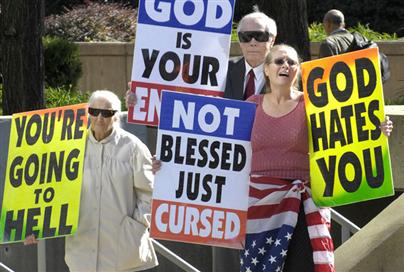
A new article about the hate-centric Westboro Baptist Church confirms what many of my secular, liberal friends and colleagues believe: fundamentalists hate.  Hate seems to be at the core of their fundamentalist identity.

But hate is a tricky thing.  Is it okay to hate the Westboro Church and its horrific tactics?  How about other fundamentalist groups?

Image Source: Top Ten Unbelievable Westboro Baptist Church Protests

Image Source: Top Ten Unbelievable Westboro Baptist Church Protests

The hatefulness of the Westboro sect is hard to deny.  Writing in the Los Angeles Times, Jenny Deam offers a portrait of Westboro refugee Libby Phelps-Alvarez.  Phelps-Alvarez, granddaughter of Westboro founder Fred Phelps, shares a story of cultish indoctrination into the Phelps family business.  You’ve seen the images: soldiers’ funerals picketed by Westboro members holding up signs saying, “God Hates Fags” and the like.

As Deams’ story relates, Libby grew up with the family church.  She began picketing at age 12.  By her late teens, though, according to Deams, “Libby began to wonder: ‘Am I doing the right thing? Should I be telling people they are going to hell?’”

Eventually, Libby left her church and family.  But she seems strangely ambivalent about it. As Deams concludes, “Libby isn’t sure what she believes anymore. She no longer hates homosexuality, but her journey is far from complete: ‘Everyone thinks when you leave you do this 180. It doesn’t work that way.’”

Many other ex-fundamentalists take a much angrier tone.  For some, hating the haters has freed them to engage in their own brand of hatefulness.

Ken Ham has complained recently of vicious verbal attacks on him and his young-earth creationist ministry by groups of atheists.  Ham planned to speak at a Texas homeschooling conference, and Texas freethinkers posted their discussion about their planned response.

Most of their planning revolved around intelligent protests and information-sharing.  Vic Wang of the Houston Humanists made the intelligent point that their protests should not be against religion.  Rather, Wang argued, they should paint Ham as a specific sort of “extremist,” a “crackpot.”

Other speakers took an angrier tone.  “Sister Shayrah” equated creationism and conservative religion with child abuse.    She insisted that religious parents were free to teach their children their beliefs, but that no parent, in any sort of school, could be allowed to use religion as an “excuse for damaging or hurting or indoctrinating your child.”

Shayrah and other participants, such as Neely Fluke, noted that they had been brought up in the world of young-earth creationism and fundamentalist Protestantism.  That has left them angry.

I can’t claim to know what it is like to grow up in the world of fundamentalism.  Many of those who grew up that way, such as Jonny Scaramanga or “Forged Imagination,” have offered compelling insights into their feelings and transformations.

But whatever personal anguish or turmoil these folks may have experienced, it does not make sense in the cold light of cultural politics to use angry, confrontational language.  It doesn’t help.

Indeed, the beneficiary of this sort of anger seems to be Ken Ham himself. He has promoted this anti-Ham video on his blog and website.  As he says to his creationist readers,

Everyone needs to experience this video chat for themselves to get an understanding of the increasing intolerance and aggressiveness of many atheists against biblical Christianity. . . .

And let’s get churches in Texas aware of this intolerance by atheists and publically get out the word, including alerting the Christian media. Pastors should speak out about the increasing intolerance of atheists to their congregations. In fact, these video excerpts should be used by pastors across this nation to warn their flocks about the growing intolerance being directed at Christians and then equip their people to stand against these secular attacks. . . .

So, let’s use this video chat by atheists as a tool to offer some practical teaching about those people who oppose the Bible’s messages.

I can’t claim to know what it was like to be taught the doctrines of young-earth creationism or Protestant fundamentalism.  I understand that I might be angry if I had.  But like any political movement, venting too much spleen against our opponents only fuels the other side.  Hate may feel good sometimes.  It may feel righteous.  But it only digs deeper the culture-war trenches that have divided our country.


The Culture War Is Over: Conservatives Lost

Gay Marriage will not wreck traditional marriage, Rod Dreher argues.  Instead, the rapid mainstreaming of gay marriage simply proves that traditional marriage was wrecked long ago.

In his recent piece in The American Conservative, Dreher channels Philip Rieff to argue that conservative Christians have already lost the culture wars.  The notion that people exist first and foremost as individuals replaced a sense of people as part of a Christian community long ago.

The current debate over gay marriage only serves as a mopping-up action by anti-Christianity.  The Christian sexual ethic, Rieff argued back in the 1960s, was not merely one rule imposed by Christianity.  Rather, the Christian sexual ethic represented the core of Christianity’s revolutionary anti-pagan cosmology.  Sex was not merely an expression of individual desire, but of God’s cosmic plan.  When Western culture abandoned that sexual ethic, Rieff argued, it offered nothing in its place.

Homosexuality and the issue of gay marriage, Dreher notes, do not change this pattern, but only complete it.  Dreher bases his case on data from Robert Putnam and David Campbell.  These political scientists noted in their 2010 book American Grace a striking demographic correlation between acceptance of homosexuality as morally neutral and a rapid decline in church membership.  When young people see homosexuality as just another way to be sexual, they do not switch to a liberal church.  Instead, they leave institutional Christianity altogether.

As Dreher argues,

Gay marriage signifies the final triumph of the Sexual Revolution and the dethroning of Christianity because it denies the core concept of Christian anthropology. In classical Christian teaching, the divinely sanctioned union of male and female is an icon of the relationship of Christ to His church and ultimately of God to His creation. This is why gay marriage negates Christian cosmology, from which we derive our modern concept of human rights and other fundamental goods of modernity. Whether we can keep them in the post-Christian epoch remains to be seen.


In Search Of . . . Love in an Age of Culture War

Can a creationist and an evolutionist be in love?  I’ve got no idea.  I’m sorry to the searcher who came by ILYBYGTH in search of an answer to this timeless question.

This touching search, though, brought to mind a memory from my wasted youth.  Readers of a certain maturity may remember the other gig Leonard Nimoy enjoyed.

This episode: Nimoy In Search Of . . . Atlantis!

Every week, Nimoy hosted a smarmy pre-cable show about the search for the paranormal: Atlantis, Roswell, etc.Managing this blog has opened my eyes to some of the searching that goes on these days.  As we’ve noted here before, Google Trends offers all of us a way to take the intellectual temperature of Fundamentalist America.

The editing tools of this blog offer additional perspectives.  We can see some of the search terms that direct people here.  Some of them are just pathetic, such as one about plagiarizing “What the Bible Means to Me.”  Some of them are encouraging, like the many searches for “I Love You But You’re Going to Hell.”  Some of them tell us something about what people care about.  We see a lot of searches, for instance, for “traditional schools vs. progressive schools.”  We see searches for “Richard Dawkins is going to hell.”  And we see various permutations of searches like, “Why are fundamentalists so resistant to evolution?”

A lot of the search terms we see are puzzling.  Consider a few recent gems:

  • “Tim Tebow is going to hell”
  • “Santorum loves Satan”
  • “Smart people become professors”
  • “Mounted patrol Horace Mann”

What were these anonymous searchers looking for?  Why do they dislike Tim Tebow so much?  And how did Horace Mann get a horse?  We will likely never know, and that’s what makes it so intriguing.

Along these lines, we have a new all-time favorite for poignancy:

  • Can a creationist and evolutionist be in love?

Somewhere, out there, two star-crossed lovers gaze longingly at one another, one from his Bible college dormitory, the other from the mean streets of secular public education.

If there’s hope for this culture-war Romeo & Juliet, there’s hope for us all.

Required Reading: Shields and the Civility of the New Right

Another reason to spend time at Mere Orthodoxy: Matthew Lee Anderson today shares his interview with Jon Shields.  Shields is the author of The Democratic Virtues of the Christian Right.  Even if you don’t have time to spend with the whole book, it is worth taking a few minutes to read this interview. 

Shields elaborates on the thesis of his book, viz., that the incivility of the Christian Right has been overplayed by journalists looking for a good story.  Using interviews and a participant-observer method, Shields found that such headline-grabbing fury did not fairly represent the movement.  As Shields notes in this interview,

If one looks at Christian radio personalities or at direct mailings or at fringe organizations, belligerency is quite common. The media picks up on these latter examples partly because they are somewhat more visible, partly because they make for more interesting stories, and partly because of the sociology of the newsroom itself. So the media has identified real incivility in the Christian Right.

Of course, such distortion takes place all over the political and theological spectrum.  In my research into the history of conservative educational activism, I find that conservative writers and pundits also relied on the tactic of the hyperbolic example.  For example, the early Soviet-friendly statements of John Dewey or George Counts are often used by conservatives to demonstrate that all of progressive education is nothing but a communist plot. 

It seems to return us to the central dilemma of America’s ballyhooed culture wars.  Even though most people–even people politically, culturally, and theologically committed on issues such as abortion or gay rights–prefer to act in civil, “small-d” democratic ways, the fevered punditry of voices on each side dominate the headlines.  One religion-bashing quip by Richard Dawkins, or one minority-bashing pronouncement by Glenn Beck, does more to define the two sides than thousands of people working quietly and politely to promote their vision of America.


Required Reading: Are we all bigots now? Haidt’s Righteous Mind

Fundamentalists get called bigots a lot.  They don’t like it.  Since the 1920s, they have spent a lot of mental time and energy proving that they are, in fact, the side of openminded scientific inquiry.  For example, in the early 1920s fundamentalist intellectual Alfred Fairhurst complained that the teaching of evolution served mainly to close student minds.  “I am sure,” Fairhurst complained,

“that the teachers who would teach the subject are not fully prepared to present both sides as should be done when taught.  I believe that the teaching of evolution is mostly dogmatic, and that the result of teaching it is a new crop of dogmatists.  I am aware that there are those who hold that the subject of evolution greatly expands the mind.  I think that, as taught, it warps the mind and closes it against much truth.”

Generations later, in 1995, Duane Gish agreed that excluding creation science from public schools was nothing but “bigotry.”

Like the creationist activist Duane Gish, fundamentalists like to call their secular and liberal foes the true bigots.  As we have explored here at ILYBYGTH, fundamentalist activists such Bradley Johnson press the limits of fundamentalist free speech.  They provoke repression of their public religiosity in order to highlight the masked bigotry of hypocritical liberals.  Traditionalists point to foundational lefty intellectuals such as Herbert Marcuse as creeping totalitarians.  Marcuse and his minions, fundamentalists assert, are the ones who will not tolerate any disagreement.

I’m no fundamentalist, but I’ve seen this kind of anti-fundamentalist bigotry in action.  My academic research focuses on the history of fundamentalism.  While giving talks or discussing my research, I’ve often been surprised by both the viciousness and the ingenuousness of anti-fundamentalist bigotry.  I once had a very intelligent, well educated college student ask me how long it would take before religious people realized that religion was only for weak, ignorant people.  A colleague asked me once, regarding fundamentalists, “What’s wrong with these people?”  Another academic acquaintance suggested that the cure to the creation/evolution debate would be to “round up all the crazy white people” and force them to go through a rigorous de-theization education.  I like to think this last person was joking, but her comment elicited raucous cheers in the conference room.  All of these comments, fundamentalists would say with some justification, would never be tolerated about any other cultural group in our society.  Perhaps most egregious, the people making these comments tend to be almost entirely ignorant about fundamentalism.  They form their opinions based on vague stereotypes and in-group thinking, the very definition of bigotry.

So I sympathize with fundamentalist claims.  But I do agree there are limits.  I agree that fundamentalists often make these claims of victimization in order to promote a false moral equivalence between cultural sides.  For example, if we acknowledge the cultural legitimacy of creation science, do we give in to a strategic desire to muddle the issues in mainstream science and evolution?  (For an example of this debate, see the discussion at the US Intellectual History blog about the legitimacy of ILBYGTH’s fundamentalist-friendly forum.)

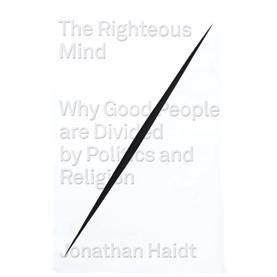
A new book casts a pox on all houses.  Psychologist Jonathan Haidt argues that most Americans decide first and come up with reasons later.  In The Righteous Mind: Why Good People Are Divided by Politics and Religion, Haidt describes his conclusions from over 130,000 online morality tests he and his colleagues delivered.  Their website, YourMorals.org, asks people an array of moral questions, from the mundane (Should teenagers listen to their parents’ advice?) to the bizarre (Is it morally acceptable to have sex with a dead chicken?).  For most people, Haidt argues, the moral answer is intuitive, not rational.  We do not start with principles and deduce the proper response.  Rather, we answer first and come up with justifications later.

If the nature of bigotry is to cling to irrational ideas demanded by ingroups and cultural cliques, then, according to Haidt, we’re all bigots now.  The moral answers we insist upon derive more from “groupishness” than from reason.

Not that both sides of America’s “culture wars” do everything the same way.  Haidt and his colleagues parsed morality into six fundamental notions: care, fairness, liberty, loyalty, authority, and sanctity.  Most Americans are deeply moved by the first three of these.  Liberals, however, tend to “care” more.  Conservatives tend to be more concerned with “fairness.”  According to Haidt—who self-identifies as a recovering partisan liberal—American conservatives do a better job with loyalty, authority, and sanctity.  Haidt disputes the notion that conservatives somehow trick voters into voting against their economic interests.  Rather, Haidt thinks conservatives simply do better at speaking to all six of the fundamental moral notions people really care about.

The most compelling part of Haidt’s book, for ILYBYGTH readers, is his conclusion about the closedmindedness of liberal America.  Haidt conducted a survey of 2,000 Americans, asking them to predict the moral choices of those with whom they disagree.  Self-identified “liberals” fared the worst at this game.  That is, respondents who called themselves “very liberal” ended up being the worst able to guess what fundamentalists cared about.  For outsiders—non-fundamentalists—who are trying to understand Fundamentalist America, this must serve as a sobering warning.  Simply because the worldview of liberal America treasures such notions as inclusiveness, tolerance, openmindedness, and rationality, doesn’t mean that we naturally apply such notions to fundamentalist ideas.  Rather, liberals—at least in Haidt’s research—tend to be the least able to understand where their cultural rivals are coming from.

Haidt hopes that true humility about the bigotry of our own moral impulses might lead to a softening of America’s culture wars.  He argues that one way to overcome our “groupishness” is to spend time engaged with the moral understandings of those with whom we disagree.  He has established one web forum to do just that.  At civilpolitics.org, he and his colleagues have listed ways to help Americans of different moral backgrounds to work together more calmly and productively.

Such anti-bigotry is the goal of ILYBTGTH as well.  Acknowledging the pre-rational roots of our strong moral feelings does not mean simply throwing up our hands and embracing moral relativity.  But making an honest effort to understand someone else’s moral universe can’t help but move us along the spectrum to a moral society we can all live with.