Teaching the Bible, Texas Style

A new report from the Texas Freedom Network warns that some public schools in Texas are teaching religion.  Not all religions, but the Bible-loving, apocalypse-watching, evolution-denying type of conservative evangelical Protestantism.

How do these public schools justify it?  According to the TFN report, public schools fold these sectarian doctrines into their Bible courses.  Public-school courses about the Bible are explicitly constitutional.  US Supreme Court Justice Tom Clark made very clear in his majority opinion in Abington Township v. Schempp (1963) that public schools can teach the Bible, if they did so in a non-devotional way.  As Clark specified,

“Nothing we have said here indicates that such study of the Bible or of religion, when presented objectively as part of a secular program of education, may not be effected consistently with the First Amendment.”

However, the TFN report argues that many of the Texas school districts are using Bible classes to teach religious doctrine, including the notion that the Bible demands a young earth.  The report’s author, Mark A. Chancey of Southern Methodist University, reports that the courses are generally poorly taught, with low academic rigor, by underprepared teachers.

Professor Chancey includes excerpts from some of the teaching materials.  In the Dalhart Independent School District, for example, one student information sheet included the following information:

“Since God is perfect and infallible, an inspired book is absolutely infallible and errorless in its facts and doctrines as presented in the original manuscript” (pg. 28).

In the Bible courses of Lazbuddie, Texas, students will read the following:

“We should have an understanding of what happened in Noah’s day if we are to know when the coming of our Lord is near.  What are the similarities between the days of Noah and the days preceding the coming of Jesus Christ (Matthew 24:37-39)?” (pg. 32)

In Dayton schools, students watch the Left Behind movie, fundamentalist author Tim LaHaye’s dramatization of the rapture and final days (pg. 19).

As Chancey points out, these doctrines are intensely sectarian.  They teach a specific interpretation of the Bible as eternally true.  Students in these public school classes would be told that the doctrines of conservative evangelical Protestantism are the correct and only interpretation of the Bible.

Are we shocked?

We shouldn’t be.

Here’s why not:

First of all, the numbers of schools and students involved is very small.  Professor Chancey found 57 districts plus three charter schools who taught Bible courses in 2011-2012, a small percentage of the 1037 districts in Texas.  Not all of these districts taught the Bible in such heavy-handed sectarian ways.  And of the districts that reported their student numbers, only three had more than fifty students enrolled in Bible class.  Six districts had fewer than five students in Bible (pg. 5).

Second, the practice of teaching sectarian religion in public-school Bible classes has a long and surprisingly uncontroversial history.  As I explored in my 1920s book, while public attention was focused on anti-evolution laws, between 1919 and 1931 eleven states quietly passed mandatory Bible-reading laws for public schools.

Finally, even after the anti-Bible SCOTUS ruling in 1963, many public schools simply continued the practice.  As political scientists Kenneth Dolbeare and Philip Hammond found in their survey of schools in a Midwestern state, the Supreme Court rulings against public-school Bible reading made absolutely no difference in school practice.  Where students had read the Bible before, they continued to do so, without raising any controversy.

So Professor Chancey’s findings that a few students in a few public schools in Texas learn a sectarian interpretation of the Bible should come as no surprise.  As Chancey notes, similar Bible classes go on in several other states as well (pg. v).  Moreover, as political scientists Michael Berkman and Eric Plutzer have convincingly argued, public school teachers usually teach ideas that are locally uncontroversial.  In some places, that means teaching creationism as science.  In others, it means teaching the Bible as history.


Science at the Creation Museum

Thanks to the ever-watchful Sensuous Curmudgeon, we came across a recent article in Scientific American in which an evolution-believing science teacher journeyed to Answers in Genesis’ Creation Museum outside of Kentucky.

Image Source: Answers in Genesis Creation Museum

Image Source: Answers in Genesis Creation Museum

For folks like me and the author Jacob Tanenbaum, the scientific claims of the museum are impossible to accept.  A science teacher, Tanenbaum recoiled at the misleading scientific claims made by the museum.  “What disturbed me most,” Tanenbaum reported,

“was the theme . . . that the differences between biblical literalists and mainstream scientists are minor. They are not minor; they are poles apart. This is not to say that science and religion are incompatible; many scientists believe in some kind of higher power, and many religious people accept the idea of evolution. Still, a literal interpretation of Genesis cannot be reconciled with modern science.”

Fair enough.  During my trip to the Creation Museum, though, what struck me most powerfully was simply how plausible it all seemed.  For those who did not set out to debunk the information, the museum seemed just as authoritative as Chicago’s Field Museum or any other natural-history museum.

But what Tanenbaum wrote makes sense: the Creation Museum presents a misleading picture of the differences between creation science and mainstream science.

My beef with Tanenbaum is with his own misleading conclusion.  The problem with such creation science education, Tanenbaum argues, is “that 40 percent of the American electorate seems to have forgotten what science is. Considering that our nation put a man on the moon and invented the airplane and the Internet, this development is extraordinary.”

Tanenbaum may be a gifted teacher of mainstream science, but this conclusion suggests that he is not deeply versed in the culture of creation science that he condemns.  For those of us who want to understand creationism, we need to get beyond this naive assumption that creationists don’t know what science is, or that they are somehow hypocritical in their use of technology.

As I argued in a recent commentary in the Chronicle of Higher Education, simple ignorance does not explain American creationism.  Many creationists have studied mainstream science.  In many cases, such as that of leading creation science author Henry Morris, they have earned advanced technical degrees.  And, beyond such stand-out leaders such as Morris, many rank-and-file creationists have extensive science educations.  As political scientists Michael Berkman and Eric Plutzer discovered in their National-Science-Foundation-funded study of high-school biology teachers, of those teachers who espoused a belief in young-earth creationism (i.e., the Creation-Museum type of creationism), fully 55% had earned college degrees in science.   Furthermore, Berkman and Plutzer’s review of other such surveys led them to the following conclusion: “the overall evidence suggests that the high support for creationism in the classroom cannot be attributed primarily, or even substantially, to overall scientific illiteracy in the United States” (pg. 52).

Also, as creationists often remind themselves and their evolutionist foes, belief in evolution is not necessary for sophisticated engineering.  Dobzhansky’s claim that nothing in biology makes sense except in the light of evolution may be true, but that would not stop creationists from traveling to the moon, perfecting airplanes, or inventing the internet.

In the end, I think it makes a big difference whether Americans with creationist beliefs have “forgotten what science is” or if they have a distinctly different definition of science.  Building an anti-creationist argument on the foundation that creationism disables technical education, as does Tanenbaum and other prominent pro-science voices such as Bill Nye, is both a false claim and poor strategy.

Please don’t misunderstand me: this is not a brief for creationism.  However, if those of us, like me, Bill Nye, and Jacob Tanenbaum–who stand outside the borders of creationism looking in–if we really want to understand creationism, we must abandon our own naive assumptions about the meanings of that creationist belief.

Pluralism and Progressivism in America’s Schools

Is American public education progressive?  Do most teachers and administrators hope to use schools to instill a sense of individuality, of self-expression, in America’s youth?  Do public schools emphasize the individual construction of knowledge over the traditional emphasis on transmitting knowledge?  In general, I don’t think so, but many informed, intelligent people still assume that they do.

For instance, in this month’s First Things Ashley Rogers Berner makes a smart argument for more pluralism in American public education.  In her essay, she assumes that the ideological training of America’s public school teachers includes a decisive dollop of progressivism.

The primary reason for the stultification of American public education, Berner argues, is the system’s lack of real pluralism.  If we Americans could get over our irrational attachment to a model of public education in which only publicly run schools could receive significant public funding, then we could enjoy the fruits of a truly diverse system.

Her article is worth reading in its entirety, but in short, in her words,

“Lasting, structural change requires reframing ‘public education’ to mean publicly funded or publicly supported, not exclusively publicly delivered, education. This in turn requires a different political philosophy, a turn to a model of education based on civil society rather than state control.”   

In today’s educational culture wars, the first response to Berner’s argument is usually that such pluralism will essentially abandon those students who most need publicly run schools.  By leaching funding away to a universe of school options, those students and families who are last to scuttle away from the sinking ship of publicly administered schools will be left with even fewer resources to scratch together a decent education.

Berner and other advocates of greater diversity in public-funded schooling blame teachers’ unions for clinging to control at the expense of educational quality.  Defenders of our current funding model of public education respond (with varying levels of coherence) that the union model ought to be understood in a different way: Only if all families and teachers stick together, the argument goes, can public education be saved for all.  In this sense, advocates argue, it is a union-like argument.  With unity comes strength; privately run schools that accept public money amount to labor “scabs” that betray the cause of quality education for all.

I won’t make that argument here.  Instead, I’ll challenge Berner’s argument in a different way.  Berner insists that one killing flaw of the current public system is that it falsely purports to be ideologically neutral, while promoting a “progressive” worldview.  Berner calls this “schooling that is supposedly ideologically neutral but in fact reflects a progressive tradition strongly committed to beliefs and to an educational philosophy rejected by many Americans.”  To be fair, Berner notes that public schooling reflects a struggle between several visions of proper education, traditional vs. progressive as well as secular vs. religious.  She notes that two visions contend for ideological control of public education.  In her words,

“Today’s educators have often been trained in progressive pedagogies, but state legislatures are now asking them to teach a more prescribed curriculum and to participate in high-stakes academic assessments. This has caused a struggle in nearly every state.”

But she proceeds with an assumption that public schooling today has been captured by a progressive ideology.  As she puts it,

“American institutions, including public schooling, tend to reinforce individual autonomy and to discourage the habit of commitment. . . . An educational philosophy whose aim is self-expression is ill-equipped to foster attachment to liberal democracy.”

Her assumption that progressivism has maintained a powerful influence in public education in America is widely shared.

But as anyone who has spent any time in public schools can agree, traditional schooling practices and ideology dominate most public schools.  The notion that schools are primarily geared toward engendering a sense of “self-expression” among students does not hold.

This is more than an anecdotal observation, though I’d welcome responses from parents, teachers, and administrators who might agree or disagree.  More systematic research confirms it.  Political scientists Michael Berkman and Eric Plutzer argue in their book Ten Thousand Democracies that American school districts display a wide variety of ideological commitment.  And they conclude in Evolution, Creationism, and the Battle to Control America’s Classrooms that teacher beliefs often fit those of their surrounding community.  Conservative, traditionalist communities hire conservative, traditionalist teachers.

My own historical research confirms that the level of dominance of progressive ideology in America’s public schools is generally not as high as is often assumed.  To cite one illustrative example, consider the deeply and self-consciously progressive vision of one educational leader from the first half of the twentieth century.

Harold Rugg taught at the bastion of progressive education: Teachers College, Columbia University.  As a charter member of the “Frontier Thinkers,” Rugg helped lead the charge for a “reconstruction” of American public education along progressive lines.  After a conservative, traditionalist campaign eliminated most of Rugg’s textbooks from America’s public schools, Rugg retained his belief that progressivism would conquer.  In his 1941 That Men May Understand, Rugg argued that his progressivism

 “has already begun to shake the old and inadequate out of our educational system and to lead to the building of a new school to implement democracy.  Nothing save a major cultural catastrophe can now stop its progressive advance. It was utterly inevitable that workers in education would find the vast library of documented data produced on the other frontiers and use it in the systematic reconstruction of the schools” (pg. 293).

Rugg’s predicted transformation of public schooling never took place.  His progressive vision may have changed some outlines of public schooling, but by and large public schools remain dedicated to a deeply traditional model of education, one that views the goal of education as transmission of information to young people in order to prepare them to take their place in America’s hierarchical economy.

The closest observers of public education and progressivism have noted the tendency away from the promised land of progressivism.

Near the end of his singularly influential career in American education and thought, John Dewey concluded glumly that “repressive and reactionary forces . . . increasing in strength” had managed to maintain “the fundamental authoritarianism of the old education.”[1]  A generation later, historian Michael Katz asserted that public education had always been “conservative, racist, and bureaucratic.”[2]  Arthur Zilversmit, in his history of the successes and failures of Progressive education, agreed that most Americans held a “strange, emotional attachment to traditional schooling patterns.”[3] More recently, Michael Apple has argued that conservatives have mounted “a powerful, yet odd, combination of forces” that has won the central battle to define cultural and educational “common sense.”[4]

None of this has much impact on Berner’s central argument for greater pluralism in public funding for schools.  But the notion that progressivism has achieved the sort of domination its advocates hoped for misunderstands both American educational history and the current state of American public education.


[1] John Dewey, “Introduction,” in Elsie Ripley Clapp, The Uses of Resources in Education (New York: Harper and Bros., 1952); reprinted in Dewey on Education: Selections with an Introduction and Notes, Martin S. Dworkin, ed. (New York: Teachers College Press, 1959), 129, 130, 131-132.

[2] Michael Katz, The Irony of Early School Reform: Educational Innovation in Mid-Nineteenth-Century Massachusetts (Cambridge, MA: Harvard University Press, 1968), 3.

[3] Arthur Zilversmit, Changing Schools: Progressive Education Theory and Practice (Chicago: University of Chicago Press, 1993), 169.

[4] Michael W. Apple, Educating the “Right” Way: Markets, Standards, God, and Inequality, 2nd Edition (New York: Routledge, 2006), 4, 31, 53, 57.


ILYBYGTH in the Chronicle of Higher Education

Hot off the presses!  I’m happy to say that the Chronicle of Higher Education is running a commentary of mine in this morning’s edition.

Readers of ILYBYGTH might not find much new in this piece.  I argue that many evolution educators display a woeful and unproductive misunderstanding of creationism.  For instance, evolution supporters generally assume that creationists such as US Representative Paul Broun must be utterly ignorant of science.  In fact, Broun and many other creationists often have degrees in science.  Broun, for instance, has a BS in chemistry and an MD.

As political scientists Michael Berkman and Eric Plutzer have demonstrated, creationists often know plenty about evolution.  Creationists just don’t believe it.

Another tricky point about Representative Broun’s particular style of creationism rests in the nature of representative democracy.  As I ask in the CHE piece, “Do we really want to demand than an elected official not fight for the ideas in which his constituents believe?”

I also appreciate the comments on the online CHE article.  There are some of the usual displays of huffy antagonism.  For instance, one reader suggested that the best lenses to understand creationism would be “abnormal psychology” and “cult theory.”  But other commenters raised more intriguing points.  One suggested that the real issue is that American education tends not to teach students anything they don’t know already.  Another pointed out that any teaching that seems to come between parents and children will be resisted.

I’ll look forward to reading more comments as they come in.  Especially since many of them make excellent counter-arguments.


Creationists Excel in Science

What’s wrong with teaching creationism?  Some folks say creationism will block America’s students from learning science.  I oppose the teaching of creationism as science in public schools, but this argument does not hold up.  As uncomfortable as it might be for non-creationists like me, we need to abandon the false argument that creationism is incompatible with learning science.

We see it now and again.  For instance, in a recent editorial in Church & State, Americans United for the Separation of Church and State insisted that creationism “leaves youngsters woefully unprepared for the demanding science courses many of them will encounter in college.”

Similarly, in his recent Youtube video against creationism, Bill Nye “The Science Guy” insisted that creationism would cripple science education.  “I say to the [creationist] grownups,” Nye announced,

“if you want to deny evolution and live in your world, in your world that’s completely inconsistent with everything we observe in the universe, that’s fine, but don’t make your kids do it because we need them. We need scientifically literate voters and taxpayers for the future. We need people that can—we need engineers that can build stuff, solve problems.”

This is a powerful argument.  We must teach science well and thoroughly, otherwise young people will not be able to understand the world.  Young people robbed of scientific education will not be able to contribute to society.

Unfortunately for those of us who want to promote more comprehensive evolution education, this argument does not hold up when we examine it closely.  Turns out creationist students can do just fine with science.  We need to grapple with this inconvenient truth.  It seems that—somehow—creationists do fine with science.

Consider a few examples.

From the recent headlines, US Representative Paul Broun received a lot of criticism for his comments that evolution, along with embryology and the Big Bang, were “lies from the pit of hell.”  Many of Broun’s critics insisted that Broun was utterly ignorant of science.  Now, I don’t agree with Broun’s ideas about evolution or astrophysics.  But we non-creationists have to acknowledge that Broun, an MD with a bachelor’s degree in chemistry, is not really utterly ignorant of science.  He certainly understands it differently, but it is a false refuge to conclude that he is simply ignorant.  He has been educated in science.  It appears he somehow chooses creationism in spite of this education.

Or take one of the most famous creationists of the twentieth century, Henry Morris.  In spite of Bill Nye’s lament that creationism will block the flow of “engineers that can build stuff,” Morris held a PhD in hydraulic engineering from the University of Minnesota.  At the same time, Morris led the way for a new sort of creationism with his books and institutional leadership.

There are other leading creationists with scientific credentials.  Kurt Wise, for instance, earned his PhD in geology at Harvard.

But we non-creationists could take some solace from the notion that exceptions are always possible.  We could tell ourselves that a few outliers do not prove that creationism is somehow compatible with scientific education.  Like the folks at Project Steve, we could take comfort from the fact that overwhelming numbers of scientists DO embrace evolution.

However, those who have looked closely at the broader picture suggest that creationists often do just fine with mainstream science education.

Political scientists Michael Berkman and Eric Plutzer, for instance, found in their large-sample survey of high-school biology teachers that many self-professed creationists had completed lots of college-level science classes.  Of the teachers who professed a belief in young-earth creationism, 32% had completed a full-semester course in evolutionary science.  More than one in ten (13%) held a graduate degree in science.  Almost half (49%) had earned forty or more college credits in biology.

These creationists managed to do fine in what Americans United called “the demanding science courses” in college.  The creationist teachers, to evolutionists’ chagrin, must be acknowledged to be among Bill Nye’s “scientifically literate voters.”

Clearly, something else is going on here.  For those of us outside the circle of creationist thinking, it is difficult to understand how creationists can combine the utterly unscientific notions of a young earth with such widespread success in the highest levels of academic science.  How do they do it?

David Long’s ethnography provides at least one clue.  Long studied creationist students enrolled in a secular biology program at a large public university.  The results suggest some disturbing lessons for those of us who want a more thorough evolutionary education.  As one of his informants described, doing well in college science classes was a snap.  “I take those really big classes,” this student informed Long,

“because it’s really easy to excel in those huge classes.  I mean, I got like a hundred on every test.  You have to be an idiot pretty much not to.  If you just sit, and you listen to what they’re saying, and you know how to take tests, it’s very easy to do well in those classes.”

Long’s ethnographic study can’t tell us how common this experience is among creationist students.  But it suggests a far more complicated educational reality than the black-and-white schemes suggest by Bill Nye and Americans United.  In a nutshell, creationists do fine in college science classes.  They do fine in science-related careers such as engineering, teaching, and medicine.

If we really want to improve evolution education in the United States, we need to wrestle with this perplexing fact: Creationists excel in science.

A Long Way from Texas…

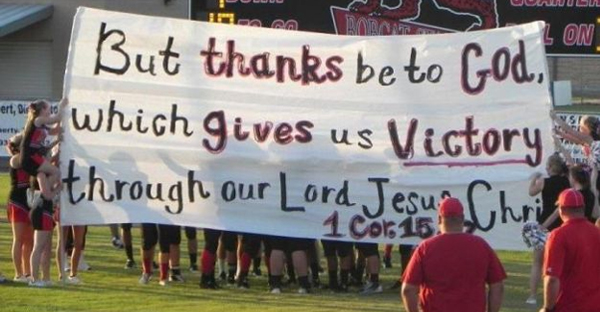
Can cheerleaders at a public school sport Biblical phrases on banners?

The cheerleaders in Kountze, Texas, think so.  So does the Texas Attorney General.  So do tens of thousands of Facebook supporters of the cheer team.

But an important part of this story is often being left out by coverage in some mainstream media outlets. Why?

We’ve reported on this story before.  In short, this group of cheerleaders sued when their school superintendent banned their religious banners from football games.  So far, the cheerleaders have been allowed to keep on cheering for Jesus at their games.

Recently, we’ve noticed a puzzling trend in the reporting about this story.  An editorial in yesterday’s New York Times, for instance, bemoaned the situation in Kountze.  “In this country — including in Texas — the Constitution does not leave religious freedom up to majority rule,” the editors insisted.

I agree with the NYT‘s basic position: the SCOTUS precedent in 2000’s Sante Fe ISD v. Doe speaks directly to this case.  Even student-led prayer, if sanctioned by the school district, implies an endorsement of particular religious beliefs by the government.  Though the Kountze cheerleaders insist that their banners represent purely private speech, this seems a stretch.

However, I’m puzzled by the way NYT coverage has left out a vital part of this story.  For those of us who want to understand the ways conservatism works in American education, whether it be about evolution, school prayer, sex education, or other issues, the skewed coverage in the NYT makes the job much harder.

Here’s the problem:  In yesterday’s editorial and in earlier reporting on this Kountze story, the NYT left out an important key player in the drama.  The NYT neglected to mention the role of the Freedom from Religion Foundation.  This Wisconsin-based group warned the school superintendent of its plans to sue over the banner issue.  Only then did the superintendent ban the cheerleaders’ religious practice.

The NYT misled readers with its description of the reasoning in Texas.  The editors described the case as follows:

“Those banners are not merely personal expressions of belief, but in that setting become religious messages endorsed by the school, the school district and the local government.       

“That’s why officials of the school district last month prohibited the banners at football games.”

But the way the story really played out, the school district only prohibited the banners under pressure.  In fact, as the Los Angeles Times reported, the school superintendent himself supported the cheerleaders.

If we hope to understand the dynamic, in this case or in the many other school-prayer cases in history and in the news, we must not omit such an important element.

Please do not misunderstand: I am not denouncing the Freedom from Religion Foundation.  I do not think that sectarian prayers belong at public-school events.  But I do want to understand these cases, and ignoring important elements such as the role of outside organizations leaves us unable to understand the situation.

As political scientists Michael Berkman and Eric Plutzer have argued in their books Ten Thousand Democracies and Evolution, Creationism, and the Battle to Control America’s Classrooms, teachers and school districts respond to local culture.  When communities want prayer and creationism in public schools, schools include prayer and creationism.

As Berkman and Plutzer proved with their survey of high-school biology teachers, the beliefs of those teachers usually closely match those of their local communities.

In the Kountze case, the school district, including even the superintendent who banned the banners, supports the cheerleaders.  As superintendent Kevin Weldon told the LA Times, the judge in this case “was in a pretty tough predicament, like myself. . . . I personally applaud the kids for standing up for their beliefs in such a bold way.”

If we hope to understand the ways issues such as creationism and school prayer play out in America’s schools, we can’t let ourselves miss the way schools, teachers, and school districts actually function.  Teachers, as Berkman and Plutzer insist, are “street-level bureaucrats.”  They represent majority opinion in their communities.  The same is often true for superintendents such as Kevin Weldon in Kountze.

None of this is new.  In the Scopes Trial in 1925, the prohibition of evolution in Dayton, Tennessee only became controversial when the American Civil Liberties Union became involved.  More recently, as political scientists Kenneth Dolbeare and Phillip Hammond demonstrated in the 1970s, US Supreme Court decisions about school prayer and Bible reading often have no discernable effect on school practice.  After the 1962 and 1963 Supreme Court decisions against the reading of the Bible and reciting of the Lord’s Prayer in public schools, Dolbeare and Hammond found that all the schools in their survey continued to pray and read the Bible.  Most important, those practices caused absolutely no controversy in the communities they studied.

If we hope to understand school prayer controversies, we can’t allow ourselves to leave out the role of key players such as the Freedom from Religion Foundation.  Perhaps the NYT editors hoped to avoid the old chestnut that only “outside agitators” brought about this sort of school controversy.  Whatever their reasons, they misrepresent the story and make it more difficult for outsiders like me to understand the nature of these school battles.

Required Reading: Evolution, Creationism, and the Battle to Control America’s Classrooms

For those who care about creationism, evolution, and America’s schools, stop reading this shine-ola and go get your hands on a copy of Michael Berkman’s and Eric Plutzer’s Evolution, Creationism, and the Battle to Control America’s Classrooms (New York: Cambridge Univ Press, 2010).  Not only is this the best “street-level” analysis about the way real teachers teach evolution and creationism, but the authors’ approach sheds light on schooling and culture far beyond the bounds of biology instruction.

Image source: Cambridge University Press

The same authors released some of their survey data in an article in Science in January 2011.  That National Science Foundation-funded survey of 926 high-school biology teachers from across the United States offered dramatic results.  A full 13% of respondents taught creationism or intelligent design in their public-school biology classrooms.  Twenty-eight percent taught recognizably evolutionary biology.  The rest, roughly 60%, muddled through in the middle, teaching neither or both evolution and creationism.  This book is built around the same survey responses, but it contains much more.

The authors argue compellingly that the evolution/creation deadlock involves three moving parts.  Berkman and Plutzer label these the procedural issues, the substantive issues, and the issues concerning the autonomy of teachers.  In other words, the tangle of evolution includes issues of who decides what gets taught, the science and religion involved, and the final decisions of teachers themselves.

Not surprisingly, these political scientists conclude that the real question here is political.  More than simply science, more than just religion, the contest is at heart “a political struggle over who decides, a question central to democratic politics” (31).

Perhaps the most attention-grabbing part of the authors’ Science article in January 2011 was the sheer volume of anti-evolution education that went on in American public-school biology classes.  As they argue in the pages of the book, their 13% number as a mark for the number of teachers who actively teach creationism or intelligent design is actually a lowball.  The real number may surge more toward 21% (138).

For those like me who want more evolution taught in America’s schools, Berkman and Plutzer’s findings may be profoundly disheartening.  For instance, in addition to the very high numbers of teachers who omit evolution, teach both ideas, or teach explicit creationism, the authors conclude that teachers don’t care too much about changing state standards in science (160).  Thus, while evolution promoters may work hard to improve those standards, the authors here suggest that actual classroom practice will likely not be much affected.

The most important factor in teachers’ choices about evolution education, Berkman and Plutzer conclude, remains teachers’ personal opinions.   Although some factors, such as a full-semester college course devoted to evolutionary biology, may tend to improve the quality and amount of evolution education offered by teachers, such changes pale in significance compared to teachers’ beliefs.  Dwarfing every other factor, if teachers don’t believe evolution, they don’t teach it (186).

Another powerful contribution of the book is the authors’ application of the notion that teachers function as what political scientists call “street-level bureaucrats” (149).  Like other such functionaries, teachers often teach what their communities want them to teach.  In the United States, despite the chagrin this causes among evolutionary scientists, large majorities want their public schools to teach both evolution and creationism, or even creationism alone (49).  This is true even among those American adults who agree that mainstream scientists have agreed on the veracity of evolution.  Berkman and Plutzer analyze a fistful of polls and surveys to conclude that, even among the 52% of adults who agree that mainstream science has embraced evolution, only 20% want only evolution taught in their local public schools.  You read that right.  Even when Americans acknowledge the scientific consensus in favor of evolution, they still favor teaching both evolution and creationism, or even creationism alone.

As “street-level bureaucrats,” teachers tend to fit in with their local communities.  Among the 926 teachers who responded to Berkman and Plutzer’s survey, most agree with the attitudes in their area.  For instance, among the 136 “most cosmopolitan” school districts, only 4% of teachers taught young-earth creationism.  On the flip side, among the 139 “most traditional” school districts, a whopping 37% of teachers taught young-earth creationism (198).

The book contains chapter after chapter of survey analyses like these.  If you’re like me, you’ll want to buy a copy to keep on your desk as a reference for all the different surveys and multivariate regression charts the authors include.  But the survey and polling data are not the only strength of the book.  Also extremely helpful is the authors’ sketch of the structure of the durable evolution/creation controversy.  As they point out, we will never make heads or tails of it if we understand it as mainly a scientific or religious dispute.  Those “substantive” issues are very important, but they are not the whole problem.  This is why, for instance, many mainstream scientists will insist that there is no controversy over the teaching of evolution.  They mean, of course, that the scientific community does not dispute whether or not evolution should be taught.  If we end there, however, we will remain hopelessly flummoxed over the nature of the continuing controversy.  Because, of course, there is a controversy.

The authors suggest two other important dimensions.  First, we need to get our heads around the “procedural” elements at play.  Where do decisions about teaching get made?  By courts, to protect minorities?  By legislatures, to represent majorities?  By professional bodies such as the American Academy for the Advancement of Science, to ensure superior expertise?  If we ignore these crucial questions we’ll never understand the nature of the impasse.

Also, Berkman and Plutzer inject a new element into these discussions.  Unlike the generations of historians, scientists, theologians, and political scientists that have preceded them, the authors emphasize the critical importance of the “autonomy of teachers” (29).  Teachers can and do consistently make daily decisions about the kind of instruction that goes on in America’s public schools.  Without looking at the impact of those decisions, we will never be able to wrap our heads around the true contours of this culture-war debate.

The authors conclude that these questions remain, at root, a fundamental “political struggle over who decides” (31).  This insight alone makes a significant contribution to stale discussions over the nature of evolution/creation.  Some of our brightest minds have foundered over this simple truth.  In a recent book, for instance, philosopher Philip Kitcher implies that the conflict has lasted so long primarily because the two sides have not adequately understood one another.  In Living with Darwin (2007), Kitcher writes, “detailed replies” to creationist challenges have calmed the controversy temporarily (3).  Yet, due to lack of understanding by creationists, Kitcher suggests “we shall not escape the cycle of controversy until it is completely clear what lies at the bottom of it all” (xi).  Clearly, Kitcher knows the science involved.  He knows the theology involved.  But his implication that a clear enough explanation will somehow clear the air ignores Berkman and Plutzer’s convincing point: this is not about understanding, this is about power.

No matter how brilliant and erudite Kitcher’s explanations of evolution, no matter how clear and cogent his arguments, Kitcher and his ilk will ultimately have little effect on the course of the creation/evolution debates.  Of the teachers who teach creationism in Berkman and Plutzer’s survey, 32% had completed a college-level semester-long course devoted entirely to evolutionary science, 55% held a bachelor’s degree in science, 13% held a graduate degree in science, and 49% had earned 40 or more college credits in biology courses.  It is not that teachers of creationism don’t know the evidence for evolution.  They simply reject it (186).  After all, how clear and convincing would an argument based on the Old and New Testament have to be to convince Kitcher of the truths of creationism?

For all its explanatory power, Evolution, Creationism, and the Battle to Control America’s Classrooms includes a few minor hiccups.  First of all, the authors insightfully note that the essence of the evolution/creation struggle has been a struggle for control of educational decisions.  But among the groups involved–“Federal judges, scientists, education policy makers, and teachers” (13)—the authors curiously omit parents as direct curricular decision-makers.  Since at least the 1920s, activists have insisted on the rights of parents to control the curriculum for their own children.  Recently, in places such as New Hampshire and Missouri, as I’ve argued in these pages and in the Washington Post’s Answer Sheet, state laws have changed the playing field.  These new laws have finally introduced what Berkman and Plutzer might call direct curricular democracy.  Not only can judges, scientists, policy makers, and teachers take part in this durable battle, but parents can and have successfully exerted their significant political influence.  The authors’ failure to include parents as interested and influential parties is a puzzling omission.

In addition, as political scientists, the authors overlook some simple historical errors.  They date the end of the American Civil War, for instance, to 1869 (66).  In a similar slip, they refer to the leading creationist Seventh-day Adventist Church as the Seventh Adventist Church (91).

But such minor quibbles do not detract from the overall argument.

The authors will likely continue to attract the most attention for their original survey data of biology teachers.  And those data are indeed compelling.  But far more important to understanding the nature of the creation/evolution debates are the authors’ arguments about the inherently political and deeply local nature of those debates.  They are not decided in state houses, but in school houses.  They are not decided in courtrooms, but in classrooms.


Cheering for Jesus in a Public School

Source: KNUE

Can they or can’t they?

No one seems too sure of the situation in Kountze, Texas.  In this town of around 2,000, high-school cheerleaders have attracted attention for their religious banners at school football games.

In late September, the district superintendent banned the explicitly Christian banners, under pressure from the Wisconsin-based Freedom from Religion Foundation.

The cheerleaders sued.  The latest decision has been that the cheerleaders can continue to display the banners while the wheels of Constitutional justice grind along.

The case demonstrates the ferocious complexity of school-prayer rules and traditions.  The cheerleaders seem entirely oblivious to the Constitutional issues.  In interviews, they tend to hurt their own legal case by stating such things as “It’s our religion and we want to portray that.”  Or this gem about the complainants, “They can be offended, because that’s their right.”

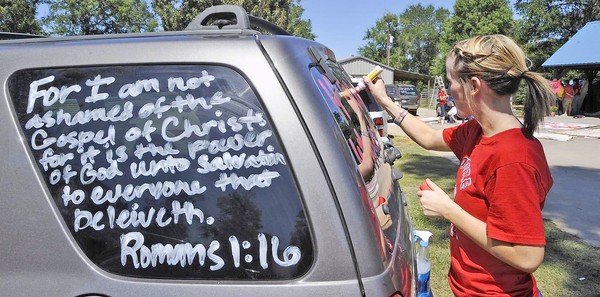
There is not much doubt of the facts of the case.  The banners are obviously and designedly Christian.  They bear such Biblical phrases as the following:

“I can do all things through Christ which strengthens! Phil 4:13.”

“If God is for us, who can be against us? Romans 8:31.”

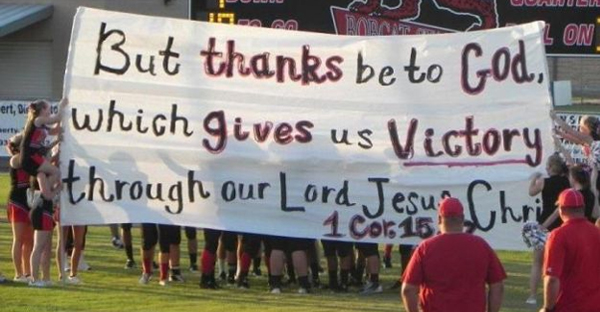
“But thanks be to God which gives us Victory through our Lord Jesus Christ. 1 Cor 15:57.”

Image Source: Los Angeles Times

The SCOTUS precedents in this sort of case are fairly clear.  The most obvious precedent is Santa Fe v. Doe (2000), the famous football-game-prayer case.  In that case, the Court ruled that a prayer at a high school football game, even when led by students, implies school endorsement of religion.

Lawyers in this case are keenly aware of the precedent.  The cheerleaders’ lawyers, therefore, emphasize the fact that this cheer group is not a school-sponsored organization.  They have no coach, they have no school-provided budget.  In essence, the cheerleaders claim that theirs is purely private speech.  If so, they would have a strong case for passing Constitutional muster.  Their lawyers have also cited the SCOTUS precedent of Tinker v. Des Moines, in which student protest-armbands against the Vietnam War were ruled protected free speech.

The school district has made the predictable counter-argument.  The cheer team, the district has argued, represents the school at a public function.  Cheerleaders must sign a “cheerleaders’ constitution,” which includes a pledge to represent the school well.  As district attorney Tom Brandt argued, “This is government speech. It’s on public property. The cheerleaders represent the school.”

This case also demonstrates the fact that public schooling in America is fractured into what political scientists Michael Berkman and Eric Plutzer have called “Ten Thousand Democracies.”   Regardless of SCOTUS decisions or state education policy, local school districts often support policies that represent the majority views of local communities.  Arguments in favor of such policies are usually framed in terms of the will of the majority.  As one of the cheerleaders insisted, “so far there hasn’t been any opposition to what we’re doing. Nothing but support.”  Such has been the case for much of the history of religion in public schools.  Local schools tend to endorse and embody local traditions.  Many of those traditions, like explicitly Christian prayer at football games, seem to imply an official endorsement of a particular religion.

It has often required outside intervention to draw attention to these continuing traditions.  In this case, that pressure came from Madison, Wisconsin, and the Freedom from Religion Foundation.

And school prayer has often, as in this case, proven to be enormously popular.  In this case, Texas Attorney General Greg Abbott has publicly supported the cheerleaders.  And the Facebook page set up in their support looks ready to top the 50,000 friends mark.

So, whether or not the Kountze cheerleaders can or can’t lead prayers at football games, they are.  Whether or not they will be allowed to continue will likely hinge on whether or not their activities are seen as school-sponsored, or private.

Required Reading: David Long and an Ethnography of Creationism

Gallup polls are what they are.  The numbers can be misleading from time to time.  As Homer Simpson scornfully concluded, “Facts!. . . pffft.  Facts can be used to prove anything that’s even remotely true.”

Image source: Dead Homer Society

But when polls keep saying the same thing, it makes sense to listen.  According to Gallup, from the mid-1980s through today, nearly half of American adults agree that the earth was created in “pretty much its present form within the last ten thousand years or so.”

Evolutionists like me tend to be shocked by this number.  How is this possible?

As David E. Long argues in his book Evolution and Religion in American Education: An Ethnography (Springer, 2011), the old evolutionists’ answers don’t hold up anymore.  Some evolutionists tend to assume that creationism, especially young-earth creationism, is similar to a public-health problem.  As soon as enough people are exposed to the saving truth of evolution, this argument goes, creationists will quickly realize the errors of their ways.  This assumption doesn’t match the historical facts, but it still has its share of true believers.  As we noted here recently, Bill Nye “The Science Guy” attracted a lot of attention when he endorsed this sort of fallacy.

Another problem, Long argues, is an implicit “deficiency model” among evolution educators.  These educators, Long asserts, would not be likely to blame students from households without a lot of books for being somewhat behind in their reading skills.  Yet they do blame students from creationist households for resisting evolution.

Long hopes to challenge these approaches to understanding creationism in America.  As he puts it, too many educators act as if learning evolution were a simple matter of “being shown discrete points of Truth and adding these bits to our respective Truth-piles” (14, emphasis in original).  If this were the case, Long argues, “there simply would be no societal issue over evolution.”  Obviously the deadlock over such issues as evolution, scientific creationism, and intelligent design proves that much more is going on here.

Long’s study joins others in offering a new approach.  As did Michael Berkman and Eric Plutzer in their study of biology education, Long hopes to get inside the heads of those who are somehow avoiding evolution education.  Berkman and Plutzer found that anti-evolutionists had not necessarily been isolated from the truths of evolution.  Instead, many anti-evolutionists “choose to ignore scientific arguments demonstrating evolution.”[*]  Knowledge of evolution, according to their large study funded by the National Science Foundation, is often relatively high among those who dispute it most fervently.  This does not match the fantasies of science fans such as Bill Nye.  Long’s study, like that of Berkman and Plutzer, promises to unravel this apparent mystery.

Instead of asking, even implicitly, “what’s wrong with these creationist students?”, Long wants to ask, “what in fact do Creationists have that makes the study of evolution troublesome or even dangerous?” (15, emphasis in original.)

Long himself grew up in a conservative Protestant family.  He remembers his mother telling him sadly that he was going to hell (11).  But this book is neither an apology for creationism nor an attack on creationists.  Instead, Long offers an ethnography of creationism in action.  He conducted interviews with thirty-one students at a state university along the Ohio River.  The results make for arresting reading.

One student, a non-traditional student who grew up as a child of missionaries, reported that she had not learned any evolution before she got to college.  Sitting in the large lecture halls, she told Long that a professor made her feel distinctly inferior.  She remembered the lecturer’s attitude:  “If you believe in God creating the earth, then pretty much you’re an idiot.  And he obviously didn’t use those words, but that’s pretty much what he said.  And I remember thinking . . . What is he talking about?. . . like, he should just go around and ask people to raise their hands ‘who believes in this and who doesn’t’!” (36).

This student, “Esther,” told Long that she had no problem with the academic challenge of evolution.  In her words, “I take those really big classes, because it’s really easy to excel in those huge classes.  I mean, I got like a hundred on every test.  You have to be an idiot pretty much not to.  If you just sit, and you listen to what they’re saying, and you know how to take tests, it’s very easy to do well in those classes” (36).  Long wrestles with the important questions this sort of testimony evokes.  For students like Esther, what does it mean to “know” evolution?  What does it mean to feel belittled for one’s background, even if it is done unintentionally?

Another thoughtful creationist interviewee told Long that accepting the truth of evolution would mean “a lot of work for me to change my worldview, a lot of time, a lot of alienation from friends” (41).  Long asked what it would mean if somehow this student—who had been homeschooled into his creationist views—what it would mean if somehow this student found out that humans had really evolved.  The student replied, “It would be a complete crisis.  It would be really tough” (41).  As Long notes, this is more than a scientific situation.  This is an entire life wrapped up in creationism.

Long argues that evolution educators have not sufficiently wrestled with the existential anxiety at stake for some creationist students.  Accepting the truth of evolution, for some, would be more than simply changing one’s mind.  It would be a radical change, and more often, the “positive, commonsensical, and affirmed” path is to simply reject evolution (47).

In most cases, Long concludes that no amount of education really threatens to change students’ worldviews.  Of his batch, only three experienced any sort of profound change, including in their attitudes toward evolution.  These three cases form the basis of Long’s fifth chapter, a chapter that’s worth the price of admission all by itself.  Long describes the case of “Cindy,” a student from a staunchly anti-evolution small town.  Cindy ended up open to the notion of human evolution, but only because she challenged her entire upbringing.  It was not the eye-opening scientific evidence for evolution that convinced her.  Rather, Cindy got pregnant and had an abortion in high school.  The gossipy and cruel reaction of her church drove her away from that worldview.  The entire experience left Cindy open to the idea of human evolution.

Equally fascinating is the case of Renee.  Renee came from a non-religious family, sort of.  She was a biology major with plans on graduate work in pharmacology.  Her non-religious worldview was shattered not by the saving words of Jesus, but rather by pair of bitter divorces.  Renee herself divorced her husband, and her father divorced her mother.  Partly as a result, Renee’s father embraced the creationist-centered conservative Protestantism of his youth.  Though Renee’s mother continued to insist on the family’s atheism, Renee embraced creationist Christianity during a trip with her father to the Creation Museum outside of Cincinnati.

These brief summaries can’t do justice to the fascinating case studies Long explores in this book.  The book itself is a must-read for any outsiders who really want to understand the evolution/creation stalemate in America.  Long’s interviews and analyses offer unmatched insight into the reasons why evolution and creation both create such durable and impermeable worldviews.

Unfortunately, unless and until a paperback edition comes out, Long’s publisher has priced this out of range for most non-institutional buyers.  At $140, it is targeted more at university libraries than interested lay readers.  Hopefully, that will not restrict the number of readers this book attracts.  Joining other nuanced studies like Berkman’s and Plutzer’s, Long’s book promises to make an end run around some of the conceptual difficulties that have stymied so many efforts to understand the durability of creationism in the United States.


[*] Michael Berkman and Eric Plutzer, Evolution, Creationism, and the Battle to Control America’s Classrooms (Cambridge: Cambridge University Press, 2010), 78.  Emphasis in original.

Getting It Wrong at The Atlantic

Watch out!  A couple of recent articles in The Atlantic dish out some misleading histories of Fundamentalist America.  It would be easy for those of us trying to understand FA to be confused.

First, let me say that I get it: Fundamentalist America is not easy to understand.  As Kevin White has noted recently on Mere Orthodoxy, this is true even for those who consider themselves FA citizens.  Even among only conservative evangelical Protestantism, we can be dazzled and confused by what historian Timothy L. Smith called the “kaleidoscope” of American evangelicalism.  Once we add conservative Catholics, cultural traditionalists, Burkean conservatives, free-market ideologues, etc. etc. etc…., mapping out a sensible understanding of Fundamentalist America can seem like an overwhelming task.  For those raised in the traditions of Tradition, this kaleidoscope can be bewildering.  And it can be even more so for those of us trying to understand Fundamentalist America from the outside.

I understand this difficulty.  I sympathize.  In the case of the recent articles in The Atlantic, neither author set out to mislead.  Unfortunately, each of them got it wrong.

First, Jonathan Merritt reflects on the thirty-third anniversary of the Christian Right.  Merritt pegs the founding of the “modern” religious Right in America to Jerry Falwell’s founding of the Moral Majority in June, 1979.  As Merritt argues,

“Previously, Evangelical Christians had been reticent to engage in partisan politics. But the cultural revolution of the 1960s brought on a blitzkrieg of social changes that left many religious conservatives feeling as if their way of life was being threatened. In response, the faithful flooded the public square — millions of them under the Moral Majority’s banner — to influence national elections and legislation. Standing tall at the helm of the movement was the silver-haired Falwell, a man whose presence could silence a room and whose rhetoric would often rouse it to raucousness.”

There is some truth to this, but only if we understand it in a very limited way.  Only if we put the emphasis of this entire paragraph on the word “partisan” does this give an accurate impression of the history of activism by religious conservatives.  A sensible reader might read this paragraph and conclude that it was not until 1979 that religious and cultural conservatives “flooded the public square.”  A reader might think that only the “blitzkrieg of social changes” from the late 1960s and 1970s spurred religious conservatives to public action.

This is a woefully misleading impression of the nature of conservative religious activism in America.  Even if we leave out the enormously important “long history” of Great Awakenings, abolitionism, and temperance, we have a twentieth century chock-full of religious activists working to maintain a traditional Godly public square.

And this activism did not differ in essence from that of later, post-1979 religious conservatives.  In the 1920s, for instance, the threat of evolution in public schools and the weakening of Biblical morality in public life spurred conservatives to action.  In the 1940s and 1950s, conservatives’ perceptions of a rapidly changing social order gave rise to new organizations such as the National Association of Evangelicals, and culture-changing revival campaigns like those of Billy Graham.

It is true that these cultural campaigns did not seize on partisan politics with vigor until the late 1970s.  Most conservative Christian activists did not see themselves as working within the confines of the Republican Party until that time.  But the implication that conservative religious folks had been somehow quiescent in earlier decades gives a very misleading impression of the history of Fundamentalist America.

Atlantic Editor Robert Wright offers up the next flawed history.  Wright suggests that the recent aggressive atheism of prominent evolutionists has led conservative religious people to turn away from science altogether.  He argues,

“I do think that in recent years disagreement over evolution has become more politically charged, more acrimonious, and that the rancor may be affecting other science-related policy areas, such as climate change.

“My theory is highly conjectural, but here goes:

“A few decades ago, Darwinians and creationists had a de facto nonaggression pact: Creationists would let Darwinians reign in biology class, and otherwise Darwinians would leave creationists alone. The deal worked. I went to a public high school in a pretty religious part of the country–south-central Texas–and I don’t remember anyone complaining about sophomores being taught natural selection. It just wasn’t an issue.

“A few years ago, such biologists as Richard Dawkins and PZ Myers started violating the nonaggression pact. I don’t just mean they professed atheism–many Darwinians had long done that; I mean they started proselytizing, ridiculing the faithful, and talking as if religion was an inherently pernicious thing. They not only highlighted the previously subdued tension between Darwinism and creationism but depicted Darwinism as the enemy of religion more broadly.”

I take Wright’s point to be less about the history of creationism and more about evolutionists’ strategy.  I agree that it will continue to be counterproductive for evolutionists to insist that evolution and religion must be eternally at odds.  As Wright concludes, “if somebody wants to convince a fundamentalist Christian that climate scientists aren’t to be trusted, the Christian’s prior association of scientists like Dawkins with evil makes that job easier.”  Fair enough.

But his admittedly conjectural assertions about a “non-aggression pact” between creationists and evolutionists suggests a dangerously false understanding of history.  As I’m sure he would readily admit, the evidence from his own high-school career does not adequately sum up the American experience.  The notion that Dawkins and Myers represent a new element in the creation/evolution debates underestimates the importance of the long history of activism by the likes of Robert Ingersoll and Thomas Henry Huxley.  Both promoted “freethought,” what a later age would call atheism or agnosticism.  And both were associated firmly in the public mind with Darwinian evolution.  Indeed, Huxley relished his nickname, “Darwin’s Bulldog.”  As Huxley wrote to Darwin,

“And as to the curs which will bark and yelp — you must recollect that some of your friends at any rate are endowed with an amount of combativeness which (though you have often & justly rebuked it) may stand you in good stead — I am sharpening up my claws and beak in readiness.”

Such aggressive evolutionism has been associated in the public mind with a combative anti-theism for as long as the public has wondered about creationism and evolutionism.  In addition, Wright’s suggestion that creationists had tacitly agreed to “let Darwinians reign in biology class” until recently woefully misses the historical boat.  Since the 1920s, conservative activists have worked energetically and consistently to make sure Darwin did not so reign.  Most famously, the 1920s saw the issue come to a public head with the Scopes “Monkey” trial in Tennessee.  But unlike the persistent Inherit-the-Wind myth suggests, creationists did not crawl back to their isolated hollers after that 1925 trial.

It is notoriously difficult to know what goes on behind closed classroom doors, but the available evidence suggests that anti-evolution sentiment remained both powerful and polticially active in every decade of the twentieth century.  One large-scale study in 1942, for example, asked thousands of high-school biology teachers about their teaching.  The survey authors concluded that evolution was taught in “notably less than half of the high schools of the United States.”  And of those schools in which evolution was taught, the study authors concluded that it was “frequently diluted beyond recognition,” either by pairing it with the teaching of special creation, or by the separation of human origins from the idea of organic evolution.  Other studies found similar results.

More recently, Michael B. Berkman and Eric Plutzer confirmed the continuing tendency of American teachers to avoid teaching evolution.  Their study of 926 US public high school biology teachers found a sizeable minority (28%) who reported to teach evolution.  It also found a smaller but still significant group (13%) who reported teaching creation.  The large middle, what Berkman and Plutzer call the “Cautious 60%,” teach a mish-mash of creationism and evolution.  One important reason teachers gave for skipping evolution is an understandable desire to avoid controversy.  In other words, in twenty-first century America as in 1920s, 1940s, 1950s, 1960s, and 1970s America, anti-evolution sentiment dictated large percentages of education policy.

Unlike the picture Wright paints, however, this is not a recent development but a generations-old cultural trend.  The suggestion that recent Gallup poll data mark any significant change in America’s enduring trench lines in this culture-war front is misleading.

My hunch is that neither of these authors hoped to use their misunderstandings of the history of Fundamentalist America as a weapon.  My hunch is that both of them sincerely believe in the historical narratives they deliver.  However, this understanding of the history of conservative religious activism in public life is not merely neutral.  It promotes a myth that religious Americans in the past did not participate in politics; it suggests that recent conservative cultural activism represents a break from American traditions.

Let me be clear: I do not object to this misuse of history because I disagree with the politics.  I do not hope to promote the values or agendas of Fundamentalist America; I don’t want to offer my own slanted history in rebuttal.  But I do object as an historian.  If we hope to understand Fundamentalist America, we need to be honest and fair about its history.  Suggesting that an activist conservative Christianity, or a defensive creationist community, are somehow recent developments distorts that history in pernicious ways.

Further reading: Oscar Riddle, F.L. Fitzpatrick, H.B. Glass, B.C. Gruenberg, D.F. Miller, E.W. Sinnott, eds., The Teaching of Biology in Secondary Schools of the United States: A Report of Results from a Questionnaire (Washington, DC: Union of American Biological Sciences, 1942); Estelle R. Laba and Eugene W. Gross, “Evolution Slighted in High-School Biology,” Clearing House 24 (March 1950); Michael B. Berkman and Eric Pluzter, Evolution, Creationism, and the Battle to Control America’s Classrooms (Cambridge University Press, 2010); George M. Marsden, Fundamentalism and American Culture: The Shaping of Twentieth-Century Evangelicalism, 1870-1925 (New York: Oxford University Press, 2006); Joel A. Carpenter, Revive Us Again: The Reawakening of American Fundamentalism (New York: Oxford University Press, 1997); Ronald L. Numbers, The Creationists: From Scientific Creationism to Intelligent Design, Exp. Ed. (Cambridge: Harvard University Press, 2006).