When Loyalty Means Dictatorship: The Latest Sad Story from Liberty U

It is not a happy time to be a Flame. Former student editor Will E. Young offered a blistering expose of the school’s “atmosphere of fear” in the Washington Post. Unfortunately, Young’s experience at Liberty was not a shocking departure from the history of evangelical higher ed, but rather just a new development of an ugly tradition. As Young asks plaintively,

How can a college education stifle your freedom of thought?

Unfortunately, Jerry Falwell Jr.’s dictatorial antics are nothing new. Whether Falwell realizes it or not, he is only the latest fundamentalist school leader to bolster his authority at the cost of his school’s intellectual and spiritual integrity.
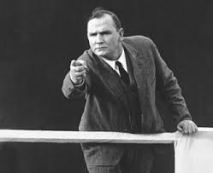
Bob jones sr

Falwell adopts the Bob Jones leadership mantra: “My Way or the Highway”

Young was student editor at the Liberty student paper and experienced the full pressure of the administration’s heavy-handed regime of censorship. His faculty advisor required him to preview articles and killed any story that made Liberty or its leader Jerry Falwell Jr. look bad.

As Young explained,

when my team took over that fall of 2017, we encountered an “oversight” system — read: a censorship regime — that required us to send every story to Falwell’s assistant for review. Any administrator or professor who appeared in an article had editing authority over any part of the article; they added and deleted whatever they wanted. Falwell called our newsroom on multiple occasions to direct our coverage personally, as he had a year earlier when, weeks before the 2016 election, he read a draft of my column defending mainstream news outlets and ordered me to say whom I planned to vote for.

Such censorship is not new for Liberty. As we’ve seen, in recent years Liberty’s censorship has grown stricter. As I argued in Fundamentalist U, this kind of leader-focused absolutism has a long and sad tradition in evangelical higher ed. It is not a quirk of Falwell or Trumpism, but rather it is the result of the definitional problem of interdenominational evangelical higher education. Without a single, clearly defined religious orthodoxy to defend, institutions such as Liberty, Bob Jones University, and many others developed a top-down, leader-centric institutional structure. In short, lacking a denominational orthodoxy or hierarchy, some fundamentalist school leaders adopted a bitter, angry “my-way-or-the-highway” approach.

Back in the 1930s, when “fundamentalism” was still finding its legs as an institutionalized religious movement, leaders of fundamentalist colleges such as Wheaton and Bob Jones faced a dilemma. They had no universally agreed-upon definition of fundamentalism, yet they were charged with teaching fundamentalism and maintaining a purely fundamentalist campus.
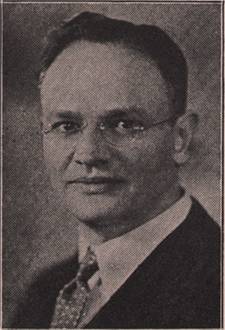
buswellpres

Buswell at Wheaton.

Different schools reacted differently. Wheaton ended up with a confusing spread of institutional authority. Early President J. Oliver Buswell found out the hard way that he could not simply dictate policy at Wheaton. When Buswell tried to embrace a vision of fundamentalism that meant full separation from non-fundamentalist Protestants, he was summarily fired.

At the same time, Bob Jones Sr. pioneered the kind of fundamentalist leadership that is on display today at Liberty University. All faculty members were required to agree with every jot and tittle of Jones’s beliefs. One faculty member was fired in 1938 for “hobnobbing” with students. As this fired faculty member wrote in an open letter, he had worked at two other evangelical universities in his career,

two of them orthodox. (But not obnoxious.) My loyalty was never questioned . . . . It simply never occurred to me that I was not free to express my opinions and I did express them. How was I to know that loyalty meant dictatorship?

It might never have been crystal clear what “fundamentalism” meant, but at Bob Jones College (later Bob Jones University), it always meant whatever the leader said it meant. Any disagreement, any “griping,” meant a fast ticket out the door, with a furious gossip campaign among the fundamentalist community to discredit the fired faculty member.

Mr. Young’s story from Liberty U is heart-wrenching, but it is not new. The dictatorial style of Jerry Falwell Jr. is not an innovation, but rather only the sad flowering of a poisonous fundamentalist flower.
Star Conservative Professor Rejects Evangelical Higher Ed

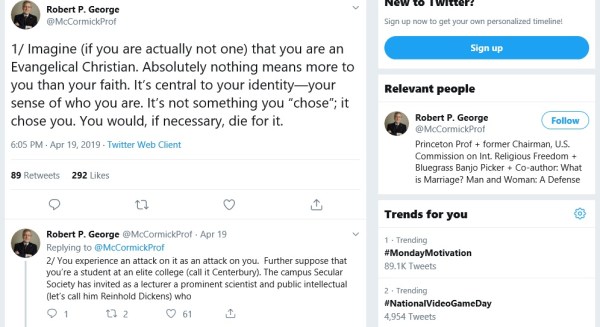
I don’t think he meant to do it. But conservatives’ favorite star academic just trashed the entire tradition of conservative evangelical higher education.robert george christian colleges

It’s pretty safe to say that Professor Robert P. George of Princeton didn’t mean to badmouth conservative evangelical colleges. He was talking—broadly speaking—about the proper way for students to react to campus ideas they didn’t like. They CAN protest, Prof. George wrote, but they really shouldn’t. Even when they are confronted with ideas that strike right at the very heart of who they are as people and as Christians, George advised, students should do something else entirely. They should listen politely, ask questions boldly, and think deeply.

What’s wrong with that? Absolutely nothing. But in his next bit, Professor George inadvertently criticized the entire body of conservative-evangelical universities and colleges. As he put it,

You [students] are there [in college] to be challenged and unsettled—to have your deepest, most cherished, identity-shaping beliefs subjected to scrutiny. That’s what liberal arts learning is most fundamentally about—leading the examined life.

FWIW, I agree entirely. As I found in my research for Fundamentalist U, however, if we accept Professor George’s vision of “what liberal arts learning is most fundamentally about,” we would be forced to admit that conservative-evangelical colleges are not really colleges at all.

After all, though it is fiendishly difficult to define “real” evangelical higher ed, both friends and foes of conservative evangelicalism agree on one thing. Namely, the higher-educational movement that began in the 1920s and included leading evangelical schools such as Wheaton College and Gordon College as well as fundamentalist institutions such as Bob Jones University and Liberty University was built on a profound dissent against Professor George’s vision of proper higher education. They were built, instead, on a promise to carefully control the ideas to which students would be exposed.

For example, though schools such as Bob Jones and Wheaton are worlds apart in many ways, they have always been united by their insistence that all faculty members adhere to a statement of belief. From their beginnings or re-beginnings in the 1920s, conservative evangelical colleges promised evangelical parents, in the words of school founder Bob Jones Sr. (1928), they would have a school in which

Fathers and mothers who place their sons and daughters in our institution can go to sleep at night with no haunting fear that some skeptical teachers will steal the faith of their precious children.

At evangelical colleges and universities, students were never supposed to have their “deepest, most cherished, identity-shaping beliefs subjected to scrutiny.”

It wasn’t only at fundamentalist Bob Jones College. At more-liberal Wheaton, too, the ideas that students encountered were carefully curated.

In 1949, for example, a student group invited a liberal, non-evangelical professor from the nearby University of Chicago to give a campus talk about the Bible. The student leader told Wheaton’s president that his group did not want to shake students’ faiths. Rather, he only wanted to strengthen their faith by giving them the experience Professor George describes.

The trustees did not take to such arguments. Professor George’s vision of proper higher education, one conservative insisted, was “a gross violation of the principles for which Wheaton stands.” Moreover, from the trustee’s point of view, this “inclusive, compromising policy” was nothing less than “clearly destructive of every foundation principle for which Wheaton has stood.”

And, lest one think that such anti-free-speech principles have been left behind in the dustbin of history, consider just a few recent cases. Wheaton students who press for greater LGBTQ inclusion have been squelched. Wheaton faculty who question (or maybe who just look like they might question) evangelical theology have been fired.

In my opinion, and the opinions of the thousands of students who thrive in evangelical institutions, these restrictions are part of what makes conservative schools great. Yes, there are significant restrictions on free speech. Yes, the schools are built on the premise and the promise that some ideas will not be given equal space. But there have always been significant advantages to those restrictions, advantages that many non-religious schools are now looking at with envy. (See, for example, trends toward new in loco parentis rules or creating “safe spaces.”)

If, however, we take Professor George’s word for it, real higher education requires a different approach. I don’t think he meant to do so, but by defining proper higher education as disturbing and soul-shaking, Professor George has accidentally insulted a vast network of successful conservative institutions.

Sinning to Survive: Evangelical Colleges Cheat to Live

Maybe it’s legal, but it sure isn’t ethical. Just like mainstream universities, evangelical ones have engaged in morally dicey practices in order to keep the tuition dollars rolling in. Should they be held to a higher standard?liberty phd online

Here’s what we know: Inside Higher Ed reported this morning on the complicated legal settlements made recently by Oral Roberts University and North Greenville University. The details are confusing, but in short, both ORU and NGU paid big bucks–$300,000 and $2.5 million, respectively—to settle accusations that they had broken the law.

Both schools are accused of contracting with a now-defunct company to recruit students. Apparently, universities aren’t allowed to offer companies a percentage of the “take” for that kind of recruiting if the students are eligible for federal loans. The law makes sense: The feds worry about “predatory” institutions chasing after federal loan dollars, leaving hapless students with big debt.

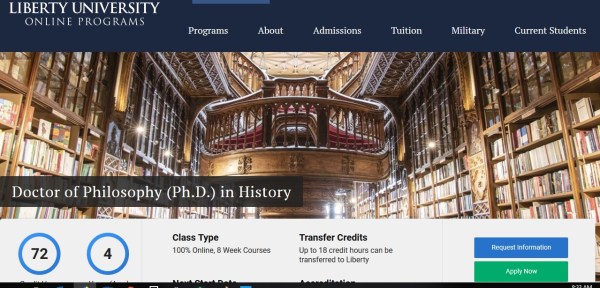
Meanwhile, what Liberty University is doing might not be illegal, to me it seems just as troubling. Recently the evangelical behemoth has been advertising a program that will leave students unemployable. The program in question is a fully online History PhD. Liberty promises that the program will help students land jobs. As they advertise (emphasis added by me),

Are you interested in a career in education, research, politics, archaeology, or management of national landmarks or museums? Whatever your history-related career goals are, Liberty University’s Ph.D. in History can provide the theoretical background, research and writing abilities, and experience you’ll need to excel in either academic or nonacademic career fields related to humanities or social sciences.

When you complete your doctorate in history, you’ll be prepared to pursue a variety of career opportunities. You might join the world of academia as a professor, professional researcher, or academic publisher or editor. Or you could pursue a position as a museum curator, international development specialist, author, archaeologist, or federal government employee.

Academics and many other career fields need people like you who are knowledgeable about the undercurrents, culture, and societal standards surrounding historical events. Prepare to excel in whichever career field you choose when you pursue our doctoral degree in history.

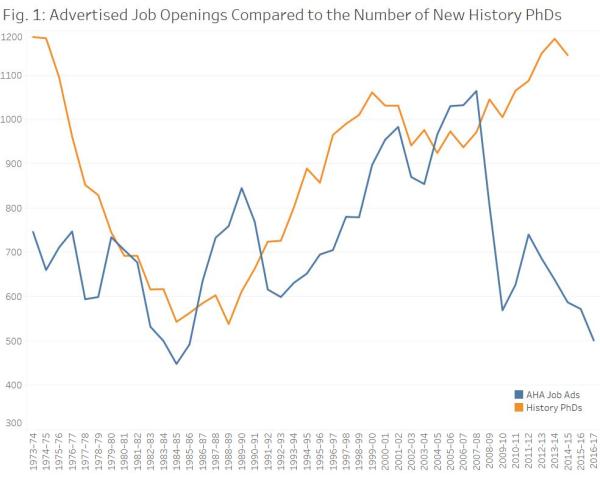
I don’t think there’s anything illegal about this sort of thing, but it does strike me as deeply misleading. The academic job market for history PhDs has not been strong since the late 1960s and these days it is positively dismal.Advertised-Job-Openings-Compared-to-the-Number-of-New-History-PhDsIn general, the very few jobs that are available in history departments have go to candidates with impeccable credentials. I have a hard time imagining that any history department would be willing to hire a candidate who had completed a fully online PhD program. In short, I do not think it is ethical for Liberty to tell people that they “might join the world of academia as a professor.”

I understand that the Liberty advertisement hedges its promises by talking about a “variety of career opportunities.” As do other desperate history programs who offer non-academic career advice, Liberty can fall back on its language about non-academic career paths as proof of its good intentions. I don’t think that’s enough. Even non-academic jobs for history PhDs are ferociously competitive and a candidate with an online degree will not be able to cut the mustard.

Don’t get me wrong. I understand why these evangelical schools make these sorts of insincere promises and shady deals. From the perspective of the recruiters’ offices, the prospect for the entire field of American higher education is scary and getting worse. There are fewer and fewer college-going young people and by 2025 the number will have dwindled even more.

Schools are closing and combining. Evangelical colleges have not been safe from this trend, as a recent shake-up at Gordon College attests. Nevertheless, I think it is fair to demand more than simple law-following from leaders of evangelical institutions. Bending the truth to get students in the door is something no one should tolerate, least of all people who want colleges to hold up the high ethical values of evangelical Christianity.

Gordon with a Twist

These are tough times for colleges. Dropping enrollments and increasing costs have led many schools to shut their doors or slash programs. The latest in the evangelical world has been Gordon College. As I shared recently with a reporter for Inside Higher Ed, I think we need to understand the peculiar pinched politics of evangelicalism if we hope to make sense of Gordon’s recent changes. I hope the changes work out well for the Gordon community, but I can’t help but notice that they don’t seem to match Gordon’s history or tradition.

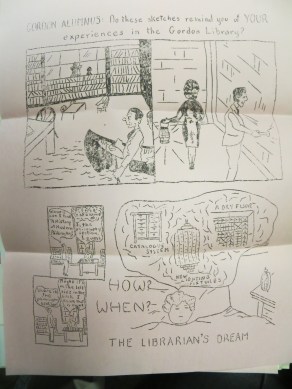
plea to alumnus funds for library cartoon

At Gordon, money has always been tight. This alumni appeal came from the 1940s.

Like all evangelical colleges, Gordon has always had to walk a tightrope. It has always had to promise parents and families a top-notch academic education, including preparation for professional careers. At the same time, it has had to guard its evangelical reputation vigilantly. Like all evangelical colleges, Gordon has had to worry that the college-going evangelical public will see it as too liberal or too conservative.

Back in the day, Gordon was a leader in the evangelical evolution from “missionary-training school” to “Bible college.” What began as the Gordon Missionary Training School in 1895 became the Gordon Bible Institute in 1914, then Gordon Bible College in 1916, then Gordon College of Theology and Missions in 1921.

Back then, the changes were not driven by financial pressures but rather by the changing nature of American higher education. As then-president Nathan Wood explained, the school changed its name in 1921 to accommodate the desires of students and alumni for a college degree, not merely a missionary certificate. As Wood explained in his autobiography, a group of current and former class presidents came to him to request the 1921 name change. They wanted, in Wood’s words,

a change of name . . .  which would express the collegiate and theological work of the school. . . . It meant much to them as future Alumni.

Culture-war politics have also always driven decisions at Gordon. In the 1960s, for example, Gordon’s faculty rejected a move to the political right. In 1964, then-president James Forrester hoped to import a free-market conservative focus to Gordon. With help from politically conservative administrators of The King’s College, Forrester planned a big free-market conference at Gordon, including conservative luminaries such as Congressman Walter Judd and Leonard Read of the Foundation for Economic Education. They wanted to bring Gordon on board, to focus on teaching students

a pervading high regard for Freedom in its spiritual, economic and political dimensions.

When Forrester ran his plan by Gordon’s faculty, however, they nixed the idea. They didn’t want Gordon to be associated with what one faculty leader called the “extreme right.” The faculty had higher academic ambitions for Gordon, not merely to indoctrinate students in what faculty called “a program of education in conservative thinking.”

Today’s changes seem worlds removed from these Gordon precedents. As Elizabeth Redden described, today’s students are not driving today’s changes. Rather, many students seemed surprised and saddened by the reduction in major programs and the reduction of faculty positions.

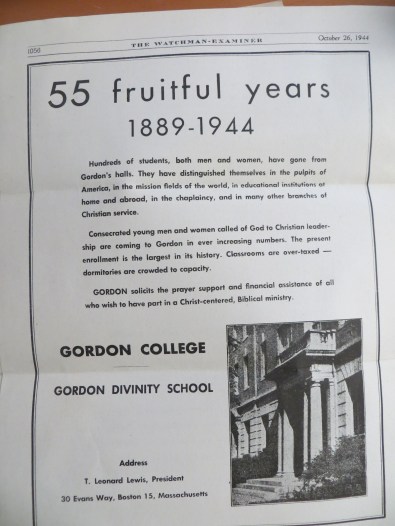
Gordon 1944 ad for donations in Watchman Examiner

A different plea for money, to the evangelical community, c. 1944.

Plus, the current administration of Gordon does not seem cowed by faculty pressure. Rather, Redden found herself unable to find a single faculty member willing to comment. The changes in Gordon were decided upon by top administrators, not faculty. Moreover, the administration seems willing to move Gordon’s reputation more to the conservative side of the evangelical world, with reminders in recent years that Gordon has never approved of LGBTQ “practice.”

I don’t doubt that Gordon’s administrators are feeling pinched. Like college administrators everywhere, they have had to make some difficult decisions. In this case, though, speaking as a fly on the wall, I can’t help but notice how different today’s decisions are from the ones Gordon College has made in the past.

Moody Student RIP

It’s difficult to believe that it’s really only a budget thing. After all, as SAGLRROILYBYGTH are well aware, student newspapers at evangelical colleges have always been a thorn in the sides of conservative administrators. Whatever the real reason, I’m sorry to hear that Moody Bible Institute in Chicago will cease publication of its student paper. In my research for Fundamentalist U I spent many hours reading through back issues. As with other student papers, the old Moody Student gave me a sense of the ways evangelical colleges really operate.

The news from Chicago is somber. One faculty member pleaded to keep the paper going. Administrators, meanwhile, insist the decision to close down the Moody Standard was about budgets, not bibles. As one administrator put it,

The decision to no longer fund The Moody Standard was not an isolated one, but prayerfully considered as a part of our ongoing strategic desire to steward resources in a way that achieves strategic balance in our education department and better serves students.

Whatever the reason for its demise, I’m sorry for future historians of MBI. After all, the old copies of the Moody Student helped me wrap my mind around the ways evangelicalism played out at MBI across the twentieth century.

For example, consider the back-and-forth on the editorial page of the Moody Student in January, 1942. One student complained that he had asked for coffee in the dining room and been snarkily informed by another student, “Real Christians don’t drink coffee.”

It wasn’t a huge issue roiling the world of American evangelicalism. It didn’t involve big labels like “fundamentalists” vs. “new-evangelicals.” There were no celebrities involved. And that’s precisely why the story was so helpful to this historian—it helped me see the everyday gripes and disagreements that defined the world of college evangelicalism.

I found similar examples all over my notes. For example, what did MBI students think of courtship and dating? One series from 1945 was a big help to me, as student reporters interviewed their peers about “What I Look for in a Christian Young Woman” and “What I Look for in a Christian Young Man.” My favorite line: the perfect Christian man, one woman explained, will help even with home décor. He won’t think “it’s sissy to regard neatness and color-harmony.”

Jumping to the 1960s, the Moody Student provided an insight into the upside-down student politics of a conservative institution.

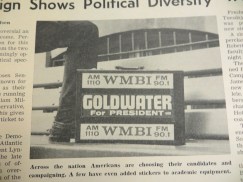
1964 WMBI and Goldwater

Capturing the evangelical vote, c. 1964.

As one student editor wrote in 1969, the job of MBI students should be to prove that a “silent majority” of students weren’t like “SDS.” Those fake radicals, the MBI editor explained,

try to give the impression that they are planting the seeds of freedom.  In truth, they are plowing furrows of division among Americans.

The student paper also helped me understand the divisions that developed over white racism at MBI. In 1970, for example, the Moody Student reported on anti-racism protests among MBI alums. As the anti-racist alums wrote,

The hypocrisy, frustration and profound spiritual damage suffered by us, both consciously and unconsciously, lead us to tear up our degrees and a diploma.

Last but not least, the Moody Student provided a public forum for the MBI community to debate changing ideas about student rules. As one editor opined in 1970,

Rules are necessary to develop discipline in the individual student, but equally important, the student must have freedom to make decisions on his own.  There must be a balance.  A person will not mature nor be able to face today’s world if he is not free to make choices. . . . I personally don’t think Moody has provided its students with that freedom to decide.

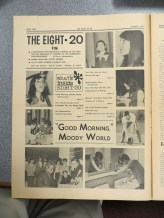
8 20 student paper pictures

What did the “Moody World” look like in 1971?

Reading the student paper, too, gave me a chance to see the non-written clues about changing norms and values at MBI. Student styles in the summer of 1971 were worlds removed from those of the buttoned-down 1940s.

In the end, I wholeheartedly agree with the MBI faculty member who argued that the student paper plays a vital role on campus. But even if I didn’t, I would feel sorry for those future historians who won’t have this resource to help understand the world of college evangelicalism in the twenty-first century.

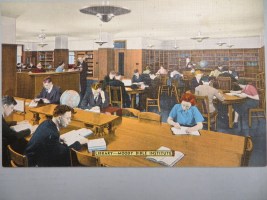
1940s postcard library

…what did it look like c. 1941?

Attention: Fellow Cheapskates!

Good news: if you’ve been waiting for the right time to acquire your copy of Fundamentalist U, wait no longer!

fundamentalist u cheap

These prices can’t last…

I can’t pretend to understand the logarithmic mysteries of Amazon.com, but it seems like they drop the price everytime they come close to selling out their latest batch.

Sales have been brisk, so right now they have dropped the price to a measly $12.25. You can’t even get in to see Endgame for that! So grab your copy while the grabbin’s good!

Will the Real Evangelical Please Stand Up?

I sympathize. I’m no evangelical myself, but I truly sympathize with all the caring, thoughtful, engaged evangelicals out there who have a hard time seeing the ugly truth. But all the sympathy in the world doesn’t make the truth less true, or any less ugly.

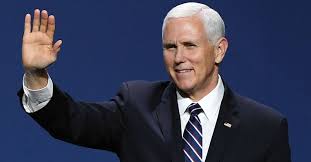
pence

Love him or hate him, Pence really does represent American evangelical values.

We saw it again this week in the news from Indiana. Writing in the Washington Post, Amy Peterson lamented the choice of Vice President Mike Pence to give the commencement speech at evangelical Taylor University.

Peterson was absolutely right that the choice of Pence serves as a signal to evangelicals of the kind of institution Taylor wants to be. She was definitely correct in suggesting that Pence sides with Taylor’s underground conservatives, evangelicals who want their institution to enforce traditional sexual norms and starchy moral codes.

But Peterson makes a common mistake in her conclusion. She reports that many faculty members and students at Taylor shared her dismay at the choice of Pence. She ends on this hopeful note,

If the uproar at Taylor this week is any indication, white evangelicals may not be such a monolithic voting bloc the next time around.

But that’s just it. The uproar at Taylor is NOT a fair indication of the way white evangelicals think. Or vote.

As Slacktivist Fred Clark calls it, “faculty lounge” evangelicalism is not a fair measure of evangelicalism as a whole. In other words, evangelical intellectuals are, by definition, not average. Their ideas about “real” evangelicalism do not match real American “evangelicalism.” As Clark put it,

the evangelicals of the faculty lounge cannot speak for most white evangelicals.

We’ve seen it over and over again. Not just in the twentieth century, as I examined in Fundamentalist U, but in the past five years. And not just at the more politically conservative schools such as Liberty—though it has been dominant there—but at “faculty-lounge” strongholds such as Wheaton. Just ask Larycia Hawkins.

This is not only a problem for evangelical academics, of course. I remember a hastily-assembled conference at my (very secular) home institution in November, 2016. A group of historians scrambled to put Trump’s election victory in context. We just couldn’t find any way to make good sense of it. Our vision of American values and American voting just didn’t match reality. But our confusion couldn’t change the fact that large numbers of Americans seemed to prefer Trump’s brand of toxic Americanism.

Evangelical academics are in the same boat. When they encourage their fellow white evangelicals not to put their nationalism before their religion, like Randy Beckum did, they are shocked to find such notions controversial.  Or, as Methodists found out recently, when they assume their ideas about sexuality are the world-wide norm, they get harshly disabused of such notions.

The Taylor/Pence story hits the same ugly notes. I sympathize entirely with Amy Peterson and her friends and allies at Taylor University. I wish evangelical institutions would embrace the best traditions of evangelical religion. I hope—though I don’t pray—that large numbers of white evangelicals reject Trump’s toxic Americanism at the polls in 2020.

In the end, however, we all need to face realities. The faculty and some students at Taylor might reel in dismay at the university’s decision to honor Mike Pence. But in the end, as Peterson recounts, lots of Taylor students and faculty loved it. And the school’s administrators, as always desperate to reassure students and families that they represent “real” evangelical values, decided that Pence embodied those values. When pollsters explore beyond the faculty lounge, they find that white evangelicals prefer Pence to Peterson.

I Love You but You Didn’t Do the Reading

Are colleges addicted to the internet? Are charter schools “public?” Do Satanists pick up litter? We read with interest the answers to all these questions and more, in our weekly round-up of news ‘n’ views:

Fancy college finds out it can’t live without technology, at IHE.

Walmartification of college, at CHE.

  • Why are evangelical universities over-represented in the mega-online world? Here at ILYBYGTH.

    college enrollment trends

    The sawdust trail moves online…

NJ passes mandatory LGBTQ curriculum, at WNYC.

Why white evangelical women still love Trump, at TC.

White evangelical women . . . rally behind Melania Trump and Ivanka Trump and equate their conservative version of traditional femininity with grace and elegance. . . . The seeming paradox of white evangelical women backing Trump really isn’t a paradox at all. In fact, their support says more about the state of white evangelical Christianity in the US than it does about anything else.

Not just polarized, but…Emma Green on “the bubble:”

a significant minority of Americans seldom or never meet people of another race. They dislike interacting with people who don’t share their political beliefs. And when they imagine the life they want for their children, they prize sameness, not difference. . . . When asked how they would feel about their child marrying someone from the opposite political party, 45 percent of Democrats said they would be unhappy, compared with 35 percent of Republicans.

More strikes and rumors of strikes: Oakland ‘n’ West Virginia, at NPR.

Fundamentalist U leading from behind: More universities assert in loco parentis authority, at CHE.

Are charter schools “public?” Peter Greene says no, at Curmudgucation.

More evidence: 1970s’ hijinx have become 2019 felonies.

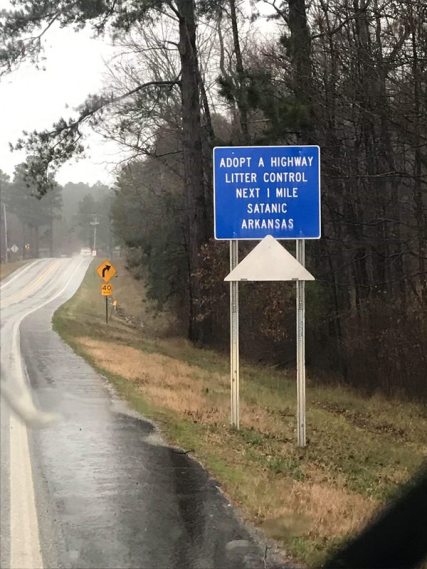
On the highway to hell: Satanists adopt a mile in Arkansas, at FA.

Highway to hell

…wow.


Fundamentalist U Leads from Behind

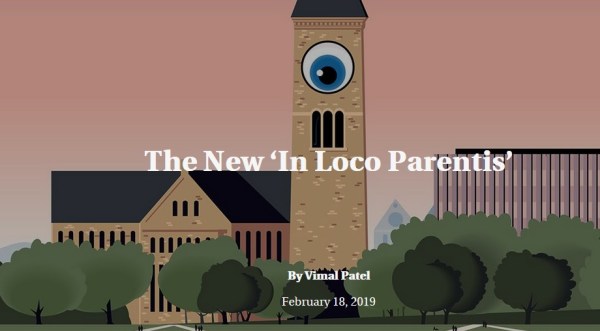
When universities these days re-impose in loco parentis rules to avoid lawsuits, they are joining a group of schools that never abandoned that role. Despite the headline in this week’s Chronicle of Higher Education, there’s nothing “new” about it. There’s not even anything new about secular schools copying evangelical ones. It’s been going on for a while. We might even say that evangelical colleges and universities have become the accidental trend-setters for mainstream higher ed.

eye on u

How “New”?

Here’s what we know: In CHE, Vimal Patel describes the trend: Some universities are claiming more institutional control over students’ lives. Historically, as Patel correctly notes, some mainstream schools abandoned such rules after student protests in the 1960s. Universities no longer agreed to act, in essence, as local parents.

With accusations of sexual assault, unsafe hazing, and other campus dangers, though, universities these days worry about legal liability. A lot. As a result, they are returning to their tradition of asserting control over students’ lives outside the classroom. As Patel writes,

This resurgent version, at traditional four-year colleges, is more attitudinal than legal, and motivated by 21st-century conditions. Past iterations were paternalistic, but the new version is driven by tuition-payers’ expectations, colleges’ concerns about legal liability, shifting cultural and social norms, and an evolving understanding of human development.

What Patel doesn’t mention is that plenty of institutions don’t have to return to in loco parentis, because they never really left. Consider as one example a talk given by President Hudson Armerding of Wheaton College at Parents’ Day Chapel, October 30, 1971. President Armerding told the assembled parents that most colleges had abandoned their in loco parentis responsibilities. He told them that mainstream colleges positively bragged about their lack of concern for students’ non-academic lives. What was the result? Quoth Armerding,

a shallow permissiveness conveys a distorted view of God who deals far differently with His children.

Wheaton College would be different, Armerding promised. He and his school embraced their in loco parentis responsibilities. As he concluded,

We believe that students should be disciplined and corrected and that this should be consistent with the teachings of the Word of God.

Patel’s not interested in the distinct and vital traditions I analyzed in Fundamentalist U. But this is not meant as a knock on Patel. (Though to be fair, I find it egregious that anyone writing about the history of in loco parentis rules wouldn’t mention Christopher Loss’s book Between Citizens and the State.)

Rather, I take Patel’s article as just another example of the ways evangelical colleges have served as reservoirs of academic tradition, reservoirs that mainstream colleges keep returning to.

Today’s interest in in loco parentis rules is only one example. Consider, too, the ways mainstream institutions seek to establish “safe spaces” on campuses. As we’ve argued in these pages, ALL of evangelical higher education was meant as an intellectual “safe space.”

Or consider today’s wave of student protests at elite mainstream schools. In many ways, like in loco parentis rules, what we call the “impulse to orthodoxy” was shepherded and nurtured at evangelical colleges long after mainstream institutions tried to discard it. When student radicals at Yale, Middlebury, and Claremont McKenna push their administrators to enforce moral absolutes, they are not breaking new ground but merely returning to old ground—ground on which evangelical schools have always remained.

If there really is a trend to return to in loco parentis rules at mainstream colleges, it might just add fuel to a surprising conclusion: After a century, instead of lingering as institutional backwaters, evangelical colleges have become trend-setters for the mainstream.

For Evangelical Colleges: The Dangers of Keeping Up

These are dark times for smallish institutions of higher ed. When it comes to universities, the rich are getting richer—in terms of applications and endowments—while the poor are getting closed down. To evangelical college administrators, this might seem like a new and desperate challenge, but in fact it goes back a long way. I know history is a bad guide, but as I found in the research for Fundamentalist U, in this case, the past fifty years offer pretty clear guidance about what NOT to do.

IMG_1558

How Wheaton hoped to survive, c. 1980.

In today’s Chronicle of Higher Education, we read about administrators at small and smallish Christian schools trying to figure out how to stay alive. Indiana Wesleyan (IWU), for example, is emphasizing its traditional focus on person-centered spiritual education while also trying to cash in on online education.

If the past is any guide, one of those is a good idea.

IMG_1557

One promise: academic rigor. Another: smart girls with modest hairstyles.

Consider the bumptious early 1960s. In many ways, they were boom years for institutions of higher education. The post-war GI Bill had set millions—MILLIONS—of new students scrambling to find someone to give their government money to.

For evangelical colleges, however, the new landscape of American higher education presented a new dilemma. At Wheaton College in Illinois, for example, the early 1960s meant a startling and dangerous drop in applications. As Charles Schoenherr reported to President V. Raymond Edman, the numbers spelled doom:

  • 1958: 2009 applications
  • 1961: 1666
  • 1962: 1467
  • 1963: 998

For good reason, Wheaton’s top administrators panicked. They struggled to find reasons to explain this sudden drop in interest among the college-going evangelical public. For one thing, they had instituted a new way to count applications and a new high-school graduation requirement, but those changes could not account for this drastic drop. Like today’s administrators, Wheaton in the early 1960s faced two unpleasant questions:

  • Why were the numbers of applications plunging? And
  • What should they do about it?

Back then, Wheaton’s administrators couldn’t answer the first question satisfactorily. But they had some suspicions. As Schoenherr asked the next President, Hudson Armerding,

Has the ‘image’ of the College changed?  Has this had a bearing on the number applying?  What has been the image?  Has it been an image of excitement, challenge, and leadership or one of apathy, status quo, and noninvolvement?  To what extent have rumors about Wheaton going ‘liberal’ hurt?

If Wheaton was dying due to perceived progressivism, then one course was clear. They could choose to swing back toward their conservative traditions, emphasizing their continuing adherence to fundamentalist norms.

That’s not what Wheaton did and it should serve as a lesson to today’s evangelical college administrators. Wheaton decided to double down on its existing strengths. It had always been known as the premier academic evangelical college, and instead of swerving hard to the right, Wheaton swerved hard toward its reputation as academically elite.

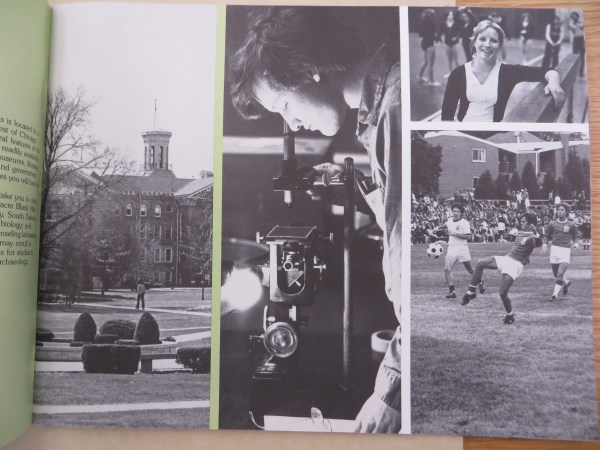
By 1980, for example, Wheaton’s promotional materials showed the school’s commitment to respecting its conservative roots while emphasizing its academic excellence. In a 1980 promotional brochure, the statement of Wheaton’s beliefs was shunted way to the back. “Yes, Wheaton is strict,” the statement concluded, “but we try not to be insensitive.”

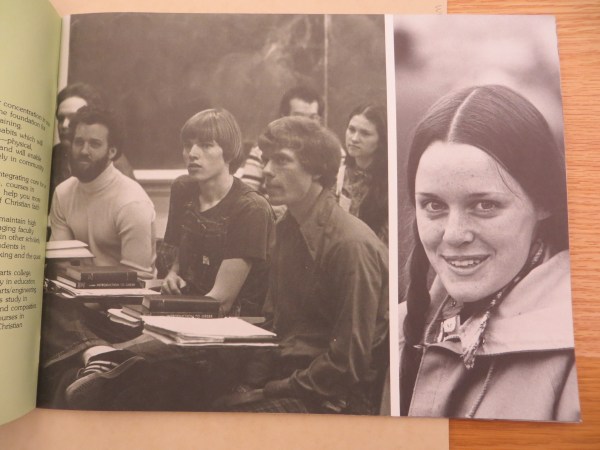
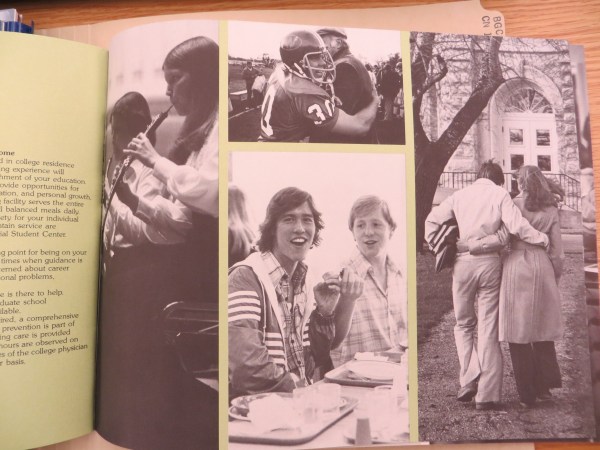
The rest of the brochure showed pictures of students doing science-looking stuff, enjoying sports, and learning in the beautiful scenic campus. The message was clear. If you want an awesome, “real” college experience, come to Wheaton. Other evangelical colleges can’t match its traditions or academic excellence.

IMG_1562

…plus football and dates.

What’s the message for today’s strapped evangelical administrators? First, take heart. These are tough times, but you’ve been here before. Second, don’t chase after trends that don’t fit with the long-standing appeal of your school. If you think you can cash in quick on online education, watch out. You might find you’ve traded in your birthright for a mess of credits.