Can Big-Time Sports Do It Again?

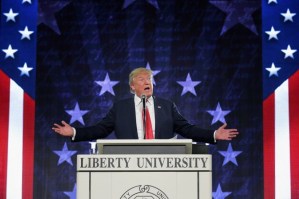
I never thought I’d see it, but here it is. Following Brigham Young University’s tentative opening to LGBTQ+ students and issues, could the same spark change things in evangelical higher ed? After all, schools like Liberty have long yearned to follow the BYU path in one crucial area.
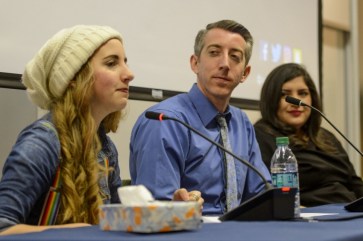
BYU LGBTQ

Fighting for LGBTQ+ recognition at BYU…

Here’s what we know: Liberty University in particular has always jonesed for recognition as a leading university, and sports has always been one of its preferred qualifications. As President Pierre Guillermin put it awkwardly in 1982, Liberty wanted to be “the Notre Dame of the Christian world athletically and the Harvard of the Christian world academically.”

Of course, the Catholic leaders of Notre Dame might say that they already ARE the Notre Dame of the Christian world athletically, but let’s move on. The central point is that leaders of evangelical higher education have always wanted recognition as more than just niche colleges; they have always wanted to reclaim their role as the leaders of American higher education overall.

When Liberty brilliantly and ruthlessly capitalized on the possibilities of online education, current president Jerry Falwell Jr. did not invest the money back into Liberty’s online program. No, Falwell tried to make the old Liberty dream come true. He poured money into traditional campus amenities, especially including Liberty’s athletic program.

This year, the investment paid off. Liberty beat top-ranked Baylor in football, triggering a joyous campus-wide freak-out. Which leads us to our question: Will the dream of big-time sports force Liberty to open itself to friendlier LGBTQ+ policies?

After all, that’s what seems to be happening at Brigham Young. As Chronicle of Higher Ed reports this morning, BYU’s recent tentative opening to LGBTQ+ students was sparked by BYU’s lust for athletic recognition.

As CHE recounts,

In 2016, the Big 12 Conference announced it was officially considering expansion. BYU’s administrators and athletic director jumped at the chance to join. But publicly vying to join the conference brought on national criticism of the university, which observers said did not uphold the NCAA’s stated support of inclusivity because of its treatment of LGBTQ students.

After the university’s effort to join the Big 12 failed, Tom Holmoe, the athletic director, suggested that pushback from LGBTQ advocate groups stood in its way. In response, BYU requested an invitation to the NCAA’s annual Common Ground conference, an effort begun in 2014 to provide a place where leaders and students at religious institutions can talk about LGBTQ issues and “begin exploring how to bridge these gaps and find common ground.”

Might Liberty follow a similar path?

Generations of Christian pleading for equality and recognition have scored only minor victories. As I noted in my recent book and in these pages, administrators at evangelical colleges—even the more liberal schools—are under intense pressure not to change their rules about same-sex issues.

Perhaps it will take a different sort of pressure from a different direction to really change things in evangelical higher education.
Professor Hankins on Fundamentalist U

I’m tickled pink this morning to read a new review of Fundamentalist U from a scholar I have long admired. Barry Hankins of Baylor offered an insightful review today in the pages of Christianity Today.family feud

What did he think? As he explains,

Laats attempts to identify the distinct nature of non-denominational, fundamentalist-evangelical higher education in the 20th century. And he succeeds admirably. . . .

In explaining how this struggle [between fundamentalism and neo-evangelicalism] played out, Laats helps us better understand both Christian higher education and the historic relationship between fundamentalism and evangelicalism.

My favorite bit of all?

With fundamentalism subject to such a fluid range of definitions, controversies often centered on the question of authority. In other words, who gets to define fundamentalism for the college? Is it the board, the president, the faculty, or the students (certainly not, unless you ask them)? This was not shared governance but something akin to WrestleMania.

Professor Hankins explores the book’s treatment of issues such as creationism and racism in evangelical higher education and sends us off with a heartening conclusion:

Overall, Fundamentalist U is an exhaustively researched and well-written book, even when it dwells on episodes we might prefer to forget.

Why Didn’t Jerry Falwell Jr. Say THIS Instead?

In this era of playground taunts and adolescent boasting, Jerry Falwell Jr. seems to feel right at home. Falwell complained recently that his Liberty University should still be considered the largest Christian university in America, despite the fact that Grand Canyon University was larger. Falwell claimed that real Christian universities do something GCU doesn’t do. It seems to this reporter he could have made a much more powerful argument against GCU. I have a hunch why he didn’t.

grand-canyon-university_2015-03-23_14-34-58.004

Cactus, cross…and ka-ching?

Here’s what we know: Religion News Service recently published an acknowledgement from Liberty that GCU had “supplanted” them as America’s largest evangelical university. President Falwell wrote to RNS to complain. GCU, Falwell wrote, isn’t really “Christian,” since it doesn’t require faculty to sign an annual statement of evangelical faith.

As historian John Fea commented, Falwell’s use of “Christian” to mean only those few conservative-evangelical universities that grew out of the fundamentalist movement seems stunted.

I certainly agree. When former Liberty President Pierre Guillermin bragged in 1982 that his evangelical school planned to become “the Notre Dame of the Christian world athletically and the Harvard of the Christian world academically,” it’s difficult not to wonder what all those Notre Dame Christians might have thought. For Guillermin, Falwell, and many other conservative-evangelical leaders, the use of “Christian” to denote only their own conservative-evangelical faith seems presumptuous indeed.

However, if we accept for the sake of argument Falwell’s definition of “Christian” universities as limited only to conservative-evangelical schools, his complaint makes a little more sense. As I noted in my recent book about the history of evangelical higher education, requiring faculty annually to sign a statement of faith really HAS been a hallmark of these schools, and GCU really has abandoned that requirement in its effort to attract more students and retain more faculty.

As GCU pointed out, they require faculty to sign a statement saying they “understand” the school’s mission, but that is a far cry from the “ironclad” attempts of fundamentalist schools to ensure all faculty members agreed with their schools’ religious beliefs without any mental reservation. In contrast to that strong fundamentalist tradition, GCU claims to be a “missional community” that welcomes “students, faculty and staff from all walks of life, some of whom may experience Christianity for the first time at the university.” Unlike the conservative-evangelical schools that grew out of the fundamentalist movement—and the many denominational schools that generally consider themselves part of the conservative-evangelical network—GCU does not require faculty to “commit to affirming and practicing the same faith.”

moreton

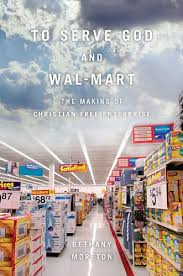
How did capitalism, Christianity, and college combine?

So when Falwell complains that GCU isn’t really following the same playbook, he’s not wrong.

But ditching the required faculty statement of faith is not the most shocking innovation GCU attempted. When its enrollment numbers plummeted at the start of this century, GCU adopted a for-profit business model. It became Grand Canyon Education, Incorporated and focused on in-demand majors such as nursing and education. These days, with for-profit schools under scrutiny, GCU has attempted to move back to non-profit status.

So here’s my question: If Falwell wanted to prove that his “Christian” school was the biggest, why didn’t he say that GCU shouldn’t be considered “Christian” because it was a for-profit business?

And here’s my hunch: Since at least the late 1800s, American cultural conservatives have assumed that capitalism is the best sort of social system. Many conservative Christians have argued that free-enterprise systems are somehow God’s preferred way of organizing an economy. In the twentieth century, a lot of the connections between capitalism and Christianity came from the shared opposition to communism.

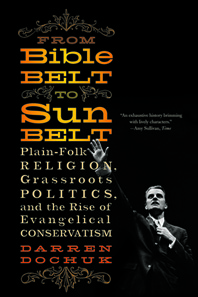
9780393339048_FromBibleBelttoSunbelt_PB.indd

God = Capital

The tight connections between free-market principles and evangelical ones were usually simply taken for granted. To cite just one example, the president of Gordon College promised in 1967 that his school was a place in which

youth is encouraged to have faith in the historical validity and continuity of the principles of competitive free enterprise.

As historians Darren Dochuk and Bethany Moreton have explored, some schools such as Harding College and John Brown University raised the principle of “Christian free enterprise” to an all-encompassing mission.

So it doesn’t seem crazy that President Falwell wouldn’t even wonder if adopting a for-profit status might push his rival GCU out of consideration as a real “Christian” school. At least, that’s how it looks to this reporter.

Am I missing something? Is there any other reason why Falwell would ignore the huge, obvious fact that GCU wasn’t really “Christian” if it peddled its mission for mere lucre?

Why Care about Evangelical Colleges?

Why should historians of religion care about schools? How can our study of history help us heal our culture-war ulcers? This week, I had the chance to talk with Professor Andrea Turpin of Baylor University about these questions and more.

RiAH FU interview

Every mystery explained…

Professor Turpin is one of the few humans who is as fascinated by evangelical educational history as I am. Her first award-winning book examined questions of gender, religion, morality and higher education in the nineteenth century. new moral vision

In our interview, she asked terrific questions that got right to the heart of the matter. What does the history of evangelical higher education tell us about the relationship between “fundamentalists” and “evangelicals?” How does political conservatism line up with theological conservatism? …and more!

For my awkward attempts at answers, click on over to Religion in American History and read the whole thing. Many thanks to Prof. Turpin!

Why Jimmy Carter?

If you didn’t know much about Liberty University or conservative evangelical higher education, you might be surprised to hear that President Jimmy Carter will be giving the commencement address at Liberty this year.

Trump at liberty

Glories of past Liberty commencements…

For SAGLRROILYBYGTH, it makes perfect sense. I lay out my case this morning at The Conversation why Jerry Falwell Jr. would want President Carter to come to Lynchburg.

Why would he? Click on over and check it out. Let me know if you think I’m off base.

Gone but Not Forgotten

Do I have a problem? For sure. Am I embarrassed about it? Not at all. But I do want to make my case for the importance of old grudges and festering scars in understanding the world of evangelical higher education.
griffith moral combat

Good company…

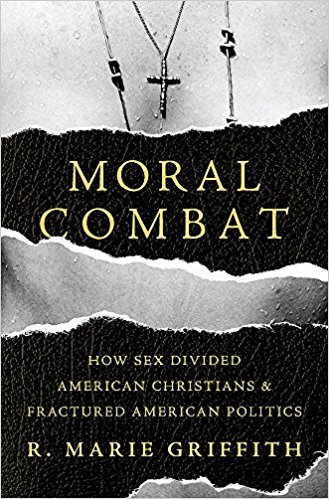
Here’s the context: I’m grateful to Professor John Compton and the LA Review of Books for a recent review of Fundamentalist U. I’m doubly honored to have my book partnered with R. Marie Griffith’s recent blockbuster Moral Combat.

Even better, Compton has nice things to say about my book. As he puts it, Fundamentalist U

offers an invaluable introduction to the esoteric world of Christian higher education. Few existing studies offer this level of insight into the inner workings of schools like BJU and Liberty.

Compton captures the central dilemmas I emphasized, such as the tension between keeping students safe and keeping up with changing academic trends. He notes the important divisions that emerge between new “evangelical” colleges and stalwart “fundamentalist” ones.

I can’t help but comment, though, on one of Compton’s points. He is doubtless absolutely correct when he states,

some readers may be turned off by Laats’s fascination with long-forgotten rivalries involving long-dead university administrators[.]

I am certainly fascinated by such things. And I don’t doubt that sensible people have better things to do with their time than ponder the administrative squabbles in Cleveland, Tennessee or Wheaton, Illinois in 1937. This is why I don’t get invited out very often. Most people are, in fact, turned off by my fascination with these questions.

For those of us who hope to understand American evangelicalism, though, there’s no way we can consider such rivalries “long-forgotten.” As in any family feud, time may have obscured the details, but it has not tempered the animosity. If anything, bitter feelings caused in 1937 may have earned angry compound emotional interest over the decades, giving original squabbles a power and fury they didn’t originally possess.

To give just one example from the book, I can certainly see how many readers might not immediately care about the firing of President J. Oliver Buswell from Wheaton College in the 1930s. President Buswell wanted Wheaton to pursue a more theologically pure separatist approach. He wanted Wheaton to encourage its faculty and students to withdraw from mainline Protestant denominations and focus instead on creating a consistently conservative evangelical institution.

Wheaton’s trustees disagreed. They insisted that Wheaton maintain its efforts to attract conservative students who remained within mainline denominations as well as those that joined breakaway fundamentalist churches.

As Professor Compton notes, all the players in this 1930s drama are long-dead. But their squabble is anything but long-forgotten. Throughout its history, Wheaton struggled to figure out how to handle the tension between conservative purity and (relatively) big-tent inclusiveness. Time after time, whenever faculty members challenged the vagaries of Wheaton’s assumptions about orthodoxy, they were given the boot.

If you think these patterns are no longer in effect, just ask Professor Hawkins. Perhaps no one in that recent Wheaton battle invoked the specter of President Buswell’s 1930s ouster, but the college as a whole still deals with the echoes of every long-ago conflict.

What They Missed about Liberty Online

Want to understand evangelical higher education these days? Then you need to read the recent exposé of Liberty University’s online program in the New York Times. But when you do, remember that they left out a central piece of the picture.

moody literature mission

Early distance-learning programs at MBI claimed to reach the world with cutting-edge technology, c. 1947. These “mountaineers” got free Gospels if they read them in school. And, yes, that is their school building.

The Liberty Online story is a big one. As the Times article describes, Liberty now claims $2.5 billion (yes, that’s B-illion with a B) in net assets, largely from its online department. Because Liberty is a non-profit, it is not subject to the same oversight as for-profit schools such as Corinthian and the University of Phoenix.

Some online students, the article describes, felt pressured to sign up and ripped off with the results. As one unhappy former Liberty student told the Times,

What’s killing me is that I went into this program to try to change my situation . . . and I’m worse off than I was at the beginning.

It’s an ugly story. There is no doubt that Liberty’s online program has been a cash cow. As we’ve noted here at ILYBYGTH, there’s also no doubt that Liberty’s Jerry Falwell Jr. has plowed his online profits back into the brick-and-mortar campus. Sports, star faculty, and campus facilities all get plenty of funding. Recently, the Liberty football squad used that money to fulfill one of the school’s long-standing dreams by defeating top-ranked Baylor.

But the Times story leaves out a crucial part of the historical context. The way they put it, Liberty’s online program came about as part of an experiment, an “educational novelty.” As the article explains,

One educational novelty that Falwell dabbled in, starting in the mid-’70s, was an early form of distance learning. Liberty would mail lecture videotapes and course packets to paying customers around the country — at first just certificate courses in Bible studies, and by the mid-’80s, accredited courses in other subjects as well.

The inspiration, according to the NYT, was the work of John Sperling and the University of Phoenix. I don’t doubt that President Falwell Jr. admired Sperling’s business model. I don’t dismiss the importance of the notion that Falwell has treated his school, as he told NYT, “like a business.”

However, if we really want to understand Liberty’s online success, we have to also understand its context as part of the history of evangelical higher education. It is difficult for some secular people (like me) to notice or acknowledge, but evangelical schools and missionary institutions have always led the way with finding new ways to use new technology to deliver distance education.
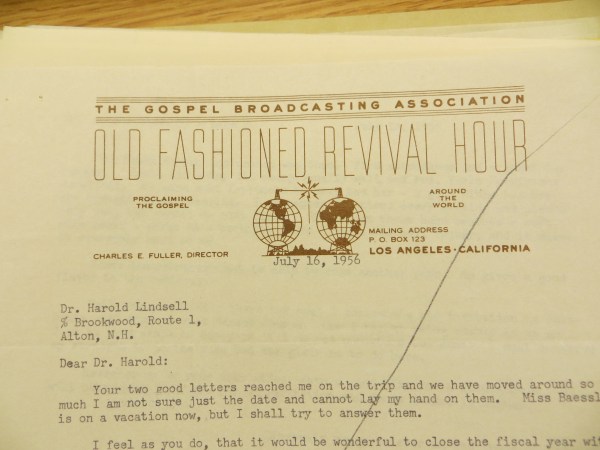
letterhead from BGC 3

Check out the 1950s-era “high-tech” logo! More evidence of the evangelical obsession with technology and distance learning, from Fuller Seminary, c. 1956.

Perhaps the best example might be the Moody Bible Institute in Chicago. No matter the decade, no matter the technology, the Moody educational empire has found ways to expand its reach using new technological means. The drive is obvious: For MBI and other evangelical institutions, the primary goal is to deliver the Gospel to as many human eyes and ears as possible, as fast as possible. If new technology will help accomplish that mission, all the better.

To note just a few of the best-known programs, MBI was a pioneer in early radio, with its WMBI established in 1926 to bring the Word to the world. By 1940, WMBI’s Radio School of the Bible had over 10,000 registrants. In 1942, WMBI claimed to broadcast its programs through 187 radio stations across the USA, Canada, China, and Latin America.

In the 1940s, MBI set up its Moody Institute of Science, distributing missionary science films to a wide audience.

At the same time, MBI carried out less-well-known distance-learning programs as well. As I discovered in the MBI archives, from the 1920s through the 1960s the Moody Literature Mission delivered millions of books and tracts to readers throughout the country and throughout the world.

The point of these distance-learning programs was always the same. MBI, like all evangelical colleges and universities, had a mission of missions. It was dedicated to training young people to carry the Gospel around the world. And, unlike some people’s image of stuffy Luddite conservatives, evangelical institutions were always pioneers in every type of technology: print, radio, film, and internet.

So when the Jerry Falwells experimented with distance education, they weren’t innovating at all, really. Rather, they were merely continuing the long tradition of evangelical higher education—using all available means to deliver the Gospel around the world.

Keeping the Faith in Evangelical Colleges

Thanks to Eric Miller and Religion & Politics for publishing an interview this afternoon about Fundamentalist U.Bob-Jones-GettyImages-50615822-780x508

Professor Miller asked questions that got right at the heart of the book: What does it mean to be a “real” college? How did students react to the strict rules at evangelical colleges? Do evangelical schools have academic freedom?

Click on over to read the entire thing.

At first, I thought Professor Miller was simply a peculiarly acute reader, but it turns out he himself spent some time in evangelical higher ed, so he really knew what he was talking about.

Crisis at Moody Bible Institute: The Curse of the Fundamentalists

The revelations coming out of Chicago are sad. Even sadder—for those who know the history of evangelical higher education—is that they fit squarely and depressingly into a century-old pattern. The nature of Protestant fundamentalism as established in the 1920s left schools like Moody Bible Institute in a treacherous position.

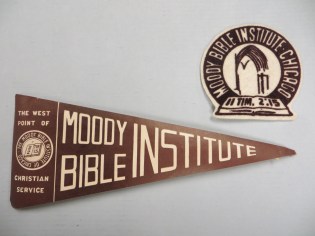
1940s MBI banner and patch

From happier times, c. 1940.

Here’s what we know: As Christianity Today has reported, the flagship Moody Bible Institute in Chicago has shaken up its leadership. The president, chief operating officer, and provost are all out. MBI officially thanked the three for their leadership, but the institute also acknowledged “widespread concerns over the direction of the school,” according to CT.

Many of those concerns were publicized by another ousted employee, Julie Roys. Roys had hosted a radio program on WMBI and she recently raised alarms at the financial and theological misdeeds of top MBI leaders. On her blog, Roys had pointed out that the leaders had made unwise and possibly shady financial arrangements. She also noted alumni complaints that the school had indulged liberal ideas.

I don’t have any inside knowledge of the goings on at MBI. As I argue in my new book about the history of evangelical higher ed, though, the pattern is familiar, and part of the DNA of evangelical higher education. In a nutshell, the fundamentalist movement in the 1920s attracted most of the Bible-institute movement. Flagship MBI became a reluctant leader of fundamentalism, along with other higher-ed institutions such as Wheaton College in Illinois and Bob Jones College in Florida (it moved twice, only becoming Bob Jones University in its current South Carolina location in 1947).
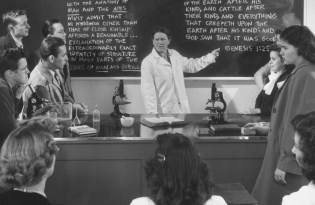
The nebulous nature of interdenominational fundamentalism left these institutions in a bind. Not as an accident, but as an inherent part of this conservative protest movement, there existed no higher (human) power that could set the boundaries of real orthodoxy for these schools.

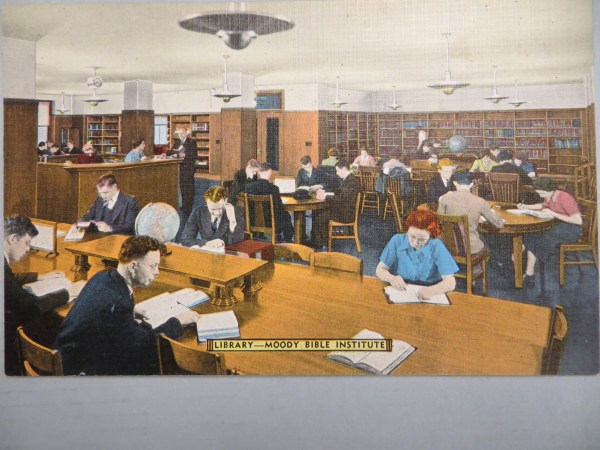
1940s postcard library

Getting those dispensations right…c. 1940s.

As a result, different schools figured out different ways to decide what was kosher and what wasn’t. Bob Jones College established a rigid authoritarian structure. True religion, at Bob Jones College, was what the Bob Joneses said it was.

Wheaton College adopted a more spread-out network of authority. They established a board of fundamentalist celebrities and donors to help guide the school. But they also hired a series of powerful, charismatic presidents to embody the school’s mission. In addition, Wheaton courted alumni to help fund and direct the school. Often, tensions among the various leaders resulted in mixed messages and confusing, conflicting arguments about what constituted proper evangelical religion. Larycia Hawkins’s experience is nothing new.  Just ask Russell Mixter or President Buswell, two stories I describe in detail in the book.

Cover art final

Read all about it…

MBI did something similar, and the results are evident in the recent controversies. Reliance on celebrity fundamentalists and in-group leadership structures has always plagued evangelical colleges. In today’s case, Left Behind author Jerry Jenkins is accused of receiving sweetheart financial deals and tweaking the school’s moral code. MBI’s leaders are accused of giving one another perks without opening their deliberations to the whole school community.

The accusations range beyond financial hanky-panky. MBI’s leaders are accused of winking at theological sloppiness, too, another pattern established in the twentieth century. In today’s MBI case, alumni have charged the top leaders with

trading the sure foundation of God’s Word and the mission of training men and women to know and teach the Gospel for the fragile foundation of the cultural tides of the day. . . . students around campus and on my floor were not acting in ways that showed their desire to love and know the Lord fully. . . . Moody has become not a unique place to study and know God’s Word, but instead a place infiltrated by liberal political stances and clichéd cultural buzzwords without a solid theological foundation.

Such accusations have a timeless ring in the world of evangelical higher education. Similar complaints have been lodged against school leaders in every decade of the twentieth century and the twenty-first. And though they always seem new, they are the predictable result of the uncertain goals of evangelical higher education.
Like all evangelical institutions, MBI is in an impossible situation. It exists as a school dedicated to a certain vision of eternal truth, yet it can only survive if it also changes periodically. For example, few members of today’s MBI community would encourage racial segregation on campus, but in the 1930s it was part of an MBI education. All schools need to change, but this can be difficult for evangelical schools that promise to be purveyors of God’s eternal Truth.

Too often, leaders at evangelical schools fudge this dilemma by making back-room decisions about changes, hoping the evangelical public does not complain too loudly. Every once in a while, however, influential board members, faculty, students, or alumni shout out a protest, like the one we hear today from Chicago.

It’s important to note, of course, that similar problems exist in non-evangelical institutions as well. Wherever charismatic leaders are allowed to make decisions without consulting concerned constituencies, abuse is predictable. Most often, in secular higher education, this has happened with high-profile athletic programs such as the ones at Penn State and Florida State.

The situation at MBI is sadly similar. Instead of a structure by which changes can be discussed and agreed upon, a closed-door group of influential leaders has felt forced to go ahead on its own. None of us should be surprised that structures like that lead to financial malfeasance or unpopular policies.

The Ol’ College Tri-al

Want to scare a fundamentalist? Tell them you’re sending their child to a state university. As I’m arguing in my new book about evangelical higher education, anxiety about college has always been a primary concern of Protestant fundamentalists and other conservative evangelicals. Today’s fundamentalists are no different, as I discovered in my recent visit to the Ark Encounter. In this last (I promise) post about the Ark Encounter, I have one final puzzle about the ways the Kentucky creationists depict the dangers of mainstream higher education.

20171226_121522

Watch out! It’s a trap!

First, the history: When evangelist Bob Jones explained his reason for starting his own college in 1926, he liked to tell the story of one woeful Christian family who had scrimped and saved to send their daughter to a fancy university. As Jones told the tale,

At the end of nine months she came home with her faith shattered. She laughed at God and the old time religion. She broke the hearts of her father and mother. They wept over her. They prayed over her. It availed nothing. At last they chided her. She rushed upstairs, stood in front of a mirror, took a gun and blew out her brains.

Who wouldn’t be scared by that sort of story? Or consider the following example, reprinted throughout the early 1920s by a number of fundamentalist pundits. It was supposedly a letter to the folks at home from a recent college graduate. As he put it,

My soul is a starving skeleton; my heart a petrified rock; my mind is poisoned and fickle as the wind, and my faith is as unstable as water. . . . I wish that I had never seen a college.

For fundamentalists in the 1920s, the dangers of college weren’t only about debt burdens and sexual assault. College itself threatened to rob children of their faith, leave them “poisoned.”

Like now, fundamentalists back then didn’t just rely on hearsay. They devoured social-science reports of the deleterious religious effects of college. Most famous was James Leuba’s study of student religiosity, published in 1916. Leuba found that most college freshmen (85%) called themselves Christians, but only 55% of recent college graduates did so. The upshot, fundamentalists told themselves, was that the college experience must do something to undermine evangelical faith.

20171226_121545

Those darn college professors…

What was true in 1916 seems just as true a century later. Conservative evangelicals—at least the ones who built Kentucky’s Ark Encounter—are convinced that mainstream higher education is a spiritual minefield.

There’s good reason to think they’re right, at least in part. Sociologist Elaine Howard Ecklund studied elite academics and found that there did indeed seem to be some elements of anti-evangelical bias among them. Evangelical professors told Ecklund they tended to keep their faith “closeted.” Others reported hearing offhand comments in the faculty lounge deriding “stupid Christianity.”

While elite academics weren’t as uniformly anti-religious as some evangelicals might assume, they did tend to be less religious than the rest of the population. And a small minority told Ecklund that they actively sought to cure students of their religious proclivities. One physicist told her that he viewed religion as a “virus” that he hoped to cure. A social scientist said she started her classes with the following disclaimer:

You don’t have to distance yourself from religion and think about it from an outside perspective, but you do if you want to succeed in this class.  And so if you don’t want to do that, then you need to leave.

If I were an evangelical parent (I’m not), I would hesitate to send my child into an environment where they would be confronted with that sort of hostile, ignorant attitude. And certainly, Ken Ham and the Answers In Genesis crowd are intensely anxious about the goings-on in mainstream higher education. Ham explained his reasoning in a critique of ILYBYGTH a while back, and my trip to the Ark Encounter confirmed it.

20171226_121555

Can college students protect their faith?

Most of the exhibits were fairly predictable, if odd. They depicted the problems with mainstream evolutionary theory and old-earth creationism. They showed the way day-to-day life on the ark could have happened. Not what I’d expect to see in a mainstream science museum, but pretty close to what I expected to find at the Ark Encounter.

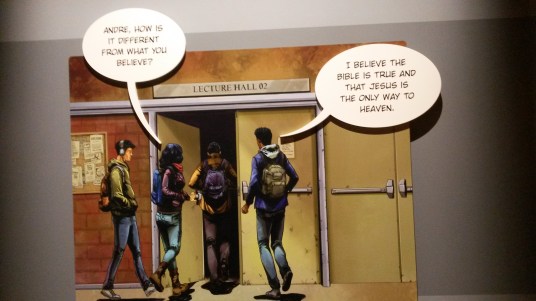
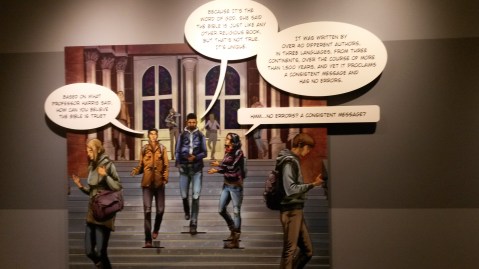
On the top floor, though, I was surprised by what I found. Ark Encounter includes a long corridor dedicated to a huge, walk-through comic-book tract. The comic book’s images have been blown up to fill the walls of the corridor, and visitors walk through the story. The plot is familiar—a student wonders about her faith. After some trials, she embraces it.

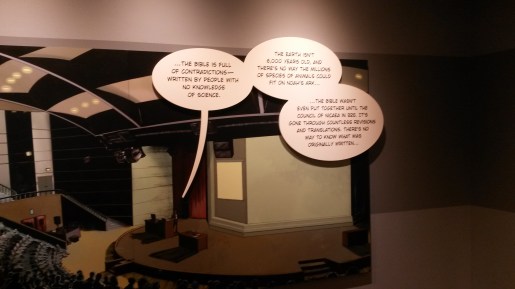
One of the trials is her smarky college professor. The central characters walk into a lecture hall, where they are told,

The Bible is full of contradictions—written by people with no knowledge of science. The earth isn’t 6,000 years old, and there’s no way the millions of species of animals could fit on Noah’s Ark…

One of the characters is a young-earth creationist and he patiently defends his faith to two friends, but their college experience puts that faith to a severe test.

The exhibit itself was a surprise, but the content wasn’t. The fears and anxieties of fundamentalists in 2018 aren’t too different from those of fundamentalists in 1918. But here’s the thing that’s been bugging me: Why does the Ark Encounter devote so much wall space to this college story, when Ken Ham thinks that the college years are already too late for successful soul-saving?

As Ham wrote in his 2009 book Already Gone, the kids that are leaving fundamentalist faith are making those decisions in their middle-school and high-school years. As Ham puts it,

Many parents will fork out big bucks to send these students to Christian colleges, hoping to protect them in their faith. But the fact is, they’re already gone.

If Ham wants his flock to understand that the college years are too late, why include this huge exhibit on the dangers of college at the Ark Encounter?