Biblical Peanut Butter at the Museum of the Bible

What is the Museum of the Bible for? Its conservative-evangelical founders insist it is supposed to be more like the Smithsonian than the Ark Encounter, but recent revelations have left me puzzled.motb-peanut-carver.jpeg

Here’s what we know: Thanks to the generosity and diligence of an ILYBYGTH correspondent who prefers to remain anonymous, your humble editor recently came into possession of some MOTB publications.

Most intriguing, MOTB publishes a glossy booklet, 99 Earth-Shattering Events Linked to the Bible. As the title promises, this publication offers biblical connections to 99 key events in human history, from the Magna Carta to Nelson Mandela.

Some of them have left this reader scratching his head. They certainly seem more Ark Encounter than Smithsonian. Am I missing something?

For example, the book credits the Bible for inspiring George Washington Carver to “Unlock . . . Peanut’s Potential.” We all know Carver’s remarkable story. In this telling, though, it was not grit or genius or perseverance that fueled Carter’s career, but rather the text of Genesis I. “To Carver,” the booklet explains,

This Bible passage revealed the potential of what he could do with the peanut to help others be lifted from poverty—particularly, the struggling African American farmers.

To this reader, the connection seems…strained, to say the least. Dr. Carver may have been an earnest Bible-believing Christian and he may have given his faith credit for his work. But so did the white-supremacist politicians and their violent allies who forced African American scientists into segregated institutions.

How can we credit the Bible for one, without also blaming it for the other? To me, this seems like Wallbuilders history–not a sincere attempt to understand the past, but rather a collection of awkward celebrations that distort the historical record.

Are Christians Allowed in New York?

It makes conservatives furious, but is Dan Piepenbring right? Piepenbring recently blasted Chik-fil-A’s “creepy infiltration” of New York City in the pages of the New Yorker. The brouhaha shows how little most of us understand about New York’s real status in our continuing culture wars. It has never really been the Great Sodom that conservatives excoriate and progressives celebrate.

chickfila20160721billboard2

The Christians that never sleep?

Piepenbring is mad that Chik-fil-A is sneaking into his city. He dislikes the conservative evangelical politics of the chain’s founder. More than that, though, he seems put out by the Midwestern aw-shucks-ism at play. Piepenbring seems offended by the way Chik-fil-A imported a family-values vibe into his grunge-chic citycape. The company’s trademark Cows exemplify the problem. As Piepenbring puts it,

The joke is that the Cows are out of place in New York—a winking acknowledgment that Chick-fil-A, too, does not quite belong here.

Conservatives reacted with predictable hauteur. For example, American Conservative’s Rod Dreher blasted Piepenbring’s “Yankee bigot[ry].” “In terms of parochial, un-self-aware narrow-mindedness,” Dreher opened,

it is hard to beat this piece from the New Yorker on how the a [sic] popular purveyor of delicious chicken and waffle fries is making Manhattan into an unsafe space.

It should be funny, Dreher notes, to read anything that soberly invokes phrases such as “suburban piety.” In actual fact, Dreher concludes, Piepenbring’s half-baked screed is more than a sad joke; it serves as yet more evidence of widespread “anti-Christian bigotry.”

I can’t agree with Dreher’s main point about anti-Christian bigotry, but I do think that Piepenbring’s brand of “keep New York weird” rhetoric misses some important truths. Full disclosure: I share the desire to sponsor local over chain. Up here in sunny Binghamton, I go to Laveggio instead of Starbucks; Consol’s instead of Olive Garden. But even though I share Piepenbring’s anti-corporate aesthetics, I can’t help but think he is willfully ignoring some fundamental truths about his city.

It’s beyond obvious, of course, that New York City is the headquarters of America’s financial and corporate culture. Less obvious, perhaps, is that New York has also served as a center of conservative evangelical intellectual culture and activism.

A century ago, progressive New Yorkers were similarly riled by the fiery fundamentalism of New York’s John Roach Straton, pastor of Calvary Baptist and one of the undisputed national leaders of the 1920s fundamentalist movement. I spent some time with Straton’s archived papers a few years back and they are chock-full of ardent correspondence with all the top conservative evangelicals of his generation.

Again and again, fundamentalist intellectuals and activists praised Straton and acknowledged his New-York-based leadership of the national fundamentalist movement. In 1922, for example, the president of fundamentalist Wheaton College in Illinois wrote to Straton

to thank you for the attack you are making on the infidel teaching of our time.

Beyond any dispute, Straton used his New York City headquarters to fight evolution and theological liberalism. He used the cultural clout of his big-city address to add oomph to his fundamentalist activism. Yet even his fundamentalist admirers tended to assume that fundamentalism was not a true product of the Big Apple. Straton himself sometimes agreed. In spite of the fact that he had built his fundamentalist empire from Manhattan, Straton told the New York Times in 1925 that fundamentalism was a Southern thing. As Straton put it, fundamentalism represented

a rising tide of spiritual earnestness preparing in the South and West which will sweep the country.

Even today, New York City is home to some of conservative evangelicalism’s most vital institutions. Most notably, The King’s College moved downtown in order to exert its presence in the heart of Gotham. As one enthusiast put it, by moving to New York, TKC could be

a counter cultural Christian college in New York City that leads with academic excellence and ‘convictional civility.’

Though both conservatives and progressives have tended to assume that conservative evangelicals don’t fit in New York’s hurly-burly cultural landscape, both sides have frequently missed the long, continuing tradition of New York’s role as a capital city of conservative evangelicalism.

They don’t agree on much, but both sides seem to ignore New York’s real role as an international headquarters of conservative evangelical religion. Why?

Dayton Dilemmas I: WBR and Christian Nationalism

How could they do it? How could earnest, intelligent, educated Christians ever mash together their faith with their patriotism? That’s the tough question people were asking yesterday at the University of Dayton. I don’t have an easy answer, but I do think the case of William Bell Riley helps shed some light on it.dayton flyers

First, the background: Thanks to the dynamic scholarly duo of Professors Bill and Susan Trollinger, authors (among other things) of Righting America at the Creation Museum, I’m down in sunny Dayton, Ohio these days. Yesterday I talked with members of the Flyer community about my recent book, Fundamentalist U. I focused on the long tradition in evangelical higher education of combining conservative evangelical Protestant faith with a certain sort of Make-America-Great-Again patriotism.

The argument I tried to make is that white fundamentalists have always felt a deep sense of proprietary interest in the United States. For white fundamentalists, America has always been “our” country. Over the course of the twentieth century, in schools and society, fundamentalists have felt kicked out by trends toward secularism and political liberalism. They have repeatedly rallied to politicians who have promised to Make America Great Again.

righting america at the creation museumTrump’s not the first. As audience members pointed out, we can go back to Reagan and Nixon to find coded and not-so-coded appeals to “law-and-order,” the “silent majority,” and “shining cities on a hill.” For white evangelical voters, particularly the more politically conservative among them, those campaign promises have always been enormously appealing.

Some of the intellectuals in the audience—steeped in a very different tradition, the Catholic intellectual tradition—asked the tough question: How could any Christian of any denominational background ever mix up their priorities so badly? How could any Christian confuse his (primary) devotion to his religion with his (secondary) devotion to his country?

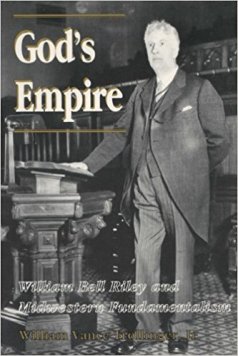
I had the chance to talk with Professor Bill Trollinger about the question. Bill is the universe’s greatest expert in the life and career of 1920s fundamentalist leader William Bell Riley. Riley, like many early fundamentalists, was a devoted Baptist. For Riley, in the early 1920s fundamentalism was a campaign to take back his denomination from the worrisome liberal trends that had begun to creep in.

American Baptists, ever since the days of Roger Williams, have placed an enormous emphasis on the freedom of the church from the government, and on the inviolate primacy of religious devotion over any political loyalty. By the twentieth century, however, Baptist fundamentalists like William Bell Riley seemed to have lost their yen for avoiding entanglement with government. Riley and other Baptist fundamentalists pushed hard to establish (or, as they would put it, re-establish) their evangelical religion in a more prominent place in public life. They wanted greater influence on public affairs. They hoped for increased influence on government decisions, such as banning alcohol, gambling, and other immoral activities.gods empire

How did that happen? How did ardent Baptists become so enthusiastic about “taking back America”?

Professor Trollinger and I came up with a short list, and I hope SAGLRROILYBYGTH will add their two cents.

How did fundamentalists like Riley combine their devotion to their religions with their devotion to the USA?

1.) Riley would always agree that church and state should be separate, but that the church must always represent the conscience of the society.

So although there must never be church control of government, government leaders should always be guided by religious leaders. Riley’s career could be characterized, in fact, by his increasing bitterness and resentment at his perceived lack of Main-Street influence. By the end of his life, Riley had become a vengeful, anti-semitic extremist, dedicated to sour conspiracy theories to explain his failure to establish himself in the level of public leadership to which he felt entitled.

2.) Riley wanted influence and was in part blinded by patriotic tradition.

Like many fundamentalists since, Riley failed in some measure to maintain his own Baptist tradition, even though he would never admit that. For Riley, as for many fundamentalists of later generations, America became representative of a Christian community. The division between church and society—if not church and state—became blurred in Riley’s mind and in his activism.

3.) The devil made them do it.

For many fundamentalists, political activism was intimately, necessarily connected and equated with religious activism. Patriotism was inseparable from faith. Why? Because of their belief in literal, incarnate supernatural entities acting through political entities. But we’ll save that for our next post.

I Love You but You Didn’t Do the Reading

Welcome to your weekly round-up of ILYBYGTH-themed stories from around the interwebs. Thanks to everyone who sent in tips.

Nun in the huddle! Sister Jean and March Madness, at NYT. HT: DW.

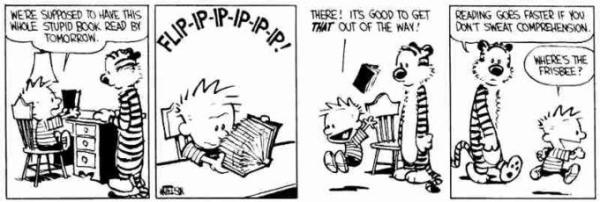
calvin reading

My kind of Calvinism…

White evangelicalism—the church of the “slave state,” at Forbes. [Editor’s note: The original Forbes article was taken down as “way out of bounds,” but the text is still available at this new link. Thanks to alert reader for pointing it out.]

Don’t have your copy of Fundamentalist U yet?

Campus cults and “passion plays:” “War on Cops” author Heather MacDonald talks with “What’s Happened to the University” author Frank Furedi at CJ.

What do college students think about free speech on campus? New poll numbers at KF.

What does Queen Betsy think? A tough interview at 60 Minutes.

Creationist Ken Ham praises the Oklahoma university that welcomed his lecture—see his op-ed at KHB.

The view from Greenville: An instructor at Bob Jones U explains why he voted Trump, at HNN.

Dripping Wax: Professor Amy Wax suspended from teaching mandatory class after latest disparaging racial remarks. At IHE.

Is the Museum of the Bible just an evangelical missionary outfit “masquerad[ing] as an educational institution”? That’s the charge at R&P.

Teacher pay and underpay: Check your state at Vox.

Students who walk out should be punished. So says Daniel Willingham. HT: XX

Too close for comfort? Ben Carson’s aide chummy with secretive religious charity, at the Guardian. HT: LC.

The Dilemma of the Fundamentalist Intellectual

It’s tough to be a conservative evangelical intellectual these days. As a recent exposé at Religion & Politics makes clear, they are still addicted to mainstream academic credentials, even when those credentials can be nearly impossible for them to achieve.

https://www.youtube.com/watch?v=PeeYUXjp_ro

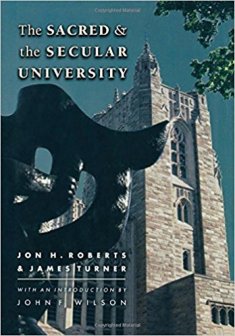
Why is it so difficult for conservative evangelicals to earn mainstream academic credentials? In part, it’s due to the stark and growing divide between mainstream institutions and evangelical intellectual assumptions. As I’m arguing in my new book about evangelical higher education, in the late nineteenth century conservative evangelicalism lost its place as the presumed intellectual backbone of America’s colleges and universities. I think historian Jon H. Roberts said it best. In the late 1800s,

Truth claims based on alternative epistemologies—tradition, divine inspiration, and subjective forms of religious experience—increasingly lost credibility within the academy.  In addition, the recognition that knowledge itself was fallible and progressive cast doubt on the legitimacy of venerable doctrines.  Claims that ongoing inquiry would eliminate error and establish truth fostered an iconoclasm toward orthodoxies.

In response, conservative evangelicals—calling themselves “fundamentalists”—built a dissenting network of higher-educational institutions. It wasn’t only brick-and-mortar schools. Fundamentalists created their own accrediting agencies, athletic leagues, alumni organizations, and more. These independent evangelical institutions allowed academics to rack up titles and honors without participating in mainstream thinking. As we’ve noted recently, the fetish for credentials has always included a frenzy of cross-institutional honorary doctorates.

sacred secular university

The empire really was in ruins.

But it’s still not enough. Throughout the twentieth century and continuing today, conservative evangelicals have yearned for more than just their own credentials. They have oohed and aahed at their colleagues who have earned mainstream academic respectability.

One notable case occurred during the mid-century creationism wars. Back in the 1940s and 1950s, evangelical intellectuals squared off (again) over the question of a young earth. Did belief in the Bible require belief in a literal six-day recent creation? In a literal world-wide flood?

At the 1948 meeting of the creationist American Scientific Affiliation at Calvin College, for example, geochemist J. Laurence Kulp battled with Calvin botanist Edwin Y. Monsma. Monsma defended the young-earth position. Kulp trashed it as mere “foolishness.” With his PhD from Princeton and his faculty berth at Columbia, Kulp’s mainstream credentials helped carry the day. As historian Ronald L. Numbers described, many ASA members were “ready to follow Kulp in boldly shedding the trite fundamentalist apologetics of the past.” Creationism, yes. Young earth, no.

At least in part, Kulp’s bona fides from outside the charmed circle of fundamentalist institutions helped convince many conservative evangelical intellectuals that Kulp’s ideas had oomph.

The_Creationists_by_Ronald_Numbers

Creationists love credentials…

Today, we see a sad case of inflated credentials from another evangelical intellectual. As Professor Jill Hicks-Keeton of the University of Oklahoma points out, a recent publicity appearance to promote the new Museum of the Bible highlighted conservatives’ desperate drive for mainstream academic credentials.

Professor Hicks-Keeton describes the spiel of Jeremiah Johnston of Houston Baptist University. Professor Johnston hopes, in his organization’s words, to “teach Christians to be Thinkers and Thinkers to be Christians.”

But in his quest to wow evangelical audiences, according to Hicks-Keeton, Dr. Johnston played fast and loose with his resume. Hicks-Keeton sleuthed a little deeper. As she puts it,

Johnston’s academic credentials sound impressive: “He has studied at Oxford,” the pastor said. The CTS [Christian Thinkers Society] website’s bio for Johnston includes a list of presses with whom he has published, led by one of the most prestigious in the guild: Oxford University Press. During his talk to the congregation, Johnston repeatedly performed such credentials for church members by dropping academic words the average churchgoer would not have encountered (shema, protois, verisimilitude) and by flagging his own academic work. . . . A closer look at his curriculum vitae reveals that his educational pedigree is unrelated to Oxford University, a premiere institution of scholarship. The “Oxford” mentioned by Pastor Daniel is actually the Oxford Centre for Mission Studies—identified by its website as “an independent Christian charity.” Johnston’s publications with OUP amount to four brief, co-authored contributions to encyclopedias and edited volumes, which are not subjected to the rigors of peer review.

Ouch. For any academic—evangelical or not–these charges sting.

Why would Professor Johnston puff up his credentials, when they are so easy to deflate? I don’t know Johnston, but my hunch is that he shares the century-old dilemma of all fundamentalist intellectuals. In spite of their long efforts to free their minds from the shackles of mainstream academic thinking, they are still wed to the same hierarchy of prestige as everyone else.

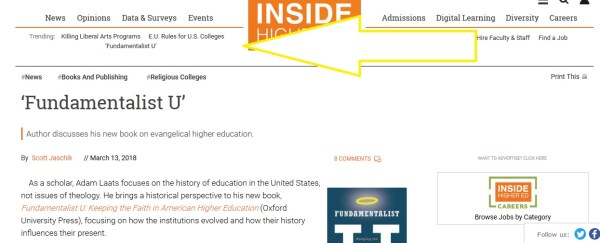
We’re Trending!

You might have trended before. I don’t think I have. I’m a little dizzy…

IHE FU story

Does this mean I’ll need new outfits?

How Did Christian Colleges Become Racist?

People keep asking: Why are white evangelicals so racist? This week we see it in The Atlantic and at Forbes. At leading evangelical colleges—in the North anyway—there’s a big, obvious answer that this week’s pundits don’t mention.

Here’s what they’re saying:

  • Michael Gerson wondered what happened. At his alma mater Wheaton College in Illinois, a strident anti-racism among white evangelical leaders slipped away.
  • Chris Ladd places the blame on slavery and the lingering dominance of Southern Baptists. As Ladd writes,

Southern pastors adapted their theology to thrive under a terrorist state. Principled critics were exiled or murdered, leaving voices of dissent few and scattered. Southern Christianity evolved in strange directions under ever-increasing isolation.

The question should bother all of us, white or not, evangelical or not. Why do so many white evangelicals seem comfortable or even enthusiastic about Trump’s Charlottesville-friendly MAGA message?

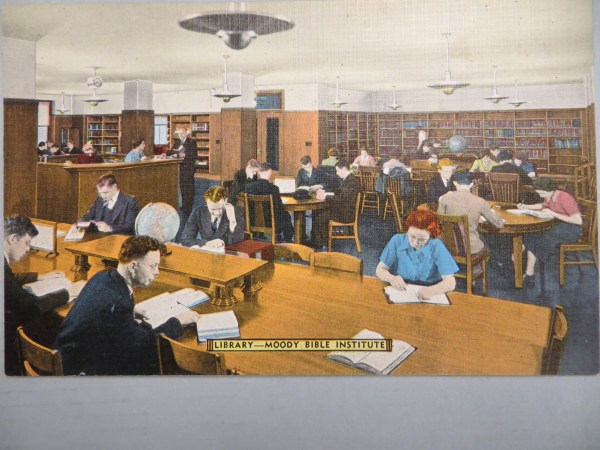
1940s postcard library

Not a lot of diversity, c. 1940s

Since neither Gerson nor Ladd bring it up, I will. At some of the leading institutions among white evangelicals, there is an obvious culprit. It’s not the political power of the slave state. It’s not craven lust for political influence. As I’m arguing in my new book about evangelical higher education, Christian colleges have always been desperate to keep up with trends in mainstream higher education. And those trends pushed white evangelicals to mimic the white supremacy of mainstream higher education.

Of course, evangelical colleges were happy to stick out in some ways. In the classroom, for example. Evangelical institutions of higher education have always prided themselves on teaching dissident ideas about science, morality, and knowledge. In social trends, too, evangelical colleges didn’t mind having stricter rules for their students about drinking, sex, and dress codes.

When it came to academic luster, however, fundamentalist academics in the first half of the twentieth century were desperate for the respect of outsiders.

At Gerson’s alma mater, for example, President J. Oliver Buswell quietly discouraged African American attendance in the 1930s. Why? There’s no archival smoking gun, but Buswell explicitly discouraged one African American applicant, suggesting that her admission would lead to “social problems.”

When we remember the rest of Buswell’s tenure, his reasons for discouraging non-white applicants become more clear. Against the wishes of other Wheaton leaders at the period, Buswell fought hard for academic respectability. He tried to decrease teaching loads, increase faculty salaries, and improve faculty credentials. As Wheaton’s best historian put it, Buswell

passionately believed that one of the best ways to earn intellectual respect for fundamentalist Christianity would be to make certain that Wheaton achieved the highest standing possible in the eyes of secular educators.

In the 1930s, that respect came from a host of factors, including faculty publications and student success. It also came, though, from limiting the number of African American students and the perceived “social problems” interracialism would impose.

Buswell and Wheaton weren’t the only northerners to impose segregation on their anti-racist institutions. Cross-town at Moody Bible Institute, leaders similarly pushed segregation in order to keep their institution respectable in the eyes of white mainstream academics.

Like other white evangelical institutions, in the late 1800s Moody Bible Institute was committed to cross-racial evangelical outreach. On paper, in any case. And MBI always remained so on paper, but by the 1950s the dean of students broke up an interracial couple. The dean was not willing to say that there was anything theologically wrong with interracial dating, but he separated the couple anyways, worried that public interracialism would “give rise to criticism” of MBI and its evangelical mission.

Why do so many of today’s white evangelicals seem comfortable with Trump and his white-nationalist claptrap? Why didn’t they hold on to the anti-racism that had animated white evangelicals in the past? Both Ladd and Gerson make arguments worth reading.

On the campuses of northern evangelical colleges, though, there was another powerful impulse. For evangelical college leaders, being a real college meant earning the respect of white non-evangelical school leaders. Between the 1930s and the 1950s, uncomfortable as it may be to acknowledge, mainstream white college leaders expected racial segregation. White evangelical college leaders weren’t more racist than non-evangelicals. They were just more desperate to seem like “real” colleges.

HT: DL, EC

Poison Pens at Evangelical Colleges

What’s going on at Taylor University in Indiana? According to a recent anonymous newsletter, the evangelical campus is seething with

gossip, slander, backbiting, profanity, vulgarity, crude language, sexual immorality (including adultery, homosexual behavior, premarital sex and involvement with pornography in any form), drunkenness, immodesty of dress and occult practice.

Zoiks!

Taylor’s administration struggles to respond to this conservative carping. For those in the know about the history of evangelical higher education, this sort of anonymous poison-pen assault has always been part of life at Christian colleges.

As I found in the research for my new book, critics from both the evangelical left and the fundamentalist right have often resorted to anonymous open letters in their attempts to influence policy at their schools. The archival files bulge with letters and newsletters of this type.

At Biola University, for example, a self-identified group of disgruntled fundamentalists buttonholed President Samuel Sutherland with a list of concerns in 1969. As they wrote anxiously,

we are deeply concerned about danger signs showing themselves among some of our conference speakers and members of the student body! Indications now present seem to point to a trend that the school is moving from its Biblical foundation.  May God prevent such a tragedy!

The students were concerned with the slackening of the student dress code, particularly for women. The rules stated that skirts and dresses must not be shorter than one and a half inches above the knee. As the conservative students complained, though,

the failure of a number of Biola girls to adhere to the dress rule is altogether too evident.  Excessive bodily exposure of Biola girls has even been seen in the seminary section of the library and has proven a hindrance to study. . . . We urge the administration to be rigorous in enforcing the rules and regulations of Biola Schools.  IN particular, the dress length rule should be observed because of its obvious Biblical basis.

Rock and roll, too, had snuck onto campus. As the protesters warned,

Unfortunately, many students here are experiencing a diet of music consisting primarily of the popular beat of the day.  Our group does not advocate avoidance of popular tunes!  However we do oppose the trend toward an exclusive diet of rock and roll even to the extent that our religious music is to be constructed around the beat.

All in all, the fundamentalist protesters in 1969 worried about the very continuation of Biola as a safe evangelical school. As they concluded,

Many great schools of the past today are under the sway of heresy.  We do not believe that loss happened within a few months.  We believe the erosion was gradual.  May God help all of the administration and faculty at Biola Schools to become more alert in detecting danger signs and in taking action to prevent the deterioration that has begun here.

These sorts of anonymous pleas for reform and renewal haven’t only come from nose-out-of-joint fundamentalists. Liberal students, too, have penned their share of open letters. The archives are full of em, but my personal favorite comes from Moody Bible Institute.
anti john rice demonstration warning letter

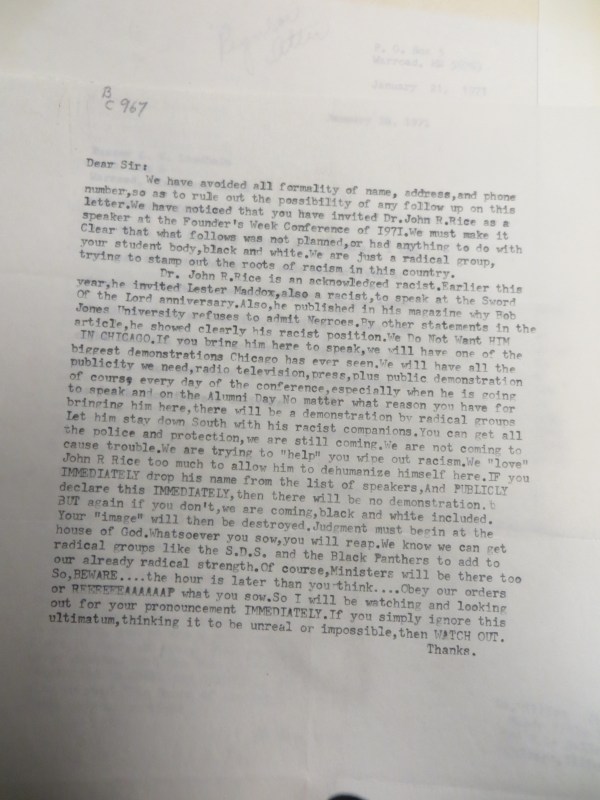
From the MBI Archives: BEWARE!

In 1971, MBI invited John R. Rice to speak at its annual Founder’s Day event. Before he could make the trip to Chicago, Rice came out in favor of the racial segregation at Bob Jones University. What was MBI to do? The leadership didn’t want to endorse Rice’s brand of Southern-fried racism. But they also didn’t want to anger his considerable fundamentalist following. As they dithered, they received an anonymous letter warning them to cancel Rice’s appearance.

The letter claimed to be written by non-students. To this reporter, however, the tone sounds awfully similar to the phrasing used by evangelical students everywhere and the letter-writers seem to know a lot more about Rice and MBI than any outsider would. For example, they had read Rice’s publication, Sword of the Lord. They knew about Rice’s recent support for racial segregation at Bob Jones U.

What should MBI do? The letter writers made threats:

We Do Not Want HIM [Rice] IN CHICAGO. If you bring him here to speak, we will have one of the biggest demonstrations Chicago has ever seen.

It would get ugly. As the letter concluded,

BEWARE . . . . the hour is later than you think. . . . Obey our orders or REEEEEEAAAAAP what you sow.

In the end, MBI canceled Rice’s speech. Perhaps the administration shared the letter-writers’ concern that their “ ‘image’ will . . . be destroyed.”

What will happen at Taylor? The conservative newsletter complains that the current campus is going to the dogs, according to Inside Higher Education. In classes, the newsletter exclaims, students learn

permissive views of human sexuality, hostility toward creationist perspectives, rejection of the rule of law (especially on the immigration issue) and uncritical endorsement of liberal-progressive ideas[.]

Such poison-pen missives have had a big impact in the past. Perhaps Taylor’s administration will take the path of least resistance and make some move to mollify the “conservative underground.”

Trumpist Towers? Or Critical Colleges?

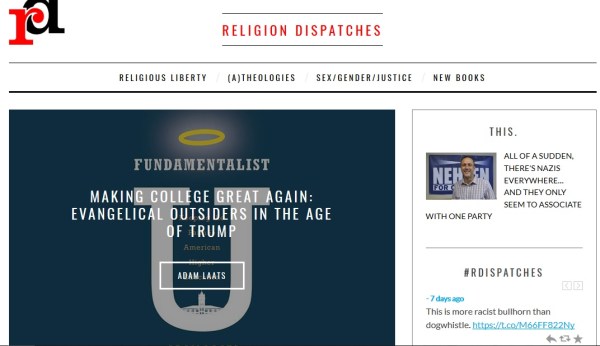
I’ve said it before and now I’m saying it again: Trumpism speaks to long traditions among white evangelicals. And time and again, evangelical colleges have been the institutional homes of Trump-like yearnings to “make America great again.” As I argue this afternoon over at Religion Dispatches, however, evangelical colleges have also played another key role.

RD screenshot

Are evangelical colleges bastions of Trumpism? Or are they the only places evangelicals can turn to find out what’s wrong with loving The Donald?

I won’t give away the entire argument. SAGLRROILYBYGTH might be bored to tears with the topic and you can read the whole thing if you’re interested. But I will say that it’s no surprise that President Trump loves Liberty University. It’s also no surprise, however, that the Liberty community isn’t sure if they love him back.

Who Still Loves Trump? Not Just the Usual Suspects

I thought I understood why so many white evangelicals supported Trump. New information about other conservative Trumpists has me wondering about it all over again.

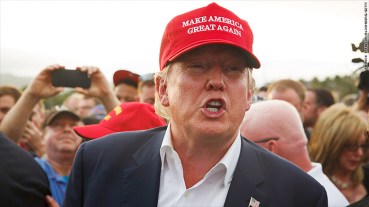
First and foremost, we need to remember that political opinions are always a mish-mash. Some conservative white evangelicals might support Trump for hard-nosed political reasons, such as control of the Supreme Court. Others might simply revile Hillary Clinton so much that they’d support anyone else. Noting all those caveats, I thought the single biggest reason for white evangelical support for Trump was the hat.

Trump make america great again

Is it the hat? Or something more?

As I’m arguing in my new book, conservative white evangelicals have long felt a sense of usurpation. They have felt kicked out of the elite universities that they themselves founded. They have felt kicked out of mainstream science organizations. They have felt kicked out of mainstream cultural attitudes about sex and behavior.

When candidate Trump promised to “Make America Great Again,” the promise carried a particularly heavy appeal for some conservative white evangelicals. They had long thought that America had gone to the dogs, that it had kicked God out of its classrooms and off its TV screens. The idea of restoring America to a mythic golden-age past has enormous appeal among some conservative white evangelicals.

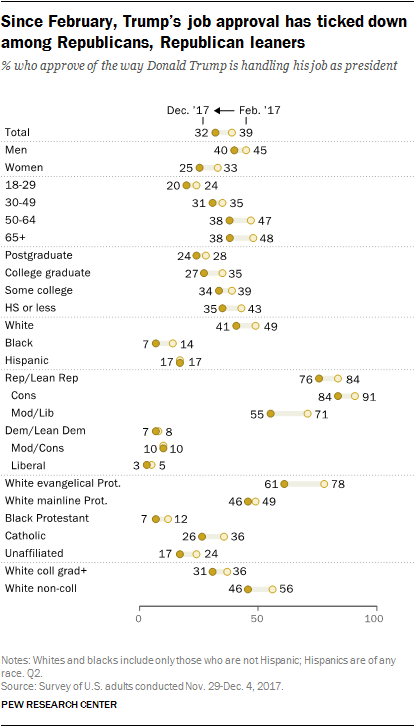
This week, I’m catching up with old news about another conservative religious group that has similarly fond feelings for Trump, but none of the same unique history in this country. Orthodox Judaism has not had the same sense of proprietary ownership over public space in these United States, but apparently the Orthodox community is even fonder of Trumpism than white evangelicals are.pew chart trump support

At Forward, Elad Nehorai explores the curious fondness for white nationalism and Trumpism among the American Orthodox community. As he points out, Trump’s support seem to be falling among white evangelicals. At least as of December, Pew found white evangelical Trump fans had dropped to 61%. Among the Orthodox, though, support for Trump jumped to 71%, as of last September.

What gives?

Nehorai argues that some of his co-religionists have been so utterly disgusted by liberal politics they are willing to embrace any alternative. As one Orthodox writer offered, if he had to choose between Antifa and the Klan he’d take the latter. Nehorai concluded, for some Orthodox thinkers,

Ultimately, even the KKK may not be as bad as the liberal world.