I Don’t Know What to Believe…

I don’t even know what to know, or what knowing means, or what believing might mean.  The good news is that I’m not alone.  No one seems sure of these things, especially not when it comes to touchy subjects like evolution. But I’m still confident of our argument that the best approach to teaching evolution is to encourage a separation in science classrooms of the need for students to KNOW evolution from the need for students to BELIEVE evolution.

It’s a tricky distinction, and I’m sympathetic to criticism that it may not make a real difference.

Some recent survey results make me wonder if this distinction might not even be a workable one in public schools. In the blog of the National Center for Science Education, the prolific Josh Rosenau notes the results of some survey work from the University of Alabama. In short, the researchers found that the more college students accepted evolution, the more they knew about it. Now, this confounds claims by cultural-cognition guru Dan Kahan that “knowing” evolution says more about who you are than about what you know. It is more a measure of belief than of knowledge.

For a mild-mannered historian like me, these conflicting survey results leave me scratching my head. Not only are we not sure if people need to “believe” evolution to “know” it, but we’re not even sure if we “know” that “believing” and “knowing” go together!

But I can’t just throw up my hands and go back to the archives. This question of knowledge and belief is central to all of us who care about evolution education. In my upcoming creation/evolution book with talented and stylish philosopher Harvey Siegel, we argue that public schools must teach evolution, but they must teach it in a way that separates claims of knowledge and belief.

Because there is one thing I do know, as a historian: Creationism is a religiously driven belief system. It is not exactly science, but this whole foofaroll about evolution education stems from the fact that creationism is a religiously driven belief system with claims to scientific legitimacy.

When it comes to educational policy, we have to make a delicate distinction that is usually lost in all the hot air. Creationists’ claims to scientific legitimacy do not carry any weight outside of their own religious circles. But that does not mean creationists do not have a right in the public square to believe in their own scientific legitimacy.  It means creationists have a right to public schools that do not force them to perform religious acts. Since affirming the truth of mainstream evolutionary thinking would be a religious act for many creationist students, public schools need to be more careful about insisting on such things.

In practice, in public schools, this means we face a situation that makes everyone unhappy. Creationism has no legitimate claim to a place in public-school science curricula, since it is derived from religious beliefs. But public-school science classes (and history classes, and math classes, and literature classes and gym classes) have no right to push creationist students to engage in religious acts, either.

Rather, to be more precise, public schools may teach ideas that tend to denigrate religious ideas. Schools shouldn’t do so casually or glibly, but if there is an important reason, they may do so. However, public schools may not force (or even encourage) students to engage in the (possibly) religious act of denigrating creationism themselves. In short, public schools CAN expose students to ideas students find religiously offensive. But public schools CAN’T ask students to do religious acts. If affirming the truth of evolution is a religious act, then public schools cannot insist upon it, or even imply that such an affirmation is desirable.

Creationists may hate this conclusion. Since the 1920s, anti-evolutionists and creationists have insisted that their beliefs are better science, true science. In court case after court case, however, experts have demonstrated the intellectual paucity of this belief. Creationists may not admit it, but they might recognize that their claims to scientific legitimacy don’t convince people outside of their own religious circles.

And for public education, that’s enough. My religious beliefs do not carry weight—as religious beliefs—in public schools. Even if my religious beliefs insist that they are better science. Or history. Or literature. Or physical education.

But traditional science-ed types will also hate this conclusion. As a set of religious beliefs, creationism is entitled to special consideration in public schools. Though the case law is somewhat mixed on this point, the moral case is compelling: Children of any religious or cultural background must be made welcome in every public school. Their beliefs may be challenged by the curriculum, but students cannot be asked to perform religious acts in those public schools. And acts that might not seem religious to me might be religious to religious people, or even to an imaginary “objective observer.”

Conservative Christians have had mixed results trying to make this case in court. Perhaps most famously, in 1987’s Mozert v. Hawkins, an appellate court ruled that conservative parents could not ban curricular materials they found offensive. The conservative parents had argued that textbooks with references to occult practices, evolution, and impolite children infringed on their rights to religious liberty. The books, the parents believed, hurt their children’s ability to freely practice their religion.

The constitutional complexity in this case was demonstrated by its tortuous path through the court system. One district court judge agreed with the parents on one point: textbooks that say there are multiple ways to worship God really are teaching religious content. In the end, the appellate court disagreed.

Other federal courts have made this difficult point. In another case from Tennessee, Wiley v. Franklin (1979), the court decided that

if that which is taught seeks either to disparage or to encourage a commitment to a set of religious beliefs, it is constitutionally impermissible in a public school setting.

The rub in these cases, it seems to me, is that courts have trouble defining the boundaries of religion. The final ruling in Mozert relied on the fact that the conservative children didn’t have to do or say or affirm anything about religion. They were only exposed to ideas that their parents considered offensive.

And that seems telling for our case here. Though I may find it a simple statement of fact, the notion that there are many paths to religious salvation has profound religious implications for many people. And though I may find it a simple statement of fact, the notion that the earth is bajillions of years old has profound religious implications for many people. Public schools should expose students to these ideas. But public schools cannot force creationist students to engage in the religious act of agreeing with these ideas.

The fact that affirming evolution is not a religious act for me does not mean it is not a religious act for anyone. For many creationist students, saying that evolution is true is a religious act. Schools can’t insist upon it. But understanding the basic concepts of evolution is not. Public schools must insist upon that.

Though this post is already too long, let me add one caveat. This argument does not agree with creationists’ insistence that evolution is a religion. Rather, it simply says that evolution is an idea that some religious people consider religious. This is a hugely important distinction.

Public schools cannot force students to do religious things. For many students, affirming that evolution is true would be a religious act.

At the same time, public schools must teach the best available knowledge. In science classes, the modern evolutionary synthesis is an example of that sort of knowledge.

So here is our goal: Separate out our demands on students. It is not as complicated as it may seem. Adding two or three little words can do it. Instead of asking students to say, “The earth is millions of years old,” we ask students to say, “Scientists say the earth is millions of years old.”  Instead of asking students to say, “Humans evolved from other forms of life,” we ask students to say, “According to scientists, humans evolved from other forms of life.”

Do I know that this will work? No, but I believe it will help.
Creationism Comes to College Campus

Quick: what university would you think most likely to host a big creationism conference? Bob Jones? Liberty? Cedarville? How about Michigan State?

Viviane Callier of the American Association for the Advancement of Science’s Science Insider reports that, yes, Michigan State will be hosting a big creationist conference this weekend. The Origin Summit will host four speakers about such issues as the Evolution-Hitler connection and the weakness of the Big Bang Theory. The organizers have invited MSU philosopher Robert Pennock to debate and targeted MSU’s Richard Lenski. So far, Lenski and Pennock have ignored them.

Powered by the Gish Gallop?

Powered by the Gish Gallop?

Pennock, also known as “Darwin’s Border Collie” (get it?), has been a leading anti-creationist voice in the academy. Most famously, his expert testimony in the Dover Intelligent-Design case tore apart the scientific pretensions of ID theorists. And Lenski has attracted attention for his long-term evolution study using E. Coli bacteria.

It seems that the organizers of the Origin Summit targeted Michigan State as the home of such prominent anti-creationists. After all, one of the four morning workshops promises to explain specifically how Lenski’s research will bear no fruit.

But that’s not what the organizers will tell you. At least, it’s not what they told Viviane Callier. Mike Smith, the group’s executive director, said they planned to host similar meetings at pluralistic campuses nationwide. The target, Smith explained, is the student body. Many of them may never have heard the message of creationism. “Once students realize they’re created beings,” Smith told Callier, “and not the product of natural selection, they’re much more open to the Gospel, to the message of God’s love & forgiveness.”

This is what Smith’s group describes as their “backdoor strategy.” Too many students, the group warns, have been “brainwashed with the Darwinian dogma while the state refuses any mention of Creation whatsoever.” Their plan is to let students hear the creation gospel, hoping that “many, for the first time ever, [will discover] that the Bible is true.”

The question everyone’s asking is this: How will Michigan State scientists respond? Should they inform students of the scientific baselessness of creationist claims? Or should they use humor to deflate the conference? So far, the MSU community has decided that the best response is no response.

Lenski hopes the “summit” will turn out to be nothing more than “another forgettable blip in the long history of antiscience, antievolution screeds.” And best of all, the university itself has welcomed the meeting. As one official put it,

Free speech is at the heart of academic freedom and is something we take very seriously. Any group, regardless of viewpoint, has the right to assemble in public areas of campus or petition for space to host an event so long as it does not engage in disorderly conduct or violate rules. While MSU is not a sponsor of the creation summit, MSU is a marketplace of free ideas.

Hear, hear! There is nothing violent or threatening about this meeting. There is no reason any pluralist university should not welcome such dissenting ideas into their communities.

Is This the Creationist Conspiracy?

Anti-creationists have warned about it for generations: Creationists are joining forces to sweep away reason and science. A growing conspiracy of dunces threatens to upend centuries of progress. But a recent tiff between leading American creationists demonstrates just how fractured and divided creationists really are.  And it demonstrates the ways hysterical anti-creationism may do more harm than good.

The threats of a creationist conspiracy go back to the roots of America’s evolution/creation culture wars. In his 1927 book, The War on Modern Science, Maynard Shipley warned that the fundamentalist “forces of obscurantism” threatened to overthrow real learning. As Shipley put it,

The armies of ignorance are being organized, literally by the millions, for a combined political assault on modern science.

Ever since, science writers have warned of this impending threat. Isaac Asimov, for instance, warned in 1981 of the “threat of creationism.” Such unified anti-scientists, Asimov believed, had made great strides toward setting up “the full groundwork . . . for legally enforced ignorance and totalitarian thought control.” Like Shipley, Asimov noted that not all religious people are creationists, but also like Shipley, Asimov failed to notice the differences between creationists. The only religious people one could trust, Asimov wrote, were those “who think of the Bible as a source of spiritual truth and accept much of it as symbolically rather than literally true.”

What Asimov missed was the crucial fact that many creationists DO endorse real science; many folks who think of the Bible as more than just symbolic also accept the ideas of an ancient earth and human evolution.

This is more than just a quibble. When leading scientists and science pundits lump together all creationists as “armies of ignorance,” they needlessly abandon and heedlessly insult potential allies in creation/evolution debates. When science writers such as Jerry Coyne attack all religious discussion as “accommodationism,” they unnecessarily alienate creationists who want to teach more and better evolution.

A recent interchange between leading creationists demonstrates the way international creationism really works. Creationism in practice is not a horde of Bible-believing fanatics, relentlessly unified on the age of the earth and the origins of humanity. In practice, rather, creationism is a splintered and fractious impulse, fighting internal foes more viciously than external ones.

The “evolutionary creationist” Deborah Haarsma, leader of BioLogos, recently reached out to young-earth creationist leader Ken Ham of Answers In Genesis. Haarsma was “troubled” by Ham’s angry polemic about a third creationist, Hugh Ross of the old-earth Reasons to Believe.

We all have our differences, Dr. Haarsma said. But why can’t we come together over our shared Biblical faith? About our shared concern that young people are leaving the church? Why can’t we at least sit down together for a cordial dinner and talk over our differences?

Ken Ham publicly rebuffed Haarsma’s efforts. Ham agreed that his animus toward Ross was not at all personal. As Ham explained, “I don’t consider Dr. Ross a personal enemy . . . he is actually a pleasant person.” But Ross was also an “enemy of biblical authority.” And Haarsma was no better. “People like Dr. Haarsma,” Ham wrote,

make it sound like they have such a high view of the Bible, whereas in reality, she has a low view of Scripture and a high view of man’s fallible beliefs about origins!

There will be no dinner. There will be no grand alliance of creationists. Instead, we see the ways some creationists will tend to isolate themselves into smaller and smaller like-minded communities.

This story spreads beyond the borders of the United States. As historian Ronald Numbers described in The Creationists, in the mid-1980s the minister of education in Turkey wrote to the San-Diego based Institute for Creation Research. Turkey’s schools, the minister wrote, needed to “eliminate the secular-based, evolution-only teaching dominant in their schools and replace it with a curriculum teaching the two models, evolution and creation, fairly” (pg. 421). And Islamic creationism, much of it based in Turkey, has thrived. However, Numbers concluded, “the partnership between the equally uncompromising Christian and Muslim fundamentalists remained understandably unstable” (425). Numbers cited the rhetoric of American creationist leader Henry Morris: “Mohammed is dead and Jesus is alive!” As Numbers noted acerbically, such talk was “hardly calculated to win Muslim friends” (425).

There will be predictable tensions between different types of creationists. Though some conservative religious voices will work to spread evolutionary theory among evangelicals, others will focus on what Ken Ham called “rebuilding a wall” (Nehemiah 6:1-3).

Folks like me who want to see more and better evolution education will be wise to reach out to those conservative religious folks who also believe in evolution. Instead of copying the tactics of Ken Ham, as Jerry Coyne is prone to do, science promoters should embrace allies and make friends. Instead of shrieking about the “armies of ignorance,” science promoters will do well to look closer at the creationist population. There are plenty of friends there.

“The Talk:” Evolution Edition

What do young people need to know about evolution?  A recent commentary from University of Washington professor David Barash has sparked a new round of debate.  For us at ILYBYGTH, it sparks a different question: When and how should ‘resistant’ students learn about evolution?

We all know that some religious students get uncomfortable when the subject of evolution comes up.  “Until recently,” Barash wrote, “I had pretty much ignored such discomfort, assuming that it was their problem, not mine.”  They should be uncomfortable, Barash concluded.  There were foundational ideas in many religious traditions that science simply made untenable.

For example, students who really understood evolutionary science would have a hard time maintaining a belief in a fundamentally good and all-powerful deity.  As Barash put it,

The more we know of evolution, the more unavoidable is the conclusion that living things, including human beings, are produced by a natural, totally amoral process, with no indication of a benevolent, controlling creator.

Also, students who hope to maintain a belief in the special nature of humanity will be in for a rude awakening.  Humans, evolutionary scientists have demonstrated conclusively, are “perfectly good animals,” but not anything specially created.

Finally, the old watchmaker argument just doesn’t hold water.  Though life might seem irreducibly complex, modern evolutionary science has demonstrated that, as Barash put it,

an entirely natural and undirected process, namely random variation plus natural selection, contains all that is needed to generate extraordinary levels of non-randomness.

Not surprisingly, creationists have reacted with outrage.  Stephen Meyer of the intelligent-design bastion Discovery Institute blasted Barash as “willfully ignorant” of recent scientific developments.  Other creationists have called Barash “intellectually dishonest.”  Even Catholic writers berated Barash.  As one Franciscan blogger put it, “His laboratory pontification exceeds his areas of competence.”

Such reactions, it seems to this writer, accomplish Barash’s goals perfectly.  With his insouciant attitude toward religious perspectives and his history of anti-religious polemics, it’s hard not to conclude that Barash and the editors at the New York Times hoped for exactly this sort of outraged response.

Here at ILYBYGTH, we want to ask different questions.  For instance, we want to know if students from anti-evolution homes can be taught about evolution without simply rejecting it.  We want to know if our deep culture-war trenches over evolution education can be bridged by a different approach.

As we’ve learned from scholars such as Dan Kahan, what people say they know about evolution tells us about their identity, not their knowledge base.  As Kahan puts it, it tells us about who they are, not what they know.  There is not a significant difference between evolution-supporters and evolution-deniers when it comes to knowledge about evolution.  That is, people who say they believe in evolution or agree with evolutionary theory don’t actually know more about it than people who say they don’t.

And, as ethnologist and science-education guru David Long has demonstrated, “evolution” is tied to a bundle of non-scientific meanings for many resistant students.  Knowledge of evolutionary theory was not a problem for the creationist students Long studied.  Instead, acceptance of the idea of evolution presented identity challenges to these students.

Perhaps more shocking to culture warriors like Barash, creationists WANT their children to know about evolutionary theory.  But they want their children to be protected from attitudes like his; creationists want their children to learn about evolution from people who understand and respect their religious qualms.

How do we know this?  Because many conservative religious schools INSIST that all students take a course on evolutionary science.  Liberty University, for example, has made an evolution/creation course a requirement for graduation.  And here at ILYBYGTH, I have been educated by creationist parents who earnestly hope to teach their children about evolution.

Learning about evolution, Liberty style

Learning about evolution, Liberty style

In an upcoming book, philosopher Harvey Siegel and I argue that the way forward in evolution education is to promote an “understanding-not-belief” approach.  Public schools must teach students the best available science.  And right now, that includes the modern evolutionary synthesis.  But public schools must also refrain from imposing religious (or anti-religious) ideas on students.

It’s a tall order, and many smart commentators have pointed out the difficulties with our prescription.  As David Long has suggested, our book might just be a “red herring” in these discussions.

But imagine how very different our version of “the talk” would be from David Barash’s.  Like Barash, we want teachers to tell all students that evolution is the best current science.  It is.  But that doesn’t mean that people can’t and don’t have good reasons for speaking out against it.  Students should be allowed, no, encouraged, to separate their personal identities from their knowledge about evolution.  Knowing evolution makes them educated, not evil.

Perhaps most important, a teacher’s attitude can make all the difference.  If a teacher hopes to make students “shift uncomfortably in their seats,” then Barash’s approach will work.  But a good teacher recognizes the world of difference between a healthy, growthful intellectual discomfort and an antagonistic, coercive one.  Barash hopes to jolt creationist students out of their intellectual blinkers.  But his approach will only weld those blinkers on more securely.

A better “talk” will be one that helps students understand that evolution is an idea, not an identity.

No, YOU’RE the Weirdo

Do you have a smartphone? Does everyone you know have one? If so, that puts you in a small minority, even though you feel like you’re part of a vast majority. And that sort of presumption of normality has a lot to say about our continuing educational culture wars.

I came across the statistic in this week’s Economist. It seems over 1.7 billion people use smartphones. That’s a lot, but it leaves 80% of the human population phone-less.

What a bunch of WEIRD-os.

What a bunch of WEIRD-os.

So what? We might notice this as more fuel for the WEIRD fire.  As in Western, Educated, Industrialized, Rich, and Democratic.  Psychologists Joseph Henrich, Steven Heine and Ara Norenzayan argued a few years back that too many subjects of psychological tests came from this relatively restricted background.  The results of those tests, they argued, should really only be claimed to apply to people of similar backgrounds.

But I also think this is a good example of the culture-war dangers of what we might call “majority myopia.” The things to which we are accustomed sometimes seem as if they are common to everybody. With smartphones, for example, it might seem like an eccentricity these days to go without one.* But despite our perceptions, actually a vast majority of people share that “eccentricity.”

When it comes to public schooling, we see this sort of myopia time and again. When it comes to teaching evolution, for example, political scientists Michael Berkman and Eric Plutzer have argued that the most important question to ask–after teachers’ personal beliefs–is what the community believes about evolution. If the community tilts toward creationism, then teachers will, too.

As they put it,

traditional districts and cosmopolitan districts tend to hire teachers whose training, beliefs, and teaching practices serve to reinforce or harmonize with the prevailing local culture.

In other words, there are some ideas that seem universally shared. Why? Because everyone we know agrees on them. With science teachers, they may certainly feel as if they are teaching the ideas that everybody agrees to be true. They are teaching the ideas that everyone in their community seems to share.

This spreads wider than evolution, of course. Back in the late 1960s, political scientists Kenneth Dolbeare and Phillip Hammond set out to investigate the practical consequences of the Supreme Court’s 1963 Schempp ruling. In that ruling, an eight-to-one court decided that reciting the Lord’s Prayer and devotional reading of the Bible could not Constitutionally be part of a public-school day.

Dolbeare and Hammond journeyed into four municipalities in an unnamed Midwestern state. They found to their surprise that the Schempp decision had had virtually no effect. In schools that had prayed before, students and teachers still prayed. In schools that hadn’t, they still didn’t.

Most puzzling at all to the political scientists, none of this raised any whisper of controversy in any of the towns. For those who lived there, it simply seemed as if the vast majority of people must share their views about school prayer. Even if they knew what the Supreme Court had decided, their “majority myopia” made them see their own praying public schools as the norm.

I’m sure there are other cases out there. For some religious schools, I’m guessing it must seem as if everyone agrees on doctrines such as a young earth. And at some progressive schools, like the ones I attended as a kid, it certainly seemed as if everyone agreed on the basic principles of secularism and left-leaning social justice.

But as this smartphone statistic shows, even those things that seem most universal can really be part of a very small minority.

*Full disclosure: I’m smart-phone-less myself. Don’t judge me.

Can We Tell Students the Truth about Truth?

HT: DL

I don’t know what to think.  For almost a hundred years, creationists and other conservatives have complained that mainstream science—often symbolized by the idea of evolution—threatened their children’s faith.  For just as long, leading scientists have insisted that there was nothing religious about real science.  But a recent chat with physicist Carlo Rovelli makes me wonder.

First, some premises:

1.) Public schools should not be teaching religious ideas to children.  Schools may and should teach ABOUT religions, but public schools should not attempt to push students toward or away from any faith.

2.) Public schools must offer students the best available scholarship.  In science class, this means students must learn the modern evolutionary synthesis.

3.) Secondary-school education–in the USA, that means high schools and middle schools–should train students to think in ways familiar to the scholarly disciplines.  So, in history class, we follow Stanford’s Sam Wineburg in hoping to teach students to engage in the “unnatural act” of thinking like a historian.  The same should be true in other disciplines.  Students should be learning basic principles of mathematical thinking, literary thinking, and scientific thinking.

So here’s our dilemma.  For a while now, conservative creationists have complained that public schools are teaching evolution as a religion.  Nonsense, mainstream scientists have responded.

Because, of course, if evolution were a religion, it should not be taught in public schools.  It could be taught ABOUT, but not taught as something towards which students ought to be pushed.

But as trenchant observers have observed, there are indeed some religious aspects of mainstream scientific belief.  Or, to put it more precisely, there are important ways in which the attitudes of mainstream scientists clash with certain conservative theological beliefs.  As my favorite atheist observer of American creationism Jason Rosenhouse argued, traditional Christians are correct in thinking that evolutionary ideas pose a drastic theological threat.

And today we come across more fuel for this dilemma.  In a recent interview in Scientific American, physicist Carlo Rovelli seconds the notion that mainstream science is–as much as it is anything–a skeptical attitude toward absolute truth.  As Dr. Rovelli put it,

I have no idea what “absolute truth” means. I think that science is the attitude of those who find funny the people saying they know something is absolute truth.  Science is the awareness that our knowledge is constantly uncertain.

Tell me the absolute truth: Do these glasses make my face look fat?

Dr. Rovelli, Tell me the absolute truth…

I don’t need to be up on the latest in quantum physics to see how such an attitude could be problematic for the conservative parents of American school children.  If such children were being taught the basic principles of mainstream science, and if those principles coincided with Rovelli’s attitude, then conservative parents might indeed have cause for complaint.

A family wouldn’t need to be any sort of creationist to take issue, either.  Anyone who takes their Judaism or Christianity seriously might be chagrined to find their children coming home from school and telling them, “I find it funny when people say they know something is absolute truth.”

Knowin’ Ain’t Believin’

What do we mean when we say we do or don’t believe in evolution?  As we’ve discussed here in the pages of ILYBYGTH, it’s not the simple question it appears.  At his Cultural Cognition blog, Dan Kahan recently rehashed his argument about the utter disjunction between knowledge and belief when it comes to evolution.  The argument has ramifications for both the way we think about the culture wars in general and the specific ways we think about evolution education.

For those interested in issues of evolution and creationism, if you’re not regularly reading Dan Kahan’s Cultural Cognition blog, you should be.  Professor Kahan argues that culture precedes facts.  Whether the issue is immunizations, climate change, evolution, or other questions of science and public understanding, Professor Kahan insists that “knowledge” is not a simple matter of exposure to facts.  The way people respond to facts is conditioned by their cultural background.

In the case of evolution and creationism, conservative religious folks may know a great deal about education, yet that knowledge tends not to show up on standard surveys.  As Professor Kahan relates, religious people often know a great deal about mainstream science, yet when they are asked about evolution, they seem not to know it.  But the standard survey questions misrepresent how many of those conservative religious types actually know about evolution.

The traditional question asked by the science literacy survey of the National Science Foundation, for instance, asks respondents the following question: “human beings, as we know them today, developed from earlier species of animals, true or false?”  Not surprisingly, among highly religious Americans, the number of people who get this question “correct” takes a huge dive.  This is true even among those respondents who answer many other science questions correctly.

You know it must be true, because it has charts 'n' stuff...

You know it must be true, because it has charts ‘n’ stuff…

But this discrepancy can be fixed by wording the question differently.  When the survey added a simple phrase such as “According to scientists,” then religious people answered the evolution question correctly.  In other words, asking some conservative religious people if evolution is “true or false” is not asking them if they “know” evolution.  But!  Asking conservative respondents if SCIENTISTS SAY human beings developed from earlier species of animals comes closer to testing real knowledge about evolution.  And the simple addition of this phrase—“scientists say”—offers a promise of healing some of the viciousness of our evolution/creationism controversies.

After all, what do we want out of people?  Must we insist that Americans believe evolution to be true, rather than false?  Or rather, do we want to insist that to be educated, one must understand what mainstream science says about evolution?

As I am arguing with co-author Harvey Siegel in a new book about the history and philosophy of evolution education, only the latter makes any real sense.  It makes sense for creationists.  And it makes sense for mainstream scientists and science educators.

Those of us who want public schools to teach evolution—and only evolution—as science  need to be clear among ourselves what it is we are really after.  We do not want to impose religious beliefs on public-school students.  If a student and his or her family finds evolution objectionable for religious reasons, it is not the job of the public school to disabuse that student of those religious beliefs.  It is similarly not the job of a public school to convince creationist students that evolution does not in fact threaten those religious beliefs.  In short, the religious beliefs of public-school students are beyond the purview of public-school teachers and curricula.

But it is entirely proper and necessary for public schools to insist that all students of all backgrounds know the best current science.  And that science is the modern evolutionary synthesis.  Whatever some creationist pundits may say, creation science, intelligent design, and other varieties of creationism are not scientific improvements.  They are, rather, religious objections to mainstream science.

Professor Kahan’s careful distinction between knowledge and belief provides a helpful guide for this vision of proper evolution education in public schools.  Public school science classes must teach evolution and only evolution as the best current scientific knowledge.  Students must be able to identify and define key ideas such as natural selection, random mutation, and genetic variance.

But too many science educators implicitly tie knowledge of those ideas to belief in them.  That connection is as unnecessary as it is harmful.

As Professor Kahan points out, this connection between knowledge and belief can be fixed with a simple patch.  In surveys, instead of asking respondents if human evolution is true or false, we can ask respondents if human evolution is true or false, according to mainstream scientists.

The same approach can work in public school science classes.  Instead of implying that evolution is true, teachers can add—either implicitly or explicitly—a notion that evolution is the way mainstream science explains the origins of life.  Students can and must be expected to explain and analyze evolution.  But they can do so with a conditional always in the background.  That is, they can maintain a notion that the mechanisms of evolution are the ideas of mainstream scientists, not some grand explanation of the truth about human life.

Can it work?  According to Professor Kahan, it already does.  Changing the wording of survey questions has an enormous impact on the answers.  And historically, as I’ve argued in both my 1920s book and my upcoming book about conservative activism in education, creationists have not objected to their children learning about evolution.  They have only disputed the way evolution was taught as the simple truth about humanity’s origins.  The same is true today, I’m guessing.  Creationists, I’m confident, will agree that their kids should know about evolution.  They simply resent the attitude of many evolution educators.

This attitude can be seen in the way we talk about evolution education.  Is evolution “true?”  That sort of question is the absolute wrong approach.  It forces evolution skeptics to reject evolution.  It forces dissenters to present themselves as anti-evolution.  And students must therefore get questions about evolution wrong.  Students must try not to “know” evolution.  But if we allow students to add a simple phrase, we might sidestep a world of unnecessary and corrosive disputation.

Consider the world of difference, for instance, between the following two student responses:

  • Scientists say that some speciation arose through the mechanism of genetic drift.”
  • “Some speciation arose through the mechanism of genetic drift.”

There are only three additional words in the first response, yet the cultural meaning of the first response is worlds different from the second.  Many creationists, I’m convinced, would be willing and eager for their children to learn about evolution, if those children had the freedom to discuss evolution with the implicit addition of the phrase “scientists say.”

Am I missing something?  For those like me who want to see more evolution education in public schools—and more effective evolution education in those schools—would this approach help?  And for creationist parents, teachers, and preachers, would the separation of knowledge from belief lead you to support this sort of evolution education for your kids?


Save the Date, Evolution Wonks!

Great news for all of us in sunny Binghamton!  Professor Michael Berkman of Penn State has agreed to come up for a talk about his work.  It is scheduled for March 30, 2015, so everyone has plenty of advance warning.  Clear your calendars.

Evolution? Creation? Who decides?

Evolution? Creation? Who decides?

Professor Berkman’s talk will be part of the fantastic Monday seminar series of our Evolutionary Studies Program (EvoS).  The brainchild of evolution maven David Sloan Wilson, EvoS makes this campus a wonderfully stimulating place to work.  I’ve had the chance to talk to the assembled multitudes, and the EvoS program has brought in a steady stream of world-class evolution experts from all fields.

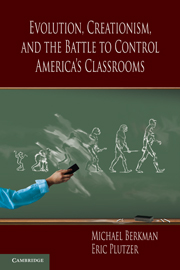
Those who follow the evolution/creation controversies may know Professor Berkman best for his recent-ish co-authored book, Evolution, Creationism, and the Battle to Control America’s Classrooms (Cambridge University Press, 2010).

The centerpiece of that book—and the part that attracted the most attention—was a survey of high-school science teachers.  Berkman and his co-author Eric Plutzer found that a sizable minority (28%) of science teachers taught evolution.  Another small minority (13%) taught creationism as science.  But a large middle—roughly sixty percent—muddled through.  This middle group either taught both, or neither, or a watered down mainstream “science” that left plenty of intellectual room for creationism.

But less noticed and more momentous was their argument that teachers make the most difference in what gets taught.  And teachers tend to fit in with their communities.  When we hear that large percentages of Americans agree with a recent creation of humanity, we might think at first that those people are mixed in with the rest of us.  But far more likely is that such folks cluster geographically. In other words, in some towns, most of the residents are creationists.  In those locales, teachers will teach what their community wants.  Not out of some sinister oppressive fundamentalist machinations, but much more simply because the teachers hold those same beliefs.

As Berkman and Plutzer argued, teachers function as “street-level bureaucrats.”  They do not simply crank out whatever ideas are enshrined in textbooks and state standards.  Rather, teachers exert profound influence on the kinds of ideas students hear, and the ways those ideas are presented.  In Berkman’s and Plutzer’s words, “not only do personal beliefs influence instruction, they also have a stronger impact than any other factor we have examined” (page 186).

Required reading for anyone interested in evolution/creation issues

Required reading for anyone interested in evolution/creation issues

As Berkman and Plutzer put it, the best way to understand the evolution/creation fight is not as a question of religion or science.  Rather, at heart, this is “a political struggle over who decides, a question central to democratic politics” (page 31).

So Monday, March 30 should be an interesting evening.  The EvoS crowd usually runs toward the biologic and away from the politic.  Many of the undergraduate students are biology majors and many of the faculty and community participants cluster in the hard sciences.  Such folks sometimes wince at any attempt to understand evolution/creation as a cultural or political issue.  Instead, some hard scientists tend to see the issue as black and white: Evolution is science, creationism is not.

I’m not sure what Professor Berkman will discuss in his talk, but I’m counting the days til then.  These talks are open to the public and free; no registration is required.  I’ll post details of the specific time and location as we figure them out.  For those who can’t make it to our scenic but out-of-the-way campus, EvoS usually posts the audio of these talks after a few days.

Hope to see you there!


Creationism, Conservatism, and the Common Core

What does creationism have to do with the newish Common Core Learning Standards? Some conservative activists and politicians are rejecting both in a knee-jerk attack on educational reform. In one new educational bill in Ohio, conservatives simultaneously threw out the Common Core and opened the door to creationism. But this isn’t just a question of creationism. Rather, this is a symptom of a broader conservative attitude toward public schooling.

Not just science, but history and literature are also targeted in this conservative educational power grab.

We first became aware of this new bill in Ohio thanks to the watchdoggery of the folks at the National Center for Science Education. The NCSE, naturally, worried first about the apparent opening of Ohio’s public-school science classes to intelligent design and creationism. Ohio’s House Bill 597 would insist on new standards that specifically “prohibit political or religious interpretation of scientific facts in favor of another.”  The sponsor of the bill, Andy Thompson of Marietta, told the Cleveland Plain Dealer that he included that language to allow school districts the freedom to include a variety of ideas about evolution, not to mandate that districts include intelligent design or creationism.

Representative Thompson wants the Common Core OUT and conservative curricula IN.

Representative Thompson wants the Common Core OUT and conservative curricula IN.

But the anti-Common Core bill also includes a broad-spectrum attack on the purportedly progressive nature of school curricula in other subjects as well. The original draft of the bill specified that 80% of the literature taught must be from American or British authors before 1970, though Thompson quickly backpedaled from that goal. But why was such a target included in the first place? As I detail in my new book, conservatives since the 1970s have looked skeptically at the trend toward “multicultural” literature. Conservative leaders from Max Rafferty to Bill Bennett have insisted that proper education—conservative education—must be based on the classics of our Western civilization. Anything else, they insisted, dooms children to a savage unawareness of their own cultural heritage.

In history, too, the Ohio bill insisted that history instruction include

the original texts and the original context of the declaration of independence, the northwest ordinance, the constitution of the United States and its amendments with emphasis on the bill of rights; incorporate the Ohio constitution; define the United States of America as a constitutional republic; be based on acquisition of real knowledge of major individuals and events; require the study of world and American geography; and prohibit a specific political or religious interpretation of the standards’ content.

Here also we hear echoes of long-time conservative worries. From Lynne Cheney to Dinesh D’Souza, it has become a commonplace of the conservative imagination that leftist history has taken over public education. As I argued recently in a commentary in History News Network, conservatives assume that students are taught that American history is the record of cruel white hate crimes against Native Americans, women, and African Americans. The Ohio bill hopes to rectify this America-bashing by mandating “real knowledge,” not just hate-filled Zinn-isms.

As we’ve seen time and again, conservatives are not united in their thinking about the Common Core. Some conservatives love them….or at least like them. Others blast the standards as yet another attempt at sneaky subversion from Washington.

In this new Ohio legislation, we see how some conservatives combine their loathing of the Common Core with a grab-bag of other conservative educational goals: Less evolution in science class, more America-loving in history class, and less multiculturalism in literature class. Taken together, conservatives such as Ohio’s Andy Thompson hope to broaden the anti-Common-Core juggernaut into a more ambitious conservative panacea.


Do You BELIEVE in Evolution?

It’s a deceptively simple question and it lies right at the heart of the creation/evolution controversies.  Unfortunately, Keith Blanchard’s recent opinion piece on the subject seems to miss the point.  Not because Blanchard doesn’t understand the issues, but because he deliberately hopes to change the conversation.  But it’s not that simple.  In at least two important ways, we need to wonder more deeply what we mean when we say we “believe” in evolution.

Can you BELIEVE this???

Can you BELIEVE this???

Blanchard writes from the heart of mainstream science.  We shouldn’t say we “believe” in evolution, Blanchard writes.  As he puts it,

if someone asks, “Do you believe in evolution,” they are framing it wrong. That’s like asking, “Do you believe in blue?”

Evolution is nothing more than a fairly simple way of understanding what is unquestionably happening. You don’t believe in it — you either understand it or you don’t…

Of course, we see what he means.  I even agree with his position.  But IMHO, this line or argument is nearly entirely beside the point.  It puts us evolution-supporters in the silly position of insisting that there is no debate about evolution.  Like Blanchard, we mean that the scientific facts of evolution are not open to debate, any more than is the fact of gravity or the fact of blue.

But so what?  How does that position get us anywhere?

Because there IS a debate about evolution, obviously.  Lots of influential people do not accept the facticity of evolution.  They do not accept that evolution explains the deep history of species on this planet.  Therefore, it matters to say that we believe in evolution.  Saying we “believe” in evolution, politically, means taking a stand about educational politics and cultural politics.

On a more basic level, too, saying that we believe in evolution has a value beyond Blanchard’s knee-jerk empiricism.  After all, in our society, we believe all sorts of things about which we only have a tentative or tenuous understanding.  For instance, when we have a serious medical malady, we trust in what medical experts tell us.  Not blindly, of course, but we talk to several experts and decide on a treatment course that seems to make sense to us.  We don’t necessarily understand every jot and tittle of the medical science.  But we take the life-or-death advice of doctors.  When it matters, we trust our experts.

And that is also the case here.  Saying we “believe” in evolution means something different than saying we understand its meaning.  Saying we “believe” in evolution means we trust a certain set of authorities over others.  Not blindly, of course, but in general outline.  So, for instance, when the National Center for Science Education mounts its Project Steve, I’m convinced.  The sheer numbers of mainstream scientists who publicly announce their “belief” in evolution convinces me.

After all, for educated folks these days, the un-interpreted evidence of our senses has long been suspect.  Blanchard writes that we should all trust the “evidence of [our] own senses.”  If we do so, he concludes, we’ll be convinced about the fact of evolution.  But educated people know that their senses might mislead them.  After all, the intuitive case for creationism is very strong.  Things seem to have been created according to some system, some plan.  Creationists might regularly appeal to people’s senses to prove their point, along the lines of Paley’s watchmaker.

As careful studies have proven, people who reject evolution don’t necessarily have a spottier understanding of science.  Contrary to what Blanchard says, people can and often do understand evolution yet reject it.  Michael Berkman and Eric Plutzer, for example, concluded from their large-group study of science teachers that creationists have an edge beyond the logic of folks like Blanchard.  Even among those Americans who understand that mainstream scientists agree on evolution, Berkman and Plutzer found, a large majority prefers that public schools teach both evolution and creationism.  That’s right: Even those Americans who know what mainstream science says about evolution still want schools to teach creationism.

In a world like that, Blanchard’s argument seems at best irrelevant.  Insisting that evolution is a simple fact, either to be understood or not understood, makes no sense in these circumstances.  On the other hand, if we say we “believe” in evolution, we’re doing something important.  Something with necessary political weight.

But there is one sense in which we should not try to “believe” in evolution.  Not Blanchard’s sense, but a more nuts-and-bolts kind of meaning.  As I’m arguing in an upcoming book with co-author Harvey Siegel, public schools need to get out of the belief business when it comes to evolution education.  That is, the goal of evolution education must not be to convince students to “believe” in evolution.  Rather, the goal should be to make sure all students understand it.

In a way, this is what Blanchard is saying, but I wonder if he would recoil in disgust from the implications.  Blanchard wants people to understand evolution.  We don’t “believe” in something that is obviously true.  We don’t “believe” in facts of nature.

In contrast, our prescription for public schools is that teachers adopt the goal of leading students to an understanding of evolution, and no more.  Students should be led to understand the principles of evolution, its mechanisms, and its evidence.  If they then choose not to “believe” evolution, that is an entirely private matter, beyond the realm of public school goals.

I don’t know for sure, but I suspect that this sort of “understanding-not-belief” is not what Blanchard has in mind.

What about you?  Do you “believe” in evolution?  What does it mean to “believe” it, rather than to just “know” it?  Or, from the other direction, what does it mean to “dis-believe” it, even if you understand it?