Required Reading: Faces of Fundamentalism

When I first saw notice for Jona Frank’s book I worried it was another callow safari-style tour of fundamentalism in America.  I worried that the photographer hoped to shock and titillate non-fundamentalists with photographs from a bizarre subculture.  While Right: Portraits from the Evangelical Ivy League does include some elements of that cultural-tourist mindset, overall Frank offers a rich collection of portraits that are well worth exploring.

The book is a collection of portraits of the students at the new Patrick Henry College.  The students at PHC usually come from conservative religious homeschooling families.  The raison d’etre of the school, after all, is to get conservative kids into influential positions in politics and culture.  When I first saw promo photographs from the book, it looked to me as if Frank hoped to emphasize the distinctive subcultural elements of these students.  Many of the students appear awkward and over-dressed.  Some look distinctly overstuffed and uptight, as if they are surprised to find themselves in twenty-first century America.

Juli, whose career goal is to be a homeschooling mom.

Juli, whose career goal is to be a homeschooling mom.

After spending some time with the book, I feel Frank deserves more credit.  She wrestles explicitly with these issues in her conclusion.  As she writes, the “assuredness” of PHC students “confuses me.”  As she put it,

I had vague notions that I would marry and have a family when I was twenty-two, but both were far off.  What I wanted was exploration, travel, stories, youth hostels and road trips, part-time jobs and film school.  Before commencement I yearned for freedom.  This is part of being young in American, or so I believed until I went to Patrick Henry.

It has to be a lot of pressure to have a daily conversation with yourself about how you will impact the world.  In some ways, it’s the summer of ’69 at PHC, and they experiencing their own counterculture.  Of course, they are not ripping off their shirts and taking LSD.  It’s much quieter, but it’s not less complex.  The world is a complicated place.  It’s at odds with the homes they grew up in, and they are holding fast to the ideals of a life they believe is right.

In this passage and elsewhere, Frank demonstrates her awareness of her own limited perspective.  Just because we make certain assumptions about what “college” is supposed to be like, we must not impose those assumptions on everyone.  This is true whether students attend a button-down fundamentalist school like Patrick Henry or whether students are working two jobs while taking classes at a local community-college campus.

For those of us trying to understand conservative thinking and practice in education, Frank’s book also contains valuable samples of student work and wonderfully lengthy interviews with students.  One student sample, by “Grace M.,” reported on David Aikman’s biography of George W. Bush.  As this student reported dutifully, as “Dubya” matured,

It became obvious that his faith and religious convictions were a pleasant aroma to Americans.

Maybe not the best prose, but no worse than much of the student work from the non-fundamentalist schools in which I’ve worked.

Some of the students sound as if they are simply parroting the party line.  Jeremiah, for example, related his understanding of the purpose of PHC.  The school’s mission, he told Frank, included

Impacting government, impacting the media, impacting Hollywood, the culture, the arts. . . . Now our heaviest focus is on government, but the long-term goal is to impact the media, the arts, television, and the movies.

To my ears, this sounds like the sort of indoctrination I’d fear at a fundamentalist school.  Teachers say something, and students repeat it.  But, to be fair, when I listen to many of my undergraduate students here at a highly selective pluralist public university, they often also sound as if they are just repeating back what they’ve been told.

And we see some evidence that PHC dives deeper into true intellectual diversity than do many secular schools.  Another student, Juli, explained why they read so many non-Christian and even anti-Christian writers.  Such writers as Nietzsche, Juli explained

May be absolutely wrong, but they are not foolish, so we can’t just mock them.

How many students at pluralist universities would say the same thing about writers they disagree with?  How many students even read the work of conservative intellectuals as part of their training?  As former New York mayor Michael Bloomberg recently accused, have too many mainstream colleges turned into liberal indoctrination mills?  Have fundamentalist schools like PHC become more intellectually diverse than mainstream colleges?

To be sure, Frank’s book also contains glimpses of more disturbing tendencies at PHC.  One student accused the leadership of being “Draconian, totalitarian, in regard to students and faculty.”  And Frank includes an image of a repressive-sounding “Bride’s Guide.”  Young women are offered the following tidbit of complementarian advice: “Be a Woman Who Is Willing to Give Up All your Dreams.”

To outsiders like me, that sounds shockingly sexist.  To her credit, Frank includes this sort of depressing anti-feminism alongside photographs of an engagement party in which the women seem joyful and wholly at peace with their complementarian commitments.  Frank seems aware that the “Bride’s Guides” might fulfill my stereotypes of harsh fundamentalist impositions, but she also seems aware that the students at PHC often confound my stereotypes by embracing such rules freely and healthily.

Of course, a book can only be so long, but I wish that Frank had explored the theme of institutional growing pains more deeply.  She notes the generational divide at work here.  Many of these students came from families who see themselves as homeschooling pioneers.  But in being part of the first decade of life at PHC, these students also take a role as pioneers.  As I explored in my 1920s book and plan to treat at more length in my upcoming higher-ed book, fundamentalist universities are similar to other organizations in many ways.  The first generation, under the direct leadership of a charismatic founder, has a unique set of challenges and problems.  PHC still lingers in that first phase of development.  It seems to me that Frank could have taken more time to explore that tension.

She might have looked at the history of evangelical higher ed, in which each successive generation has opened a new school meant to be a “fundamentalist Harvard.”  In the 1920s, it was Bob Jones University.  In 1970, it was Liberty University.  How does PHC echo those experiences?  How is it unique?  Frank seems disappointingly uninterested in those questions, or unaware of them.

Instead, Frank seems to play along with the school’s claim to be part of something new, a new “evangelical Ivy League.”  Why, when she is careful to hold the school’s other assumptions at arm’s length, does Frank simply accept this kind of description?  After all, a school founded in the past five years can’t fairly be compared to the Ivy League.  Those institutions have a unique place in elite circles.  No student from the real Ivy League would say that no one knows about their college, as one of the PHC students complained about PHC.  Though PHC’s students might have ambitions of taking a fast track to elite positions, the school itself is more bluster than reality at this point.  To accept the founder’s (and students’) claim that PHC represents the very best of evangelical higher education is to make a woeful misapprehension of the state of American evangelical culture.

Such quibbles should not deter readers from getting their hands on a copy of Frank’s book.  For those interested in exploring the world of conservative education, Right will be well worth your time.

 

Does Fundamentalism Promote Sex Abuse?

Do conservative Protestant evangelicals have a problem with sex abuse? Does evangelicalism suffer from an overabundance of “Christian cesspools” of abuse?

I’ve been chastised for asking whether this is a specifically fundamentalist problem—that is, a problem of theology—or rather an institutional problem. That is, is it specifically fundamentalist theology and “purity culture” at fundamentalist schools that encourages rape and sexual assault? Or do we see the same sorts of systemic abuse in non-fundamentalist colleges and universities? At big football schools, for example, administrators protect rapists to protect the football program. Could “party culture” be just as conducive to rape and sexual assault as “purity culture?”

In an article about the sex-abuse travails at Bob Jones University, Boz Tchividjian says this is not a question of theology, but of “authoritarianism.” Tchividjian argues that church structures lend themselves to sex abuse, but that this sort of abuse could happen “in any culture, elevating leaders beyond accountability, leaving victims’ rights to their whim, and sidelining critics who challenge their rule.” Yet Tchividjian’s work has illuminated the gruesome world of sex abuse and rape in evangelical and fundamentalist institutions.

As Kathryn Joyce describes in a recent essay in American Prospect, Tchividjian’s anti-abuse group GRACE was called in to Bob Jones University in 2012 to investigate accusations of widespread institutional neglect of charges of rape and sex abuse. Tchividjian, grandson of evangelist Billy Graham and former law professor at Liberty University, has long campaigned for more transparency about sex abuse among evangelicals. In Joyce’s AP piece, Tchividjian made his case for the terrible evangelical record with sex abuse. “One study,” Joyce writes,

has found that 93 percent of admitted sex offenders describe themselves as religious. Offenders who report strong church ties abuse more often, with younger victims. That’s not because Christians are inherently more abusive, he said, but because they’re more vulnerable to those who are. Tchividjian repeated what one convicted sex abuser told clinical psychologist Anna Salter in her book Predators: Pedophiles, Rapists, and Other Sex Offenders: “Church people”—always looking to see the best in people, to welcome converts, to save sinful souls—are “easy to fool.”

“When something does surface, all too often the church leadership quiets it down. Because they’re concerned about reputation: ‘This could harm the name of Jesus, so let’s just take care of it internally.’

Tchividjian rattled off ways in which Christians’ openness can allow abuse to go unchecked: Perpetrators tend to use scripture to coerce, justify, and silence. If they’re clergy, they will exploit their positions; if they’re laypeople, they will take advantage of a church hungry for volunteers and rely on the trust given to members of a church family. “The reason why offenders get away with what they do is because we have too many cultures of silence,” Tchividjian said. “When something does surface, all too often the church leadership quiets it down. Because they’re concerned about reputation: ‘This could harm the name of Jesus, so let’s just take care of it internally.’

In case after case, Tchividjian and his colleagues unearthed terrible and terrifying stories of abuse and cover-ups. Of students like Katie Landry at Bob Jones University. When Landry reported her rape to Dean Jim Berg, Berg allegedly told her that there was a “sin in your life that caused your rape.”

Tchividjian says this is a question of organizational structure, not of theology. But his own work seems to make the case that fundamentalist culture seems particularly prone to this sort of victim-blaming. As in this story from BJU, it seems fundamentalist cover-ups have the ability to use theologically inflected language to cow victims into silence.

I’m certainly sensitive to charges of fundamentalist-bashing. Indeed, my first take on the recent spate of “exposes” of sex abuse at fundamentalist colleges was to wonder if this was just another attempt to dismiss dissenting colleges. But there does seem to be a connection between fundamentalism—both theology and culture—and this climate of sex-abuse cover-up. It might not generate higher numbers of abuse victims than other opaque institutions—ask anyone at Penn State, Florida State, or a host of other non-fundamentalist institutions—but it seems fair to say that fundamentalism has generated a sick culture of abuse.


Ken Ham Is My Guidance Counselor

Why does Ken Ham care where you go to college? Where you send your kids?   Because “college” is more than just a collection of classes and academics. For religious conservatives as for everybody else, “college” represents a formative experience. The ideas one will encounter, the personal connections one will make, and the changes in one’s outlook and worldview all make the college years some of the most transformative in our lives.

In recent years, Ham, America’s (and Australia’s) leading voice for young-earth creationism, has established himself as the arbiter of creationist orthodoxy in college attendance. And his word carries weight in the world of evangelical higher education.

Recently, for instance, Ham warned readers at Answers In Genesis about the dangers of attending Calvin College. Students at that storied Christian school, Ham explained, were “being influenced . . . to undermine the authority of Scripture in many ways.” When faculty engage in evolutionary research and teaching that might turn away from Ham’s strict attitudes about knowledge and creation, Ham warns, students will too often abandon their creationist faith.

As a precaution, Ham offers readers a list of schools that adhere to the young-earth creationism taught by Ham’s Answers In Genesis ministry. To be safe, Ham warns, parents and students ought to stick with schools that have proven their fidelity to these ideas.

Ham’s anxiety over the crumbling orthodoxy in Christian higher education is nothing new. As I argue in my 1920s book, many of today’s evangelical schools had their origins in the founding decade of American fundamentalism. Back in the 1920s, religious schools often faced a choice between fundamentalist orthodoxy and modernist adaptation. Most chose modernism. The University of Chicago, for example, founded as a Baptist beacon of learning, became the leading voice for theological modernism, employing such folks as Shailer Mathews and Shirley Jackson Case. In contrast, a few Christian schools, most famously Wheaton College, sided with the fundamentalist movement.

Leading fundamentalists in the 1920s also founded a spate of new schools to embody their theological and cultural conservatism. Perhaps most prominently, evangelist Bob Jones Sr. opened Bob Jones College (now Bob Jones University) in 1926. The goal of this school was to form the fundamentalist character of young people while educating them in the best traditions of arts and sciences. In order to reassure parents that the school would never slide toward theological modernism or cultural liberalism, Jones and his allies established a rock-ribbed charter. This charter hoped to guarantee the continuing orthodoxy of the school. The charter’s second paragraph outlined that orthodoxy:

The general nature and object of the corporation shall be to conduct an institution of learning for the general education of youth in the essentials of culture and in the arts and sciences, giving special emphasis to the Christian religion and the ethics revealed in the Holy Scriptures, combating all atheistic, agnostic, pagan and so-called scientific adulterations of the Gospel, unqualifiedly affirming and teaching the inspiration of the Bible (both Old and New Testaments); the creation of man by the direct act of God; the incarnation and virgin birth of our Lord and Saviour, Jesus Christ; His identification as the Son of God; His vicarious atonement for the sins of mankind by the shedding of His blood on the Cross; the resurrection of His body from the tomb; His power to save me from sin; the new birth through the regeneration by the Holy Spirit; and the gift of eternal life by the grace of God.

Perhaps most notably, the next line specified that this charter “shall never be amended, modified, altered, or changed as to the provisions hereinbefore set forth.” Also remarkable, according to a 1960 reminiscence by Bob Jones Sr., at its founding BJU decreed that every graduating senior would pledge to monitor the school’s continuing fundamentalism. “Should the policy and conduct of the University ever, in my lifetime, deviate, in the slightest particular, from the letter or spirit of this Creed,” seniors would promise,

I hereby pledge myself to exert all my influence to affect a change in conditions; failing which, I will resort to such legal measures as the courts may offer to the end that the institution may be kept true to the University Creed and the original intentions of the founder.

Most evangelical colleges established similar creeds and many promised never to amend them. Not many others, to my knowledge, required such strict supervision by their alumni.

These days, Ken Ham has taken over the role of orthodoxy’s gadfly. In addition to his warnings about waverings from his definition of creationism at Calvin College, Ham has warned that other evangelical schools might be threatening the faith of their students. And Ham’s warnings carry weight.

In one recent episode at Bryan College, for example, Ham’s public worries about faculty orthodoxy led the school’s leadership to instigate a new sort of creationist orthodoxy pledge for faculty. From now on, faculty must publicly avow their belief in a real, historic Adam and Eve. As I argued at the time, the fallout from Bryan College’s policy shift might lead to a shake-up of faculty. More directly relevant, the furor at Bryan seems to testify to Ham’s influence. Worried that creationist parents might not send their students and their tuition dollars, Bryan’s leaders acted to shore up their image as a home of young-earth creationist orthodoxy.

Also intriguing, I must ask again if the drive to protect their reputations as safe theological and cultural havens has led some conservative evangelical schools to cover up incidents of sexual assault. Of course, these are very serious allegations, and I do not ask these questions lightly. I am certainly not accusing Ken Ham or the leadership of these schools of condoning sexual assault. But the drive to present a public face as a uniquely safe environment for fundamentalist students certainly puts undue pressure on college leaders. It is not unfair to wonder if such pressure might lead schools to downplay any cases that might threaten those reputations.

Outside the world of conservative evangelical Protestantism, colleges spend an inordinate amount of time and treasure to attract students. Flashy dorm rooms, high-visibility sports programs, celebrity faculty, and lavish campus lifestyles all hope to convince families to send their kids and their money to certain schools. The pressure on recruiters is intense.

There is a similar pressure on evangelical colleges. Influential voices such as that of Ken Ham are able to exert outsized influence by warning creationist families toward or away from certain schools. Without Ham’s imprimatur, conservative schools may lose the loyalty of students and families.


Florida, Football, and Fundamentalism

Is football a religion? Do the high priests of college football act like the leaders of the nation’s most conservative fundamentalist colleges? In some ways, when it comes to responding to accusations of rape and sexual assault, the similarities seem creepily prominent.

News emerged today that the case of football star Jameis Winston at Florida State will undergo a new round of scrutiny. Back in December, Winston evaded charges about an alleged sexual assault. At the time, pundits accused FSU of coddling Winston because of Winston’s star power.

As we’ve seen in these pages, conservative evangelical Protestant colleges–“fundamentalist” schools–have weathered similar charges of stonewalling and covering up charges of sexual assault on their campus.

Are these cases similar? Does football function like fundamentalism? That is, does the culture of big-name, big-money football create an environment in which everything else takes a back seat to success on the gridiron? Where any questioning of the football team becomes similar to questioning basic tenets of orthodox religious belief?

Let’s take a look at some of the similarities and differences.

At least according to some accusers, fundamentalist schools actively target victims of sexual assault. Both men and women, students and administrators, are steeped in a “purity culture” that encourages all involved to see female victims as sexual temptresses. When accusations of rape emerge, victims are attacked by students and administrators. The threat of making such accusations intimidates many other victims into a scarred silence.

Similar hostility emerges with college football. The alleged victim of the FSU rape, for instance, eventually dropped out of school and moved out of town due to constant harassment and death threats.

Also, it seems both football and fundamentalism push college administrators to worry first about the school, and only secondly about the complaints of victims. With football, the stars must be protected. No one can win a Heisman Trophy or a national championship from a jail cell. And with fundamentalism, schools must protect their reputations as uniquely safe environments. Publicity about sexual assault would certainly threaten that reputation.

But there are also significant differences. First of all, non-fundamentalist schools are almost all subject to review by federal guidelines. In the case of FSU, for example, the case has come back into the headlines because of accusations that the FSU administration might have violated provisions of Title IX in its handling of the case. Most fundamentalist schools refuse all federal funding, so they can operate without such oversight or federal review.

More profoundly, cases at fundamentalist schools are about more than just administrative cover-ups. Some pundits insist that the culture at fundamentalist schools operates as a hyper-charged version of broader cultures that blame women victims. More than at pluralist public schools such as FSU, critics allege, fundamentalist schools promote both sexual assault and victim-blaming by insisting on a “purity culture” standard. Women involved in sex of any kind often find themselves accused of instigating sinful acts.

Victory we have heard on high

Victory we have heard on high

There’s no doubt that big-time college sports look like religions, in lots of ways. They have weekly rituals, with ceremonial outfits and traditional musical accompaniment. They have high priests and acolytes who huddle to make important decisions. And, at least in the eyes of many fans and players, they involve the community in a staged fight of the powers of good versus the powers of evil.

But does this quasi-religious adoration of college sports bleed over into the treatment of accusations of rape as well?


Faith & Physics, Part III

ILYBYGTH is happy to continue our series of guest posts from Anna.  In her first post, Anna described her shift from creation science to mainstream science.  In her second, she described her early education in the world of conservative Christian fundamentalism.  Anna blogs about her experiences leaving the fundamentalist subculture at Signs You Are a Sheltered Evangelical.  She holds an M.Sc. degree in Astroparticle Physics and currently lives in Virginia with her fiance Chelsey and a cat named Cat.  Good news: She has recently been accepted into a PhD program in physics at a top research university in the United States. 

Why is Creationism so appealing?

Last installment, I spent some time discussing my Creationist curriculum.  Through five years, I learned science alongside Young Earth Creation apologetics.  No small amount of time was spent on discussing the evidence for young earth, explaining the Grand Canyon as a result of a global flood, reinterpreting the geological record, and more.  Over and over, it was repeated and reassured that Creationism was a viable theory based on the evidence alone.  Yes, the Bible made assertions regarding the origin of the world, but all of the text books and apologists emphasized that the theory could stand on its own merits and that even atheists should be able to see the evidence and agree to it.

And yet, when it came down to it, the evidence was truly secondary.  On some level, I think that the most devoted creation “experts” still realize that Young Earth might not stand up to honest scrutiny.  This is why almost the entire YEC battle is fought for children.  Creationists have already lost in the arena of mainstream science.  They can’t influence people there.  But children are easy to influence.  Children are much more trusting.  And if they start kids with these theories early, perhaps they can build walls around them that will keep them there.

And they did.  There were walls built around our minds to ensure that we never wandered too far from the correct doctrine.  Creation apologists were very clear: even if you find yourself doubting the evidence for 6-day creation… even if you realize that secular science has the more compelling arguments… you CAN’T change your beliefs.  You can’t, because the creation story in the Bible is the Word of God, while evolutionary science is the word of men.  To question a literal interpretation of Genesis is to question God himself.

For a young conservative Christian homeschooler, this is the ultimate threat.  While most YEC advocates do not claim that salvation is dependent on disregarding modern science, this is hardly much better.  Conservative Christian culture can be surprisingly cut-throat, and demonstrating a lack of faith in God can be paramount to social and spiritual suicide.  Such people were a by-word among my creationist peers… the “lesser” Christians that would probably lose their faith if they were allowed to go to college.

Indeed, this argument was ultimately more compelling to me than all the evidence that was offered for a global flood, the evidence for “design”, or the convoluted explanations of how the universe could have been created 6000 years ago despite the fact that distant galaxies are visible from earth.  Sure, I absorbed all that information and I believed it.  But I quickly realized that my evidence probably looked puny compared to the vast amounts of data and research in evolutionary biology and cosmology.  But I refused to back down, because I was a Good Christian.  I would not trust flawed humans over God.  I would not cave in to scientific “persecution.”  I would not believe, no matter how much evidence I was given, because to do so, would be to spit in the face of my savior.  The guilt and the fear kept me securely in the Creationist’s camp.

Now, being sheltered and homeschooled probably made me especially susceptible to this sort of fear and guilt.  But I am certain that I am not alone in my experiences.  The fact that YEC apologists place so much evidence on this argument leads me to believe that this fear and guilt is quite intentional.  It is the surest way to make sure that their school of thought survives the opposing evidence.  If you can’t make your case with facts, make it with fear.

To be fair, I’ve seen a little bit of these sorts of tactics used against Creationists in mainstream science communities.  For example, I can’t agree with the claim that “a Creationist cannot contribute to science” and the shame and guilt tactics that this statement employs makes me very uncomfortable.  It echoes a lot of the indoctrination I received from Creationists.  I do think that being a young earth believer limits the contributions that you can make to science, but there are many, many fields of research that do not require a background in evolutionary biology and as such, these sorts of blanket statements are deceptive at best.

All the same, I cannot fault scientists for being openly frustrated with science deniers.  No theory should have to be shored up with threats of spiritual damage and guilt over betraying a deity.  The thought is almost laughable.  However, until secular scientists begin to appreciate how influential these arguments can be, they cannot fully understand why young earth creation has such appeal to many… and why it can control even very intelligent and learned people.  Many people do not deny science because they are ignorant or stupid, but because they feel like they have no other choice.

But there’s an up-side to this.  We can change.  And those who accept science can help.  Unfortunately, the attitudes that many people display towards science deniers is not helpful.  In the next installment, I’ll try to delve a little into some of my interactions with some of my secular peers and explain which ones helped me on my journey and which ones set me back.

Introducing: Shelfies!

What’s on your shelf?  What do you read to help you figure out questions about conservatism and American education?

I Love You But You’re Going to Hell is happy to introduce a new feature: Shelfies.  Readers are invited to send pictures of their bookshelves with annotations.  You can send them to the editor: alaats@binghamton.edu  Make sure the titles are legible.

Here’s a shelfie from our editor’s office:

What's on your shelf?

What’s on your shelf?

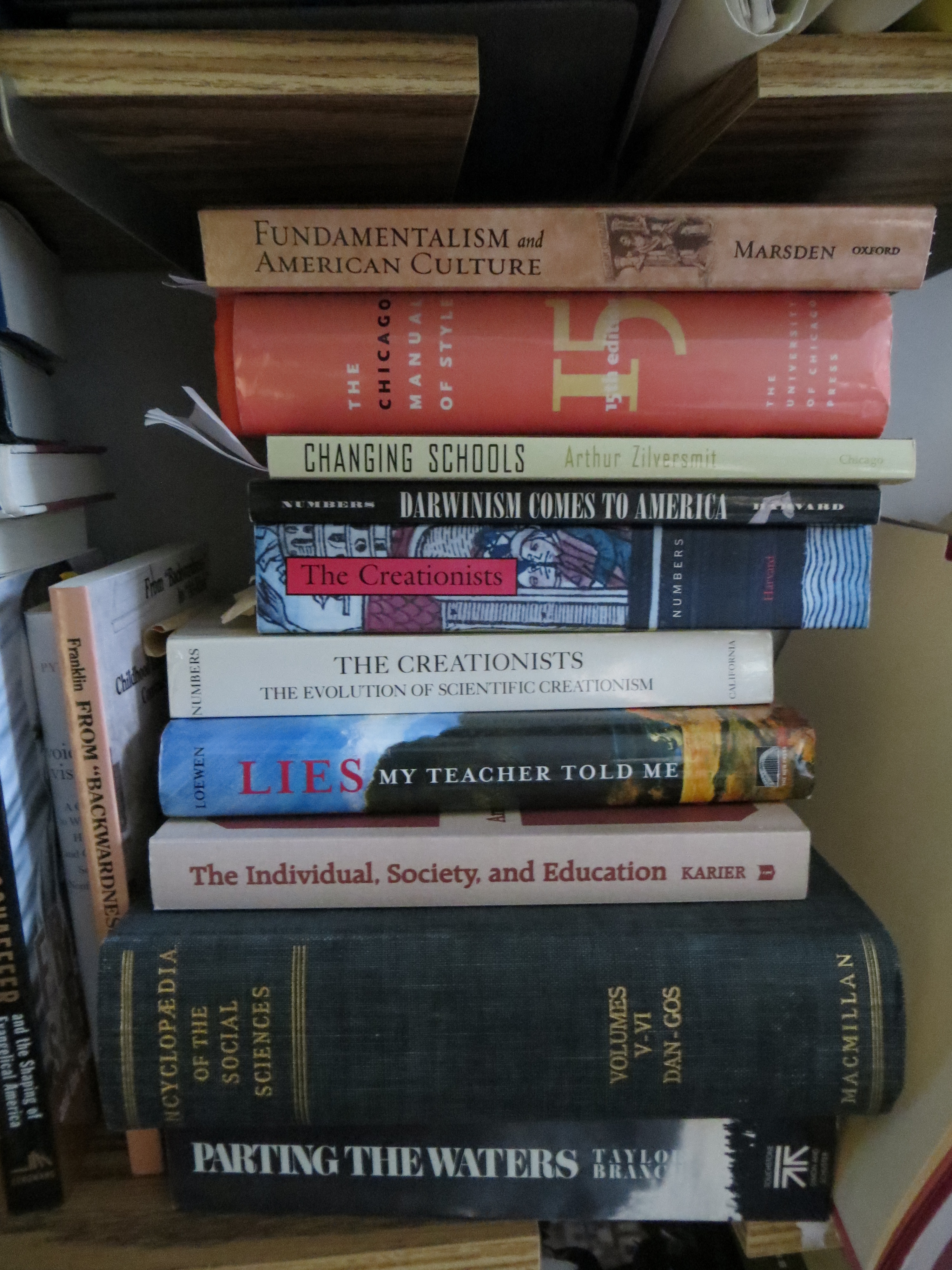
This is one of my go-to piles in my current work.  Here’s the breakdown:

1.) George Marsden’s Fundamentalism & American Culture.  It was this book (in an earlier edition) that first got me interested in the culture and activism of conservative evangelical Protestants.

2.) Arthur Zilversmit’s Changing Schools.  I refer to this book regularly.  It looks at the slippery nature of “progressivism” in American schools in the crucial period of 1930-1960.

3, 4, & 5.) The Ron Numbers Collection: Ron was my mentor in grad school at Wisconsin.  His work on creationism has been the bedrock reference for my historical research.

6.) James Loewen, Lies My Teacher Told Me.  I use this book regularly with my students who are going into history education.  Loewen’s tone is always a little too strident for my tastes, but this book is always good for those who are thinking about teaching history for a living.

7.) Clarence Karier, The Individual, Society, and Education.  This is a good book.  Not enough people seem to read it these days.  Karier looks somewhat idiosyncratically at the long history of education in the United States.

8.) Encyclopedia of the Social Sciences, 1935.  In this volume, historian Richard Niebuhr (brother of theologian Reinhold) offers an early and skewed definition of “fundamentalism.”  Niebuhr concluded, without much evidence, that fundamentalism was a rural phenomenon, an outgrowth of ignorance and isolation.  Though this definition doesn’t match the historical record, it proved enormously influential.  For decades, non-evangelical scholars accepted Niebuhr’s slanted definition without demur.

9.) Taylor Branch’s Parting the Waters. This well-known civil-rights history is there because I needed something to cover the gap in my bookshelves.  I can’t say I’ve ever read it, though I’ve always meant to.

So how bout it?  Send in some shelfies, tell us about what you’re reading.

Outlaw Colleges

Why do so many otherwise right-thinking Americans embrace leftist ideas?  For generations, conservative intellectuals have blamed the skewed perspective of American colleges and universities.

This morning in the pages of National Review Online, Victor Davis Hanson offers a ten-point condemnation of the American higher educational system.

For those unfamiliar with the real history, it might be tempting to assume that conservatives turned against the higher-education system during the campus tumults of the 1960s and 1970s.  Free speech movements, hippies, sit-ins, campus radicals occupying dean’s offices…there was certainly enough reason for conservatives to look askance at campus culture in those years.  But conservative intellectuals and activists had worried about the state of higher education long before that.

In the 1920s, for example, religious conservatives worried that mainstream campuses converted faith-filled young people into atheists and skeptics.  As I describe in my 1920s book, the first generation of fundamentalists realized that college determined culture.  William Jennings Bryan, for example, often trumpeted the findings of James H. Leuba.  Leuba had studied the beliefs of college students, and in his 1916 book The Belief in God and Immortality, Leuba concluded that the number of self-identified religious believers declined during college years.  In speech after speech in the 1920s, Bryan used Leuba’s numbers as proof that college wrecked faith.

Bryan wasn’t the only one.  Throughout the 1920s, evangelist Bob Jones Sr. warned of the dangerous effects of typical college curricula on young people.  One of the reasons Jones founded his own uniquely religious school, he explained in sermons, was because too many young people became college “shipwrecks.”  He told the story of one hapless family who had scrimped and saved to send their beloved daughter to

a certain college.  At the end of nine months she came home with her faith shattered.  She laughed at God and the old time religion.  She broke the hearts of her father and mother.  They wept over her.  They prayed over her.  It availed nothing.  At last they chided her.  She rushed upstairs, stood in front of a mirror, took a gun and blew out her brains.

In the 1930s, too, conservatives fretted that college corrupted culture.  Beyond the ranks of religious conservatives, activists in patriotic organizations such as the American Legion warned that colleges had been subverted by anti-American socialist moles.  As I argue in my upcoming book, worries about the subversive state of higher education became a central tenet of their conservative ideology.  For instance, in 1935 New York Congressman, red-hunter, and American Legion co-founder Hamilton Fish attacked the state of higher ed.  He named names, including Columbia, New York University, City College of New York, the University of Chicago, Wisconsin, Penn, and North Carolina.  These elite schools, Fish warned, and many others, had become “honeycombed with Socialists, near Communists, and Communists.”  A less prominent American Legion writer echoed this sentiment.  “Colleges all over the land” Legionnaire Phil Conley warned in a 1935 article, had begun teaching “the overthrow of our government . . . through subterfuge and through destroying faith and confidence in our democratic institutions.”

Long before “The Sixties,” then, conservatives concluded that colleges and universities threatened to shatter the cultural cohesion that had made America great.  These days, too, conservative intellectuals often condemn the state of higher education.  Of course, just as with earlier generations of conservatives, today’s conservatives may find many different reasons to worry about what goes on in America’s campuses.  Publications such as Minding the Campus and from the National Association of Scholars offer conservatives forums for sharing their complaints about the state of higher ed.

In the pages of National Review Online, we read one summary of conservative complaints about college today.  Victor Davis Hanson calls the state of higher education criminal.  He damns “virtual outlaw institutions” that take students’ money mainly to line their own pockets and fuel the narcissistic lifestyles of fat-and-happy professors and administrators.  “If the best sinecure in America,” Hanson concludes,

is a tenured full professorship, the worst fate may be that of a recent graduate in anthropology with a $100,000 loan. That the two are co-dependent is a national scandal.

In short, the university has abjectly defaulted on its side of the social contract by no longer providing an affordable and valuable degree. Accordingly, society can no longer grant it an exemption from scrutiny.

Hanson offers a ten-point brief.  College can be saved, he argues, if these senseless traditions are subjected to radical reform.  First, abolish tenure.  Second, rationalize hiring.  Third, take ideological garbage out of the curriculum.  Fourth, add transparency to the admissions process.  Fifth, cut the fat out of administration.  Sixth, remove the useless teaching credential.  Seventh, add national competency tests for faculty.  Eighth, publish school budgets.  Ninth, eliminate expensive and unnecessary university presses.  Finally, open campuses to real free speech.

Taken together, Hanson suggests, these radical reforms promise to renew the promise of American higher education.  Without them, American students and their families will continue to be held at intellectual and financial knife-point by the highway robbers known as professors and administrators.

How bout it?  Have you experienced college strife?  For those readers who come from conservative religious backgrounds, did your college experience shatter your faith?  Or did college turn you from a patriotic youth into a skeptical adult?  And what about Hanson’s broader challenge?  Do colleges take students’ money and offer only a skewed ideological indoctrination in return?


Fundamentalism’s Roots: A Review

What does it mean to be a “fundamentalist?”

At his lively blog Leaving Fundamentalism, Jonny Scaramanga has offered a review of my 1920s book that puts this question squarely at the center.

Two Thumbs Up...

Two Thumbs Up…

As Scaramanga points out from his current work and from his personal life history, the term “fundamentalist” is often used as more of a bludgeon than a label.  People accuse each other of being “fundamentalist” about this issue or that.  People dither over whether this or that person is a true “fundamentalist.”

Scaramanga notes that unless and until we get a sense of the formative first decade of American fundamentalism—the 1920s—we’ll never wrap our heads around the contentiousness that has always been at the core of defining the term.  I agree entirely.

Best of all, he gave the book a thumbs-up.  As Scaramanga put it,

I was genuinely surprised how much I liked this book. I’m a longtime reader of Adam’s blog and he’s helped me out with research on numerous occasions, so I knew he’s an engaging writer and a top bloke, but I was still expecting to find this a dry, academic slog. Actually, I was riveted. Everything I’ve studied of fundamentalism makes so much more sense in the historical context this book provides. I’d recommend it to people with a casual interest in fundamentalism just as much as those with an academic interest.

Thanks, Jonny.  I don’t think I’ve ever been called a “top bloke” before.  A “top bloke’s” a good thing…right?

Faith & Physics, Part II

ILYBYGTH is happy to continue our series of guest posts from Anna.  In her first post, Anna described her shift from creation science to mainstream science.  Today she tells us a little bit about the way she learned her creationist science as a kid.  Anna blogs about her experiences leaving the fundamentalist subculture at Signs You Are a Sheltered Evangelical.  She holds an M.Sc. degree in Astroparticle Physics and currently lives in Virginia with her fiance Chelsey and a cat named Cat.

Creationist Curriculum

I am a conservative, anti-government-educator’s dream.  Because I was homeschooled, my family had the unique opportunity to control every aspect of my education completely.  Part of this included being taught with a Christian science curriculum that supported Biblical 6-day creation, denied Evolution, described scientific evidence for a global flood, and opposed modern environmental policies.  When I tell my secular peers this, the reactions of shock, horror, and amazement are often rather comical.  Very often, I am told that I must be remarkably resilient or intelligent to be able to make a successful science career for myself after being handicapped by my early education.  As much as I’d love to accept the accolades, I simply don’t see it that way.  My seemingly-bizarre education did not hamper me much at all, and in some ways, I must credit it for inspiring me to become a scientist in the first place.  Although I cannot defend the inaccuracies in the curriculum, I still have fond memories of it, and I can highlight both the shortcomings and successes of the book series.

My formal science education, I believe, started around age 10 or 11 (since I was homeschooled, I did not progress through formal grades, so it is sometimes very difficult for me to track the passage of time without these milestones to help.)  I was started on an A-beka book, which I remember little of besides loathing.  It was spiral bound with wire and the pages were made of cheap paper, meaning that they were constantly tearing out, scattering across the floor, and getting lost.  Besides that, the text itself was dry, the pages were cluttered with illustrations that illustrated nothing, and the quizzes (aptly named “brain drains”) never seemed to pertain to the actual text and would often quiz you in facts only found in the illustration captions.

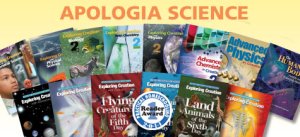
For the rest of my pre-college education, I used Apologia‘s Christian-centered curriculum by Dr. Wile, and I loved it.  Over the years, I worked through Exploring Creation with General Science, Exploring Creation with Physical ScienceExploring Creation with Biology, Exploring Creation with Chemistry, Exploring Creation with Physics, and Advanced Physics in Creation.  I wish that I had a copy of some of these books still with me… especially the 1st edition of General Science and Physical Science (if anyone feels like getting me an early Christmas present… I won’t say no) because I recall those two books having the most absurdities in them.  Obviously, I cannot cover all of the curriculum in detail, but I can shed some light on the divergences from science that I recall.

Image Source: Apologia

Image Source: Apologia

I have to laugh now recalling that one of the books (General Science, I think) had an entire chapter devoted to attempting to validate the Bible as an accurate scientific and historical record.  This would seem grossly out of place in any standard science text.  For a creationist, however, it is perfectly reasonable and, indeed, necessary to discuss this in depth.  I recall in my early years of college, seeing my peers and professors laugh at the absurdity of creationism.  “Scientists start with evidence and draw a conclusion from it.  Creationists start with a conclusion and draw evidence for it,” was posted on my professor’s office door.  I felt a little defensive.  “We all tend to accept conclusions that come from reputable, repeatedly-tested sources,” I thought.  “If the Bible were not reputable and repeatedly-tested, then obviously accepting claims from it would be absurd, but that is not the case.”  Much of my conviction on the validity of the Bible originated from the early Apologia texts.  It’s important to remember that Creationists do not see themselves as anti-science… they want to find compelling evidence for their claims.  As a result, I waded through a chapter discussing the accuracy of Bible translations, similarities between different Biblical manuscripts, refutations of Biblical contradictions, etc.  The purpose of this was to prove that the Bible could be reliably used as a basis for scientific theory.  To exclude this chapter would be grossly negligent if claims in the Bible are indeed the basis of your theory.  Even so, the whole conversation bored me; I wanted to learn science.

The Physical Science textbook spent an inordinate amount of time condemning modern environmental policies as fraudulent.  I recall the book passionately opposing the ban on CFC’s, claiming that the ozone hole was a scare tactic used by politicians to promote a hysterical agenda, and predicting that people would suffer from increased rates of infection now that medical tools could no longer be sterilized by the chemical.  These political discussions now irritate me more than any of the other inaccuracies in the books.  I had been raised when I was young in a very rural area and had developed a great love of nature.  I was fiercely protective of the environment, and all of the flora and fauna in it.  I wrote an article to my local newspaper about reducing litter when I was 11 years old or so which I was very proud to see published.  As such, it angers me in retrospect that I was taught so many lies about proper stewardship of the environment and that I believed them for so long.  I have never fully understood why Christian Fundamentalism is so opposed to environmental protection, and yet it seems to be a common theme.  Apologia science chose to start kids on that path early.

The Biology text book focused on disproving Evolution.  Of course.  In all honesty, as silly as 6-day-creation seems to me now, my Bible-based text book really did not deprive me of a decent education on evolutionary biology.  Because of the sheer amount of information I was provided with to refute Evolution I came away with a pretty darned good understanding of it.  I disbelieved it, of course, but once I came around to accepting true science, I was no further behind in understanding than any of my secular peers.  This is why the shock-and-horror response to my anti-evolution education makes me chuckle a little.  If one truly wants to argue effectively against an opponent, one must know his position at least as well as he does.  Thus, I truly believe that my anti-evolution text served me surprisingly well.

Now that I’ve discussed all of these lies, distortions, and absurdities, you might wonder how I can have a favorable memory of Apologia at all.  Well, for one, the books were very well written.  Their style was conversational, without sacrificing content.  The illustrations were meaningful and placed sparingly to complement the text, rather than cluttering the book.  Learning felt like learning… like you were truly on a road to discovery, rather than simply memorizing information for a test.  And, perhaps most awesome of all, if you emailed the author, he would email you back within 24 hours.  If I ever found myself confused by a concept or curious about some theory, I would write to him and eagerly await his response.  He was always friendly and informative with his replies.  Perhaps my enthusiasm over this simple email contact seems exaggerated but, remember, I was homeschooled.  I was almost entirely in charge of my own education by the time I reached higher sciences.  My mother did not have the education to help me in science or math, and none of the other homeschooling moms in my group were any better.  Whenever I was uncertain about something, I would have to figure it out myself.  Thus, having an authority figure to direct my questions to was amazing.  I felt like I was talking to a celebrity.  My childish enthusiasm aside, I think that it also highlights Dr. Wile’s admirable dedication to education.  It meant a lot to me at the time, and I still think back on it fondly.

Dr. Wile was one of my inspirations to become a scientist.  I loved his enthusiasm for the subject, I loved his dedication to the students using his books, and I wanted to emulate that.  Honestly, I still do.  As an instructor, I strive to let my enthusiasm show, to infect others with it, and to always make myself available to my students for questions and assistance.  But what about the science-denial?  It is still a bit difficult for me to look back on authority figures and members of my community that I looked up to and respected and wonder: are they just ignorant, or are they purposely deceptive?  How can a scientist be completely honest with him- or herself and still make the claim that ALL evidence points to a 6-day creation, without question or doubt?  I give myself a lot of grace for my early ignorance because I was young and had little access to any information outside of the pre-approved worldview that I was being fed.  But creationists like Ken Ham, Dr. Wile, and others have no such excuse.  So, without being able to see inside their minds, can I offer them the grace of assuming that they are truly honest in their seeking and have just been misled?  I think the answer is both yes and no, and it is greatly complicated by a wide array of cultural factors involved in the creation/evolution debate.  In order to begin to tackle this, I need to first discuss the factors and pressures that surround a creationist belief in the first place.  For that, however, you will have to wait for the next installment.


Should Adults Lie to Children?

I’ll say it: Lying to children is a vital part of a good education.

Adults lie to children all the time.  Santa Claus. Easter Bunny. Tooth Fairy. Daddy will eventually come home again…

But can such lies be considered “education?”  Our attitude toward this question might tell us a thing or two about the continuing culture wars over American education.

The question came up again in Professor Jerry Coyne’s review of Jonny Scaramanga’s Salon article.  For those of you who just joined the party, Professor Coyne is an irascible atheist and scientist.  He is an inveterate campaigner against creationism and delusional religionism.  Scaramanga is a recovering fundamentalist, blogger, and sometime contributor to these pages.  Scaramanga’s Salon article decried the repackaged fundamentalist curricula that are being taught in some publicly funded charter schools in Texas.

In response, Coyne thundered,

Adults have the right to be as stupid as they want, but I don’t think they have the right to tell lies to children. Those lies include not only religious dogma, but the antiscience attitudes that come with it. How sad that a group of bright and curious children can become ignorant, superstitious ideologues simply because they were born into the wrong families.

Professor Coyne is not the first science pundit to take this position.  In his 1964 anti-creationism book This View of Life, paleontologist George Gaylord Simpson blasted the lies that had thwarted evolution education.  “Even now,” Simpson argued,

a hundred years after The Origin of Species, most people have not really entered the world into which Darwin led—alas!—only a minority of us.  Life may be considerably happier for some people in the older worlds of superstition.  It is possible that some children are made happy by a belief in Santa Claus, but adults should prefer to live in a world of reality and reason.

But as anyone involved with education knows, adults lie to children all the time.  Doing so is a vital part of every good education.  Let’s look at a couple of examples.

1.) “This is what we believe.” 

Every education, in every culture, whether it means formal schooling, apprenticeships, or informal instruction, includes the passing along of central ideas.  Professor Coyne meant that adults should not tell young people things that are untrue.  But what if the adults believe it fervently?  Is that a lie?  Or, to complicate the matter, what if the adult isn’t sure if she believes it fervently, but is convinced that it will be good for the young person to believe?  For example, in the world of religious faith, an adult may have had serious doubts about her faith, but decide that a young person is not yet mature enough to consider those gray areas.  She might then tell young people that certain religious mysteries are simply truths, knowing that later the child will and should wrestle with the more complicated questions about it.

2.) “You can do this.”

This can be a flat-out lie.  Teachers and parents often work to inspire confidence in their children and students, even when the adults are very unsure of the truth of their statements.  Adults may have serious doubts that young people can, indeed, accomplish certain goals.  Yet the adults might tell the children that such goals are definitely, absolutely, 100% achievable.  It’s a lie.  But it is something good parents and teachers do.

3.) “I hate phonies.”

In our culture, many of the biggest truths are best understood through lies.  I’m no Salinger fan, but I still remember reading Catcher in the Rye in high school.  I remember Holden’s struggle with phonies.  It taught me important truths about the ways people interact with one another.  None of it was “true,” of course.  It was all fiction, all lies.  But my teacher taught me those lies.  And I’m very glad she did.

Our attitude about lying to young people can tell us a lot about our positions on key educational culture-war issues.  Professors Coyne and Simpson think it is not okay for young people to learn creationism or other religious falsehoods.  But that position doesn’t include room for the complexities of real education.  Adults lie to children all the time, for the children’s benefit.  Sometimes they do so deliberately.

But more often, adults tell children things that the adults think are true.  Creationists don’t set out to deceive their children; they hope instead to protect their children from the deceptions of mainstream science.

But what if we don’t agree that creationism is true?  Are those creationists guilty of lying to children?  Professor Simpson said yes.  Professor Coyne says yes.  Jonny Scaramanga, I’m guessing, would say yes.

I disagree.  Teaching children our core beliefs is not lying.  Even if I think those beliefs are untrue (and I do think young-earth creationist beliefs are untrue), parents who teach such things to their children are guilty of nothing more than educating their offspring.

There is no parental right more fundamental than that.