Revisionaries and the Experts

Thanks to all who came to last night’s screening of The Revisionaries at Binghamton University.  Despite some technical glitches, the discussion ranged widely from the meanings of science to the purposes of public education.

One of the most intriguing elements of the film and of our discussion was its theme of “experts.”

That was certainly not the only reason to view this documentary.  It tells the story of the 2010 textbook requirement hearings at the Texas State Board of Education.  As the film describes, the influence of the Texas market in defining the nation’s choices in public school textbooks has long been decisive.

Conservatives such as Don McLeroy and Cynthia Dunbar battled with folks such as Eugenie Scott of the National Center for Science Education, Ron Wetherington of Southern Methodist University, and Kathy Miller of the Texas Freedom Network.

In the fight over the 2010 textbook requirements, conservatives insisted on a science framework in which textbooks would include creationist-friendly criticisms of evolutionary theory.  They also battled to revise history standards to emphasize the influence of conservative heroes such as Ronald Reagan and Phyllis Schlafly, and to underscore the meanings of the United States as a profoundly “Christian Nation.”

In all these battles, Don McLeroy insisted on a populist argument, one with a long and storied tradition among conservatives.  Dr. McLeroy repeated as a sort of motto, “I disagree with the experts.  Someone has to stand up to them.”  To McLeroy, this strategy applied equally well to the scientists who promoted evolutionary theory as it did to the politicians who had moved American culture to the “Far Left.”

The distrust of “experts” has long been a powerful motivator in American politics and culture, of course.  Within the universe of conservative evangelical Protestantism, it has both theological and political taproots.  As I note in my 1920s book, the role of experts played a similar role for the first generation of American fundamentalists.

But this distrust of experts has also often been taken too glibly at face value as a bald anti-intellectualism.  The distrust of experts, as seen by McLeroy’s foes in The Revisionaries, can be interpreted as a dunderheaded insistence that knowledge is a bad thing.

But McLeroy and other conservatives have a more complicated position.  In fact, McLeroy and his allies cherished the status of experts, even as they claimed to be fighting against them.  In the evolution hearings, for instance, conservatives brought in two eminent intelligent-design experts from Seattle’s Discovery Institute.  In his presentation to the board, Stephen C. Meyer prominently displayed his expert qualifications, including a PhD from Cambridge University.

Similarly, McLeroy’s close ally on the board represented the tradition of conservative evangelical expert.  Cynthia Dunbar teaches at Liberty University, a school founded by Jerry Falwell in 1971 precisely to raise new generations of fundamentalist experts.  And Dunbar wielded her expert club with ferocious abandon.  During the history hearings depicted in The Revisionaries, Dunbar attempted to silence her opponents by reminding them that she taught political philosophy “at the doctoral level.”

The Revisionaries is a must-see for anyone interested in issues of cultural contests in America’s schools.  For those out there like me who teach college classes in educational foundations or history, ask your library if they will purchase a copy for classroom use.

Beyond what I’ve described here, the film includes gems like the awkward conversation between evolutionary anthropologist Ron Wetherington and McLeroy.  The two are able to be congenial, but they aren’t able to do more than disagree with one another smilingly.

Most intriguing, the documentary demonstrates many of the complicated intellectual traditions of American conservatism, including not least McLeroy’s insistence that he plans to combat the intrusions of experts, even as he relies on his own experts to make his points.




Faith and Football

Forget Tim Tebow.  The real story in the world of fundamentalist football is Liberty University. The fundamentalist Virginia school founded in the early seventies by Moral Majority frontman Jerry Falwell wants to become the face of conservative Christian college ball.

This isn’t news, but Bill Pennington offered a new look at the program in last weekend’s New York Times.

Pennington points out that a big sports program can signal the emergence of a religious school from sectarian obscurity, as happened with Knute Rockne’s Notre Dame, or a later generation’s Brigham Young University.  Pennington gets the dates wrong; Rockne pulled Notre Dame football to national prominence in the 1920s, not the middle of the century.  But the point still holds.  Football made Notre Dame an American story, not just a Catholic one.

Image source: Wikipedia

According to Pennington, Liberty is different.  The vision of both founder Jerry Falwell and current chancellor Jerry Falwell Jr. is of a team that competes with the likes of Alabama and LSU while remaining staunchly fundamentalist.  As Falwell Jr. told Pennington,

‘“We think there would be a vast, committed fan base of conservative, evangelical Christians around the country and maybe even folks who are conservative politically who would rally behind Liberty football,” Falwell Jr. said, smiling at the thought. “They would identify with our philosophy.”’   

In order even to have a shot at such elite play, schools need money.  According to Falwell Jr., that should not be a problem.  Thanks largely to an exploding online program enrolling over 80,000 students, Liberty has announced it will soon reach one BILLION dollars in net assets.

Could they make it happen?  In the world of big-time college ball—to paraphrase an old prayer—with money, all things are possible.

Pennington’s article is worth reading, especially for those interested in college football.  Those interested in the world of conservative Christian higher education will wish Pennington probed a little deeper.  The story of Liberty University in 2012, after all, is much bigger than just an ambitious football program.  As Karen Swallow Prior of the Liberty University faculty pointed out recently, the campus culture has been changing in other important ways as well.  In addition to a loosening of the dress code, students at Liberty have begun showing more diversity in terms of politics and culture, according to Prior.

Liberty watchers have to wonder: Did all these changes—a push for big-time ball, loosening of the dress code, broadening of the politics of the student body—did these changes result from the big on-line payday, or did these changes lead to that payday?  That is, did Liberty make itself the big winner in the new world of online higher education by broadening its appeal?  Or did the broadening happen after the money starting rolling in so fast, according to Falwell Jr., that “we can’t spend it fast enough”?

These questions aren’t new to the world of fundamentalist higher education, nor are they unique to Liberty.  In the 1920s, Bob Jones University also fielded intercollegiate athletic teams.  However, school founder Bob Jones Sr. quickly dropped the program.  Friends said Jones worried that sports would pull the new school too far from its central mission.  Enemies whispered that Jones feared having to accommodate any outside influence in his flagship university.

Liberty University will certainly wrestle with this same tension.  As any football fan knows, money drives success.  It will be difficult for Liberty to compete without putting athletic success first.  And it will be hard to do that without changing the focus of the school from the religion of Falwell to the religion of football.


Behind the Mask: A Halloween Guide to Telling Christians Apart

The prolific Russell Moore offers a light-hearted Halloween guide to help tell apart various types of evangelical Protestant.  For those of us outsiders trying to make sense of America’s conservative impulses, it is a handy resource.  After all, as Moore points out, there are huge differences between “fundamentalists” and “evangelicals,” between “Emerging Church evangelicals” and “confessional evangelicals.”

To start, Moore paraphrases John Mark Reynolds.  Reynolds had joked, “An evangelical is a fundamentalist who watches The Office.”

With Halloween in mind, Moore came up with the following handy guide to making sense of the kaleidoscope of American evangelicalism:

“An evangelical is a fundamentalist whose kids dress up for Halloween.

“A conservative evangelical is a fundamentalist whose kids dress up for the church’s ‘Fall Festival.’

“A confessional evangelical is a fundamentalist whose kids dress up as Zwingli and Bucer for ‘Reformation Day.’

“A revivalist evangelical is a fundamentalist whose kids dress up as demons and angels for the church’s Judgment House community evangelism outreach.

“An Emerging Church evangelical is a fundamentalist who has no kids, but who dresses up for Halloween anyway.

“A fundamentalist is a fundamentalist whose kids hand out gospel tracts to all those mentioned above.”

I know Moore was just joking around, but I appreciate the field guide.  After all, those of us outside the evangelical tradition tend to have difficulty hearing the different accents among evangelicals.

I cringe when I hear some of my fellow nones or theological liberals clump together all evangelicals into dismissive categories such as “Bible Thumpers,” “Holy Rollers,” or other pejorative terms.  We liberals would never speak in such stereotyped labels about other social groups, but it seems socially acceptable among some folks to use such stereotypes to belittle conservative Protestants.

Worst of all, some of the self-professed liberal folks with whom I interact don’t seem to understand that their stereotyping reveals their expansive ignorance of the complicated intellectual kaleidoscope of evangelical belief in America.

ILYBYGTH at RiverRead Books

…and you’re invited!  Everyone in the Binghamton area is welcome at a book talk I’ll be

giving at RiverRead Books in downtown Bingo.  Mark your calendars: September 20 at 6:30 PM.

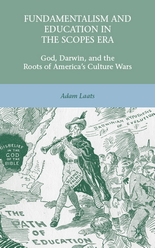
I’ll be talking about the subject of my first book, Fundamentalism and Education in the Scopes Era: God, Darwin, and the Roots of America’s Culture Wars.  I’ll start by making my case for why we need to understand the 1920s if we hope to get a handle on today’s culture wars.  Then we’ll open up a discussion on any and all topics of interest to ILYBYGTH readers: the meanings of fundamentalism, the nature of the creation/evolution stalemate, the proper role for religion in public life, and so on.

So come on down!  Even if you can’t make this event, be sure to stop by RiverRead.  It’s a great place to buy books.


Christian Terrorism and the Milwaukee Shootings

Fundamentalist America scares people.  As ex-fundamentalists such as Jonny Scaramanga have argued, the small-f sort of separatist Protestant fundamentalism can easily be imagined to encourage violence.

A few days ago, Mark Juergensmeyer argued on Religion Dispatches that the temple atrocity in suburban Milwaukee should be considered an act of Christian terrorism.  Juergensmeyer argued,

“It is fair to call [shooter Wade Michael] Page a Christian terrorist since the evidence indicates that he thought he was defending the purity of white Christian society against the evils of multiculturalism that allow non-white non-Christians an equal role in America society. Like the Oklahoma City bomber, Timothy McVeigh, and the Norwegian militant, Anders Breivik, Page thought he was killing to save white Christian society.”

As well it might, Juergensmeyer’s claim ignited a storm of ferocious discussion about the nature of the killings and their relationship to Christianity.  Some commentators argued that the killer’s brand of white supremacy bore little relation to even nominal Christianity.  Others insisted that conservative Christianity promotes exactly this sort of violence.

ILYBYGTH readers will want to read through these comments.  The heat and anger of some of the writers shows how difficult it can be for outsiders to discuss Fundamentalist America calmly and sympathetically.  For instance, as one commenter argued,

“You guys – I’m referring to the giant festering mass known as Evangelicals/Teavangelicals/Fundamentalists – are abject subhumans, by
your own doing. Your blatant disrespect and disregard for the truth, science,
and intellectualism have made you, imo, the most dangerous demographic to
modern civilization on the planet.”

That’s strong language.  And while I think it would be denounced by many anti-fundamentalists, it still represents the kind of emotion lurking in the background of these kind of culture-war discussions.

The main point here is that people have been killed.  Our sympathies must start with them and their families.  But we must also resist the urge to use this horrifying act of violence to unleash even more hate.  As with other outbreaks of culture-war violence, such as the shootings of doctors who provide abortions or the murder of people due to their sexual orientation, this kind of murder sends a frightening signal.  In other places and times, as we’ve noted here before, “culture war” slides all too easily into regular, bloody war.

It is the job of all of us to contain and limit that violence, not encourage it.  When we live in a gunpowder factory, we must all watch out for anyone who drops lit matches.


Required Reading: The “Gospel Homosexual”

Just like all people, many Fundamentalist Americans can be a lot of things at the same time.  At Religion Dispatches, Douglas Harrison interviews Anthony Heilbut about people who live with seemingly irreconcilable contradictions: African American, conservative Christian, and homosexual, all at once.  And often without feeling the conflict.  How do they do it?

Heilbut describes his recent book, The Fan Who Knew Too Much: Aretha Franklin, the Rise of the Soap Opera, Children of the Gospel Church, and Other Meditations.  One of his themes is the persistent tradition of “gospel homosexuals.”  Heilbut says in this tradition, homosexuals have long had an influential role.  Often called “the children,” they experienced an intensely ambiguous role as singers, musicians, and fans.

On the one hand, “the children” endured or even participated in an increasingly rabid anti-homosexual theology and culture in the black church.  On the other, they pushed for acceptance–albeit in a very different way than many other post-Stonewall gay-rights activists.

Heilbut wants to crack the anti-gay code, both to prevent more ruined lives and to promote better music.  As he told Harrison,

“What I want to say to all of these people from all denominations—and we know that homophobia is allowed in all the churches—is: where would religious art be without gay men? You wouldn’t have the Sistine Chapel. You wouldn’t have The Last Supper. You wouldn’t have “Ave Maria.” Most likely you wouldn’t have the “Hallelujah Chorus,” because we seem to think Handel was gay.”   

The story, as Heilbut tells it, is not a happy one.  His gospel homosexuals lived tortured, even persecuted lives.  “You must remember,” he concludes,

 “that I’m really very angry. I really want to be literate and literary, but I’m really furious. Probably the most daring thing I say in the book is when I compare [the gospel church to] the Taliban, and then I say, thinking of all the ruined gay lives, this really is the number that no man can number.”

It would be hard to imagine a group of people more exposed to the destructions of America’s culture wars than this.  Forced to negotiate between seemingly irreconcilable cultural identities, some members of this contested group made some of the greatest contributions to gospel music.  More than that, Heilbut implies that other gay African Americans, such as James Baldwin and George Washington Carver, found themselves propelled by these ambiguities to excel in literature or science, too.

Olympic Fever and Reading the Bible like a Fundamentalist

Call Benny Hinn!  ILYBYGTH has caught Olympic Fever!

And in our delirium, we’ve hit upon a mental challenge for all our fellow non- and anti-fundamentalists out there.  Here’s the question: Why is mental discipline heroic in sports but anathema in non-fundamentalist intellectual culture?

For the elite athletes who compete in these international games, a key component of their success is mental discipline, mental toughness.  As journalists marveled about Michael Phelps the last time around, winning in the Olympics means being “mentally tough.”   For all peak athletes, it means developing a powerful single-mindedness in training, preparation, and competition.  As one study defined it, mental toughness means “an unshakeable perseverance and conviction towards some goal despite pressure or adversity.”

This is the quality that allows elite athletes to prepare.  It gets them into the pool, or onto the track, or into the gym, day after day, hour after hour, through grueling workouts.

This summer, we’ll see this kind of preparation pay off for some.  But we have to remember that the athletes themselves have no guarantee of victory.  The key to real mental toughness is realizing that these athletes subject themselves to this kind of regimen in spite of the fact that they might still lose.  They might devote years of their lives to preparation, to struggle and suffering, only to find that they did not win, or didn’t even make the Olympic team.

What does this have to do with Fundamentalist America?  For those of us outside of fundamentalism, the way many conservative Protestants read the Bible can seem ridiculous.  For those of us outside this tradition, it makes very little sense to read the Bible as a collection of inerrant writings.  We have been taught, instead, to question every assertion of authority; to approach every statement with profound and illuminating skepticism.

But for many conservative Protestants, the proper approach to reading the Bible is more like the preparation plans of elite athletes.  They read the Bible with “an unshakeable perseverance and conviction towards some goal despite pressure or adversity.”  In other words, those who read the Bible as an inerrant Book might simply be demonstrating the mental toughness necessary to compete at an elite level.  They may be fully aware of the “pressure or adversity” that comes from a skeptical mindset.  But they may consciously and knowingly set those doubts to the side in order to pursue the indefinite goal of greater spiritual understanding.

Is this really the way fundamentalists read the Bible?  I don’t know.  But I do wonder why many of us non-fundamentalists admire this kind of devotion in the realm of Olympic sports, but disdain it in the world of intellectual culture.


Slaughter, Science, and Fundamentalist America

What if Batman shooter James Holmes had been a seminary student instead of a science student?

The horrific shooting at a Colorado cinema on Friday has led to an understandable search for meaning.  Why did this man allegedly storm into a movie theater and open fire, killing twelve total strangers and wounding dozens?

We here at ILYBYGTH have a different question.  In our quest to understand Fundamentalist America without prejudice and without smug presumption, we must ask: What if Holmes had been a deeply religious person?  What if he had been a student at Liberty University or Bob Jones University instead of the University of Colorado?  How would the media have reported this story?

As it is, as details of Holmes eccentric history have been uncovered, coverage has often noted that Holmes was a scientist, BUT he still engaged in this bizarre atrocity.  The Huffington Post headline, for example, reported the following: “James Holmes, Theater Shooting Suspect, Was Brilliant Science Student.”  ABC News framed the story as an utter mystery.  In its report, ABC said police were “hoping to discover there clues to what would make a young man recognized as one of the nation’s ‘outstanding neuroscientists and academicians’ unleash a storm of terror in a packed movie theater.”  USA Today made this distinction explicit.  They noted that “Two Portraits” of the alleged shooter have emerged, one as an intellectually gifted neuroscience student” and another as a “suspected mass murderer.”

Here’s what we have not seen: “Science Drives Student to Murder;” “Fanatic Scientist Kills Twelve;” or “Science Killings on the Rise.”  We will not likely hear calls to limit the amount of neuroscience young people can study.  We will not listen to talking heads discuss the dangerous way scientists promote their ideas on young and impressionable minds.  We will also not see a rehashing of every story about violent scientists in recent years.  At least in the mainstream media, we won’t hear discussions of the ways a scientific worldview encourages this sort of nihilistic atrocity.

Yet it does not take an enormous leap of imagination to picture what journalists might say if Holmes had been instead a brilliant student at a conservative religious school.  There would doubtless be talk of “American Taliban,” or perhaps “Fundamentalist Massacre.”  The teachings of the religious school would doubtless be used as headlines, such as “Holmes’ School Taught Literal Interpretation of Bible, Young Earth” or some such.  Perhaps the diaries of the student would be plumbed eventually for religious references, such as God’s call to purify the earth.  If we recognize our prejudice against Fundamentalist America, we should recognize that such connections between one mentally troubled murderer and the education and training of that person are not necessarily causally linked.  In other words, if we don’t blame Science for the Colorado shootings, we should not blame religion for every atrocity committed by a religious person.

Fundamentalist Fast Food? Christian Chicken? Fresh Hot Hate?

Chick-fil-A President Dan Cathy

The interweb has been squawking about Chick-fil-A President Dan Cathy’s recent statements.  Earlier this week, Cathy told the Baptist Press that his 1600-strong chain of fast-food restaurants was founded on Biblical principles, and will keep running that way.  Part of this means support for the traditional family.  “We are very much supportive of the family,” Cathy said,

“– the biblical definition of the family unit. We are a family-owned business, a family-led business, and we are married to our first wives. We give God thanks for that.”

Chick-fil-A’s committment to Biblical values goes beyond supporting traditional marriage.  Most famously, the restaurants are closed on Sundays.  The corporation also conducts missionary work among its workers, to its customers, and in its advertising.  When asked about his support for such Fundamentalist groups as Exodus International and the Family Research Council, Cathy happily replied, “Guilty as charged.”

Opponents have accused Chick-fil-A of an anti-gay position.  Many took umbrage at Cathy’s assertion that non-traditional marriages “invit[ed] God’s judgment on our nation.”  On Wednesday, Tim Carman asked in the Washington Post if readers would continue to eat there.  Not everyone will.  As Melissa Browning noted in the Huffington Post, “I can’t eat hate.”  But it appears Browning represents a minority, at least among Carman’s readers.  The results of the Washington Post poll (as of 11:00 New York time on Friday, July 20, 2012) showed 62% of almost 19,000 respondents planning to continue their patronage.

Nevertheless, Chick-fil-A offered yesterday a clarification of its position.  It officially noted that it takes no position on gay marriage.  However, it plans to continue its policy of “Biblically-based” management principles.

Does it matter if chicken is processed biblically?  More important, do we need to be sure that every dollar we spend supports only those corporations whose culture-war positions are as palatable as their products?

Fundamentalist America and Asian America

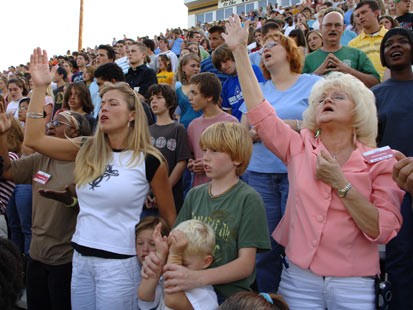
Quick: Which of these two pictures depicts American evangelical Protestants?

Of course, the answer is both.  But a lot of us still have a lingering, politely unmentionable stereotype about the nature of race and ethnicity in Fundamentalist America.

Academic historians of religion in America often lament this knee-jerk connection of whiteness with evangelicalism.  (See, for example, Edward Blum’s recents posts on the subject at Religion in American Life.)

Beyond just African American evangelicals, the connections between non-white America and Fundamentalist America are profound, but complicated.

Yesterday, the Pew Research Forum published the results of a survey that will illuminate the religious lives of Asian Americans.  As the authors titled the report, there is no simple way to pigeonhole this “Mosaic of Faiths.”  Religious identity for Asian American often depends on the country of origin, with Filipinos often Catholic, Koreans often evangelical Protestant, Vietnamese often Buddhist, and Indians often Hindu.  But just as common is a firmly non-religious identity.

“Indeed,” the report describes,

“when it comes to religion, the Asian-American community is a study in contrasts, encompassing groups that run the gamut from highly religious to highly secular. For example, Asian Americans who are unaffiliated tend to express even lower levels of religious commitment than unaffiliated Americans in the general public; 76% say religion is not too important or not at all important in their lives, compared with 58% among unaffiliated U.S. adults as a whole. By contrast, Asian-American evangelical Protestants rank among the most religious groups in the U.S., surpassing white evangelicals in weekly church attendance (76% vs. 64%). The overall findings, therefore, mask wide variations within the very diverse Asian-American population.” 

What does this mean for those of us trying to understand Fundamentalist America?  First of all, it is another reminder that we need to look beyond deep-rooted stereotypes about the nature of conservative religiosity.  The sweaty Southern tent preacher with snakes in a box and a kerosene-soaked cross up on the hill is a thoroughly misleading picture.  On the campus of the large public university where I work, one of the most active campus religious groups is the Korean Baptist Fellowship, not the traditional Campus Crusade for Christ or Intervarsity Fellowship.

Second, we need to keep in mind that Fundamentalist America no longer maps evenly or neatly onto conservative evangelical Protestant America.  The ecumenism of conservatives got a big boost with Jerry Falwell’s inclusion of Jewish and Catholic conservatives in his Moral Majority movement in the late 1970s and 1980s.  More recently, conservative Catholic scholar Robert P. George and conservative Muslim scholar Shaykh Hamza Yusuf teamed up to demand the elimination of pornography from major hotel chains.  Catholics and Jews have long claimed their roles as part of Fundamentalist America.  And those groups have been given a push in a thoroughly conservative direction from members of the faith from outside the Euro-American sphere.

Perhaps in coming decades we will see more and more partnership among conservative Hindus, Muslims, Christians, Jews, and others.  After all, this was the claim of scholar James Davison Hunter in his 1991 book Culture Wars.  The America of the 1980s, Hunter claimed, no longer was divided between Catholics, Protestants, and Jews, but rather between the “tendency toward orthodoxy” and the “tendency toward progressivism.”  Perhaps the orthodox will continue to widen their boundaries to embrace the mosaic of fundamentalism among the Asian American community.