Keep Education Useless!

What is education for?  At Front Porch Republic today we find a stirring call to keep education useless.

Thaddeus Kozinski laments the contemporary tendency to ask what purpose a college education will serve.  Not that one can’t learn a trade or profession in college, Kozinski argues, but that is not higher education’s main purpose.  “The end, goal, or use of liberal education,” Kozinski insists, “is not found in anything outside of the study itself.”

Kozinski doesn’t ask readers to take his word for it.  He claims the support of thinkers from across the centuries, including Simone Weil, Robert Hutchins, Cicero, Plato, Josef Pieper, Aristotle, Cardinal Newman, and St. Augustine.

Education must be about learning itself.

As Kozinski puts it,

to say that all education must be ordered to use in the work-a-day world, is to imply that there is nothing that transcends, that we are trapped in the realm of the temporal, material, and instrumental. And this is to make human happiness not an end but a means, bound to whatever we can use from this world, bodily pleasure, emotional satisfaction, wealth, honor, power, and the like. These are legitimate goods, of course, and education can help us obtain these goods. But unless there is a transcendent reason for pursuing these goods, unless this work-a-day world is seen for what it is, a means and never an end, then we end up making a means our of an end, and an end out of a means, and we thus make human happiness, and concomitantly, true education, impossible.


College Needs Christ

What is the purpose of higher education?  Patrick Deneen argued recently that colleges lost their traditional purpose when they lost their connection to organized religion.

Deneen, the high-profile conservative professor of political thought at Notre Dame, didn’t just say this about higher education.  He argued that both health care and higher education lost their way when they became unmoored from Church control.

Both hospitals and universities, Deneen points out, had origins as charitable institutions run by the Church.  The current sense of crisis in both higher education and health care, he argues, has its roots in the fact that neither institution can function properly when cut off from its religious roots.

Deneen critiques both liberal and conservative analyses of higher education.  Many of today’s conservatives go wrong, he says, when they assume that market solutions will save colleges.  For their part, liberals pin too much faith on the ability of the state to regulate and direct higher education.

The market can’t be trusted to do the job, Deneen insists.  “The very idea,” he writes,

that doctors and teachers are or ought to act out of the motivations of self-interest, and provide services to their “consumers,” seems fundamentally contradictory to the kind of work and social role performed by each.

As for state control, Deneen thinks such leftist fantasies miss by an equally wide mark:

At the same time, the State is rightly suspected of being unable to fundamentally improve or even maintain the quality of either sphere. It is doubtless the case that it can assure access by the heavy hand of threats, but many rightly worry that, as a consequence, the quality of care and education will deteriorate as a result.

Neither side in America’s stunted liberal/conservative divide has grasped the essence of the underlying problem, Deneen says. College, like health care, must reconnect with its churchly roots.  As Professor Deneen puts it,

it seems increasingly evident that practices such as health care and education are likely to fail when wholly uninformed by their original motivation of religious charity. Neither functions especially well based on the profit-motive or guided by large-scale national welfare policies.

At their root, he writes, college and hospital must claim an authority over its students that neither a market-model nor a state-directed model can provide.  “Both spheres,” he says,

also require a concomitant shared commitment to commonweal on the part of those who benefit from the contributions of the professions. Doctors and teachers are not simply to be viewed as providing a service for pay, subject to the demands of “consumers.” Viewed through this market-based lens, the “buyers” make the demands on the providers. However, this understanding undermines the proper relationship between trustee and beneficiary—the doctor or teacher is actually in a relationship of responsible authority with the recipient, and ought rightly to make demands and even render judgments upon the one who is paying for the service. The trustee has a duty and a responsibility to enlarge the vision of the recipient—in matters of health (how certain behaviors might have led to a state of illness, in what ways the person ought to change their lives outside the doctor’s office), and formation (thus, a student should be challenged by the teacher not only to do well in the subject at hand, but to become a person of character in all spheres of life). Both the market and the State, however, increasingly regard the recipients simply as “consumers,” a view that is increasingly shared by every member and part of society.


MR or MRS Degree? Ask Jesus!

Looking for more than just an education?  For those who hope to find a life partner as part of their college experience, it seems like a Christian college might be the way to go.

In Religion News Service, Katherine Burgess reports on a recent Facebook survey.  According to those findings, of the top 25 colleges where men are likely to meet their spouse, all are Christian.  For women, sixty-four percent of the top 25 husband-finding schools are Christian.

Twelve of the schools that appear on both lists of top-25 are Christian:

  1. Faith Baptist Bible College and Theological Seminary,      Ankeny, Iowa
  2. Harding University, Searcy, Ark.
  3. Martin Luther College, New Ulm, Minn.
  4. Bob Jones University, Greenville, S.C.
  5. Brigham Young University, Provo, Utah
  6. Freed-Hardeman University, Henderson, Tenn.
  7. Maranatha Baptist Bible College, Watertown, Wis.
  8. Dordt College, Sioux Center, Iowa
  9. Baptist Bible College, Springfield, Mo.
  10. Oklahoma Christian University, Edmond, Okla.
  11. Kentucky Christian University, Grayson, Ky.
  12. Johnson University, Knoxville, Tenn.

This makes sense.

College, after all, is about much more than academics.  Where people go to school—especially when that school is strongly associated with a certain cultural identity—says a lot about who they are as people.

It also fits long-standing stereotypes about Christian schools.  As Jeff Schone, vice president for student life at Martin Luther College in New Ulm, Minnesota, told Burgess, “There’s a Lutheran boy for every Lutheran girl.”

Marlena Graves reflected on this syndrome recently in the pages of Christianity Today.  As a counselor at Cedarville University, Graves lamented the fact that so many young women seem to neglect their own personal growth in their race for a spouse.  “I can’t even count,” Graves wrote,

the number of times I’ve heard, “My mom and dad told me that if I don’t find a husband now when there are so many to choose from, then chances are slim that I’ll find one after college.”

This isn’t just true for Christians, of course.  As Charles Murray argued controversially in his recent book Coming Apart, those who attend elite schools tend to marry other people from those same elite schools.

In her Christianity Today piece, Graves quoted a letter to the Daily Princetonian by Susan Patton.  Patton gave Princeton women the same advice heard by so many young Christian collegians:

Smart women can’t (shouldn’t) marry men who aren’t at least their intellectual equal….there is a very limited population of men who are as smart or smarter than we are. And I say again — you will never again be surrounded by this concentration of men who are worthy of you.

Higher education, for many non-Christians as well as many Christians, seems to be seen as the place to find suitable life partners.  My hunch is that this trend is exaggerated at schools that attract students from self-identified subcultural or countercultural backgrounds.

This marriage tendency can help us understand the durability of cultural notions.  Why are so many Americans creationist, for instance?  It helps when creationist kids go to creationist colleges, marry other creationist kids and start creationist families of their own.


Booze and Bibles

Have a cocktail with your Leviticus?

That’s the new option for faculty and hangers-on at Chicago’s storied Moody Bible Institute.

Image Source: Renew Chicago

Image Source: Renew Chicago

It represents only the newest iteration of an age-old story for conservative evangelical institutions: How much to embrace and how much to eschew contemporary cultural norms.

According to a story in Religion News Service, the downtown Bible institute will now allow faculty and staff to drink.  This is new.

The question asked by Sarah Pulliam Bailey is whether this represents a trend among leading evangelical institutions.  As Bailey points out, evangelical organizations such as Focus on the Family and Wheaton College have made similar changes to their lifestyle policies.

Bailey might also have mentioned recent changes at the more conservative Liberty University.

Such questions of cultural relevance and theological fidelity are nothing new at Moody Bible Institute.  As I argued in my 1920s book, President James M. Gray wondered at that time whether the new fundamentalist movement was a boon or a threat to the MBI’s evangelical mission.

In the end, President Gray and the 1920s MBI generation took a skittery position on fundamentalism.  Insofar as fundamentalism supported a firm insistence on the inerrancy and primacy of Scripture, it was all to the good.  But if the new fundamentalist movement took attention away from the primary goals of Bible knowledge and evangelical effectiveness, it was a threat.

Nor is the weightiness of the MBI’s internal debates about this issue unique among conservative educational institutions.  Many evangelical schools have a long history of struggle with questions of change and cultural consonance.  At Wheaton College, for example, President Charles Blanchard fretted throughout the 1920s about the meanings of modernism.  At that time, “modernism” among evangelical Protestants referred, first and foremost, to a theological movement.  Modernists in the 1920s hoped to bring church doctrine more in line with changing cultural norms.  Fundamentalists and their conservative allies, on the other hand, insisted on keeping true to traditional theological norms.

Blanchard, as did other evangelical educational leaders in the 1920s and since, experienced a good deal of anguish as he worked to guide his school through this cultural Scylla and Charybdis.  On the one hand, Blanchard, like Gray, did not want to truckle to fads.  On the other hand, neither leader wanted to insist on tradition merely for the sake of fuddy-duddy-ness.

The recent decision to allow drinking among MBI faculty represents a similar wrangling with contemporary cultural issues.  How much does a trenchant cultural Amishness contribute to true Biblical understanding?  And how much does it distract from MBI’s central goals of Biblical missiology?


MOOCs and Mardi Gras

What is college for?  Can MOOCs transform a sclerotic system of higher education?

Conservative commentators have been split as to whether MOOCs are a blessing or a curse.  As we’ve noted here on ILYBYGTH, some conservative intellectuals have bemoaned the implications of free online education.  Others have celebrated MOOCs as the ultimate free-market corrective to ossified funding structures.

This morning Rod Dreher, the thinking man’s conservative, connected readers to an emotional description of college that squeezes MOOC-ery far out to the sidelines.

In an online dialogue about the many reasons to go to Louisiana State University, one writer gave a nostalgic endorsement.  Why go to LSU?  The writer describes a close personal mentorship with a philosophy professor, the rich history and tradition of campus life, friendships made for a lifetime.  And booze.

There are many aspects to “college” that are simply not contained in an online course.  For many people, college is not defined by academic achievement alone, nor by mastery of vocational skills.  College, as it was for our LSU fan, represents a jumble of intellectual growth, personal identity formation, social ferment, and human bonding.

Those things don’t seem challenged by any sort of MOOC revolution.


Fundamentalists Go to School

Homeschool, fundamentalist colleges, mainstream law school.

That’s the educational career described movingly this morning by “Georgia” at Defeating the Dragons.

Georgia describes her parents’ decision to pull her out of public schools.  Though her parents were indeed staunchly conservative religious folks, the decision, as she remembered, was more about academic rigor than about Jesus.

When it came time for college, she first attended Pensacola Christian College.  As I’ve written elsewhere, the founders of this school chastised the leaders of Bob Jones University for not being strict enough.

From there, she moved to the relatively liberal Liberty University, “relatively” being the key word here.  With that degree under her belt, she attended Vanderbilt University Law School.

For those of us outsiders who are trying to understand conservative thinking about education, her story can tell us a great deal about one family’s attitudes.  As she remembers it, there was (and is) a good deal of bitterness and disagreement within her own family about the contours of proper education for conservative Christians.


Celebrity to Nerd: New Leadership at The King’s College

Who will train a new generation how to bring America to Christ?

The leaders of The King’s College decided a nerd can do the job better than a celebrity.

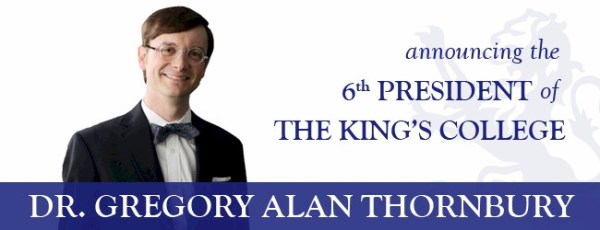
After its unhappy breakup with headline-grabbing conservative icon Dinesh D’Souza, The King’s College will now be led by Southern Baptist theologian and administrator Gregory A. Thornbury.

Image Source: The King's College

Image Source: The King’s College

The bowtie-wearing, Carl-Henry-loving, religious-school administrating Thornbury seems to be the exact opposite of D’Souza, at least within the world of conservative Christian higher education.

Thornbury’s career has been squarely within the world of conservative evangelical higher education.  Before Manhattan and The King’s College, Thornbury served as the founding dean of Union University’s theology school.  His academic background as a philosopher with degrees from the Southern Baptist Theological Seminary and Messiah College puts him in a different league from the sometimes-fevered punditry of D’Souza.

Leaders of the evangelical establishment love him.  Russell Moore of the Southern Baptist Convention called Thornbury “Jonathan Edwards meets Rolling Stone magazine.”

Thornbury himself seems to prefer the Jonathan Edwards part.  His recent book about theological Carl Henry hopes to make Henry “cool again.”  Unlike other leaders at The King’s College, who stress its Manhattan location as the ideal spot to influence mainstream American culture, Thornbury himself notes the location’s close ties to the strongest intellectual giants of American evangelicalism and conservatism, including Jonathan Edwards, Alexander Hamilton, and Carl Henry.

What’s next for The King’s College under its new president?  In the words of one enthusiastic King’s College alum, Thornbury will lend new life to The King’s College mission: “a counter cultural Christian college in New York City that leads with academic excellence and ‘convictional civility.’”


Of MOOCs and Monsters

Does Monsters University have a conservative anti-MOOC message?

I took my daughter to see it the other day.  It was great.  I laughed.  I cried.  There were lots of creatively imagined monsters, smart dialogue, and sight gags.  Plus a heartwarming story of friendship and dedication.
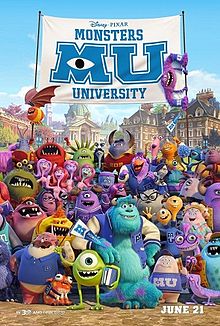
Monsters_University_poster_3But was it also a Disney-fied version of conservative arguments about the fate and future of higher education?

I couldn’t help wondering what the conservative intelligentsia would have to say about the movie’s implications for the future of higher education.  Especially about the latest craze to sweep the educational establishment, Massive Open Online Courses.

Conservatives have been divided about the moral and practical implications of MOOCs.

Some free-market aficionados have trumpeted the promise of the new approach.  By providing courses for free from elite universities such as Harvard and MIT, MOOCs make world-class learning more widely available than ever.  Economist Richard Vedder, for example, argued that a MOOC approach could cull out inefficiencies in higher education.

More recently, Benjamin Ginsberg fretted that MOOCs represented just another way for administrators to cut apparent costs, at the real cost of abolishing real learning.

Other conservatives have agreed that the MOOC model abandons the proper goal of higher education.  Rachelle DeJong complained that higher ed must take more responsibility for the formation of young minds and spirits. “The student,” DeJong wrote,

as yet unformed and uneducated, cannot judge what studies best suit his needs, his vocation, or his intellectual development. How can he discern a steep ascent to the mountaintop from a difficult dead-end, when all he knows are the briars, the rocks, and the stitch in his side?

In the pages of Minding the Campus, Peter Sacks warned that MOOCs will generate a crushing mediocrity and exacerbate the existing class divide among institutions of higher education.  Rich students will get a full learning experience, Sacks insisted, while less well-off students will only hear distant digital echoes of profound learning environments.

Such conservative arguments make sense to the historian in me.  Even a nodding acquaintance with the history of technology and education makes anyone skeptical of any new technological “revolution” for classrooms.  As Larry Cuban has demonstrated, new technologies often garner enthusiasm and enormous investment, only to crash against the reefs of complex educational reality.

Perhaps the best example was the flying broadcast technology of the 1950s.  The US government and the Ford Foundation poured tens of millions of dollars into this program, which sent planes circling over the Midwest and Great Plains.  These planes broadcast educational television programs to schools in those areas.  The idea was that the very best teachers could supply content for audiences of schoolchildren nationwide.

The program failed because schooling is about much more than simply receiving information from a TV screen.  CAN young people learn this way?  Of course.  Is such learning the equivalent of all the complex interactions that go into our notion of “school?”  Of course not.

A similar future seems in store for MOOCs.  Such distance learning is nothing really new and some students will likely benefit greatly from it.  But it will not replace the entirety of higher education, since that entirety includes such a broad range of ingredients.

What does all this have to do with adorable monsters?  I won’t give away any of the plot of Monsters University, but I can say that the movie centers around the dreams of a young adorable monster who yearns to attend Monster University.  The film includes long sweeping vistas of colored foliage and ancient-looking buildings.  It revolves around the intense traditions and intense personal interactions that make up higher education for monsters.

The main character, to be sure, went to MU for vocational reasons.  He wanted to earn a certain type of job.  Without giving away the plot, I can’t comment here on some of the movie’s ultimate implication about the career efficacy of those choices.

But for the main monster character, the allure of MU was at least as much about personal relationships between students and a hard-nosed dean as it was about attaining information.  The attraction of MU depicted in the film was at least as much about learning from fellow students as it was about downloading information from star professors.  The campus and its social scene played crucial roles in the education depicted in the film.

If the film gives us anything beyond two pleasant hours in an air-conditioned theater, it is an emotional, playful articulation of the drier anti-MOOC arguments made by conservative intellectuals.  College, in this film, is a whole-life experience.  College includes formal education, but it also requires a whole lot more.  In order to be educated, the film implies, young people must submit to a stupendous tradition.  Institutions of higher learning, as portrayed in this summer fantasy, are literally supernatural conglomerations of love, life, and learning.

Such conglomerations can never be replaced with online learning platforms.  No matter how much star power goes into them.


Lock Up the Principals!

Lock em up!  Charge em with felonies!

That is the prescription for education reform from Professor Richard Vedder.  In the pages of Minding the Campus, Vedder lamented recently the sad state of affairs in schools that train America’s teachers.  Ed schools, Vedder pointed out, do not attract the best or the brightest.  On elite campuses, Vedder argues, ed schools are seen as a “weak link, sometimes something of an embarrassment.”  Such lackluster ed schools only perpetuate an educational miasma.

How to get around this?  Vedder offers a bold plan:

the goal should be to eliminate undergraduate colleges of education. And rather than fight the battle one university at a time, state governments can make it happen easily:  make it a felony for a principal to knowingly hire a graduate of a college of education to teach our youth in public schools.

Though I am a card-carrying faculty member at one of the schools Vedder wants to criminalize, I will not use this space to defend schools like mine.  Instead, I will only point out the somewhat surprising durability of this anti-ed-school animus among American conservatives.

Why has the ed school been seen for so long as such an intellectually dangerous place?

Perhaps a look at the twentieth-century record will help…

In the ferociously anti-communist atmosphere of the 1930s, for instance, many conservative activists blamed ed schools for training subversive teachers.

In 1938, American Legion national leader Daniel Doherty claimed that “Many of our institutions of higher learning are hotbeds of Communism.”

Doherty was in illustrious company.  A few years earlier, conservative US Congressman Hamilton Fish had denounced schools such as Columbia, New York University, City College of New York, the University of Chicago, Wisconsin, Penn, and North Carolina as “honeycombed with Socialists, near Communists and Communists.”

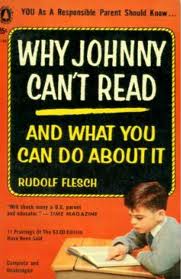
Into the 1950s, leading conservatives blamed ed schools for promulgating terrible teaching.  In his blockbuster phonics book Why Johnny Can’t Read (1955), for example, Rudolph Flesch blamed Teachers College, Columbia, for masterminding a plot to spread ineffective but progressive reading techniques.

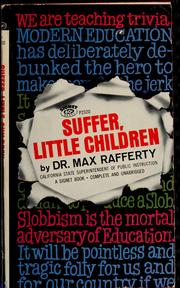
flesch why johnny cant readAs usual, among educational conservatives, few have articulated an idea with the same style and verve as the prolific Max Rafferty, in the 1960s the State Superintendent of Education in California.  In his syndicated column, published in book form in 1963 as Suffer, Little Children, Rafferty zeroed in on the role of education schools in promoting educational blah.

At that time, Rafferty identified the danger as a wrong-headed and misleadingly named “progressive education.”  Such dunderheaded notions, Rafferty argued, oozed out of ed schools to create a nation barely able to compete with the aggressive Soviet Union.

1963

1963

As Rafferty put it,

For thirty years, our Columbia University philosophers, our educational psychologists, and our state department consultants have been leading us down a primrose path where report cards read like Abbott and Costello comedy routines, where competition was a naughty word, and where memorization and drill were relics of the Dark Ages.

In the last three years, we have found out for ourselves that our morals are rotten, our world position degenerating so abysmally that a race of lash-driven atheistic peasants can challenge us successfully in our own chosen field of science, and our rate of juvenile murder, torture, rape, and perversion so much the highest in the world that it has become an object of shuddering horror to the rest of the human race.  More, our greatest leaders today, both in and out of Education, now assure us that these fairy stories with which we have for thirty years bulwarked our thinking and our actions are just—plain—not—true.

My hunch is that Superintendent Rafferty would approve of Professor Vedder’s suggestion.  Close down the ed schools, teach teachers the way we teach everybody else.

My hunch is that somewhere at the back of this conservative ire is a feeling that education schools have become the domain of the academic left.  On many campuses, not only do education schools represent a different sort of student, they often also represent a dwindling redoubt of the unapologetic academic left.

Are there other reasons why smart conservatives feel such virulent distaste for ed schools?


Being Gay at a Catholic College

Is gay okay the Catholic way?

Religion writer Michael O’Loughlin recently surveyed the experiences of gay students at a variety of Catholic colleges.  The answer, maybe not surprisingly, is that different schools do things differently.

At Chicago’s DePaul University, O’Loughlin found, students can minor in LGBTQ Studies. Students and faculty are out and supportive.

Other schools, such as Washington DC’s Catholic University, have a more mixed record.  Students are gay, O’Loughlin reported, and that’s only sort of okay.

One constant, at Catholic universities as across American culture, is rapid change.

O’Loughlin returned after just a handful of years to his alma mater, St. Anselm College in Manchester, New Hampshire.  When he attended, gay students kept their sexual identity private. Now, the school itself has initiated programs to make all students, explicitly including homosexual students, feel welcomed, loved, and guided.

As some of the comments on O’Loughlin’s essay proved, not all Catholics are okay with this trend.  As “JP” noted,

Can one imagine a group of Catholic adulterers or thieves organizing at a Catholic college in order for their “voice to be heard”? Homosexual acts as well as larceny or adultery are still considered Mortal Sins by the RCC.

Catholic schools are not alone in their struggles with this issue.  As we noted a while back, Brandon Ambrosino shared his experiences with faith and sexuality at the conservative evangelical flagship school, Liberty University.  Just as Catholic colleges have had a range of responses to the issues of student homosexuality, so folks at conservative Protestant schools  have had surprisingly mixed reactions as well.