Colleges Call for Cop Killings

Do radical professors encourage violence? That’s the question some conservative commentators are asking in the wake of the vicious assassinations of two New York City police officers. As I argue in my upcoming book about educational conservatism, this sort of conservative worry has a long history. It goes much farther back than the campus radicalism of the 1960s.
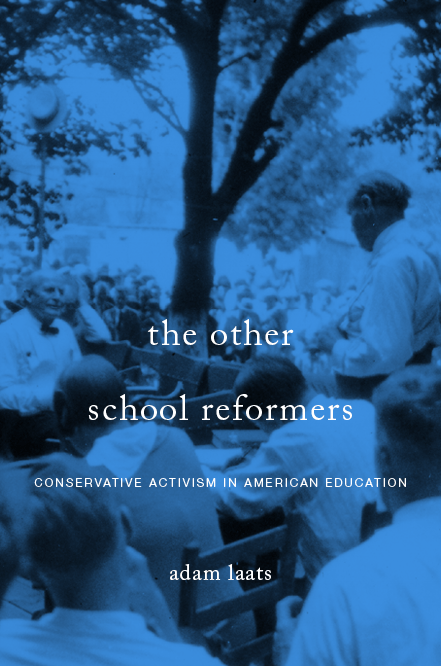
Available soon: the more things change...

Available soon: the more things change…

At National Review Online, for instance, Katherine Timpf shares a story from Brandeis University. At that prestigious school just outside of Boston, student Daniel Mael has published violent tweets from fellow student Khadijah Lynch.

Mael blasted Lynch for advocating violence against the government, and Brandeis for supporting her. According to Mael, Lynch had tweeted that she had “no sympathy for the nypd officers who were murdered today.” Earlier, according to Mael, Lynch had written, “I am in riot mode. F*** this f****** country.”

Instead of being punished for such incendiary language, Mael noted, Brandeis had made Lynch an official campus student officer, responsible for advising younger students. She had been a featured speaker at university events and, according to Mael, remained an undergraduate student representative of her academic department.

Is the university to blame for encouraging racial violence?

Timpf is not the only conservative pundit to ask the question. At Minding the Campus, Peter Wood blasts college culture for nurturing violent extremism. Today’s leftist-riddled faculties and administrations, Wood charges, encourage and condone wild-eyed radicalism among students.

Students and faculty, Wood writes, have been implicated in recent anti-police violence in New York City. But that’s not all. On the bitterly divided campus of the University of Virginia, the administration has turned a blind eye to student violence against innocent fraternity members.

Wood gives several examples of graduate students and faculty who have encouraged racial violence. Does this implicate universities? As he concluded,

the links don’t have to be guessed at. They are there to be seen.  Some of the connections are in the form of forceful declarations. . . . Some of the connections are in the form of heedless enthusiasm from individuals who have no sense of where this goes.

Wood’s indictment goes beyond the murders of New York policemen. At the University of Virginia, Wood writes, violence against innocent fraternity members has been winked at by the administration.

After the debacle of the Rolling Stone article falsely accusing fraternity members of a horrific sexual assault, a group of UVA students attacked the fraternity house. They were not punished, even though their identities were well known, according to Wood. Wood writes,

faced with the real crime of serious vandalism against a fraternity that had been falsely accused, and having the opportunity at hand to charge the culprits, President Sullivan [of UVA] decided to take no action.

Virginia is not alone, Wood argues. At other schools, a certain sort of student violence is condoned or even encouraged by faculty and administration who sympathize with student attitudes. The radical likes of Ward Churchill and Bill Ayers, Wood implies, are only the most famous cases of red professors guiding student malfeasance.

Wood argues that this campus radicalism has been a problem “Since the 1960s.” But in reality both campus radicalism and conservative denunciations have a much longer history. In some cases, conservative denunciations can seem eerily eternal.

For example, Wood calls out a doctoral student by name at Teachers College Columbia. Aaron Samuel Breslow, Wood writes, has been an active supporter of violent resistance. In 1938, it was Teachers College doctoral student William Gellerman who attracted conservative ire. Back then, Gellerman published a denunciation of American Legion activism. The Legion, Gellerman accused, represented nothing more than

an expression of entrenched business and military interests which attempt to hide their true purposes under democratic guise.

Legion leader Daniel Doherty accused Teachers College of coddling this sort of inflammatory leftist claptrap. Doherty asked an audience at Columbia University,

Why not rid this institution of such baleful influences? The name of Columbia is besmirched from time to time when preachments containing un-American doctrines emanate from those who identify themselves with this institution. . . . Do you like having it called ‘the big red university?’

As I argue in my upcoming book, this sort of anti-higher-ed accusation was a standard part of conservative activism long before the 1960s. Indeed, its roots can be clearly seen in the 1920s.

In the 1930s, the question was clear: Should universities purge their leftist faculty? The same question echoes throughout conservative punditry today, with an inflammatory twist:

Are universities morally culpable in the assassination of police officers?
Conservative Warriors and Homosexuality

Where is the line? What can conservatives say about homosexuality that won’t be considered bigotry? The case of Professor John McAdams has lit up the conservative intellectual world with its implications for the eroding respectability of conservative opposition to gay rights and the utterly transformed intellectual environment on US college campuses.

Let’s start with a few caveats. First, full disclosure: I taught one semester at Marquette University, Professor McAdams’s school. I also taught for several years down the street at Marquette High School, which is no longer directly connected to the university. I feel an abiding love for both institutions. More important, I am unapologetically biased in this case. I believe it is legitimate and important to regulate speech in public (and some private) forums, including college classrooms. Hard as it is to hear, some ideas do not deserve to be granted equal status with others. Ideas that dehumanize classes of people are not just as good as other ideas. For instance, if a student in a seminar wants to insist that no white people can possibly understand US history because they are by definition part of an exploitative class, such talk should be ruled out of bounds. It would tend to exclude an entire class of people simply because of their cultural identity. Similarly, if a student wanted to rule that homosexuals were incapable of being moral in their relationships, or that women cannot understand certain concepts, or that non-citizens have no right to be heard in political discussions, such talk should be out of bounds.

Of course, many conservative intellectuals share that basic framework, but they disagree bitterly that traditionalist notions about homosexuality constitute that same sort of exclusionary mentality. In other words, many conservative thinkers agree that public speech shouldn’t be racist or chauvinist, but they disagree that conservative ideas about homosexuality fall into that same category.

The steamroller drive of homosexual rights in recent months and years has put some traditionalist conservatives on edge. A few recent cases have raised hackles among many conservative thinkers. At Mozilla and Gordon College, to cite just two examples, conservative intellectuals attracted instant and furious retribution for statements that have been perceived as anti-gay. In each case, ideas that would have been unremarkable just a few years ago are now taken as beyond the pale of respectable public speech.

In the case of Professor McAdams, college politics and bureaucracy have added new wrinkles into the question of acceptable conservative opinion about homosexuality. In brief, McAdams has been suspended with pay and asked to stay away from campus. Why? He blogged about the statements of a teaching assistant. That TA had told a student that opposition to homosexual marriage would not be considered in a class on ethics. The student complained to Professor McAdams, and McAdams outed the TA on his blog.

As McAdams noted, his support for the student prompted furious condemnation by “leftist academics,” who “demanded our head on a pike.” A group of prominent faculty at Marquette published an open letter on the issue. McAdams’s actions, they write, constituted “harassment and intimidation” of the TA. Other members of the Marquette community, they write, altered their behavior to avoid similar attacks from McAdams.

In the end, McAdams has been suspended with pay. The Fox-News commentariat has had its chance to recoil in horror at the anti-conservative “inquisition.”

There is, of course, more at stake here than intellectual positions about homosexuality and gay rights. We also must consider faculty politics and the unfortunate ways academics learn to teach. How do teaching assistants learn to handle disagreement among students? When does a tenured professor have a duty not to attack publicly a non-degreed teaching assistant? How should faculty respond when a colleague behaves in ways they dislike?

At the center of all these questions, however, is the question of conservatism and homosexuality. Not too long ago, opposition to gay marriage was a common part of our mainstream political discussion. These days, in college seminars, newspapers, technology companies, and public policy, any conservative notion that homosexuals do not have the right to marry one another is often considered rank bigotry.

Is it possible for conservative intellectuals to oppose gay marriage without being branded bigots? Has that culture-war train left the station?

Confronting the Myth of Leftist College Students

I plead guilty. When I was a college student, I debated whether our campus Marxist-Leninist was really leftist enough. I remember feeling honestly surprised back then that so many people clung to their outmoded religious beliefs when the world had so obviously proved them wrong. In short, (cue the dramatic music): I Was a College Leftist. And I admit to a continuing illogical tendency: I tend to think that young people are somehow “naturally” more leftist than older adults. Are they? A scholar recently defended his claims that most college students in reality are conservatives. And not just any sort of conservatives, but a dunderheaded, abrasive, unreflective, Rush-Limbaugh sort.

I don’t think I’m alone. I’m not the only one who assumes college students are somehow naturally inclined to go through a leftist phase. We all know the jokes:

Q: What is a “fiscal conservative?”

A: A college leftist who just got a mortgage.

Q: What is a “social conservative?”

A: A college leftist who just had a daughter.

Before we look at the back-and-forth about students and conservatism, let’s remember our continuing debate about college faculty. As we’ve seen in these pages, Neil Gross has argued that the professoriate really does lean left. And conservatives in Colorado, at least, have mandated that their flagship state university open its halls to at least one staunch conservative.

But what about students? Some conservative writers have worried that conservative students are systematically denied free speech on today’s campuses. Some surveys suggest that faculty look askance at conservative religious students. And pundits often simply assume that conservatism is not allowed to rear its rightist head on most campuses these days.

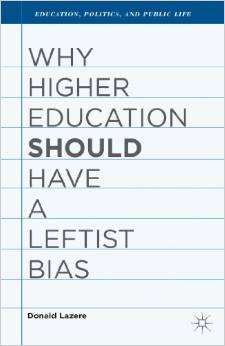
In the pages of The American Conservative, scholar Donald Lazere defended his claims that most college students these days are actually knee-jerk conservatives. Lazere was responding to a harsh critique of his book by political scientist Jonathan Marks. In his book, Why Higher Education Should Have a Leftist Bias, Lazere argued that students needed to be exposed to thoughtful liberalism.lazere

In his original review, Marks pointed to some survey data that seem to undermine Lazere’s central claims. “I don’t know Lazere’s students,” Marks wrote,

but I do know that the Higher Education Research Institute annually conducts a survey of incoming freshmen. That survey shows that more students enter college as self-identified liberals (26.8 percent in 2012) than enter as self-identified conservatives (21.1 percent). Many (47.5 percent) call themselves middle-of-the-road. Seventy-five percent agree that same-sex marriage should be legal. Some 64.6 percent agree that the wealthy should pay more taxes. So much for conservative commonplaces.

Maybe at Marks’s fancy-pants Ursinus College, Lazere responded.

But I taught mainly at California Polytechnic State University, San Luis Obispo, in a rural stretch of Central California; it was originally an ag college, and most of the English courses I taught were lower-division General Education and Breadth requirements for students in majors like Agricultural Management. Many such students resented having to waste their time and money on any general education at all. Does Marks really think that more college students resemble those at Ursinus than those at Cal Poly?

Lazere points out a key problem with many of our studies of college culture. Too often, social scientists look at fairly elite schools and make unsupportable generalizations. Or, more precisely, too often scholars examine elite schools and hasty readers make unsupportable generalizations.

For example, Elaine Howland Ecklund’s study of scientists and religion is often used to “prove” that scientists are ignorant about religion. As Ecklund made clear, however, she only spoke with scholars at elite universities. What about scholars at the kinds of schools most Americans actually attend? Similarly, Amy Binder’s look at student conservatives looked at only two schools, a western public flagship university and an elite eastern Ivy League school. What about the average student at the more representative non-flagship, non-Ivy League college?

Even back in the supposedly radical 1960s, leftist students at elite colleges attracted most of the attention. It was the takeover of the dean’s office at Columbia and shotgun-wielding curriculum changes at Cornell. It was bombings at Wisconsin and Free Speech Movements at Berkeley. What were the “Sixties” like at less elite schools?

After all, there are colleges and then there are colleges. At the colleges I’m currently studying, I certainly find a dominant conservatism during the late 1960s and early 1970s, along with a struggling dissident liberalism.

This leads us to some important questions. Are students more or less conservative at certain types of schools? Specifically, are students more conservative at less-elite schools?

I don’t see any answers in the UCLA Higher Education Research Institute surveys. Those hard-working folks offer lots of information. They break down student responses from all types of schools: public, private, Catholic, HBCU, University, college, and more. But I don’t see any division by selectivity. I don’t see a breakdown of student responses from more elite schools and less elite schools.

To me, Lazere’s central point makes some intuitive sense. Students at less-elite colleges might tend to be more oriented toward cultural conservatism. They might be more inclined to see college as a professional training course first, and a chance to let their freak flags fly second.

Without better data, though, it seems we’ll be left with anecdotes. Are students more conservative the farther we get from the Ivy League?

From the Archives: Fundamentalist Luxury

Why do families choose fundamentalist colleges? As regular ILYBYGTH readers know, I’ve been wondering about this question as part of the research for my new book. Today’s work in the archive of Bob Jones University offered one surprising answer from the early days.

I’ll be working in the archive here all week. The archivist has been extraordinarily helpful and productive, digging through piles of files to track down whatever I’ve mentioned.

I'll be here all week...

I’ll be here all week…

One of the questions I’m curious about is the appeal of these schools. In its early days, Bob Jones College (it only became Bob Jones University in the late 1940s) worked hard to attract new students. In the early files, I found an example of a personal letter written by a college official to a potential student in 1928.

It’s not clear who wrote it, but it may have been any of a handful of early 1920s administrators. In any case, the letter starts out as you’d expect. As I argued in my 1920s book, back then schools such as BJC promised a safe haven from the developing higher-education world of evolution, smoking, and flappers.

So the letter’s first questions are about what we’d expect:

Would you like to attend a school where you would be taken care of physically, where you have fine Christian boys and girls for associates—where you would have fine, scholarly, Christian teachers who would give you personal and constant attention, and where expenses are reasonable? If so, fill in the enclosed application blank.

But as always, it’s more complicated than that. Check out the promises at the end of the letter:

I will give you and [your friend] a room together. This is one of the nicest dormitories you ever saw. There is a connecting bath between every two bed rooms, hot and cold running water in every room and steam heat for winter time. It is the last word in physical convenience and comfort.

Not what I expected! But of course, it makes sense that a college recruiter would pull out all the stops in an effort to get students for a brand new college…any brand new college. To me, this is more evidence that the world of fundamentalist higher education shared a good deal more with mainstream schools than we tend to think.

Rah rah

Rah rah

Just as colleges these days go broke building climbing walls and luxury dorm suites, so colleges in the 1920s fell all over themselves to attract paying students. Even fundamentalist colleges—or, at least, this one fundamentalist college—promised a collegiate life of luxury.

Firing Creationist Scientists

HT: AT

Can a scientist be fired for simply being a creationist? Or for teaching what Glenn Branch has called “zombie science?” In contrast to what sharp-tongued activists on both sides may say, the answer is not at all clear. The case of Mark Armitage in the California State University system brings these questions back to the fore.

Armitage, a microscopist formerly at Cal State Northridge, is suing his former employer for wrongful termination. Armitage had discovered some soft-tissue residue in a fossil from a Triceratops horn. Like many young-earth creationists, he took this as proof that the fossil layer was thousands of years old, not millions.

Though he left his creationist conclusions out of his peer-reviewed publications about the fossil, he did not leave those conclusions out of conversations with students. And, though Nature magazine could not get a satisfying answer from Cal State Northridge, it seems those conversations were the problem. Armitage was not accused of doing a bad job as a microscopist. That’s why he’s suing.

Armitage complains that he was fired for his religious beliefs. According to Armitage, he had always been open and forthcoming with his colleagues about his religious beliefs. He had always been praised for his work in the microscope labs. But he had also been open and forthright in sharing his views with students. And that seems to have been the problem. After one such conversation, Armitage claims that the department chair of biology “stormed” into Armitage’s microscope lab and roared, “We are not going to tolerate your religion in this department!!”

Does Armitage have a case? Can a public university fire a scientist for being a creationist? Or for teaching students creationism?

It seems as if it would be easier to decide these issues at the K-12 level, but the case of John Freshwater demonstrates how complicated it can be even there. Freshwater was an Ohio middle-school teacher fired for teaching creationism in a public-school science class. Freshwater hoped to appeal the case all the way to the Supreme Court. He didn’t make it, but the lower courts didn’t give us the satisfying precedent we might hope for. The Ohio Supreme Court avoided any decision about Freshwater’s constitutional right to his religious and academic views. Instead, the Ohio court decided against him due to his insubordination.

When it comes to teaching creationism in public higher ed, the case is even more fudgy. Consider the case of Emerson McMullen at Georgia Southern University. McMullen attracted negative attention from the Freedom From Religion Foundation for his blatant preaching of creationist religion in his history of science classes. The FFRF asked GSU to discipline McMullen, but the issue raises difficult questions of academic freedom. Even staunch anti-creationists such as PZ Myers and Larry Moran worry about this kind of college crackdown on creationists.

Even more confounding, the federal government does not seem to have any qualms about employing young-earth creationists as scientists. As we noted a while back, Douglas Bennett and Brent Carter worked for decades as geologists for the US Bureau of Reclamation, all the while actively promoting young-earth creationism.

Maybe the long government careers of Bennett and Carter provide the central clue. Maybe the government can employ creationists as scientists, but it can’t pay them to teach creationism as science. As far as I can tell, neither Bennett nor Carter taught anyone anything. And Armitage was fired, it seems, not for believing creationist ideas, but for teaching them as science.

Which returns us to our central question: Should public universities get rid of creationist scientists? Should they only get rid of them if the creationists in question actually teach creationism as science? Or should there be a more energetic inquiry into the scientific thinking of publicly funded scientists?

Are creationists the victims of religious persecution?  Jerry Bergman says yes...

Are creationists the victims of religious persecution? Jerry Bergman says yes…

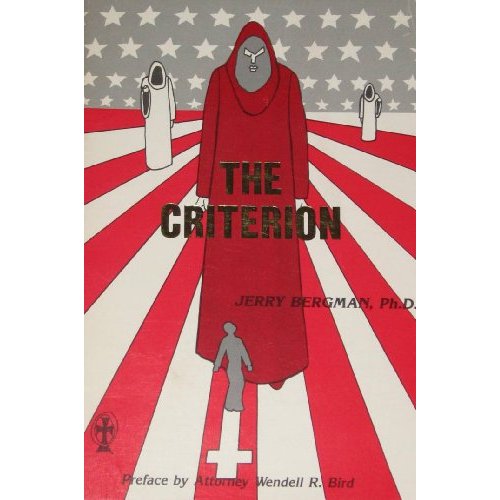
For their part, creationists have long complained, like Mark Armitage, that they have been persecuted for their religious beliefs. Over thirty years ago, Jerry Bergman insisted that he had been fired from Bowling Green State University solely for his religion. As he argued in his 1984 book The Criterion,

Several universities state it was their ‘right’ to protect students from creationists and, in one case, from ‘fundamentalist Christians.’ . . . This is all plainly illegal, but it is extremely difficult to bring redress against these common, gross injustices. This is due to the verbal ‘smoke-screen’ thrown up around the issue. But, a similar case might be if a black were fired on the suspicion that he had ‘talked to students about being black,’ or a woman being fired for having ‘talked to students about women’s issues.’

Creationists today are just as positive that Armitage is the victim of both religious and scientific persecution. As the Pacific Justice Institute put it,

It has become apparent that ‘diversity’ and ‘intellectual curiosity,’ so often touted as hallmarks of a university education, do not apply to those with a religious point of view. This suit was filed, in part, to vindicate those ideals.

Similarly, the headline in the ferociously conservative World Net Daily screamed, “Scientist Fired for Making Dinosaur Discovery.”

As Armitage’s lawsuit wends its way through the courts, I have a hunch that even the most conservative creationists might privately acknowledge that Armitage was not fired for his discovery. Rather, Armitage seems to have been fired for teaching students that the earth is likely only several thousand years old.

As Nature magazine concluded in its recent story about the affair, employers can’t legally fire someone for his or her religious beliefs. But employers can fire employees for conduct that goes against the mission of the institution. If radically dissenting visions of science undermine the assumptions of secular mainstream science, can a creationist scientist be fired?

If Fundamentalists Hate So Many People, Why Do They Love Artists?

Why does the leading fundamentalist university in America also have one of its best private art collections? Not just a collection of Jack Chick cartoons, either, but a diverse collection of religious art from the greatest of European old masters? One writer recently called this bewildering. The answer lies in the misunderstood nature of fundamentalism itself.

This is not what fundamentalist art looks like at Bob Jones University.

This is NOT what fundamentalist art looks like at Bob Jones University.

In the pages of The Imaginative Conservative, Dwight Longenecker recently described his trip to the art museum on the campus of Bob Jones University. As Longenecker explained,

I thought the art gallery would be perhaps a small and preachy collection of kitsch Evangelical art: pictures of the rapture taking place, memorabilia of the Jones family or stilted illustrations of Bible stories. I was wrong. The Bob Jones gallery houses an astounding array of old master paintings, icons, antiques, sculpture and Biblical antiquities.

And Longenecker asks the right questions: How can a school famed for its rigid fundamentalism host such an eclectic display of non-fundamentalist art? How can Bob Jones Jr. denounce Jerry Falwell as “the most dangerous man in America” in 1980 due to his willingness to work with conservative Catholics, yet splurge on a collection of Catholic and Russian Orthodox art treasures?

Fundamentalist art, BJU-style.

Fundamentalist art, BJU-style.

One question Longenecker doesn’t ask is also vital: How can a university pay faculty and staff much less than going salary rates, while its leader travels across Europe, purchasing world-class art for a private gallery?

The answer lies in the history of fundamentalist higher education itself. As I’m exploring in my new book, beginning in the 1920s, fundamentalist colleges struggled to figure out how to remain fundamentalist. After all, too many religious colleges had slidden into liberalism and eventually into secularism. Harvard, University of Chicago, Duke…too many leading schools had begun with conservative religious intentions, only to drift into worldly liberalism and pluralism.

Different schools worked out different solutions. One leading college, Wheaton College in Illinois, eventually settled into a pattern. The board of trustees kept careful watch on the goings-on among students and faculty. But the wider fundamentalist world, too, constantly questioned Wheaton’s leaders about on-campus events and tendencies. Conservative evangelicals around the country felt a right and a responsibility to keep Wheaton safely orthodox.

Wheaton’s archives are full of this sort of fundamentalist scrutiny. To pick just one example, President Hudson Armerding received a short, scrawled note in late 1968 from a woman who had no apparent personal connection to Wheaton. She was not an alumna, not a parent of a student. She was just a concerned fundamentalist who worried about the school’s continuing conservatism. “Recently after a church meeting,” she wrote to Wheaton’s president,

a group of persons was discussing Wheaton College. Some said that your school now teaches ‘theistic evolution’ and has departed from the fundamentals of the Bible. Is this true? Would you please investigate your curriculum? Also—statements made were that [sic] the school allows ‘worldly practices’—movies, smoking, etc. Please reply. Thank you.

At Bob Jones College (it became Bob Jones University only in the late 1940s), on the other hand, the 1930s wrought a very different way of maintaining orthodoxy. During that period, the school’s founder, Bob Jones Sr., established a principle of “loyalty.” The school community would be guided and maintained in its fundamentalist rigor by unswerving loyalty to the school’s original fundamental purpose. Faculty would be expected to support the school fervently and unstintingly. As Bob Jones Sr. put it in one chapel talk,

We are not going to pay anybody to ‘cuss’ us. We can get ‘cussin’’ free from the outside. . . . We have never been a divided college. . . . We are of one mind in this school. We have not always had smooth sailing, but we have thrown the Jonah overboard. If we get a Jonah on this ship, and the ship doesn’t take him, we let the fish eat him! We throw him overboard. . . ‘United we stand, divided we fall.’ That is the reason that in this school we have no ‘griping.’ Gripers are not welcome here. If you are a dirty griper, you are not one of us. . . . God helping us, we are going to keep Bob Jones College a kingdom that isn’t divided and a house that stands together.

In practice, this expected loyalty to the school became an expected loyalty to the school’s leader. The Bob Joneses—Senior, Junior, then III—embodied the meanings of “fundamentalism” at the school. As outsiders have struggled to understand, this development allowed Bob Jones College to be more liberal in some matters, while still maintaining its status as a ferociously fundamentalist school.

For example, at the far less conservative Wheaton College, students were not allowed to put on plays until the 1960s. The worry of the broad fundamentalist community was that “worldly” drama might tarnish students’ religion.

But throughout its existence, Bob Jones University has encouraged students to dive into drama, especially the not-particularly-Christian work of Shakespeare. This may seem like a paradox, a mystery, but it is explained by the principle of loyalty at BJU. At BJU, the entire fundamentalist community did not debate whether or not Shakespeare was acceptable for fundamentalists. The leaders decided.

And once they decided, it became a principle of loyalty for faculty and community members to go along. One faculty member in the 1930s criticized the school’s policy of putting on Shakespearean dramas. Such worldly amusements, she argued, could not help guide the fundamentalist faith of BJC students. At a school like Wheaton, those arguments carried a lot of weight. But not at Bob Jones College. As Bob Jones Sr. later explained,

She walked around and said, ‘You know, I’m so concerned. They have drama at Bob Jones College, and I think we should have a prayer meeting.’ . . . that’s her privilege. You don’t have to love Shakespeare. . . . But she knew Bob Jones College loved Bill Shakespeare.

She was fired.

For many observers, this is the constant paradox of Bob Jones University. As Dwight Longenecker reports from his visit to the art gallery, the school combines an indefatigable insistence on rigid fundamentalism with an embrace of non-fundamentalist art that might shock even moderate evangelicals. From the worldly Shakespeare to the Catholic Old Masters, Bob Jones University has the ability to be less conservative about some things than more moderate schools.

Dwight Longenecker attributes this seeming paradox to the “eccentric and unique flair” of Bob Jones Jr., president of the school between 1947 and 1971. There’s truth to that, but only part of the explanation. At Bob Jones University, the loyalty/leadership principle allowed Bob Jones Jr. to indulge his taste for non-fundamentalist art and drama in ways that less conservative fundamentalist institutions could never have allowed.

This history matters for more than just the campus surprise of BJU’s beautiful art museum. The influence of BJU among fundamentalists is hard to overstate. Due to its extensive network of influential alumni and its powerful school-publishing arm, the meanings of “fundamentalism” at Bob Jones University can influence the meanings of fundamentalism nationwide.

And with so much of that meaning determined by the school’s leaders, the personality and taste of a leader such as Bob Jones Jr. can have an enormously outsized influence on fundamentalism in general.

MOOCing Jesus

Does online education work? A new survey of college faculty by Gallup for Inside Higher Education offers an unstartling new answer: It depends. Here at ILYBYGTH, we have a different question: Does online education work for conservative religious colleges?

After all, as I’m exploring in my new book, conservative religious colleges have always had a different goal from secular schools. Instead of just hoping to prepare students for careers and intelligent life, conservative schools have also intended to bolster the faith of their students. They have worried that any change might lead them into a slow slide into secularism. As a corollary, most conservative schools have maintained stricter lifestyle rules over students than secular colleges have. Conservative schools have insisted that classes be led faithfully, not just competently. But can they do this in online classes?

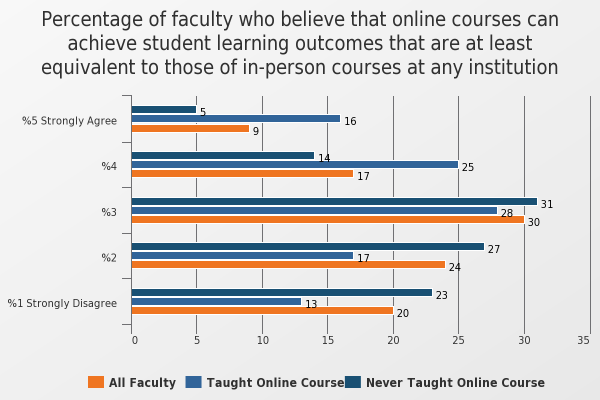
The survey of faculty for Inside Higher Ed includes some interesting points. [You can click to get the entire report, but you have to register.] In brief, faculty remain unconvinced that online education can deliver equal results to old-fashioned in-person classes. Online classes might do a good job—in some cases—at delivering content. But most faculty agree: there is something important lost when face-to-face interaction isn’t a leading part of university classes.

IHE CHART

Source: Carl Straumsheim, “Online Ed Skepticism and Self-Sufficiency: Survey of Faculty Views on Technology,” Inside Higher Education, October 29, 2014.

The survey specifically excluded some of the schools we’re interested in, what it calls “Bible colleges and seminaries.” And none of the questions included anything about student faith.

But no one interested in online higher education these days can ignore the fundamentalist elephant in the room. Liberty University, a school founded by Jerry Falwell in 1971, now claims almost 100,000 online students. In addition to standard online coursework, Liberty offers online spiritual help, too. Students can join online prayer groups and Bible blogs.

But this menu of religious fare does not seem to match the traditional goals of conservative religious colleges. At most schools, the faith of students has been the primary concern, not merely an additional click on a webpage. And most college administrators have been keenly worried about sliding into heterodoxy and secularism. In his brilliant 1994 dissertation about Wheaton College, historian Michael Hamilton explained this sentiment like this:

The paradigm that has dominated Wheaton through the [twentieth] century holds that colleges, more than any other type of institution, are highly susceptible to change, and that change can only move in one direction—from orthodoxy toward apostasy. . . . The very process of change, no matter how slow and benign it may seem at first, will always move the college in a secular direction, inevitably gathering momentum and becoming unstoppable, ending only when secularization is complete.

This mindset, I believe, is common among conservative evangelical schools. From Wheaton, to Biola, to Gordon, to more conservative schools such as Bob Jones and Liberty…all have worried that change will equal declension. All have been concerned, first and foremost, that novelty will lead faculty and students to abandon their faiths.

So here’s the question we wished Inside Higher Ed had asked professors at conservative schools: How can online education remain orthodox? How can the faith of students be preserved if student/teacher interaction is weakened?

And perhaps this is the toughest question for the folks at Liberty University: Has their wildly successful pursuit of online education changed their goal? Has Liberty abandoned its religious mission? Or, rather, could this massive online presence be compared to the televangelism of an earlier generation? Could the thousands of online students be seen as an enormous “mission field” for Liberty’s evangelical message?

Only Religious Colleges Can Still Do It

Higher-ed types have a deskful of crises to pick from.  There’s the sexual-assault crisis, the student-debt crisis, the MOOC crisis.  One of the biggest of these crises doesn’t seem to attract its share of attention, though it threatens a bigger transformation of higher education than any of the rest.  And when it comes to this crisis, Christopher Noble of Asuza Pacific University suggests that only religious college might have the solution.

The crisis we’re talking about is the crisis in the humanities.  As Noble notes in the Chronicle of Higher Education, fewer and fewer students are signing up as English majors, or philosophy majors, or history majors.  The reasons aren’t too hard to find.  These days, a college degree is an increasingly expensive document.  And young people want to make sure that their work will turn into a well-paid job.  That’s not a guarantee with an English degree, the way it might be with a chemistry degree or engineering degree.

But Noble offers a ray of hope.  Many secular students these days are fully literate in a verbal culture, not a print culture.  For such students, Noble reflects, the humanities might rightly seem “obsolete.”  But this is not true of conservative religious students.  Those students, Noble argues, are hard-wired to embrace the humanities.  As Noble puts it,

Suppose . . . that there existed a large group of middle-class and upper-middle-class prospective customers in the educational marketplace who shared an intense prior commitment, consciously or not, to the obsolete textual worldview. That group of customers already believes, before ever setting foot in a classroom, that a ragamuffin set of ancient texts, a collection of dissonant poetic voices in unfamiliar languages, holds the key to human meaning.

Suppose further that those customers come to learn how much humanistic study will improve their facility with ancient texts. Envision consumers for whom hermeneutical skill and ancient wisdom, rather than technical expertise, constitute the nonnegotiables of a college education. Imagine a “people of the book” in the era of the book’s demise. Such is the condition of observant Muslims, Jews, and Christians in developed countries today.

Could it be true?  Could conservative religious colleges provide not only a religious haven, but a haven for the humanities?  If so, as Professor Mark Bauerlein of Emory University has pointed out, we’ll have to recognize the painful historical irony.  Bauerlein concludes with some satisfaction that many secular humanities professors are in fact

aggressively secular,  hostile to any expression of faith outside church and home. . . . If the humanities spring from a religious impulse, or at least need it to thrive, then the irreligious, irreverent postures of humanities professors are suicidal.

Certainly, following this logic, it seems that secularizing scholars might have eaten their own tails.  But is that really the case?  Aren’t there plenty of wholly secular reasons why some students will continue to embrace the humanities?

In my case, my interest in vigorously secular thinkers led me backwards.  Because I wanted to understand Sartre, I had to read Heidegger.  And because I wanted to understand Heidegger, I went back to Hegel.  And Hegel didn’t make much sense until I had spent time with Kant, Descartes, and Spinoza.

In my case, at least, none of my appetite for studying the humanities came from a religious impulse.  Not consciously, at least.  Am I the odd duck?  Or are Bauerlein and Noble simply hoping against hope for some ratification of their love for conservative religious colleges?

Rubio’s College Fix: Make Students Profitable

Vouchers. Charters. Conservatives these days like to offer “market” solutions to school problems. In the pre-run-up to the 2016 presidential contest, Florida Senator Marco Rubio is offering a market fix for college students: Sell shares in yourself.

Of course, not every conservative is a free-marketeer. “Traditionalist” conservatives (for good examples, check out the Imaginative Conservative or the American Conservative) decry the dehumanizing effect of ruthless commodification. But there has been a long tradition in these United States of tying traditional values to an apotheosis of the free market.

In education, the most influential voice for marketization has been the late Milton Friedman. As he remembered in the 1980s, when he started advocating vouchers, it was “far out of the mainstream.” But by the twenty-first century, such market ideas had become dominant. Parents should all have the right to choose the right school for their children, Friedman insisted. The only reason they could not, he wrote, was because self-interested teachers’ unions had seized control of education and forced an “excess of conformity.”

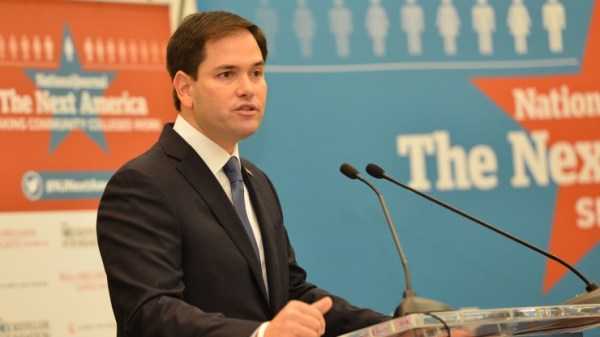
Rubio’s plan expands on this principle. In a recent talk organized by the National Journal, Rubio worried that the “American dream” of college education has become unaffordable for many. The danger, Rubio warns, is an increasing opportunity gap between those who have advanced education and those who do not. His plan will help narrow that gap by making it possible for everyone to go to college. Our “new economy,” he says, is still working with a higher-ed system built for the “old economy.”

Sell yourselves, students...

Sell yourselves, students…

Tuition costs have shot up far faster than the rest of the economy. Students from less-affluent backgrounds have been forced out of college, or saddled with impossibly huge debt burdens. Colleges are getting fat on these hefty tuition bills, largely financed by federal student loans. And, according to Senator Rubio, many “high-skilled, high-paying industries suffer from a shortage of labor.”

His solution? Among other ideas, Rubio wants students to sell shares in themselves. Instead of borrowing a fixed amount, students could promise investors, say, four percent of their earnings for ten years after graduation. Students might end up paying far more than they borrowed. Or they might pay less. But that is all part of the promise and peril of the market.

As Rubio notes, this will pusher higher education in “practical” directions. It will push students to pursue “the right degree, geared toward the right industry.” Not a lot of investors will jump at the chance to invest in a philosophy major. But students in “engineering, health services and education,” Rubio thinks, will be a good bet.

There are plenty of conservatives, I think, who would be aghast at this marketization plan. The purpose of education, many conservatives insist, is to humanize.

Rubio’s brand of conservatism is different. He wants to let the market work its magic.

Christianity Kicked Out of Public Universities

Ball State University doesn’t want any more attention. It has been the subject of a nationwide campaign by pundits who were shocked—shocked!—to hear that one professor spoke kindly of intelligent design. But my current work in the archives at the Billy Graham Center at Wheaton College shows me just how dramatically things have changed in the past fifty years.

You may remember the intelligent-design case. In mid-2013, Eric Hedin was accused of larding his class with religious content. The Wisconsin-based Freedom From Religion Foundation complained, and eventually Ball State’s president announced that religious ideas must not be taught as part of science classes.

Hedin’s use of religious themes became objectionable for two reasons. Mainly, observers complained that he was presenting religious ideas as if they were scientific. But Ball State University was also criticized as a public school using taxpayer dollars to favor one religious group.

According to Jerry Coyne, when Ball State President Jo Ann M. Gora made her announcement that religious ideas should not be taught as science, she emphasized both of these notions. Intelligent design should not be taught as science, Gora told the Ball State community, since

Intelligent design is overwhelmingly deemed by the scientific community as a religious belief and not a scientific theory. Therefore, intelligent design is not appropriate content for science courses.

But Gora specified that even if such religious ideas were taught as part of humanities courses, they must only be taught as ideas, not as dogma. That is, even non-science classes could not teach religious ideas as true, but only as history or literature. As Gora put it,

Discussions of intelligent design and creation science can have their place at Ball State in humanities or social science courses. However, even in such contexts, faculty must avoid endorsing one point of view over others. . . . As a public university, we have a constitutional obligation to maintain a clear separation between church and state. It is imperative that even when religious ideas are appropriately taught in humanities and social science courses, they must be discussed in comparison to each other, with no endorsement of one perspective over another.

Things have changed. As I’ve dug through the archives here at the Billy Graham Center, I’ve come across an intriguing historical coda to the Eric Hedin story. These days, professors at Ball State may not teach religious ideas as science. They may not even teach any single religious idea as history or literature.

But as late as 1957, Ball State University—like many other public universities—taught evangelical Protestantism explicitly and purposefully. Many public colleges, especially teachers’ colleges, had entire programs devoted to what was usually called “Christian Education.” In these courses, public-school students could learn the basics of evangelical proselytization, usually under the heading of learning to be “Sunday School” teachers. Most typically, students were women who hoped to begin or enhance their careers as part-time religious educators.

The current logo hints at this heavenly history...

The current logo hints at this heavenly history…

In some cases, today’s public colleges used to be religious or denominational schools. That doesn’t seem to be the case with Ball State. It claims to have always been part of the government system.

Not only did universities such as Ball State teach courses in spreading the evangelical Gospel to children, but they also accepted transfer credits from unapologetically fundamentalist seminaries. In my archival work, I’ve found several examples of students using their credits from the Winona Lake School of Theology to advance their degrees at public universities like Ball State and the University of Georgia. Even the state of California apparently accepted Winona Lake credits toward public-school teaching certificates.

At the time, Winona Lake School of Theology was a firmly fundamentalist summer school. It was going through an ugly separation from the Fuller Theological Seminary over Fuller’s alleged drift away from Biblical inerrancy. Now defunct, the Winona Lake school refused to go along as Fuller Seminary moved into a more ecumenical attitude.

And in 1957, teachers could use their credits from this religious school to complete their religious program in Christian Education at Ball State University. Though there is too much heated rhetoric about God being “kicked out” of American public education, this example shows us how things really have changed over the past decades.

In 2013, the president of Ball State had no problem announcing that her university must not favor one religion over another; as a public school it must not teach religion, though it can and should teach about religion. But as late as 1957, Ball State and other public universities found it unexceptional to teach entire programs in Christian evangelism. Ball State had no problem taking credits from a fundamentalist seminary, since both programs taught similar course content.

More evidence that we are not just replaying every old culture-war script. Things really have changed.