Required Reading: Our American Dilemma

Is America a racist place? Like, fundamentally and deeply racist? When historians look around, they tend to say yes. But as a terrific new book about the 1920s Ku Klux Klan makes clear, saying that white racism has always been a central part of American culture is only the beginning. If we really want to understand white racism in America, we need to be prepared to wrestle with some complicated and uncomfortable facts.
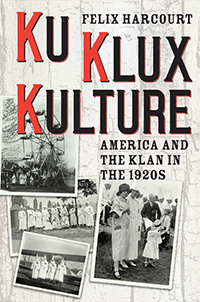
harcourt ku klux kulture

Required reading…

We can see the dilemma everywhere we look these days. White nationalism seems to be thriving, as we saw in the 2016 presidential elections. We also see it all over today’s college campuses. And—as I argued recently in Religion Dispatches—we find it in places we might not expect, such as evangelical colleges and universities.

But white nationalism is only part of the story. These days, every triumph of Trumpishness is also a catalyst for anti-Trump activism.

This paradox at the heart of American identity is made disturbingly clear in a wonderful new book by Felix Harcourt. Harcourt examines the impact of the 1920s Ku Klux Klan on the wider American culture of the 1920s. I’ve spent my share of time studying the 1920s Klan—it was a big part of my book about the history of educational conservatism.

Harcourt’s book raises new and intriguing ways to understand the everyday bigotry associated with the Klan of the 1920s. When most of us imagine the Ku Klux Klan, we think of the much smaller, much different Civil-Rights-era group. In the 1950s and 1960s, the Klan had been reduced to small clusters of southern hillbillies lashing together dynamite bombs and informing for the FBI.

The 1920s Klan wasn’t like that. Some of the symbols were the same, such as the fiery cross, the infamous hood, and the night-rider imagery. In the 1920s, though, membership in the Klan boomed into the millions. Instead of hunkering down in barns and basements, the 1920s Klan seized Main Street with lavish parades and open celebrations of “100% Americanism.” The organizations briefly ran the government of states such as Indiana and Oregon. Its main bugbear was not voting rights for African Americans, but rather infiltration by Catholics and other sorts of immigrants.

Not that the 1920s Klan wasn’t fiercely controversial. It was. Even as it attracted endless criticism, however, it also attracted millions of members, each coughing up ten dollars for required accoutrements and registration forms.

Professor Harcourt does the best job any historian has done yet of capturing this American paradox. He examines the way the Klan presented itself in newspapers, books, and other media. He also looks at the ways outsiders unwittingly helped drive membership by attacking the Klan. As Harcourt makes abundantly clear, the real lesson of the 1920s Klan lies in its everyday radicalism, in the way its members thought of the Klan as a muscle-bound Rotary Club, another expression of their Main-Street claim to white Protestant supremacy.

For example, journalists in Columbus, Georgia took great personal and professional risks to confront their local Klan. They went undercover to expose their governor as a Klan stooge. The upshot? Their newspaper won a Pulitzer Prize for brave investigative journalism but the outed governor won a landslide re-election.

Beyond electoral politics, the 1920s Klan made a huge impact on popular culture. As Harcourt recounts, publishers generally were more interested in exploiting the Klan’s controversial reputation than in supporting or denouncing it. Maybe the best example of this was the June, 1923 special edition of the pulp magazine Black Mask.
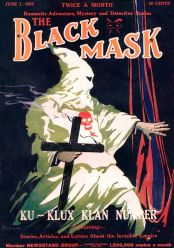
black mask kkk june 1 1923

“Rip-snorting” racism.

In a masterpiece of blather, the editor told readers of the Klan issue that the hooded empire was

the most picturesque element that has appeared in American life since the war, regardless of whether or not we condemn its aims—whatever they may be—or not.

This same editor told one author to provide a “rip-snorting dramatic tale” about the Klan, but to leave out any sort of controversy. In the story, “Call Out the Klan,” a WWI veteran investigates the Virginia Klan who has kidnaped his love interest. Turns out it was fake news—a non-Klansman put on robes and hood and kidnaped the southern belle in order to discredit the Klan. In the end, the true Klan saved the day, in particularly dramatic fashion. The story includes no mention of racism, anti-Semitism, or anti-Catholicism.

The 1920s Klan was at once frightening and fascinating; lauded as a tough answer for tough times and excoriated for anti-democratic thuggery; hailed as America’s salvation and cursed as its damnation.

In our popular memory, the Klan is usually conveniently dismissed as a nutty group of thugs and crazies. In fact, as Harcourt reminds us, “the men and women of the Klan were far from aberrant and far from marginal.”

Those of us who were shocked by President Trump’s surprise electoral victory in 2016 should heed these historical lessons. White nationalism has always been able to mobilize Americans. Many of us get off the couch to fight against it, but equally large numbers will fight in favor.

And though no one says President Trump is a latter-day Clifford Walker, it’s difficult not to get spooked by some of the parallels. As one Klansman told reporters, the Klan’s strategy was always to attract attention, no matter what. As he put it, “the Klan organization dealt very deliberately in provocative statements, knowing they would garner front-page headlines.”
Trumpist Towers? Or Critical Colleges?

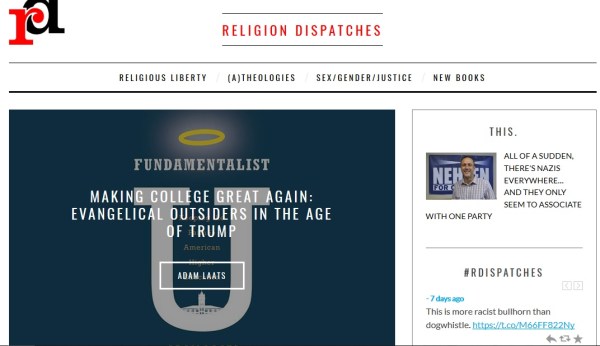
I’ve said it before and now I’m saying it again: Trumpism speaks to long traditions among white evangelicals. And time and again, evangelical colleges have been the institutional homes of Trump-like yearnings to “make America great again.” As I argue this afternoon over at Religion Dispatches, however, evangelical colleges have also played another key role.

RD screenshot

Are evangelical colleges bastions of Trumpism? Or are they the only places evangelicals can turn to find out what’s wrong with loving The Donald?

I won’t give away the entire argument. SAGLRROILYBYGTH might be bored to tears with the topic and you can read the whole thing if you’re interested. But I will say that it’s no surprise that President Trump loves Liberty University. It’s also no surprise, however, that the Liberty community isn’t sure if they love him back.

Why Don’t We Tell Children the Truth about Slavery?

A sad new report offers proof of something history teachers have long lamented: Most students don’t learn much about slavery in their history classes. This terrible failure of our school network isn’t just about slavery; it’s a profound and depressing fact about our schools: We don’t dare to tell kids the truth.

life-of-george-washington-junius-brutus-stearns

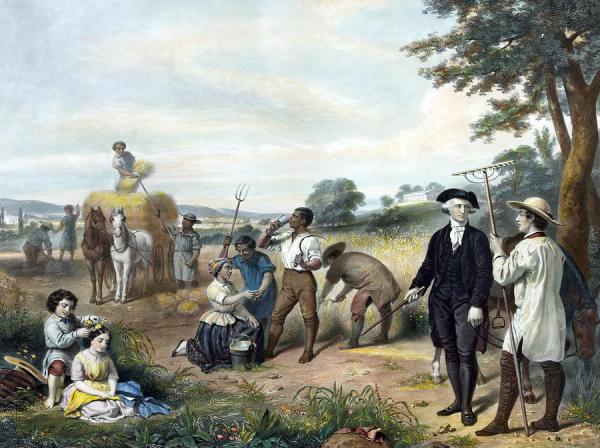
George Washington doing what George Washington did. Why is it considered unpatriotic to tell the children about it?

Why not?

The report on students’ knowledge about slavery comes from the Southern Poverty Law Center. The numbers are sadly predictable. Under a quarter of the students surveyed could identify the ways the Constitution gave advantages to slaveholders. Most teachers (over 90%) claimed to want to teach more and better information about slavery, but they reported feeling unsupported by textbooks and state standards.

Our national reticence to teach children the undeniable and important historical truth about slavery has long roots. Time and time again, history classes focus on a feel-good national story. As Yale’s David Blight puts it in the report’s preface:

In America, our preferred, deep national narratives tend to teach our young that despite our problems in the past, we have been a nation of freedom-loving, inclusive people, accepting the immigrant into the country of multi-ethnic diversity. Our diversity has made us strong; that cannot be denied.

And, as the reports’ authors note,

We teach about slavery without context, preferring to present the good news before the bad. In elementary school, students learn about the Underground Railroad, about Harriet Tubman or other “feel good” stories, often before they learn about slavery. In high school, there’s over-emphasis on Frederick Douglass, abolitionists and the Emancipation Proclamation and little understanding of how slave labor built the nation.

This fear of telling students ugly truths has a long history. As I noted in my book about educational conservatism, many of our culture-war battles about teaching US History pitted the bashers against the boasters. Conservatives wanted kids only to hear about America’s glories. Progressives wanted to teach that the US has always had plenty of moral flaws.

In the 1930s, for example, journalist and patriot Bertie Forbes attacked the popular textbooks written by Harold Rugg. Rugg hoped to introduce students to the real complexity of international relations. In Forbes’s opinion, such efforts would rob students of their patriotic fervor. As Forbes wrote in 1940,

If I were a youth, I would be converted by reading these Rugg books to the belief that our whole American system, our whole American form of government, is wrong, that the framers of our Constitution were mostly a bunch of selfish mercenaries, that private enterprise should be abolished, and that we should set up Communistic Russia as our model.

By and large, historically speaking, the Forbeses of the world have always won these fights. Schools primarily teach (and taught) students that America was a place they could love. Teaching too much or too frankly about slavery has always been seen as a dangerous and controversial effort.

It’s not only slavery that is ignored or misrepresented. As SAGLRROILYBYGTH are keenly aware, schools shy away from all types of controversial topics, even when the controversy is contrived.

berkman plutzer chart 2 better text color

From Berkman & Plutzer: Can we please not talk about it?

As Penn State political scientists Michael Berkman and Eric Plutzer found, only a minority of high-school biology teachers teach mainstream evolutionary theory and only mainstream evolutionary theory in their classes. The rest tend to mash together a mix of mainstream science and dissenting creationist ideas. Why? Because most teachers share the ideas of their local communities. If people want their kids to learn a variety of ideas about science, that’s what most teachers will deliver.

This has always been the case. In the 1940s, an enterprising scholar set out to discern how many teachers taught evolution. One teacher from California explained why he avoided the topic of evolution in class. As he put it,

Controversial subjects are dynamite to teachers.

And there’s the rub. Teachers will tend to avoid controversy. There’s no controversy among historians about whether or not slavery was a vital and decisive element in US history. There’s no controversy among mainstream scientists about whether or not mainstream evolutionary theory is a vital and decisive element in biology.

But broad segments of the population disagree. They don’t want their children to learn that America has historical flaws. They don’t want their children to learn that our species developed by a long series of minor changes.

Unless and until those things change, classrooms won’t improve. I heartily concur with the four-point action plan put forth by the recent SPLC report. It recommends the four following steps:

  1. Improve Instruction About American Slavery and Fully Integrate It Into U.S. History.
  2. Use Original Historical Documents.
  3. Make Textbooks Better.
  4. Strengthen Curriculum.

All good ideas. But they won’t be enough. Just like evolutionary theory, the history of slavery won’t be included in our classrooms until it is included in our day-to-day conversations. Until the country as a whole recognizes the importance of America’s ugly past, classrooms will continue to ignore it.

As we’ve seen time and again, we can’t use curriculum to change society. We need to change society and watch curriculum follow along.

I Love You but You Didn’t Do the Reading

A holiday week didn’t slow down the news. Cussing from the Oval Office, aspirations from Oprah’s couch…it was a weird week. Here are some of the top ILYBYGTH-related stories:

President Oprah?

Why do so many white evangelicals love Trump? Darren Guerra says it’s only “Jacksonian Evangelicals,” at First Things.Bart reading bible

Want to stop school segregation? Stop attacking charter schools, says Emily Langhorne at USNWR.

Liberalism is over, by Patrick Deneen at The Spectator.

San Diego State: Lecturer took anti-white attitudes too far, at CHE.

Museum of the Bible: A “safe space for Christian nationalists,” by Katherine Stewart at NYT.

Leadership shake-up at Moody Bible Institute, at CT.

More Trump/evangelical crack-up. How did evangelicals respond to Trump’s “S***hole” comments?

Big-time college sports—the new Jim Crow. So says Victoria Jackson at LA Times.

I Love You but You Didn’t Do the Reading

Believe it or not, Labor Day is already here. Time to put away those white shoes, fellows. It has been a hectic last week of summer here at ILYBYGTH. Here are a few stories of interest that you may have missed:

Are some cultures better than others?

Love means never having to say you’re sorry: Trump pardons Sheriff Joe Arpaio.

At The Gospel Coalition, an open letter from Christian scholars denouncing racism.

Are white evangelicals more racist than Christian?

The problem with “privilege.” Jeffrey K. Mann wants us to look beyond race and gender.

What happened to all the Christian bookstores?

Yes, you read it correctly: Reese Witherspoon will be playing the role of a defector from the “God-Hates-Fags” Westboro Baptist Church.

Where are all the sinister atheists who are trying to undermine Christian America? The Trollingers couldn’t find them at the American Atheists Convention, from Righting America at the Creation Museum.

Family sues NYC schools over their son’s “gender expansive” preference for dresses. The school accused the parents of sexual abuse.

Vouchers and stealth vouchers: The Progressive offers a guide to the wild and woolly world of public-school funding options.

What should conservative evangelicals think about gender and sexuality?

Only in New York: A Brooklyn school principal accused of recruiting her students into the communist movement.

The Real Reason We Can’t Fix Our Schools

We all know public schools are not all equal. Rich kids get meticulous college-prep educations. Poor kids are often stuck in crumbling schools with shoddy expectations. Why haven’t we been able to fix this problem? We get a clue this week from an unlikely source. It underlines an unpopular argument I’ve been making for a while now: in spite of decades of “progressive” reform, our public education system is dominated by deeply conservative assumptions.

public school crappy

Do your local public schools look like this…

This week, our already-fractured academic world was thrown another culture-war bone to chew on by law professors Amy Wax (Penn) and Larry Alexander (UCLA). Writing at Philly.com, the two scholars articulated the unpopular idea that some cultures were better suited for modern American life than others. To help people in poverty, society should encourage them to live more stable personal lives, more in line with “bourgeois” culture.

Penn students and alumni condemned the essay as part of the culture of white supremacism. Some of Wax’s colleagues “categorically reject[ed] her claims.”

What does any of this have to do with school reform? A lot.

We don’t need to support or condemn Wax and Alexander in order to understand this. (Although, full disclosure, I personally put their argument in the same unfortunate category as James Damore’s Google goof. They twist social-science research to suit their own already-convinced positions. They play the provocateur merely to gain attention and they don’t mind articulating atrocious ideas in order to do so.)

public school fancy

….or more like this?

The point here is not whether or not Wax and Alexander are bold speakers of truth—as Jonathan Haidt has argued—or self-inflated stalking-horses for white supremacy.

The point, rather, is that this dust-up among elite academics shows the real reason why school reform is so difficult. It is not because we Americans are unwilling to invest in public education. As recent headlines from New York City have shown, we often have put bajillions of dollars into efforts to improve schools for students from low-income families.

As the case of the Wax/Alexander letter shows, the real reason we can’t fix public education is because we find it impossible to talk reasonably about poverty. Americans in general can’t even agree on the meaning of poverty. Some people think poverty is mainly due to personal failings. Others see the reason as structural inequality.

As a result, we talk instead about fixing schools so that poverty will be magically eliminated. Instead of talking about reforming society so that fewer students in public schools come from low-income families, we reverse the discussion. We talk about fixing schools so that more students from low-income families will get ahead in life.

In effect, our centuries-long strategy to avoid discussions of social reform by investing instead in school reform shows how deeply conservative our fundamental assumptions about schooling have always been. Instead of fixing society to eliminate poverty, we try to fix schools so that individual people might get a chance to escape poverty. Instead of directly addressing the third-rail topic of poverty in America, we sidestep the issue by making a few schools a little better.

The assumption is so deeply embedded in American culture that it is rarely noticed, let alone addressed. As long as kids from low-income families have access to a decent public school—the assumption goes—it is their own darn fault if they don’t improve their economic future. So money goes into shiny programs to make schools for low-income students a little better here and there, instead of going into programs that would change the fundamentally inequal structure of society itself.

SAGLRROILYBYGTH are sick of hearing it, but I have to say it again. At the root of our endless failure to reform public schools is our endless failure to address the real problem. Schools can’t fix society, schools ARE society.

From the Archives III: Playing the Rice Card

Editor’s Note: I am happy to say that my book about the history of evangelical higher education has entered its final production stages. We are on track to release Fundamentalist U by January 1, 2018. The sad fact, though, is that so much great archival material got cut from the final draft. In this series, I’ll be sharing some of these too-good-too-lose gems from my work in the archives.

Were white evangelicals racist? Short answer: Yes. Long answer: Yes, but.

In Fundamentalist U, I’m working hard to tease out the ways evangelical and fundamentalist colleges, institutes, universities, and seminaries wrestled with questions of race and racism in the twentieth century. It wasn’t easy, but I had to cut one of the most intriguing sections of my chapter.

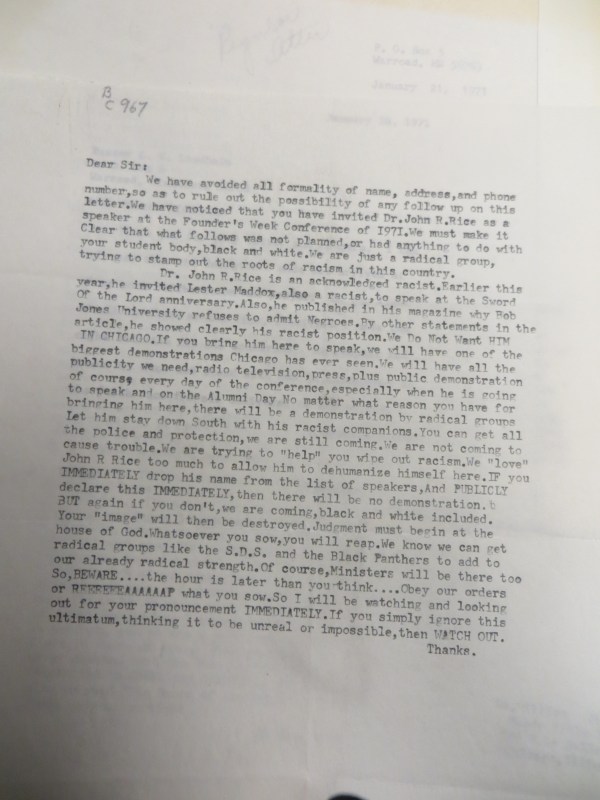
Here’s what happened: In 1970, fundamentalist publisher John R. Rice came out in favor of Bob Jones University’s racial-segregation policy. The leaders of Moody Bible Institute had just invited Rice to give one of the most prominent speeches in their annual Founder’s Week celebration.

What was MBI to do? Like most white evangelicals in the era, they had moved away from the unabashed racism that they had shown since the 1930s. But they hated to alienate Dr. Rice and the potent strain of unreconstructedly racist fundamentalism that he represented.anti john rice demonstration warning letter

As MBI’s leaders hemmed and hawed, they received a clumsy letter opposed to Rice’s appearance at MBI. The authors go to awkward lengths to insist they are not students at MBI—and honestly I have no evidence that they were—but the language and content of the letter seem to suggest that it was written by MBI students.

What does this tell us about white racism at evangelical institutions? Here are some of my thoughts and I’ll welcome yours:

1.) White evangelicals in 1970 often opposed their historic racism.

2.) They often did so as part and parcel of their evangelical belief.

3.) Institutions—even ones that wanted to move away from their segregated pasts—hesitated to alienate powerful fundamentalist factions.

4.) Students at evangelical schools closely watched the goings-on at secular colleges and often mimicked the activism of their secular peers.

5.) Student activists often misunderstood the attitudes of their school administrators.

In this case, at least, MBI President William Culbertson was as ardently anti-racist as any student, but he didn’t want to hurt his school by insulting John R. Rice too publicly. When the cards were down, however, Culbertson went ahead and cut off Rice, consequences be damned.

As Culbertson wrote to John R. Rice, they both agreed on theology, but they had split on questions of race and racism. If Rice were to come speak at MBI, Culbertson concluded, it would give

the impression that the Institute agrees with your views in this regard. This cannot be.

Just When You Thought It Was Safe to Be a Creationist on Campus…

Who’s the racist? In creation/evolution debates these days, you’re likely to hear creationists tar evolution as a racist idea. Recently, however, young-earth creationist impresario Ken Ham complains that creationist anti-racism has now been labeled a racial “microaggression.”

It has long been a favorite claim of creationist activists. At the end of the twentieth century, for example, veteran creationist campaigner Jerry Bergman argued that Darwin’s evolutionary ideas led in a direct line to the Nazi Holocaust. From the Institute for Creation Research, too, Henry Morris insisted that creationists were the true anti-racists, since they believed all humans came from the same original two ancestors.

Small wonder, then, that creationists today are flummoxed by their renewed role as racists. Ken Ham took umbrage at a new list of microaggressions published by the University of California. As have many campus commentators, the UC list warns that some statements intended to be innocent or race-neutral may actually carry undertones of white privilege. For instance, to say that race doesn’t matter, or that one does not believe in race, can be seen by some as a fair-minded anti-racist statement. For others, however, such “color-blind” statements de-legitimize the unique difficulties experienced by racial minorities.

Ken Ham does not seem interested in those sorts of distinctions. Rather, he tackles the UC accusation head-on, insisting that his creationist anti-racism is the only truly scientific position. As he puts it,

Really, “races” is just an “evolutionized” term we shouldn’t use anymore because the idea is simply not true. So for the University of California to say that we shouldn’t say there’s only one race flies in the face of what observational science has clearly shown to be true! And of course, the Bible makes it obvious there is only one race because all humans are descended from Adam! The University of California (and many other campuses) is trying to suppress certain ideas and promote only one worldview—even contrary to observational science. Our starting point really does matter!

To this reporter, Ham’s umbrage seems to miss the point. By the time California students had time to be offended by his creationist anti-racist microaggression, wouldn’t they already be even more put out by his macro-aggressive creationist evangelism?

I’m Convinced: We Need More Conservatives on Campus

[Update: For new readers, this conversation has evolved since the post below.  In short, I’m not convinced anymore.  I now think there are better, more practical solutions to this dilemma.  Check out the developments here.]

My eyes were opened a few years back. I was offering a senior seminar in the history of American conservatism. Several students—some of whom eventually took the class and some of whom did not—came to my office and said something along the lines of “Thank God we finally have a conservative professor!” When I explained to them—sympathetically but clearly, I hope—that I was not actually conservative myself, students had a variety of reactions. Some were deflated. But another common response convinced me that Jon Shields and Jon Zimmerman are right.

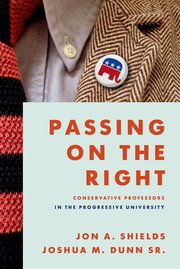
Shields Passing on the Right

Time for more affirmative action?

Shields has made the case again recently that college campuses need to recruit more professors who come from conservative backgrounds. He reviews the available research and concludes that conservatives are victims of explicit, intentional bias. As a result, there are far fewer conservative professors than we need if we want to have truly diverse campuses.

Years ago, Zimmerman made a similar argument. Like me, he’s no conservative himself. But he thinks universities need to be more inclusive places, more representative of our society’s true diversity. The best way to do that, he argued, was to reverse the trend toward intellectual homogeneity among college faculty. As he wrote back in 2012,

Race-based affirmative action has made our universities much more interesting and truly educational places, adding a range of voices and experiences that hadn’t been heard before. Hiring more conservative faculty would do the same thing.

I’m convinced, and not just because Jon Zimmerman is the smartest guy I know. The things I heard from my wonderful students told me that something was indeed wrong with our current set up.

When I told students that I wasn’t conservative myself, many of them told me something along these lines: You may not be conservative personally, but at least you don’t make fun of me or belittle me for being a conservative.   At least I can be “out” with my conservative ideas in your class. In most of my classes, I feel like I have to keep my ideas to myself or I will be attacked by students and teachers alike.

Yikes!

Please correct me if I’m off base, but isn’t that EXACTLY the problem that our campaigns for campus inclusivity have been meant to address? I know some folks think this notion of affirmative action for conservatives is a travesty, an insult to underrepresented groups that have faced historic persecution and discrimination. I understand that position and I agree that conservatives as a group cannot claim the same history as other groups.

But is there anyone out there who would want a campus climate in which students were belittled and attacked for their ideas?

Even if we want to do something about it, however, it is not at all clear how. As Neil Gross has argued, there is not really a liberal conspiracy when it comes to hiring professors. Rather, there has been a more prosaic tendency for people to go into fields in which they think they will be comfortable.

Maybe we could look to Colorado as a guide. They have had a conservative affirmative-action plan going for a while now at their flagship Boulder campus. How has it worked?

In any case, I’m looking forward to Professor Shields’s new book, scheduled for release next year. It promises to share the data gathered from 153 interviews and other sources. Maybe it will help us break out of this logjam.

Should College Classes Make Students Uncomfortable?

Whitney Cox is right on. In her classes at the University of Houston, she insists that conservative religious students be open to the idea of discomfort as they study the Bible. Can we translate her advice to college students in general?

whitney cox

Preach!

Cox tells the story of a “star pupil” who worries that her Bible class might shake up his preconceptions. It should, she replies. She doesn’t want to tell the student what to believe. In fact, she insists that she is not willing or able to do so. But she does want her class to challenge him to think about the Bible in new ways.

Hear, hear. That is the purpose of education, especially higher education. IMHO.

So here’s our question: What if we change things around a little bit? What if we replace a conservative religious student with a left-leaning social-action student?

I’ve argued lately that the recent tumults on college campuses result from an “impulse to orthodoxy” among such leftist students. Students demand an end to ideas that make them feel “unsafe.” They demand the ouster of faculty and administrators with whom they disagree.

Could such students and such campuses benefit from Cox’s advice? Here’s what she told her conservative student:

I find frustrating the too-frequent sentiment from Christians that equates interrogating and examining the texts with destroying faith. There is a strain of anti-intellectualism in modern US Christianity that is vile, unbiblical, and deadlier to faith than scholarly examination could ever be. It demands an unquestioning obedience and punishes anyone who doesn’t conform to the party line, who dares to question the people in power.

I am forever angry at the orthodoxies that demand literal belief as an all-or-nothing proposition, not only because that kind of approach makes you immune to reason, but because it means that more likely than not, that one bit of counter-information that makes it through takes down the rest like a Jenga tower. I’ve seen this a lot with people raised as strict creationists but who later realize that the scientific support for evolution is overwhelming — and because they’ve been taught they can’t doubt one part without doubting it all, they end up tossing it all out the window. Because they’ve learned that any questioning is evil, they decide they have to take all their questions elsewhere.

Fantastic, and right on.  SO right on, in fact, that we should broaden it to include other sorts of student worry as well.

What if we tweaked the wording here and there? What if we gave this advice to students?

I find frustrating the too-frequent sentiment from left-leaning students that equates interrogating and examining the texts with racism. There is a strain of anti-intellectualism in modern US society that is vile, anti-social, and deadlier to social justice than scholarly examination could ever be. It demands an unquestioning obedience and punishes anyone who doesn’t conform to the party line, who dares to question the people in power.

Please don’t misunderstand me. As I’ve said repeatedly, I support the moral impulse behind the student activism at many schools today. Like many commentators, though, I worry that the necessary tension has been leached out of campus life.

Schools must be aggressive and decisive in their efforts to make sure every student feels welcome. Incidents such as the repeated racial hazing at Mizzou, for example, are not merely over-wrought snowflake problems.

The flip side of that campus necessity, however, is that students must be intellectually challenged. They must be physically safe. More than that, they have a right to demand institutional action to help them feel confident that they are safe from demeaning microaggressions.

Too often, however, this vital goal of safe spaces has turned into an overzealous drive for intellectual safety. Nothing will kill higher education faster than that.

I’ll say it again.  We need to remember both halves of the higher-education mandate:

  • Students must be physically and even emotionally safe.
  • Students should never feel intellectually safe.

If we’re doing our jobs, as Whitney Cox is, this should apply in equal measure to conservative creationists and progressive anti-racists.