Teen Rebels, Creationism, and the Real History of Kicking God Out of the Public Schools

The Abington School District v. Schempp (1963) case is not usually remembered as a case of teenage rebellion or creationist science.  But as the man at the center of the case recalled recently in the pages of Church & State, we can’t separate out such issues from the Bible, school prayer, or “The Man in the Gray Flannel Suit.”

Image Source: Wikipedia

Image Source: Wikipedia

As I’ve written in these pages and in the pages of the Journal of Religious History, it is difficult to overestimate the importance of this case for American schooling, religion, and culture.  In its decision, the US Supreme Court decided that public schools must not mandate the recitation of the Lord’s Prayer or the reading of the Bible.  Among many religious conservatives, this decision has taken on enormous symbolic significance as the moment that the United States “kicked God out of the public schools.”  In reality, the decision specified that religion still belonged in public schools.  It was only teacher-led devotional religion to which the Court objected.

Ellery Schempp, who went on to a highly successful career as a physicist, remembered his teenage decision to contact the American Civil Liberties Union to protest his treatment in his Pennsylvania public high school.

As Schempp recalled, his protest came partly from principle, and partly from “teen rebellion.”  The sixteen-year-old Ellery resented being squeezed into a conformist mold.  Schempp recalled his lightbulb moment:

“It was one day when some kid read Genesis in 10th grade,” Schempp continued. “I thought, ‘This is nonsense; this does not fit with the science that I know.’ I began to pay more attention.

For those like me who hope to understand the meanings of conservatism and conservative religion in American education, Schempp’s memories offer two important reminders.

First, we must keep in mind that we cannot easily separate out issues such as Bible reading, prayer, evolution, sex ed, or progressive pedagogy.  For activists and pundits on both sides of these culture-war divides, there is no bright line dividing them.  In this case, we see that the young Schempp was offended both by the Christian heavy-handedness of his school’s policy and by the anti-science of Biblical creationism.

Second, we must never forget the hidden vector of school issues: youth.  In most cases, protagonists such as the young Schempp are not only activists, they are young activists.  In his memories, at any rate, Schempp protested against the implied coercion to become another cog in the soulless wheel of American corporate governance.  As Schempp recalled, “There was enormous pressure to conform as the greatest goal in life – to be ‘The Man in the Gray Flannel Suit.’”  Fighting against this conformist compulsion was just as important a motivator as any civil-liberties principle.

Of course, folks like me sometimes assume that all teen rebellion must push against revealed religion and social traditions.  But we must remember that teenage pushback often pushes back in a variety of directions.  As we’ve noted before, in some cases conservative young Christians rebel by embracing a much more radical young-earth creationism than do their moderate Christian parents.

In whatever direction young people rebel, the youthfulness of that protest must be part of our analysis.  We can’t forget that schools are full of a specific type of people—young people.  As such, they may have very different attitudes and perspectives than the rest of their families.  They may be more likely to protest against traditional religion, OR more likely to fight for more traditional religion.
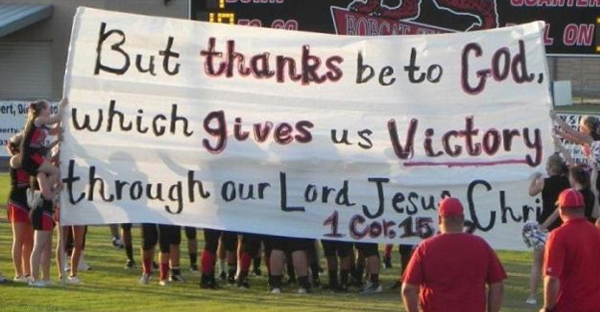
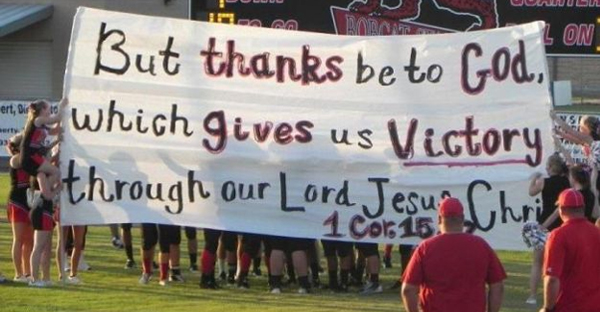
Update: Cheerleaders Can Love Jesus

Tim Tebow can love Jesus.  But can cheerleaders at a public high school?  A Texas judge ruled this week that they can.

This story has been circulating for several months.  As we’ve reported here on ILYBYGTH, in September the Kountze Independent School District banned high school cheerleaders from displaying Bible-based banners at football games.  Prompted by the Wisconsin-based Freedom from Religion Foundation, the school district worried that such displays violated the Constitution.

Source: KNUE

Source: KNUE

Parents fought back.  They argued that the cheer squad was a student organization, not funded by public dollars.  As such, the students’ religious speech was protected by the Constitution.

Earlier this week, according to a local TV station, District Judge Steve Jones ruled that the cheerleaders should be allowed to continue with their religious messages. 

End of story?  Not quite.  The school district has promised to change its policies, which might give it the right to ban such banners again. 


Kruse-ing to Conservative Schools

For those of us who follow conservative education policy and ideology, Dennis Kruse of Indiana has been one to watch lately.  Senator Kruse chairs the state senate committee on education and career development.

In December, Kruse attracted our attention with his promise of a new “truth-in-education” bill.  This bill would allow students to question their teachers on any controversial subject.  Teachers would be legally responsible to provide evidence supporting his or her classroom content.

Recently, we discovered a helpful way to track the legislative ambitions of this conservative leader.  The Indiana State Senate website allows anyone to view legislation introduced or sponsored by any legislator.

A review of Kruse’s 2013 activity shows us the educational vision of this particular conservative, at least.  For example, this busy senator has authored bills to support prayer in charter schools, to declare that parents have supreme rights concerning their children, and even to mandate the teaching of cursive in Indiana public schools.

Of course, many of these bills will never see the light of day; many are simply political discussion starters.  But even as such, the vision of America’s schools demonstrated by Senator Kruse’s ambitions can tell us a great deal about what conservatives want out of education.  If somehow Senator Kruse became Supreme Emperor Kruse, we can imagine an education system in which religion played a leading role.  It might also be a school system where students learned traditional skills such as writing cursive.  Parents might be empowered to insist on curricula friendly to their religious backgrounds.

Kruse’s 2013 legislative record also demonstrates the tight connections—among conservatives like Senator Kruse—between educational conservatism and a broader cultural conservatism.  In addition to his school bills, Senator Kruse has supported bills to have mandatory drug testing for all state assistance recipients and to provide every abortion recipient with explicit information about the dangers and risks of abortion.

This tightly bundled conservatism demonstrates, IMHO, the need to understand conservatism broadly.  Too many commentators focus on high-profile issues such as creationism or school prayer in isolation.  By instituting better science standards, for instance, some progressive types think they can derail conservative policy.  Such one-issue reforms will not have much impact unless they recognize that educational conservatism is bigger than any one issue.

So what do conservatives want out of America’s schools?  In the case of Senator Kruse, at least, outsiders like me can see an explicit legislative program.

The Bible and Atlanta’s Cheating Teachers

What made them do it?  Those dozens of teachers in Atlanta indicted for cheating?  Do they need more Bible?

Some commentators have blamed the high-stakes testing regime itself.  As David Callahan wrote for the Huffington Post, the culture of testing pushes teachers and superintendents to doctor test results.  According to Sean Higgins of the Washington Examiner, Randi Weingarten of the American Federation of Teachers blamed America’s “test-crazed policies.”

Arch-creationist Ken Ham takes a different approach. The problem, Ham insists, is America’s Godless culture.  In a Facebook post yesterday, Ham indicted the schools themselves.  America’s public schools, Ham wrote, “take billions of dollars of your tax money for education,” but they fail to recognize the truths about human nature clearly explained in the Bible.  Most teachers, Ham argued, “are hatched from the same cultural eggs as much of the rest of society,” and that society kicked the Bible out of public life back in the 1960s.

As a result, Ham concluded, “it should NOT be a surprise to us when they try and cheat the testing system in order to make themselves look good!”

For Ham, the problem behind the Atlanta cheating scandal was not the way the tests encouraged teachers to lie.  The problem, instead, was the secularized culture of public life and public schooling.  Without the guidance of the Bible, teachers—like all Americans—will sink into the degrading morass of cheating and lying.


Jesus Increases Graduation Rates

In Christianity Today we find a story about Detroit’s Cornerstone Schools.

Founded in 1991, today these schools serve 1,500 students, 97% of whom graduate from high school and 90% of whom go on to college or the military.

These statistics have attracted national attention.  In one profile for CNN, the schools’ success was credited to “three Cs:” a Culture of education, Commitment to learning, and Community.  (See video clip, 2:28, right at the end.)

The profile in Christianity Today, not surprisingly, focused on another C: Christ.  In an interview with the schools’ leaders Ernestine Sanders and Clark Durant, CT‘s Dwight Gibson concluded that the schools’ success comes from one simple fact: Cornerstone represents “a school whose culture is centered on the person of Jesus.”

Chairman Durant framed the schools’ success this way:

“We have fabulous statistics. Most of our kids graduate from high school in a city where maybe 30 or 35 percent do. More than 90 percent go onto college, the military, or some other kind of learning. But those are not the measurements that really determine a fulfilling life. Sure, it’s important, but is it the measurement we use for our own children? Is it the measurement that God uses for us?”

President Sanders did not credit the schools’ academic successes with innovations such as an 11-month school year, mandatory Mandarin classes, or mandatory parental commitment.  Instead, Sanders explained Cornerstone’s success this way:

“It’s our people, whether it’s our maintenance man, Mr. Cole, or a teacher. In Mr. Cole finding his place in this community, the kids see him as valuable. He has wisdom.  That’s why Cornerstone is excellent—we try so hard even as imperfect as we are to lift up a Christ-centered culture.

“And in lifting up that culture, the education is coming along. So you keep aspiring to that excellence. What we try to do here is not to be daunted by the circumstances. Rather than being daunted by it, we try to be as strategic as we possibly can. I see us trying to build that broad and beloved community that Clark referenced.”

The story raises some key questions about the proper relationship between religion and education.

  • Can public-funded schools use religion to boost graduation rates?
  • Is it enough justification to have religion in public-funded schools if those schools produce academic success?
  • And why didn’t the CNN story mention the religious nature of these schools?

Why School Choice?

As National School Choice Week moved into the history books, we have to ask: Is school choice a “conservative” issue?

There is no doubt that conservatives support choice.  Stalwart conservative organizations such as the Family Research Council and the Heritage Foundation make choice a centerpiece of their education policy platforms.

But the arguments conservatives usually make in favor of school choice often sound more traditionally “progressive” than anything else.  Is this mere political strategy?  Or a more profound commitment to social justice for those without economic resources?

The stereotypically “conservative” reasons for school choice are fairly simple.  First, opening up a variety of schools that receive tax dollars will enshrine the principles of free-marketism into public education.  Second, a thriving choice system will send more tax dollars to religious schools.

And we do occasionally see such arguments by conservative intellectuals.  The Friedman Foundation, for instance, legacy of free-market guru Milton Friedman, argues that choice will fix America’s public-education system.  According to Milton and Rose Friedman, that system has too often been “deprived of the benefits of competition.”

Similarly, Notre Dame’s Richard Garnett recently argued that school choice could help save struggling Catholic schools like the one that educated US Supreme Court Justice Sonia Sotomayor.

More often, however, conservative activists argue for school choice using different themes.  Most commonly, choice is presented as the best hope of low-income families in neighborhoods with sub-par public schools.  During National School Choice Week, we saw an outpouring of such rhetoric.
For instance, the Heritage Foundation publicized a speech in favor of choice by former Alabama Congressman Artur Davis.  Choice, Davis argued, could give options to a seventh-grader who submitted the following barely literate argument:

“[Y]ou can make the school gooder by getting people that will do the jod that is pay for get a football tame for the kinds mybe a baksball tamoe get a other jamtacher for the school get a lot of tacher.”

According to Davis, this student from Highland Park, Michigan was passed into eighth grade despite his struggles with basic writing.  Choice, Davis argued, could help.  It could offer parents, teachers, and students better schools now.  According to the Heritage Foundation article, Davis believed that school choice offered “the education [children] need right now, instead of simply pouring more money into the program or waiting for some new reform plan.”

Similarly, a writer at the social-conservative Family Research Council insisted that the main reason to support school choice was that “School choice gives students an opportunity to achieve a quality education and helps them not to fall through the cracks. We should all be in favor of helping children reach their fullest potential.”

Perhaps the most compelling statement of this conservative argument for the progressive virtues of school choice came over twenty years ago in an essay by Berkeley Law School’s Professor Emeritus John Coons.  As Coons argued in his 1992 essay, school choice advocates too often focus only on choice as a free-market device.  Instead, Coons insisted, such choice must be seen as “Simple Justice.”  Despite efforts to desegregate schools and make schools less imposingly Protestant, Coons wrote,

“we still arrange education so that children of the wealthy can cluster in chosen government enclaves or in private schools; the rest get whatever school goes with the residence the family can afford. This socialism for the rich we blithely call ‘public,’ though no other public service entails such financial exclusivity. Whether the library, the swimming pool, the highway, or the hospital—if it is ‘public,’ it is accessible. But admission to the government school comes only with the price of the house. If the school is in Beverly Hills or Scarsdale, the poor need not apply.

Choice is the obvious remedy for such maldistribution and discrimination.”  

Coons argued that non-elite parents deserved the right to send their children to schools that matched parents’ religious and cultural beliefs.  Such parents did not write op-eds in the New York Times.  Such parents did not have the option to influence the greater culture by making award-winning films or prize-winning books.  “Children,” Coons wrote, “are the books written by the poor.”

Yet despite such protestations among conservative intellectuals and pundits, school choice remains its reputation as a conservative issue.  As one angry commenter noted on the Family Research Council website,

“you see, school choice is really about getting as many students to pray to God each day. And, how many of these school choice advocates would have pressed for integration back in the 50’s? Very few. It’s about supporting religious schools through taxpayer dollars.”

Similarly, Americans United for Separation of Church and State has protested,

“It’s about funding religious and other private schools with taxpayer dollars and ultimately destroying the public school system.

“If you think the Heritage Foundation, the Koch Brothers and Betsy DeVos are in this just to help to some poor kid in the inner city, they’ve got a privatized bridge in Brooklyn they want to sell you.”

We ask again: Why school choice?  Do conservatives support school choice because choice will crush teachers’ unions?  Because choice will promote a freer free market?  Because choice will get more students praying in schools?

Or do conservatives support choice in order to help more children faster?  Because choice offers a way to deliver better education to low-income students?

My hunch is that, for many conservatives, the best answer is all of the above.  No doubt many conservatives want freer markets and a more Christian public square.  And school choice promises to deliver those things.  But choice might also be attractive because it gives better schools to more people faster than any other measure. 

Teaching the Bible, Texas Style

A new report from the Texas Freedom Network warns that some public schools in Texas are teaching religion.  Not all religions, but the Bible-loving, apocalypse-watching, evolution-denying type of conservative evangelical Protestantism.

How do these public schools justify it?  According to the TFN report, public schools fold these sectarian doctrines into their Bible courses.  Public-school courses about the Bible are explicitly constitutional.  US Supreme Court Justice Tom Clark made very clear in his majority opinion in Abington Township v. Schempp (1963) that public schools can teach the Bible, if they did so in a non-devotional way.  As Clark specified,

“Nothing we have said here indicates that such study of the Bible or of religion, when presented objectively as part of a secular program of education, may not be effected consistently with the First Amendment.”

However, the TFN report argues that many of the Texas school districts are using Bible classes to teach religious doctrine, including the notion that the Bible demands a young earth.  The report’s author, Mark A. Chancey of Southern Methodist University, reports that the courses are generally poorly taught, with low academic rigor, by underprepared teachers.

Professor Chancey includes excerpts from some of the teaching materials.  In the Dalhart Independent School District, for example, one student information sheet included the following information:

“Since God is perfect and infallible, an inspired book is absolutely infallible and errorless in its facts and doctrines as presented in the original manuscript” (pg. 28).

In the Bible courses of Lazbuddie, Texas, students will read the following:

“We should have an understanding of what happened in Noah’s day if we are to know when the coming of our Lord is near.  What are the similarities between the days of Noah and the days preceding the coming of Jesus Christ (Matthew 24:37-39)?” (pg. 32)

In Dayton schools, students watch the Left Behind movie, fundamentalist author Tim LaHaye’s dramatization of the rapture and final days (pg. 19).

As Chancey points out, these doctrines are intensely sectarian.  They teach a specific interpretation of the Bible as eternally true.  Students in these public school classes would be told that the doctrines of conservative evangelical Protestantism are the correct and only interpretation of the Bible.

Are we shocked?

We shouldn’t be.

Here’s why not:

First of all, the numbers of schools and students involved is very small.  Professor Chancey found 57 districts plus three charter schools who taught Bible courses in 2011-2012, a small percentage of the 1037 districts in Texas.  Not all of these districts taught the Bible in such heavy-handed sectarian ways.  And of the districts that reported their student numbers, only three had more than fifty students enrolled in Bible class.  Six districts had fewer than five students in Bible (pg. 5).

Second, the practice of teaching sectarian religion in public-school Bible classes has a long and surprisingly uncontroversial history.  As I explored in my 1920s book, while public attention was focused on anti-evolution laws, between 1919 and 1931 eleven states quietly passed mandatory Bible-reading laws for public schools.

Finally, even after the anti-Bible SCOTUS ruling in 1963, many public schools simply continued the practice.  As political scientists Kenneth Dolbeare and Philip Hammond found in their survey of schools in a Midwestern state, the Supreme Court rulings against public-school Bible reading made absolutely no difference in school practice.  Where students had read the Bible before, they continued to do so, without raising any controversy.

So Professor Chancey’s findings that a few students in a few public schools in Texas learn a sectarian interpretation of the Bible should come as no surprise.  As Chancey notes, similar Bible classes go on in several other states as well (pg. v).  Moreover, as political scientists Michael Berkman and Eric Plutzer have convincingly argued, public school teachers usually teach ideas that are locally uncontroversial.  In some places, that means teaching creationism as science.  In others, it means teaching the Bible as history.


School Shootings and the “Crime of ‘62”

Governor Mike Huckabee is not alone.

As we’ve noted, the former governor of Arkansas and prominent conservative radio personality denounced the lack of prayer and Bible-reading in public schools.  Such a-religiosity, Huckabee declared, must be part of the reason for last week’s terrible school shootings in Connecticut.

More recently, Bryan Fischer, public face of the conservative American Family Association, echoed Huckabee’s sentiments.  In this video posted by the watchdog group RightWingWatch, Fischer intoned, “Back when we had prayer, the Bible, the Ten Commandments in school, we did not need guns.”  In a follow-up article on the AFA website, Fischer offered similar explanations:

“The truth may be that God was made unwelcome and left. God submits himself to the law of faith, and will not go where he is not wanted. He will not force us to put with him if we don’t want him around. It may be that his protective presence is being removed from our land and from our schools because he has been told repeatedly that his protective presence is not wanted.

“We have, as a culture, systematically booted God from our public schools for over five decades.. In 1962, the Supreme Court issued a diktat that American schools could no longer seek his help and protection. In 1963, the Supreme Court issued a second diktat prohibiting the reading of his Word in our public schools. And in 1980, the Supreme Court issued a third diktat prohibiting the display or teaching of the Ten Commandments, God’s abiding and transcendent moral standard for human conduct.

“So God is no longer prayed to, his counsel is no longer sought and his standards are no longer respected. Is it any wonder that he might not be around when we need him? If we have spent 50 years telling him to get lost, it should not come as a surprise that we eventually begin to feel the absence of his powerful presence.”

Fischer’s evocation of 1962 as a major turning point in American culture is one that resonates deeply among conservative evangelical Protestants in the United States.

Yet among the broader culture, the year does not have the same dramatic power.  This was noticed by conservative evangelicals at the time, as well.

First of all, for evangelicals at the time, it was not 1962, but 1963 that was the real watershed.  In 1963, after all, the US Supreme Court’s decision in Abington Township School District v. Schempp ruled that public schools may not lead devotional Bible readings or teacher-led classroom prayers.

The similar but distinct 1962 decision, Engel v. Vitale, was actually welcomed by many evangelical leaders.  In that decision, SCOTUS ruled that the state could not impose an ecumenical state-written prayer on public schools.

As I argue in my recent article in the Journal of Religious History, evangelical intellectuals at the time could not understand the widespread mainstream indifference to the US Supreme Court’s Schempp decision in 1963, especially when contrasted with the popular uproar that met 1962’s Engel decision.  The article is subscription-only, but here is a small snippet:

“A Moody Monthly poll of evangelical editors in early 1964 found that they considered the Schempp decision the most important event of 1963, outranking the year’s civil-rights activism and Birmingham’s 16th Street Baptist Church bombing in importance to American culture and society.[i]  Yet compared to the popular outrage against the Engel decision, the Schempp decision caused less public protest.[ii]  As the editors of Christianity Today noted in the aftermath of the Schempp decision, ‘Why church leaders and the public at large took the broader 1963 decision more calmly deserves nomination for the mystery of the year.’”[iii]

It is difficult to know what to say in the wake of an event like the recent school shootings.  The public remarks of prominent conservative Christians such as Governor Huckabee and Bryan Fischer demonstrate the deeply held feelings among many Americans that the SCOTUS decisions of 1962 and 1963 put America on a woeful path.  Public schools, many feel, must embody the religious traditions of the nation.  Not only as history or literature, but as guideposts for morality and prayer life.

As Fischer’s comments illustrate, it is not the specifics of the SCOTUS decisions of 1962 and 1963 that matter to conservatives, but the notion that mainstream America has turned its back on God by kicking God out of public schools.


[i] “Report: The Month’s Worldwide News in brief,” Moody Monthly 64 (January 1964): 8.

[ii] Donald E. Boles, The Two Swords: Commentaries and Cases in Religion and Education (Ames, IA: Iowa State University Press, 1967), 111-112.

 [iii]  “Compliance, Defiance, and Confusion,” Christianity Today 8 (11 October 1963): 34.

School Shooting? Blame the Supreme Court

Is the US Supreme Court responsible for the recent horrific shooting at an elementary school in Newtown, Connecticut?

That is the implication made by Mike Huckabee, conservative radio personality, former Governor of Arkansas, and occasional presidential candidate.  Huckabee told Fox News that school violence could be prevented by letting God back into public schools.

Asked by reporter Neil Cavuto how God could allow such a tragedy, Huckabee responded,

“We ask why there’s violence in our schools, but we have systematically removed God from our schools. Should we be so surprised that schools would become a place of carnage? Because we’ve made it a place where we don’t want to talk about eternity, life, what responsibility means, accountability. That we’re not just going to have to be accountable to the police if they catch us, but one day we stand before a holy God in judgment. If we don’t believe that, then we don’t fear that. . . . Maybe we ought to let (God) in on the front end and we wouldn’t have to call him to show up when it’s all said and done at the back end.”

As I argued recently in an article in the Journal of Religious History, this argument has been a standard theme among conservative evangelical Protestants since SCOTUS’ 1963 Schempp decision.  The journal is subscription-only, but the essence of my argument is as follows:

many religious Americans, far beyond the ranks of evangelical Protestants, concluded that the Court had kicked God out of public schools.  Unlike other religious Americans, however, evangelicals had long had special influence over public education.  These Court decisions had a unique impact on evangelical attitudes because evangelicals had harbored an implicit trust in their own unique role in public education.  When the Supreme Court ruled that evangelical staples such as recitation of the Lord’s Prayer and reading from the Bible could no longer be performed in public schools, it forced evangelicals to an unexpected grappling with their wider relationship to American society.  Not only did the Court decisions kick God out of public schools, in other words, but it effectively kicked evangelicals out of the American mainstream.  

            As a result, evangelicals shifted from feeling part of a politically invulnerable religious majority to feeling themselves part of a put-upon minority. This dramatic and relatively sudden change in evangelical sentiment had important results.  For decades, politicians and politically minded preachers attracted evangelical support by articulating these new minority sentiments.  Jerry Falwell, for example, organized the significantly named Moral Majority as an effort to represent the values of conservative Fundamentalists, whom Falwell called “the largest minority bloc in the United States.”[i]  Similarly, in a stump speech in early 1984, Ronald Reagan played to the sensibilities of evangelical voters when he condemned “God’s expulsion” from public schools.[ii] 

Could a more robust religious curriculum in America’s public schools have deterred the school shooter in this case?  That does not seem to fit the facts.  However, Governor Huckabee has articulated a notion that remains very common among some religious conservatives: Schools cannot teach without religion.


[i] George Vecsey, “Militant Television Preachers Try to Weld Fundamentalist Christians’ Political Power,” New York Times, January 21, 1980, A21.

[ii] Quoted in Catherine A. Lugg, For God and Country: Conservatism and American School Policy (New York: Peter Lang, 2000), 159.

A Long Way from Texas…

Can cheerleaders at a public school sport Biblical phrases on banners?

The cheerleaders in Kountze, Texas, think so.  So does the Texas Attorney General.  So do tens of thousands of Facebook supporters of the cheer team.

But an important part of this story is often being left out by coverage in some mainstream media outlets. Why?

We’ve reported on this story before.  In short, this group of cheerleaders sued when their school superintendent banned their religious banners from football games.  So far, the cheerleaders have been allowed to keep on cheering for Jesus at their games.

Recently, we’ve noticed a puzzling trend in the reporting about this story.  An editorial in yesterday’s New York Times, for instance, bemoaned the situation in Kountze.  “In this country — including in Texas — the Constitution does not leave religious freedom up to majority rule,” the editors insisted.

I agree with the NYT‘s basic position: the SCOTUS precedent in 2000’s Sante Fe ISD v. Doe speaks directly to this case.  Even student-led prayer, if sanctioned by the school district, implies an endorsement of particular religious beliefs by the government.  Though the Kountze cheerleaders insist that their banners represent purely private speech, this seems a stretch.

However, I’m puzzled by the way NYT coverage has left out a vital part of this story.  For those of us who want to understand the ways conservatism works in American education, whether it be about evolution, school prayer, sex education, or other issues, the skewed coverage in the NYT makes the job much harder.

Here’s the problem:  In yesterday’s editorial and in earlier reporting on this Kountze story, the NYT left out an important key player in the drama.  The NYT neglected to mention the role of the Freedom from Religion Foundation.  This Wisconsin-based group warned the school superintendent of its plans to sue over the banner issue.  Only then did the superintendent ban the cheerleaders’ religious practice.

The NYT misled readers with its description of the reasoning in Texas.  The editors described the case as follows:

“Those banners are not merely personal expressions of belief, but in that setting become religious messages endorsed by the school, the school district and the local government.       

“That’s why officials of the school district last month prohibited the banners at football games.”

But the way the story really played out, the school district only prohibited the banners under pressure.  In fact, as the Los Angeles Times reported, the school superintendent himself supported the cheerleaders.

If we hope to understand the dynamic, in this case or in the many other school-prayer cases in history and in the news, we must not omit such an important element.

Please do not misunderstand: I am not denouncing the Freedom from Religion Foundation.  I do not think that sectarian prayers belong at public-school events.  But I do want to understand these cases, and ignoring important elements such as the role of outside organizations leaves us unable to understand the situation.

As political scientists Michael Berkman and Eric Plutzer have argued in their books Ten Thousand Democracies and Evolution, Creationism, and the Battle to Control America’s Classrooms, teachers and school districts respond to local culture.  When communities want prayer and creationism in public schools, schools include prayer and creationism.

As Berkman and Plutzer proved with their survey of high-school biology teachers, the beliefs of those teachers usually closely match those of their local communities.

In the Kountze case, the school district, including even the superintendent who banned the banners, supports the cheerleaders.  As superintendent Kevin Weldon told the LA Times, the judge in this case “was in a pretty tough predicament, like myself. . . . I personally applaud the kids for standing up for their beliefs in such a bold way.”

If we hope to understand the ways issues such as creationism and school prayer play out in America’s schools, we can’t let ourselves miss the way schools, teachers, and school districts actually function.  Teachers, as Berkman and Plutzer insist, are “street-level bureaucrats.”  They represent majority opinion in their communities.  The same is often true for superintendents such as Kevin Weldon in Kountze.

None of this is new.  In the Scopes Trial in 1925, the prohibition of evolution in Dayton, Tennessee only became controversial when the American Civil Liberties Union became involved.  More recently, as political scientists Kenneth Dolbeare and Phillip Hammond demonstrated in the 1970s, US Supreme Court decisions about school prayer and Bible reading often have no discernable effect on school practice.  After the 1962 and 1963 Supreme Court decisions against the reading of the Bible and reciting of the Lord’s Prayer in public schools, Dolbeare and Hammond found that all the schools in their survey continued to pray and read the Bible.  Most important, those practices caused absolutely no controversy in the communities they studied.

If we hope to understand school prayer controversies, we can’t allow ourselves to leave out the role of key players such as the Freedom from Religion Foundation.  Perhaps the NYT editors hoped to avoid the old chestnut that only “outside agitators” brought about this sort of school controversy.  Whatever their reasons, they misrepresent the story and make it more difficult for outsiders like me to understand the nature of these school battles.
