From the Archives: Were You Trumpared?

I wasn’t. Studying populist conservatism taught me the wrong lessons—I thought conservatives would never tolerate an anti-strategic leader like Trump, even if they liked his policies. I wrongly believed more conservatives would do anything to maintain their reputations as respectable mainstream traditionalists. Did anything in your background prepare you to have a president who flits from tweet to tweet and treats foreign policy like a reality-TV ratings sweep?

Peter Greene says his did. As he wrote recently,

In many ways, becoming a student of ed reform prepared me for a Trump presidency, because it made me really confront the degree to which many of my fellow citizens do not share values that I had somehow assumed were fundamental to being a citizen of this country.

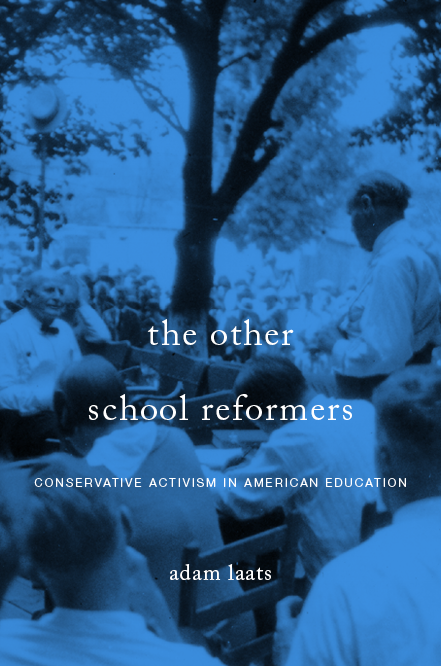
Here’s where I went wrong: In my 2015 book The Other School Reformers, I looked at the kind of populist conservatism to which Trump appeals so strongly. I didn’t study conservative intellectuals, but grass-roots activists who tried to push schools in conservative directions.
SPL 1

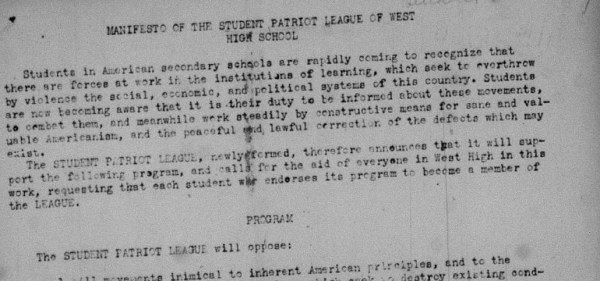
From the American Legion Archives, c. 1936.

Throughout the twentieth century, conservatives refused to be dominated by the anti-strategists in their camp. Time after time, conservative organizations carefully curated their public image to avoid the “extremist” label. Not all of them, of course, but the ones that really mattered. I thought—wrongly—that this pattern would continue.

My surprise is not about Trump’s specific policies. I can see how any conservative would love having Neil Gorsuch and Brett Kavanaugh on SCOTUS. My surprise is about style and strategy. In the history of American grass-roots conservatism there has always been an element we might call “Trumpish.” Meaning mercurial, impulsive, and unwilling to think through the likely consequences of any given action. Meaning acting first—speaking without reflection—heedless of accusations of radicalism or extremism. In Krusty-the-Klown terms, Trumpism means saying the quiet part loud and the loud part quiet.

In the past, that element was always held in check. Not by “faculty lounge” conservatives, but by practical, hard-nosed activists who wanted to win votes long-term.

This morning I’ll share an example from the archives that I hope will illustrate the tradition and demonstrate why I was so un-prepared for the triumph of Trumpism among American conservatives.

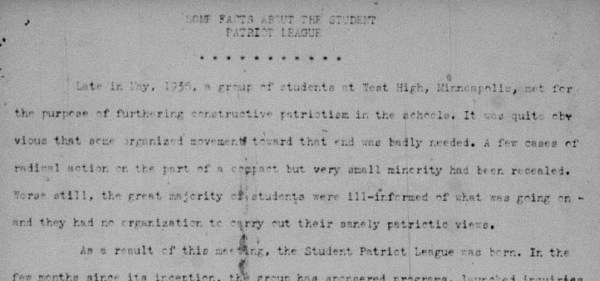
Exhibit A: The American Legion and the Student Patriot League, c. 1935. In the mid-1930s, the American Legion had a hard-earned reputation as a tough defender of a conservative patriotism and flag-waving militarism. The Student Patriot League was formed separately as part of a desire to get young people involved in fighting—literally fighting—for those values. The unofficial goal of the SPL was to send uniformed brigades of conservative youth to leftist rallies to disrupt them.

How did the American Legion respond? At the time, the obstreperous head of the Americanism Commission, Homer Chaillaux, engaged in a careful two-sided interaction. Officially, the American Legion had no relationship with the SPL. Chaillaux was worried that any violence would ruin the Legion’s already-shaky reputation as a reputable mainstream group. Publicly, Chaillaux maintained a careful distance between the SPL and the Legion. He told SPL leaders that he could not officially endorse their activities.

Unofficially, however, Chaillaux distributed SPL materials among his friends and allies. Chaillaux privately told his friends the SPL was a

splendid organization of scrappy young Americans who are students in high schools and colleges of the United States.

So what? The interactions between the Legion and the SPL demonstrate the ways grassroots conservative organizing used to work. There is no doubting Chaillaux’s dedication to his conservative principles. When it came to a new and untested youth organization, however, Chaillaux maintained a cautious official distance.
SPL 2

Conservatives used to care about their reputations for mainstream respectability.

That has always been the strategy of (most) conservative organizations. They have thought carefully and deliberately about their public image. They have been leery of losing credibility and ending up dismissed as extremists, like the Ku Klux Klan or eventually the Birchers. Or even Barry Goldwater or Curtis LeMay. Mainstream respectability used to matter to conservatives. A lot.

Trump doesn’t seem to care about his respectability. He doesn’t seem to mind the outrage and consternation caused by his last-minute decisions, even when the outrage comes from his own conservative allies. Instead, Trump does Trump and lets the chips fall where they may. That’s what I was unprepared for.

How about you? Were you like Peter Greene, prepared for the triumph of Trumpism? Or were you more like me, expecting GOP leaders to care primarily for their public image as respectable maintainers of the mainstream status quo?
From the Archives: “The Ku Klux Klan: Is It of God?”

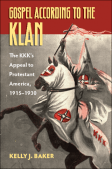
Will they or won’t they? Ever since editor Mark Galli broke the internet by denouncing Trump in Christianity Today, pundits have been struggling to decide if white evangelicals will turn anti-Trump in 2020. Historians like me can’t help but notice the pattern: When it comes to political controversy, interdenominational evangelicalism has always been hopelessly divided. From the archives today, a look at a similar division back in the 1920s.Gospel-According-to-the-Klan-Cover-320x483

First, in case you’ve been living under a holiday rock, a little context: White evangelicals voted for Trump in droves in 2016, and they remain as a group one of his most solid voting blocs. So when “flagship” evangelical magazine Christianity Today called for Trump’s removal, it caught people’s attention. Outgoing editor Mark Galli looked his fellow evangelicals in the eye—so to speak—and offered this blandishment:

Remember who you are and whom you serve. Consider how your justification of Mr. Trump influences your witness to your Lord and Savior. Consider what an unbelieving world will say if you continue to brush off Mr. Trump’s immoral words and behavior in the cause of political expediency. If we don’t reverse course now, will anyone take anything we say about justice and righteousness with any seriousness for decades to come?

Would evangelicals listen? Some evangelical Trumpists immediately fired back, doubling down in their support for Trump. As Wayne Grudem wrote,

On issue after issue, President Trump is changing the direction of the country for the better. When I weigh these results against his sometimes imprecise and coarse speech, there is no comparison. . . . I’ll vote again for Trump.

I know people won’t like the comparison, but this 2019 debate sounds a lot like a 1920s debate among white evangelicals. Back then, white evangelicals engaged in a similarly vituperative political debate. Back then, white evangelicals wondered if they should support the resurgent Ku Klux Klan. I’m not saying Trump is a 21st-century Hiram Evans. Or even a 21st-century Warren Harding. But I AM saying that evangelicals have always been divided on similar sorts of political issues.

To get the gist of the 1920s debate, we have to understand the nature of the 1920s Klan. Most people these days, if they think about the Klan at all, think mostly of the Civil-Rights-Era Klan, when it was a violent fringe group dedicated to upholding Southern racism and white supremacy.

To be sure, the 1920s Klan was plenty racist, but it was a very different organization in a lot of ways from the later 1960s Klan. First of all, it was much, much bigger, with millions of members all over the nation. It was also depressingly mainstream, with members openly joining and touting their membership. And though the Klan has always been devoted to racism and white supremacy, the 1920s Klan was also ferociously centered on fighting CATHOLIC influence.

Back then, as historians such as Kelly Baker have described, the Klan was all about white supremacy, for sure, but specifically more about white Protestant supremacy.

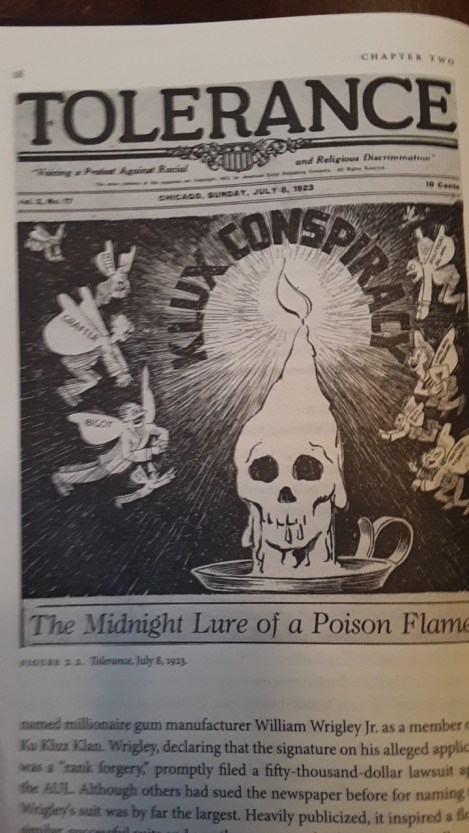
And, as historian Felix Harcourt argued brilliantly in his book Ku Klux Kulture, the 1920s Klan was controversial in ways that sound creepily familiar today. Back then, civil-rights groups felt a need to prove to America that the Klan was a “poison flame,” attracting “bigots,” “busy-bodies,” and “lame-duck preachers.”

Among evangelical leaders—both intellectual and populist ones—the question of the Klan was difficult. Indeed, in ways that later generations of white evangelicals would find eternally embarrassing, white evangelicals back then conducted a high-profile debate that sounds depressingly similar to today’s.

Back then, some evangelical pundits were unwaveringly pro-Klan. Down in Texas, Baptist fundamentalist pundit J. Frank Norris ardently supported the Klan. In 1924, for example, the Texas Baptist Convention planned to debate a resolution denouncing the Klan. As Norris put it in his trademark style,

suffice to say that every Roman Catholic priest and Knights of Columbus would be glad to sign the [anti-Klan] resolution, and the Pope at Rome will have [anti-Klan Baptists] cannonized [sic] as a Saint for all the ‘faithful’ to worship.

Up in Chicago, a similar Klan debate unfurled in the pages of the Moody Bible Institute Monthly. One contributor from Texas argued in 1923 that evangelicals must not fall for the siren song of Ku-Kluxism. As he wrote, the Klan failed the Biblical sniff test in a number of ways. First, the Bible clearly denounces any sort of anti-Semitism. Second, the Klan’s viciousness was not Christian. When it came to Catholics, this preacher wrote,

The Bible says, ‘Do good to them and pray for them.’ The Klan says, ‘Drive them out.’

In the end, this preacher opined, the Klan should not be supported for merely political ends. Yes, they do fight against alcohol, he admitted. And divorce. And gambling. And other sorts of public sin. But those shared goals did not make the Klan Christian. As he concluded,

The great principle of Christianity is love.  The outstanding principle of Ku Kluxism is hatred.

In response, a preacher from Lancaster, Pennsylvania defended the Klan as a good Christian organization. In the tumultuous ‘twenties, he wrote, subversive communism, drug-peddling immigrants, and corrupt politicians called for drastic action. As he concluded,

Investigate the Klan. So far I have found that the churches never had a more active ally, the state a more determined champion; our homes a more resolute defender, and lawlessness and vice a more powerful foe than the Ku Klux Klan.

The debate in MBIM went on throughout the early years of the 1920s. As celebrity pastor Bob Shuler wrote from California, the Klan had its problems, but overall it deserved evangelical support. Shuler offered a careful six-point list: The Klan defended Protestantism, public schools, “women’s virtue,” law enforcement, and American idealism. Plus, all the enemies of the Klan were dangerous types—bootleggers, pimps, and Catholics. As Shuler concluded,

I have for over twelve months conducted a most comprehensive investigation of the ideals, principles, teachings and activities of the Klan and have come to the slow and deliberate conclusion that there is not now organized in America a more hopeful secret society.

What was the upshot? MBIM editor-in-chief James M. Gray was no Mark Galli. He came out against the Klan in 1924, but in a very wishy-washy way. However, by the middle of the decade it was no longer quite so difficult for white evangelicals to know what to think. A series of scandals plagued the Klan organization and it became clear that they were not spotless warriors for Christian virtue.

None of that has any direct bearing on today’s Trumpist debate, of course. There are a million factors still at play for 2020. In the 1920s, it took blockbuster events such as Indiana’s DC Stephenson’s shocking conviction for a particularly brutal rape to push the debate about the Klan’s virtue off the evangelical front page. Will there be a similar deciding event in the evangelical debate about Trumpism? Has there already been one?

We Need LESS History, Not More

With apologies to SAGLRROILYBYGTH, I just couldn’t shut up and enjoy Christmas in peace. Instead, I had to keep brooding over the reasons why Andrew Ferguson’s piece was so silly. trump meanHere’s the upshot at Washington Post. Not only should historians be encouraged to talk about politics, but the best reasons for historians’ engagement can be pulled from history itself. In this piece, I pull from my new book about American creationism to point out the obvious: Historians’ expertise is important and it can move the needle on issues like impeachment.

In this case, America is not suffering from a lack of historical awareness. Rather, we find ourselves with a wide variety of histories to choose from. Like President Trump, we can assume that George Washington would smile on Trumpism. Or like the thousands of historians who support impeachment, we can point out that Trump’s misdeeds fit the Founders’ definition of impeachable offenses.

What does this have to do with creationism? A lot. The problem with creationism is not a lack of science. Rather, it is the fracturing of science. When Darwin first made his claims about natural selection and evolution, some fans assumed that people would accept it as soon as they heard about it. But we all know that’s not what happened. Instead, a bunch of different sciences developed, competing for followers.

We’re in a similar situation with history. There is not one history to learn, but a million. People are forced to pick a history to trust. They can believe Trump’s version, or they can listen to thousands of professional historians who disagree. In situations like this, expertise matters. Historians can help people agree on the historical truths that have the best claims, instead of just picking the ones they find most convenient.

At least, that’s the argument I made this week over at Washington Post. Click on over and read the whole thing.

Should Historians Talk Politics?

The question is not whether or not historians should get into politics. The proper question is whether or not historians should get into history. In case you missed it, journalist Andrew Ferguson just antagonized historians by mocking their attempts to weigh in on impeachment. As I’m arguing in my new book about creationism, sometimes the intellectual “sloppiness” Ferguson condemns is right on the money.

president supervillain

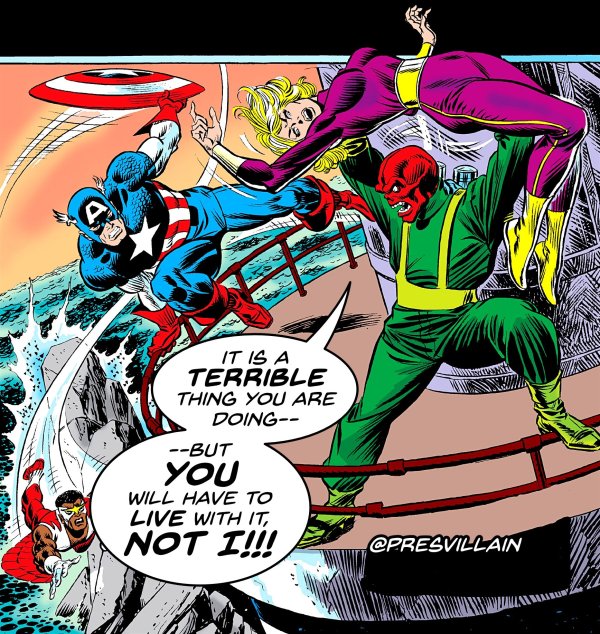
Should cartoonists weigh in on cartoons? Should Red Skull weigh in on villainy? [Side note: If you’re not following President Supervillain (@PresVillain) on Twitter, you’re missing the best part of today’s politics.]

Full disclosure: I signed. Ferguson was fluffed about the petition signed by over 2,000 historians in favor of Trump’s impeachment and removal. And, no doubt intentionally, Ferguson used provocative language to condemn activist historians, calling them merely “obscure signatories from backwater colleges scattered between the coasts.”

Beyond my hurt feelings, I think it’s fair to wonder if Ferguson’s accusations have any merit. The basis of his complaint is that historians are calling for impeachment based only on an argument from authority. As he puts it,

It is a reflexive form of what logic-choppers call an argumentum ab auctoritate, or argument from authority. The idea is to prove a disputed claim by pointing out that some expert or other authority believes the claim to be true. It’s a bogus but very popular trick.

In this case, though, Ferguson misses the central point. Historians are not merely weighing in as credentialed experts who have a certain political belief. Rather, in an age of fractured truth, historians are weighing in on an historical issue, as credentialed experts who have earned their expertise at great cost and toil. They are signaling to a bewildered public that not all forms of history have equal merit. All historical claims are tentative, but some are far more wildly bogus than others.

Trump letter pelosi

It is no longer self-evident that all historical arguments are not born equal.

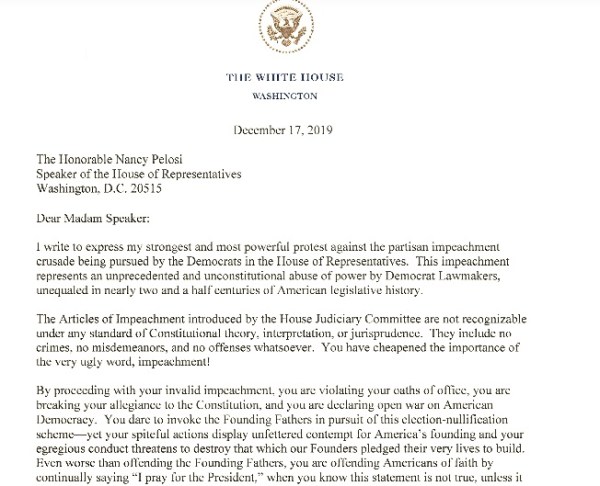
The disagreement in this case is not merely whether or not historians as individuals think Trump is a dangerous lout. More specifically, the impeachment case hinges on the nature of American history itself. In his self-defense, for example, Trump has made all sorts of claims based on his reality-TV-level understanding of history. As he wrote in his recent letter to Speaker Pelosi,

You dare to invoke the Founding Fathers in pursuit of this election-nullification scheme—yet your spiteful actions display unfettered contempt for America’s founding and your egregious conduct threatens to destroy that which our Founders pledged their very lives to build.

In other words, Trump is leaning on history to make his case against impeachment. Trump is not only defending his “perfect” phone call, but insisting that his actions are in line with the intentions of America’s founders centuries ago. The fight here is not only about today’s politics, but yesterday’s. To say that historians should not weigh in on events of the past seems more than a little silly. As Princeton’s Kevin Kruse put it,

The GOP invoked “history” repeatedly in their defense of the president — making claims about the Constitution, Franklin, Hamilton, past precedents of impeachment, etc. Don’t get angry when actual historians respond to those claims to point out they’re wrong.

Right on. In this case, historians are not merely voicing their views about politics based on their PhDs and institutional authority. They are speaking to the public on issues in which they have reasonable claims to expert authority.

Consider a parallel from another field of fractured truth. As science historian Adam Shapiro noted, telling historians not to speak politically is similar to the ways scientists have been told to stay in their labs. And it is just as meaningless.

Back in 1968, for example, SCOTUS was considering the constitutionality of a bunch of 1920s anti-evolution laws. As SCOTUS considered, scientists weighed in. The scientific case was clear. Leading biologists, 179 of them, signed a brief informing the justices that “scientists and other reasonable persons” no longer doubted the explanatory power of mainstream evolutionary theory. The justices eventually agreed.

These days, too, mainstream scientists happily lend their authority to the prestige of mainstream evolutionary theory. As the National Center for Science Education playfully demonstrated with its Project Steve, the number of scientists who support evolution—JUST NAMED STEVE—stretches to over a thousand.

Are these arguments from authority? In a way, but what Ferguson misses is that in an age of fractured truth, when politicians and preachers make outlandish claims about history and science, the authority of historians and scientists has real value. To a public confronted with bogus ideas about the past or about DNA, arguments based on the number of experts who attest to the truth of the matter is not only acceptable, but absolutely vital.

The Politics of Evangelical Magazines

The kerfuffle over Christianity Today got us thinking: How often have evangelical magazines gone out on a political limb? And what happened when they did?

First, the basics: Outgoing editor Mark Galli got people’s attention yesterday when he called for the impeachment and removal of Trump. As Galli wrote,

the facts in this instance are unambiguous: The president of the United States attempted to use his political power to coerce a foreign leader to harass and discredit one of the president’s political opponents. That is not only a violation of the Constitution; more importantly, it is profoundly immoral.

Some observers wondered if this statement by a leading evangelical publication signaled a “crack in the wall of Trump evangelical support.”

Trump’s evangelical supporters didn’t seem to think so. Conservative stalwarts such as Franklin Graham blasted CT‘s statement, saying his father, CT-founder Billy Graham, “would be embarrassed.”

trump et

Taking a bold stand against aliens…or Entertainment Tonight.

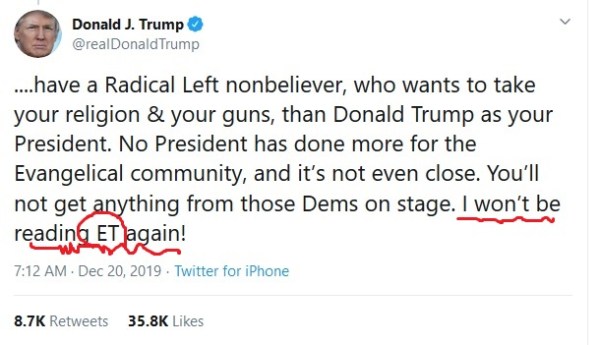
True to form, Trump himself blasted the decision in confusing and seemingly uninformed ways. He called CT a “far left magazine” and concluded that he “won’t be reading ET [sic] again.”

SAGLRROILYBYGTH already know all that. What they might not know is the history of political statements by leading evangelical magazines. From my Fundamentalist U research, I pulled up an example from the twentieth century.

Back in 1957, Billy Graham started a similar political firestorm among the white evangelical community by integrating his revival meetings. Based at Biola University in Los Angeles, the popular evangelical magazine King’s Business came out in favor of integration.

Editor Lloyd Hamill made clear in a scathing editorial in November, 1957, that King’s Business supported racial integration. As Hamill put it,

Graham was only proclaiming what the Bible plainly teaches. . . . No Spirit-controlled Christian can escape the solid fact that all men are equal in God’s sight.  Integration is not only the law of our nation, it is also the plain teaching of the Bible.

Another writer wrote in the same issue,

Now and then you hear some Christian say, ‘I don’t want any Negroes or Mexicans in my church.’  In whose church?  Christ paid for the Church with His precious blood and some saints seem to think because they put an offering in the plate on Sunday they have bought the Church back.

Bold words for the world of white evangelicalism in 1957. And predictably, the president’s office of Biola University was immediately flooded with mail. A few white evangelicals agreed with Hamill. But by a factor of about ten to one, the readers expressed their outrage.

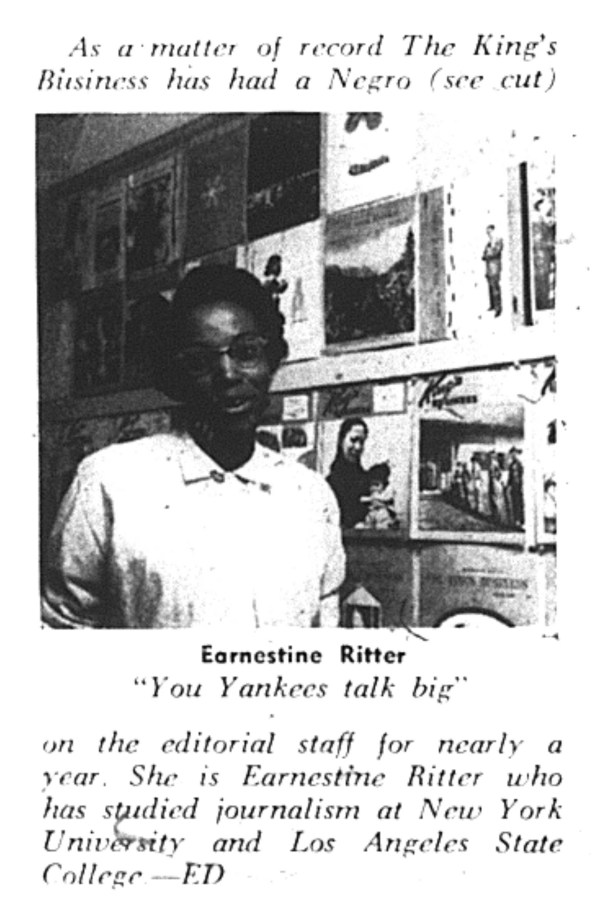
earnestine ritterHamill did not back down. He pointed out that the offices of King’s Business did not only advocate racial integration, they practiced it. As Hamill noted in the following issue,
As a matter of record The King’s Business has had a Negro on the editorial staff for nearly a year.  She is Earnestine Ritter who has studied journalism at New York University and Los Angeles State College.

What happened? Hamill was fired. Biola President Samuel Sutherland apologized to Billy Graham for the “very foolish letters [Hamill] wrote and statements which he made.”

Mark Galli won’t be intimidated. He already planned to retire soon. But the controversy unleashed by his anti-Trump editorial is far from the first time an evangelical editor has tried to push the needle among evangelical Americans.

The OTHER Myth about Evangelical History

Thanks to leading historian Matthew Avery Sutton, we see a reminder this morning that Trump is nothing new. Conservative evangelicals have always backed morally besmirched leaders. The idea that evangelical voters previously preferred “clean” candidates joins the myth that evangelicals retreated from politics in the twentieth century. It’s just not true. Weirdest of all, though, white evangelicals have long tended to pretend—maybe even believing it themselves—that their immoral candidates somehow personally embody Christian virtue. Why?

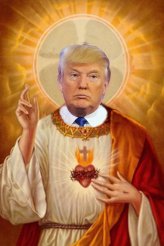
saint-donald1

St. Donald the Orange?

Professor Sutton, author of field-defining books such as American Apocalypse and now Double Crossed: The Missionaries Who Spied for the United States during the Second World War, points out that conservative evangelicals have a long history of supporting Trumpish crooks. Back in the 1920s, for example, prominent institutions like the Moody Bible Institute gave cigar-puffing, booze-swilling, corrupt wheeler-dealer Warren Harding their full-throated support. As Prof. Sutton relates,

The editors of the leading fundamentalist periodical Moody Monthly routinely praised Harding for his leadership. “We are thankful just now for a Federal administration,” they acknowledged, “which seems honestly disposed to do its best for the nation.” They insisted that “it is generally admitted that the President has gathered around him an efficient cabinet with a genius for team work.”

Conservative evangelical support for the train-wreck presidency of Warren Harding was not the exception. As Prof. Sutton writes, conservative evangelicals also picked divorced actor Ronald Reagan over Sunday-school teacher Jimmy Carter in 1980. They ignored Eisenhower’s meh attitude toward organized religion. Support for Trump among white evangelicals is just more of the same. As Prof. Sutton concludes,

Fundamentalists in the 1920s separated Harding’s personal morality from his pro-fundamentalist policies. Evangelicals in the Trump era do the same. If politicians champion white evangelicals’ proposals on immigration, foreign policy and religion in the public square, they are willing to forgive many, many personal sins. And when Trump’s nonvirtuous behavior serves their political goals by boosting his political power — for example, by accepting election interference from the Russians or by allegedly trying to pressure the Ukrainian president by withholding aid — they may see these acts as advancing a virtuous cause.

And evangelical support for dodgy politicians is often more than merely a pragmatic political decision. As Professor Sutton reminds us, white evangelicals have talked about their support for moral monsters in odd terms. As some evangelical leaders are doing these days with Trump, evangelicals have tended to lavish praise on their chosen political leaders, as when they hailed President Harding as “the Christian president,” or as “‘an earnest Christian man’ who ‘in all his speeches … advocated a return to the Bible and to Bible righteousness.'”

Support for Trump among white evangelicals is not an exception. It is the rule—white evangelicals have always done more than just hold their noses and vote for candidates based on hard-nosed policy considerations. In every case, some evangelicals will pretend to themselves that their candidates are actually good Christians.

Can anyone explain that one to me?

Is Trump the Real Menace to Evangelical Higher Ed?

We’ve had a lot to talk about this week. When Beto O’Rourke told CNN he would try to revoke the tax-exempt status of any religious institution that didn’t recognize same-sex marriage, he set off a firestorm among the evangelical-higher-ed community. As two Democratic congresspeople pointed out this week, though, the bigger threat to evangelical higher ed might actually be coming from a very different direction.

As SAGLRROILYYBYGTH are aware, the discussions at evangelical universities and colleges about LGBTQ rights have been intense. By stating that he would revoke the tax-exempt status of religious institutions that did not recognize same-sex marriage, O’Rourke raised the specter of Bob Jones University v. USA. Back in the 1980s, that SCOTUS case proved that the government really could deny tax-exempt status to schools that insisted on maintaining racial segregation. Might the government make a similar move about LGBTQ rights?

Evangelical intellectuals reacted furiously. As John Fea commented,

Beto has no chance of winning the Democratic nomination. His campaign has been on life support for a long time and last night he probably killed it.  You better believe that his comment will rally the Trump base and legitimate the fears of millions of evangelical Christians.

In my opinion, too, Beto’s comment was a poorly considered response to a badly worded question. I’m no evangelical, but like Friendly Atheist Hemant Mehta, I disagree with Beto on two counts. First of all, the government should not be in the business of policing religious belief. (When we want to talk about federal funds for student loans, we will need to have a different conversation.) Second, though, simply strategically, Beto goofed. In short, when the clown car of Trumpism is on fire, opponents should do everything they can to help people escape. It makes no strategic sense to lock people in.

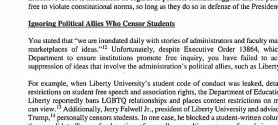
Unnoticed in all the hubbubery about Beto’s comments, though, two Democratic congresspeople this week sent a letter to Ed Secretary Betsy DeVos. Representatives Andy Levin of Michigan and Jamie Raskin of Maryland complained that the Trump administration was selectively enforcing its rules about campus free speech.

As they noted, President Trump signed an executive order threatening to withhold grants from universities that do not welcome free speech. The idea was to punish public universities such as the University of California that de-platformed conservative speakers. As the congresspeople noted, however, the worst offenders against campus free speech are conservative evangelical colleges like Liberty University.

As the Congresspeople complained,

Despite Executive Order 13864, which directs the Department to ensure institutions promote free inquiry, you have failed to act in cases of suppression of ideas that involve the administration’s political allies, such as Liberty University.

It’s not just Liberty U., which by any standards is an outlier in the field of evangelical higher ed. As I’ve argued in these pages and in Fundamentalist U, free speech presents a unique challenge to conservative evangelical higher education as a whole. Restrictions on speech and belief are the defining feature of evangelical universities. Unlike mainstream colleges, evangelical colleges do not claim to represent forums for all sorts of controversial ideas.

liberty letter devos

Dear Queen Betsy:

Threatening to revoke the tax-exempt status of religious institutions that don’t believe in same-sex marriage might sound scary to conservative evangelicals. But Trump’s warning to revoke student grants from institutions that don’t recognize free-speech rights should be of more immediate concern. To be fair, Trump’s executive order specified that private institutions should only be pushed into

compliance with stated institutional policies regarding freedom of speech.

Presumably, that wouldn’t help Liberty much, but it would give cover to conservative evangelical colleges that respect their own official rules restricting student and faculty speech. However, in the big picture, by threatening to take federal action against schools that restrict free speech, Trump might be planting the seeds of a longer-term problem for evangelical institutions.

After all, the language of LGBTQ rights has some wiggle room. Plenty of evangelical institutions could plausibly claim to recognize the rights of LGBTQ students and faculty while still embracing their religious skepticism about LGBTQ “practice.”

When it comes to free speech, however, evangelical universities have been built on a promise of restriction. If they were forced to abandon those rules, it would force them to give up the biggest single feature that distinguishes them from mainstream higher ed. It is free speech, not LGBTQ rights, that is the most important thing separating evangelical colleges from others.

Beto is talking a lot, but the real danger to evangelical higher ed might come from the other side. It might be Trump, in the end, who blunders into undermining the very foundation of evangelical higher ed.

Seeing Red at the Big Red University

If you read the culture-war headlines these days, you’d likely conclude that elite universities are citadels of uncompromising and relentless leftism. News from my alma mater today makes that myth a little more complicated.

madison trump protest_LI

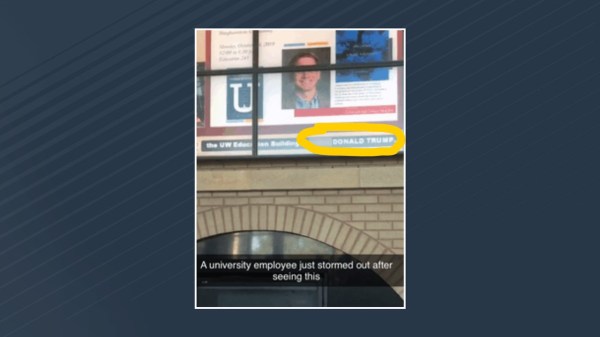
Waitaminit: Who’s that snappy-looking fellow on the big screen?

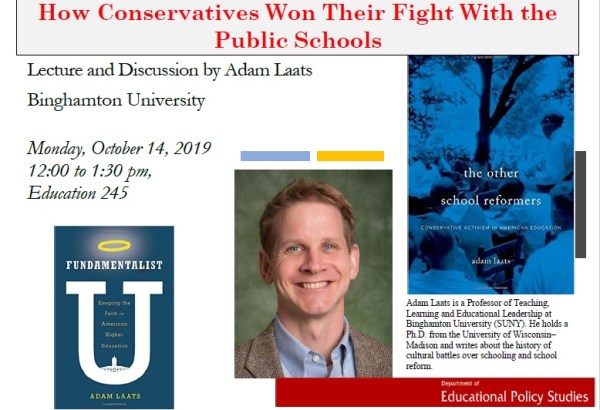
Here’s the story: So apparently there is a big digital display board on Madison’s campus. They use it to announce exciting upcoming events, such as the best lecture ever to take place, coming soon on October 14. If you look closely, you can see that someone typed in a derogatory reference to President Trump.

Apparently, a keen-eyed campus Trump supporter (or maybe just a vigorous devotee of Madison’s political-speech policy) complained and the message was removed. As a university spokesperson explained,

university policy prohibits the use of university resources for political campaigns. On UW-Madison’s website explaining the policy, “political campaigns” are described as an activity that “can include, among other things, solicitation of campaign contributions, service in furtherance of candidates, political parties and political action committees, and advocating a particular position on a referendum.

So is this proof that campuses are hotbeds of leftist thinking? Well, yeah, sorta. Someone in charge of that message board saw fit to insert an anti-Trump message. On the other hand, this story also shows that such leftist activism is officially quashed immediately, and that people are on the lookout for it. It is not tolerated or winked at. It is not universally agreed upon.

Most important, it shows that there is a scintillating event coming up on campus. If you’re in Madison on Monday, October 14, be sure to come to Education 245 at noon to hear my talk about the ways conservatives won their school battles in the twentieth century!

madison talk flyer

I Love You but You Didn’t Do the Reading

A professor fired for threatening Christians. Christians fired up about Trump the Blasphemer. Christian colleges on the rocks. And, yes, racist organic farmers in Indiana. All these stories and more made our list this week:

How can a professor get fired in Iowa? By saying, “It’s not pretty, and I’m not proud, but seeing what Evangelical Christians are doing to this country and its people fills me with rage, and a desire to exact revenge.” At IHE.

White evangelicals once changed their minds about lovin a president. Will Trump be next? At WaPo.

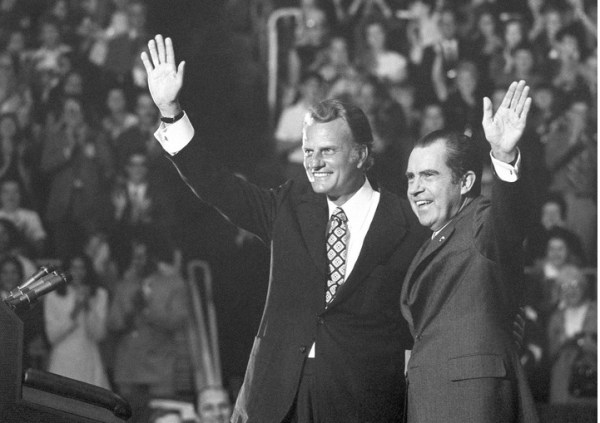
“Whether we like it or not, a major problem we face as evangelical Christians today is the identification in the popular mind of the religious position we represent with the Nixon administration and its actions. We are ‘middle America,’ the group sector that gave President Nixon his ‘mandate.’ We are the war party, the white backlash (if not racist) party, the Watergate scandal party.”

nixon graham wapoSome evidence that younger white evangelicals are already giving up on Trumpism, at 538.

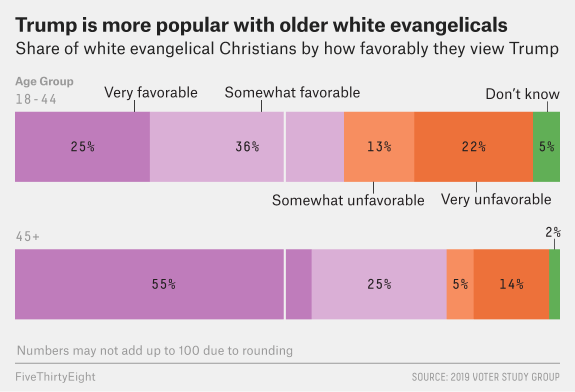
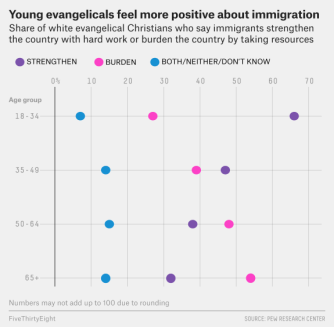
But there are increasing signs of a generational rift: Younger white evangelicals have not fully bought into Trump’s politics and are less receptive to Trump’s message of cultural decline. The age gap among white evangelicals in some ways just mirrors the age gap among the public overall with regards to Trump, but in conversations with a number of younger white evangelical Christians, many said they are reexamining the way their faith informs their politics and whether the two have become too tightly intertwined. . . . Two-thirds (66 percent) of young white evangelical Christians (age 18 to 34) say that immigrants coming to the U.S. strengthen the country because of their hard work and talents, a view shared by only 32 percent of white evangelical seniors (age 65+). A majority (54 percent) of older white evangelical Christians believe that immigrants are a burden on American society.

evangelical youth and trump 538

…still a lot of Trump-ism in there.

…or maybe all the blasphemy will drive evangelicals away? At WaPo.

Trump is neither the “Second Coming of God” nor the “Messiah.”. . . .

I am a conservative evangelical who cast my vote for Trump for the very same reason many other evangelicals did: his conservative stance on issues concerning abortion and religious freedom. I visited Washington last October for a briefing at which faith leaders listened to White House officials address many policy issues. . . .

We must . . . vocally denounce [Trump’s] blatantly egregious actions, including not only Wednesday’s tweets but also his consistently negative interactions and dialogue with people of different races, genders and ethnicities.

Christian mom vs. teacher-led school prayer, at Christianity Today.

Though I understand it’s pleasant for some to hearken back to a day when a tight-bunned teacher led children through a crisp Pledge and a Prayer (no matter what her heart, mind or soul actually believed) as somehow holier, better, safer, they weren’t. Schools with teacher-led prayer refused to admit black children. Schools with teacher-led prayer burnt to the ground. Students were still bullied. They still had sex, got abortions, and got high. Homes were still broken. Kids were still confused and frightened by their sexuality. Even back then. Even with all that prayer.

Yoga: Banned in Alabama, at CBS42.

“I don’t know if it is the school system or if it is a polarized subject, like abortion or common core,” Gray said. “It’s one of those things that people think is bad.”

Another good time not to be the mayor of Bloomington, Indiana. What are they supposed to do with racist organic farmers at their farmers’ market? At NYT.

Bloomington has declined to remove Schooner Creek from the market. Mayor John Hamilton said the farmers had First Amendment rights to their personal views as participants in a city-run market, and said the farm did not appear to be breaking any written rules about how vendors should behave at the market.

While some in Bloomington want Schooner Creek to leave, others said they wished protesters would drop their cause. In late July, an associate professor at Indiana University was arrested as she held up a paper sign in front of the Schooner Creek stand. Protesters yelled “Shame, shame!” as police officers escorted her away from the market.

racist farmers NYTTough times for evangelical colleges, at WORLD.
Nyack College, a Christian and Missionary Alliance (CMA) school in the New York City area, received an independent audit in 2017 with an opinion any institution dreads: “substantial doubt about its ability to continue as a going concern.”

What will the future hold for LGBTQ exemptions? Will evangelical institutions be forced to comply? At The Atlantic.

For religious groups and institutions that teach that homosexuality is a sin, and that men and women were created as such by God, the prospect of this kind of legislation is worrying. “It would be years of litigation—that’s what we would look forward to under the Equality Act as currently drafted,” Shirley Hoogstra, the president of the Council for Christian Colleges and Universities (CCCU), told me. For the nearly 140 Christian institutions that are members of her organization, she said, the bill “would put federal funding, it would put accreditation, it would put hiring rights, it would put campus student-life policies all at risk.” Fundamentally, these kinds of groups want to be able to preserve what they see as religious integrity in their own spaces—and they object when that is described as bigotry. “The Equality Act as currently drafted has caused Christian institutions to really wonder about whether their particular educational contribution is valued in America,” Hoogstra said.

Send in the clowns: A historical review of clownish leaders at HNN.

Making fun of those who have power over us is a small blow against authority. But the clown princes go further. What could be more anti-elitist than to take politics to the polar opposite extreme? Elitists read books, use evidence to make arguments, rely on science, demand proof; the clown prince needs no such intellectual crutches; they rely on passion, emotion, feelings. Lashing out is their feel-good option.

Women, transgender women, and sports. What is the fair solution? At Arc.

Free speech on campus: A new book argues that conservative gripes are bogus, at IHE.moskowitz IHE

Is denying someone admission to a college a threat to that person’s free speech? Is failing someone in a class a threat to their free speech? Is a student not being able to disrupt a class whenever they want a threat to free speech? We take these limits as a given, and even a positive in colleges, yet when it comes to students requesting or demanding that colleges not allow professors or students to say racist, transphobic and other offensive language without punishment, that becomes a step too far for administrators. So I would question whether they’re really afraid of limiting speech (which, as I said, they do all the time), or whether they’re afraid of confronting just how common and ingrained transphobia, racism and other forms of oppression are on their campuses.


Will Fundamentalist U Crush Trumpism?

Don’t be fooled by the noises coming out of Lynchburg. Though Jerry Falwell Jr. of Liberty University might be shameless (and just kind of weird) in his white-evangelical support for Trump, the overall landscape of evangelical higher education might be driving younger white evangelicals off the Trump train. We have to ask: Did the efforts of evangelical school administrators in the twentieth century lay the foundation for Trump’s political demise?

white evangelical youth immigration

Did ‘Fundamentalist U’ teach young evangelicals to value immigration?

Here’s what we know: Recent surveys show that younger white evangelicals don’t share their elders’ anxieties about immigration. As Daniel Cox wrote recently at 538:

Two-thirds (66 percent) of young white evangelical Christians (age 18 to 34) say that immigrants coming to the U.S. strengthen the country because of their hard work and talents, a view shared by only 32 percent of white evangelical seniors (age 65+). A majority (54 percent) of older white evangelical Christians believe that immigrants are a burden on American society.

That’s bad news for Trumpism. If younger white evangelicals don’t dislike immigration, they might waver in their support Trump. It might just crack his electoral base.

How does any of this relate to evangelical higher education?

As I found in the research for Fundamentalist U, many evangelical universities had a long and shameful racist history, just like most of the rest of American higher education. Starting in the 1950s, though, white evangelicals participated—and often took the lead—in promoting anti-racist attitudes among white Americans.

Institutions such as Wheaton College often floundered, but in the end they added new curriculum about African and African-American history and culture. They recruited more non-white faculty and students. They did not succeed as well as we might hope, but evangelical faculty members and administrators at many colleges worked hard to fight against white racism at their institutions.

What’s the upshot? In some cases, such as at storied Nyack College, the racial climate on campus has been utterly transformed. Nyack might be drowning in debt, but it has succeeded in attracting and retaining non-white evangelical students. When a white evangelical student attends a school like Nyack these days, she gets a very different sense of what it means to be a “good Christian” than her grandmother would have.

It’s not only Nyack or Wheaton. These days, evangelical colleges are far more racially diverse than they were in the past. As Cox notes,

On Christian college campuses, which have seen enrollment gains in recent years, young white evangelical Christians are part of an increasingly diverse student body. White students account for 62 percent of the student body on the roughly 140 campuses affiliated with the Council for Christian Colleges and Universities, down from 82 percent in 1999.

Younger white evangelicals, in other words, are experiencing life as part of a new kind of America, one in which white evangelicals no longer assume that they have a special role to play as the ‘real’ Americans, one in which Making America Great Again is not such a compelling battle cry. In large part, evangelical colleges and universities helped teach each new generation that diversity and immigration are not dangers, but strengths.

And because white evangelicals play such a large role in supporting Trump, today’s evangelical colleges could be spreading a message that will spell the end of Trumpism.