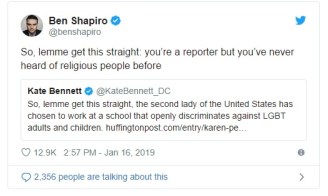
Understandably, some of her conservative defenders are taking the path of least resistance. Opposing any sort of non-hetero, non-married sexual activity, they say, has ALWAYS been a standard Christian belief. As Ben Shapiro put it most bitingly, Pence’s critics seem to have “never heard of religious people before.”
Thanks to the Made By History series editors, this morning I’m arguing in The Washington Post that Pence’s defenders are making an old mistake in their hasty counter-attacks. I won’t give away the details–you’ll have to click over to read the whole thing–but I will say I work in some of the biggest names in twentieth-century creationist history: Henry Morris, Bernard Ramm, and William Jennings Bryan.
Like many heretics, Falwell and his fellow evangelical Trump apologists are on their way to founding a new religion, one in direct conflict with the old.
I wasn’t going to do it. I was going to try awkwardly to maintain my dignity and refrain from any sort of year-end top-ten list. But then a couple of enforcers from the WordPress goon squad showed up and made me an offer I couldn’t refuse.
So here it is: The eleven most popular posts of 2018:
What is Life Like at Evangelical Colleges? Reflections from alumni of “Fundamentalist U.” What was it like to attend different schools in different decades? How did evangelical higher ed shape these students’ lives?
Billy Graham and Bob Jones From the archives, a look at the tempestuous and angry relationship between teacher and former student.
RIP Billy Graham, here preaching to the multitudes in London, 1954.
Crisis at Moody Bible Institute From way back in January 2018, a look at the ways the history of fundamentalist higher ed in the early 1900s set the pattern for the recent leadership shake-up at Chicago’s storied Bible school.
The Myth of Evangelical Political History Just Won’t Die: It doesn’t seem to matter that historians have punctured this story completely. Journalists still love it, probably because a lot of evangelicals love it.
Where Were You Radicalized? A simple question on Tweeter gets people thinking, but there’s one place no one seemed to be talking about.
Evangelical Colleges Aren’t Teaching Christianity A professor complains that her students don’t know Christian orthodoxy. I lay out the historical case that this is nothing new in evangelical higher education.
Bad News for Creationists Science just makes young-earth creationism harder and harder to believe. What will YECs do? I have a guess…
Will protests and activism follow? Will risk-averse administrators at major college programs decide that a game against Liberty is not worth the trouble? Will elite black high school athletes decide they don’t want to play for Trump University?
Should teachers exhort their students to vote for a particular candidate? No. Do teachers have the right to discuss controversial political issues in their classroom, without being forced to present opposing views? Of course they do– imagine a class a teacher must explain how Nazis and slave owners had valid points of their own.
I may disagree with what you say, but I’ll defend to the death my ability not to hear it…
As I’m arguing in my new book, the usual explanations just don’t hold water. The Richard Dawkinses of the world tend to think of creationism—at least the radical young-earth kind—as a kind of simple deficit. As Dawkins famously opined in 1989, creationists would have to be
ignorant, stupid or insane (or wicked, but I’d rather not consider that).
For those of us who understand the history and nature of America’s radical young-earth creationists, Dawkins’ dismissal doesn’t fit the evidence. Even if we are staunchly anti-creationist, if we’re paying attention we can’t help but notice that plenty of creationists know a lot about evolutionary theory. They are clearly intelligent and in possession of their mental faculties. And they might be wicked, that doesn’t seem to be a primary factor in their creationism.
Why? Hugo Mercier and Dan Sperber argue that human reason is not the engine of pure enlightenment it is often considered. Instead, reasoning evolved as a way to encourage group cooperation. In their words,
What reason does . . . is help us justify our beliefs and actions to others . . . and evaluate the justifications and arguments that others address to us.
What does this have to do with the durability of radical young-earth creationism? In spite of the accusations of angry Oxonians like Richard Dawkins, creationists have not abandoned their ability to reason and weigh evidence. Rather, if these cognitive psychologists are correct, human reasoning ability will tend to lead to greater in-group cohesion.
The brains of radical creationists tend to favor evidence that supports the dominant views of their group. They tend to dismiss evidence and arguments that go against them. This isn’t something unique to creationists. All our brains work in similar fashion. We don’t weigh facts evenly or dispassionately. We don’t even hear them that way. Rather, our brains seem hard-wired to accept facts that help us fit in with our groups.
In short, why are so many Americans creationists? Because they evolved that way.
Care a lot about the age of the earth? The origin of humanity? The actual historical existence (or not) of Adam & Eve? If so, you’re an oddball. According to a new report, however, you’re an oddball who probably gets a lot more attention than you deserve.
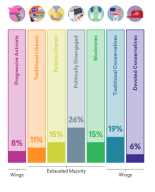
In their study of culture-war polarization, the folks at More In Common didn’t ask directly about creationism. In their survey of 8,000 adult Americans, though, they came up with a bunch of categories into which Americans divide themselves. Instead of using the usual demographic categories of race, class, gender, age, religion, and so on, they split respondents into seven major groups:
Progressive Activists
Traditional Liberals
Passive Liberals
Politically Disengaged
Moderates
Traditional Conservatives
Devoted Conservatives
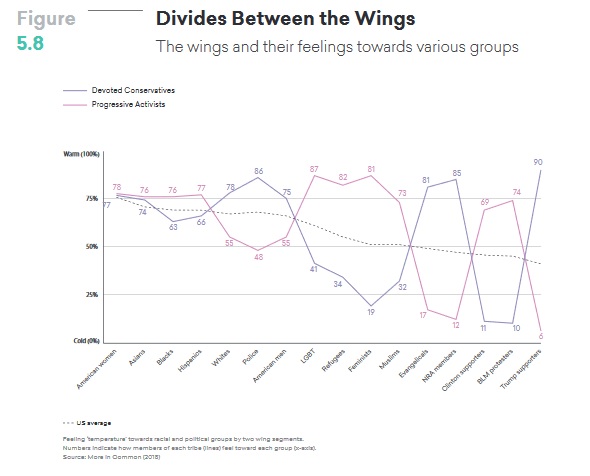
Time and time again, they found, the loudest voices on the margins dominated public debates, in spite of the fact that a large “Exhausted Majority” hoped for more compromise. As the report puts it,
Public debates are often dominated by voices that come from the furthest ends of the spectrum and who are the least interested in finding common ground. This makes it much harder to make progress on these issues, deepening the frustration felt by many in the middle.
On most issues, the people on the edges have diametrically opposed views and hold them very strongly. That is not the case for most people on most issues.
They didn’t ask specifically about creationism, but their findings translate well. As I’m arguing in my new book about creationism, Americans don’t really disagree as much about creationism and evolution as we’d think if we only read the headlines.
For example, when most people think about “creationism” these days—IF they think about creationism—they tend to think of the extreme young-earth creationists who make the most noise. Pundits such as Ken Ham dominate the headlines about “creationism,” even though their beliefs represent only a tiny fraction of the real landscape of American creationism.
Think about it: if we define “creationism” as a basic belief that some sort of higher power had something to do with the way life has come to be, then almost ALL Americans would fit into that category. Even leading “evolutionists” such as Ken Miller would fit. Professor Miller is one of America’s leading explainers and promoters of evolutionary theory, yet he is also a believing Christian. When it comes down to it, Miller wrote in his 1999 book Finding Darwin’s God,
God is every bit as creative in the present as He was in the past.
Is Prof. Miller a “creationist?” By any reasonable definition, of course he is. But when Americans fight about “creationism” vs. “evolution,” we don’t make room for the vast middle ground that includes religious scientists like Miller.
As the Hidden Tribes report states, most Americans
are going about their lives with absurdly inaccurate perceptions of each other.
Radical creationists think they are the only ones who care about God and creation. Radical atheists warn that creationist armies are scheming to turn public schools into madrassahs. In the vast middle ground, people think “creationism” must include a radical belief in a literal world-wide flood or a literal special creation in the Garden of Eden.
It doesn’t. There are plenty of ways to be a “creationist” while still accepting the explanatory power of mainstream evolutionary theory. In reality, there isn’t a flat-out culture war between creationists and the rest of us. There can’t be, because in reality almost all Americans are creationists of one sort or another. And almost all Americans want their children to learn evolutionary science.
You can be excused for not believing it, though, because the loudmouths on the outer edges distort all of our discussions.
It’s not about Darwin. It’s not even about Jesus. We see again this morning that radical young-earth creationism—at least Ken Ham’s Answers In Genesis brand—is built on a vision of American history in which fundamentalists are always under more and more attack.
Here’s what we know: This morning Ham tweeted a nostalgic video about Apollo 8. On that mission, astronauts circled the moon for the first time on Christmas Eve, 1968. In a live broadcast, astronauts read the opening verses from Genesis.
We can ignore the obvious stuff, like the fact that Ken Ham misdescribed this 1968 moon circling as the 1969 moon landing. We’re more interested this morning in Ham’s take-away from the video itself. What lesson did Ham draw?
2: The culture has changed–NASA sadly would not allow this today
Of course, as historians and SAGLRROILYBYGTH are well aware, back in the 1960s, Ham’s predecessors were articulating very similar laments about the dangerous trends in American culture. In early 1963, for example, Samuel Sutherland of the Bible Institute of Los Angeles (BIOLA) warned of the dangerous effects of the recent SCOTUS ruling against Bible-reading and teacher-led prayer in public schools.
What would happen now? Sutherland warned the SCOTUS decision might
Make our country an atheistic nation, no whit better than God-denying, God-defying Russia herself. . . . in prohibiting the name of God to be used in any form of prayer, [SCOTUS] are in effect advocating that the children be taught atheism.
Sutherland wasn’t alone in warning that 1960s America had gone to the atheist dogs. In 1965, for example, in the pages of Carl McIntire’s Christian Beacon magazine, one writer warned that the banishment of teacher-led Christian devotions from public schools
will mean the division even more sharply of this nation into communities of the secular and the Church, which will inevitably lead to more expression of the secular and more repression of the Christian. When this happens, repression, restriction, harassment, and then outright persecution will be the natural course to follow in secular opposition to Christian witness.
In the glorious 1960s, then, Ken Ham’s predecessors were making the same kinds of warnings that Ham is making today: Things used to be better for conservative evangelical Protestants. Public schools and public policy used to speak in the tones of evangelicalism.
Over and over again, across the decades, fundamentalist Cassandras have articulated a similar historical vision. The past was always better. The present–no matter what year–is characterized by a bitter sense of loss, by a grief for a glorious Christian past stripped away by scheming secularists and soft-minded false Christians.
It doesn’t have much to do with actual creationism, of course, or with evolutionary science. But this relentless alarmist nostalgia does a lot to help us understand why some evangelicals yearn to Make America Great Again.
What can we do to promote better public policy about climate-change science and evolution? As one group has done, we can notice the blindingly obvious fact that religion supports good science.
By and large, the goal is to encourage religious voters to vote in favor of savvy climate-change science, to support politicians who want to take action to mitigate the negative effects of climate change.
Too often, radicals on both sides have harped on the old myth that religion and science are enemies. Radical young-earth creationists like Ken Ham have warned, for example, that real religion needs to be skeptical of the fake science being peddled by today’s mainstream experts.
To counter this sort of unnecessary antagonism, it just makes sense to remind voters that mainstream science is entirely compatible with even the most conservative strains of evangelical Protestantism.
As one supporter enthused,
A vote for science is a vote for creation, for the most vulnerable of the Earth and for future generations.
As another agreed,
It is smart political tactics to try to build coalitions between religious and environmental voters. . . . If we are to truly tackle the climate crisis, these efforts will be critical.
Hear, hear!
Want to end the utterly unnecessary century-long antagonism between mainstream science and conservative evangelical religion? Don’t tell religious people they are dumb. Don’t accuse them of “child abuse.” Instead, reach across the trench to notice that we all want the same things.
What makes young-earth creationists fight so hard against mainstream science? Hard as it is for outsiders like me to understand, it’s not really about evolutionary theory itself, as today’s headlines remind us.
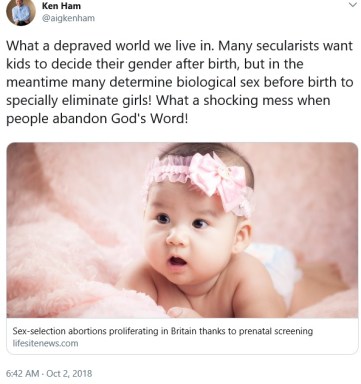
Here’s what we know: This morning, young-earth impresario Ken Ham warned the twittersphere about the dangers of sex-selective abortions. And his warning helps us understand the real issue at stake for most young-earthers.
What a depraved world we live in. Many secularists want kids to decide their gender after birth, but in the meantime many determine biological sex before birth to specially eliminate girls! What a shocking mess when people abandon God’s Word!
As SAGLRROILYBYGTH will notice right off the bat, there’s nothing about evolution involved in these claims. Ham, of course, would likely say that evolutionary theory is lurking in the background of everything, but this morning Ham doesn’t actually talk about evolution. As usual, today the issue for Ham is not specifically the science of evolution, but something else. So if Ham and other YEC pundits aren’t really anxious about evolutionary theory itself, what are they worried about?
As Ken Ham often points out, the dangers come from two directions. First, there are lurking “secularists” who are trying to deprive Christians of both their civic rights and their religious beliefs. Second, ever since the days of Bernard Ramm (1956), some conservative evangelical Christians have worried that any open consideration of the theological implications of mainstream evolutionary theory will lead to a galloping retreat from faith.
As they have since the days of The Genesis Flood (the 1961 book, not the event), radical young-earth creationists have argued that the only way to preserve true Christian belief is to draw a hard line against mainstream evolutionary science.
As today’s updates show, most of the arguments in favor of young-earth creationism are not really about evolutionary theory itself. Instead, they warn Christians about the likely results of considering the merits of mainstream science.
Instead of asking, “What are the theological implications of mainstream science?” YEC pundits ask, “Do you want to kill more girl babies?”
For those of us who want secular public schools and mainstream evolutionary science only in public-school science classes, the news from Arizona could be either a glass half-full or half-empty. Either way, though, it serves as a clear reminder of how creationism wins.
Here’s what we know: In Arizona, the superintendent of public instruction picked Joseph Kezele to serve on an eight-person board reviewing state science standards. Kezele is the president of the Arizona Origin Science Association. He is an ardent young-earth creationist. In his work on the board, he has nudged the standards toward more skepticism about mainstream evolutionary theory.
To this reporter, the story reveals the most important reason creationists win. As I’m arguing in my new book, it’s not really about evolutionary science itself. Before we get to that main reason, though, let’s look at some of the contributing factors:
1.) Creationists win by being polite.
Kezele’s fellow board members don’t like his radical creationism, but they do like him. As the University of Arizona’s William Roth told the Phoenix New Times, in all their interactions Kezele was “polite and thoughtful.”
2.) Creationists win by taking advantage of their grandparents’ work.
Though Arizona Christian University itself was founded only in 1960, it is part of the evangelical higher education network I described in Fundamentalist U. Since the 1920s, creationists founded their own network of universities specifically, in part, to provide a home for creationist scientists like Kezele.
These days, creationists like Kezele can only have higher-ed credentials because of the work of their parents, their grandparents, and in some cases, their great-grandparents. The fundamentalists who stormed out of mainstream colleges and started their own schools built a network that is still providing credentials and paychecks to radical creationists today.
3.) Creationists win by not asking for much.
In Arizona, according to Professor Roth, Kezele never tried to “foist any kind of creationism” on the committee. As Roth put it,
I never got the impression that he was really arguing for the inclusion of creationism in the standard. . . . I think he was pretty aware of the court rulings that religion is not going to be taught in science class.
Kezele did nudge the committee, though. For example, Kezele put his feet down to insist that the language be changed. Instead of explaining evolution as “THE” explanation for speciation, the new standards call evolution “AN” explanation. It’s a huge difference, to be sure, but worlds removed from actually adding any specific creationist content to the standards.
4.) Most important, creationists win these days for reasons that have nothing really to do with evangelical theology or evolutionary science.
It’s just politics. The superintendent who appointed Kezele wants creationism and evolution both to be included in public school science classrooms. But if she had not been elected, someone else who also favors creationism probably would have. As Arizona Central reported, Superintendent Diane Douglas was re-elected sought re-election from among a field crowded with creationism-friendly candidates. [Thanks to GB for the correction!]
Of the five Republican candidates for the job, four ardently supported teaching some sort of creationism in public schools. They may have had their personal reasons for wanting it, but they also made an obvious political calculation. If anyone is going to be elected in Arizona, that is, she must promise to make public schools creationism-friendly.
The reasons the candidates gave for supporting creationism in public schools were all about culture-war politics, not theology or science.
Candidate Frank Riggs, for example, argued that students needed creationism to be good Americans. As he put it, high-school students
should know what our founding fathers believed and put in our founding documents . . . “that all men are created equal, that they are endowed by their Creator with certain unalienable Rights.” . . . We can’t skip over that, or we do a huge disservice to our students.
Another candidate, Tracy Livingston, poured some unadulterated MAGA rhetoric into the mix. Why should public schools include creationism? In her answer, Livingston bemoaned the “fact” that
Schools don’t even allow Merry Christmas anymore.
Why support creationism in public schools? For candidate Livingston, at least, it was part of a culture-war playbook. To Make America Great Again, schools needed to give Christianity a special spot. Children needed to be taught in a vaguely Christian atmosphere, one that included creationism.
It’s not science. It’s not even really religion. Instead, the main reason for creationist victories is simple, ugly, culture-war politics.
How do creationists win? Lots of reasons. They win if they are polite. They win if they take advantage of the long work of previous generations, establishing creationist institutions that can provide credentials. They win if they don’t ask for much, but insist on a little.
Most importantly, though, they win because they own the Republican Party in some locations. To win election as state superintendent of public education, candidates raced to out-creationist one another. Creationism has become yet another culture-war red flag. It’s not really about theology or science, but about what side you want to be on.







 They didn’t ask specifically about creationism, but their findings translate well. As I’m arguing in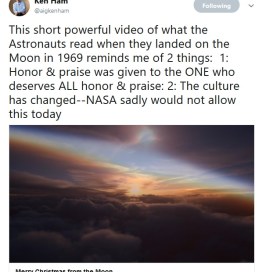




 I Love You but You're Going to Hell