Creationism in Texas: A Foreshortened History

Read it.  It’s good.  But be warned: this story has a fatal flaw.

Brentley Hargrove’s history of the Texas textbook wrangles is a helpful introduction to the recent round of textbook fights in the Lone Star State.

In the pages of the Dallas Observer, Hargrove introduces readers to the recent history of creationist influence in the selection of Texas science textbooks.  He offers the backstory of review-board members such as intelligent-design proponent Raymond Bohlin.

Hargrove takes the story of the Texas Textbook Two-Step back to the 1970s, when self-appointed watchdogs Mel and Norma Gabler wielded outsize influence on the adoption of books.

He describes the rise to educational power of creationist dentist Don McLeroy and the board membership of theologue Cynthia Dunbar.

This story is a must-read for everyone interested in today’s culture wars over education, not just in Texas but around the nation.  It joins films such as The Revisionaries and documentaries such as the Long Game in pointing out both the peculiarities of educational politics in Texas and the broader meanings Texas school politics has for all of us.

But as a historian of these school battles, I must protest against the foreshortened history Hargrove describes.  He gives a nod to the long history of cultural battles over education.  He mentions the nineteenth-century Bible wars that rocked America’s cities.  But then he skips from 1844 to 1961.  He leaves out the formative period of today’s educational culture wars.

As he puts it, since the nineteenth century,

the fear of secularism and modernity remains as potent as ever. Yet it wasn’t until the Gablers came along that this fear took shape in Texas and assumed power.

Now, that’s just not true.  I understand Hargrove is interested in the way these battles have developed over the past fifty years.  But the way they did so was decisively influenced by earlier generations of Texas activists.

To be fair, Hargrove’s historical myopia is widely shared.  In his Observer article, he quotes prominent sociologist William Martin.  “The Gablers,” Martin told Hargrove, “were the first people to have taken this on in such as systematic way.”

Even if we make allowances for the contemporary interests of journalists and sociologists, this sort of misrepresentation of the history of Texas’ school battles can’t be given a pass.

The tradition of conservative activism in which the Gablers, McLeroy, Bohlin, and Dunbar take part has direct roots in the 1920s battles in Texas and elsewhere.

As I argue in my 1920s book, anyone with even a passing familiarity with Texas history will recognize the historical importance of J. Frank Norris, for example.  In the 1920s, Norris established the activist precedent that later conservatives followed.  Norris fulminated against the directions of 1920s public schools in ways that McLeroy, Dunbar, and the Gablers would have appreciated.

And he had even more political pull.  In the 1920s, though a state-wide law banning the teaching of evolution failed in the Texas legislature, the governor ordered textbook publishers to remove any mention of evolutionary science from the state’s textbooks.

All well and good, you might say.  But does that pre-history have anything to do with today’s textbook fights?  If we want to understand the current moment, do we really have to go so far back?  Isn’t it enough to look to the Gablers and start there?

The school fights of the 1920s are of interest to more than just nitpicky academic historians like me.  Even if we want to start with the Gablers, we need to understand the formative school battles of the 1920s.  Mel Gabler was ten years old in 1925.  The content and structure of the schools he attended was decided by the activism of pundits such as J. Frank Norris and the pusillanimity of politicians such as the Governors Ferguson.

It was in the 1920s that America first battled over schooling in the terms that have remained so familiar ever since.  The issues and positions laid down in the 1920s have become the durable trench lines in American education.

As Gabler biographer James Hefley described, by the 1960s the Gablers had become

the cream of self-reliant Middle America.  They lived by the old landmarks, took child-rearing seriously, supported community institutions, sang ‘God Bless America’ with a lump in their throats, and believed that the American system of limited and divided governmental power was the best under the sun.

How did they get to be that way?  How did they become so confident that their vision of proper schooling and society must be fought for?  The Texas the Gablers loved had been defined by the activism of the 1920s and succeeding generations.  The vision of proper education that fueled the self-confident activism of the Gablers had been established as such in the controversies of the 1920s.

If we really want to understand what’s going on today, we need at the very least to acknowledge the longer history of these issues.  We need to understand that today’s fights grew out of earlier generations, and those earlier generations did not just spring up full-grown from the Texas soil.


Can Evolution Match This?

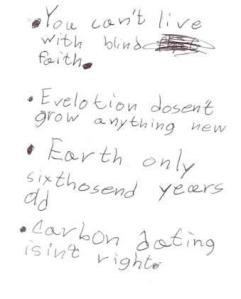
So clear and compelling a seven-year-old can understand it.  That’s the boast of young-earth creationist leader Ken Ham.  As proof, he published the lecture notes of one of his young audience members.

Image Source: Answers In Genesis

Image Source: Answers In Genesis

Image Source: Answers In Genesis

Image Source: Answers In Genesis

Image Source: Answers In Genesis

Image Source: Answers In Genesis

For those of us hoping to improve evolution education in the United States, Ham’s revelation raises a serious question: Can evolution hope to match the gut-level appeal of creationism?

Science pundits have long noticed this yawning gap between the popular acceptability of mainstream science and that of creation science.  The most clear-headed writers have admitted that creationism has better stories.

As Richard Dawkins put it in his 1996 book The Blind Watchmaker,

It is almost as if the human brain were specifically designed to misunderstand Darwinism, and to find it hard to believe.

The creation stories of young-earth creationists, on the other hand, are appealing to all age levels.  There’s a garden, there’s love, there’s disobedience, there’s punishment.  All of these are powerful themes that resonate with young and old alike.

And, lest we evolution-embracers smugly conclude that this stark advantage of creationism will fade as audiences get more intelligent and more sophisticated, let’s remember that creationism’s advantage also pulls in the intellectually sophisticated.

ILYBYGTH readers may remember the postmodern plea of journalist Virginia Heffernan.  A few months back, Heffernan declared her affinity for creationism over evolution.  Why?  In her words,

I was amused and moved, but considerably less amused and moved by the character-free Big Bang story (“something exploded”) than by the twisted and picturesque misadventures of Eve and Adam and Cain and Abel and Abraham.

Obviously, something doesn’t need a compelling narrative in order to be true.  But in the stubborn culture wars over evolution and creationism, popular appeal matters.  Evolution’s biggest selling point is that it does a better job of explaining and predicting than does creationism.  Maybe the winning narratives won’t be the detailed natural-selection classic tales starring finches and moths, but rather the far more stirring story of enlightenment triumphing over dunderheaded fogeys.

That’s a good story.  At least it worked for Kevin Bacon in Footloose.


Christian College Embraces Atheist Student

What would happen to an atheist student at a conservative Christian college if his professors and peers found out about his lack of faith?  Turns out, not much.

That was the experience of Eric Fromm, at least, at Oregon’s Northwest Christian University.  Fromm, the student body president at the 600-student school, worried about the reaction when he “came out” as a non-believer.

According to a story in the Eugene Register-Guard, the school community has turned out to be supportive.  Michael Fuller, NWCU’s vice president for enrollment and student development, said there was no conflict between Fromm’s views and the school’s religious mission.  “I want students like Eric here,” Fuller told the Register-Guard,

students who are looking to explore their faith and willing to look hard and make their faith their own. . . . If we all had our wishes, we wish Eric would be a strong Christian man. . . .  We’re an open and welcome community, and we meet students exactly where they’re at.

Those of us from outside the world of conservative Christian higher education might be surprised by Fuller’s and NWCU’s open attitude.  After all, Fromm himself wondered what kind of reception he’d get when he publicized his atheism in the school paper.

Maybe we shouldn’t be.  After all, Fromm’s story is not unique.  ILYBYGTH readers may remember the testimony of Brandon Ambrosino, who reported his experiences at Liberty University.  Ambrosino, like Fromm, fretted over his decision to come out as homosexual at the rigorously conservative Liberty.  Like Fromm, Ambrosino found his faculty mentors downright supportive.

If the mission of many conservative colleges is to provide a “safe” theological environment for students, one that will support their faiths, then we’d expect faculty and administration to take a harsh line against students who thwart that mission.  An atheist student or an openly gay student would seem to introduce threatening elements into that safe environment.  That would seem doubly true if the atheist were popular and influential, as Fromm seems to be.

In practice, however, conservative schools seem well able to handle student dissent.


You Don’t Need a Young Earth to Get to Heaven

Do creationists use intimidation and spiritual threats to coerce young people to believe?  Not as often as some critics assume.

Young-earth creationist leader Ken Ham of the organization Answers In Genesis repeated his call recently that Christians do not need to believe in a young earth.

For outsiders like me, this can appear puzzling.  After all, those of us outside the circle of conservative evangelical belief often assume that all conservative evangelical Protestants spend their time sweating over their eternal fate.  We might make the mistake of assuming that conservative evangelicals thrive by threatening sinners with hellfire, brimstone and damnation.

Take, for example, the Christian beliefs of young-earth creationists.  From the outside, it’s tempting to assume that the more insistent YECs must somehow bully new generations into embracing their beliefs.  After all, those beliefs are so radically different from the ones embraced by mainstream science that it seems impossible for young people to become YECs unless compelled.

This is why some prominent atheists have called this kind of creationism “child abuse.”  As we’ve seen in these pages, smart young people brought up in the faith have wondered why their trusted adult leaders sold them a scientific bill of goods.  As Anna wondered recently in her illuminating ILYBYGTH series about her youth as a YEC, “It is still a bit difficult for me to look back on authority figures and members of my community that I looked up to and respected and wonder: are they just ignorant, or are they purposely deceptive?”

For us outsiders then, it can seem surprising that arch-creationist Ken Ham takes time to point out that young-earth belief is not a salvation issue.  That is, Ham insists that good Christians can disagree about the age of the earth.  As he puts it,

Many great men of God who are now with the Lord have believed in an old earth. Some of these explained away the Bible’s clear teaching about a young earth by adopting the classic gap theory.

Others accepted a day-age theory or positions such as theistic evolution, the framework hypothesis, and progressive creation.

Scripture plainly teaches that salvation is conditioned upon faith in Christ, with no requirement for what one believes about the age of the earth or universe.

Ham hastens to add that discarding a belief in a young earth can have “very severe consequences.”  In sum, since the Bible clearly describes the origins of earth, disregarding that message puts Christians on the very slippery slope to disregarding Biblical authority as a whole.

“All biblical doctrines,” Ham concludes, “including the gospel itself, are ultimately rooted in the first book of the Bible.”

Make no mistake: Ken Ham wants you to believe in a young earth.  But this is not a threat.  This is not a tent-preacher warning that only YEC can save your soul.

Too many outsiders like me ignore these kinds of nuance in the intellectual world of conservative evangelical Protestantism.  We end up calling YECs child abusers or worse, without taking the time to understand the real culture of young-earth creationism.  That might make for good headlines, but it does so at the heavy cost of relying on caricature rather than reality.

College Is Dumb

What do college kids learn about these days?  It is a question about which conservatives have fretted for a long time.

Most recently, the Heritage Foundation warns that too many students, especially at America’s elite universities, are filling their heads with the mental junk food of Lady Gaga and zombie thrillers.  Worst of all, according to Mary Clare Reim on Heritage’s education blog, elite schools don’t seem to do much to encourage more substantial mental work.  For hefty tuition fees, Ivy League schools seem happy to have pampered youth meander lazily through fluff classes such as

“The Fame Monster: The Cultural Politics of Lady Gaga”; “Blame It on the Bossa Nova: The Historical Transnational Phenomenon”; “The Sociology of the Living Dead: Zombie Films”; “Fairytales: Russia and the World.”

Students are given the freedom, Reim laments, to fill their college years with nothing but such interesting but ultimately impractical mental games.

Reim cites a recent study from the American Council of Trustees and Alumni (ACTA).  The ACTA graded schools on how much core curriculum they require for their students.  By this measure, Harvard, Yale, and Stanford all get Ds.  Baylor and Colorado Christian University, on the other hand, move to the head of this class.

Reim’s worries place her in a storied tradition of nervousness among American conservative thinkers.  Since at least the 1920s, conservatives have worried that college students are being sold an intellectual bill of goods.  Classes are watered down, or worse, pernicious ideas are snuck in as the latest academic fad.

In the 1920s, for instance, William Jennings Bryan warned that elite schools such as Wellesley, Yale, and the University of Wisconsin filled the heads of students with pernicious nonsense.  In a dispute with Wisconsin’s president in 1921, Bryan snarkily suggested that Wisconsin should post the following warning sign:

Our class rooms furnish an arena in which a brutish doctrine tears to pieces the religious faith of young men and young women; parents of the children are cordially invited to witness the spectacle.

In 1935, one American Legion writer warned that “colleges all over the land” had been taken over by left-leaning numbskulls.

In 1950, one anonymous letter-writer wrote in to the Pasadena Independent to offer an explanation of why so many classes were so stupid.  If young people didn’t learn basic facts and skills, they would become easy prey for what this conservative writer called “propaganda leaders.”

In other words, keeping young people dumb was more than just laziness or faddishness.  Among conspiracy-minded activists, dumbing down colleges could work to prepare America for failure.

More recently, too, conservative intellectuals often assume that the content of higher education—especially at the most elite schools—ranges from sex-soaked to subversive.  Peter Collier, for example, in a recent article in the Weekly Standard, warned that left-wing ideas had taken over at Teachers College, Columbia University, beginning in the 1980s.  Under the name of “critical pedagogy,” Collier wrote, academics had “slowly infiltrated leftist ideas into every aspect of classroom teaching.”

Given the possible intellectual threat posed by socialism and blundering leftism, it seems conservative intellectuals might be happy to see courses that are merely stupid.


Keep Your Kid Conservative

Watch out!  Going to school might ruin a perfectly good conservative child.

That’s the message this morning from pundit and school-founder Dennis Prager.

In the pages of National Review Online, Prager gives conservative parents advice about how to keep their kids conservative.

The danger is clear, Prager warns.  Those who believe in “traditional American values” must fight a “war” with “the media and the schools” for control of their children’s minds.

Kids must be told repeatedly and explicitly about the propriety of conservative ideas.  Not only that, they must be intellectually inoculated against the sorts of left-wing propaganda they will be subjected to in college.  One way to do that is to get high-schoolers to spend some time in the world of work before college.  By seeing a slice of the real world, young people will be protected from the drivel that passes for academic thought these days, Prager claims.

Another option is to have young people spend a year or so after college studying their faith.  After all, he says, leftism itself is an influential faith on college campuses.  Students who are grounded in their own religious traditions will have a better chance of resisting the siren call of college leftism.

In general, Prager writes, young people who are taught character, not given a false sense of “self-esteem,” have the best chance to remain sensibly conservative.

Overall, Prager tells conservative parents, don’t fret.  “It is not all that hard,” he says, “to produce a son or daughter able to withstand left-wing indoctrination.”  It just takes some doing.


Obamacore = Ku Klux Klan

We’ve seen this before, warns Robert Morrison of the Family Research Council.

The Common Core State Standards, which Morrison calls “Obamacore,” represent just another misguided and dangerous attempt to centralize America’s schools.

Centralization has long been a goal of education reformers.  Morrison correctly points out that the Ku Klux Klan successfully banned all private education in Oregon during the 1920s.  Though the Oregon law was blocked by the US Supreme Court, the goal was clear.  The Klan wanted to centralize school, to force all children to go through a government-directed educational program.

Back then, Morrison writes, the US Supreme Court had a better sense of the dangers of educational centralization.  These days, the bureaucratizers and centralizers have a freer hand.  It is up to religious conservatives such as those at the Family Research Council to resist.

“Under ObamaCore,” Morrison warns,

the elites in Washington shall direct the destinies of our children.

This is unwarranted. It will ultimately fail, just as the fifty-year record of federal usurpation of state and local authority in education has failed.

It necessarily involves indoctrination of all our children in federally-mandated curricula. We know what this means.

Strong stuff.  As we’ve noted before, conservatives as a whole are not united in their opposition to the Common Core State Standards.  Perhaps potent rhetoric like this will tip the scales.


Why Are Schools So Terrible?

Conservative intellectuals have long asked the question: What went wrong with America’s schools?

Of course, the question presumes that something HAS gone wrong.

We at ILYBYGTH don’t really care if America’s schools are terrible.  We’re more focused on dissecting conservative approaches to the question. How have different conservatives at different times offered different answers to this perennial question?

Now available free online is an argument I put together a few years back. The article appears in the pages of the storied Teachers College Record.

This article looks at the school-history visions of four very different conservative thinkers: Milton Friedman, Max Rafferty, Sam Blumenthal, and Henry Morris. Each of them agreed that public schools had become ineffective, even dangerous institutions. But the reasons they gave for that lamentable decline differed. Friedman, for example, blamed teachers’ unions and government control, beginning just after the American Civil War. Rafferty blasted the wrong-headed “progressive” takeover of the 1930s. Blumenfeld and Morris both looked further back, to a Unitarian coup at Harvard University variously timed either in 1805 (Blumenfeld) or in 1869 (Morris).

These conservative activists do not only differ in the timelines they gave for America’s educational decline, but also in their diagnoses and prescriptions. Friedman wanted a free-market solution. Rafferty hoped for clear-headed traditionalism. Blumenfeld wanted to scrap public education entirely. Morris hoped to heal schools with creationism.

In every case, these conservatives based their arguments about schooling on a historical vision. They are not alone. Activists of every political stripe use history to prove their points. In this essay, I outlined the ways a few prominent conservatives did so.

Allmon at EVoS

Clear your calendars!

Next week Professor Warren Douglas Allmon will be traveling down scenic Route 96 from Ithaca to talk about creationism.

Allmon’s talk, “Creationism in 2013: Not in the Headlines but Never Far Away,” will be on Monday, November 18, at 5:00 in room AG008 on the beautiful campus of Binghamton University in sunny Binghamton, NY.  The talk will be free and open to the public; no registration is required.

It will be part of the continuing series of Monday seminar talks hosted by the Evolutionary Studies program here on campus.

Allmon is the Hunter R. Rawlings III Professor of Paleontology at Cornell.  He also runs Ithaca’s Museum of the Earth.

I’m excited to hear what Professor Allmon has to say.  A couple years back, Allmon argued in the pages of Evolution: Education and Outreach that evolution educators must begin by understanding the reasons for resistance, not just riding roughshod over it.  As he put it,

This multiplicity of causes [for rejecting evolution] is not sufficiently appreciated by many scientists, educators, and journalists, and the widespread rejection of evolution is a much more complicated problem than many of these front-line practitioners think it is.

Hear hear!  If you want to hear what Allmon has to say, come on down.  Hope to see you there.

Keep Education Useless!

What is education for?  At Front Porch Republic today we find a stirring call to keep education useless.

Thaddeus Kozinski laments the contemporary tendency to ask what purpose a college education will serve.  Not that one can’t learn a trade or profession in college, Kozinski argues, but that is not higher education’s main purpose.  “The end, goal, or use of liberal education,” Kozinski insists, “is not found in anything outside of the study itself.”

Kozinski doesn’t ask readers to take his word for it.  He claims the support of thinkers from across the centuries, including Simone Weil, Robert Hutchins, Cicero, Plato, Josef Pieper, Aristotle, Cardinal Newman, and St. Augustine.

Education must be about learning itself.

As Kozinski puts it,

to say that all education must be ordered to use in the work-a-day world, is to imply that there is nothing that transcends, that we are trapped in the realm of the temporal, material, and instrumental. And this is to make human happiness not an end but a means, bound to whatever we can use from this world, bodily pleasure, emotional satisfaction, wealth, honor, power, and the like. These are legitimate goods, of course, and education can help us obtain these goods. But unless there is a transcendent reason for pursuing these goods, unless this work-a-day world is seen for what it is, a means and never an end, then we end up making a means our of an end, and an end out of a means, and we thus make human happiness, and concomitantly, true education, impossible.