Sex Ed: Letting Molesters Have Their Way with Our Kids

Sex ed means giving over our children to theories oozed out of the warped minds of pedophiles and child molesters.

That’s the accusation made recently in the pages of Public Discourse by Miriam Grossman.

It’s no secret that conservatives have long opposed sex ed.  As historians such as Jeffrey Moran and Natalia Mehlman Petrzela have explored, sex and children have always been a touchy combination for Americans.

It’s not surprising.  Sex is a touchy subject for anyone.  Talking about sex with young people has always been fraught with awkwardness, at best.  Even more so when the decisions about what to say and how to say it have become political footballs in educational culture wars.

Grossman’s essay pulls no punches.  She identifies the roots of sex ed in the perverted sexuality of early leaders of the movement.

She calls Alfred Kinsey, for instance, “afflicted at his core. . . . a depraved human being.”

John Money, according to Grossman, formed part of the “incest lobby.”  His career followed a path dictated by the fact that he was “troubled, and he molested young boys.”

What can we expect, Grossman argues, from a field pioneered by such sexual deviants and predatory perverts?  It is no surprise, she says, that sex ed has become a moral horror show.

Talk of using sex ed, or “health” education, to fight disease and reduce teen pregnancy, Grossman believes, is a red herring.  In fact, she insists,

Sex ed is not about preventing disease, it’s about sexual freedom, or better—sexual license. It’s about changing society, one child at a time.

For those of us hoping to understand conservative attitudes about sex education, Grossman’s essay is worth reading in its entirety.  Certainly, she does not speak for all conservatives on this issue, nor does she claim to.  But her vision of the roots of sex ed offers conservatives an understanding of sex ed as a sinister and malicious entity, one that must be opposed root and branch.

After all, if conservatives understand sex ed as a ploy to lure young people into the embrace of leering sexual predators, they will be are understandably reluctant to compromise on the issue.


White House Petition: Halfway against Creationism

Half-way.  That’s how far the anti-creationism White House petition made it.

Well, almost.  After one month, the petition to President Obama to “ban creationism and intelligent design” attracted a total of 46,070 signatures, just under half of the 100,000 it needed to guarantee Presidential consideration.

What does it mean?  Not much.  Even if the petition had succeeded, it would have only been a symbolic statement about the popularity of anti-creationism.

For the sake of argument, I’m curious how many signatures a petition would get if it asked President Obama to support the right of students to learn about alternatives to evolutionary theory.

Postmodern Creationism: A Better Story

Add a new category to the creationist bloc in America: postmodernists who don’t “believe” anything.

Journalist Virginia Heffernan has caused a mini-uproar this week by explaining why she’s a creationist.

In a recent essay on Yahoo! News, Heffernan argued that the stories of creationism are simply more “compelling” than those of mainstream science.  In her telling, she wanted to embrace science, since she loves technology.  But science just doesn’t have the right stories.  In her words,

I was amused and moved, but considerably less amused and moved by the character-free Big Bang story (“something exploded”) than by the twisted and picturesque misadventures of Eve and Adam and Cain and Abel and Abraham.

Predictably, science pundits reacted with dismay.  University of Chicago biologist Jerry Coyne lambasted Heffernan’s “remarkable celebration of ignorance.”   University of Minnesota biologist PZ Myers noted Heffernan’s anti-science history: “every time she meets a scientist she opens her mouth and says something stupid . . . .”

Also predictably, evangelical Christians defended Heffernan.  In the Christian Post, journalist Leonardo Blair noted that Heffernan had become a “lightning rod for ridicule,” but that she has also won support from religious people for “standing by her beliefs.”

It seems to me, however, that both the fervent anti-creationist commentators and the evangelical pro-creationists ignore the central thrust of Heffernan’s essay.  Heffernan is not making a case for the truth of creationism.  Indeed, as she explains, “I guess I don’t ‘believe’ that the world was created in a few days, but what do I know? Seems as plausible (to me) as theoretical astrophysics, and it’s certainly a livelier tale.”  This is not a full-throated defense of Biblical creationism.  Instead, Heffernan is making a case for the plausibility of creationism.

And, as far as that goes, she’s right.  Creationism is more than just a religious belief.  It is a convincing and intuitive way of understanding humanity’s predicament.  This is why leading science educators have recognized that simply pouring more science on Americans will never convince them of the truths of evolution.

Heffernan’s attitude does not result from childhood brainwashing in the Bible.  Heffernan does not howl at mainstream institutions from the wilds of San Diego or Northern Kentucky.  She complains, instead, that it is hard to admit to creationism in New York restaurants, to acquaintances from her jobs, perhaps, at the New Yorker or New York Times.  With her handy PhD from Harvard, Heffernan’s attitude does not come from a lack of mainstream education.

Heffernan’s avowed creationism, instead, comes from an over-abundance of mainstream education.  Her attack on mainstream science comes not from Genesis, as she suggests elsewhere, but from Derrida.

Other creation/evolution commentators have made similar points, without going as far as embracing creationism.  Jason Rosenhouse, for instance, in his book Among the Creationists, admits that creationist explanations of life and humanity are much more appealing than the messy truths of mainstream science.

Unlike Rosenhouse, Heffernan takes the postmodern leap.  IF we have no Archimedean perspective from which we can judge competing truth claims, THEN we are forced to choose between competing narratives.  BECAUSE creationism has the better narrative, Heffernan concludes, she must call herself a creationist.

Plus, it generates better headlines to say “I’m a creationist” than to say “Creationism tells better stories of humanity’s origins, but I don’t really believe those stories, but you gotta admit, they are better stories, plus scientists can sometimes be jerks.”


Celebrity to Nerd: New Leadership at The King’s College

Who will train a new generation how to bring America to Christ?

The leaders of The King’s College decided a nerd can do the job better than a celebrity.

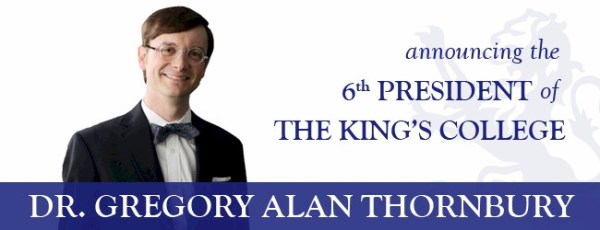
After its unhappy breakup with headline-grabbing conservative icon Dinesh D’Souza, The King’s College will now be led by Southern Baptist theologian and administrator Gregory A. Thornbury.

Image Source: The King's College

Image Source: The King’s College

The bowtie-wearing, Carl-Henry-loving, religious-school administrating Thornbury seems to be the exact opposite of D’Souza, at least within the world of conservative Christian higher education.

Thornbury’s career has been squarely within the world of conservative evangelical higher education.  Before Manhattan and The King’s College, Thornbury served as the founding dean of Union University’s theology school.  His academic background as a philosopher with degrees from the Southern Baptist Theological Seminary and Messiah College puts him in a different league from the sometimes-fevered punditry of D’Souza.

Leaders of the evangelical establishment love him.  Russell Moore of the Southern Baptist Convention called Thornbury “Jonathan Edwards meets Rolling Stone magazine.”

Thornbury himself seems to prefer the Jonathan Edwards part.  His recent book about theological Carl Henry hopes to make Henry “cool again.”  Unlike other leaders at The King’s College, who stress its Manhattan location as the ideal spot to influence mainstream American culture, Thornbury himself notes the location’s close ties to the strongest intellectual giants of American evangelicalism and conservatism, including Jonathan Edwards, Alexander Hamilton, and Carl Henry.

What’s next for The King’s College under its new president?  In the words of one enthusiastic King’s College alum, Thornbury will lend new life to The King’s College mission: “a counter cultural Christian college in New York City that leads with academic excellence and ‘convictional civility.’”


“Home-school Freak:” A Portrait of American Christian Homeschooling?

What is the world of conservative Christian homeschooling like?

A recent memoir in Salon painted a picture of cultic isolation and criminal parental negligence.

Author Leslie Patrick described a youth spent watching TV with her sister while her overworked mother slept.  They were told to stay away from windows so that the happy public-school children across the street wouldn’t witness their truancy.  They had some schoolbooks, but without parental guidance, Patrick and her sister spent their days curled up in front of the television instead.

The result?  No surprise.  When Patrick finally enrolled in a Christian school in tenth grade, she could not begin to keep up with the academic work.  Her natural shyness added to her “freak”-ish separation from the current fashions of teenagers in her school.  With good luck, Patrick reports, she somehow managed to survive her religious education and emerge “normal.”

Is this what Christian homeschooling is like?  As Patrick notes,

I realize that many of the nearly 2 million home-school students in the United States don’t have experiences like mine. They get sparkling educations, and come through the relative isolation with their social skills intact.

If this is the case, why do we find articles about religious-educational freakishness so compelling?

I wonder if a number of us liberals harbor deluded stereotypes about the world of Christian education.  The “secret” world of such intensely religious schools becomes an object of morbid fascination, a theological, cultural, and personal trainwreck from which we self-satisfied liberals cannot turn away.  This is why, perhaps, occasional glimpses like that of the recent “Bible dinosaur” quiz become such objects of fascination.  This is why, perhaps, the editors at Salon agreed to publish Patrick’s idiosyncratic expose.

My hunch is that the everyday world of the average Christian homeschooler is far too boringly mundane to ever rival the headline-grabbing allure of the “home-school freak.”  Nevertheless, in spite of Patrick’s belated acknowledgement of the real experience of “many” Christian homeschoolers, readers of her sad memoir are likely to come away with a skewed and misleading vision of conservative education.


Saintliest City in the USA?

Eve apparently didn’t take her bite out of the Big Apple.

According to one new survey, New York City leads the list of America’s saintliest cities.

How do they know?  This survey tallied up a list of presumably sinful institutions and events: strip clubs (lust), cosmetic surgeons (pride), violent crime (wrath), theft per capita (envy), charity (greed), obesity (gluttony), and physical activity (sloth).

By this tally, the megapolis of New York had the fewest such sinful occurrences per capita.

Does it mean much?  Not really.  In this quirky survey, New York scored big due to its relatively low levels of obesity and relatively high levels of physical activity.  Such things don’t paint a convincing picture of “saintliness.”

Nevertheless, this survey can serve as a reminder once again to watch out for simplistic assumptions about the nature of religiosity in 21st-century America.

Despite the presumptions of some culture-war pundits, the “God-fearing” America is not limited to small towns and the Midwest.  Big cities often host the most religious Americans, acting in the most religious ways.


Of MOOCs and Monsters

Does Monsters University have a conservative anti-MOOC message?

I took my daughter to see it the other day.  It was great.  I laughed.  I cried.  There were lots of creatively imagined monsters, smart dialogue, and sight gags.  Plus a heartwarming story of friendship and dedication.
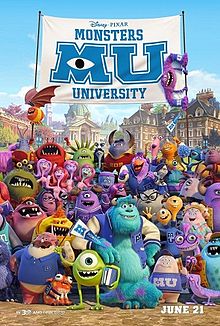
Monsters_University_poster_3But was it also a Disney-fied version of conservative arguments about the fate and future of higher education?

I couldn’t help wondering what the conservative intelligentsia would have to say about the movie’s implications for the future of higher education.  Especially about the latest craze to sweep the educational establishment, Massive Open Online Courses.

Conservatives have been divided about the moral and practical implications of MOOCs.

Some free-market aficionados have trumpeted the promise of the new approach.  By providing courses for free from elite universities such as Harvard and MIT, MOOCs make world-class learning more widely available than ever.  Economist Richard Vedder, for example, argued that a MOOC approach could cull out inefficiencies in higher education.

More recently, Benjamin Ginsberg fretted that MOOCs represented just another way for administrators to cut apparent costs, at the real cost of abolishing real learning.

Other conservatives have agreed that the MOOC model abandons the proper goal of higher education.  Rachelle DeJong complained that higher ed must take more responsibility for the formation of young minds and spirits. “The student,” DeJong wrote,

as yet unformed and uneducated, cannot judge what studies best suit his needs, his vocation, or his intellectual development. How can he discern a steep ascent to the mountaintop from a difficult dead-end, when all he knows are the briars, the rocks, and the stitch in his side?

In the pages of Minding the Campus, Peter Sacks warned that MOOCs will generate a crushing mediocrity and exacerbate the existing class divide among institutions of higher education.  Rich students will get a full learning experience, Sacks insisted, while less well-off students will only hear distant digital echoes of profound learning environments.

Such conservative arguments make sense to the historian in me.  Even a nodding acquaintance with the history of technology and education makes anyone skeptical of any new technological “revolution” for classrooms.  As Larry Cuban has demonstrated, new technologies often garner enthusiasm and enormous investment, only to crash against the reefs of complex educational reality.

Perhaps the best example was the flying broadcast technology of the 1950s.  The US government and the Ford Foundation poured tens of millions of dollars into this program, which sent planes circling over the Midwest and Great Plains.  These planes broadcast educational television programs to schools in those areas.  The idea was that the very best teachers could supply content for audiences of schoolchildren nationwide.

The program failed because schooling is about much more than simply receiving information from a TV screen.  CAN young people learn this way?  Of course.  Is such learning the equivalent of all the complex interactions that go into our notion of “school?”  Of course not.

A similar future seems in store for MOOCs.  Such distance learning is nothing really new and some students will likely benefit greatly from it.  But it will not replace the entirety of higher education, since that entirety includes such a broad range of ingredients.

What does all this have to do with adorable monsters?  I won’t give away any of the plot of Monsters University, but I can say that the movie centers around the dreams of a young adorable monster who yearns to attend Monster University.  The film includes long sweeping vistas of colored foliage and ancient-looking buildings.  It revolves around the intense traditions and intense personal interactions that make up higher education for monsters.

The main character, to be sure, went to MU for vocational reasons.  He wanted to earn a certain type of job.  Without giving away the plot, I can’t comment here on some of the movie’s ultimate implication about the career efficacy of those choices.

But for the main monster character, the allure of MU was at least as much about personal relationships between students and a hard-nosed dean as it was about attaining information.  The attraction of MU depicted in the film was at least as much about learning from fellow students as it was about downloading information from star professors.  The campus and its social scene played crucial roles in the education depicted in the film.

If the film gives us anything beyond two pleasant hours in an air-conditioned theater, it is an emotional, playful articulation of the drier anti-MOOC arguments made by conservative intellectuals.  College, in this film, is a whole-life experience.  College includes formal education, but it also requires a whole lot more.  In order to be educated, the film implies, young people must submit to a stupendous tradition.  Institutions of higher learning, as portrayed in this summer fantasy, are literally supernatural conglomerations of love, life, and learning.

Such conglomerations can never be replaced with online learning platforms.  No matter how much star power goes into them.


Our Fundamentalist Neighbors: A Rebuttal

Guest Post by Jonny Scaramanga

I am very happy to welcome a guest post today by Jonny Scaramanga. Jonny’s blog, Leaving Fundamentalism, is a must-read for everyone interested in issues of conservative Christianity and education. Jonny and I have gone back and forth a little bit about the propriety of attacking creationism. Recently, I contributed a guest post to Leaving Fundamentalism about how to handle our fundamentalist neighbors. The following is Jonny’s rebuttal. What do you think?

Adam and I are bad at choosing neighbours. I too have had a bothersome neighbour. Unlike Adam, though, I found the law quite helpful in dealing with the antisocial Ned Flanders next door.

He let his dog bark all day and night for months, so I informed the city council. They served him with an abatement notice and then fined him £5,000.

He built a hideous extension on his house without permission. For this he faced a choice between removing the extension and paying a maximum fine of £20,000.

When he continually harassed and berated me for not sharing his worldview, he received an Anti-social Behaviour Order. And when he was caught persistently leaving his rubbish on someone else’s property, he went to prison for five years.

It is true that we can’t legislate against being an unpleasant person, but we can and do legislate against behaviour that harms other people.

Adam has argued on my blog that banning the teaching of Creationism would not make sense, in the same way that passing an anti-dick law would not make sense. But the two cases are not equivalent. For one thing, dickish behaviour is already covered by existing legislation, while teaching Creationism in private and home schools is not. For another, we are not talking about the right to be a Creationist. We are talking about the right to impose Creationist views on someone else.

Adam also argues that banning the teaching of Creationism probably wouldn’t stop people doing it. That might be true, but it’s a practical matter. I’m more interested in whether there’s a moral case for banning Creationism in education.

First, we need to get the misleading notion of parents’ rights off the table. Parents are humans, with human rights; children are humans, and they also have human rights. Parental rights are not human rights; they are rights that one human being has to exert control over another. Can you think of another instance where liberal democracies allow a person to act in this way? The only similar examples I know are slavery, imprisonment, and archaic ideas of marriage where ownership of a woman passes from her father to her husband. These do not seem like paradigms to emulate.

Children have rights, but they are not yet capable of exercising those rights wisely. Someone must make decisions on their behalf. Usually, the best-placed people to do this are parents. Generally, a child’s interests and her parents’ are aligned, and parents are best placed to act in the child’s interests. But – apart from a right not to be forcibly separated from her children without good reason – these are not rights. These are responsibilities. Other conceptions of childrens’ rights treat children as though they are the property of the parents.

The right to teach Creationism is not the right to practice religion. It’s the right to indoctrinate someone else. The only relevant question is whether teaching Creationism harms children. The answer seems entirely obvious to me. Teaching Creationism involves telling children blatant falsehoods, which have no practical application, which reduce the likelihood of their integrating with wider society, and which require the corruption of the ability to think logically. I think you’d struggle to argue this could be anything other than harmful.

The only exception I can see is that it is in children’s interests to have a good relationship with their parents. It’s also probably beneficial for children to have good relations with their parents’ community. If rejecting the theory of evolution is a requirement for this, then perhaps teaching Creationism serves the child’s interests.

This would ignore the list of possible harms caused by Creationism. If followed to its logical conclusion, the study of ‘scientific’ Creationism has devastating consequences for the life of the mind. It impacts not only on obvious areas like biology and astronomy, but also on areas as diverse as history, linguistics, and psychology. ‘Survivors’ of Accelerated Christian Education writing for my blog express bitterness at the educational opportunities they were denied. Creationism may have united their families when they were children, but now it has created rifts. Creationist children endured mockery and alienation from their evolution-accepting peers, for no obvious benefit. Now they complain of setbacks in their professional life, because their poor education failed to set them up for a real career.

I suspect Adam, along with the Sensuous Curmudgeon, is right that a petition to ban Creationism in schools is likely to be counter-productive. But that doesn’t mean we shouldn’t look for effective ways to get rid of it.

About the author: Jonny Scaramanga grew up as a fundamentalist and a student in Accelerated Christian Education. He is now a PhD candidate at the Institute of Education, University of London. He has written about creationism for the Guardian and Times Education Supplement, and discussed it on the BBC and Channel 4 (UK). He blogs about his fundamentalist experiences at Leaving Fundamentalism.

Our Fundamentalist Neighbors, Part I

What do we do when fundamentalists act like dicks? That’s the question I ask in a guest post this morning at Jonny Scaramanga’s lively Leaving Fundamentalism blog.
The post continues Jonny’s and my conversation about the meanings of the White House petition to ban the teaching of creationism and intelligent design.  Jonny has promised to offer a thoughtful rebuttal in these pages.

In the meantime, come on over and participate in the chattering…

Lock Up the Principals!

Lock em up!  Charge em with felonies!

That is the prescription for education reform from Professor Richard Vedder.  In the pages of Minding the Campus, Vedder lamented recently the sad state of affairs in schools that train America’s teachers.  Ed schools, Vedder pointed out, do not attract the best or the brightest.  On elite campuses, Vedder argues, ed schools are seen as a “weak link, sometimes something of an embarrassment.”  Such lackluster ed schools only perpetuate an educational miasma.

How to get around this?  Vedder offers a bold plan:

the goal should be to eliminate undergraduate colleges of education. And rather than fight the battle one university at a time, state governments can make it happen easily:  make it a felony for a principal to knowingly hire a graduate of a college of education to teach our youth in public schools.

Though I am a card-carrying faculty member at one of the schools Vedder wants to criminalize, I will not use this space to defend schools like mine.  Instead, I will only point out the somewhat surprising durability of this anti-ed-school animus among American conservatives.

Why has the ed school been seen for so long as such an intellectually dangerous place?

Perhaps a look at the twentieth-century record will help…

In the ferociously anti-communist atmosphere of the 1930s, for instance, many conservative activists blamed ed schools for training subversive teachers.

In 1938, American Legion national leader Daniel Doherty claimed that “Many of our institutions of higher learning are hotbeds of Communism.”

Doherty was in illustrious company.  A few years earlier, conservative US Congressman Hamilton Fish had denounced schools such as Columbia, New York University, City College of New York, the University of Chicago, Wisconsin, Penn, and North Carolina as “honeycombed with Socialists, near Communists and Communists.”

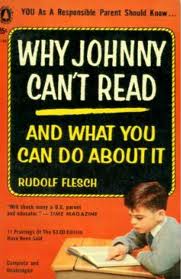
Into the 1950s, leading conservatives blamed ed schools for promulgating terrible teaching.  In his blockbuster phonics book Why Johnny Can’t Read (1955), for example, Rudolph Flesch blamed Teachers College, Columbia, for masterminding a plot to spread ineffective but progressive reading techniques.

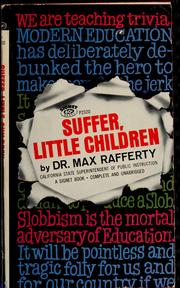
flesch why johnny cant readAs usual, among educational conservatives, few have articulated an idea with the same style and verve as the prolific Max Rafferty, in the 1960s the State Superintendent of Education in California.  In his syndicated column, published in book form in 1963 as Suffer, Little Children, Rafferty zeroed in on the role of education schools in promoting educational blah.

At that time, Rafferty identified the danger as a wrong-headed and misleadingly named “progressive education.”  Such dunderheaded notions, Rafferty argued, oozed out of ed schools to create a nation barely able to compete with the aggressive Soviet Union.

1963

1963

As Rafferty put it,

For thirty years, our Columbia University philosophers, our educational psychologists, and our state department consultants have been leading us down a primrose path where report cards read like Abbott and Costello comedy routines, where competition was a naughty word, and where memorization and drill were relics of the Dark Ages.

In the last three years, we have found out for ourselves that our morals are rotten, our world position degenerating so abysmally that a race of lash-driven atheistic peasants can challenge us successfully in our own chosen field of science, and our rate of juvenile murder, torture, rape, and perversion so much the highest in the world that it has become an object of shuddering horror to the rest of the human race.  More, our greatest leaders today, both in and out of Education, now assure us that these fairy stories with which we have for thirty years bulwarked our thinking and our actions are just—plain—not—true.

My hunch is that Superintendent Rafferty would approve of Professor Vedder’s suggestion.  Close down the ed schools, teach teachers the way we teach everybody else.

My hunch is that somewhere at the back of this conservative ire is a feeling that education schools have become the domain of the academic left.  On many campuses, not only do education schools represent a different sort of student, they often also represent a dwindling redoubt of the unapologetic academic left.

Are there other reasons why smart conservatives feel such virulent distaste for ed schools?