UPDATE: Yoga Okay for Public Schools

When is a school prayer not a prayer?  According to Superior Court Judge John Meyer, once the “lotus” position has been transformed into “crisscross applesauce.”

As historian Natalia Mehlman Petrzela argued in these pages months ago, the fight in Encinitas, California over the teaching of yoga in public schools flipped some culture-war themes on their heads.  In this battle, conservative Christian parents fought against the use of religion in public schools.

Spearheaded by the National Center for Law and Policy, a conservative activist organization, Christian parents complained that teaching yoga amounted to promotion of a set of religious notions.

Judge Meyer ruled yesterday that the school district had stripped the yoga routine of its religious nature.  An objective observer, Meyer decided, would not perceive the practice as religious.  The program had been funded by a half-million-dollar grant from the Jois Foundation.  The judge found this entanglement “troublesome,” but not enough so to abandon the health program.

This kerfuffle resurrects some old school-prayer controversies in new ways.  First of all, does this case reveal a bias against Christian prayer?  That was the complaint of Dean Broyles of the National Center for Law and Policy.  As Gary Warth of the San Diego Union-Tribune reported, Broyles claimed, “If [the school practice] were Christian-based and other parents complained, it would be out of schools. There is a consistent anti-Christian bias in cases like this that involve schools.”  Could a case be made that non-Abrahamic religious traditions get more leeway in public schools?

Also, does this case open the door for a new spate of school-prayer policies?  In the early 1960s, the US Supreme Court ruled in Engel v. Vitale that school-sponsored prayers violated the Constitution.  The prayer in that case, however, had been composed by the State of New York as a broadly ecumenical prayer, one thought to offend no one.  Could this precedent open the door to a new sort of ecumenical school prayer?  A secular prayer?  If religious groups could argue the health benefits of a prayer and find a prayer practice sufficiently stripped of sectarian meaning, could Judge Meyer’s argument apply here?

Of course, as I’ve noted elsewhere about the Engel v. Vitale case, most evangelical Protestants supported the SCOTUS decision to ban a bland ecumenical prayer.  Would any conservative religious people want to include a prayer in public schools if that prayer had been secularized?  If Jesus on a cross had been transformed to “crisscross applesauce?”


I PROMISE Not to Pervert or Subvert

Good news: I just got a promotion!

But to do so, I had to promise not to subvert the constitution of the United States.

Why?

The answer can tell us something about the history of conservative educational activism in the US of A.

As part of my move to the rank of Associate Professor at the august Binghamton University, State University of New York, I had to reaffirm my pledge to support the constitution of the USA and of the State of New York.  I also had to promise to “faithfully discharge the duties” of my new position.

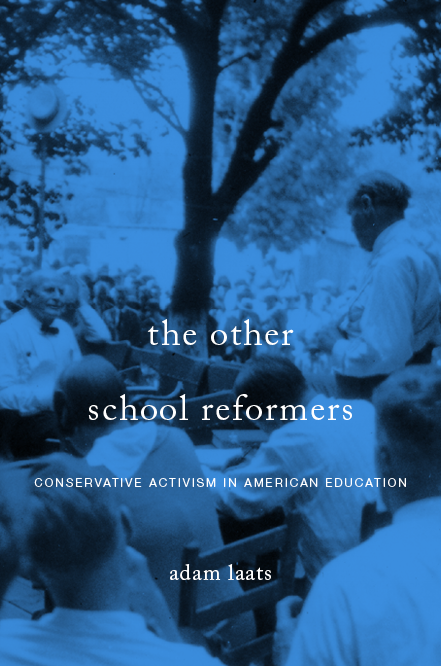
As I discuss in my current book, The Other School Reformers, conservative school activists throughout the twentieth century insisted on this sort of loyalty oath as an iron-clad requirement for all teachers in public schools.  It seems quaint these days to think of asking enemy agents to solemnly promise not to undermine the American way of life, but from the 1930s through the 1950s and beyond, many leading conservatives considered such oaths a primary means of combating alien influence in American society.

In 1950, for example, conservatives in Pasadena, California, fretted that their award-winning school superintendent had aligned himself too closely with communist-friendly “progressives.”  One of the fixes the conservatives insisted on was to put the Daughters of the American Revolution in charge of administering new teacher loyalty oaths.

The move made sense at the time.  Throughout the 1930s, the DAR had led the fight to pass mandatory loyalty-oath laws in several states.  By the 1950s, the DAR had established itself as the leading proponent of teacher loyalty oaths.  Therefore, it makes sense to think that if we want to understand the reasoning behind such oaths, we should start with the DAR.

At the tail end of the 1920s, for example, Grace Brosseau, national leader of the DAR, told the annual meeting that teachers’ loyalty oaths made up a key component of the DAR’s strategy to improve American education.  Such oaths, Brosseau insisted, could help America’s mothers be confident that “instructors in your communities are of the right calibre and are teaching sound Americanism instead of instilling pernicious doctrines into the minds of their pupils.”[1]

At that same national meeting, the assembled DAR representatives passed a resolution in favor of such teacher loyalty oaths.  Why?  Because, in their words, “anti-American elements are incessantly working to overthrow our constitutional form of government.”  Teacher loyalty oaths could help, they thought, along with “greater care in the selection of instructors for our schools, more widespread interest in curriculum and textbooks and a deeper understanding of methods of instruction.”[2]

In the mid-1930s, a successor to Grace Brosseau agreed that teacher loyalty oaths constituted a key element of right-thinking conservative school reform.  As President General Florence Becker argued in 1935,

A Teachers’ Oath of Allegiance law is but a tardy recognition of the fact that of all public servants holding positions of trust and receiving pay from public funds, the teacher holds the key position of importance.  The education system should be kept free from government control, and the American people should not commit suicide by failure to provide teachers who have faith in America.[3]

One DAR activist in Michigan thought that a teacher oath would at least give parents some legal recourse if they found a subversive teacher in their local school, “spreading his un-American doctrines among our children.”[4]

In sum, it seems that teacher loyalty oaths resulted from anti-communist political pressure in the 1930s and 1950s.  Even at the time, other anti-communists wondered if such oaths mattered.  Would a foreign agent dedicated to subversion be deterred by such an oath?

These days, the United States does not face the threat of a large body of communist agents.  Does it make any sense to continue these loyalty oaths?


[1] Grace L.H. Brosseau, “Annual Message of the President General,” Proceedings of the Thirty-Eighth Continental Congress, National Society of the DAR (1929), page 11.


[2] “Resolution No. 16, Teachers’ Oath,” Proceedings of the Thirty-Eighth Continental Congress, NSDAR (1929), 681-682.


[3] Mrs. William A. Becker, Tapestry Weavers: an Address of Mrs. William A. Becker, President General, National Society, Daughters of the American Revolution at Fall State Conferences, 1935 (no publisher, no date, [likely DAR published, likely 1935.  Copy in the NSDAR archives, Washington, DC]), pages 6-7.


[4] Vivian Lyon Moore, “Michigan’s ‘Oath of Allegiance’ Bill,” DAR Magazine Volume 65 (July 1931), page 404.


White House Petition: A Creationist Scheme?

Is the White House petition to ban creationism and intelligent design just a creationist scheme?

That’s the question asked recently by the ever-vigilant Sensuous Curmudgeon.

Here’s an update for those just joining us: Two weeks ago, someone filed a petition with the White House to ban creationism and intelligent design in the US.  These petitions need 100,000 signatures in 30 days in order to guarantee consideration by the Obama administration.  So far, this petition has 39,080 signatures, with 60,920 more needed by July 15.

The Sensuous Curmudgeon‘s blog is a must-read for anyone who follows creationism issues.  The Curmudgeon tracks and ruthlessly pillories creationism wherever and whenever it raises its head.  Yet the Curmudgeon opposes this petition.  The Curmudgeon argues that such things are not only useless to stop creationism or intelligent design, they actually help creationists paint themselves as victims.

We agree.

The Curmudgeon, however, goes one step further.  This petition is such a bad idea for those who support evolution education, the Curmudgeon believes, that it smells like the work of a creationist provocateur.

As the Curmudgeon puts it,

We suspect that it’s really something concocted by a small group of “clever” creationists — possibly in some dingy Seattle “think tank” — who want to demonstrate how “intolerant” we “Darwinists” really are, and how we want to suppress their glorious insights about creation science and intelligent design, and how we’ll resort to governmental force to maintain our “atheistic monopoly” on public education.

What do you think?  Is this petition just a creationist scheme?

Common Core = Christian Core

What is an evangelical Christian to do?

The prolific Karen Swallow Prior recently argued that evangelicals ought to embrace the emerging Common Core State Standards (CCSS).

The CCSS have been attacked and defended by both progressives and conservatives.  They have been called both totalitarian and liberating, intrusive and effective.

Conservatives are divided.  Some say the Common Core is the least-bad planOthers warn of “control by Obama administration left-wing bureaucrats.”

Not so fast, Prior wrote. She attended a workshop with Core Mastermind David Coleman, and came away convinced that the standards have promise to improve literacy skills in the USA.  Especially as Bible-centered Christians, Prior argues, evangelicals need to get behind this effort.

After all, Prior insisted, “no one more than evangelicals can appreciate the importance to a people and a culture of the ability to read, and read well—or the devastating effects of being unable to do so.”


Creation Wins the Culture War

Quick: What rhymes with mitochondria?

It’s a tough question, and it helps illustrate the uphill cultural battle evolution has faced for the past hundred years in America.

A fluffy piece in Sunday’s New York Times gives us an example of this persistent imbalance.

The article describes the results of an outreach program to New York City teens, Science Genius.  The program hopes to use hip-hop as a sweetener to connect urban youth to science.

A victory for evolution and mainstream science?  I don’t think so.  I’m no creationist, but I can’t help but conclude that pop music seems to be more suitable for creationism than mainstream science.

Though the supporters of the NYC program claim some limited successes, even those claims highlight the deep difficulties of engaging young people of every cultural background with mainstream science.

We don’t want to make too much out of just one example, but listeners are not likely to be much moved by rhymes like the following: “Bioclast, foliation, and that granite, . . . I can tell you something ‘bout an aphanitic.”

I applaud the student, and the program, but rapping the truths of mainstream science doesn’t fall as trippingly off the tongue as those of creationism.

How much evolution music can you name?  Good stuff?

Creationists, on the other hand, can claim all sorts of pop music from the headlining Jonas Brothers to internet-cluttering obscure artists across the world.  Christian and Creation rock has long been an enormous and aggressive cultural presence, as ex-fundamentalist Jonny Scaramanga has remembered.

Where is the evolution-rock?

As critic Jason Rosenhouse perceptively noted in his book Among the Creationists, mainstream science does not have to worry about creationist challenges to the strength of real evolutionary science.  But creationists, Rosenhouse argues, DO have an easy time of constructing narratives that make sense to people.  Mainstream science?  Not so much.

Perhaps this is why people trust their intuition about creation and evolution more than they trust mainstream science.  As Penn State political scientists Michael Berkman and Eric Plutzer noted in their book Evolution, Creationism, and the Battle to Control America’s Classrooms, even the small minority of Americans who agree that mainstream science is firmly evolutionist support the inclusion of creationism in America’s classrooms.  That’s right: even those Americans who recognize that scientists agree about evolution tend to agree that creationism should be part of public science education.

Why is that?  At least part of the reason must be because mainstream science does not offer a compelling story to which Americans can cling.  There is no telos, no plot, no conflict (in the literary sense), no protagonists worth following.

Creationism, on the other hand, makes a good deal of intuitive sense.  It makes sense that a world so complex, so morally challenging, must have been created on purpose.

Evolutionary science, for its part, needs to make the case that humanity occurred somehow, but we don’t know exactly how.  It needs to explain that the feelings people have of purpose, of cosmological intent, are only vestiges of happenstance.

A hard bill of goods to sell on the pop-culture marketplace.  Just like it is hard to find a rhyme for mitochondria.


Are We Post-Racial Yet? Conservatives and Affirmative Action

It appears the US Supreme Court’s non-decision today about affirmative action won’t settle anything. In its 7-1 ruling in Fisher v. University of Texas, the Court sent the case back down to lower courts to decide.  This doesn’t rule out university use of affirmative action policies in admissions, but it does not exactly endorse it either.

Significantly, Court conservatives including Justices Scalia and Thomas voted with the majority today, but both indicated they would be willing (eager?) to rule such affirmative-action policies unconstitutional.

Legal and higher-ed policy wonks will have plenty to chew over in coming days.

For me, the recent ruling underscores the ways debates over affirmative action in university admissions policies have become a stand-in for conservative sentiment about race and racism in America.  Though it is too simple to say anything about conservatism as a whole, the last forty years have established a new kind of anti-racist conservatism.  These self-described anti-racists, however, have struggled to convince anyone besides themselves of their sincere dedication to fighting racism and traditional preferences that favor whites.

The recent SCOTUS history alone has given the debate over race and schooling a kick in the pants.  In the late 1970s, in the Bakke case, the Supreme Court ruled against the use of any racial quotas in college admissions.

More recently, in Grutter v. Bollinger (2003), SCOTUS decided that race could be used in admissions decisions, as one category among others.  The key element in this decision was that race could be used to further the state’s interest in fostering a diverse learning environment.

One influential strain of opinion among conservatives can be summed up in a pithy statement by Chief Justice Roberts from 2007.  In a case from Seattle, Roberts insisted, “the way to stop discrimination on the basis of race is to stop discrimination on the basis of race.”

Conservative thinking on this issue has, in some ways, remained remarkably constant for the past generation.  In the mid-1980s, for instance, writing for the Heritage Foundation, Philip Lawler articulated a conservative critique of affirmative action admissions policies that sounds fresh today.  Such policies, Lawler argued, effectively promote racism against African Americans and other historically underrepresented college populations.  Affirmative action degrades true achievement and breeds resentment towards all African Americans.  It also leads to a racist dismissal of the true achievements of some African Americans.

Former US Representative Allen West made similar arguments in his amicus brief filed in the Fisher case.  “Race-conscious policies do not advance – in fact, they harm – the most compelling of all governmental interests: protecting and defending our Nation’s security. This is true whether practiced by colleges and universities (which, together with the Nation’s military academies, produce the majority of the commissioned officers in our country’s military), or by the military itself in the selection and advancement of its officer and enlisted personnel,” West argued.  West, a prominent African American conservative, argued that affirmative action policies degraded all applicants, African Americans most of all.

The problem with these kinds of conservative arguments is that they are often dismissed as mere window dressing.  With important exceptions such as Representative West and Justice Clarence Thomas, most African Americans support affirmative action policies.  The NAACP, for instance, has consistently and energetically supported Texas’ race-conscious admissions policy.  The National Black Law Students Association, in its amicus brief in the Fisher case noted the “systematic racial hierarchy that produces and perpetuates racial disparities in educational opportunities and outcomes.”  Affirmative-action admissions policies, the NBLSA insisted, remained necessary to promote a truly non-racist society.  Conservative insistence that such affirmative action policies actually support anti-black racism tends to fall on deaf ears among the majority of African Americans and whites who consider themselves racial liberals.

Conservative activists and intellectuals—white and black—often express what seems like honest surprise when accused of anti-black racism.  Perhaps one episode that illustrates this kind of conservative anti-racism might be that of Alice Moore and the 1974 Kanawha County textbook protest.  In this battle from the Charleston region of West Virginia, conservative parents and activists protested against a new series of English Language Arts textbooks.  Among the many complaints were protests against the inclusion of authors such as Eldridge Cleaver and George Jackson.  Such militant African American voices, many Kanawha County residents insisted, did not belong in school textbooks.  Conservative leaders insisted that this was not because they were black, but because they were violent and criminal, and apparently proud of it.

Conservative leader Alice Moore came to the 1974 controversy freshly schooled in the ideology of anti-racist conservatism.  She had attended a conference in which conservative African American politician Stephen Jenkins blasted the anti-black implications of multicultural literature.  Such literature collections, Jenkins insisted, implied that the violent, angry, criminal voices of militants such as George Jackson and Eldridge Cleaver represented the thinking of African Americans.  Such implications, Jenkins explained, proved that the true racists were the multiculturalists.  By pushing a skewed vision of African American culture, such multicultural textbooks implied that African Americans as a whole were criminal and violent.

Moore embraced this sort of anti-racist conservative ideology.  When she (politely, as always) confronted African American leader Ron English at a heated board of education meeting, Moore seemed honestly flummoxed that the English did not agree with her.  Moore pointed out that voices such as Jackson and Cleaver did not fairly represent the truths of African American life.  But The Reverend English rebutted that such militant voices represented an important part of the American experience, stretching back to Tom Paine.

Moore’s befuddlement in 1974 matches that of anti-racist, anti-affirmative action conservatives today.  Many conservatives feel that their opposition to affirmative action makes them the true anti-racists.  Yet they consistently find themselves accused of racism.  The fight over Fisher never seemed to be changing this dynamic.  Now that the Court has punted, there is even less resolution on offer.  Conservative notions that true anti-racism requires the elimination of race-based considerations in college admissions will likely continue to fall on deaf ears among leading African American advocacy groups.

Being Gay at a Catholic College

Is gay okay the Catholic way?

Religion writer Michael O’Loughlin recently surveyed the experiences of gay students at a variety of Catholic colleges.  The answer, maybe not surprisingly, is that different schools do things differently.

At Chicago’s DePaul University, O’Loughlin found, students can minor in LGBTQ Studies. Students and faculty are out and supportive.

Other schools, such as Washington DC’s Catholic University, have a more mixed record.  Students are gay, O’Loughlin reported, and that’s only sort of okay.

One constant, at Catholic universities as across American culture, is rapid change.

O’Loughlin returned after just a handful of years to his alma mater, St. Anselm College in Manchester, New Hampshire.  When he attended, gay students kept their sexual identity private. Now, the school itself has initiated programs to make all students, explicitly including homosexual students, feel welcomed, loved, and guided.

As some of the comments on O’Loughlin’s essay proved, not all Catholics are okay with this trend.  As “JP” noted,

Can one imagine a group of Catholic adulterers or thieves organizing at a Catholic college in order for their “voice to be heard”? Homosexual acts as well as larceny or adultery are still considered Mortal Sins by the RCC.

Catholic schools are not alone in their struggles with this issue.  As we noted a while back, Brandon Ambrosino shared his experiences with faith and sexuality at the conservative evangelical flagship school, Liberty University.  Just as Catholic colleges have had a range of responses to the issues of student homosexuality, so folks at conservative Protestant schools  have had surprisingly mixed reactions as well.


To Win Elections, Conservatives Need to Win in Schools

What happened?

Why do conservative candidates lose elections?

That is the question Mark Bauerlein of Emory University asked in Friday’s Public Discourse.

Bauerlein finds the answer not in demographics or policy prescriptions, but in college and high-school curricula.  The revolution in teaching of the past forty years, he says, means that conservative candidates lack the intellectual heft and agility necessary to win.  Bauerlein modifies a Thatcher motto: “First you win the schools, then you win the government.”

Governor Romney, Bauerlein argues, exemplified the problem.  Romney’s famous blunder about “47%” of the electorate was a lost opportunity, Bauerlein thinks, to introduce a new generation of voters to true conservative principles.  Romney did not explain the central conservative principles of thrift, independence, and liberty that could have made his point.

The real remedy, Bauerlein insists, is not in new polls or smoother candidates.  The long-term conservative remedy will be to take advantage of the profound conservatism at the heart of American culture.  If young people receive a better education in the American tradition, they will be both more receptive to and more articulate about those conservative American principles.

“The lesson is this:” Bauerlein tells us,

Conservative candidates must possess, among other attributes, a conservative tradition in their heads, not just political principles, but great thinkers and artists of them, too. . . .

The best way, perhaps the only consistent one, to plant conservative writings and art in the formation of politicians is through the high school and college curriculum. There, individuals have the space to absorb them as common intellectual equipment, as regular facets of the world, not as political positions. . . .

What they encounter and how it is presented determine what they think is important. If English and history courses don’t include Brave New World and Fahrenheit 451 (an anti-political correctness novel) alongside multiculturalist fiction of the 2000s, if they don’t add David Horowitz’s Radical Son to celebrations of the 1960s counterculture, if James Madison doesn’t precede Malcolm X, then the conservative tradition has no place in the accepted body of cultural literacy. If The Scarlet Letter is taught as an indictment of sexual oppression in a Puritan community, not as a complicated tale in which the community has a valid claim upon Hester’s desires, then social conservatism is reinforced as an uptight, obsolete imposition.

This is to recognize the curriculum as an authorizing process. What makes it onto the syllabus has legitimacy, and the angle the teacher takes upon the materials tends to stick. If conservative donors wish to back winning candidates, to cultivate politicians who can deflect sallies of biased reporters and liberal counterparts with intelligent and informed convictions, they must reach conservative politicians not only in election years, but at impressionable ages, too.

The good news for conservatives, Bauerlein writes, is that many schools have already begun to implement this kind of strategy.  They teach conservative ideas not only in short-term intellectual boot camps, but as part of a thoughtful tradition that includes all the best thinkers from across the intellectual spectrum.

What could this look like?  According to Bauerlein, it could mimic the success of liberal efforts such as the Ford Foundation’s funding of centers for Women’s Studies.  That field went from zero to influential in a decade, thanks in part to such funding. Bauerlein thinks it’s time for conservatives to do the same.


An Atheist and a Fundamentalist Walk into a Bar…

Can skeptics and believers talk civilly to one another? Can creationists and mainstream scientists ever have a constructive dialogue?

Most of the time, the best efforts at culture-war mediation leave everyone only more bitter and more convinced of the “extremism” and “irrationality” of the other side.

Thanks to coverage from the Texas Freedom Network, we recently caught up with an illuminating intellectual exchange between a leading creationist advocate and a witty, informed science skeptic.  Neither one seems to have been “converted” by the argument, but the civil yet heated discussion demonstrated the possibilities of creation-evolution dialogue.

Steven Novella, president of the New England Skeptics Society, interviewed Texas creation activist Don McLeroy last month.  You can hear the full interview on the Skeptics’ Guide to the Universe podcast.  Also fascinating, you can follow the post-interview back-and-forth on Novella’s NeurologicaBlog.

As we’ve argued here before, trying to understand Don McLeroy is a great way to begin making sense of conservatism in American education more broadly.  As the chairman of the Texas State Board of Education in 2010, McLeroy spearheaded a campaign to overhaul Texas’ influential textbook guidelines.  In that fight, McLeroy cared about more than evolution.  He also promoted an emphasis on such disparate themes as the Christianity of the founding fathers, the beneficence of the National Rifle Association, and the civic value of country music.

In the May 8, 2013 interview, Novella and his colleagues asked mainly about McLeroy’s position on evolution education.

During the interview, McLeroy makes his case for teaching the scientific alternatives to mainstream evolution theory.  As Novella and his associates point out, McLeroy carefully avoids making a case for teaching creationism or any religious ideas in public schools. Instead, McLeroy consistently advocates only for teaching the scientific criticisms of evolutionary theory.  Most of the discussion consists of a back-and-forth on the merits and weight of those criticisms.

Are there enough real scientific challenges to evolutionary theory to merit their inclusion in public-school science curricula?

One of the most intriguing points of the exchange was McLeroy’s insistence that religious thinkers are free to be more open-minded about the scientific claims of evolution.  Since religious intellectuals are open to the idea of both materialistic and supernatural explanations, McLeroy claimed, they have greater ability to weigh the evidence. This argument did not sit well with Novella and his colleagues.

Another fascinating discussion resulted from McLeroy’s defense of his anti-expert position.  During the 2010 school fight in Texas, as captured so movingly in Scott Thurman’s Revisionaries documentary, McLeroy argued that educators needed to seize control from “experts.”  Novella and his associates explained to McLeroy why this claim seemed preposterous to them.  Why should science curricula ignore the thinking of mainstream scientists—the real experts—and instead follow the inclinations of one dentist from Texas?

I was surprised to hear McLeroy’s willingness to waffle.  As I’ve argued before, McLeroy’s indictment of “experts” has a storied history, of which Novella and his colleagues seemed unaware.  For many anti-evolution activists, indeed for many conservative educational activists on a range of issues, the baleful influence of educational experts has long been assumed.  The recent trashing of CSCOPE in Texas demonstrated only the most recent emergence of this anti-expert sentiment.  I wished Dr. McLeroy had tried to articulate some of this broader anti-expert tradition.

More important than the details of the transcript, however, was the tone of the interview and post-interview exchange.  Neither Novella nor McLeroy apologized for their beliefs.  Neither held back from pointed and fundamental criticisms of the other, though as guest McLeroy tended to be more polite.  Yet the two sides managed to speak politely to one another.  McLeroy called Novella a “scholar and a gentleman.”

For his part, Novella called McLeroy

an exemplary guest. He stayed polite throughout, and did not bristle even when directly confronted on his position. He also did something I find extremely rare in such interviews – occasionally acknowledging a point on the other side or a weakness in his own position. He also had clearly made a genuine effort to read pro-evolution material and criticisms of his position.

I came away with the impression that he is genuinely trying to understand the creation/evolution debate and to rely on only valid arguments.

Did either side walk away from this exchange converted?  Definitely not.  But was the exchange worthwhile?  Certainly yes, for several reasons.

First of all, for interested observers, this back-and-forth gave both sides a chance to make their own arguments.  Readers and listeners can see what intelligent advocates might say on some basic stumpers of the creation/evolution debate.

Second, in any tense culture-war standoff, elaborate courtesy and face-to-face meetings help defuse the tendency to demonize the opposition.  For evolution believers like me, the contours of the debate change when I hear a friendly, seemingly well-intentioned leader of the creationist cause, if only to prove that both sides can include people of good will.


Would You Sign It? UPDATE

This just in: the new petition to urge President Obama to ban creationism and intelligent design has evolved!

When we first noticed it yesterday, it had garnered 7662 signatures.  One day later, it has tallied 11,321.  That’s 3659 signatures per day. In order to guarantee Presidential consideration, the petition needs 88,679 more signatures by July 15. 

That would require, by my awkward public-school mathematics, just about 3550 new signatures per day.  So the future looks bright for this symbolic sally into the culture-wars No Man’s Land. 

Who knows what the future brings.  Perhaps this campaign will fizzle after the initial buzz dies down.  Or just maybe, more and more people will sign per day, blasting past the 100,000 minimum requirement. 

I don’t think that would present President Obama with much of a political dilemma.  Unlike GOP leaders, Obama does not really need to truckle to religious conservatives.  He could easily issue a few diplomatic murmurings about the importance of thorough, accurate science education in the nation’s schools. 

I will keep my eyes peeled, in any case, to see how this petition plays out.  Stay tuned.