Update: Cheerleaders Can Love Jesus

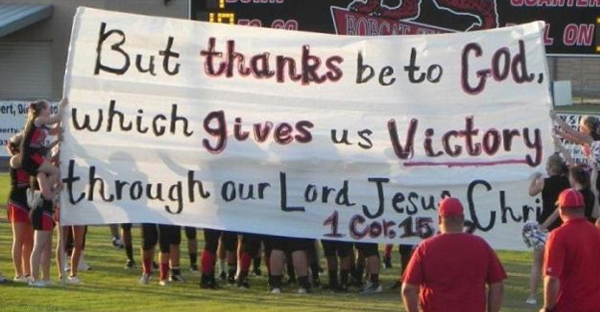
Tim Tebow can love Jesus.  But can cheerleaders at a public high school?  A Texas judge ruled this week that they can.

This story has been circulating for several months.  As we’ve reported here on ILYBYGTH, in September the Kountze Independent School District banned high school cheerleaders from displaying Bible-based banners at football games.  Prompted by the Wisconsin-based Freedom from Religion Foundation, the school district worried that such displays violated the Constitution.

Source: KNUE

Source: KNUE

Parents fought back.  They argued that the cheer squad was a student organization, not funded by public dollars.  As such, the students’ religious speech was protected by the Constitution.

Earlier this week, according to a local TV station, District Judge Steve Jones ruled that the cheerleaders should be allowed to continue with their religious messages. 

End of story?  Not quite.  The school district has promised to change its policies, which might give it the right to ban such banners again. 


A Christian Teen Army in Public Schools

“High school Christian teens, Join Us!”

That is the call of a new video promoted by the evangelical Christian group Reach America.

In the video, teenagers ask a series of provocative questions, such as the following:

Why can’t I pray in school?  Why do I have to check my religion at the door?  Why can’t I write about God in my school papers?  Why do I have to tolerate people cursing my God, but I’m not allowed to talk about God and my faith? Why are they taking God out of my history books? Why do they teach every other theory in science besides creation?  Why am I called names because I believe in marriage the way God designed it?

Like many conservative evangelical educational activists, Gary Brown, founder of Reach America, believes that public schools have lost their way.  Beginning with the prayer and Bible SCOTUS decisions in 1962 and 1963, Brown insists, God has been systematically frozen out of schools.  Christian students have been targeted for bullying, indoctrination, and harassment.  Every part of public education is a threat, from pornographic sex education to mandatory dating.

Brown’s answer has been a call for youth engagement.  In the recent video, Reach America teens warn, “People who do not love our God have stolen our country. . . . We are an army.  Christ is our commander. . . . We are in a war for the hearts and souls of our generation.  And we know it.”

This culture-war army can be directed, Reach America promises, by programs such as its new Educational Partnership.  From its headquarters in northern Idaho, Reach America wants to organize a non-school school.  At this “partnership,” students will come to this non-school school every day, September through June.  In the mornings, they will work on academic work.  That work, though, will not come from the non-school, but rather from parent-directed online education or homeschool assignments.  In the afternoons, students will work on the “four Cs:” Christ-Centered Counter-Culture.

So how is this school not a school?  Parents pay tuition.  Students study there.  The program even offers “P.E. and electives.”  Do the Browns avoid calling this a school to avoid legal hassles?  It certainly looks that way.

How big is the program?  Not too big.  According to Brown, twenty-three students are enrolled for the current non-school year.  My guess is that Reach America will attract the attention of scribblers like me with the culture-war rhetoric of this video, but will soon encounter the difficulties that plague every Christian school, even non-school ones.

In any case, the message of the teens’ video is clear.  The way to prevent bullying is to fight back.  As they declare, “America will be one nation under God, again.”


Scientists Are Dumb

What do elite scientists know about religion?

Not much, according to sociologist Elaine Howard Ecklund.  Asking these out-of-touch elite scientists for advice about religion is akin to asking residents of a nudist colony for advice about fashion.

If anyone would know, it would be Ecklund.  In her study of scientists, between 2005 and 2008, she surveyed 1700 scientists from what she called “elite” schools (157-158).  She announced her goal in her 2010 book Science vs. Religion: to give voice to “the scientists whose voices have been thus far overlooked in the science-and-religion debates” (x).

To this reader, Ecklund seems to have made a strange decision to include social scientists—economists, political scientists—in her sample.  It seems a better fit to call her sample elite “academics” instead of elite “scientists.”  Other reviewers have pointed out different complaints.

But whatever the merits or faults of the study as a whole, it tells us something about the connection between some elite academics and the rest of America.  As Ecklund describes, the religious affiliation of her sample does not match that of Americans as a whole.  Among her sample, only two percent identified as “evangelical Protestant,” compared to twenty-eight percent among the general population.  Only two tenths percent as “Black Protestant,” compared to the general public’s eight percent.  Nine percent identified as Catholic, compared to twenty-seven percent of the public.  Sixteen percent were Jewish, compared to the general population’s two percent.  Perhaps most interesting, given recent attention to the rise of the “nones,” a full fifty-three percent of Ecklund’s sample claimed no religious affiliation, compared to sixteen percent of the rest of us. (15).

The same trend was true when it came to professing atheism or agnosticism.  In Ecklund’s sample, just over one-third called themselves atheists, compared to a mere two percent of the American population.  Thirty percent called themselves agnostic, compared to the general four percent.  And a relatively meager nine percent agreed with the statement “I have no doubts about God’s existence,” compared to a whopping sixty-three percent of the general public (16).

These elite academics, then, certainly do not match the rest of America in religious ideas or identity.  That really doesn’t come as much of a surprise.  But Ecklund argues more provocatively that this religious quirkiness among elite academics also creates a sort of self-perpetuating echo chamber.  It creates what Ecklund calls three “myths scientists believe” (152).

First, Ecklund charges, elite academics tend to think that if they ignore religion, it will go away.  Second, they too often equate all religion with an imagined bogeyman of “fundamentalism” (153).  And elite academics tend to think that “All evangelical Christians are against science” (155).

The utter lack of evidence for all these myths does not stop elite academics from feeling correct, even intellectually superior to those who question their blundering assumptions.  As Ecklund argues, non-religious academics often have little idea even about the working of religion on their own elite campuses, “much less about what drives a typical American worshipper” (8).

Ecklund depicts an environment on some elite college campuses that encourages, or at least allows, growths of strange ideological excess.  One physicist she interviewed—admittedly one extreme end of Ecklund’s sample—described religion as a “virus” to which he is “immune” (13).

Most of her interviewees did not express such virulent hostility, but many of the traditionally religious folk still expressed a felt need to live a “closeted faith” (43).  Even when they had some religious colleagues, these elite academics often felt surrounded by angry anti-religion.  One self-identified “Christian” academic told Ecklund about a conversation with a colleague about their students’ poor academic preparation.  The fault, this Christian was told, was with “stupid intelligent design.  It’s stupid Christianity” (45).  Her colleague had not meant to offend, but had simply assumed that such comments could not be considered offensive.

In this self-reinforcing world of arrogant ignorance, many of the academics in Ecklund’s study made strange and unwarranted assumptions.  One biologist, for example, assumed that “mature” students would not consider creationism.  Advanced students, this biologist explained, “are just not religious in the first place.”  But this biologist, Ecklund points out, really had no idea about the religious ideas or backgrounds of his students (78).

Even on their own campuses, most of Ecklund’s sample reported woeful ignorance of attempts to promote dialogue between science and religion.  “The reality of university life,” Ecklund argued, “does not match these scientists’ ideal” (98).

Yet this ignorance among elite academics did not create a questioning or humble attitude.  One social scientist, for instance, explained how she began her classes.  “You don’t have to distance yourself from religion,” she told her new students, “and think about it from an outside perspective, but you do if you want to succeed in this class.  And if you don’t want to do that, then you need to leave” (84).

How can such smart people say such dumb things?  How can elite academics profess such blinkered ideas without even recognizing their own biases?  As a product of two of the “elite” schools in Ecklund’s sample (Washington University in St. Louis and University of Wisconsin—Madison), I can attest to the fact that the environments in such places can lead to a perception of a single, right, “progressive” orthodoxy.  But even academics should be allowed their own opinions, right?  Even if they are grossly out of line with popular notions?

The real question, to my way of thinking, is this: How can people who have purportedly dedicated their professional lives to increasing their knowledge allow themselves such lamentable ignorance when it comes to religion?

In the News: Scott Retiring

The National Center for Science Education has announced the retirement of Executive Director Eugenie Scott.

Scott has long been one of the most prominent voices against creationism and intelligent design.  Her books and public appearances consistently articulated a bold anti-creationism without, IMHO, attacking religion itself or religious people.  In the angry world of creation/evolution controversy, that has been a significant accomplishment.

We will be watching carefully to see who NCSE picks to replace her.   If you’re interested in the job, check out the job posting.

Does Science Hate God?

If God loves science and scientists love God, why do we keep hearing that they hate each other?

It’s the $64,000 question Daniel Silliman asked yesterday on his terrific blog.*  As Silliman points out, the “warfare thesis” between religion and science just doesn’t hold water.

Yet films such as The Unbelievers attract enormous attention and support.  In that upcoming documentary, leading science pundits Richard Dawkins and Lawrence Krauss apparently insist that true science must crush false religion.

Silliman could have extended the point on the other side, as well.  Plenty of religious leaders have encouraged the legend of warfare between true religion and “science falsely so-called.”  Young-earth creation leader Ken Ham, for instance, insists on the importance of this “struggle over the question of authority.”

Silliman ends with a great question for fans of The Unbelievers:

The real question that this documentary raises, though, is why there’s such a market for the conflict thesis. Why does it persist in its obfuscations and false oppositions so long after it was demonstrated to be historically bankrupt as a theory and demonstrably empirically false?

Is it because a fight is just more interesting than a compromise?  Is it due to our reality-show culture in which viewers insist on drama?  Or are there substantial differences, necessary hostilities, that persist in the face of historians’ denial of the warfare thesis?

*You can tell it’s a great blog because he lists yours truly as one of his links.  Thanks!

Dinosaur Quizzes and Beleaguered Minorities

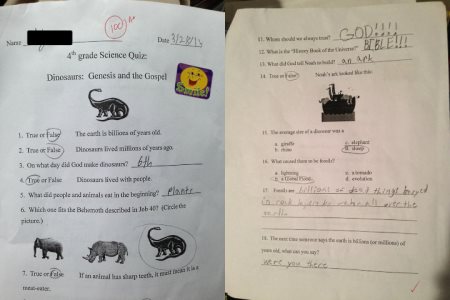
Have you seen it?  The dinosaur quiz below has been making the rounds lately.

dino quiz

Source: Answers in Genesis

This seems like a good chance for an ILYBYGTH gut check: What does this quiz tell us about creationism and American education?  For fans of evolution, this quiz confirms that creationism is a looming threat.  For young-earth creationists, though, this quiz and its public career tell us that Biblical creationists have become a righteous minority, besieged on all sides.

Here’s the story so far:  This quiz apparently came from a fourth-grade classroom at a private Christian school in South Carolina.  A parent posted it online when he found out to his dismay that his daughter had been learning this account of the origins of life.

What does this tell us about the state of American education?  Depending on your perspective, it can teach very different lessons.

For some commenters at r/atheism, this quiz serves as proof of the creeping power of Christian fundamentalism.  One poster noted, “They’re teaching these kids how to respond to people who spread the ‘evils of the world,’ in order to defend their faith.  It’s just very, very sad.”

Another agreed.  “This is just disgusting, my goodness,” he or she noted, concerning the fact that so many accredited schools in the United States teach this kind of science.  “I would really love to see a full on description of what is required to be taught to remain accredited, and then see if I could develop a program based around worship of FSM [i.e., the Flying Spaghetti Monster] that would meet those requirements.”

For young-earth creationist leader Ken Ham, however, the brouhaha over this quiz tells a very different lesson.  Ham complained that the backlash to this quiz proves that atheists have taken over America.  As he put it recently,

It seems that since the last presidential election, atheists have grown more confident about having something of a license to go after Christians. These secularists want to impose their anti-God religion on the culture. They are simply not content using legislatures and courts to protect the dogmatic teaching of their atheistic religion of evolution and millions of years in public schools. There is something else on their agenda: they are increasingly going after Christians and Christian institutions that teach God’s Word beginning in Genesis.

The danger, Ham and his colleague Mark Looy warned, should be readily apparent: “the atheists want your children. They are aggressively trying to demonize and marginalize Christians in their attempts to recruit your children for atheism or secularism.”

So who is the victim here?  Is it besieged Christians, defending their schools against dominant atheism?  Or is it science and reason, holding out in a last-ditch effort to save American education from Taliban-ism?

I’ll go out on a limb and try to define America’s educational consensus on this one.  The overwhelming majority of Americans agree, I’ll argue, that private schools can teach whatever they wish.  But there is one enormous exception: schools cannot teach doctrines that will cause harm to students or the wider society.

Obviously, this kicks the discussion back to the definition of “harm.”  We will all agree that teaching students how to rob liquor stores will ultimately be bad for both students and society.

But does teaching creationism constitute harm?  To anyone?  Here’s where tempers get heated.  I do not endorse young-earth creationism, but I believe the harm it does to students and society is far less than the harm that would be done if steps were taken to coerce schools to teach evolution.  Let schools teach young-earth creationism.  Try to persuade–not force–people to teach their children evolution instead.

Smart people disagree.  Some folks consider teaching young-earth creationism to be no harm at all.  Others, such as physicist Lawrence Krauss, consider teaching creationism to be a form of “child abuse.”   

Whichever side of this fence you fall on, this dinosaur quiz and the response it has generated can serve as a creationism quiz, a quick check of your attitudes toward this alternative science.  Does this sort of teaching harm students?  Does this sort of education harm society?


Common Core + Climate Change Science = Progressive Beer Bong

Solve the equation for X.

Many conservative educational activists are up in arms about the new Common Core State Standards.  Today we read a new articulation of this conservative hostility from Iowa State Representative Ralph Watts.

Watts called the Next Generation Science Standards—the science branch of the Common Core—a “beer bong for American education.”  For those whose college education did not include the arts and sciences of beer bongs, the Honorable Representative Watts meant to imply that these standards will deliver ideas quickly enough to overwhelm students’ ability to digest them.  In his words, the new standards constitute “a vehicle for progressive activists to spread their philosophies and propaganda to our children through a conduit designed very effectively to serve their needs.”

Next Generation Science Standards, Watts warns, insist that human-caused climate change is a fact.  This is another episode of federal overreach, Watts insists.  “Centralization. . . .” Watts concludes, will be a “colossal mistake and a classic failure.”

In the field of science education, Watts has a point.  Local control often protects the teaching of creationism and intelligent design, for example.  The same could be true for climate-change skepticism.  Putting mainstream scientists in charge of more rigorous science standards can’t hurt.  But I worry that it also won’t help too much.

In spite of Representative Watts’ poignant words, there are no true beer bongs in American education.  There is no way for any central body to deliver ideology so overwhelmingly to students nationwide as to overwhelm their home culture’s beliefs.

Pennsylvania Science Teachers Teach Creationism as Science

Pennsylvania science teachers teach creationism.  It really should come as no surprise, since that is the case for science teachers in public schools across the country.  But every new batch of data offers some new insight.

Thanks to the ever-vigilant Sensuous Curmudgeon, we see a new survey from the Pittsburgh Post-Gazette.  It doesn’t contain any mind-blowingly unexpected results, but the facts on the ground in the evolution/creation/intelligent design controversy are always mind blowing.

This survey collected results from 106 science teachers from the Keystone State.  The responses show us once again that there is no bright line between science and religion in many public-school classrooms.  For instance, while 90% of teachers said they believe in evolution, 19% listed creationism as their belief, while 13% claimed to believe in intelligent design.  Unfortunately, the survey did not require respondents to define what they meant by any of these terms.

But even with these results, we see that for many science teachers, it is entirely possible to claim both creationism and evolution as beliefs.  Teachers could choose more than one label, and many did.

As we might expect, teachers’ beliefs seem to carry over into their classroom practice.  One teacher claimed to spend five class periods teaching evolution and one class teaching creationism.

Another accused the newspaper of conducting a witch hunt to identify and persecute Biblical Christians.

One teacher warned his students against tools such as radiocarbon dating, since they contradicted the Bible.

In each of these cases, teachers insisted their school administrators approved of their classroom practice.

Most intriguing, one anonymous teacher—the one who taught one creationism class among five classes about evolution—confirmed the findings of political scientists Michael Berkman and Eric Plutzer.  Though Berkman and Plutzer hail from Penn State, they collected data from across the nation.  “Many teachers’ individual values,” they concluded, “match up well with those of the district in which they teach” (30).  Stricter state standards and certification rules, Berkman and Plutzer argued, will not make a decisive impact.  Instead, teachers tend to teach the ideas and values of their local communities.

This teacher agreed.  “Most parents and officials,” this teacher from Indiana County—just west of Pittsburgh—reported, “do not want evolution ‘crammed’ into their children.  They have serious philosophical/religious issues with public schools dictating to their students how to interpret the origins of life.”

For those like me who want to see more and better evolution education in public schools, this survey confirms the difficulty of the task.  Just as schools cannot be charged with solving poverty, so school science cannot fairly be asked to change our culture’s beliefs.  In the case of evolution, creation, and intelligent design, those beliefs are far different from what mainstream scientists might like to see.  Instead of locating the problem in science classrooms, we need to understand the true dimensions of this controversy.


Can a Public University Teach Religion as Science?

Jerry Coyne says no.  The prominent scientist and atheist brought our attention yesterday to a course being taught at Ball State University.  This course, Coyne complains, pretends to teach science, but fills students’ heads with religious notions.

Professor Coyne makes a strong case.  But it just doesn’t hold water.

Coyne insists such a course would be acceptable at a public university if it focused on the history of science and religion, or the relationship between science and religion.  But Coyne’s beef is with the fact that the course is being taught as a science course, for science credit.

Coyne demonstrates convincingly that the course is indeed infused with religious thought.

The professor, Eric Hedin, has often introduced his Christian faith into his teaching, at least according to some “Rate my professor” quotations that Coyne cites.

The reading list includes books by intelligent-design thinkers Stephen Meyer and Michael Behe.  It also asks students to read the religious/scientific work of Francis Collins and old-earth creationist Hugh Ross.  As Coyne argues, it does not include any of the leading works from the other side of this continuing controversy.

As Coyne wrote to the chair of the Ball State Physics Department,

As as [sic] scientist, I find this deeply disturbing. It’s not only religion served under the guise of science, but appears to violate the First Amendement [sic] of the Constitution. You are a public university and therefore cannot teach religion in a science class, as this class appears to do.  Clearly, Dr. Hedin is religious and foisting this on his students, and I have seen complaints about students being short-change[d] [‘d’ added in original] by being fed religion in a science course.

Coyne’s got it wrong.  First of all, a university is not the same as a K-12 public school.  Students are not forced to take this class.  This is one course from a galaxy of courses available to Ball State students.  Plus, the public funding of a public university is far different than that of K-12 schools.  According to Ball State, in 2011 the state paid for under half of operating expenses—just over $5,500 out of a total cost of $13,579 per student.

Second, and more important, a good university—public, private, whatever—should expose its students to a variety of ideas, presented by both believers and skeptics.  The University of Colorado at Boulder, for instance, attracted a good deal of attention lately for hiring Steven Hayward to fill its visiting chair in Conservative Thought and Policy.  The university’s goal was precisely to introduce a richer diversity of ideas on its campus.

In Colorado, the university and state went to considerable expense to encourage this sort of intellectual variety.  Ball State students are getting this sort of university exposure to new ideas and perspectives in-house.

Professor Coyne objects that this course is being taught as science.  And his objection has merit.  The definition of science, after all, has been a key issue in the legal battles over the teaching of creationism in public schools.

However, in order for scientists and students of science to be truly educated, they must be exposed to a true diversity of ideas.  Professor Hedin teaching his courses as part of a Ball State education is a very different thing than a religious group taking over a public education system.  Indeed, as I’ve argued elsewhere, scientists’ ignorance about creationism encourages more radical creationism.  If we want to reduce creationism’s cultural impact, we should help scientists learn more about its foundational ideas, not less.

Hedin is offering students a different way to see the world.  That kind of course should be part of every university education, in whatever department it falls.


If You Don’t Like It, Get Out: Hasidim and Schooling in Rockland County

“The hand that writes the paycheck rules the school.”

That was the line of William Jennings Bryan in the 1920s.  As I describe in my 1920s book, the conservative Presbyterian leader hoped to purge American public schools of theologically suspect notions, especially evolution and atheism.

Almost a century later, we can see a case in which religious conservatives have put this saying into action.

But William Jennings Bryan would have been surprised.  The conservatives in this case are not Protestants, but Hasidic Jews.

Journalist Benjamin Wallace-Wells offers a spellbinding account of the takeover of the public-school system in Rockland County, New York by Hasidic Jews.  Over the past several years, the ultra-orthodox Jewish sect has moved in large numbers into towns such as Ramapo.  Members of the community have used their demographic dominance to win control over the East Ramapo school board.  Since community members send their children to private schools, the school board has shifted funding from those public schools to private yeshivas, most commonly in the forms of special-education services.  Public-school funding has also been cut to the bone and beyond.

Public school students, Wallace-Wells describes, often have a hard time filling their schedules, since so many teachers have been laid off.  When non-Hasidic parents and activists complain, the president of the school board has a simple message: “You don’t like it?  Find another place to live.”

According to Wallace-Wells, the origins of the public-school takeover came from the unlikely field of special education.  Hasidic parents noticed that many of their children needed special-education services.  Yet they could not—for religious reasons—attend the pluralist public schools where such services were provided.  As a result, the Hasidic community won spots on the school board.  That school board then allowed students with special-education needs to receive needed services at private religious schools.

Many of the foes of conservative educational activism and policy worry about a “fundamentalist takeover” of public education.  What would it mean if conservatives won control of public schools?  In this fascinating essay we can see one example of conservative takeover in action.