Conservatives Look South

If educational progressives these days tend to wave Finland’s flag, perhaps educational conservatives will start to wave Mexico’s.

Mexico’s new president, Enrique Pena Nieto, has made aggressive moves against his country’s powerful teachers’ unions.  Most dramatically, the government arrested teachers’ union leader Elba Esther Gordillo, “La Maestra.

Gordillo had long been famous for her lavish lifestyle, suspicious on her relatively frugal official salary.

La Maestra in 2005

La Maestra in 2005

By moving against the teachers’ union, President Pena Nieto made some powerful enemies.  The Mexican union had ultimate power over teachers’ jobs, often creating hereditary no-work positions.

But by attacking the union he has also gained some influential friends and admirers.  The Heritage Foundation, for instance, a leading conservative think-tank in the United States, lauded Pena Nieto’s move as the first step toward “meaningful education reforms.”  In the United States, after all, conservatives like those at the Heritage Foundation have long attacked the pernicious anti-market power of teachers’ unions.

This conservative admiration for Mexican education policy has not always been the case.  As historian Ruben Flores of the University of Kansas argues in an upcoming book, a century ago it was educational progressives who fell in love with the Mexican education system.  Back then, according to Flores, United States progressives admired the centralization and efficiency of the Mexican system.

Today, it is union-bashing conservatives who look south.


Boston Bombings: Blame the Democratic University

Who or what is to blame for the horrific Boston Marathon killings?  Conservative commentator Peter S. Rieth blames America’s doddering higher-education system.

In a post at The Imaginative Conservative, Rieth blames both a warped immigration culture and a degraded university culture for the bombings.  America’s universities, Rieth argues, have decayed into party camps, hosting dunderheaded drinkers with little sense of intellectualism.

The surviving accused Boston bomber, Dzhokhar Tsarnaev, was a student at the University of Massachusetts at Dartmouth.

Such “gargantuan democratic institutions” as the university must bear some of the blame for a culture of violence, Rieth believes. When America’s university system was “forcibly and systematically democratized over the past few decades,” the original purpose was squeezed out.  In its place has grown a culture so degraded that murderers find a happy home.  As Rieth writes,

In this democratic university, the real students and the real professors would be but a faction, and a minority faction at that. The intelligentsia would be forced into the corner of their own institutions to make room for the “college means party,  study means cliff notes” crowd. The democratic university would be open and find room for everyone,  including – apparently – the psychopathic and dangerous. To those who may think I am over reaching, please consider this question: why do we live in an America where these heinous acts are perpetuated by young people who are students? . . . The university system in America; that assembly line of mediocrity, has failed to such an extent that we now have students killing people.

Amid the flurry of commentary over the Boston murders, this is the first I’ve seen that has blamed the educational system.  To be fair, as a Kirkean traditionalist, Rieth may not represent a large segment of American conservative opinion.  But Rieth’s vehement hostility to higher education seems fairly common among conservative pundits.

Will some conservatives join Rieth in blaming college for atrocity?

Kruse-ing to Conservative Schools

For those of us who follow conservative education policy and ideology, Dennis Kruse of Indiana has been one to watch lately.  Senator Kruse chairs the state senate committee on education and career development.

In December, Kruse attracted our attention with his promise of a new “truth-in-education” bill.  This bill would allow students to question their teachers on any controversial subject.  Teachers would be legally responsible to provide evidence supporting his or her classroom content.

Recently, we discovered a helpful way to track the legislative ambitions of this conservative leader.  The Indiana State Senate website allows anyone to view legislation introduced or sponsored by any legislator.

A review of Kruse’s 2013 activity shows us the educational vision of this particular conservative, at least.  For example, this busy senator has authored bills to support prayer in charter schools, to declare that parents have supreme rights concerning their children, and even to mandate the teaching of cursive in Indiana public schools.

Of course, many of these bills will never see the light of day; many are simply political discussion starters.  But even as such, the vision of America’s schools demonstrated by Senator Kruse’s ambitions can tell us a great deal about what conservatives want out of education.  If somehow Senator Kruse became Supreme Emperor Kruse, we can imagine an education system in which religion played a leading role.  It might also be a school system where students learned traditional skills such as writing cursive.  Parents might be empowered to insist on curricula friendly to their religious backgrounds.

Kruse’s 2013 legislative record also demonstrates the tight connections—among conservatives like Senator Kruse—between educational conservatism and a broader cultural conservatism.  In addition to his school bills, Senator Kruse has supported bills to have mandatory drug testing for all state assistance recipients and to provide every abortion recipient with explicit information about the dangers and risks of abortion.

This tightly bundled conservatism demonstrates, IMHO, the need to understand conservatism broadly.  Too many commentators focus on high-profile issues such as creationism or school prayer in isolation.  By instituting better science standards, for instance, some progressive types think they can derail conservative policy.  Such one-issue reforms will not have much impact unless they recognize that educational conservatism is bigger than any one issue.

So what do conservatives want out of America’s schools?  In the case of Senator Kruse, at least, outsiders like me can see an explicit legislative program.

Testing, Testing, 1, 2, 3…

Some conservative commentators these days swing school tests around like bludgeons.  Testing and more testing is often the conservative answer to school woes.

William J. Reese reminds us that school testing has a much longer history than most of today’s school culture warriors tend to recognize. (Full disclosure: Bill was my PhD director and is still a good friend.  But I’d still want everyone to buy his book even if I didn’t know the guy.)

testing wars in the public schools

Get your copy today!

In an op-ed in this morning’s New York Times, Reese offers a reminder from his new book that testing wars have a history as old as public education itself.

In the 1840s, it was the conservative side that opposed standardized, written tests, according to Reese.  Progressive reformers such as Horace Mann hoped to undermine the power and authority of stuffy school masters.  Traditionally, those masters administered oral exams to each student.  Reformers claimed written tests could abolish prejudice and subjectivity.  Written tests, progressives promised, would shake the cobwebs out of conservatives’ school power.

To be fair, there are plenty of thoughtful conservatives around today who echo this nineteenth-century anti-testing conservatism.  But we still often think of testing as a typically conservative notion.  Those tests, after all, are often sold as a way to hold left-leaning teachers’ unions’ feet to the fire.  Bill’s essay and book remind us that testing itself has long been used as a club to beat up conservative education curmudgeons.


“I Love Studing Dinosaurs:” Everyday Creationism

Folks like me often ask why there are so many young-earth creationists in America.  How is it possible, we wonder, that nearly half of American adults agree humanity was created in “pretty much its present form” within the past 10,000 years?

The answer seems simple: Creationism is passed along just like any other idea.  Children learn a complex bundle of understandings from their homes, schools, parents, friends, and acquaintances.  In the case of young-earth creationism, kids learn what they are taught.

Leading young-earth creationist Ken Ham shared recently some of the cards he’s received from children.  Like the image here, these cards mostly included pictures of dinosaurs and adorably misspelled sentiments of support.  The cards give us outsiders a glimpse into the ways young people adopt the ideas of their home communities.

I Love Studing Dinosaurs

Source: Ken Ham’s Around the World Blog

Ken Ham calls his outreach “Rescuing the Children.”  Ham promised that his organization, Answers in Genesis, would continue to do “our best to reach more kids than ever to help raise up a generation that will stand on the authority of God’s Word, defend the Christian faith, and proclaim the gospel.”

For most evolution educators, this is precisely the problem.  Answers in Genesis is doing a good job.  Lots of children are learning that Biblical birds and dinosaur skeletons somehow roamed the earth together.  Thousands of children are learning an impossible science.

For those of us outside the circles of young-earth creationism, the mechanism by which these outlandish ideas are passed down can seem mysterious and even sinister.  But cards like the one above show the everyday, banal nature of creationist education.  Like non-creationist kids, creationist kids learn what they are taught.  They imbibe the culture of their homes, families, and churches.  There is nothing mysterious and sinister about the process, even if we do not think the ideas passed along are correct.

The lesson for evolution education is clear: pouring more mainstream science on people will not do the trick.  What is needed is a thoroughgoing cultural campaign that understands creationism on its own terms.

Our Creationist President, Part Deux: Bobby Jindal

GOP front-runners are already lining up in support of creationism.

We’ve noted that conservative favorite Ben Carson has emphasized his young-earth creationist beliefs.  Now another 2016 hopeful has joined the pack.

Governor Bobby Jindal told NBC news that Louisiana schools must be free to teach creationism along with evolution and intelligent design.  As Jindal asked, “What’re we scared of?”

Jindal endorsed the creationist interpretation of his state’s 2008 Science Education Act.  According to this law, creationism may be included as part of a rigorous science education.  The state, this law insisted,

shall allow and assist teachers, principals, and other school administrators to create and foster an environment within public elementary and secondary schools that promotes critical thinking skills, logical analysis, and open and objective discussion of scientific theories being studied including, but not limited to, evolution, the origins of life, global warming, and human cloning.

Does that mean teaching creationism?  Jindal told NBC that it did.  “I’ve got no problem,” Jindal said, “if a school board, a local school board, says we want to teach our kids about creationism, that people, some people, have these beliefs as well, let’s teach them about ‘intelligent design’.”

It’s early days, of course, but it seems the 2016 GOP field will have at least two contenders who have firmly established their creationist credentials.

Sexting: Sex Ed’s Cutting Edge?

How would you feel if your teenage children received sexually explicit sexual text messages?  How would you feel if they received them from the City of New York?

Ruthie Dean recounts her experiences with the new program for Christianity Today.  As part of its aggressive public campaign against teen pregnancy, the City of New York operates a texting service.

Most coverage of this program has focused on the posters.  These posters have emphasized the financial cost of teen pregnancy.  But every poster also includes a number to text in order to find out more.

Image Source: New York City Human Resources Administration

Image Source: New York City Human Resources Administration

Dean tried it.

Dean describes receiving a series of explicit text messages, describing the fictional story of two teenagers who got pregnant accidentally.  The texts ask teens to answer questions about sex and pregnancy, including questions such as “What should you say to a guy if he says: ‘I don’t like wearing a condom’? Text your reply.”

Dean argues that the text approach makes some sense.  If teens will only read texts, then why not send out important sex information that way?  Other critics of the program have focused on the questionable tactic of public shaming as a way to decrease teen pregnancy.  Dean laments the text program itself.  Not only does it seem glitchy—some of Dean’s questions went unanswered—but the notion that the important and sensitive topic of sex can be handled in brief informational bursts seems inhuman and inhumane.

What do conservatives think of this approach to sex ed?  Most conservative commentary has focused on the poster campaign.

Writing in the conservative City Journal, Heather MacDonald called the campaign “gutsy.”  Like the commentators on Fox News, MacDonald applauded Mayor Bloomberg for his willingness to take on the liberal establishment.  Though Planned Parenthood attacked the ads for “stigmatizing” teen pregnancy, MacDonald wrote, the posters only publicized “incontrovertible facts that social science has known for decades but that professors and politicians have not dared inject into the public sphere.”

But what about the texting program?  Conservative pundits might praise the posters for their willingness to offend liberal sentiment.  But do conservatives really approve of sexually explicit text messages sent directly to teen phones?  That does not seem to match the history of conservative opposition to sex ed in America’s public schools.

CSCOPE Blues: Or, How I Learned to Stop Worrying and Love the Curriculum

**Warning: This post contains selections from textbooks that include potentially offensive language.**

Just when conservative Texans thought it was safe to go back to their public schools, they are told that a new curriculum will pervert their children’s values.

The culprit this time is CSCOPE, a curriculum “management system” designed in 2005-2006 and currently used in many Texas school districts.  The goal of the system was to streamline curricular decisions and align classroom teaching with state tests.

Recently, the curriculum has come under conservative fire.  Conservatives in Texas accuse the system of being President Obama’s plan to teach “our children how wonderful socialism is and that communism is even better.”  Nationally, pundits such as Glenn Beck have blasted the teaching system as a smear campaign against the nation’s founders.  The liberal Texas Freedom Network has publicized local attack ads that have accused CSCOPE of delivering “Communist, Marxist, Progressive, Leftist Dogma, Propaganda, and Indoctrination at the expense of taxpayers!”

Tea-Party_CSCOPEad

Source: TFN Insider

The Texas Freedom Network complains that such accusations veer dangerously into the “bizarre” and “paranoid.”  TFN writers point out that many Christian schools in Texas have adopted CSCOPE.  The curriculum system, the TFN argues reasonably, has long been used without a whisper of protest, even in conservative private schools.

Unfortunately for liberals like me and the TFN crew, animosity against CSCOPE is about more than just one set of classroom lessons.  This conservative crusade is about more than just CSCOPE, but involves a long and intractable history of suspicion against curricular systems in general.  Throughout modern American history, conservatives have worried—often with a great deal of justification—that curriculum systems hoped to do more than educate children.  In many cases, curricula have hoped to inject dramatic cultural change into America’s schools.

Many of the accusations, like the newspaper ad from Marble Falls and Burnet, seem outlandish and irrelevant.  But such sentiments often reflect the rightward edge of a widely held notion that school culture seeks to pervert the morals of the young.  In those cases, reasonable protests like that of the Texas Freedom Network do not make much of an impact.  Once a curriculum has become an object of conservative ire, the issue has grown beyond the details of any specific school lessons.  It has become a fight over the cultural control of American schools.

We saw this same dynamic in the 1970s.  When the school district of Kanawha County, West Virginia considered a new set of textbooks, wild rumors spread about the content of those books.  In some cases, distributed fliers included materials that were not in the books under consideration.  One flyer included instructions on the use of condoms from Sol Gordon’s Facts about Sex for Today’s Youth (1973).  In that book—again, not part of the series under consideration—Gordon explained sexual ideas in a frank manner.  The circulated flyer included excerpts meant to highlight this frankness.  “Some ‘street’ words for vagina,” Gordon wrote,

Are ‘box,’ ‘snatch,’ ‘cunt,’ ‘hole,’ ‘pussy.’  It is not polite to say any of these expressions.  However, since they are sometimes used, there is no need to be embarrassed by not knowing what they mean.

Many parents in Kanawha County objected to this sort of language.  The fact—as many liberals protested at the time—the fact that such language did not appear in any of the new textbooks did not change the political discussion.  Conservative parents objected as much to the tendency of school books in general as to the content of any specific books.  As conservative leader Elmer Fike wrote at the time of the controversy, “You don’t have to read the textbooks.  If you’ve read anything that the radicals have been putting out in the last few years, that was what was in the textbooks.”

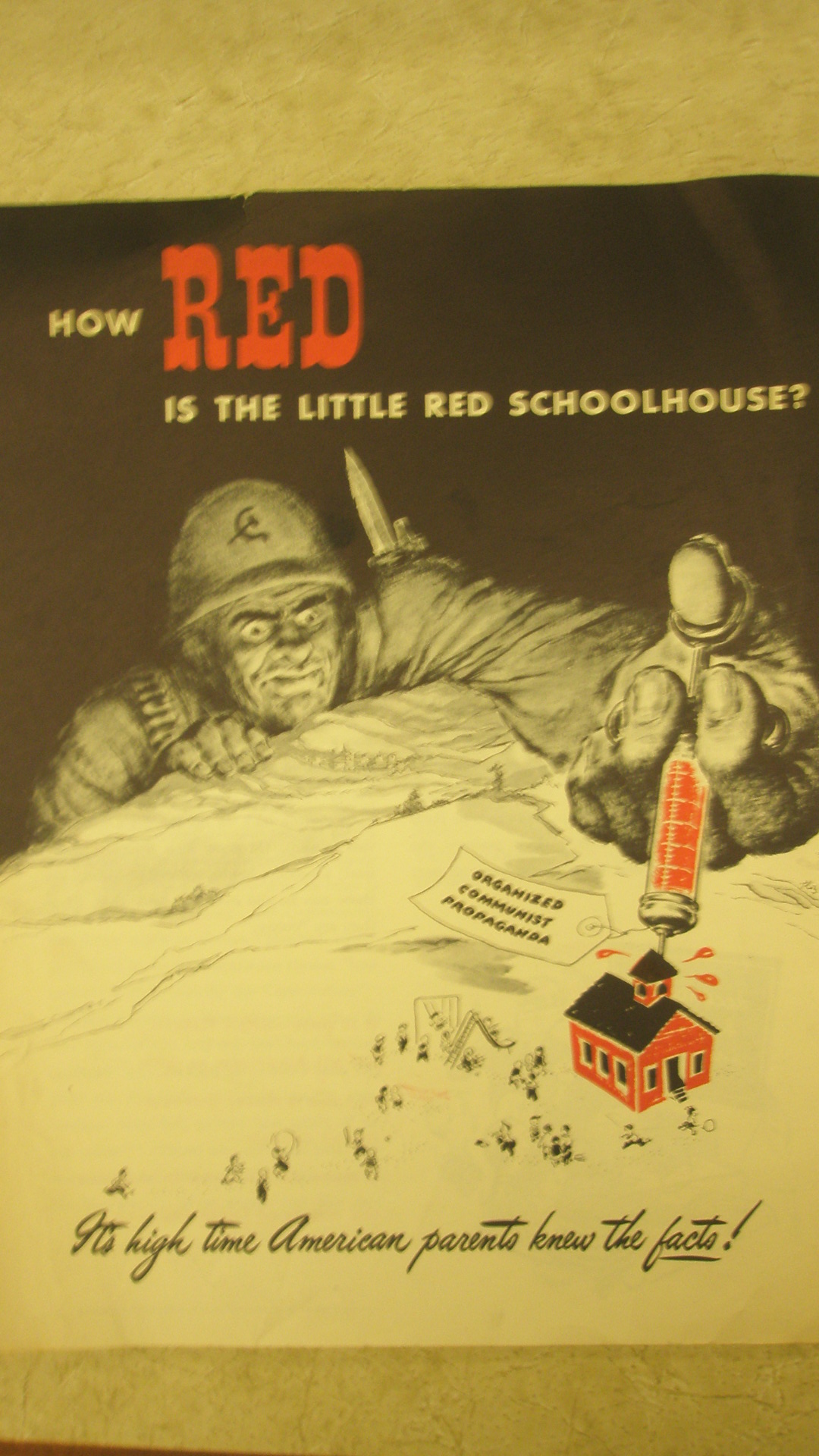
This sense that textbooks and school curricula might set out deliberately to change the morals of young people has a longer history, too.  The source of the cultural danger may have shifted, but at the start of the Cold War conservatives fretted about the threat from subversive communism in school books.  One pamphlet from 1949 Chicago asked, “How Red is the Little Red Schoolhouse?”

Cover imageA decade earlier, Harold Rugg had to defend his popular textbook series from charges of socialist, collectivist subversion.  As Rugg complained, many of his critics had never read the books themselves.  Conservatives, Rugg charged, would say, “I haven’t read the books, but—I have heard of the author, and no good about him” (Rugg, That Men May Understand, 1941, pg. 13).

Seventy-plus years later, Rugg’s books do not seem particularly subversive.  But just as CSCOPE’s critics bundle every anti-American rumor into the Texas curriculum system, so Rugg’s critics blamed him for every anti-patriotic sentiment of the day.

Most important, once school materials get a reputation for left-leaning propagandizing, whether it is Rugg’s books in 1940, or the Interaction series in Kanawha County in 1974, or the CSCOPE materials in 2013, the books seem sure to attract ferocious and effective political attack.  Sometimes, as in the newspaper ad from Marble Falls and Burnet, these attacks seem far-fetched.  But behind even such far-fetched notions lies a germ of uncomfortable truth.

Curriculum developers often DO want to introduce culturally challenging and provocative ideas into America’s schools.  Howard Rugg wanted his books to help along a sweeping “social reconstruction.”  One of the editors of the book series under consideration in Kanawha County dreamed that the controversial books might lead to “further innovations in schooling” [James Moffett, Storm in the Mountains, 1988, pg. 5].

Though CSCOPE insists it is “not designed to show favor toward any special interest group/ organization,” conservative critics can claim some justification for their worries.  For generations, curricula have been introduced to public schools that HAVE hoped to show favor to certain ideas.

CSCOPE might offer an ideologically balanced, pedagogically efficient way for Texas school districts to streamline their teaching systems.  But once it has acquired the reputation for leftist indoctrination, the writing is on the wall.

No matter how fervently the Texas Freedom Network or other supporters might protest, history has shown that in cases like this, among conservatives, school curricula are guilty until proven innocent.


The Culture War Is Over: Conservatives Lost

Gay Marriage will not wreck traditional marriage, Rod Dreher argues.  Instead, the rapid mainstreaming of gay marriage simply proves that traditional marriage was wrecked long ago.

In his recent piece in The American Conservative, Dreher channels Philip Rieff to argue that conservative Christians have already lost the culture wars.  The notion that people exist first and foremost as individuals replaced a sense of people as part of a Christian community long ago.

The current debate over gay marriage only serves as a mopping-up action by anti-Christianity.  The Christian sexual ethic, Rieff argued back in the 1960s, was not merely one rule imposed by Christianity.  Rather, the Christian sexual ethic represented the core of Christianity’s revolutionary anti-pagan cosmology.  Sex was not merely an expression of individual desire, but of God’s cosmic plan.  When Western culture abandoned that sexual ethic, Rieff argued, it offered nothing in its place.

Homosexuality and the issue of gay marriage, Dreher notes, do not change this pattern, but only complete it.  Dreher bases his case on data from Robert Putnam and David Campbell.  These political scientists noted in their 2010 book American Grace a striking demographic correlation between acceptance of homosexuality as morally neutral and a rapid decline in church membership.  When young people see homosexuality as just another way to be sexual, they do not switch to a liberal church.  Instead, they leave institutional Christianity altogether.

As Dreher argues,

Gay marriage signifies the final triumph of the Sexual Revolution and the dethroning of Christianity because it denies the core concept of Christian anthropology. In classical Christian teaching, the divinely sanctioned union of male and female is an icon of the relationship of Christ to His church and ultimately of God to His creation. This is why gay marriage negates Christian cosmology, from which we derive our modern concept of human rights and other fundamental goods of modernity. Whether we can keep them in the post-Christian epoch remains to be seen.


Rednecks and the Bible

H/t: H.T.

From the I-can’t-believe-I-haven’t-heard-about-this-til-now desk: The American Bible Challenge, a TV game show in which contestants go head-to-head on their knowledge of Bible trivia.  This show, in which a famous redneck asks teams about the Bible, has proven to be enormously popular.

Generally, I can’t say I’m a big fan of comedian Jeff Foxworthy.  His schtick seems to rely only on a single tired question: Are you a redneck?

But Foxworthy has parleyed his aw-shucks routine into major stardom.  First, he starred as part of a painful Blue Collar Comedy Tour.  Then, he asked game-show viewers if they were smarter than fifth-graders.

Now, as host of the Bible quiz show, Foxworthy has participated in the most popular game show in the history of the Game Show Network.

With contestants such as “The Rockin Rabbis” and an evangelical pastor with the nickname “The Walking Bible,” contestants seem to come from a variety of faith backgrounds.  As a segment from the news show Rock Center described, the show seems to be more than just Jesus Jeopardy.  With an on-stage gospel band and a prayer-service-like studio audience, this Bible show feels more like a worship service than a chance to win thousands of dollars.

More proof, if more were needed, that American religiosity is an infinitely malleable thing.  Not a vestige from some imagined past, but part and parcel of the everyday changes in American culture.