Behind the Mask: A Halloween Guide to Telling Christians Apart

The prolific Russell Moore offers a light-hearted Halloween guide to help tell apart various types of evangelical Protestant.  For those of us outsiders trying to make sense of America’s conservative impulses, it is a handy resource.  After all, as Moore points out, there are huge differences between “fundamentalists” and “evangelicals,” between “Emerging Church evangelicals” and “confessional evangelicals.”

To start, Moore paraphrases John Mark Reynolds.  Reynolds had joked, “An evangelical is a fundamentalist who watches The Office.”

With Halloween in mind, Moore came up with the following handy guide to making sense of the kaleidoscope of American evangelicalism:

“An evangelical is a fundamentalist whose kids dress up for Halloween.

“A conservative evangelical is a fundamentalist whose kids dress up for the church’s ‘Fall Festival.’

“A confessional evangelical is a fundamentalist whose kids dress up as Zwingli and Bucer for ‘Reformation Day.’

“A revivalist evangelical is a fundamentalist whose kids dress up as demons and angels for the church’s Judgment House community evangelism outreach.

“An Emerging Church evangelical is a fundamentalist who has no kids, but who dresses up for Halloween anyway.

“A fundamentalist is a fundamentalist whose kids hand out gospel tracts to all those mentioned above.”

I know Moore was just joking around, but I appreciate the field guide.  After all, those of us outside the evangelical tradition tend to have difficulty hearing the different accents among evangelicals.

I cringe when I hear some of my fellow nones or theological liberals clump together all evangelicals into dismissive categories such as “Bible Thumpers,” “Holy Rollers,” or other pejorative terms.  We liberals would never speak in such stereotyped labels about other social groups, but it seems socially acceptable among some folks to use such stereotypes to belittle conservative Protestants.

Worst of all, some of the self-professed liberal folks with whom I interact don’t seem to understand that their stereotyping reveals their expansive ignorance of the complicated intellectual kaleidoscope of evangelical belief in America.

Required Reading: Moran’s American Genesis

From time to time people ask me for a place to start.  For those who don’t want to dedicate their entire lives to understanding the creation/evolution controversies, they ask, what is one smart, short book that offers a useful introduction?

I am very happy to suggest a new book by Jeffrey Moran of the University of Kansas: American Genesis: The Evolution Controversies from Scopes to Creation Science.  In the newest edition of the Reports of the National Center for Science Education, I offer a brief review of this terrific book.

Moran was already the author of two essential books on my shelf, Teaching Sex and The Scopes Trial.  In American Genesis Moran does more than just hash over the history of controversy.  As I write in my NCSE review,

“Moran examines the history of antievolutionism as more than just religion, more than just science. As Moran explains, ideas about evolution offer a unique “mirror, however distorted, of [American] culture itself” (p 24). The most intriguing sections of American Genesis, accordingly, offer readers more than just a clear and compelling brief history of the American antievolution “impulse” (p x). Moran demonstrates the ways that anti-evolutionism has been both a bellwether and an influence on broader trends in American culture. In the first three chapters, Moran’s book approaches antievolutionism as a question not only of religion and science, but also of gender, region, and race.”

In just under 200 pages Moran crafts an argument that connects anti-evolutionism to the bigger pictures of American history and culture.  His book is consistently readable and wonderfully worthwhile for both experts and the general public.

Those interested in creation/evolution will find other items of interest in the most recent Reports of the NCSE.  The editors include a review of David Long’s ethnographic study of creationism among college students and Jason Rosenhouse’s Among the Creationists.

Worth checking out!


Marxists and Creationists: Peas in a Pod?

Are Marxists and Creationists sharing carrel space at American universities?

A query by Kurt Newman at the ever-interesting US Intellectual History blog generated a lively discussion of the question: How many Marxist historians are out there?

Reading the discussions led me to wonder a different question: Are academic Marxists and creationists flip sides of the same coin?

Darwin. Image Source: Humanist Life

Full disclosure: I’ve got thoroughly Marxist intellectual roots myself.  As an undergraduate, I found Marxism and its derivatives intensely interesting; those years remain profoundly influential in my thinking.  On the other hand, I’ve never been a creationist, though recently I’ve been accused of being one.  My intellectual world in my formative years had absolutely nothing to do with religion, the Bible, or creationism.

I’m not trying to promote one or the other, but the similarities between the two traditions jumped out at me.  Allow me to list a few of the obvious parallels:

  • Both Marxists and creationists remain surprisingly common on mainstream college campuses.  As David Long discovered when he began his ethnographic study of creationism on secular campuses, creationists are far more common than one might think.  The same result for Marxists becomes starkly clear when we read the responses to Newman’s query at USIH.
  • Both Marxists and creationists could make some claim to being persecuted.  Certainly, many mainstream scientists would not want to have creationist faculty in their departments.  And, as Newman points out in one of his comments, Marxist professors have a long history of institutional controversy.  Newman astutely mentioned in one aside, “(This is to say nothing of the apoplexy that would be induced in large swaths of the political class upon learning that any state-funded school was offering Marxist classes under the guise of US history, which might also say something about the stakes of doing Marxist research in 2012).”
  • Both Marxists and creationists could be accused of clinging obdurately to an intellectual tradition whose heyday has come and gone.
  • Both Marxist and creationist intellectuals and academics have always been famously and ferociously sectarian.  Gramsci-ites might not speak with Trotskyites, who might look down their noses at Bernsteinians, etc.  The same is true with today’s creationist galaxy of “evolutionary creationism,” “young-earth,” pre-Adamics, post-Adamics, day-agers, gap theorists, etc. etc. etc.

Marx. Image Source: Georgia Spears

Of course, some obvious differences jump out at us.  Here are a couple:

  • Marxism is profoundly secular, though some have called it a religion.  Creationism is profoundly religious, though some have insisted on its secular merits.
  • The two groups have enormous sociological differences.  Creationism does not thrive at elite schools, while Marxism seems to. The background of each group of scholars likely differs immensely.
  • Marxism seems to be losing influence outside the academy, while creationism has been steadily gaining strength in politics and popular culture for the past century.

So, are these flip sides of the same phenomenon?  Intellectuals who pride themselves on their superior insight into the workings of humanity and history?  Folks who take encouragement from the cultural slings and arrows directed their way?

Just askin…


Authority and Education

When is a school not a school?

According to Anthony Esolen, a school forfeits its rights to that name when it tries to abandon its authority over its students.

Esolen’s essay in Public Discourse is roughly a year old, but I came across it recently.  Esolen reviews Philippe Beneton’s Equality by Default and insists, among other things, that true education requires a submission of student to the authority of the teacher and the school.

For those of us struggling to understand the conservative tradition in American education, Esolen’s article is worth reading in its entirety.  Esolen articulates a position that has long been at the root of American protest against the excesses of progressive education.

True teachers must take on the burden of authority, Esolen believes.  This is not autocracy, but rather a humble assumption of responsibility for the formation of the young students in teachers’ care.  Such authentic, authoritarian teachers, Esolen argues,

“would no doubt have furrowed their brows to try to make the least sense of the educational patois of our day, which insists that school be ‘child-centered.’ It would be like asking a hymn to be ‘choir-centered,’ when the very purpose of a hymn is to bring the singers out of themselves, in devotion. So too the ‘child-centered’ classroom, if indeed it focuses on the tastes and habits of the children who happen to be there, mistakes both the nature of the child and the purpose of education. It ignores what the child, as a human person, most needs, and that is to give himself in love to what transcends his personality or his class or his age.”

Esolen articulates in this essay the philosophic core of traditionalist education.  Before we seek to reform our schools, Esolen argues, we need to clarify the true purpose of education.  “If the object is to produce an elite cadre of technicians,” Esolen argues, “. . . then I fail to see why people should support schools at all.”  True education, Esolen insists, consists of “the handing on of culture, against which the mass phenomena of our time, and the facile reductions of scientistic academe, array themselves in enmity.”

As I argue in the book I’m currently working on, tentatively titled The Other School Reformers, this notion has lodged squarely at the heart of conservative reform movements in American education throughout the twentieth century.  Though many activists and politicians could not express the idea as elegantly and coherently as Esolen does in this essay, conservative activists fighting against evolutionism, socialism, “sexualityism,” secular humanism, progressivism, and other perceived cultural problems in America’s schools usually based their protest on the notion that such doctrines fundamentally subvert the true purpose of education.

To cite just one example from the textbook controversy in Kanawha County, West Virginia, in 1974, conservative businessman and activist Elmer Fike defined the two sides in any education controvery as follows:

“The traditionalists perceive education as a process of teaching the child the basic knowledge and skills.  Since some indoctrination is inevitable, it should promote the accepted social attitudes and morals of the society in which the child lives.  The job of the schools is considered to be the transmission of the tradition of the parents to the children in order to preserve society. . . .The progressives claim to object to any indoctrination because it gives too much power to the agency that determines the thrust of the indoctrination and because it does not teach the child how to examine ideas critically.  They would prefer that the child be allowed to examine all philosophies with a minimum of guidance.  Thus, the child develops the ability to choose what is best and will not, as a mature adult, be easily misled or indoctrinated by demagogues who offer simple solutions.  The philosophy is most easily summed up by the statement, ‘Teach the child how to think, not what to think.’  The progressives also prefer a minimum of discipline and greater freedom for the student to decide what or how he will study.”

For Fike, as for Esolen and generation of conservative educational activists, the first goal of school reform must be a thorough examination of the true purpose of education.  At their core, battles over sex ed, prayer in schools, and evolution education often boil down to competing visions.  Are schools first meant to pass along the cultural inheritance of our civilization?  Or are they mean to train children to challenge all inherited notions?

Condoms on Bananas, or, Why Culture Warriors Aren’t Funny

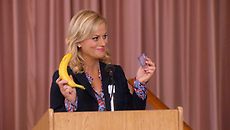
Parks and Rec’s Leslie Knope Sheaths the Banana

I disagree with Russell Moore on many things.  But I do agree with the heart of Moore’s recent argument in the pages of Christianity Today.

Moore commented on a recent episode of the sitcom Parks and Recreation.  I didn’t see the show.  But according to Moore, the plotline concerned an outbreak of sexually transmitted infections among residents at a small-town nursing home.  Moore argued that the show engaged in the worst kind of smug culture-war preaching.

Moore’s accusations ring true.  Many self-professed “liberals” engage in the kind of liberal fundamentalism that Moore describes on the show.  In Moore’s words,

“the show intended to reinforce a view already held by the people to whom they were talking. Those who already deride abstinence education could nod their heads in affirmation, ridicule the morons who oppose good common sense, and feel much better about their moral and intellectual superiority to the Neanderthals out there.”

I support comprehensive sex education in public schools.  But as Moore points out, lots of people disagree.  And lots of those people are smart, caring, informed, and engaged.  At best, the kind of self-satisfied mockery that he describes on Parks and Rec sounds ineffective.  As Moore charges, “few people are going to have minds changed by seeing their viewpoints caricatured.”  At worst, this kind of preaching to the choir deepens our culture-war divisions and leaves us all more bitter, angry, and, in the end, ignorant about the real conflict.

As we battle over issues such as sex ed, prayer in schools, and creationism, we need to keep in mind that those with whom we disagree may have legitimate reasons for their positions.  Moore takes conservative evangelicals to task for often forgetting this message.  As Moore argues,

“Sexual liberation ideology is deadly, but we aren’t preaching to those in bondage to it if we simply repeat slogans. In order to see the true wickedness of sexual liberation, we must ask why it’s appealing, and why deceptive arguments can seem plausible. Only when we speak to the conscience can we get to where people are, as we all once were, hiding from God.

“Darwinism can’t explain the meaning and purpose of the universe or of humanity. But when we simply laugh and say, “My grandpa wasn’t a chimpanzee,” we aren’t taking seriously the claims of our opponents. In fact, we’re not speaking to them at all, just to ourselves.

“When unbelievers hear a canned, caricatured argument, they recognize exactly what I recognized when I listened to the moralizing of the Parks and Rec script: They’re not trying to convince me, or even to talk to me. They just want to soothe the psychologies of their partisans.”

Moore’s central point remains powerful even if we don’t agree about the nature of Darwinism or sex ed.  When we talk about the cultural truths at the heart of our education system, we need to remember that those with whom we disagree deserve respect.  True liberalism is not the pat preachiness of Leslie Knope.  Rather, it requires a much more difficult cultural argument that disagrees without deriding its opponents.

The Revisionaries

I don’t often wish I lived in a bigger city.  But with the limited release of a new documentary, I’m wishing I had a chance to see it.

The Revisionaries has been released in a few cities and film festivals.  According to its producer, this documentary focuses on the intellectual and political worlds of Don McLeroy.

A short review in the New York Times emphasizes the “startling” way conservatives such as McLeroy and Cynthia Dunbar injected partisan and sectarian ideas into the curriculum of Texas in 2009-2010.

As I noted in an article in Teachers College Record a little while back (behind a paywall, unfortunately, but the executive summary is public), Dr. McLeroy cared about more than just creationism.  As Russell Shorto pointed out in a New York Times article, McLeroy insisted that Texas schoolchildren be taught “two basic facts about man.  He was created in the image of God, and he is fallen.”  According to amendments proposed by McLeroy, Texas students should also learn more about Ronald Reagan’s “leadership in restoring national confidence”
and about the positive contributions to American history from such conservative icons as “Phyllis Schlafly, the Contract with America, the Heritage Foundation, the Moral Majority and the National Rifle Association.”

I am looking forward to seeing the film.  I have a couple of worries.  Though this morning’s NYT review insists that producer Scott Thurman is “admirably evenhanded,” the clips available on the film’s website suggest that the documentary is yet another breathless expose of the deeply conservative ideas of McLeroy and his allies.

I hope not.  I think those of us outside of the intellectual world of activists such as McLeroy and Dunbar will benefit from a sincere attempt to truly understand their worldview.  After all, it is a vision of American culture and education that is enormously popular.  Another piece of journalism or filmmaking that hopes simply to mock or deride those ideas won’t help at all.  We KNOW we don’t agree with these ideas.  We don’t need to be reminded that some people hold these ideas.  What is really interesting, in contrast, are the arguments folks like McLeroy might make to support their beliefs in a young earth.

So, for those in Pasadena, NYC, Denver, Sarasota, or other screening locations, make some time to check out the film.  Be sure to send your thoughts, reviews, and comments to us here at ILYBYGTH.  Out here in the boonies, we’ll only wait for the film to get around to our neck of the woods.

Sex as Religion in America’s Public Schools

Try this one on for size: Religious conservatives are fighting to keep America’s public schools free from religion.  And they have been doing so for a long time.

Here’s the catch: the religion they want excluded is the awkwardly named faith of “sexualityism.”  The campaign by some conservative intellectuals to ban this newly identified theology joins a long history of conservative attempts to reframe secular, liberal, “progressive” ideology.  Such ideas as the relativism of value systems and the virtues of commitment-free sex, these conservative argue, are actually theological ideas.  As such, the conservative argument goes, the fabled wall of separation between church and state requires that they be kept far away from public schools.

For example, writing recently for the conservative journal Public Discourse, Greg Pfundstein denounced a new sex policy in New York City schools.  As we’ve noted here, the Connecting Adolescents to Comprehensive Health (CATCH) program offers contraception to public-school students without parental notification.  The program recently expanded to include “morning-after” pills, in addition to condoms and birth-control pills.

Pfundstein insisted that this program made no sense from a public-health perspective.  Instead, Pfundstein argued, “This is the work of religious fanatics, and their religion is sexualityism.”

At the core of programs such as CATCH, Pfundstein concluded, is nothing less than a “theocracy of the sexual emancipation of children.”

The strategy of identifying secular ideology in public schools as a religion has a storied history among conservatives.  In the 1920s, as I argue in my 1920s book, much of the anti-evolution fervor among religious conservatives resulted from the identification of evolutionary ideas as profoundly religious.  In this case, conservatives argued that evolution was merely atheism in disguise.

More recently, beginning in the 1970s, conservatives attacked public-school ideology as “secular humanism.”  Conservative writers, intellectuals, and activists insisted that public-school curricula embodied the religion of secular humanism, and, as such, violated the First Amendment ban on state-supported religion in public schools.

Perhaps the political high-water mark for this strategy came on May 12, 1976.  US Representative John Conlan of Arizona successfully amended a bill about the financing of higher education to include a denunciation of secular humanism.  As Conlan argued on the floor of the House,

“there is a significant current in education to teach children that there are no values, there is no right, there is no wrong, that everything is relative, and it all depends upon situational ethics.  This is the heart of the First Secular Humanist Manifesto of 1933 and the [13533] Second Secular Humanist Manifesto of 1973.

            “What we are really saying is that much of the social problems that are being dealt with in the schools came from the premise that there are no moral or religious principles.  What I am saying is that since we cannot teach and will not fund those grants and programs to develop the Judaic-Christian ethical concepts, then it seems to me fair that those curriculums opposed to Judaic-Christian concepts should also not be funded.  That is all we are asking.      

            “I have in my hand here the recently published Humanist Magazine article which brags that ‘humanism is alive and thriving in secondary schools.’  But we could go on and on documenting the case of what is happening in our schools.” (Source: Congressional Record, May 12, 1976, pg. 13532-13533)

This argument has had some success in courtrooms.  Most famously, the plaintiffs in Mozert v. Hawkins County (1987) had initial success with their claims.  Though a federal circuit court eventually disagreed, early hearings supported the Mozerts’ claim that textbooks in public schools ought not teach ideas that promoted “secular humanism.”

Could this strategy change the argument about sex-ed in public schools?  Could it shift the debate from talk of public health to talk of public religion?

If the history of conservative attempts to ban “secular humanism” is any guide, the answer is likely no.  In Mozert v. Hawkins County, for instance, federal judges eventually ruled that the Mozerts’ did not have a significant claim to have been harmed.  In essence, the judges disagreed that “secular humanism” represented a state-sponsored religion.

The same will likely be true with the awkwardly named “sexualityism.”  The religious nature of teaching sexuality seems plausible, but courts and public opinion will likely continue to see the public-health benefits of sex ed outweighing the religious objections of conservatives.

A Long Way from Texas…

Can cheerleaders at a public school sport Biblical phrases on banners?

The cheerleaders in Kountze, Texas, think so.  So does the Texas Attorney General.  So do tens of thousands of Facebook supporters of the cheer team.
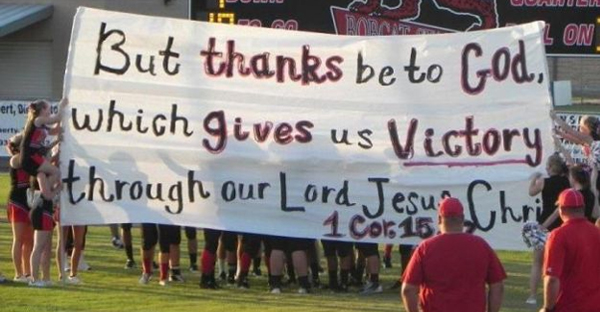
But an important part of this story is often being left out by coverage in some mainstream media outlets. Why?

We’ve reported on this story before.  In short, this group of cheerleaders sued when their school superintendent banned their religious banners from football games.  So far, the cheerleaders have been allowed to keep on cheering for Jesus at their games.

Recently, we’ve noticed a puzzling trend in the reporting about this story.  An editorial in yesterday’s New York Times, for instance, bemoaned the situation in Kountze.  “In this country — including in Texas — the Constitution does not leave religious freedom up to majority rule,” the editors insisted.

I agree with the NYT‘s basic position: the SCOTUS precedent in 2000’s Sante Fe ISD v. Doe speaks directly to this case.  Even student-led prayer, if sanctioned by the school district, implies an endorsement of particular religious beliefs by the government.  Though the Kountze cheerleaders insist that their banners represent purely private speech, this seems a stretch.

However, I’m puzzled by the way NYT coverage has left out a vital part of this story.  For those of us who want to understand the ways conservatism works in American education, whether it be about evolution, school prayer, sex education, or other issues, the skewed coverage in the NYT makes the job much harder.

Here’s the problem:  In yesterday’s editorial and in earlier reporting on this Kountze story, the NYT left out an important key player in the drama.  The NYT neglected to mention the role of the Freedom from Religion Foundation.  This Wisconsin-based group warned the school superintendent of its plans to sue over the banner issue.  Only then did the superintendent ban the cheerleaders’ religious practice.

The NYT misled readers with its description of the reasoning in Texas.  The editors described the case as follows:

“Those banners are not merely personal expressions of belief, but in that setting become religious messages endorsed by the school, the school district and the local government.       

“That’s why officials of the school district last month prohibited the banners at football games.”

But the way the story really played out, the school district only prohibited the banners under pressure.  In fact, as the Los Angeles Times reported, the school superintendent himself supported the cheerleaders.

If we hope to understand the dynamic, in this case or in the many other school-prayer cases in history and in the news, we must not omit such an important element.

Please do not misunderstand: I am not denouncing the Freedom from Religion Foundation.  I do not think that sectarian prayers belong at public-school events.  But I do want to understand these cases, and ignoring important elements such as the role of outside organizations leaves us unable to understand the situation.

As political scientists Michael Berkman and Eric Plutzer have argued in their books Ten Thousand Democracies and Evolution, Creationism, and the Battle to Control America’s Classrooms, teachers and school districts respond to local culture.  When communities want prayer and creationism in public schools, schools include prayer and creationism.

As Berkman and Plutzer proved with their survey of high-school biology teachers, the beliefs of those teachers usually closely match those of their local communities.

In the Kountze case, the school district, including even the superintendent who banned the banners, supports the cheerleaders.  As superintendent Kevin Weldon told the LA Times, the judge in this case “was in a pretty tough predicament, like myself. . . . I personally applaud the kids for standing up for their beliefs in such a bold way.”

If we hope to understand the ways issues such as creationism and school prayer play out in America’s schools, we can’t let ourselves miss the way schools, teachers, and school districts actually function.  Teachers, as Berkman and Plutzer insist, are “street-level bureaucrats.”  They represent majority opinion in their communities.  The same is often true for superintendents such as Kevin Weldon in Kountze.

None of this is new.  In the Scopes Trial in 1925, the prohibition of evolution in Dayton, Tennessee only became controversial when the American Civil Liberties Union became involved.  More recently, as political scientists Kenneth Dolbeare and Phillip Hammond demonstrated in the 1970s, US Supreme Court decisions about school prayer and Bible reading often have no discernable effect on school practice.  After the 1962 and 1963 Supreme Court decisions against the reading of the Bible and reciting of the Lord’s Prayer in public schools, Dolbeare and Hammond found that all the schools in their survey continued to pray and read the Bible.  Most important, those practices caused absolutely no controversy in the communities they studied.

If we hope to understand school prayer controversies, we can’t allow ourselves to leave out the role of key players such as the Freedom from Religion Foundation.  Perhaps the NYT editors hoped to avoid the old chestnut that only “outside agitators” brought about this sort of school controversy.  Whatever their reasons, they misrepresent the story and make it more difficult for outsiders like me to understand the nature of these school battles.

Darwin Denounced as “Jew” in Turkish Textbooks

Every now and again we hear from evolution educators that creationism is somehow unique to the United States.  In his recent popular video denouncing creationism, for instance, Bill Nye “The Science Guy” said exactly that.

Not so fast!  As scholars such as Ronald Numbers have documented, creationism has long been an international affair.  In places such as Australia and Turkey, for instance, creationism has strong and apparently growing support.

And, thanks to the Sensuous Curmudgeon, we come across a story from the international edition of the Financial Times demonstrating the durability of Turkish anti-evolution education.

The FT story demonstrates both the similarities and differences of creationism across national and cultural boundaries.  In some senses, the story could come straight out of the USA.  Other parts seem uniquely Turkish.

For instance, the story describes a controversy over the use of anti-evolution textbooks in Turkish schools.  A teachers’ union has taken legal action to block schools in Istanbul from using anti-evolution textbooks.  Just as in the USA, the Turkish government has made moves to loosen Turkey’s traditional government secularism in a strongly religious nation.  The government, according to the FT article, has allowed more schools to favor religious themes.

All of this sounds like it could have come directly from the evolution/creation controversies in the USA.

But other parts of the story have a uniquely Turkish twist.  The schoolbooks, for example, denounce Darwin as Jewish.  According to the FT, the textbooks warn students that Darwin “had two problems:  first he was a Jew; second, he hated his prominent forehead, big nose and  misshapen teeth.” The books mock Darwin’s lack of formal education, noting strangely that he preferred to spend his time with monkeys in the zoo.

Such anti-Semitic attacks do not usually appear in America’s evolution/creation controversies.  More common would be attacks on Darwin’s atheism.  For the record, Darwin was not Jewish.  However, a creationist attempt to discredit Darwin by “accusing” him of Jewishness makes some sense in a Turkish context.

Clearly, context matters.  Students in Louisiana’s publicly funded schools might read textbooks promoting creationism and evangelical Protestantism.  Students in Istanbul’s publicly funded schools had read that Darwin could not be trusted because he was Jewish.

Shake Up at King’s College

If you look at the $30,000,000 box office sales for his film 2016: Obama’s America, it would seem that Dinesh D’Souza is very in.

But at King’s College in Manhattan, D’Souza is out.  According to a recent story by Warren Cole Smith at WORLD magazine, D’Souza has stepped down as the high-profile president of King’s College.  Smith had reported a few days earlier on the tensions among King’s leadership.  D’Souza had ruffled some feathers when he appeared with a woman who was not his wife, shared a hotel room with her, and introduced her as his fiancee.  D’Souza had separated from his long-time spouse, but had not yet been officially divorced.

More interesting for ILYBYGTH readers than the Gossip Girl-ing involved, the story sheds some revealing light on the nature and institutional structure of King’s College itself.  As historian John Fea has remarked, the leadership of King’s College embarked on a remarkable re-branding in the mid-1990s.  It shifted from a small, quiet, conservative evangelical Westchester County college to an aggressive culture-war college in the heart of Manhattan.  The “new” King’s College narrowed its scope, offering only business and politics/economics majors.  The goal of the revised school was to bring conservative evangelical leadership to the heart of New York City.

As journalist Amy Sullivan noted in her piece in The New Republic about the King’s College shake-up, the rivalry between long-time provost Marvin Olasky and D’Souza likely contributed to the scandal.

It seems charismatic conservative evangelical leaders will continue to struggle with such issues.  King’s College represents a long tradition of “new” approaches to fundamentalist higher education.  Liberty University was founded in 1971 with the same purpose.  Even further back, this goal of teaching a new generation of conservative evangelical students to compete for the levers of cultural and political power has roots in the culture-war struggles of the 1920s.  As I argued in my 1920s book, college and seminary founders such as those at Dallas Theological Seminary and Bob Jones University explicitly set out to create schools that would train fundamentalist leaders for mainstream politics, religion, and culture.

Back in the 1920s, such schools wrestled with the same tensions that bedevil King’s College today: How can we institutionalize the uncompromising theology that so often thrives only under the leadership of charismatic individuals?  How can we remain true to our mission of training students in the specific doctrines of our faith while preparing them to engage with the wider world?  How can we retain the loyalty of those who want a firmly conservative evangelical institution, while convincing the world that our graduates have had the kind of broad education they might get at a more pluralistic college?