Medievalism and Fundamentalist America

Are Fundamentalists medieval?  Only kinda sorta, says Carl Pyrdum at Got Medieval.  On the one hand, as Pyrdum points out, American Protestant fundamentalism would not be recognizable to European medieval church folks.  But on the other hand, both medieval chroniclers and some American fundamentalists take lessons from lake monsters.

Here’s the story:  As we’ve reported here recently, Accelerated Christian Education–a very conservative fundamentalist school curriculum publisher popular with Christian schools and fundamentalist homeschoolers–has been accused of teaching children that the Loch Ness Monster helps disprove evolution.  Pyrdum describes a story from a seventh-century life of St. Columba as Columba traveled in today’s Scotland.    When Columba came to Loch Ness, he encountered the terrifying monster within.  Instead of quaking in fear, Columba dispelled the monster with a holy wave.

St. Columba and Nessie

Pyrdum is being lighthearted in his discussion, but I think there are some lessons to be learned from this comparison across the centuries.  First of all, we must lament Pyrdum’s lumping together of the Westboro Baptist Church with Answers in Genesis as all fundamentalist together.  As we’ve written here before, the WBC often serves as a sort of menacing but misleading symbol of all of Fundamentalist America.  This is simply unfair.  I’m no fundamentalist, but the differences between a tiny cultish group like the WBC and Answers in Genesis still seem worthy of respecting.

Those quibbles aside, Pyrdum’s description of Columba’s encounter with Nessie shows the very different world of early medieval European Christianity.  As Pyrdum extracts, Columba’s trouncing of the monster won the admiration of all his fellows:

Then the brethren seeing that the monster had gone back, and their comrade Lugne returned to them in the boat safe and sound, were struck with admiration, and gave glory to God in the blessed man. And even the barbarous heathens, who were present, were forced by the greatness of this miracle, which they themselves had seen, to magnify the God of the Christians.

Columba’s world is one inhabited by both Christians and heathens; it is one in which Christians expected to be able to demonstrate significantly more power than the heathen; it was one in which God intervened directly, powerfully, and often.  Prydum does not make this point, but to our minds this world view is one that would resonate powerfully with many twentieth-century American fundamentalists.  In tone and substance, it feels very similar to the world inhabited by those Left Behind in Tim LaHaye and Jerry Jenkins’ best-selling series about the fundamentalist apocalypse.

The first connection might be a fascination with lake monsters, but I think the more powerful link is the similarity across the centuries.  Pyrdum may be correct that medieval Europeans would not understand the world of postmodern fundamentalism. However, those fundamentalists would have an easy time relating to the struggles of St. Columba, a stranger in a strange land, demonstrating the power of God’s love among the heathen multitudes.

Required Reading: Kicking God Out of Public Schools

We have looked recently at the effects on Fundamentalist America of the US Supreme Court’s rulings in 1962 and 1963.  These decisions ruled against the use of state-sponsored prayer and school-led religious devotions and Bible reading in public schools.  As any observer of Fundamentalist America is aware, many conservatives pinpoint these events as the date when God was “kicked out” of American public schoolsAs we’ve noted, the historical reality was much more complex.

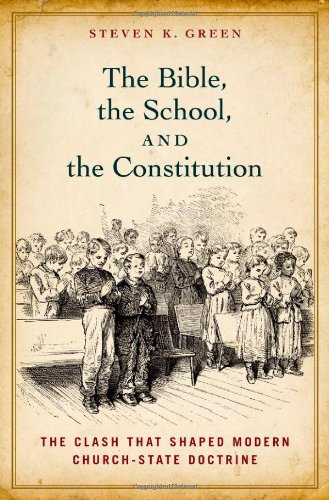
Happily, those interested in these questions now have a promising new book to help them muddle through the mishmash of Constitutional, cultural, educational, and devotional questions raised by this thorny issue.  At Religion & Politics, Michael Waggoner has offered a thoughtful review of Steven Green’s newish The Bible, the School, and the Constitution: The Clash That Shaped Modern Church-State Doctrine (New York: Oxford University Press, 2012).

Waggoner, a scholar of higher education at the University of Northern Iowa and editor of the academic journal Religion and Education, concludes that the most significant contribution of Green’s book is that it moves the discussion away from the 1960s and back to their proper arena: the 1860s.  As Waggoner notes,

“while many Americans believed in 1962—and continue to believe today—that the crisis over the proper relationship between religion and public education arose full blown in the chambers of the Supreme Court, in fact these changes were a century in the making.”

In Green’s telling, the significant struggle over the role of religion and public education took place in the second half of the 19th century.  The linchpin, Green argues in his third chapter, was not only the US Supreme Court’s 1962’s Engel and 1963’s Schempp rulings, but the Ohio Supreme Court’s 1870 Board of Education of Cincinnati v. Minor.*  In that case, the culmination of Cincinnati’s angry “Bible Wars,” the school board successfully defended its decision to remove the reading of the King James Bible from public schools.  The first plaintiffs, John D. Minor and a group of concerned citizens, complained that such a removal was illegal, impractical, and immoral.  One of their reasons was that “large numbers [of city school children] receive no religious instruction or knowledge of the Holy Bible, except that communicated as aforesaid in said schools.”

As Green argues, this case and the cultural controversies that accompanied it nationwide laid the groundwork for the Court decisions of the 1960s.  The “culture wars” of the 1860s and 70s demonstrated the nation’s growing unease with traditional Protestant domination of public life.  Minor’s argument that children would not learn about the Bible if not in public schools did not win over the justices of the Ohio Supreme Court.  Not only that, as Green details, activists who sought to marshal the forces of traditionalism soon realized they faced a fundamentally different political and cultural environment.  A coalition of Protestant ministers first proposed a “Christian Amendment.”  They hoped to answer Cincinnati’s anti-Bible ordinance with a change to the US Constitution clarifying the government’s role in promoting religion.  More successful was the Blaine Amendment.  Largely a move to isolate Catholic schools, Congressman James Blaine proposed an amendment that would clarify: public funds must never support religious schools.

Green’s book will not likely satisfy the critics who insist that God was kicked out of public schools in the 1960s.  But for those of us hoping to understand the long cultural conversation about the changing role of religion in the public square, Green’s book is a great new resource.

* A nerdy detail: as with “Schempp” and “Engel,” this case is usually incorrectly described as Minor v. Board of Education.  That was indeed the name of the original 1869 Cincinnati case that sought to get the Bible back into Cincinatti schools.  However, the Ohio Supreme Court case in 1870 was actually an appeal by the Board of Education against John Minor, thus Board of Education of Cincinnati v. Minor.

The Bible in America: Rightly Dividing the Word of Truth, Part II: Dispensational Premillennialism

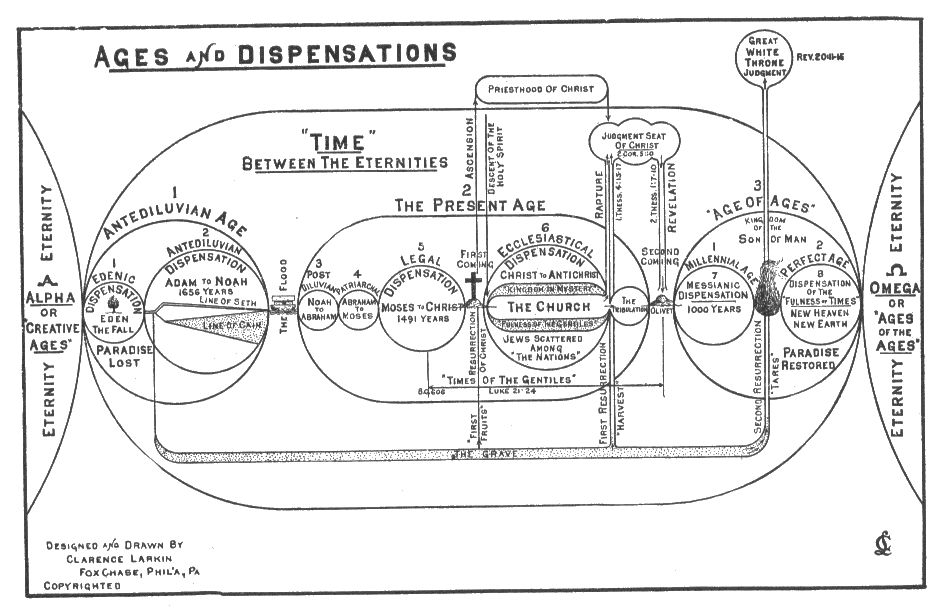
“Daniel and Revelation Compared,” by Clarence Larkin, c. 1919

For most kinds of conservative Protestants, it is difficult to overestimate the importance of the Bible in theology and culture.  After all, at the heart of the Protestant Reformation was a call to return Christianity to reliance on Scripture, Faith, and Grace.  For outsiders trying to understand this segment of Fundamentalist America, a good starting point is an attempt to wrap our heads around a Biblical worldview.

As historian Timothy Weber argued in the early 1980s, one tradition of conservative evangelical Protestantism has long confronted a decisive Biblical dilemma.  In the early twentieth century, this self-identified “fundamentalist” group wrestled with this stubborn paradox: the Bible must be assumed to be clear and comprehensible to all readers, yet readers must be guarded against naïve misinterpretation.  In the end, Weber argued, the first generation of fundamentalist Bible teachers “fought hard to keep the Bible accessible to ordinary believers but in the end made them nearly totally dependent on themselves” (117).

Let me be as clear as possible: in these discussions we are not talking about the wider cultural traditionalist “Fundamentalist America” that usually fills these pages.  Instead, we’re focusing now on a small but influential subset of conservative evangelical Protestants, those few who fit the definition of small-f Protestant fundamentalism.

In the early twentieth century, this group rallied around a particular sort of Biblical interpretation.  Though not without dissent and voluble disagreement, a theology of dispensational premillennialism became for many conservative evangelical Protestants the only proper interpretation of the Bible’s message.

This post will attempt to introduce outsiders to this theology.  As with every topic in the kaleidoscopic world of Fundamentalist America, this introduction will include some broad-brush oversimplifications.  Especially important to remember is that this theology, like every theology or ideology, is constantly changing and subject to intense criticism and disagreement.  Outsiders should never allow themselves to relax into a false sense of self-satisfaction when it comes to understanding such notions.  We at ILYBYGTH write with full consciousness of our inadequate theological background and apologize for our stuttering and awkward presentation of these ideas.  However, with the broad-brush caveat in mind, we can lay out a few basic facts about dispensational premillennialism.

The theology came to the United States in the late 1800s, introduced by theologian John Nelson Darby.  Darby found that he could not convert many American evangelicals to his Plymouth Brethren sect, but his theology became surprisingly influential.

Christians have been arguing about both dispensations and the millennium for thousands of years.  Saint Augustine, for example, noted in his Confessions (Book III, Chapter 7) that naïve Christians complained of inconsistency with Old Testament rules.  “The people of whom I am speaking,” Augustine wrote, “have the same sort of grievance when they hear that things which good men could do without sin in days gone by are not permitted in ours, and that God gave them one commandment and has given us another.”

The answer, for Augustine as for Darby and subsequent generations of Christians, is that sacred history has been divided into discrete dispensations.  For American Protestant fundamentalists, this understanding of the Bible has been taught assiduously for generations.  In the first generation, Bible and prophecy scholars such as James M. Gray of the Moody Bible Institute, A.T. PiersonI.M. Haldeman, and Arno Gaebelein taught readers how to understand the divisions in sacred history.

But no other single work was more influential in teaching the fundamentalists’ new interpretation of Scripture than Cyrus I. Scofield’s annotated study Bible.  This commentary on the King James Version first appeared in 1909 and remains in print.  These days, it is also readily available online.  Scofield’s commentary led many readers to assume a dispensational premillennial reading was part of Holy Writ itself.  To give just one example, in a note to Exodus 19:8 (“And all the people answered together, and said, All that the LORD hath spoken we will do”), Scofield added this dispensational interpretation:

“The Fifth Dispensation: Law.  This dispensation extends from Sinai to Calvary—from the Exodus to the Cross.  The history of Israel in the wilderness and in the land is one long record of the violation of the law.  The testing of the nation by law ending in the judgment of the Captivities, but the dispensation itself ended at the Cross. . . . See, for the other six dispensations: Innocence (Gen. 1:28); Conscience (Gen. 3:23); Human Government (Gen. 8:20); Promise (Gen. 12:1); Grace (John 1:17); Kingdom (Eph. 1:10).”

Another prominent dispensational interpreter and popularizer was Clarence Larkin of Philadelphia.  Larkin’s dispensational charts laid out this theology for students of dispensational premillennialism.

The second half of this term, “premillennialism,” also has a long and storied history among Christians.  Christians traditionally fell into several interpretations of the second coming of the Christ.  Premillennialism, the notion that Christ will return to save a fallen world and usher in a thousand years of earthly peace and justice, remained popular for generations in the early church.  By the third century AD, however, mainstream Christianity welcomed a variety of interpretations of the millennium.  Postmillennialism became influential in American Protestantism throughout the nineteenth century.  In this reading, Christ would return at the end of a thousand years of earthly peace.

Darby’s theology introduced a new wrinkle into these traditional disputes.  Based on his interpretation of 1 Thessalonians 4:14-18,* Darby argued for a secret rapture of all true believers at the start of the end-times.  For many conservative evangelicals, this notion of a secret rapture has become the standard interpretation of the last days.  And, again, it is vital to remember that these ideas are the subject of intense dispute.  Schools of futurists, historicists, amillennialists, and many others insist on their own vision of the apocalypse.

Bumper Sticker Culture War-ning

For those of us trying to understand Fundamentalist America, simply understanding the basic outlines of dispensational premillennial theology will help.  Believers in this vision of Bible truth will see history and politics as primarily an unfolding of Bible prophecy.  The future, in this theology, is written and clear to all those who rightly divide the word of truth.  As historian Dwight Wilson argued in the 1970s, premillennial belief has had a decisive influence on American foreign policy for generations.  Candidates for the important role of the Antichrist have included Franklin D. Roosevelt, Mussolini, Hitler, and a succession of Roman Catholic Popes.  Central in every interpretation, however, is the decisive role of the state of Israel and the world’s Jews.

Those who view world politics and history through this lens will likely be difficult for outsiders to understand.  They will certainly be less likely to agree to pragmatic solutions or a two-state solution to the Palestinian/Israeli dispute, for instance, since they believe they have read the ending of this story in advance.

For such Bible believers, political activism is not intended to procure half a loaf.  Rather, the goal is to line up on the right side and to watch as prophecy unfolds.  Thus, returning Jews to Israel is an important part of divinely dictated history, but returning Palestinians to that same land is not.  Signing on to the program of a charismatic UN leader might mean condemning innocent souls to hell, not merely wasting aid dollars.  In sum, though it is important not to fall for scare stories about the power of Bible prophecy in determining US foreign policy, it is also important to understand the theological roots of some of fundamentalism’s most distinctive ideas.

*          “For if we believe that Jesus died and rose again, even so them also which sleep in Jesus will God bring with him.  For this we say unto you by the word of the Lord, that we which are alive and remain unto the coming of the Lord shall not prevent them which are asleep.  For the Lord himself shall descend from heaven with a shout, with the voice of the archangel, and with the trump of God: and the dead in Christ shall rise first: Then we which are alive and remain shall be caught up together with them in the clouds, to meet the Lord in the air: and so shall we ever be with the Lord.  Wherefore comfort one another with these words.”

Further Reading: Timothy P. Weber, “The Two-Edged Sword: The Fundamentalist Use of the Bible,” 101-120, in Nathan O. Hatch and Mark A. Noll, eds., The Bible in America: Essays in Cultural History (New York: Oxford University Press, 1982); see also Weber’s Living in the Shadow of the Second Coming: American Premillennialism, 1875-1982 (Chicago: University of Chicago Press, 1987) and Ernest R. Sandeen, The Roots of Fundamentalism: British and American Millenarianism, 1800-1930 (Chicago: University of Chicago Press, 1970); Dwight Wilson, Armageddon Now! The Premillenarian Response to Russia and Israel since 1917 (Berkeley: University of California Press, 1975).

In the News: To Wed or To Bed? Blankenhorn and the Gay-Marriage Debates

What is a family?  What is sex?  What role should government and church play in defining these issues?

For the last generation, these questions have become trench mortars in America’s continuing culture wars.  Recently, a leading anti-gay-marriage voice switched sides.  Writing in the op-ed pages of the New York Times, David Blankenhorn declared, “I have no stomach for what we often too glibly call ‘culture wars.'”  Yet Blankenhorn has played his role as culture warrior.  Most famously, as leader of the Institute for American Values and author of 2007’s The Future of Marriage, Blankenhorn testified in favor of California’s 2010 Proposition 8.  This measure, like similar measures in states across the nation, defined marriage as a bond between one man and one woman.

Why did Blankenhorn change his position?  In sum, as he explains in his op-ed piece, he had hoped a defense of traditional marriage would protect the rights of children.  Instead, the cultural wind has shifted.  The issue has become one of equity and fairness for homosexuals.  As such, Blankenhorn hopes to move the discussion about gay marriage toward one that focuses on the rights of children and the responsibilities of parenting.

Defenders of traditional marriage have not taken Blankenhorn’s defection lightly.  At Public Discourse, Maggie Gallagher articulates her reasons for disagreeing with Blankenhorn’s change of heart.  Gallagher, founder of the National Organization for Marriage and a former colleague of Blankenhorn, insists that Blankenhorn goes too far in abandoning first principles about marriage.  “Marriage,” Gallagher argues,

“is the union of male and female, the way society tries to give a child the gift of his own mother and father in one family union. Gay marriage is part of the process of deinstitutionalizing marriage, removing it from a tight matrix of social norms designed to get this good for children; it is part of a larger process of reformulating marriage as a product of choice oriented toward the private goods of the people who choose it.”

At First Things, Matthew Schmitz takes Blankenhorn to task for ignoring the larger implications of the marriage debates.  Not only must gay marriage itself be fought against, Schmitz argues, but the fight must be kept up in order to maintain the rights of religious believers across the board.  After all, Schmitz insists, “As soon as we stop contending for the natural truth of marriage in the public square, certain people will try to strip us of the right to proclaim it anywhere.”

Similarly, Douglas Farrow accuses Blankenhorn of simply having lost his nerve.  “Regrettably,” Farrow notes,

“David has sought relief in a position that provides none. No one of sound mind supposes that same-sex marriage is being sought in order to bring sexual discipline to the homosexual culture (or the culture at large), or to enhance the institution of marriage and parenting. Whether it makes our stomachs churn or not, we must face the truth about the struggle that is under way and understand (as I have argued elsewhere) that no peace is to be had by capitulation.”

In all these debates, the culture-war divide in our understandings about marriage and sexuality becomes vividly clear.  As Blankenhorn notes in his op-ed piece, for many gay marriage supporters, the issue is simply one of human rights, of civil rights.  From this perspective, opponents of gay marriage look like nothing other than bigots and reactionaries, viciously clinging to outdated traditions in order to shore up untenable cultural vestiges.  For opponents of gay marriage, marriage is the bedrock of proper society.  Discussions about changing the nature of the marriage institution are harmful in themselves.  Furthermore, any erosion of traditional marriage will serve as the camel’s nose, spearheading the eventual abandonment of all sexual mores and traditional social bonds.  For historically minded conservatives, these frights are not mere fantasies.  Rather, the dissolution of traditional family and sexual norms has been the first step in the crumbling of every human civilization.  The fight against gay marriage, from this perspective, is nothing less than a fight for moral value itself.

With such a stark cultural divide, a public reversal from a leader such as Blankenhorn is truly remarkable.  He may say he has lost his stomach for culture-war battles, but I’m guessing Blankenhorn’s change of position will make him even more of a symbolic figure of great importance in these continuing marriage controversies.

Evolution in American Schools: The View from the UK

—Thanks to EB.

What Scottish people look like.

Our Man in Scotland informs us of a recent news item in Scotsman.com.  It seems some Christian-press textbooks have suggested that the Loch Ness Monster can help disprove evolution.  If the earth is really only roughly six to eight thousand years old, the creationist line goes, humans and dinosaurs must have coexisted at some point.  Relics like the Loch Ness Monster show that such coexistence continues into the present.BTW, the article cites as an authoritative reference frequent ILYBYGTH commentator Jonny Scaramanga.  In addition, the article implies that such notions are included in curricular materials produced by two leading Christian school publishers, Accelerated Christian Education and Bob Jones University Press.  I can’t confirm that these textbooks really contain such materials.  However, it is true that the coexistence of humans and dinosaurs has long been a key idea for many creationist intellectuals.

For instance, The Creation Museum of Ken Ham’s Answers In Genesis actively promotes the notion that human history is replete with evidence of human/dinosaur coexistence.  I visited the museum a while back and was struck by the emphasis on the ubiquity of the dragon motif in a variety of human cultures.  This served as proof, AIG contends, that humans throughout history have lived alongside dinosaurs.

Further back in twentieth-century history, the debate over the authenticity of the Paluxy River tracks   covered similar ground.  Creationists interpreted these fossilized footprints in Texas as evidence that humans and dinosaurs had coexisted.

Not surprisingly, mainstream scientists disagreed.  For mainstream scientists, the notion that humans and dinosaurs coexisted is simply impossible.  Even a rough understanding of the evolutionary “bush” of life shows that millennia separated the age of dinosaurs from that of humans.  But, of course, taking a Biblical worldview, it is just as obvious that dinosaurs and humans coexisted.  If God created the world, humans, plants and animals after their kind in Eden, then there must be some crossover between dinosaurs and humans.

With this understanding, it would be shocking for creationists to teach students anything BUT a hope that Nessie proves to be a plesiosaur.  If true, Nessie would bolster creationists’ claims for a young earth.

The SBC and Fundamentalist America

The Southern Baptist Convention is changing.  All of us who hope to understand Fundamentalist America should be watching very carefully.

We know it is a mistake to equate the SBC with conservative Protestantism, but as America’s largest Protestant denomination, one that has been firmly under conservative control since the 1980s, watching the goings-on among SBC members can tell us a lot.

Historians know that today’s political conservatism is a fairly recent phenomenon.  As Baylor‘s prolific Barry Hankins has described in Uneasy in Babylon, before the 1980s the SBC was dominated by relatively moderate leaders.  It was only in that decade that the SBC became the conservative powerhouse that it remains today.

More recently, SBC leaders agreed that churches could adopt the name “Great Commission” Baptists.  The goal was to distance the SBC from its reputation as an outpost of regional obscurantism.

The Reverend Fred Luter, SBC President

Similarly, as Ingrid Norton noted in a recent piece in Religion & Politics, the SBC elected its first African American president, the Reverend Fred Luter.

What does this mean for Fundamentalist America?  As we’ve argued elsewhere, it implies that the close historic links between racism and cultural conservatism may be breaking down.  It seems to make sense to more and more residents of Fundamentalist America to unite across the color line.  After all, with so many deeply traditionalist Americans from ethnic minorities, the ability to unite around cultural issues would mean a huge boost for the power of traditionalism.

All in the Family: The Westboro Baptist Church

–Thanks to EH

“God Hates Fags.”  That is the line that has attracted so much attention for Fred Phelps and his cultish Westboro Baptist Church.  This is the tiny family-based church from Topeka, Kansas that pickets the funerals of American servicemen and -women.  They insist that such casualties are God’s just punishment for America’s sinful ways.

ILYBYGTH’s attention was drawn to a fascinating interview with Nate Phelps, one of the pastor’s sons.  Nate grew estranged from the family church and has taken to public criticism.  Nate Phelps tells an horrific tale of cruelty and terror justified by dogmatic if erratic Biblicism.

We here at ILYBYGTH have only joked about Phelps’ brand of extreme fundamentalism.  We know it’s not funny, but we also feel that Phelps is not representative of Fundamentalist America.  Rather, as my new hero “Ivan Fyodorovich” perceptively commented during an online discussion about Nate Phelps’ story,

There’s some weird codependent relationship between Phelps and progressives.  I’m here a couple hours away from Topeka in Kansas City, where my sister and her family are heavily involved in an enormous evangelical community (which played prominent role in that revival Perry appeared at in Houston last year) that is activist in the same culturally conservative causes as as WBC is — opposition to gay marriage, anti-abortion, theocratic civil governance, and all part of End Time preperation — and she had never heard of Fred Phelps when I mentioned him a few years ago.  Because WBC is a non-entity in this larger world that is much more active, much more powerful and influential than WBC ever will be.
And yet those of us opposed to this worldview spend so much time on Phelps and so little time on the millions like my sister’s ministry.  The reason for that is that her ministry absolutely doesn’t want the sort of press that Phelps gets.  They are more influential without the press than they would be with it.  But Phelps wants this kind of press, though, because it’s not about being influential in achieving his worldview, it’s about the fact that he’s an evil fuck with a cult who loves the limelight.
The views that we despise in Phelps are views we rightly despise elsewhere.  And I’m not saying that we shouldn’t oppose him, really.  He’s noxious.  But he’s not really the face of the enemy.  In a way, he’s the face the enemy wants us to have of them.  We’re not helping our cause when we place some much importance and attention on Phelps.

In our opinion, Ivan Fyodorovich hits the nail on the head here.  Phelps’ WBC is part of Fundamentalist America.  Fair enough.  But for many outsiders, especially for many anti-fundamentalists, Phelps’ brand of Bible-based noxiousity ends up standing in for the real complexity of Fundamentalist America.  It does not lead to real understanding if we outsiders simply assume that Phelps’ pathology can be taken as a demonstration of the meaning of conservative Protestantism.  Please don’t misunderstand: I’m not trying to justify or dismiss Phelps’ angry sect.  We need to understand Phelps as one of the frightening possibilities of fundamentalism in America.  But we must not fall into the outsiders’ trap of assuming that Phelps is representative of anything except himself.

A much better place to begin would be with Ivan F.’s moving description of his family relationships that helps demonstrate a clearer picture of life in Fundamentalist America.

Required Reading: Growing Up Un-Absurd with The Sword of the Lord

How can we get along with fundamentalists if we don’t embrace fundamentalism?  More specifically, how can we tolerate religious people who will not tolerate others?

Many voluble ex-fundamentalists out there (see a few examples here and here) wrestle with this question.  Some are angry, some bemused, some both.
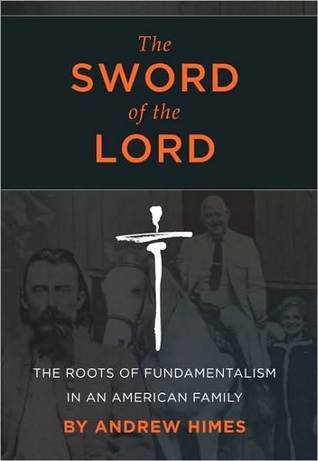
Andrew Himes’ Sword of the Lord: The Roots of Fundamentalism in an American Family (Seattle: Chiara Press, 2011),  offers a unique vision into the world of both fundamentalism and ex-fundamentalism.

Himes is the grandson of John R. Rice.  He was born in 1950 into one of the leading families of post-World War II fundamentalism.  The Reverend Rice led the branch of separatist, revival-based conservative Protestant evangelicalism, the branch that clung resolutely to the label ‘fundamentalist.’  In this sense, Himes’ meaning of ‘fundamentalism’ differs from the broader, cultural traditionalist definition we use at ILYBYGTH.

Himes broke bitterly with his family tradition in high school, but over the years, he came to embrace a more complicated relationship with his family’s vision of fundamentalism.  As Himes puts it, his grandfather remained “one of the kindest, funniest, and most honorable people I knew.”  But Rice also embraced “downright silly” notions of cultural separatism—no card playing, no movies, no short hair for women.  Even worse, Himes argues, his grandfather supported racial injustice in America and imperialist injustices in Southeast Asia. (5) The central dilemma for Himes is the same as it is for ILYBYGTH: How can we love someone whose ideas and policies seem so radically different from our own?

In his attempt to understand fundamentalism and his family, Himes tells the long story of evangelicalism in American history.  Indeed, those familiar with American religious history can safely skip the second and third parts of Himes’ tale.  Himes writes with an engaging style, weaving his own experiences into this long history.  However, his reliance on secondary sources leads him to make a few minor errors.  For instance, he repeats the story that John Scopes of the 1925 “monkey” trial had been teaching evolution for years, (179) when in fact Scopes had a very tenuous record of classroom teaching at all.  Also, Himes overstates the novelty of the Scopes trial in 1925. (180)  By that time, the notion of a media-grabbing “Trial of the Century” had been pioneered by the experiences of dramatic stories like Leopold and Loeb.  These are minor missteps in a tale that sweeps centuries of American history.  However, Himes’ book is also marred somewhat by a number of distracting typos and unclear footnotes.

These quibbles aside, Sword of the Lord is a great introduction to the world of separatist “Big-F” fundamentalism in the later twentieth century.  ILYBYGTH readers will likely appreciate several contributions of Himes’ work.

First of all, the intimate world of John R. Rice offers an eye-opening perspective into life in fundamentalist America.  To cite just one example, Himes tells the story of his childhood spent with colorful evangelists such as C.B. “Red” Smith and Apostle the Premillennial Horse.  This passage is so revealing I’ll quote it at length:

The summer after I turned 12 [c. 1962], C. B. “Red” Smith came to the Bill Rice Ranch and brought along Apostle the Premillennialist Horse.  On the first night of the camp meeting in the open-air tabernacle at the Ranch, Brother Smith himself stepped up to the pulpit and led the singing for the first gospel song.  He was a tall man with curly brown hair, a pink, whiskerless face, and laugh wrinkles around his eyes.  He tilted back his head on the high notes and pointed his chin down at the floor on the low notes, and held back nothing.

            “When we ALLLL get to heaven,” sang Brother Smith, “what a DAY of rejoicing that will BE!  When we ALLLLL see Jesus, we’ll SING and SHOUT the victorEEEEE!”. . .

            “We’ve got a guest speaker in the house tonight,” said Brother Smith with a big grin that showed off a gold-capped tooth.  “He’s a good friend of mine, and he’s come all the way from Jonesboro, Arkansas.” . . .

“Please allow me to introduce Apostle the Premillennialist Horse,” said Brother Smith with a twinkle in his eye.  “Apostle, say hello to all the folks out here.” . . .

            “All right now, Apostle,” said Brother Smith, “what’s our chapter and verse for tonight?”

            Apostle tossed his head, then picked up his right forefoot and stomped deliberately, four times in a row. . . . Apostle shook his head, cocked his ears as if considering, then began stomping his foot again, with Brother Smith counting right along with him: “One, two, three . . . fourteen, fifteen sixteen! Amen!  So that’s Thessalonians chapter four, verse sixteen, is it Apostle?” . . .

            My great-uncle Bill Rice stepped up to the pulpit, waved to the woman seated at the piano, and launched into a spirited rendition of an old revival favorite: “Give me that old-time religion, give me that old-time religion, give me that old-time religion, it’s good enough for me!”

In addition to this kind of illuminating vignette of life growing up in a fundamentalist family, Himes also illustrates the difficulties of changing cultural identities.  For Himes, rejecting fundamentalism meant more than an intellectual decision.  It was more than a theological awakening.  He remembers spending teenaged hours “staring at the animals in the Racine [Wisconsin] Zoo behind rusting iron bars in their drab concrete cages.  I woke in the early morning hours crying piteously, half-remembering the fragments of a dream in which lost souls were dying and God was among the missing.”  (141)

In his youth, Himes swung to the opposite cultural pole, embracing Maoism and leftist radicalism.  In the end, he concluded that he had only “traded in one form of fundamentalism for another, equally rigid, dogmatic, and wrongheaded.” (294)  As a teenager, though, Himes’ transformation pushed him into a “deep pit of self-righteousness and suicidal despair.” (266)

Finally, Himes’ book offers a sympathetic yet critical biography of Himes’ grandfather John R. Rice.  Himes implies that Rice’s doctrinal rigidity may have been a result of his hardscrabble origins.  After all, a childhood spent motherless, left alone to tend for stock animals every year at Christmas, might have led to what Himes calls Rice’s childhood “fear of death and hell—an unsaved boy confronting the terrors of solitude and unknown dangers in a little house under the arc of the great Texas skies.” (105)  That kind of analysis may make sense in Rice’s case, but it doesn’t help us understand the strength and durability of separatist fundamentalism in America.  After all, many ardent fundamentalists had no such childhood, yet they embrace a strict doctrinal orthodoxy.

Childhood trauma aside, Himes offers a fascinating glimpse into his grandfather’s intellectual world.  For instance, Rice was a relative moderate on issues such as race.  In Rice’s time and place, that meant an eventual disavowal of the vigilantism of the Ku Klux Klan.  It meant an insistence that God created all people equally.  But it did not include an embrace of social equality or of the Civil Rights Movement.  As Himes describes, Rice condemned the grisly murder of Emmett Till as a result of interfering activist African Americans. (258)

Rice was also a firm cultural traditionalist, insisting consistently on traditional family life, aggressive anti-communist foreign policies, and anti-abortion activism.  Finally, Himes chronicles the many splits and dissensions among conservative evangelical Protestants.  Rice eventually broke with Billy Graham over Graham’s ecumenism.  Later, Bob Jones Jr. broke with Rice for Rice’s willingness to be yoked with non-fundamentalists.

Those hoping to get the flavor of life in this fundamentalist subculture would do well to read Himes’ book.  By the time of his writing, Himes had overcome much of his bitterness against his grandfather’s faith.  Himes succeeds in his effort to paint a loving portrait without endorsing his grandfather’s ideas.

In the News: Can God Bless America at a Public School?

The storyline seems familiar enough to those who follow culture-war issues: a school principal bans the singing of “God Bless the USA” at a public-school kindergarten celebration.  A coalition of patriotic, religious, and traditionalist Americans protest this secularist monstrosity.  Conservative politicians show up to make election-year hay, and activist groups on all sides mobilize their fundraising apparatchiks to publicize the horrors of life in modern America.  Conservatives bellow that secularism has gone too far when kindergartners are abused in this way.  Liberals howl that American fascists have mobilized to overthrow the Constitutional wall of separation between church and state.  Whoever wins or loses the specific dispute, the two sides both walk away more confident than ever in their mission.

But in a recent controversy at Brooklyn’s Public School 90, this shopworn tale has included some unique twists.  The story from Brooklyn serves to demonstrate just how complicated Fundamentalist America can be.

Here’s the latest: the New York Times reported recently that Congressman Bob Turner led a rally in favor of “God Bless the USA.”  In the words of reporter Ginia Bellafante, Turner’s move was nothing more than a cheap campaign stunt.  Bellafante said Turner’s opportunism “inspires a wish for high-grade exfoliants to scrub away all the contact grease and grime.”

The school had been in the news since Principal Greta Hawkins banned “God Bless the USA” from the kindergarten graduation, briefly replacing it with a Justin Bieber hit, before also canceling the Bieber selection.

On some conservative blogs, we read that Hawkins is “A LIBERAL…….LIBERAL=TRAITOR.”  According to Andrew Jones of  the progressive Raw Story, Fox News reporter Laura Ingraham called Hawkins a member of the “angry left.”

For Turner, a retired media executive, Catholic, and mildly conservative Republican, this may have seemed like a no-brainer.  Who can lose a campaign for “God Bless the USA?”

But the story has more wrinkles than a breeze-ruffled flag.  First of all, Hawkins, an African American, has been the subject of horrific racist attacks since her decision to ban the song.  The New York Daily News reported she received letters calling her “a filthy, dirty, ugly subhuman gorilla.”  One of these letters included the vile threat, “Let’s hope that AIDS will do what sickle cell anemia failed to do, exterminate your whole simian race.”

And there’s more.  Hawkins claimed to have banned the song because its lyrics were meant for adults, not children.  A flashy New York Post article quoted some teachers as saying Hawkins objected to the song’s monocultural offensiveness.  But Hawkins is no Che-loving, Bible-hating secular humanist.  To the contrary, she is a Jehovah’s Witness, a denomination famously averse to patriotic demonstrations.  Anyone with a doorbell is aware that Jehovah’s Witnesses are an intensely Biblical denomination.  According to a Pew Forum study (see pages 44-45), The Watchtower Bible and Tract Society–as the group is formally known–is also a majority minority denomination.

Hawkins did not call this a religious-freedom case.  Rather, she claimed to want a more appropriate and culturally sensitive ceremony.  And Congressman Turner did not call this a religious fight.  He only wanted to take a stand for traditional American values and patriotism.

There’s another twist as well: among the kaleidoscope of conservative religion in America, there is a long tradition of enmity between evangelical Protestants and Jehovah’s Witnesses.  In the 1920s, the Bible Institute of Los Angeles (now Biola University) published a series of books denouncing Jehovah’s Witnesses (along with Christian Science, Seventh-day Adventism, Spiritualism, Catholicism, Mormonism, and ‘New Thought’) as one of the most dangerous “Cults and False Religions.”  (King’s Business, August 1920, page 807.)  And, though this tone may have moved to the fringes of conservative evangelical Protestant thought, it is easy to find evangelicals who continue to blast Jehovah’s Witnesses for embracing a false faith.

With all these wrinkles, the story of God Blessing the USA at Brooklyn’s Public School 90 demonstrates the complicated nature of life in Fundamentalist America.  We see a Bible-believing public school administrator enduring vicious verbal attacks for her decision to ban a popular patriotic song.  We see politicians rushing to burnish their patriotic credentials, joining in an attack that has included depressingly horrific racist slurs.  We see groups of conservative, Bible-based religious people attacking one another more viciously than they attack the secularizing, atheistic, evolutionistic demons of modern American culture.

Whatever the pundits and politicians might say, this seems like nothing so much as a reminder that life in Fundamentalist America is not as simple as it may appear.  The trenches in these kinds of culture-war battles do not run straight.

In the News: Dinosaur Billboards and the Creation Museum

ABC News reported recently that Answers in Genesis’ Creation Museum has launched a new nationwide billboard advertising campaign.

The billboards feature retro-style dinosaurs, and appeared recently in cities such as Chicago, San Francisco, and Houston.  Some critics have wondered why the ads focus on dinosaurs instead of God, or whether this equates to a ‘Flintstones’ theology, but Ken Ham of Answers in Genesis pooh-poohed such folks.  Ham pointed out on his AIG blog that atheists have long used billboards to promote their point of view.