Don McLeroy’s Long Game

What do Phyllis Schlafly, Moses, and country/western music have in common? They all get happy shout-outs in new history textbooks in Texas.  Or at least, that’s what conservative education leaders wanted.  As Politico reported yesterday, new history textbooks in Texas are causing a stir.  But this time, it is liberal activists, not conservative ones, who are denouncing the textbooks as biased and ideological.
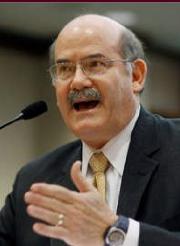
What Hath McLeroy Wrought?

What Hath McLeroy Wrought?

The new textbooks were written to satisfy new standards approved years ago by the Texas State Board of Education.  Back then, conservatives on the board, led by the genial Don McLeroy and the obstreperous Cynthia Dunbar, pushed through new standards that warmed the hearts of conservative activists.

No one who watched Scott Thurman’s great documentary about these Revisionaries can forget the moments when the SBOE debated including more country-western music and less hip hop.  More positive statements about Reagan and the National Rifle Association.  More happy talk about America’s Christian past and less insistence on the horrors of racial segregation.
The Revisionaries

The Revisionaries

As Don McLeroy said at the time, “America is a special place and we need to be sure we communicate that to our children. . . . The foundational principles of our country are very biblical…. That needs to come out in the textbooks.”

Now those changes in the Texas standards have shown up in new social-studies textbooks.  As Stephanie Simons reports in Politico, liberals have complained that the new texts are woefully biased.  In some spots, the books apparently knock Affirmative Action.  They pooh-pooh the benefits of taxes.  They imply that racial segregation was really not so bad.

For those who know the history of America’s educational culture wars, this seems like a drastic turnabout.  Throughout the twentieth century, conservative school activists complained that they had been locked out of educational influence by a scheming leftist elite.  Textbooks and standards, conservatives complained, had been taken over by pinheaded socialist intellectuals.

In one of the most dramatic school controversies of the twentieth century, for instance, conservative leaders lamented the sordid roots of new textbooks.  That battle took place in Kanawha County, West Virginia, across the tumultuous school year 1974-1975.  Conservatives were disgusted by the sex and violence embedded in new literature textbooks.  But some of them weren’t surprised.

Conservative leader Elmer Fike told readers that the textbooks were bound to be rotten.  In Fike’s opinion, conservatives didn’t even need to read the books.  As he explained,

You don’t have to read the textbooks.  If you’ve read anything that the radicals have been putting out in the last few years, that was what was in the textbooks.

As the Kanawha County battle ground on, California’s conservative celebrity schoolman Max Rafferty came to town.  Rafferty, too, told a crowd of West Virginians that they shouldn’t put any faith in textbook publishers.  Those publishers, Rafferty explained, only wanted to make a buck.  As he put it,

They have no particular desire to reform anybody, do anybody any good or find a pathway to heaven.

These days—in Texas at least—the shoe is on the other foot.  The conservative standards that the state adopted in 2010 have pushed market-conscious textbook publishers to come up with books that meet them.  And at least some conservatives are delighted with the success of their long game.  As conservative school board member David Bradley told journalist Stephanie Simon, liberals who complain about biased textbooks can lump it.  “They need to put on their big-girl panties,” Bradley crowed, “and go run for office.”


Heavy Hitters Take on the Common Core, Sort of…

What is a conservative to think? Are the Common Core Learning Standards a threat? A blessing? As we’ve discussed recently in these pages, some conservative intellectuals have argued that the standards are a triumph of conservative activism. But tonight, the Family Research Council hosts a star-studded slamfest to explain all the reasons why conservatives should fight the standards. Yet it seems to me that this group will conspicuously leave out some of the most obvious reasons for conservatives to oppose the new standards.

They Are Coming for Conservatives' Children...

They Are Coming for Conservatives’ Children…

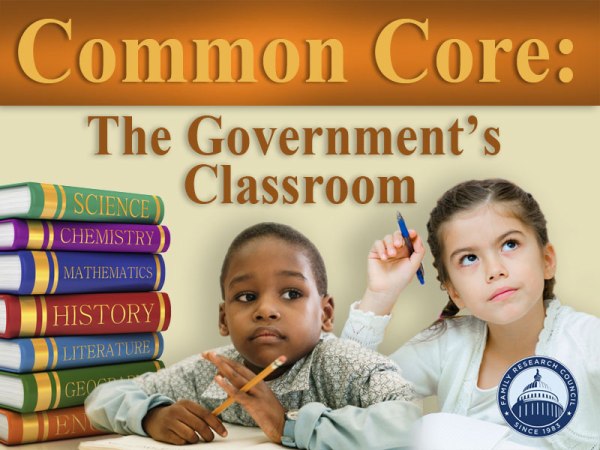
What’s the FRC’s beef with the standards? The name of tonight’s event says it all: “Common Core: The Government’s Classroom.” As have other leading conservatives including Phyllis Schlafly, Glenn Beck, conservative Catholics, and libertarians such as JD Tuccille, the heavyweights at tonight’s event will likely condemn the standards as another example of leftist government overreach.

For tonight’s roundtable, the FRC has assembled folks such as Louisiana Governor Bobby Jindal and University of Arkansas scholar Sandra Stotsky. Governor Jindal has taken the lead among conservative state leaders with his endless legal wrangling over the new standards. Professor Stotsky has become the academic leader of the antis. Her work with the standards’ development left her convinced that the Common Core was rotten. As Stotsky argued in a video jeremiad produced by the anti-Core Home School Legal Defense Association, the intellectual weakness of the standards presents as much of a threat as does the sneaky way they were introduced.

What is a conservative to think about the Common Core? Tonight’s video roundtable apparently hopes to convince more conservatives to fight it.

It will raise key questions about conservatism and educational politics. For example, from time to time, the anti-Core fight is tied to anti-evolution. As we noted a while back, Ohio’s now-defunct House Bill 597 pushed IN creationism as it pushed OUT the Common Core.

To this observer, it seems natural for conservatives to use the political muscle of creationism to fight against the Common Core. In some cases, conservatives have done just that, since the Next Generation Science Standards would likely push for more evolution and less creationism in America’s classrooms.

But this FRC event doesn’t mention evolution or creation. It doesn’t mention literature, history, or math, either, for that matter. Instead, the focus of tonight’s event seems to be on the federal-izing dangers inherent in the new standards.

But why not? Why wouldn’t the Family Research Council want to use every intellectual weapon at its disposal to discredit the standards in conservatives’ eyes? Maybe they will, of course.  The different panelists might emphasize different aspects of the standards.  One or some certainly might note the connection between evolution education and centralized power.  I’d love to watch and find out.

Unfortunately, I won’t be able to. If anyone has the time tonight to spend with this all-star conservative panel, I’d love to hear your thoughts…

Obama Persecutes Christian Schools

Does President Obama have it out for conservative evangelical Christians?  Does he plan to crush them by hitting them where it hurts?  In the pages of today’s Christian Post, Michael Zigarelli worries that Obama’s anti-discrimination policy will do just that.  By putting the squeeze on religious colleges, Zigarelli writes, Obama plans to squeeze the life out of conservative evangelicalism.  This sort of conspiracy-theorizing may sound far-out to non-conservatives like me.  But for those who know the history of evangelical education, it might not seem so wacky.

Zigarelli is commenting on the recent controversy at Gordon College in Massachusetts.  As we’ve noted in these pages, President D. Michael Lindsay of Gordon College attracted attention for signing an open letter to President Obama.  In case you missed the story, Lindsay signed the letter requesting an exemption from a planned executive order.  The order would ban discrimination against LGBTQ persons.

For those like me outside of the world of conservative evangelicalism, Lindsay’s attitude sounds an awful lot like a license to discriminate.  If, as Lindsay wrote, Gordon College does not discriminate against gay students and does not plan to start, why would they need such an exemption?

I don’t want to put words in anyone’s mouth, but as I understand it, the evangelicals did not ask to be able to discriminate against anyone, but rather to be able to continue their policy that requires all students and faculty to agree to a goal of chastity outside of marriage.  As we discussed here at ILYBYGTH, to many non-evangelicals and former evangelicals, that seems like a distinction without a difference.

But if we put those sorts of questions to one side for a moment, we can see that Zigarelli’s attitude demonstrates key elements of evangelical thinking.  His op-ed articulates some of the fears of conservative evangelicals.  For many conservatives, Obama’s order means more than just the end to discrimination.  It means the end of conservative evangelicalism in general.  Once conservatives are no longer able to operate their schools and colleges as they see fit, they will no longer be able to educate their children properly.  As Zigarelli concludes ominously,

Empty desks will follow empty pews, at least if this capricious; destabilizing theology is foisted upon our Christian schools. It’s time to take a stand.

To historians, this sort of rhetoric sounds familiar. As I’ve argued in the pages of the Journal of Religious History, conservative evangelicals made very similar sorts of statements after the Supreme Court’s anti-prayer decision in 1963. That school decision prompted conservative evangelicals to shift their thinking about their relationship to the broader American culture. As the editors of the flagship evangelical magazine Christianity Today expressed it, before that decision, they were confident of their roles as leaders of America’s “devout masses.” After the decision, though, they worried that conservative evangelicals had become nothing but a “believing remnant” in a sinful American culture.

For evangelicals, like all other Americans, any loss of control over schooling can signal a loss of control over public life itself. Some of us may scratch our heads and wonder why evangelicals worry so much about President Obama’s planned non-discrimination order. If, as President Lindsay insists, conservative schools don’t discriminate against homosexuals, what do they have to worry about?

Throughout the twentieth century and into today, though, conservative evangelicals have maintained a tense relationship with the wider American culture. Many conservatives believe themselves to be the representatives of the real American mainstream, the “moral majority.” At the same time, however, conservatives see themselves as persecuted outsiders in a twerking culture besotted with sin, sexuality, and secularism. When big public-policy decisions seem to hurt Christian education, evangelicals react vigorously.

Does Obama plan to crush conservative opposition? As Zigarelli admits, such statements may sound “absurd” and “alarmist.” But given the past fifty years of evangelicals’ relationship with public education, the notion that the federal government might take drastic steps that hurt Christian education does not seem absurd or alarmist at all.


Fundamentalist Parents Can’t Relax

Rich parents can relax.  At least according to an article in this week’s Economist.  But fundamentalist parents never can.  They have to worry about more than their kids’ careers.  They have to fret about eternal damnation.  And they have to worry that Satan lurks in every textbook, every TV show, and every mainstream school.

The Economist article is worth reading in its entirety.  As it explains,

Well-to-do parents fear two things: that their children will die in a freak accident, and that they will not get into Harvard.

Getting into Harvard might be harder than getting into heaven...

Getting into Harvard might be harder than getting into heaven…

Both fears lead to exaggerated and ultimately counterproductive lifestyles.  In terms of safety, the article notes, an American child under five years of age in 1950 was five times as likely to die of disease or accident as that same kid would be today.  And though it is difficult to get into Harvard, most kids of affluent families will have fine careers without an Ivy-League transcript.

But fundamentalist parents have more to worry about.  Since the birth of American fundamentalism in the 1920s, conservative evangelicals have fretted about the influence of mainstream culture on their offspring.  Even if their kids don’t get polio, and even if their kids do get into Harvard, fundamentalist parents have to worry that success in life will lead to terrible punishment after death.  For fundamentalists, even Harvard itself can be more of a threat than an achievement.

As historian Randall Balmer put it in his blockbuster book Mine Eyes Have Seen the Glory,

the greatest fear that haunts evangelical parents is that their children will not follow in their footsteps, that they will not sustain the same level of piety as their parents—stated baldly, that they are headed for hell rather than heaven.

As I argued in my 1920s book, historically this fear for the children has fueled fundamentalism’s public campaigns.  Fundamentalist leaders and parents worried that no level of affluence and economic privilege could protect their children from a culture sliding nonchalantly straight to hell.

As conservative leader William Jennings Bryan explained in 1922, even the rich and powerful had lost the ability to protect the faith of their children.  As a former Secretary of State, Bryan knew many of these families personally.  He wrote about one acquaintance, a US Congressman, whose daughter came home from college only to tell the family that “nobody believed in the Bible stories now.”

It was not only conservative Congressmen who worried.  Fundamentalist evangelist Bob Jones Sr. liked to tell the story of a less powerful family who had a similar experience.  This family, Jones explained in one of his most popular 1920s sermons, scrimped and saved to send their precious daughter to

a certain college.  At the end of nine months she came home with her faith shattered.  She laughed at God and the old time religion.  She broke the hearts of her mother and father.  They wept over her.  They prayed over her. It availed nothing.  At last they chided her.  She rushed upstairs, stood in front of a mirror, took a gun and blew out her brains.

Even when fundamentalist families did not experience that sort of cataclysm, we must keep their anxiety in mind when we try to understand fundamentalism from the outside.  Why do conservative evangelicals fight against evolution?  Why do they insist on school prayer?  Why do they worry about rights for homosexuals?

In all these cases, conservative evangelicals’ public activism is made more desperate by their intense worry about their children.  In this, there is no difference between conservative evangelicals and mainstream Americans of any background.  As the Economist article points out, almost all parents love their children and make sacrifices for them.  In the case of mainstream affluent parents, it might even help if they relaxed a little bit.  As Bryan Caplan of George Mason University argues,

Middle-class parents should relax a bit, cancel a violin class or two and let their kids play outside.

Easy enough.  But fundamentalists face a very different situation.  If we want to understand the mind of fundamentalists, we can try a mental experiment.  Non-fundamentalist parents have a hard enough time relaxing about their kids, even though they feel at home in mainstream culture.  Non-fundamentalist parents fret too much about their kids’ futures, even if they don’t feel alienated by their local public schools and elite universities.

Let’s try to translate the anxiety experienced by fundamentalist parents into mainstream terms.  Imagine, for example, the sorts of public outcry there would be if public schools began promoting ideas or practices that affluent secular parents found dangerous.  For instance, what do you think would happen if a public school somewhere began promoting smoking as a fun and healthy activity?


Does Anyone Actually Read the Index?

My eyeballs are beginning to chafe.  This week, I’m finishing up the index for my new book.  It’s a lot of work, even though I had a gifted grad student do most of the intellectual heavy lifting.

How the sausage gets made...

How the sausage gets made…

So now I’m wondering: Does anyone actually read the index?  I know professional academic historians do.  In fact, that’s one of the first cheap tricks we learn in our PhD programs.  We flip quickly to the back to see what we can glean from the index.  What are the book’s themes?  What are its main ideas?  Its blind spots?

But do any normal people read a book’s index?  Make no mistake, I’m compiling a kick-ass index, whether anyone ever reads it or not.  But I can’t help but wonder if readers will find useful my painstaking distinctions between “authoritarian teaching” and “traditional education.”

Coming soon...

Coming soon…

Will anyone care that I spent so many long hours in a stuffy library teasing out the nuances of “educational conservatism” as opposed to the broader category of “conservatism” in general?


Child Abuse or Church Camp?

The way we ask the question says a lot.

We could ask it this way: Is it abusive to encourage children to have certain religious experiences?

Or we could put it like this: Should children and toddlers be coerced and terrified?

Either way, these questions are prompted by a new church-camp video that is making the rounds these days.  In the video, we see young children experiencing some of the typical manifestations of charismatic Christian worship.  They jerk their limbs, fall to the ground, engage in babbling speech, cry and shout.

Adults surround the children, clearly encouraging them to behave the right way.  Some children seem to participate enthusiastically.  Others seem confused, intimidated, or tearful.

There’s not much new here.  These sorts of behaviors have been manifestations of charismatic worship for a long time.  For just as long, they have been criticized by critics.  In the first Great Awakening of the 1740s, Boston minister Charles Chauncy famously attacked the revivalists for their embrace of “enthusiasm.”  Their emotional services prompted false conversions, Chauncy believed.  Attendees at big revival meetings found themselves caught up in the moment, jerking their bodies, crying out, falling down, but not becoming truly Christian.

More recent critics focus on the way young children are bullied into a traumatic emotional experience.  Atheist pundit Jerry Coyne, for instance, puts it this way:

It’s brainwashing, pure and simple. The kids have no choice. Is there anyone who wouldn’t call this abuse?

These behaviors seem bizarre to me as well.  But I don’t call it abuse.  The adults in this video, to my mind, don’t appear to be victimizing children, but rather trying to share an authentically held belief with them.  That’s a big difference.

I know this is a difficult topic to discuss.  I also know that I have absolutely no personal experience with this sort of thing.  And I sympathize deeply with those who found themselves traumatized by this sort of intense religious upbringing.

But if we call it “abuse” we are doing more than simply insulting these adult believers.  If we call it “abuse” we open the door to government intervention in these religious ceremonies, and others.

Perhaps some other examples will help make the case.  It is sadly not uncommon for religious people to insist on alternative medical care for children.  Instead of chemotherapy, for example, some believers may lay hands on a child who is suffering from cancer.  This is abusive.  The child is being substantially harmed by being denied effective treatment.

It is also sadly not uncommon for religious organizations—and, to be fair, non-religious organizations—to cover up sex abuse of minors in the name of religious solidarity.  Here, too, the government must intervene.  This is abuse.

Again, my heartiest sympathies go out to those who are struggling to overcome religious upbringings they found coercive.  Writers such as Samantha Field and Jonny Scaramanga have educated me a great deal about the ways religious beliefs can cause emotional harm and long-term trauma.

I’m not dismissing that.  But the church-camp activities here seem to be something different than “abuse.”  Am I wrong?


How to Hit your Child

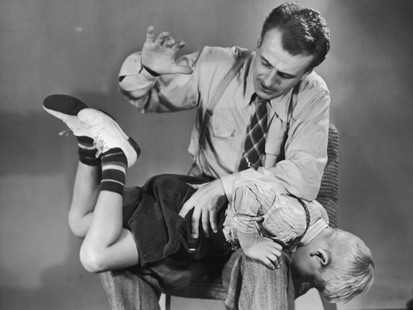
What do you do when your kids misbehave?  Do you hit them?  Or is that a form of abuse?  It seems as if our culture is confused about this question.  Throughout the twentieth century, as I argue in my upcoming book, conservatives argued that parents and teachers MUST beat children in traditional ways.  Anything else threatened civilization itself.  Has that attitude changed?

Is this "abuse?" Or is this "parenting?"

Is this “abuse?” Or is this “parenting?”

In American culture, a certain form of physical correction of children by parents has long been the norm.  Especially “spanking.”  In this kind of punishment, the child is swacked on the butt by the parent, either with a hand, a spoon, a brush, a belt, or some other mild weapon.

As a survey article in National Review Online describes, states now differ in their laws about spanking.  In New York, for instance, a judge recently ruled in favor of parents’ right to spank, as long as it is done mildly, with only an open hand.  In the New York case, the parent insisted he had not used a belt on his child.  That would have crossed the line, he felt.  In other states as well, courts have struggled to draw clear boundaries between acceptable spanking and unacceptable child abuse.

Until 2012, according to the NRO article, all 50 states recognized parents’ right to spank their own children.  In that year, Delaware passed a law forbidding any form of physical punishment.  At the first and second degrees, parents in Delaware can be charged with a felony for causing harm to their children.

As you might expect, a certain sort of conservative finds this sort of law outrageous.  Not only should the rights of parents over their children be sacrosanct, some conservative activists have argued, but spanking is a healthy and humane form of punishment.  The Home School Legal Defense Association, for example, called Delaware’s new law “a violation of the right of parents to direct the upbringing of their children, including the long-recognized right to administer reasonable corporal discipline.”

It’s not a new issue.  As I found during my research for my upcoming book, educational conservatives have long insisted on the right and duty of both parents and teachers to use physical punishment on unruly youth.  For some conservatives, this sort of corporal punishment is the only way to properly shape character.  As the old saying goes, “Spare the rod and spoil the child.”

In 1950 Pasadena, for instance, local activists bubbled over with their outrage at progressive novelties in their local public schools.  One parent insisted that teachers must use “whipping . . . when the situation calls for such punishment.”  The problem, many conservatives in Pasadena thought at the time, was not that teachers might abuse students.  Rather, the danger came from a generation of children left uncorrected and unbowed to authority.  Such unguided youth, one letter-writer complained, were in danger of total “moral disintegration.”  And the obvious reason for that disintegration, according to this anonymous writer, was the “fatal lack of the right kind of instruction in our schools.”

A few years later, conservative stalwart Max Rafferty agreed on the importance of corporal punishment.  In his 1964 book What Are They Doing to Your Children, Rafferty warned of the dangers of progressive methods.  New teachers, Rafferty explained, came

Fresh from college and still pretty Dewey-eyed about things, [they] compromise themselves and their careers in a hopeless attempt to convince some freckled-faced [sic] urchin with devilment coming out visibly all over him that he must discipline himself.

Instead, Rafferty believed, the traditional methods remained the best.  Each teacher should learn when and how to correct a student using physical punishment.  In the old days, Rafferty wrote, such things were beyond argument.  In times past, Rafferty described, some parents might

Storm into the schoolyard and whip the teacher for abusing little Willie, but by far the more typical parental reaction to the tearful complaint ‘Teacher licked me!’ was to reach for the razor strop and give a home version of teacher’s treatment out in the woodshed.

Rafferty and the Pasadena conservatives knew that such physical punishment was controversial in their own times.  Each conservative writer appealed to a past in which teachers and parents had an unfettered right and duty to use appropriate methods to raise children right.  In 1950 and 1964, conservatives saw themselves as stalwarts of traditional methods.  Those methods had already come under attack by dunderheaded progressives.

So there is nothing new to controversy over corporal punishment.  Yet clearly, as the NRO review shows, things are changing.  Could we be on the cusp of a new age for corporal punishment?  Will more states follow Delaware in outlawing all forms of physical punishment?


The Files Are In!

Well, there’s nothing more to be done about it now.  I’ve just sent my final draft of my next book manuscript to the publisher.  There’s a sense of relief at being done, but also trepidation at the impossibility of further revisions.  After years of researching, writing, then revising, revising, revising, it’s hard to believe I won’t be able to keep tweaking and improving.

Pre-order your copy today!

Pre-order your copy today!

In general, though, I’m extremely pleased with the shape of the manuscript.  In a nutshell, I try to make the case that we’ve seen a potent tradition of educational conservatism in the United States, one that has had a decisive impact on the structure and content of schooling.  And, I argue, that tradition has not been recognized by historians or education scholars.

To make this case, I examine in four looooong chapters the four biggest school controversies in twentieth-century America: the Scopes Trial of 1925, the Rugg textbook controversy of 1939-41, the Pasadena superintendent ouster of 1950, and the Kanawha County textbook battle of 1974-75.  What did conservatives say and do in these controversies?  In each case, the attention-grabbing events attracted conservative participation from both locals and national leaders.  In each case, the issues prompted conservatives to articulate their visions of proper schooling.  To me, that’s the interesting question.

We’re still a ways from final publication.  The publisher will send me proofs in July.  At that stage, I’ll put together the index and fine-tooth-comb the proofs for any typos.  But I won’t be able to make substantive changes at that point, just minor corrections.

During these last weeks, as I’ve been going over the copy-edited chapter files, I’ve been very grateful for the careful work of the editor.  She or he pointed out some embarrassing errors on my part and I’ve been able to make changes in the argument.  Hopefully this draft is as crystal-clear as I can make it.

I’m looking forward to hearing what readers think of the book.  For that, I’ll have to wait until 2015.  The press will release the book on January 12, 2015.  Pre-orders are available!


Pre-Orders Now Available!

Want to be the first on your block to get your copy of The Other School Reformers?  Then pre-order your copy today!

Pre-order your copy today!

Pre-order your copy today!

As I was happy to announce recently, Harvard University Press will be releasing the book in early 2015.  But the pre-order just became available on sites such as Amazon.  The hardcover won’t be available until January 12, 2015, but if you pre-order today, you’ll be sure to WOW your friends and family by getting your hands on it first.

The Other School Reformers

Clear your calendars! We have a release date. The Other School Reformers will be hitting store shelves in February.  I know that’s a long time to wait, so I’m suggesting everyone dress up as their favorite conservative educational activist and camp out outside their local bookstore.

Coming January 2015.

Coming January 2015.

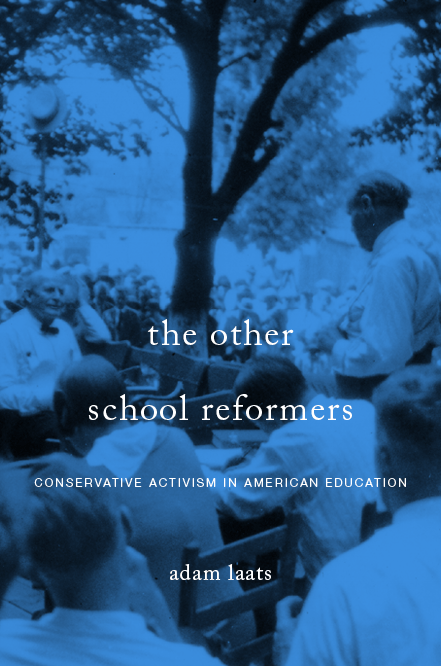
Thanks to the Smithsonian for this terrific cover image.  That’s Clarence Darrow (standing) facing William Jennings Bryan at the Scopes Trial.  In this book, I examine four epochal school controversies from the twentieth century.  In each case, I ask what conservative intellectuals and activists wanted out of schooling.  My goal is to find out what it meant to be “conservative” when it came to education.

The catalog listing just went up.  Here’s how the talented folks at Harvard University Press describe the book:

The idea that American education has been steered by progressive values is celebrated by liberals and deplored by conservatives, but both sides accept it as fact. Adam Laats shows that this widely held belief is simply wrong. Upending the standard narrative of American education as the product of courageous progressive reformers, he calls to center stage the conservative activists who decisively shaped America’s classrooms in the twentieth century. The Other School Reformers makes clear that, in the long march of American public education, progressive reform has more often been a beleaguered dream than an insuperable force.

Laats takes an in-depth look at four landmark school battles: the 1925 Scopes Trial, the 1939 Rugg textbook controversy, the 1950 ouster of Pasadena Public Schools Superintendent Willard Goslin, and the 1974 Kanawha County school boycott. Focused on issues ranging from evolution to the role of religion in education to the correct interpretation of American history, these four highly publicized controversies forced conservatives to articulate their vision of public schooling—a vision that would keep traditional Protestant beliefs in America’s classrooms and push out subversive subjects like Darwinism, socialism, multiculturalism, and feminism. As Laats makes clear in case after case, activists such as Hiram Evans and Norma Gabler, Homer Chaillaux and Louise Padelford were fiercely committed to a view of the curriculum that inculcated love of country, reinforced traditional gender roles and family structures, allowed no alternatives to capitalism, and granted religion a central role in civic life.

Almost makes me want to read it myself.  For me, the next steps will be to review and copy-edit the full manuscript next month.  Then in July I’ll put together the index, with help from a talented graduate student.