Apocalyptic Academics: Conservatives and the Myth of Outrageous Schools

There it is again!

Today we find yet another example of conservative commentators lambasting the outrageousness of public education.  This firmly ensconced tradition of school-bashing doesn’t make much sense to me.  I would think conservatives would want to promote public education in America as one field in which conservative ideas and ideals have taken firm control.

Today’s example comes from the pages of Public Discourse, in an essay by Professor William Jeynes.  The opening paragraph highlights the terrible activism of public schools:

An inquisitive elementary school student asked his teacher, “Is it wrong to steal?” The teacher replied, “I don’t know. What do you think?” This incident in a major midwestern public school alarmed thousands of parents, and reminded myriad others why they value religious private schools: these schools are usually guided by a moral compass for academics and behavior that public schools patently do not offer.

This notion of vaguely outrageous teaching in America’s vaguely described public schools is a dominant theme of conservative talk about public schooling.

Browsers of conservative media hear about high-school students strip-searched during exams, or teachers rewarded for “stomping” on the American flag.

In all these stories, public schools and their teachers loom as out-of-control dictators, blasting away at traditional morality, patriotism, religion, and common sense.

Nor is this theme a new one among conservative pundits.

In the 1980s, for example, commentator Sam Blumenfeld warned readers that “the neighborhood school is controlled by a national educational and bureaucratic hierarchy completely insulated from local community pressures and answerable only to itself.”[1]

In the 1970s, US Representative John Conlan (R-AZ) worked hard to control what went on in public schools.  Debating House Bill 12851 in May, 1976, Conlan advised,

I think one of the things that perhaps the gentleman from Michigan is not aware of is that there is a significant current in education to teach children that there are no values, there is no right, there is no wrong, that everything is relative, and it all depends upon situational ethics.[2]

As I argued in my 1920s book, conservatives in that decade also insisted on the terrifyingly amoral or immoral dominance of public schools.  For instance, one well-funded insurgent group, the Bible Crusaders, warned that public schools had been taken over by a conspiratorial sect determined “to secretly and persistently work to overthrow the fundamentals of the Christian religion in this country.”[3]

In all these tellings, schools and teachers represent insidious threats to traditional values.  As with Professor Jeynes’ recent warning, a single example, often vague or imprecise, is used as proof of the continuing trend of public schools nationwide. For some reason, conservatives have long tended to exaggerate the perniciousness of public schools.

Of course, this is not only a conservative tendency.  Progressives, too, often hyperventilate over isolated examples of conservative influence in schooling.  As we noted recently, for instance, the specter of creationism often looms much larger in the progressive imagination than it does in actual schools.

In the face of such assertions of apocalyptic academics in public schools, more careful scholarship demonstrates that most teaching fits in with local community values.  Political scientists Michael Berkman and Eric Plutzer have noted that most teachers’ values match those of their school and district.[4]

Of course, there always are and always have been some teachers who flout local values.  But such events are newsworthy precisely because they are unusual.  In general, most teachers prefer to avoid controversy.  Most teachers, like most people, try to fit in.  The notion that teachers and schools are out to demolish the values of their students just doesn’t match experience.

Yet conservatives will presumably continue to trumpet examples of outrageous public-school teaching.  To a non-conservative like me, this does not make sense.  I would think conservatives would rather exaggerate the conservative nature of most public education.  These days, talk about public schooling is dominated by demonstrably conservative themes: privatization, competition, and union-bashing, to name a few.

Wouldn’t it make better strategic sense for conservatives to claim all of these as victories?


[1] Samuel L. Blumenfeld, Is Public Education Necessary?  (Old Greenwich, CT: Devin-Adair, 1981), 4.

[2] Congressional Record, May 12, 1976, pg. 13532.

[3] “The Bible Crusader’s Challenge,” Christian Fundamentals in School and Church 8 (April-June 1926): 53.

[4] Michael Berkman and Eric Plutzer, Evolution, Creationism, and the Battle to Control America’s Classrooms (New York: Cambridge University Press, 2010), 199-200.
Creationist Bogeymen

Say, did you hear what happened to Senator Kruse’s “Truth in Education” bill in Indiana?

Unless you’re a close personal friend of the Senator, I’m guessing you haven’t.  The career of bills like this one can tell us a thing or two about the cultural politics of creationism.

Senator Kruse garnered some headlines six months ago for his plan.  Kruse, the chairman of the Indiana State Senate Education Committee, promised a new law that would guarantee students’ right to challenge their teachers’ pronouncements.  The barely disguised goal was to allow creationist students to confront evolutionary teaching.

At the time, pundits and scribblers announced Kruse’s plan as the latest offensive in a creationist juggernaut.  Reporters noted the connections to Seattle’s Discovery Institute, the leading intelligent-design think tank.  Progressives lamented this latest power play by religious conservatives.  One commenter called the bill the latest effort to “march the education of American children toward the 19th century.”  Another explained Kruse’s new effort as an end run around evolution.

But here’s the problem: Kruse’s bill didn’t do any of those things.  It didn’t do anything.

Kruse’s bill died the quiet death of most legislation.  As House Bill 1283, Truth in Education went nowhere.  But no one reported on that. [**DOUBLE CORRECTION: First, HB 1283 was not introduced by Senator Kruse, but by Kruse’s ally, Representative Jeff Thompson.  Second, the National Center for Science Education, that tireless watchdog of all things creationism, did in fact report on the fate of HB 1283.  Thanks to Glenn Branch of the NCSE for calling our attention to it.]

To be fair, several of the journalists who talked about the looming threat of Indiana’s latest creationist bill wondered if the bill would ever get anywhere.  But a casual news reader could be forgiven for assuming that creationists pass laws like this all the time.  The news media’s hunger for the sensational feeds a skewed perspective on what is and is not legal in America’s schools.

This is not new.  In 1942 Oscar Riddle and his colleagues conducted a survey of high-school science teachers.[1]  They asked teachers if they taught evolution or special creation, and why.  Those answers were illuminating.  Over three thousand teachers responded to the questionnaire.  Those who claimed not to teach evolution gave a wide range of reasons.  One teacher from North Carolina explained that evolution education was “a taboo subject to most people” (73).  A Nebraska teacher said she avoided evolution education mainly due to “Lack of time.”  One California teacher added, “Controversial subjects are dynamite to teachers” (74).  In the stereotype-shattering department, another California teacher from a “large city” explained that he or she didn’t teach evolution because the “Fundamentalist beliefs of majority of our students may not be attacked (negro and Mexican)” [sic] (74).

Most relevant here, lots of teachers incorrectly believed evolution education was illegal in their states.  Since the 1920s, as I detail in my 1920s book, a handful of states really did pass anti-evolution laws or education-department rules.  But a significant percentage of teachers in the 1940s believed incorrectly that their states had also done so.

Why?  My hunch is that anti-evolution bills get much more attention than they deserve.  Any conservative religious lawmaker can earn quick points for introducing a bill destined to go nowhere.  This was the case in the 1920s, the 1940s, and it is the case today.  Senator Kruse’s bill did not change anything for any students in Indiana.  But it did contribute to a widespread notion that creationism is on the march all over the country.


[1] Oscar Riddle, F.L. Fitzpatrick, H.B. Glass, B.C. Gruenberg, D.F. Miller, E.W. Sinnott, eds., The Teaching of Biology in Secondary Schools of the United States: A Report of Results from a Questionnaire (Washington, DC: Union of American Biological Sciences, 1942).

Oh, Horror! Stephen King Plumps for Intelligent Design

Promoting his new book, Stephen King told NPR’s Terry Gross that intelligent design is the only thing that makes sense.  Not only that, but King promoted a particularly religious interpretation.

I choose to believe it. … I mean, there’s no downside to that. If you say, ‘Well, OK, I don’t believe in God. There’s no evidence of God,’ then you’re missing the stars in the sky and you’re missing the sunrises and sunsets and you’re missing the fact that bees pollinate all these crops and keep us alive and the way that everything seems to work together. Everything is sort of built in a way that to me suggests intelligent design. But, at the same time, there’s a lot of things in life where you say to yourself, ‘Well, if this is God’s plan, it’s very peculiar,’ and you have to wonder about that guy’s personality — the big guy’s personality. And the thing is — I may have told you last time that I believe in God — what I’m saying now is I choose to believe in God, but I have serious doubts and I refuse to be pinned down to something that I said 10 or 12 years ago. I’m totally inconsistent.

Fear and Loathing in Fundamentalist America

Who hates whom?  Do “fundamentalists” hate the rest of us?

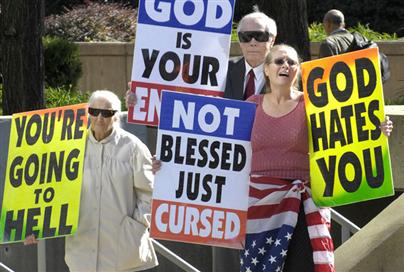
A new article about the hate-centric Westboro Baptist Church confirms what many of my secular, liberal friends and colleagues believe: fundamentalists hate.  Hate seems to be at the core of their fundamentalist identity.

But hate is a tricky thing.  Is it okay to hate the Westboro Church and its horrific tactics?  How about other fundamentalist groups?

Image Source: Top Ten Unbelievable Westboro Baptist Church Protests

Image Source: Top Ten Unbelievable Westboro Baptist Church Protests

The hatefulness of the Westboro sect is hard to deny.  Writing in the Los Angeles Times, Jenny Deam offers a portrait of Westboro refugee Libby Phelps-Alvarez.  Phelps-Alvarez, granddaughter of Westboro founder Fred Phelps, shares a story of cultish indoctrination into the Phelps family business.  You’ve seen the images: soldiers’ funerals picketed by Westboro members holding up signs saying, “God Hates Fags” and the like.

As Deams’ story relates, Libby grew up with the family church.  She began picketing at age 12.  By her late teens, though, according to Deams, “Libby began to wonder: ‘Am I doing the right thing? Should I be telling people they are going to hell?’”

Eventually, Libby left her church and family.  But she seems strangely ambivalent about it. As Deams concludes, “Libby isn’t sure what she believes anymore. She no longer hates homosexuality, but her journey is far from complete: ‘Everyone thinks when you leave you do this 180. It doesn’t work that way.’”

Many other ex-fundamentalists take a much angrier tone.  For some, hating the haters has freed them to engage in their own brand of hatefulness.

Ken Ham has complained recently of vicious verbal attacks on him and his young-earth creationist ministry by groups of atheists.  Ham planned to speak at a Texas homeschooling conference, and Texas freethinkers posted their discussion about their planned response.

Most of their planning revolved around intelligent protests and information-sharing.  Vic Wang of the Houston Humanists made the intelligent point that their protests should not be against religion.  Rather, Wang argued, they should paint Ham as a specific sort of “extremist,” a “crackpot.”

Other speakers took an angrier tone.  “Sister Shayrah” equated creationism and conservative religion with child abuse.    She insisted that religious parents were free to teach their children their beliefs, but that no parent, in any sort of school, could be allowed to use religion as an “excuse for damaging or hurting or indoctrinating your child.”

Shayrah and other participants, such as Neely Fluke, noted that they had been brought up in the world of young-earth creationism and fundamentalist Protestantism.  That has left them angry.

I can’t claim to know what it is like to grow up in the world of fundamentalism.  Many of those who grew up that way, such as Jonny Scaramanga or “Forged Imagination,” have offered compelling insights into their feelings and transformations.

But whatever personal anguish or turmoil these folks may have experienced, it does not make sense in the cold light of cultural politics to use angry, confrontational language.  It doesn’t help.

Indeed, the beneficiary of this sort of anger seems to be Ken Ham himself. He has promoted this anti-Ham video on his blog and website.  As he says to his creationist readers,

Everyone needs to experience this video chat for themselves to get an understanding of the increasing intolerance and aggressiveness of many atheists against biblical Christianity. . . .

And let’s get churches in Texas aware of this intolerance by atheists and publically get out the word, including alerting the Christian media. Pastors should speak out about the increasing intolerance of atheists to their congregations. In fact, these video excerpts should be used by pastors across this nation to warn their flocks about the growing intolerance being directed at Christians and then equip their people to stand against these secular attacks. . . .

So, let’s use this video chat by atheists as a tool to offer some practical teaching about those people who oppose the Bible’s messages.

I can’t claim to know what it was like to be taught the doctrines of young-earth creationism or Protestant fundamentalism.  I understand that I might be angry if I had.  But like any political movement, venting too much spleen against our opponents only fuels the other side.  Hate may feel good sometimes.  It may feel righteous.  But it only digs deeper the culture-war trenches that have divided our country.


Jonny Scaramanga Gives Us…Creation Rock!

Think creationism is a bunch of dweebs with thick glasses stammering as they refute mainstream science?  Think again!

UK former fundamentalist Jonny Scaramanga offers some priceless creation-rock videos today.  Jonny grew up with this stuff, but for secular folks like me, it is a revelation.

Geoff Moore and the DistanceCheck out Jonny’s guest post at Laughing in Purgatory, and, best of all, watch the video he saved for his own blog, Leaving Fundamentalism.  This video mixes “Smokin in the Boys Room” with “Take On Me.”

Thanks Jonny… Motley Crue + A Ha + The Genesis Flood = Wow.

What do Pastors Believe about Origins?

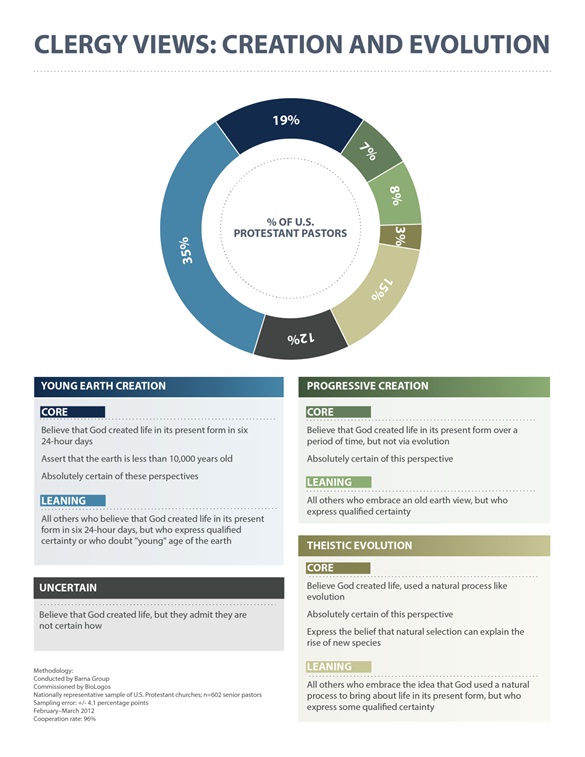
What do America’s professional Protestants think about evolution and creation?  Biologos has published the results of a survey of US Protestant pastors.

Those concerned with creationism and evolution have published many surveys of the ways evolution is taught in public schools.  Those surveys tend to focus on the ideas of high-school biology teachers.  Most recently, the work of Penn State political scientists Michael Berkman and Eric Plutzer offered a thorough nation-wide look at what biology teachers think and teach.

Source: Biologos Forum

Source: Biologos Forum

This survey, in contrast, asked 602 “senior pastors” for their views.  The results invite a few comments.

First of all, we should note that this is not a survey of religious Americans’ views about evolution and creation.  Rather, this is specifically a survey of a spectrum of US Protestant pastors’ views.  There were no leading Catholics involved, much less Muslims, Jews, Hindus, or any other religious group.  That matters.

Second, the numbers themselves make some interesting points.  We are not surprised by the majority (54%) who call themselves young-earth creationists.  We are surprised, though, by the strong showing for “uncertain” (12%) and the relatively weak showing for “theistic evolution” (18%).  Could these two answers be reasonably combined to form a much stronger bloc—nearly a third—of American pastors who take a theistic but uncommitted view of evolution?

Finally—for now, though the Biologos editors have promised to dig in more deeply to these survey results in the future—what about the striking Biologos note in its seventh point?  As the Biologos editors point out, a majority of pastors with young-earth creationist (YEC) beliefs agreed that publicly challenging those views might cost them their jobs.  In other words, for pastors with YEC beliefs, even a whiff of doubt or skepticism must be avoided.  This seems to confirm the accusations of anti-creationists.  If YEC pastors feel obliged to maintain their positions—feel dug in to YEC beliefs regardless of evidence or personal struggles—it seems fair to accuse YECs of closed-mindedness, obdurate clutching of YEC due more to social and economic pressure than to Biblical conviction.

Certainly, Biologos is not a disinterested party.  The organization hopes to promote “evolutionary creationism” or “theistic evolution.”  And my social-science chops, I’m afraid, aren’t sharp enough to offer a good critique of this survey methodology.  But if we take Biologos’ word for it, there might be a large number of YEC pastors out there who stick to their YEC guns for other reasons than Bible-based conviction.


A Christian Teen Army in Public Schools

“High school Christian teens, Join Us!”

That is the call of a new video promoted by the evangelical Christian group Reach America.

In the video, teenagers ask a series of provocative questions, such as the following:

Why can’t I pray in school?  Why do I have to check my religion at the door?  Why can’t I write about God in my school papers?  Why do I have to tolerate people cursing my God, but I’m not allowed to talk about God and my faith? Why are they taking God out of my history books? Why do they teach every other theory in science besides creation?  Why am I called names because I believe in marriage the way God designed it?

Like many conservative evangelical educational activists, Gary Brown, founder of Reach America, believes that public schools have lost their way.  Beginning with the prayer and Bible SCOTUS decisions in 1962 and 1963, Brown insists, God has been systematically frozen out of schools.  Christian students have been targeted for bullying, indoctrination, and harassment.  Every part of public education is a threat, from pornographic sex education to mandatory dating.

Brown’s answer has been a call for youth engagement.  In the recent video, Reach America teens warn, “People who do not love our God have stolen our country. . . . We are an army.  Christ is our commander. . . . We are in a war for the hearts and souls of our generation.  And we know it.”

This culture-war army can be directed, Reach America promises, by programs such as its new Educational Partnership.  From its headquarters in northern Idaho, Reach America wants to organize a non-school school.  At this “partnership,” students will come to this non-school school every day, September through June.  In the mornings, they will work on academic work.  That work, though, will not come from the non-school, but rather from parent-directed online education or homeschool assignments.  In the afternoons, students will work on the “four Cs:” Christ-Centered Counter-Culture.

So how is this school not a school?  Parents pay tuition.  Students study there.  The program even offers “P.E. and electives.”  Do the Browns avoid calling this a school to avoid legal hassles?  It certainly looks that way.

How big is the program?  Not too big.  According to Brown, twenty-three students are enrolled for the current non-school year.  My guess is that Reach America will attract the attention of scribblers like me with the culture-war rhetoric of this video, but will soon encounter the difficulties that plague every Christian school, even non-school ones.

In any case, the message of the teens’ video is clear.  The way to prevent bullying is to fight back.  As they declare, “America will be one nation under God, again.”


Scientists Are Dumb

What do elite scientists know about religion?

Not much, according to sociologist Elaine Howard Ecklund.  Asking these out-of-touch elite scientists for advice about religion is akin to asking residents of a nudist colony for advice about fashion.

If anyone would know, it would be Ecklund.  In her study of scientists, between 2005 and 2008, she surveyed 1700 scientists from what she called “elite” schools (157-158).  She announced her goal in her 2010 book Science vs. Religion: to give voice to “the scientists whose voices have been thus far overlooked in the science-and-religion debates” (x).

To this reader, Ecklund seems to have made a strange decision to include social scientists—economists, political scientists—in her sample.  It seems a better fit to call her sample elite “academics” instead of elite “scientists.”  Other reviewers have pointed out different complaints.

But whatever the merits or faults of the study as a whole, it tells us something about the connection between some elite academics and the rest of America.  As Ecklund describes, the religious affiliation of her sample does not match that of Americans as a whole.  Among her sample, only two percent identified as “evangelical Protestant,” compared to twenty-eight percent among the general population.  Only two tenths percent as “Black Protestant,” compared to the general public’s eight percent.  Nine percent identified as Catholic, compared to twenty-seven percent of the public.  Sixteen percent were Jewish, compared to the general population’s two percent.  Perhaps most interesting, given recent attention to the rise of the “nones,” a full fifty-three percent of Ecklund’s sample claimed no religious affiliation, compared to sixteen percent of the rest of us. (15).

The same trend was true when it came to professing atheism or agnosticism.  In Ecklund’s sample, just over one-third called themselves atheists, compared to a mere two percent of the American population.  Thirty percent called themselves agnostic, compared to the general four percent.  And a relatively meager nine percent agreed with the statement “I have no doubts about God’s existence,” compared to a whopping sixty-three percent of the general public (16).

These elite academics, then, certainly do not match the rest of America in religious ideas or identity.  That really doesn’t come as much of a surprise.  But Ecklund argues more provocatively that this religious quirkiness among elite academics also creates a sort of self-perpetuating echo chamber.  It creates what Ecklund calls three “myths scientists believe” (152).

First, Ecklund charges, elite academics tend to think that if they ignore religion, it will go away.  Second, they too often equate all religion with an imagined bogeyman of “fundamentalism” (153).  And elite academics tend to think that “All evangelical Christians are against science” (155).

The utter lack of evidence for all these myths does not stop elite academics from feeling correct, even intellectually superior to those who question their blundering assumptions.  As Ecklund argues, non-religious academics often have little idea even about the working of religion on their own elite campuses, “much less about what drives a typical American worshipper” (8).

Ecklund depicts an environment on some elite college campuses that encourages, or at least allows, growths of strange ideological excess.  One physicist she interviewed—admittedly one extreme end of Ecklund’s sample—described religion as a “virus” to which he is “immune” (13).

Most of her interviewees did not express such virulent hostility, but many of the traditionally religious folk still expressed a felt need to live a “closeted faith” (43).  Even when they had some religious colleagues, these elite academics often felt surrounded by angry anti-religion.  One self-identified “Christian” academic told Ecklund about a conversation with a colleague about their students’ poor academic preparation.  The fault, this Christian was told, was with “stupid intelligent design.  It’s stupid Christianity” (45).  Her colleague had not meant to offend, but had simply assumed that such comments could not be considered offensive.

In this self-reinforcing world of arrogant ignorance, many of the academics in Ecklund’s study made strange and unwarranted assumptions.  One biologist, for example, assumed that “mature” students would not consider creationism.  Advanced students, this biologist explained, “are just not religious in the first place.”  But this biologist, Ecklund points out, really had no idea about the religious ideas or backgrounds of his students (78).

Even on their own campuses, most of Ecklund’s sample reported woeful ignorance of attempts to promote dialogue between science and religion.  “The reality of university life,” Ecklund argued, “does not match these scientists’ ideal” (98).

Yet this ignorance among elite academics did not create a questioning or humble attitude.  One social scientist, for instance, explained how she began her classes.  “You don’t have to distance yourself from religion,” she told her new students, “and think about it from an outside perspective, but you do if you want to succeed in this class.  And if you don’t want to do that, then you need to leave” (84).

How can such smart people say such dumb things?  How can elite academics profess such blinkered ideas without even recognizing their own biases?  As a product of two of the “elite” schools in Ecklund’s sample (Washington University in St. Louis and University of Wisconsin—Madison), I can attest to the fact that the environments in such places can lead to a perception of a single, right, “progressive” orthodoxy.  But even academics should be allowed their own opinions, right?  Even if they are grossly out of line with popular notions?

The real question, to my way of thinking, is this: How can people who have purportedly dedicated their professional lives to increasing their knowledge allow themselves such lamentable ignorance when it comes to religion?

In the News: Scott Retiring

The National Center for Science Education has announced the retirement of Executive Director Eugenie Scott.

Scott has long been one of the most prominent voices against creationism and intelligent design.  Her books and public appearances consistently articulated a bold anti-creationism without, IMHO, attacking religion itself or religious people.  In the angry world of creation/evolution controversy, that has been a significant accomplishment.

We will be watching carefully to see who NCSE picks to replace her.   If you’re interested in the job, check out the job posting.

Does Science Hate God?

If God loves science and scientists love God, why do we keep hearing that they hate each other?

It’s the $64,000 question Daniel Silliman asked yesterday on his terrific blog.*  As Silliman points out, the “warfare thesis” between religion and science just doesn’t hold water.

Yet films such as The Unbelievers attract enormous attention and support.  In that upcoming documentary, leading science pundits Richard Dawkins and Lawrence Krauss apparently insist that true science must crush false religion.

Silliman could have extended the point on the other side, as well.  Plenty of religious leaders have encouraged the legend of warfare between true religion and “science falsely so-called.”  Young-earth creation leader Ken Ham, for instance, insists on the importance of this “struggle over the question of authority.”

Silliman ends with a great question for fans of The Unbelievers:

The real question that this documentary raises, though, is why there’s such a market for the conflict thesis. Why does it persist in its obfuscations and false oppositions so long after it was demonstrated to be historically bankrupt as a theory and demonstrably empirically false?

Is it because a fight is just more interesting than a compromise?  Is it due to our reality-show culture in which viewers insist on drama?  Or are there substantial differences, necessary hostilities, that persist in the face of historians’ denial of the warfare thesis?

*You can tell it’s a great blog because he lists yours truly as one of his links.  Thanks!