Dinosaur Quizzes and Beleaguered Minorities

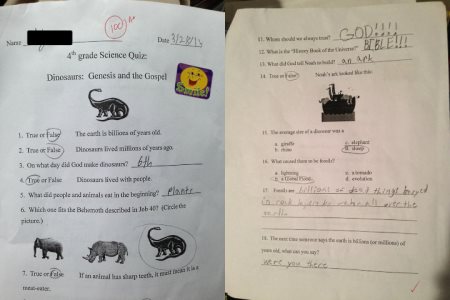
Have you seen it?  The dinosaur quiz below has been making the rounds lately.
dino quiz

Source: Answers in Genesis

This seems like a good chance for an ILYBYGTH gut check: What does this quiz tell us about creationism and American education?  For fans of evolution, this quiz confirms that creationism is a looming threat.  For young-earth creationists, though, this quiz and its public career tell us that Biblical creationists have become a righteous minority, besieged on all sides.

Here’s the story so far:  This quiz apparently came from a fourth-grade classroom at a private Christian school in South Carolina.  A parent posted it online when he found out to his dismay that his daughter had been learning this account of the origins of life.

What does this tell us about the state of American education?  Depending on your perspective, it can teach very different lessons.

For some commenters at r/atheism, this quiz serves as proof of the creeping power of Christian fundamentalism.  One poster noted, “They’re teaching these kids how to respond to people who spread the ‘evils of the world,’ in order to defend their faith.  It’s just very, very sad.”

Another agreed.  “This is just disgusting, my goodness,” he or she noted, concerning the fact that so many accredited schools in the United States teach this kind of science.  “I would really love to see a full on description of what is required to be taught to remain accredited, and then see if I could develop a program based around worship of FSM [i.e., the Flying Spaghetti Monster] that would meet those requirements.”

For young-earth creationist leader Ken Ham, however, the brouhaha over this quiz tells a very different lesson.  Ham complained that the backlash to this quiz proves that atheists have taken over America.  As he put it recently,

It seems that since the last presidential election, atheists have grown more confident about having something of a license to go after Christians. These secularists want to impose their anti-God religion on the culture. They are simply not content using legislatures and courts to protect the dogmatic teaching of their atheistic religion of evolution and millions of years in public schools. There is something else on their agenda: they are increasingly going after Christians and Christian institutions that teach God’s Word beginning in Genesis.

The danger, Ham and his colleague Mark Looy warned, should be readily apparent: “the atheists want your children. They are aggressively trying to demonize and marginalize Christians in their attempts to recruit your children for atheism or secularism.”

So who is the victim here?  Is it besieged Christians, defending their schools against dominant atheism?  Or is it science and reason, holding out in a last-ditch effort to save American education from Taliban-ism?

I’ll go out on a limb and try to define America’s educational consensus on this one.  The overwhelming majority of Americans agree, I’ll argue, that private schools can teach whatever they wish.  But there is one enormous exception: schools cannot teach doctrines that will cause harm to students or the wider society.

Obviously, this kicks the discussion back to the definition of “harm.”  We will all agree that teaching students how to rob liquor stores will ultimately be bad for both students and society.

But does teaching creationism constitute harm?  To anyone?  Here’s where tempers get heated.  I do not endorse young-earth creationism, but I believe the harm it does to students and society is far less than the harm that would be done if steps were taken to coerce schools to teach evolution.  Let schools teach young-earth creationism.  Try to persuade–not force–people to teach their children evolution instead.

Smart people disagree.  Some folks consider teaching young-earth creationism to be no harm at all.  Others, such as physicist Lawrence Krauss, consider teaching creationism to be a form of “child abuse.”   

Whichever side of this fence you fall on, this dinosaur quiz and the response it has generated can serve as a creationism quiz, a quick check of your attitudes toward this alternative science.  Does this sort of teaching harm students?  Does this sort of education harm society?
 

Common Core + Climate Change Science = Progressive Beer Bong

Solve the equation for X.

Many conservative educational activists are up in arms about the new Common Core State Standards.  Today we read a new articulation of this conservative hostility from Iowa State Representative Ralph Watts.

Watts called the Next Generation Science Standards—the science branch of the Common Core—a “beer bong for American education.”  For those whose college education did not include the arts and sciences of beer bongs, the Honorable Representative Watts meant to imply that these standards will deliver ideas quickly enough to overwhelm students’ ability to digest them.  In his words, the new standards constitute “a vehicle for progressive activists to spread their philosophies and propaganda to our children through a conduit designed very effectively to serve their needs.”

Next Generation Science Standards, Watts warns, insist that human-caused climate change is a fact.  This is another episode of federal overreach, Watts insists.  “Centralization. . . .” Watts concludes, will be a “colossal mistake and a classic failure.”

In the field of science education, Watts has a point.  Local control often protects the teaching of creationism and intelligent design, for example.  The same could be true for climate-change skepticism.  Putting mainstream scientists in charge of more rigorous science standards can’t hurt.  But I worry that it also won’t help too much.

In spite of Representative Watts’ poignant words, there are no true beer bongs in American education.  There is no way for any central body to deliver ideology so overwhelmingly to students nationwide as to overwhelm their home culture’s beliefs.

Pennsylvania Science Teachers Teach Creationism as Science

Pennsylvania science teachers teach creationism.  It really should come as no surprise, since that is the case for science teachers in public schools across the country.  But every new batch of data offers some new insight.

Thanks to the ever-vigilant Sensuous Curmudgeon, we see a new survey from the Pittsburgh Post-Gazette.  It doesn’t contain any mind-blowingly unexpected results, but the facts on the ground in the evolution/creation/intelligent design controversy are always mind blowing.

This survey collected results from 106 science teachers from the Keystone State.  The responses show us once again that there is no bright line between science and religion in many public-school classrooms.  For instance, while 90% of teachers said they believe in evolution, 19% listed creationism as their belief, while 13% claimed to believe in intelligent design.  Unfortunately, the survey did not require respondents to define what they meant by any of these terms.

But even with these results, we see that for many science teachers, it is entirely possible to claim both creationism and evolution as beliefs.  Teachers could choose more than one label, and many did.

As we might expect, teachers’ beliefs seem to carry over into their classroom practice.  One teacher claimed to spend five class periods teaching evolution and one class teaching creationism.

Another accused the newspaper of conducting a witch hunt to identify and persecute Biblical Christians.

One teacher warned his students against tools such as radiocarbon dating, since they contradicted the Bible.

In each of these cases, teachers insisted their school administrators approved of their classroom practice.

Most intriguing, one anonymous teacher—the one who taught one creationism class among five classes about evolution—confirmed the findings of political scientists Michael Berkman and Eric Plutzer.  Though Berkman and Plutzer hail from Penn State, they collected data from across the nation.  “Many teachers’ individual values,” they concluded, “match up well with those of the district in which they teach” (30).  Stricter state standards and certification rules, Berkman and Plutzer argued, will not make a decisive impact.  Instead, teachers tend to teach the ideas and values of their local communities.

This teacher agreed.  “Most parents and officials,” this teacher from Indiana County—just west of Pittsburgh—reported, “do not want evolution ‘crammed’ into their children.  They have serious philosophical/religious issues with public schools dictating to their students how to interpret the origins of life.”

For those like me who want to see more and better evolution education in public schools, this survey confirms the difficulty of the task.  Just as schools cannot be charged with solving poverty, so school science cannot fairly be asked to change our culture’s beliefs.  In the case of evolution, creation, and intelligent design, those beliefs are far different from what mainstream scientists might like to see.  Instead of locating the problem in science classrooms, we need to understand the true dimensions of this controversy.


Can a Public University Teach Religion as Science?

Jerry Coyne says no.  The prominent scientist and atheist brought our attention yesterday to a course being taught at Ball State University.  This course, Coyne complains, pretends to teach science, but fills students’ heads with religious notions.

Professor Coyne makes a strong case.  But it just doesn’t hold water.

Coyne insists such a course would be acceptable at a public university if it focused on the history of science and religion, or the relationship between science and religion.  But Coyne’s beef is with the fact that the course is being taught as a science course, for science credit.

Coyne demonstrates convincingly that the course is indeed infused with religious thought.

The professor, Eric Hedin, has often introduced his Christian faith into his teaching, at least according to some “Rate my professor” quotations that Coyne cites.

The reading list includes books by intelligent-design thinkers Stephen Meyer and Michael Behe.  It also asks students to read the religious/scientific work of Francis Collins and old-earth creationist Hugh Ross.  As Coyne argues, it does not include any of the leading works from the other side of this continuing controversy.

As Coyne wrote to the chair of the Ball State Physics Department,

As as [sic] scientist, I find this deeply disturbing. It’s not only religion served under the guise of science, but appears to violate the First Amendement [sic] of the Constitution. You are a public university and therefore cannot teach religion in a science class, as this class appears to do.  Clearly, Dr. Hedin is religious and foisting this on his students, and I have seen complaints about students being short-change[d] [‘d’ added in original] by being fed religion in a science course.

Coyne’s got it wrong.  First of all, a university is not the same as a K-12 public school.  Students are not forced to take this class.  This is one course from a galaxy of courses available to Ball State students.  Plus, the public funding of a public university is far different than that of K-12 schools.  According to Ball State, in 2011 the state paid for under half of operating expenses—just over $5,500 out of a total cost of $13,579 per student.

Second, and more important, a good university—public, private, whatever—should expose its students to a variety of ideas, presented by both believers and skeptics.  The University of Colorado at Boulder, for instance, attracted a good deal of attention lately for hiring Steven Hayward to fill its visiting chair in Conservative Thought and Policy.  The university’s goal was precisely to introduce a richer diversity of ideas on its campus.

In Colorado, the university and state went to considerable expense to encourage this sort of intellectual variety.  Ball State students are getting this sort of university exposure to new ideas and perspectives in-house.

Professor Coyne objects that this course is being taught as science.  And his objection has merit.  The definition of science, after all, has been a key issue in the legal battles over the teaching of creationism in public schools.

However, in order for scientists and students of science to be truly educated, they must be exposed to a true diversity of ideas.  Professor Hedin teaching his courses as part of a Ball State education is a very different thing than a religious group taking over a public education system.  Indeed, as I’ve argued elsewhere, scientists’ ignorance about creationism encourages more radical creationism.  If we want to reduce creationism’s cultural impact, we should help scientists learn more about its foundational ideas, not less.

Hedin is offering students a different way to see the world.  That kind of course should be part of every university education, in whatever department it falls.


Kruse-ing to Conservative Schools

For those of us who follow conservative education policy and ideology, Dennis Kruse of Indiana has been one to watch lately.  Senator Kruse chairs the state senate committee on education and career development.

In December, Kruse attracted our attention with his promise of a new “truth-in-education” bill.  This bill would allow students to question their teachers on any controversial subject.  Teachers would be legally responsible to provide evidence supporting his or her classroom content.

Recently, we discovered a helpful way to track the legislative ambitions of this conservative leader.  The Indiana State Senate website allows anyone to view legislation introduced or sponsored by any legislator.

A review of Kruse’s 2013 activity shows us the educational vision of this particular conservative, at least.  For example, this busy senator has authored bills to support prayer in charter schools, to declare that parents have supreme rights concerning their children, and even to mandate the teaching of cursive in Indiana public schools.

Of course, many of these bills will never see the light of day; many are simply political discussion starters.  But even as such, the vision of America’s schools demonstrated by Senator Kruse’s ambitions can tell us a great deal about what conservatives want out of education.  If somehow Senator Kruse became Supreme Emperor Kruse, we can imagine an education system in which religion played a leading role.  It might also be a school system where students learned traditional skills such as writing cursive.  Parents might be empowered to insist on curricula friendly to their religious backgrounds.

Kruse’s 2013 legislative record also demonstrates the tight connections—among conservatives like Senator Kruse—between educational conservatism and a broader cultural conservatism.  In addition to his school bills, Senator Kruse has supported bills to have mandatory drug testing for all state assistance recipients and to provide every abortion recipient with explicit information about the dangers and risks of abortion.

This tightly bundled conservatism demonstrates, IMHO, the need to understand conservatism broadly.  Too many commentators focus on high-profile issues such as creationism or school prayer in isolation.  By instituting better science standards, for instance, some progressive types think they can derail conservative policy.  Such one-issue reforms will not have much impact unless they recognize that educational conservatism is bigger than any one issue.

So what do conservatives want out of America’s schools?  In the case of Senator Kruse, at least, outsiders like me can see an explicit legislative program.

“I Love Studing Dinosaurs:” Everyday Creationism

Folks like me often ask why there are so many young-earth creationists in America.  How is it possible, we wonder, that nearly half of American adults agree humanity was created in “pretty much its present form” within the past 10,000 years?

The answer seems simple: Creationism is passed along just like any other idea.  Children learn a complex bundle of understandings from their homes, schools, parents, friends, and acquaintances.  In the case of young-earth creationism, kids learn what they are taught.

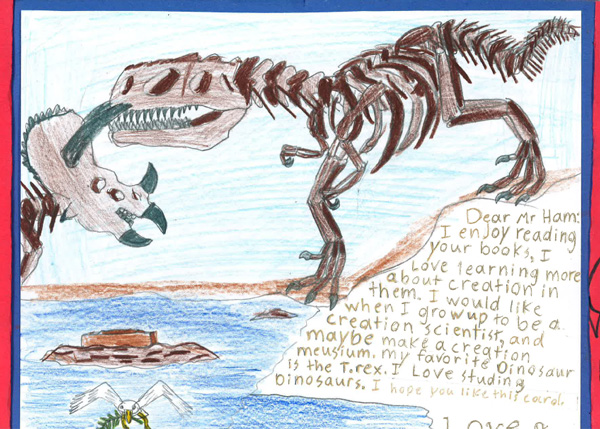
Leading young-earth creationist Ken Ham shared recently some of the cards he’s received from children.  Like the image here, these cards mostly included pictures of dinosaurs and adorably misspelled sentiments of support.  The cards give us outsiders a glimpse into the ways young people adopt the ideas of their home communities.

I Love Studing Dinosaurs

Source: Ken Ham’s Around the World Blog

Ken Ham calls his outreach “Rescuing the Children.”  Ham promised that his organization, Answers in Genesis, would continue to do “our best to reach more kids than ever to help raise up a generation that will stand on the authority of God’s Word, defend the Christian faith, and proclaim the gospel.”

For most evolution educators, this is precisely the problem.  Answers in Genesis is doing a good job.  Lots of children are learning that Biblical birds and dinosaur skeletons somehow roamed the earth together.  Thousands of children are learning an impossible science.

For those of us outside the circles of young-earth creationism, the mechanism by which these outlandish ideas are passed down can seem mysterious and even sinister.  But cards like the one above show the everyday, banal nature of creationist education.  Like non-creationist kids, creationist kids learn what they are taught.  They imbibe the culture of their homes, families, and churches.  There is nothing mysterious and sinister about the process, even if we do not think the ideas passed along are correct.

The lesson for evolution education is clear: pouring more mainstream science on people will not do the trick.  What is needed is a thoroughgoing cultural campaign that understands creationism on its own terms.

Our Creationist President, Part Deux: Bobby Jindal

GOP front-runners are already lining up in support of creationism.

We’ve noted that conservative favorite Ben Carson has emphasized his young-earth creationist beliefs.  Now another 2016 hopeful has joined the pack.

Governor Bobby Jindal told NBC news that Louisiana schools must be free to teach creationism along with evolution and intelligent design.  As Jindal asked, “What’re we scared of?”

Jindal endorsed the creationist interpretation of his state’s 2008 Science Education Act.  According to this law, creationism may be included as part of a rigorous science education.  The state, this law insisted,

shall allow and assist teachers, principals, and other school administrators to create and foster an environment within public elementary and secondary schools that promotes critical thinking skills, logical analysis, and open and objective discussion of scientific theories being studied including, but not limited to, evolution, the origins of life, global warming, and human cloning.

Does that mean teaching creationism?  Jindal told NBC that it did.  “I’ve got no problem,” Jindal said, “if a school board, a local school board, says we want to teach our kids about creationism, that people, some people, have these beliefs as well, let’s teach them about ‘intelligent design’.”

It’s early days, of course, but it seems the 2016 GOP field will have at least two contenders who have firmly established their creationist credentials.

Our Creationist President

What would it mean to have a fervent young-earth creationist in the Oval Office?

With Dr. Ben Carson mooted as a possible GOP candidate in 2016, it is a possibility we need to consider.

Creationists themselves trumpet a long history of presidential creationism, from Ike to George Dubya.  The case can be made, by both creationists and their foes, that several conservative presidents have been friendly to the politics of creationism.

Carson’s creationism, however, would be different.  In a recent interview with the Adventist News Network, Carson defended his creationism.  “I’ve seen a lot of articles, Carson told ANN,

that say, “Carson is a Seventh-day Adventist, and that means he believes in the six-day creation. Ha ha ha.” You know, I’m proud of the fact that I believe what God has said, and I’ve said many times that I’ll defend it before anyone. If they want to criticize the fact that I believe in a literal, six-day creation, let’s have at it because I will poke all kinds of holes in what they believe. In the end it depends on where you want to place your faith – do you want to place your faith in what God’s word says, or do you want to place your faith in an invention of man. You’re perfectly welcome to choose. I’ve chosen the one I want.

Carson’s earnest creationism should come as no surprise.  As a lifelong member of the Seventh-day Adventist church, Carson belongs to one of the staunchest creationist denominations out there.

As historian Ron Numbers has demonstrated, much of today’s young-earth creationist orthodoxy among conservative Protestants can be traced back to the creationist activism of Adventists such as George McCready Price.

However, presidential politics in the USA have a long history of denominational wrangles.  In 1928, Al Smith failed to convince voters that his Catholicism would not mean a Roman dictatorship of the White House.  A generation later, Kennedy pulled it off.  Most recently, Governor Romney seemed to have convinced Americans that his LDS religion would not mean a similar sort of Utah overlordship.

As a politician, the good doctor could make a similar plea to be free from the sectarian demands of his denominational background.  He could distance himself publicly from the more controversial aspects of Seventh-day Adventism.  In this interview, Carson does not seem interested in such tactics.  Instead, he embraces the creationism of his church.

What would that mean in the White House?

Will It Matter?

The New York Times reports that new state science standards endorse more rigorous teaching of climate change and evolution. According to one conservative group consulted by the Times, the new standards will disregard creationists’ rights, will “classify them as outsiders within the community.”

But will they?

Happily for religious conservatives, and unhappily for those like me who support more rigorous evolution education, these standards will not make much impact on the ways evolution is actually taught.

Political scientists Michael Berkman and Eric Plutzer have argued convincingly that state standards have “only minimal impact” on what goes on in science classrooms.[1]  The decisions made at the state level are not nearly as important as the daily decisions made by teachers.

Similarly, science educator Randy Moore has noted that state standards “often mean little in biology classrooms.”[2]

So will these new standards fulfill the hopes of science educators or the fears of religious conservatives?  Likely not.  That does not mean that such standards are useless.  The political process of crafting and wording state education standards can make a significant symbolic statement about the cultural and intellectual values of a community.

However, in terms of transforming teaching on a day-to-day level, these new suggested standards will not likely have the impact journalists suggest.  As long as local communities feel ambivalent about evolution education, teachers will largely avoid the topic.


[1] Michael Berkman and Eric Plutzer, Evolution, Creationism, and the Battle to Control America’s Classrooms (New York: Cambridge University Press, 2010), 160.

[2] Randy A. Moore.  2002. “Teaching Evolution: Do State Standards Matter?” BioScience 52 (4) 380.

Jerry Coyne Joins the Creationists

H/T: Sensuous Curmudgeon

Has Jerry Coyne really allied with creationists?

If you follow the creation/evolution wars, you’re likely familiar with the work of Coyne, a biologist and a leading voice in the long-running creation/evolution controversy.  Coyne famously argues that religion and science are incompatible.  In his book Why Evolution Is True, Coyne elegantly and concisely made the case for evolution and demolished the claims of creationists.

So how could this arch-atheist anti-creationist have joined with creationists?

In a recent interview with Haaretz, Coyne suggested that evolution went hand-in-hand with atheism, a strong central government and an expansive tax-funded social safety net.  In doing so, Coyne has added his voice to a long creationist intellectual tradition.

Science and religion, Coyne stated in this interview, “are polar opposites, both methodologically and philosophically. . . . Such contradictions [between differing religious truths], of course, render the term ‘religious truth’ ridiculous.”

In order to approach truth, Coyne believes, we must move away from religion and toward science.  To help the process along, Coyne told Haaretz, society must embrace a bigger government and a more egalitarian economy.

“The Scandinavian countries . . .” Coyne argued,

Have the most highly developed social-welfare systems in the world, and they are also the least religious countries ‏(for example, only 23 percent of Norwegians and 34 percent of Swedes describe themselves as religious‏). They are also the most receptive to evolution.

When citizens feel as if they have a government-provided safety net, Coyne told interviewer Smadar Reisfeld, they are less likely to cling to the false comfort of religion.

If scientists hoped to convince Americans of evolution’s obvious truth value, they must overthrow the false idol of religion.  Instead, Coyne said, “the government should intervene to a certain degree in order to give people a sense of security. . . . A more just, caring, egalitarian society must be created.”

So how does this sensible and pragmatic progressivism put Coyne in the creationist camp?

For generations, creationists have argued that evolution will and must lead to both atheism and socialism.  My hunch is that Coyne would not accept the “socialist” label, but Coyne’s vision of a government-led, Scandinavian-style social contract is precisely the sort of structure many creationists would call “socialist.”

At the dawn of the long creation/evolution struggle, for instance, William Jennings Bryan warned that evolution could only lead to atheism.  “Atheists, Agnostics, and Higher Critics begin with Evolution,” Bryan insisted in 1921, “They build on that.”  [Bryan, The Bible and Its Enemies: An Address Delivered at the Moody Bible Institute of Chicago (Chicago: Bible Institute Colportage Association, 1921), 19.]

As historian Edward Larson has pointed out, lawyers in 1926 Tennessee defended the anti-evolution Butler Law as a way to protect young students from creeping communism, not just a way to save them from the ideas of evolution itself.    [Larson, Summer for the Gods (Cambridge: Harvard University Press, 2001), 215.]

Throughout the twentieth century, anti-evolutionists have insisted that evolution must lead to—or come from—both atheism and socialism.

By the end of the twentieth century, for example, leading creation-science pundit Henry Morris equated evolution with every ideological terror of the century.  “Marxism, socialism, and communism, no less than Nazism, are squarely based on evolutionism.” [Morris, The Long War Against God (Master Books, 2000), 83).]

Perhaps Professor Coyne might not relish the company.  But by insisting that thinking people must choose between science and religion, Coyne encourages creationist dogma.  By tying evolution to large government and restricted capitalism, Coyne agrees with generations of the most fervent creationists.
